- Market Value (2025): USD 613.1 Mn
- Estimated Value (2026): USD 652.3 Mn
- Forecast Value (2036): USD 1211.8 Mn
- CAGR (2026-2036): 6.4%
What is the DD Cream Market forecast to be worth by 2036?
USD 652.26 million in 2026 to USD 1211.79 million by 2036, at a 6.4% CAGR.
- As per Fact.MR analysis, the DD_Cream_Market market was valued at USD 613.1 million in 2025.
- Industry revenue is forecast to rise from USD 652.3 million in 2026 to USD 1211.8 million by 2036.
- The 6.4% forecast CAGR reflects demand for simpler daily beauty routines, tinted complexion products and wider access through online retail.
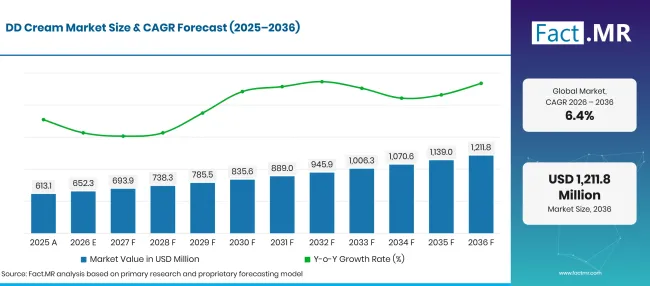
Dd Cream Market Forecast Global | Source: Fact.MR
| Year | Basis | Market Value (USD million) |
|---|---|---|
| 2025 | Historical estimate | 613.1 |
| 2026 | Base-year estimate | 652.3 |
| 2036 | Forecast | 1211.8 |
| CAGR 2026–2036 | Forecast growth | 6.4% |
Source: Fact.MR analysis. Updated Oct 26, 2026
What are the defining numbers behind DD Cream Market growth?
Global revenue is projected to add USD 559.53 million by 2036. Tinted DD cream leads the product split at 68.4% in 2026, while cosmetics is the largest assigned application at 42.3%. Women account for 79.2% of end-user demand. Claims are a commercial dividing line: a cosmetic complexion benefit is not automatically equivalent to an authorized sunscreen claim. The US FDA classifies products by their intended use and claims, making label wording important to brands that sell across markets. [4]
- Demand Drivers in the Market
- Tinted formats bring color correction and light coverage into one daily step. Consumers considering facial cream products may trade across the two categories when texture and complexion finish matter as much as a moisturizing claim.
- Digital try-on tools and online shade guides help explain a complexion product that shoppers cannot sample physically. Poor shade representation can still lead to returns and weak repeat purchase.
- Multi-benefit formulas attract consumers who prefer fewer products in a routine, although claims must be supported by the product's actual testing and regulatory classification. [4]
- Brands are extending shade and undertone choices beyond the narrow 'universal tint' concept. This can improve reach but makes stock planning more complex for smaller specialty outlets.
- Sun-exposure awareness supports interest in products marketed with protection benefits. A DD cream can make a tested SPF claim only where its formulation, labeling and authorization meet the relevant local rules. [2]
- Key Segments Analyzed
- Tinted DD creams are the clear market leaders in 2026, commanding a 68.4% share over non-tinted alternatives.
- Cosmetic enhancement is the leading use case (42.3%), outpacing traditional skincare applications as the primary reason for purchase.
- E-commerce remains the primary route to market, with online retail capturing the largest channel share at 39.4%.
- Women represent the overwhelming majority of the consumer base, driving nearly 80% (79.2%) of all declared purchases.
- Analyst Opinion at Fact.MR
- Shambhu Nath Jha, Sr. Consultant, Fact.MR says, “A DD cream that matches undertone and skin texture reliably has a stronger case for repeat purchase than one promoted through an ever-longer list of claimed benefits. Consumers can compare a texture or finish in minutes, but broad skin-treatment claims can create regulatory and credibility risks. Brands that clearly separate cosmetic appearance, moisturizing claims and substantiated sun protection are likely to build a more durable proposition.”
- Strategic Implications
- Manufacturers should test pigmentation, oxidation and wear across more than one skin tone before expanding an online shade range.
- Marketing teams must keep treatment and SPF claims aligned with evidence and country-specific rules; US cosmetic and drug classifications do not simply map onto other jurisdictions. [4]
- Retailers should use controlled lighting for shade imagery and avoid presenting a heavily edited demonstration as a typical result.
- Formulators can study expectations from after-sun care products while keeping post-exposure relief claims distinct from a daytime complexion cream.
How does the DD Cream Market break down by segment?
DD cream demand is organized around whether a tint is present, the benefit that principally motivates purchase, the retail channel and the marketed user group. A product may offer several benefits, but it is counted once under its primary assigned application to avoid overstating market revenue.
What is sustaining the preference for tinted DD creams?
Tinted DD Cream accounts for 68.4% of the Product Type segment in 2026.
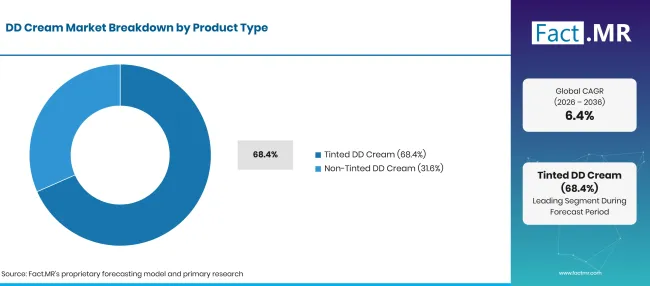
Dd Cream Market Breakdown Product Type | Source: Fact.MR
| Product Type | Share (2026) |
|---|---|
| Tinted DD Cream | 68.4% |
| Non-Tinted DD Cream | 31.6% |
Source: Fact.MR analysis. Updated Oct 26, 2026
Tinted DD creams hold 68.4% of 2026 market value because they offer an immediate, visible complexion effect. Shoppers can judge the result before assessing less visible skincare benefits, so tone matching and finish are crucial. Non-tinted creams are an option for consumers who want the skincare positioning without pigment, but the value proposition then overlaps more directly with established moisturizing products. The competitive reference point is the wider color cosmetics market, where shade choice, finish and wear quality are already well understood.
Why does cosmetics lead the DD cream application split?
Cosmetics accounts for 42.3% of the Application segment in 2026.
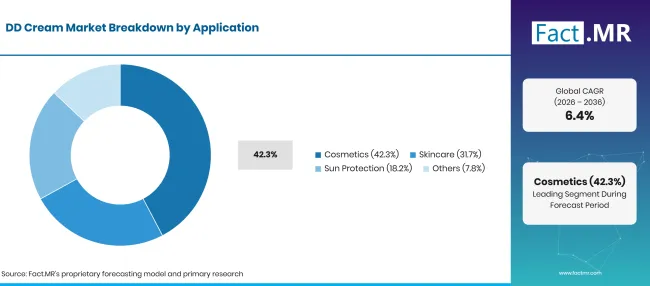
Dd Cream Market Breakdown Application | Source: Fact.MR
| Application | Share (2026) |
|---|---|
| Cosmetics | 42.3% |
| Skincare | 31.7% |
| Sun Protection | 18.2% |
| Others | 7.8% |
Source: Fact.MR analysis. Updated Oct 26, 2026
Cosmetics accounts for 42.3% of DD cream application revenue in 2026. The consumer usually sees complexion improvement first, while longer-term skincare benefits are harder to demonstrate at the point of sale. Skincare use has a 31.7% allocation, driven by products emphasizing moisture, texture and everyday wear. Sun protection carries 18.2%, but it should be interpreted as an application grouping, not a finding that every DD cream offers verified SPF. Related sun protection products face separate testing and labeling requirements across countries. [2] [4]
How has online retail changed the buying process?
Online Retail accounts for 39.4% of the Distribution Channel segment in 2026.
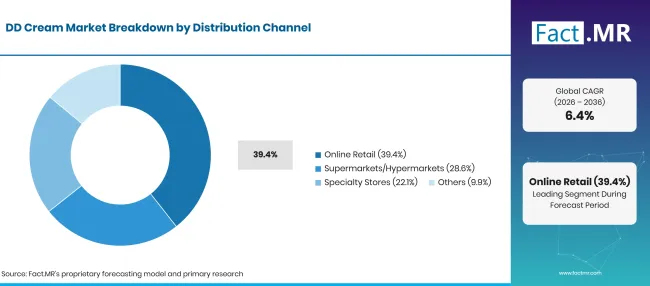
Dd Cream Market Breakdown Distribution Channel | Source: Fact.MR
| Distribution Channel | Share (2026) |
|---|---|
| Online Retail | 39.4% |
| Supermarkets/Hypermarkets | 28.6% |
| Specialty Stores | 22.1% |
| Others | 9.9% |
Source: Fact.MR analysis. Updated Oct 26, 2026
Online retail contributes 39.4% of 2026 sales. It makes shade comparisons, ingredient descriptions and user reviews available at the same time, which can lower the need for a counter consultation. Physical stores retain an advantage when shoppers want to test texture or match an undertone under natural light. Brands that sell online need consistent photography and disclosure of the actual level of coverage; vague before-and-after images are a poor substitute for clear shade information. Regulatory scrutiny of cosmetics labeling raises the cost of careless product descriptions. [5]
What does the end-user split reveal?
Women accounts for 79.2% of the End-User segment in 2026.
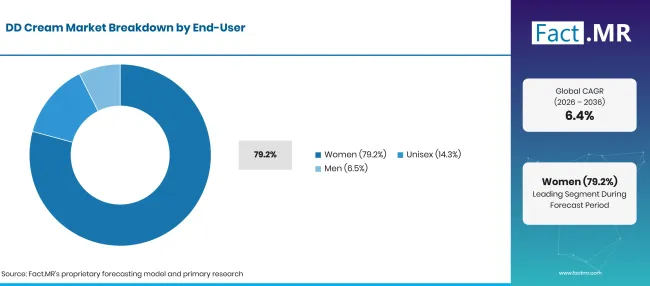
Dd Cream Market Breakdown End User | Source: Fact.MR
| End-User | Share (2026) |
|---|---|
| Women | 79.2% |
| Unisex | 14.3% |
| Men | 6.5% |
Source: Fact.MR analysis. Updated Oct 26, 2026
Women account for 79.2% of the market, reflecting the legacy of complexion makeup merchandising and shade-led product discovery. The unisex grouping captures products marketed without a single-gender target and may grow as skincare routines become less segregated. The male-specific share remains smaller, partly because tinted complexion products are not consistently marketed through traditional men's grooming channels. These categories reflect product positioning and purchases, not a claim about which individuals may use a cream.
What is accelerating DD Cream Market adoption, and what is holding it back?
The growth outlook depends on repeat purchases and trustworthy product claims. Improving shade availability can expand the audience, while inadequate labeling or disappointing performance can quickly weaken consumer confidence.
Drivers Impact Analysis
| DRIVER | (~) % IMPACT ON CAGR | GEOGRAPHIC RELEVANCE | IMPACT TIMELINE |
|---|---|---|---|
| Demand for fast multi-step routine substitutes | +0.7% | USA, UK, Japan | 2026–2033 |
| Better shade matching online | +0.6% | North America, East Asia | 2027–2036 |
| Wider tinted-product assortment | +0.5% | Europe, Latin America | 2026–2034 |
| Moisturizing formulas with comfortable wear | +0.4% | Global mass and premium | 2027–2036 |
| Repeat purchases through direct online channels | +0.5% | USA, Brazil, UK | 2026–2035 |
Source: Fact.MR analysis. Updated Oct 26, 2026
Opportunity Impact Analysis
| OPPORTUNITY | (~) % IMPACT ON CAGR | GEOGRAPHIC RELEVANCE | IMPACT TIMELINE |
|---|---|---|---|
| Expanded shades for underserved undertones | +0.8% | Brazil, USA, Europe | 2027–2036 |
| Clearly differentiated fragrance-free versions | +0.4% | Japan, Germany | 2028–2035 |
| More transparent wear and shade demonstrations | +0.3% | Global digital retail | 2026–2032 |
| Climate-adjusted textures for hot and humid markets | +0.6% | Asia, Latin America | 2027–2036 |
Source: Fact.MR analysis. Updated Oct 26, 2026
Restraints Impact Analysis
| RESTRAINT | (~) % IMPACT ON CAGR | GEOGRAPHIC RELEVANCE | IMPACT TIMELINE |
|---|---|---|---|
| Poor shade matching and high return rates | -0.6% | Global e-commerce | 2026–2034 |
| Unsupported treatment or SPF claims | -0.7% | USA, European Union | 2026–2036 |
| Category overlap with BB, CC and foundations | -0.5% | Global | 2026–2036 |
| Ingredient reformulation and compliance cost | -0.4% | Europe, UK, USA | 2027–2035 |
Source: Fact.MR analysis. Updated Oct 26, 2026
Which countries are scaling the DD Cream Market through 2036?
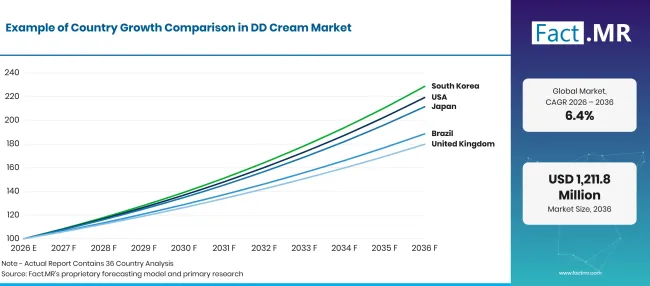
Dd Cream Market Growth Index | Source: Fact.MR
| Country | CAGR (2026–2036) |
|---|---|
| Germany | 4.94% |
| Brazil | 6.55% |
| United States | 8.2% |
| United Kingdom | 6.04% |
| Japan | 7.78% |
Source: Fact.MR analysis. Updated Oct 26, 2026
Why is DD cream growth measured in Germany?
4.94% CAGR through 2036. Ingredient scrutiny and product credibility keep the market selective.
Germany's 4.94% CAGR outlook points to steady rather than explosive growth. Consumers have a broad choice of pharmacy skincare, tinted moisturizers and established complexion products, so a DD label alone is unlikely to persuade them. Ingredient discussion in Europe remains active; the European Commission's scientific committee has reviewed the safety of specific UV filters used in cosmetics. [2] Safety Gate reporting also keeps cosmetic product safety in regulatory focus. [1] Brands entering Germany need technically sound claims and shade performance that stands up beside familiar alternatives.
How do climate and complexion needs affect Brazil?
6.55% CAGR through 2036. Texture, shade range and online availability create the main opportunities.
The Brazilian forecast is 6.55% CAGR. Lightweight textures are commercially important in warm and humid conditions, while the country's range of skin tones makes a limited shade assortment a significant obstacle. Sellers can expand discovery through digital marketplaces, but repeat buying depends on how a product actually looks after several hours of wear. The clearest opportunity is in formulas that combine comfortable daytime use with realistic shade photography and consistent availability.
What supports the United States faster DD cream outlook?
8.2% CAGR through 2036. E-commerce discovery and hybrid beauty routines contribute to growth.
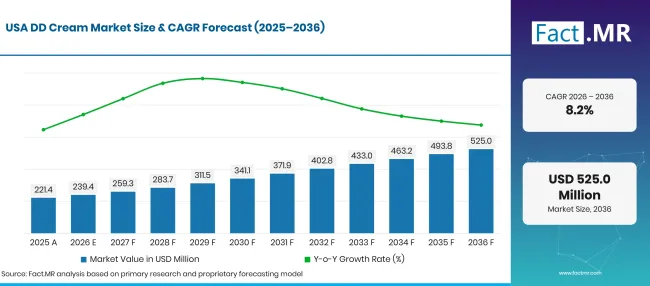
Dd Cream Market Forecast Usa | Source: Fact.MR
The US is forecast to post 8.17% CAGR, the highest rate in the five-country comparison. Direct-to-consumer brands can test new shade ranges quickly and identify repeat purchase patterns. A major boundary remains product classification: FDA guidance distinguishes cosmetics from products making drug claims, including certain sunscreen claims. [4] A company can expand aggressively without compromising credibility if marketing staff and formulators agree on what a DD product actually does.
How does UK retail influence DD cream sales?
6.04% CAGR through 2036. Clear labeling and channel breadth shape adoption.
UK market demand is projected to increase at 6.04% CAGR. Drugstores, beauty specialists and digital sellers compete for shoppers who already know tinted moisturizers and CC creams. The UK product-safety framework requires appropriate cosmetic product information and local compliance arrangements. [3] Brands need to explain the practical reason to choose a DD cream, such as finish or ease of use, rather than relying on an abbreviation that many consumers do not recognize.
Why is Japan an important testing ground for daily-use creams?
7.78% CAGR through 2036. Refined textures and routine compatibility drive product selection.
Japan's 7.78% CAGR projection reflects interest in carefully formulated daily complexion products. Texture, transfer resistance and comfortable layering with skincare can matter more than exaggerated multifunctional claims. Consumers have access to sophisticated domestic beauty ranges, so new formulas require a clear result at an acceptable price. Brands offering natural finishes and accurate undertone options may find a place in a crowded but technically discerning market.
Who competes for DD Cream Market demand?
Competition comes from companies selling named DD creams and from established beauty groups offering comparable tinted skincare. L'Oréal, Shiseido, Beiersdorf, Estée Lauder and regional K-beauty brands can influence category expectations through their wider complexion and skincare portfolios. Their presence in adjacent cosmetics should not be treated as proof that every company reports a separate DD cream product line.
The market's strategic challenge is positioning. A consumer might compare a DD cream with a tinted moisturizer, a BB cream or a complexion base from a completely different price tier. Clear texture descriptions, shade continuity, tested claims and reliable supply are commercially important.
Which companies are the key providers?
- L’Oréal Groupe
- Shiseido Company, Limited
- Beiersdorf AG
- The Estée Lauder Companies Inc.
- MISSHA / Able C&C Co., Ltd.
- Erborian
How is the market segmented?
-
By Product Type
- Tinted DD Cream
- Non-Tinted DD Cream
-
By Application
- Cosmetics
- Skincare
- Sun Protection
- Others
-
By Distribution Channel
- Online Retail
- Supermarkets/Hypermarkets
- Specialty Stores
- Others
-
By End-User
- Women
- Unisex
- Men
-
By Region
- North America
- Latin America
- Western Europe
- Eastern Europe
- East Asia
- South Asia & Pacific
- Middle East & Africa
Bibliography
- [1] European Commission. (2026, March 5). Commission’s 2025 Safety Gate report shows increased action against dangerous products and stronger consumer protection.
- [2] European Commission, Scientific Committee on Consumer Safety. (2025, June 30). Opinion on ethylhexyl methoxycinnamate (EHMC).
- [3] Office for Product Safety and Standards. (2021, October 4). Making cosmetic products available to consumers in Great Britain.
- [4] U.S. Food and Drug Administration. (2024, September 11). Is it a cosmetic, a drug, or both? (Or is it soap?).
- [5] U.S. Food and Drug Administration. (2026, August 10). Modernization of Cosmetics Regulation Act of 2022 (MoCRA).
This Report Answers
- How much revenue does the DD cream category generate in the base year?
- Which product type accounts for most 2026 sales?
- How much DD cream demand is assigned to cosmetic versus skin-care applications?
- What is the online retail contribution?
- Why do DD cream SPF claims need separate regulatory attention?
- How does the market vary across Germany, Brazil, the USA, the UK and Japan?
What does the DD Cream Market cover?
The market covers products sold as DD cream, including tinted and non-tinted variants. The analysis distinguishes the chief marketed application, sales route and end-user positioning. It assesses growth in five selected countries and discusses how cosmetic claims, ingredient reviews and complexion preferences affect buying decisions.
What is included in the scope?
DD-labeled complexion creams, relevant skin-care and cosmetic applications, sun-protection-positioned DD formulas when lawfully marketed, online and offline retail, and products targeted to women, men or unisex buyers.
What is excluded from the scope?
Pure foundations, standalone sunscreens, BB or CC creams not sold as DD products, prescription dermatological medicines and face creams without DD positioning. Adjacent beauty categories help explain consumer choice but are not counted as DD cream revenue.
How Was the Analysis Built?
The analysis draws on 120+ sources, 35+ company portfolios, 25+ countries, and more than 20 industry interviews.
- Primary Research: Primary research includes discussions with manufacturers, service providers, technology developers, distributors, end users, and subject-matter experts. These conversations examine purchasing priorities, product adoption, operational challenges, approval requirements, competitive positioning, and the factors that influence wider market acceptance.
- Desk Research: Desk research covers government statistics, regulatory publications, company filings, trade data, technical studies, industry associations, standards, public policy, and other authoritative sources. Every source used in the analysis is documented in the bibliography.
- Market Sizing and Forecasting: Market estimates combine historical performance, demand indicators, pricing and volume trends, segment shares, company participation, country-level growth, adoption patterns, investment activity, and barriers to market expansion.
- Data Validation and Update Cycle: Findings are validated by comparing primary interviews with public data, company activity, regulatory changes, trade patterns, and industry developments. Regular updates review new product launches, capacity changes, partnerships, approvals, and shifts in commercial adoption.
Segmentation
What is the report’s scope and coverage?
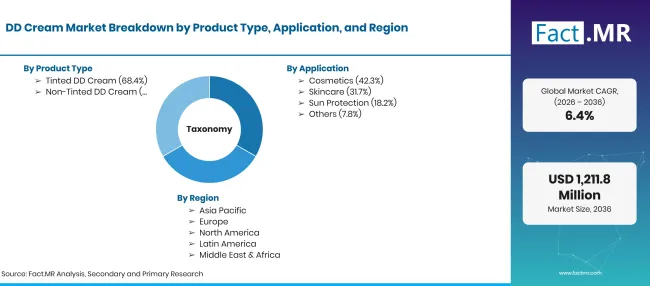
Dd Cream Market Taxonomy | Source: Fact.MR
| Attribute | Details |
|---|---|
| Study title | DD Cream Market |
| Base year | 2026 |
| Historical reference | 2025 |
| Forecast period | 2026–2036 |
| Base market value | USD 652.26 million |
| Forecast market value | USD 1,211.79 million |
| Forecast CAGR | 6.4% |
| Segment dimensions | Product Type, Application, Distribution Channel, End-User |
| Country analysis | Germany, Brazil, United States, United Kingdom, Japan |
| Regional coverage | North America, Latin America, Western Europe, Eastern Europe, East Asia, South Asia & Pacific, Middle East & Africa |
Source: Fact.MR analysis. Updated Oct 26, 2026
Frequently Asked Questions
What is the DD cream market valued at in 2026?
What is the expected 2036 market value?
How quickly is DD cream demand expected to grow?
Which DD cream product type leads?
Which distribution channel is the largest?
Which country is expected to grow fastest in this comparison?
Who worked on this report


Preview the report firsthand - request a free sample
Free SampleGet the brochure for pricing and purchase details
Download PDF