- Market Value (2025): USD 32.2 Bn
- Estimated Value (2026): USD 35.9 Bn
- Forecast Value (2036): USD 105.8 Bn
- CAGR (2026-2036): 11.4%
What is the Defense Cybersecurity Market forecast to be worth by 2036?
USD 35.9 billion in 2026 to USD 105.8 billion by 2036, at 11.4% CAGR.
- The defense cybersecurity market crossed a valuation of USD 32.2 billion in 2025 across public-sector networks and regulated enterprise environments.
- Demand is projected to increase from USD 35.9 billion in 2026 to USD 105.8 billion by 2036 across protected public-sector and regulated enterprise environments.
- The market is anticipated to record an 11.4% CAGR from 2026 to 2036 while security operations teams and regulated organizations expand continuous monitoring across protected environments.
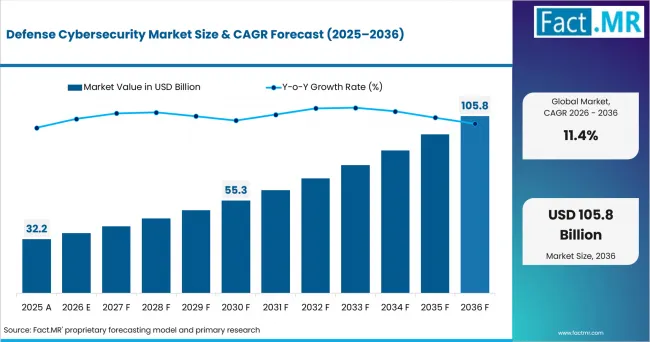
Defense Cybersecurity Market Market Value Analysis | Source: Fact.MR
What are the defining numbers behind Defense Cybersecurity Market growth?
USD 69.9 billion absolute opportunity by 2036, led by SME and Workflow Automation alongside BFSI.
- Demand Drivers in the Market
- Security operations teams need connected detection and response workflows because isolated alerts slow triage across distributed cloud and on-premise environments.
- Smaller contractors need manageable security services supported by repeatable evidence collection that reduces the burden of maintaining specialized internal teams.
- BFSI security teams need rapid incident containment owing to payment continuity requirements and sensitive customer data across always-on digital services.
- Cloud security architects need auditable policy enforcement driven by workloads that move across hosted and controlled infrastructure under different access rules.
- Key Segments Analyzed
- By Component: Software is expected to account for 46.9% share in 2026, driven by continuous detection and policy enforcement across protected environments.
- By Deployment: Cloud is projected to garner 46.3% share in 2026, supported by centralized telemetry and distributed security operations.
- By Organization Size: SME is anticipated to record 50.5% share in 2026, attributable to limited internal staffing and rising compliance pressure.
- By Application: Workflow Automation is estimated to hold 48.8% share in 2026, owing to pressure for faster triage and repeatable response actions.
- By End Use: BFSI is forecast to capture 34.0% share in 2026, shaped by payment continuity needs and sensitive customer data exposure.
- Analyst Opinion at Fact.MR
- Shambhu Nath Jha, Senior Analyst at Fact.MR states: “Defense cybersecurity is drawing attention because response teams are under pressure to turn scattered alerts into governed actions. Market is projected to favor providers that connect workflow automation with cloud controls across smaller organizations and regulated sectors. Providers should combine auditable software and integration services with incident response teams able to work inside existing security operations.”
- Strategic Implications
- Security leaders should map response workflows before adding tools so automation supports established escalation paths and approval responsibilities.
- SME contractors should compare managed service coverage against internal staffing gaps before selecting platforms that require constant specialist administration.
- Cloud architects should test audit trails across hosted and controlled environments before moving sensitive workflows between deployment models.
- BFSI security teams should validate recovery procedures against payment continuity requirements before expanding automated actions across critical systems.
Organizations operating in high-security environments are placing greater emphasis on solutions that unify detection and response functions. BAE Systems launched Velhawk Cybersecurity Solutions in December 2025 to automate critical detection and remediation workflows for government customers. The company described the system as a way to improve security posture while reducing incident response time and staffing pressure.
India is projected to record 13.2% CAGR during the forecast period, driven by rising incident response activity and defense technology localization. China is anticipated to post 12.5% CAGR by 2036, supported by national security controls and wider cybersecurity standardization. Australia is estimated to register 11.2% CAGR over the assessment period, attributable to sustained government incident response and critical network protection. The United Kingdom is forecast to expand at 10.9% CAGR between 2026 and 2036, owing to defense network resilience programs and active threat response. The United States is expected to advance at 10.7% CAGR across the forecast horizon, shaped by defense cyber budgets and contractor compliance requirements.
How does the Defense Cybersecurity Market break down by segment?
Software is projected to account for 46.9% share; Cloud is estimated to garner 46.3% share in 2026.
Which Component dominates?
Software is projected to account for 46.9% share in 2026
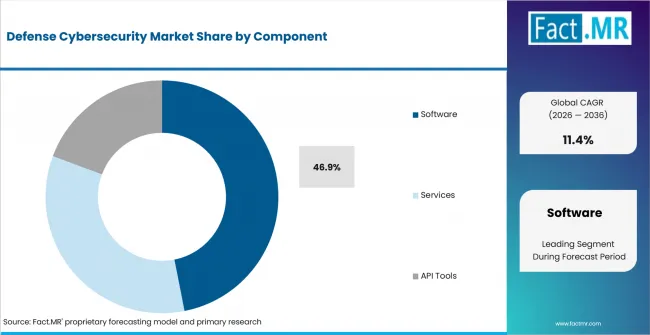
Defense Cybersecurity Market Analysis By Component | Source: Fact.MR
Software is expected to represent 46.9% share in 2026 because threat detection and policy enforcement depend on continuously updated logic. Services remain relevant where organizations need integration support and incident response capacity beyond internal teams. API Tools connect security workflows across cloud services and operational platforms that otherwise produce isolated alerts. In March 2024, the U.S. Department of Defense requested USD 14.5 billion for fiscal 2025 cyberspace activities. Spending depth is expected to keep software qualification tied to integration and measurable response outcomes.
What leads the Deployment segment?
Cloud is estimated to garner 46.3% share in 2026
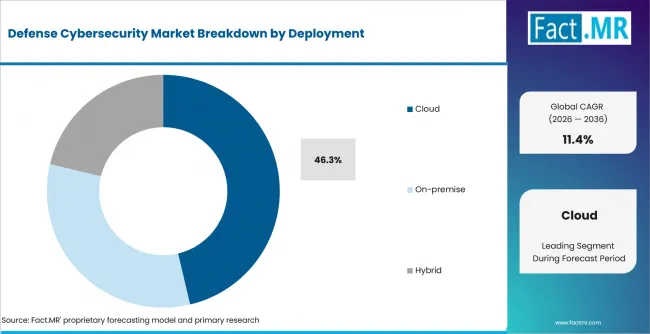
Defense Cybersecurity Market Analysis By Deployment | Source: Fact.MR
Cloud deployment is anticipated to capture 46.3% share in 2026 while security teams centralize telemetry and response workflows across distributed environments. On-Premise deployment remains relevant for sensitive workloads that require direct infrastructure control and restricted administration. Hybrid estates connect protected applications with scalable analysis while keeping sensitive workloads behind segmented access rules. Security teams also evaluate endpoint security systems once cloud access extends to dispersed users and devices. Procurement is expected to favor architectures that preserve auditability across hosted infrastructure and directly controlled systems.
How does Organization Size shape demand?
SME is anticipated to record 50.5% share in 2026
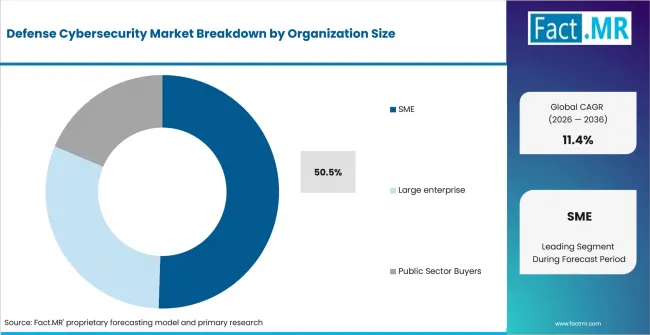
Defense Cybersecurity Market Analysis By Organization Size | Source: Fact.MR
SME is forecast to hold 50.5% share in 2026 due to limited internal cyber staffing and rising compliance pressure across smaller contractors. Large Enterprise accounts maintain broader internal security teams but still purchase specialist services for complex integration and response work. Public Sector Buyers require detailed procurement evidence and controlled delivery models that remain suitable for sensitive network environments. In October 2024, the U.S. Department of Defense announced support efforts for small businesses preparing to meet cybersecurity requirements under CMMC. Demand is expected to favor services that translate control requirements into repeatable operating steps for smaller security teams.
What supports Workflow Automation within Application?
Workflow Automation is forecast to capture 48.8% share in 2026
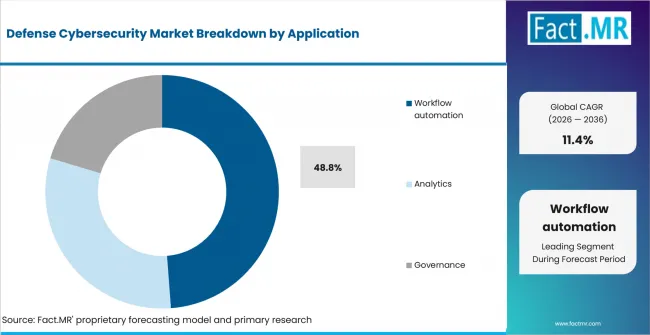
Defense Cybersecurity Market Analysis By Application | Source: Fact.MR
Workflow Automation is estimated to account for 48.8% share in 2026 owing to pressure on security teams to shorten triage and response cycles. Analytics follows where operators need event correlation and risk prioritization across large telemetry volumes from multiple security platforms. Governance supports policy evidence and approval workflows that document security decisions across regulated operating environments. In February 2026, Leidos described automation that isolates anomalies and supports defenders during high-stakes missions. Adoption is projected to expand where automated actions remain visible to analysts and fit existing review procedures.
Which End Use category is projected to account for the primary share?
BFSI is expected to represent 34.0% share in 2026
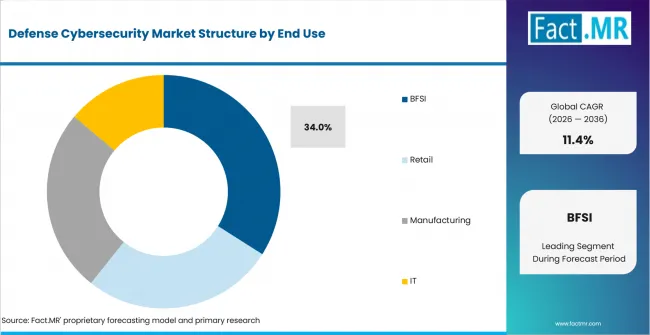
Defense Cybersecurity Market Analysis By End Use | Source: Fact.MR
BFSI is projected to garner 34.0% share in 2026 because payment systems and customer data create high consequences for service disruption. Retail follows because payment exposure and distributed endpoints create recurring protection needs across large store networks. Manufacturing needs cyber defense around production systems while IT providers protect shared platforms and customer environments. In June 2025 the European Banking Authority reported that 58% of banks had experienced at least one cyberattack during the second half of 2024. Sector demand is expected to remain focused on service resilience and incident recovery across always-on financial operations.
What is accelerating Defense Cybersecurity Market adoption, and what is holding it back?
Persistent attack exposure drives demand across protected environments; legacy integration complexity restrains adoption across older operational systems.
Drivers Impact Analysis
| DRIVER | (~) % IMPACT ON CAGR | GEOGRAPHIC RELEVANCE | IMPACT TIMELINE |
|---|---|---|---|
| Persistent attack exposure and incident response pressure | +1.4% | Global defense networks | Medium term (2-4 years) |
| Compliance and supply-chain security controls | +1.1% | United States and allies | Short term (<= 2 years) |
| Cloud migration across protected workloads | +0.9% | North America and Europe | Medium term (2-4 years) |
| Secure information sharing across trusted organizations | +0.7% | NATO and Indo-Pacific partners | Long term (>= 4 years) |
| Cyber readiness testing and validation | +0.5% | Global military organizations | Medium term (2-4 years) |
Source: Fact.MR analysis. Updated Jul 10, 2026
- Persistent attack exposure: Connected software and communications paths create more places for attackers to move across public-sector and regulated environments. In October 2025, the United Kingdom NCSC reported 204 nationally significant cyber attacks during its latest annual review period. Security teams are expected to expand continuous monitoring where operational disruption carries direct service consequences.
- Compliance pressure: Cyber requirements are moving deeper into procurement workflows and supplier qualification across government technology programs. In October 2024, the Department of Defense finalized the CMMC program rule to verify contractor protection of regulated information. Procurement teams are projected to demand documented control evidence earlier during bid evaluation and later program reviews.
- Protected cloud migration: Organizations are moving selected workloads into controlled cloud environments while keeping sensitive functions behind stricter boundaries. Identity policy and configuration evidence must follow each protected workload across deployment models and administrative control boundaries. Adoption is anticipated to expand where providers prove segmented access and incident visibility across mixed estates.
- Secure information sharing: Joint operations and cross-organization workflows require controls that preserve access boundaries while information moves between trusted partners. In December 2025, NATO Allied Command Transformation reported that Cyber Coalition 2025 used seven realistic scenarios to test multinational defenders. Demand is estimated to rise for tools that preserve trust while authorized partners exchange operational data.
- Readiness validation: Cyber teams need exercises that expose weak procedures before real incidents affect critical services and protected operations. In November 2025, NATO CCDCOE brought more than 30 senior officials into a seminar that included an exercise derived from Locked Shields. Service demand is forecast to widen for cyber ranges and adversary simulation tied to realistic operating dependencies.
Opportunity Impact Analysis
| OPPORTUNITY | (~) % IMPACT ON CAGR | GEOGRAPHIC RELEVANCE | IMPACT TIMELINE |
|---|---|---|---|
| Connected operational system cyber assurance | +0.9% | United States and Europe | Medium term (2-4 years) |
| Automated cyber validation and workflow orchestration | +0.7% | North America and Asia Pacific | Medium term (2-4 years) |
| Managed detection and response for SMEs | +0.6% | United States and United Kingdom | Short term (<= 2 years) |
| Cyber range and adversary simulation services | +0.4% | NATO and Indo-Pacific partners | Long term (>= 4 years) |
Source: Fact.MR analysis. Updated Jul 10, 2026
- Connected operational system assurance: Cyber defense is moving deeper into operational technology and connected physical systems where availability and safety constraints limit ordinary security methods. In September 2025, CISA and the United Kingdom NCSC released joint guidance for securing operational technology systems through stronger asset records and protection planning. Opportunity is expected to expand for providers that connect cyber controls with operational engineering and recovery procedures.
- Automated cyber validation: Security teams need faster testing because manual analysis slows response across complex software and network environments. In April 2026, RTX BBN Technologies released Maude-HCS under a DARPA-funded program to model and validate covert communication networks. Providers are projected to gain relevance when automation shortens validation cycles while preserving analyst review.
- Managed defense for SMEs: Smaller organizations often need continuous monitoring without maintaining full internal cyber operations teams. In November 2025, CMMC Phase 1 began under a phased implementation plan for applicable defense contracting requirements. Managed service demand is anticipated to increase where providers translate control requirements into repeatable operational evidence.
- Adversary simulation services: Organizations need realistic testing that combines technical attack paths with command decisions and recovery procedures. In May 2025, Japan’s Ministry of Defense joined Locked Shields 2025 to strengthen cyberattack response capacity and track defense cybersecurity trends. Service providers are estimated to gain work where exercises use authentic operating dependencies and measurable recovery tasks.
Restraints Impact Analysis
| RESTRAINT | (~) % IMPACT ON CAGR | GEOGRAPHIC RELEVANCE | IMPACT TIMELINE |
|---|---|---|---|
| Integration burden across legacy operational systems | -0.9% | Global defense estates | Long term (>= 4 years) |
| Cyber workforce shortages and role qualification gaps | -0.7% | North America and Europe | Medium term (2-4 years) |
| Approval delay caused by governance and authorization cycles | -0.5% | Global public-sector programs | Medium term (2-4 years) |
| Sovereignty limits on cloud and cross-border data handling | -0.4% | Europe and Asia Pacific | Long term (>= 4 years) |
Source: Fact.MR analysis. Updated Jul 10, 2026
- Legacy integration burden: Many operational systems were designed before continuous monitoring and identity segmentation became standard engineering requirements. Retrofitting controls often disrupts established certification baselines and maintenance procedures across long-lived platforms and infrastructure. Adoption is forecast to remain slower where cyber upgrades require repeated system testing and formal approval.
- Cyber workforce limits: Security operations require technical skill and incident experience that ordinary hiring pipelines do not replace quickly. In February 2026, ASD reported responding to 408 cyber incidents from government entities during the 2024–25 financial year. Demand is expected to strain response capacity while public agencies and regulated organizations compete for experienced specialists.
- Governance and approval cycles: Cyber tools often need testing inside restricted environments before they reach production systems or protected networks. In May 2024, the DoD CIO published a Cybersecurity Reciprocity Playbook to guide reuse of accepted assessment evidence across authorization decisions. Market entry is projected to remain slower when providers cannot produce evidence suited to formal security reviews.
- Data sovereignty limits: Organizations restrict storage locations for sensitive information and define which personnel receive access to operational telemetry. In March 2024, China issued rules that defined security assessment requirements for certain cross-border data transfers. Deployment is anticipated to stay country-specific where security rules require local control over data and infrastructure.
Which countries are scaling Defense Cybersecurity Market fastest?
India 13.2%; China 12.5%; Australia 11.2%; United Kingdom 10.9%; United States 10.7%.
.webp "Top Country Growth Comparison Defense Cybersecurity Market Cagr (2026 2036)")
Top Country Growth Comparison Defense Cybersecurity Market Cagr (2026 2036) | Source: Fact.MR
Defense Cybersecurity Market covers North America and Europe alongside Asia Pacific, while Latin America and the Middle East & Africa complete regional coverage.
| COUNTRY | CAGR |
|---|---|
| India | 13.2% |
| China | 12.5% |
| Australia | 11.2% |
| United Kingdom | 10.9% |
| United States | 10.7% |
Source: Fact.MR analysis. Updated Jul 10, 2026
What is powering India's lead?
13.2% CAGR during the forecast period, driven by incident pressure and local defense technology programs.
India combines high cyber incident volumes with defense procurement policies that increasingly emphasize local technology capability. The market is expected to record 13.2% CAGR during the forecast period, driven by stronger assurance needs across connected ministry and contractor programs. In January 2026, the Press Information Bureau reported that CERT-In handled more than 2.94 million cyber incidents during 2025. Local response capacity is projected to gain value when it links national incident intelligence with defense system validation.
What supports China's cybersecurity outlook?
12.5% CAGR by 2036, supported by national security rules and wider technical standardization across protected networks.
China is tightening rules for network data security while state agencies emphasize national cyber sovereignty and incident response capacity. Government guidance is projected to support 12.5% CAGR by 2036 across domestic security platforms and protected public networks. In September 2024, the State Council published network data security regulations that took effect on January 1, 2025. Domestic providers are expected to gain access where procurement requires local control over protected data and infrastructure.
How is Australia scaling defense cyber protection?
11.2% CAGR over the assessment period, attributable to government incident response and critical network protection.
Australia is expanding cyber response around government systems and critical services while defense programs depend on shared national security infrastructure. In October 2025, ASD reported responding to more than 1,200 cyber security incidents during the 2024–25 reporting year. Demand is anticipated to post 11.2% CAGR over the assessment period, attributable to stronger monitoring and recovery requirements across operational agencies. Procurement is expected to favor providers that combine classified delivery experience with local incident response teams.
What underpins the United Kingdom outlook?
10.9% CAGR between 2026 and 2036, owing to defense resilience programs and active threat response.
United Kingdom defense organizations are strengthening mission networks while national cyber authorities report heavier incident pressure across connected services. The market is forecast to expand at 10.9% CAGR between 2026 and 2036, owing to tighter links between cyber resilience and defense readiness. In October 2025, the NCSC reported handling 429 incidents during its latest annual review period. Local providers are expected to benefit where cleared teams connect operational testing with continuous response support.
How is the United States sustaining defense cyber demand?
10.7% CAGR across the forecast horizon, shaped by cyber budgets and contractor compliance requirements.
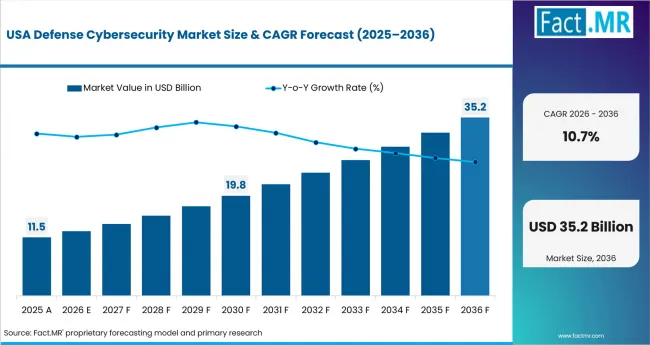
Defense Cybersecurity Market Country Value Analysis | Source: Fact.MR
United States demand is anchored in direct defense spending and cyber rules that extend requirements across the industrial base. The market is estimated to register 10.7% CAGR across the forecast horizon, shaped by agency demand for protected tactical communication systems and auditable supplier controls. In June 2025, the Department of Defense fiscal 2026 budget briefing identified USD 15.1 billion for cybersecurity. Providers are expected to gain where technology delivery includes compliance evidence and mission integration support.
Who leads the Defense Cybersecurity Market?
Northrop Grumman, Leidos and RTX strengthen direct cyber mission coverage.
Key players such as Northrop Grumman combine cyber operations with secure network integration across mission environments. In March 2025, the company said NG InSight would demonstrate integrated networking and communications alongside cybersecurity for U.S. Air Force connectivity. Leidos adds defensive operations that extend from internet access points to endpoints across large government mission environments. RTX BBN Technologies expanded vulnerability testing in August 2025 under DARPA’s INGOTS program for complex exploit-chain analysis.
BAE Systems remains active in government cyber resilience while SAIC and General Dynamics support national security customers through mission technology and cybersecurity services. SAIC agreed to acquire SilverEdge in October 2025 to add cyber and intelligence capabilities for defense missions. General Dynamics Information Technology received an Army Europe task order in October 2025 that includes cybersecurity and cloud modernization. Booz Allen Hamilton launched its Vellox agentic cyber suite in March 2026 for national security missions and critical infrastructure. Competition is forecast to center on integration depth and automation that remains visible and auditable to security analysts.
Which companies are the key providers?
Some of the key players profiled include Northrop Grumman and Leidos alongside RTX and BAE Systems while SAIC and General Dynamics join Booz Allen Hamilton.
- Northrop Grumman
- Leidos
- RTX
- BAE Systems
- SAIC
- General Dynamics
- Booz Allen Hamilton
Bibliography
- Australian Signals Directorate. (2025, October 14). Annual Cyber Threat Report 2024–2025. Australian Cyber Security Centre.
- Australian Signals Directorate. (2026, February 12). The Commonwealth Cyber Security Posture in 2025. Australian Cyber Security Centre.
- BAE Systems. (2025, December 3). BAE Systems launches Velhawk™ Cybersecurity Solutions to strengthen customer resilience and accelerate cyber defense. BAE Systems.
- Booz Allen Hamilton. (2026, March 20). Booz Allen launches Agentic Cyber Product Suite at RSAC 2026. Booz Allen Hamilton.
- Cybersecurity and Infrastructure Security Agency. (2025, September 29). CISA and UK NCSC release joint guidance for securing OT systems. Cybersecurity and Infrastructure Security Agency.
- Department of Defense Chief Information Officer. (2025, November 10). Cybersecurity Maturity Model Certification overview and implementation. U.S. Department of Defense.
- European Banking Authority. (2025, June). Operational risks and resilience. European Banking Authority.
- General Dynamics Information Technology. (2025, October 2). GDIT awarded $1.25 billion Enterprise Mission Information Technology Services 2 task order to support U.S. Army Europe and Africa. General Dynamics.
- Japan Ministry of Defense. (2025, May 6). Participation in the NATO CCDCOE cyber defence exercise Locked Shields 2025. Japan Ministry of Defense.
- Leidos. (2025, October 21). Cyber defense from the internet to the endpoint. Leidos.
- Leidos. (2026, February 20). Harnessing AI and automation to strengthen human-led cyber defense. Leidos.
- National Cyber Security Centre. (2025, October 14). NCSC Annual Review 2025. National Cyber Security Centre.
- National Cyber Security Centre. (2025, October 14). UK experiencing four nationally significant cyber attacks weekly. National Cyber Security Centre.
- NATO Allied Command Transformation. (2025, December 5). NATO Cyber Coalition 2025: Advancing cyber defence and strengthening Alliance resilience. NATO.
- NATO Cooperative Cyber Defence Centre of Excellence. (2025, November). Executive Cyber Seminar: Strengthening cyber resilience through whole-of-society cooperation. NATO CCDCOE.
- Northrop Grumman. (2025, March 18). Northrop Grumman’s NG InSight™ to demonstrate secure communications integration for U.S. Air Force connectivity. Northrop Grumman.
- Press Information Bureau. (2026, January 23). CERT-In: India’s frontline defender against cyber threats. Government of India.
- RTX. (2025, August 5). RTX to optimize cyber vulnerability detection for DARPA. RTX.
- RTX. (2026, April 1). RTX’s BBN Technologies launches open-source tool to validate covert cyber networks. RTX.
- SAIC. (2025, October 6). SAIC to acquire SilverEdge Government Solutions. SAIC.
- State Council of the People’s Republic of China. (2024, March 23). China issues regulations on cross-border data flows. Government of China.
- State Council of the People’s Republic of China. (2024, September 30). China issues regulations on network data security management. Government of China.
- U.S. Department of Defense Chief Information Officer. (2024, May 15). Cybersecurity Reciprocity Playbook. U.S. Department of Defense.
- U.S. Department of Defense. (2024, October 16). Army announces effort to help small business meet cybersecurity requirements. U.S. Department of Defense.
- U.S. Department of Defense, Office of the Under Secretary of Defense (Comptroller). (2024, March). Defense budget overview: Fiscal year 2025 budget request. U.S. Department of Defense.
- U.S. Department of Defense. (2024, October 15). Cybersecurity Maturity Model Certification (CMMC) Program. Federal Register.
- U.S. Department of Defense. (2025, June 26). Background briefing on fiscal year 2026 defense budget. U.S. Department of Defense.
This Report Addresses
- The report provides strategic intelligence on Component and Deployment choices that shape cyber defense programs across public-sector and regulated enterprise environments.
- Segment analysis covers Software and Cloud and explains their procurement logic.
- Regional outlook evaluates India and China alongside Australia while the United Kingdom and United States complete the country growth comparison.
- Competitive analysis profiles Northrop Grumman and Leidos alongside RTX and BAE Systems while SAIC, General Dynamics and Booz Allen Hamilton complete provider coverage.
- Organization Size assessment covers SME and Large Enterprise accounts while Public Sector Buyers complete the organization framework.
- Application assessment covers Workflow Automation and Analytics while Governance completes the use-case structure across protected environments.
What does the Defense Cybersecurity Market cover?
Software and Services alongside API Tools used to detect attacks and coordinate response across protected environments.
The Defense Cybersecurity Market covers software and services that detect threats and coordinate cyber response across government and regulated enterprise environments. API Tools connect security platforms so alerts and workflow actions move between cloud and on-premise systems.
The market differs from narrow military cybersecurity because the end-use framework also covers BFSI and Retail alongside Manufacturing and IT. Ordinary IT management is excluded unless the product performs a defined cyber defense or governance function.
What is included in the scope?
Defense cybersecurity systems used across cloud and on-premise environments alongside hybrid estates and automated security workflows.
Coverage includes Software and Services alongside API Tools that connect cyber defense platforms across protected environments. Cloud and On-Premise deployments are included while Hybrid estates combine controlled infrastructure with hosted security workflows. Organization Size coverage includes SME and Large Enterprise accounts together with Public Sector Buyers that follow distinct procurement paths. Applications cover Workflow Automation and Analytics while Governance represents policy evidence and control oversight across regulated security programs. End-use coverage includes BFSI and Retail alongside Manufacturing and IT where cyber defense products protect critical services and data.
What is excluded from the scope?
General IT administration and business workflow software are outside the scope unless they perform a defined cyber defense function.
The scope excludes general IT administration and business process automation that does not perform a defined cyber defense function. Standalone analytics and governance software are also excluded unless they support threat detection and response or security control evidence. Military platform protection remains in scope when cybersecurity protects connected systems or regulated information environments.
How was the analysis built?
130+ sources, 45+ company portfolios, 30+ countries, 25+ interviews
- Primary Research
- Primary research includes interviews with defense cybersecurity solution providers, military communications specialists, defense IT executives and cybersecurity program managers. It also includes input from defense contractors, security architects, threat intelligence teams and government stakeholders responsible for protecting defense networks, mission systems and critical infrastructure.
- Desk Research
- Desk research reviews defense spending statistics, national cybersecurity strategies, military modernization programs, cybersecurity product portfolios and provider capability statements. Government publications, defense procurement updates, threat intelligence reports and company announcements are also assessed to evaluate market trends and competitive positioning.
- Market-Sizing and Forecasting
- Forecasting uses defense technology investments, cybersecurity spending patterns, military network modernization activity, threat landscape developments and adoption of advanced security solutions across major countries. Models consider demand for endpoint protection, network security, cloud security, threat intelligence, zero-trust architecture and cyber resilience programs within defense environments.
- Data Validation and Update Cycle
- Forecasts are validated through provider checks and industry interviews that test assumptions on cybersecurity adoption, procurement priorities and defense modernization plans. Portfolio mapping, defense budget assessments and stakeholder feedback help confirm market direction, while ongoing reviews of threat developments, contract awards and technology launches support forecast updates.
Segmentation
What is the report’s scope and coverage?
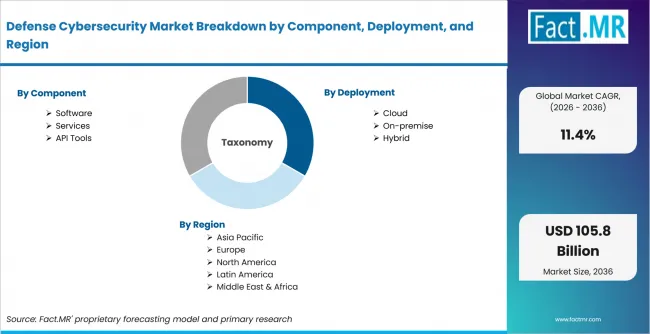
Defense Cybersecurity Market Breakdown By Component, Deployment, And Region | Source: Fact.MR
| Attribute | Details |
|---|---|
| Quantitative Units | USD Billion |
| Market Definition | Cyber defense software, services and API-based tools used to prevent, detect, automate and govern responses across public-sector and high-risk enterprise environments. |
| Component | Software; Services; API Tools |
| Deployment | Cloud; On-Premise; Hybrid |
| Organization Size | SME; Large Enterprise; Public Sector Buyers |
| Application | Workflow Automation; Analytics; Governance |
| End Use | BFSI; Retail; Manufacturing; IT |
| Regions Covered | North America; Europe; Asia Pacific; Latin America; Middle East and Africa |
| Countries Covered | United States; Canada; United Kingdom; Germany; France; Italy; Spain; China; Japan; India; South Korea; Australia; Brazil; Mexico; Argentina; UAE; Saudi Arabia; Israel; South Africa |
| Key Companies Profiled | Northrop Grumman; Leidos; RTX; BAE Systems; SAIC; General Dynamics; Booz Allen Hamilton |
| Forecast Period | 2026 to 2036 |
| Approach | Desk-based top-down and bottom-up analysis using cyber incident activity; software and services attachment; cloud adoption; organization-size mix; workflow automation demand; end-use exposure; provider activity checks. |
Source: Fact.MR analysis. Updated Jul 10, 2026
How is the market segmented?
-
By Component
- Software
- Services
- API Tools
-
By Deployment
- Cloud
- On-Premise
- Hybrid
-
By Organization Size
- SME
- Large Enterprise
- Public Sector Buyers
-
By Application
- Workflow Automation
- Analytics
- Governance
-
By End Use
- BFSI
- Retail
- Manufacturing
- IT
-
By Region
- North America
- United States
- Canada
- Europe
- United Kingdom
- Germany
- France
- Italy
- Spain
- Asia Pacific
- China
- Japan
- India
- South Korea
- Australia
- Latin America
- Brazil
- Mexico
- Argentina
- Middle East & Africa
- UAE
- Saudi Arabia
- Israel
- South Africa
- North America
Frequently Asked Questions
What share is Software expected to account for in 2026?
Why is Cloud projected to dominate in 2026?
Which Organization Size category is projected to account for the primary share?
What supports Workflow Automation within the Application split?
How much End Use share is BFSI estimated to represent?
How quickly is India expected to expand?
What supports China’s projected expansion?
Which factor is shaping Australia’s outlook?
How is the United Kingdom market expected to progress?
What underpins United States demand during the forecast?
What is the primary demand driver for defense cybersecurity?
Which factor is expected to restrain adoption?
Why does Workflow Automation carry commercial weight?
Why are SME accounts commercially significant users?
Who worked on this report


Preview the report firsthand - request a free sample
Free SampleGet the brochure for pricing and purchase details
Download PDF