- Base Value(2025): 1.5 Bn
- Estimated Value(2026): 1.6 Bn
- Forecast Value (2036): 3.9 Bn
- CAGR (2026 - 2036): 9.3%
Dehydrated Meat Product Market Forecast and Outlook By Fact.MR
In 2025, the dehydrated meat product market was valued at USD 1.5 billion. Based on Fact.MR analysis, demand for dehydrated meat products is estimated to grow to USD 1.6 billion in 2026 and USD 3.9 billion by 2036. FACT.MR projects a CAGR of 9.3% during the forecast period.
The market is expected to generate an absolute dollar opportunity of USD 2.3 billion between 2026 and 2036. This represents transformational expansion reflecting accelerating adoption of dehydrated meat in high-protein snack retail, outdoor and sports nutrition, and military and emergency food supply procurement. Growth is moderated by raw material cost volatility for beef and chicken, competition from plant-based protein snacks, and shelf-life regulatory compliance costs across key export markets.
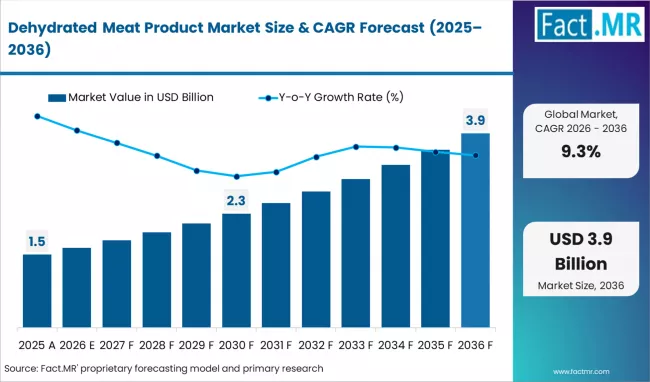
Dehydrated Meat Product Market Market Value Analysis | Source: Fact.MR
| Metric | Value |
|---|---|
| Estimated Value in 2026 | USD 1.6 billion |
| Forecast Value in 2036 | USD 3.9 billion |
| Forecast CAGR (2026 to 2036) | 9.3% |
Source: Fact.MR analysis. Updated Mar 24, 2026
Demand is shifting toward shelf-stable, high-protein snacks. Growth in camping, adventure sports, and outdoor retail is pushing buyers toward premium vacuum-dried products. Military and emergency procurement programs continue to support steady demand in North America and Europe.
Country growth reflects protein snack adoption rates, retail channel infrastructure, outdoor recreation market size, and food safety regulatory compliance investment. Canada leads at 16.5% CAGR driven by outdoor recreation retail expansion and strong premium jerky product demand across convenience and specialty channels. China follows at 14.5% through convenience retail penetration and urban protein snack consumption growth. Germany records 12.6% through EU food additive and preservation regulation alignment and health food specialty channel development. Structural constraints across mature markets include high raw material cost exposure and private-label competition in mainstream supermarket dried meat segments.
Summary of Dehydrated Meat Product Market
- Market Definition
- The market covers chicken, beef, lamb, and hog products dried through various methods, sold as jerky and dried sausage in pouch and canned formats for snacks, military, outdoor, and foodservice use globally.
- Demand Drivers
- Rising demand for high-protein snacks among fitness and outdoor consumers in Canada and the U.S. is boosting premium vacuum-dried meat sales.
- China’s expanding convenience retail network is driving adoption of dehydrated meat as a portable protein snack among urban consumers.
- Military and emergency procurement programmes in North America and Europe are sustaining steady demand for ration-grade dried meat products.
- Key Segments Analyzed
- By Type: Chicken leads with 33% share in 2026 due to cost advantage, wide acceptance, and stable supply.
- By Technology: Vacuum dried leads with 38% due to better quality, longer shelf life, and higher pricing compared to other methods.
- By Geography: Canada leads with 16.5% CAGR through outdoor market growth and strong premium jerky retail channels.
- Analyst Opinion at FACT.MR
- Shambhu Nath Jha notes principal consultant at Fact.MR notes that premium vacuum-dried products and military procurement are reshaping competitive positioning through 2036.
- Strategic Implications
- Invest in vacuum-dried capacity and premium packaging to access higher-margin specialty and outdoor retail channels.
- Target military and emergency procurement programmes for stable long-term demand.
- Develop small-format, locally adapted products for China’s convenience retail with compliant labelling.
- Methodology
- Market sizing based on retail volumes and pricing, validated with 2024-2025 brand and retail data.
- Regulatory inputs from USDA, EU, CFIA, and Chinese GB standards supported analysis.
- Forecasts include snack trends, outdoor demand, procurement data, and expert insights.
Segmental Analysis
Dehydrated Meat Product Market Analysis by Type
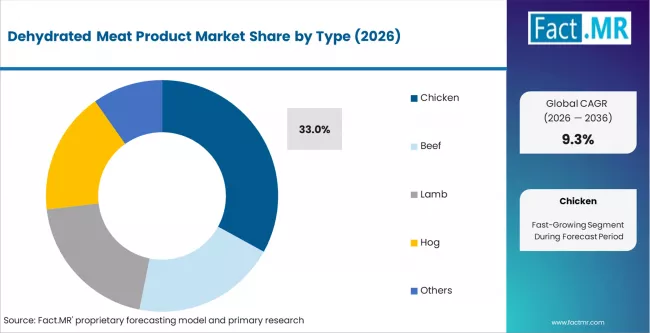
Dehydrated Meat Product Market Analysis By Type | Source: Fact.MR
Chicken is expected to hold 33% share in 2026 due to its cost advantage, wide consumer acceptance, and strong supply chain support globally.
- Tyson Foods Investment: In 2024, Tyson expanded dehydrated chicken production in Arkansas to support retail and military demand. [4]
- Vacuum Dried Technology Development: Hormel enhanced vacuum-dried processing in 2024, improving texture and extending shelf life for premium retail channels. [5]
- Beef Jerky Channel Trend: U.S. jerky sales reached USD 3.1 billion in 2024, with premium and clean-label products growing faster than standard variants. [6]
Dehydrated Meat Product Market Analysis by Technology
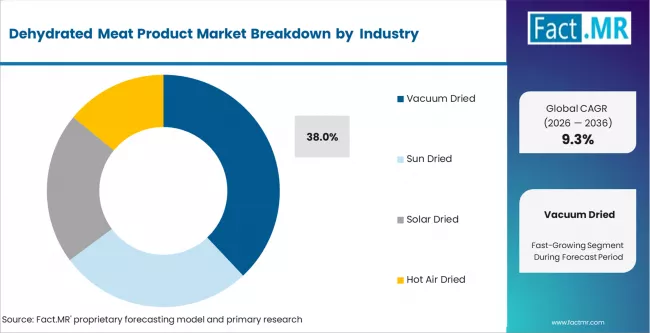
Dehydrated Meat Product Market Analysis By Technology | Source: Fact.MR
Vacuum drying leads premium adoption in 2026 with 38% due to better moisture removal, preserved quality, and compliance with military and retail standards.
- Pinnacle Foods Technology Upgrade: In 2024, Pinnacle upgraded vacuum-dried lines to support premium outdoor and military supply with extended shelf-life certification. [7]
- Solar Dried Product Launch: In 2025, Nu Harvest launched solar-dried beef jerky in Canada, targeting sustainability-focused outdoor consumers. [8]
- Hot Air Dried Volume Trend: Canada reported 12% growth in hot air-dried production in 2024, driven by demand in convenience retail and foodservice. [9]
Drivers, Restraints, and Opportunities
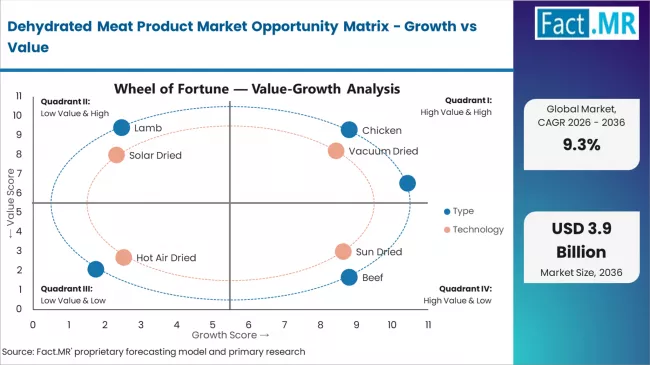
Dehydrated Meat Product Market Opportunity Matrix Growth Vs Value | Source: Fact.MR
FACT.MR analysts note the shift from commodity dried meat to premium high-protein snacks. Commodity products face price pressure, while vacuum-dried and specialty products command higher margins. Premium pricing supports revenue growth despite moderate volume expansion.
- Jack Link's Snack Innovation: In 2024, Jack Link’s expanded its vacuum-dried jerky range with high-protein and clean-label variants targeting U.S. and Canadian outdoor and sports nutrition channels. [2]
- China Convenience Retail Expansion: China’s 2024 retail data showed 19% growth in convenience food sales, with dried meat among the fastest-growing protein snack categories in urban markets. [3]
- EU Food Safety Compliance: Updated EU guidance in 2024 strengthened hygiene and traceability requirements, pushing exporters to upgrade compliance systems and supporting growth in Germany. [4]
Regional Analysis
The dehydrated meat product market is analysed across North America, Asia Pacific, Europe, Latin America, and Middle East and Africa, covering 40 or more countries with distinct demand profiles shaped by protein snack adoption rates, outdoor recreation market scale, military and emergency procurement activity, retail channel infrastructure, and food safety regulatory compliance frameworks. The full report offers market attractiveness analysis based on retail category growth, military programme pipeline, and premium product penetration benchmarks.
.webp "Top Country Growth Comparison Dehydrated Meat Product Market Cagr (2026 2036)")
Top Country Growth Comparison Dehydrated Meat Product Market Cagr (2026 2036) | Source: Fact.MR
| Country | CAGR (2026 to 2036) |
|---|---|
| Canada | 16.5% |
| China | 14.5% |
| Germany | 12.6% |
Source: Fact.MR analysis. Updated Mar 24, 2026
Source: Fact.MR (FACT.MR) analysis, based on proprietary forecasting model and primary research
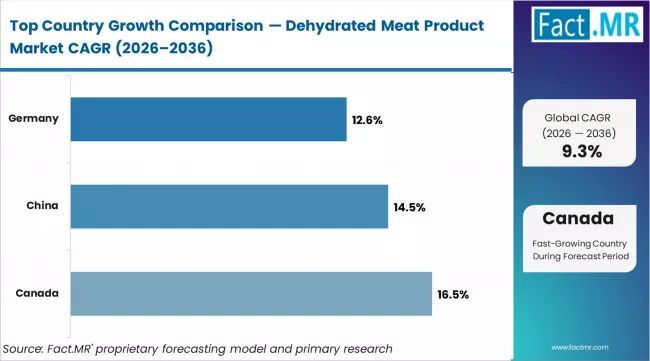
Dehydrated Meat Product Market Cagr Analysis By Country | Source: Fact.MR
North America Dehydrated Meat Product Market Analysis
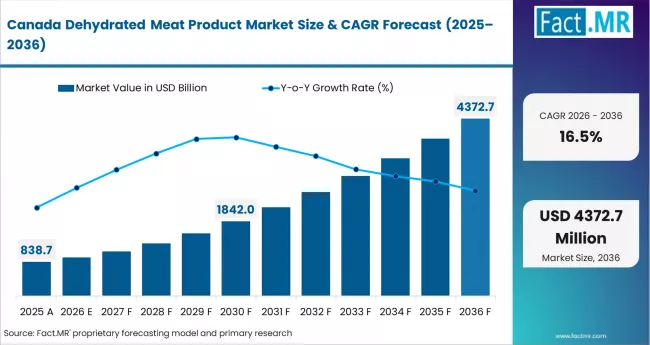
Dehydrated Meat Product Market Country Value Analysis | Source: Fact.MR
North America is the production epicentre and highest-value market for dehydrated meat products, anchored by Canada's outdoor recreation-driven premium jerky channel growth and the United States' established large-scale brand manufacturing ecosystem. Jack Link's, Tyson Foods, and Hormel Foods lead supply, while Pinnacle Foods and Nu Harvest Foods serve premium and specialty outdoor retail segments.
- Canada: Outdoor recreation retail growth and rising premium protein snack demand are driving the market, with Canada projected at 16.5% CAGR through 2036. Retailers like Mountain Equipment Company and Sport Chek expanded shelf space for vacuum-dried and clean-label jerky in 2024. Updated CFIA labelling standards improved protein and ingredient clarity, supporting premium positioning. Growth is driven by retail channel expansion, unlike Germany’s compliance-led model.
- China: Strong urban convenience retail growth and rising protein snack demand are supporting China’s market, projected at 14.5% CAGR through 2036. Convenience food sales grew 19% in 2024, with dried meat among the fastest-growing categories in cities like Beijing and Shanghai. Campofrio expanded partnerships with Lawson and FamilyMart to target young urban consumers. Growth is driven by retail infrastructure, unlike Canada’s outdoor retail-led model.
FACT.MR's analysis of North America includes the United States, Canada, and Mexico. The study covers outdoor retail data, military procurement benchmarks, pricing trends, and forecasts by meat type and technology.
Europe Dehydrated Meat Product Market Analysis
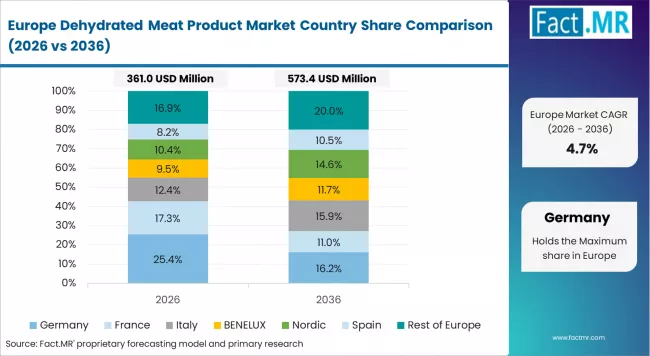
Dehydrated Meat Product Market Europe Country Market Share Analysis, 2026 & 2036 | Source: Fact.MR
Europe is a regulation-driven market where EU food safety standards shape production and compliance investment. Campofrio and Slim Jim serve mass retail, while specialty producers in Germany, Austria, and Italy target premium deli and health food segments.
- Germany: Compliance investment and specialty retail growth are driving demand, with Germany projected at 12.6% CAGR through 2036. Updated EU guidelines in 2024 strengthened hygiene and traceability requirements, pushing manufacturers to upgrade systems. Campofrio expanded fermented sausage offerings in German specialty retail channels. Growth is driven by compliance and certification, unlike Canada’s retail-led expansion.
FACT.MR's Europe analysis includes Germany, France, the UK, Italy, Spain, and Western Europe. The study covers EU compliance data, category benchmarks, retail trends, and forecasts.
Competitive Aligners for Market Players
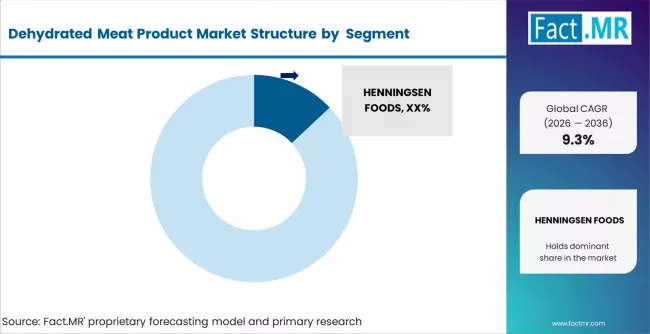
Dehydrated Meat Product Market Analysis By Company | Source: Fact.MR
The dehydrated meat market is fairly concentrated at the premium end. A few big players like Jack Link’s, Hormel Foods, and Tyson Foods hold strong positions, especially in North America. But the competition really works in two layers.
At the mass level, brands compete on price, flavours, and how widely they are available in supermarkets and convenience stores. It’s a volume game. In the premium space, things are different. Here, brands compete on protein content, clean ingredients, better processing like vacuum drying, and access to niche channels like outdoor retail and military supply. Jack Link’s stands out because of its strong retail presence across multiple channels and its steady stream of new products. Hormel Foods has an edge with its integrated operations, helping it maintain quality while supplying both retail and military segments. Tyson Foods benefits from its scale in chicken processing, giving it cost advantages in high-volume production.
Buyers like retailers and military agencies also shape competition. They often work with multiple suppliers and review pricing regularly. Military contracts, once secured, are hard to lose due to strict qualification processes. Meanwhile, premium retail channels reward innovation, pushing brands to focus on quality and differentiation rather than just low pricing.
Key Players of Dehydrated Meat Product Market
- HENNINGSEN FOODS
- Slim Jim
- The Campofrio Food Group
- Tyson Foods, Inc.
- Nu Harvest Foods
- Kublei Company LLP
- Hormel Foods
- Pinnacle Foods Group LLC
- Jack Link's
Bibliography
- [1] European Commission. (2024). Regulation (EC) 853/2004 Hygiene Standards for Food of Animal Origin: Updated Implementation Guidance for Dehydrated and Dried Meat Products Including Fermented Sausage Destined for EU Retail Distribution. November 2024.
- [2] Jack Link's. (2024). Product Portfolio Update: Vacuum-Dried Beef Jerky Range Expansion with High-Protein and Clean-Label Variants for Canadian and U.S. Outdoor Recreation and Sports Nutrition Retail Channels. October 2024.
- [3] National Bureau of Statistics of China. (2024). Retail Trade Survey 2024: Convenience Store Channel Food Sales Growth of 19% Year-on-Year Including Protein Snack and Dried Meat Product Category Performance in Tier 1 and Tier 2 Cities. December 2024.
- [4] Tyson Foods Inc. (2024). Operations Disclosure: Dehydrated Chicken Product Output Expansion at Springdale Arkansas Processing Facilities for North American Retail and Military Institutional Procurement Supply. October 2024. tysonfoods.
- [5] Hormel Foods Corporation. (2024). Product Update: Enhanced Vacuum-Dried Processing Implementation Across Natural Choice and Applegate Dried Meat Lines Achieving 24-Month Shelf Life Certification for Retail and Outdoor Recreation Channel Distribution. 2024.
- [6] Snack Food Association. (2024). State of the Snack Food Industry 2024: Beef and Chicken Jerky Combined U.S. Retail Sales Data, Premium and Clean-Label Category Growth Rates Versus Standard Format Products. October 2024.
- [7] Pinnacle Foods Group LLC. (2024). Facility Investment: Vacuum-Dried Processing Line Upgrades at Pennsylvania Facility for Premium Outdoor Recreation and Military Ration Supply Including USDA FSIS Extended Shelf-Life Certification for Government Procurement Qualification. 2024.
- [8] Nu Harvest Foods. (2025). Product Launch: Certified Solar-Dried Beef Jerky Range for Canadian Health Food and Specialty Outdoor Retail Market Targeting Eco-Conscious Outdoor Recreation Consumers with Sustainability-Differentiated Product Positioning. January 2025.
- [9] Canadian Meat Council. (2024). Industry Review 2024: Hot Air-Dried Dehydrated Meat Product Production Volume Growth of 12% Year-on-Year in Canada Driven by Convenience Retail and Foodservice Shelf-Stable Protein Snack Demand Expansion. December 2024.
This Report Addresses
- Strategic intelligence on Canada outdoor recreation retail premium jerky expansion, China convenience retail protein snack penetration, EU Regulation (EC) 853/2004 dried meat compliance investment, U.S. military vacuum-dried ration procurement, and premiumisation trends shaping dehydrated meat demand through 2036.
- Market forecast from USD 1.6 billion in 2026 to USD 3.9 billion by 2036 at 9.3% CAGR, segmented by packaging type, meat type, product type, drying technology, and region.
- Growth opportunity mapping across Canada's premium outdoor recreation channel, China's urban convenience retail expansion, Germany's EU compliance-driven specialty deli adoption, and North American military vacuum-dried ration programme procurement.
- Country CAGR outlook for Canada 16.5%, China 14.5%, and Germany 12.6%, with retail channel, regulatory compliance, and military procurement drivers documented per country.
- Competitive analysis of Jack Link's, Hormel Foods, Tyson Foods, Campofrio Food Group, Pinnacle Foods, and Nu Harvest Foods covering vacuum-dried technology investment, premium channel positioning, and military qualification strategies.
- Technology tracking covering vacuum-dried premium product development, solar-dried sustainability-positioned product innovation, hot air-dried volume category scale, and military MIL-PRF-44073-compliant product certification.
- Regulatory analysis covering EU Regulation (EC) 853/2004 dried meat hygiene standards, USDA FSIS shelf-stable product certification, Canada CFIA dried meat labelling standards, and Chinese GB food safety product specifications.
- Report delivered in PDF, Excel datasets, PowerPoint summary, and dashboard formats supported by brand revenue data, food retail category statistics, government procurement notices, and primary research interviews.
Dehydrated Meat Product Market Definition
The dehydrated meat product market includes processed meat such as beef, chicken, lamb, and hog that undergo moisture removal through sun, solar, hot air, or vacuum drying. These are sold as jerky, dried sausage, and related formats for retail snacks, military rations, outdoor use, and foodservice.
Dehydrated Meat Product Market Inclusions
Covers global and regional forecasts from 2026 to 2036 by packaging, meat type, product type, and drying technology. Includes chicken, beef, lamb, and hog products in pouch and canned formats across major regions.
Dehydrated Meat Product Market Exclusions
Excludes fresh, frozen, and non-dried cured meat products. Also omits plant-based meat alternatives, industrial meat powders, and meal kits where dehydrated meat is a minor component.
Dehydrated Meat Product Market Research Methodology
- Primary Research: Interviews with brand managers, retail buyers, military procurement officers, outdoor retailers, and food safety experts across North America, Europe, and Asia Pacific.
- Desk Research: Includes USDA reports, EU regulations, Canada CFIA standards, Chinese GB standards, and brand reports from 2024-2025.
- Market Sizing and Forecasting: Hybrid model using retail volumes, pricing by format and technology, and military procurement data, supported by industry interviews.
- Data Validation and Update Cycle: Validated through brand revenues, retail data, procurement records, and expert inputs with regular updates.
Segmentation
Scope of Report
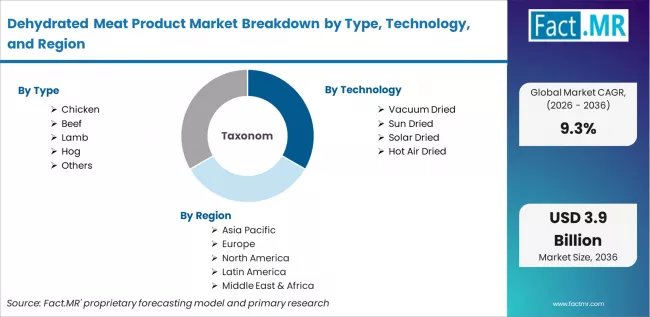
Dehydrated Meat Product Market Breakdown By Type, Technology, And Region | Source: Fact.MR
| Quantitative Units | USD 1.6 billion (2026) to USD 3.9 billion (2036), at a CAGR of 9.3% |
|---|---|
| Market Definition | Market includes Chicken, beef, lamb, and hog products with moisture removed through sun, solar, hot air, and vacuum drying, sold as dried and fermented sausage in pouch and canned formats for protein snack, military, outdoor, and foodservice end uses. |
| Packaging Type Segmentation | Pouches, Canned Frozen |
| Type Segmentation | Chicken, Beef, Lamb, Hog, Others |
| Product Type Segmentation | Fermented Sausage, Dried Sausage |
| Technology Segmentation | Sun Dried, Solar Dried, Hot Air Dried, Vacuum Dried |
| Application Coverage | Retail high-protein snack, military and emergency ration supply, outdoor recreation and adventure food, foodservice shelf-stable meal components, and specialty deli fermented sausage distribution. |
| Regions Covered | North America, Europe, Asia Pacific, Latin America, Middle East and Africa |
| Countries Covered | USA, Canada, Mexico, Germany, UK, France, Italy, Spain, Nordic, BENELUX, Eastern Europe, China, Japan, South Korea, India, ASEAN, Australia and New Zealand, Brazil, Chile, Ecuador, Rest of Latin America, Saudi Arabia, GCC, Turkey, South Africa, Rest of MEA |
| Key Companies Profiled | HENNINGSEN FOODS, Slim Jim, The Campofrio Food Group, Tyson Foods Inc., Nu Harvest Foods, Kublei Company LLP, Hormel Foods, Pinnacle Foods Group LLC, Jack Link's |
| Forecast Period | 2026 to 2036 |
| Approach | Hybrid top-down and bottom-up model using dehydrated meat retail sales volumes, average selling prices by packaging and technology tier, military programme procurement values, and primary interviews with brand managers, food retail buyers, and military procurement officers. |
Source: Fact.MR analysis. Updated Mar 24, 2026
Dehydrated Meat Product Market by Segments
-
By Packaging Type :
- Pouches
- Canned Frozen
-
By Type :
- Chicken
- Beef
- Lamb
- Hog
- Others
-
By Product Type :
- Fermented Sausage
- Dried Sausage
-
By Technology :
- Sun Dried
- Solar Dried
- Hot Air Dried
- Vacuum Dried
-
By Region :
- North America
- United States
- Canada
- Mexico
- Latin America
- Brazil
- Chile
- Ecuador
- Rest of Latin America
- Western Europe
- Germany
- United Kingdom
- France
- Italy
- Spain
- Nordic
- BENELUX
- Rest of Western Europe
- Eastern Europe
- Russia
- Poland
- Hungary
- Balkan and Baltic
- Rest of Eastern Europe
- East Asia
- China
- Japan
- South Korea
- South Asia and Pacific
- India
- ASEAN
- Australia and New Zealand
- Rest of South Asia and Pacific
- Middle East and Africa
- Kingdom of Saudi Arabia
- Other GCC Countries
- Turkey
- South Africa
- Other African Union
- Rest of Middle East and Africa
- North America
Frequently Asked Questions
How large is the dehydrated meat product market in 2025?
What will the market size be in 2026?
What is the projected market size by 2036?
What is the expected CAGR?
Which meat type segment leads the market?
Which technology segment leads premium adoption?
Which country shows the fastest growth?
What is the primary restraint?
Who worked on this report


Preview the report firsthand - request a free sample
Free SampleGet the brochure for pricing and purchase details
Download PDF