- Base Value(2026): 1.2 Bn
- Estimated Value(2026): 1.2 Bn
- Forecast Value (2036): 3.8 Bn
- CAGR (2026 - 2036): 12.2%
Dendritic Cell Cancer Vaccine Market Forecast and Outlook 2026 to 2036
The global dendritic cell cancer vaccine market is valued at USD 1.2 billion in 2026 and is projected to reach USD 3.8 billion by 2036. This represents an absolute increase of USD 2.6 billion and total growth of 216.7% over the forecast period. Demand is expected to expand at a CAGR of 12.2% between 2026 and 2036, with overall market size growing by nearly 3.2X.
Growth is underpinned by rising adoption of personalized immunotherapy, increased clinical focus on precision oncology, and broader investment in advanced cancer treatment infrastructure across hospitals and specialized oncology centers.
Key Takeaways from the Dendritic Cell Cancer Vaccine Market
- Dendritic Cell Cancer Vaccine Market Value (2026): USD 1.2 billion
- Dendritic Cell Cancer Vaccine Market Forecast Value (2036): USD 3.8 billion
- Dendritic Cell Cancer Vaccine Market Forecast CAGR: 12.2%
- Leading Vaccine Type in Dendritic Cell Cancer Vaccine Market: Sipuleucel-T (38.4%)
- Key Growth Regions in Dendritic Cell Cancer Vaccine Market: North America, Europe, Asia Pacific
- Key Players in Dendritic Cell Cancer Vaccine Market: Dendreon Pharmaceuticals LLC, Northwest Biotherapeutics Inc., Argos Therapeutics Inc., Immunocellular Therapeutics Ltd., Medigene AG
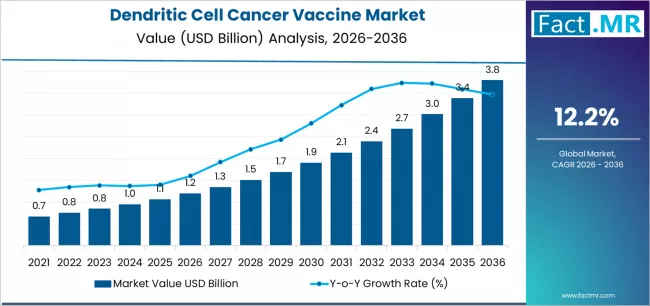
Dendritic Cell Cancer Vaccine Market Market Value Analysis | Source: Fact.MR
Sipuleucel-T remains the leading product segment, accounting for 38.4% of market value in 2026. Its established clinical use in prostate cancer and its ability to stimulate patient-specific immune responses support continued uptake in advanced oncology care. From an end-use perspective, hospitals represent the dominant application setting, holding 47.6% share in 2026. Hospitals offer the clinical coordination, laboratory capacity, and regulatory oversight required for autologous cell-based therapies.
Advances in cellular immunotherapy platforms, improved manufacturing scalability, and growing clinical validation shape the market trajectory across multiple cancer indications. Integration of neoantigen targeting, combination therapy approaches, and data-driven treatment optimization is strengthening clinical confidence and supporting wider adoption. Ongoing healthcare modernization, coupled with sustained oncology R&D funding, continues to reinforce long-term demand for dendritic cell–based vaccine solutions.
Dendritic Cell Cancer Vaccine Market
| Metric | Value |
|---|---|
| Estimated Value in (2026E) | USD 1.2 billion |
| Forecast Value in (2036F) | USD 3.8 billion |
| Forecast CAGR (2026 to 2036) | 12.2% |
Source: Fact.MR analysis. Updated Dec 17, 2025
Category
| Category | Segments |
|---|---|
| Vaccine Type | Sipuleucel-T Vaccines; CreaVax Vaccines; Autologous Vaccines; Allogeneic Vaccines; Other Vaccine Configurations |
| Application Sector | Hospitals; Cancer Treatment Centers; Specialty Oncology Clinics; Research Institutions; Others |
| Technology Platform | Cellular Immunotherapy; Neoantigen Targeting; Combination Therapy; Personalized Medicine; Other Technology Platforms |
| End-User Category | Public Hospitals; Private Healthcare Facilities; Cancer Research Centers; Other End-User Services |
| Region | North America; Europe; Asia Pacific; Latin America; Middle East & Africa |
Source: Fact.MR analysis. Updated Dec 17, 2025
Segmental Analysis
Why do Sipuleucel-T Vaccines Experience the Maximum Uptake?

Dendritic Cell Cancer Vaccine Market Analysis By Vaccine Type | Source: Fact.MR
Sipuleucel-T vaccines are projected to account for 38.4% of the dendritic cell cancer vaccine market in 2026, retaining segment leadership. Their dominance reflects established clinical validation, consistent therapeutic outcomes, and compatibility with existing oncology treatment protocols.
Healthcare providers continue to adopt sipuleucel-T due to its reliability in prostate cancer management and its integration within hospital-based immunotherapy workflows. Ongoing institutional investment and familiarity among clinicians further support sustained demand across developed healthcare systems.
By Application Sector, Which Segment Registers the Highest Share?

Dendritic Cell Cancer Vaccine Market Analysis By Application Sector | Source: Fact.MR
Hospitals are expected to represent 47.6% of market demand in 2026, making them the leading application sector. This position is driven by centralized oncology services, access to specialized infrastructure, and the ability to administer complex personalized vaccines.
Hospitals also benefit from standardized clinical oversight and reimbursement frameworks, supporting consistent adoption. Continued advancements in dendritic cell vaccine technologies are likely to reinforce hospital-led utilization over the forecast period.
What are the Drivers, Restraints, and Key Trends of the Dendritic Cell Cancer Vaccine Market?
The dendritic cell cancer vaccine market is advancing due to healthcare modernization and rising demand for advanced therapeutic solutions with improved clinical performance across oncology applications. Growth is supported by increasing focus on personalized immunotherapy and precision medicine adoption in hospitals and specialized cancer centers. The market faces restraints from competition with alternative immunotherapies, high vaccine development and manufacturing costs, and complex regulatory approval processes that can delay commercialization and limit adoption.
A key trend shaping the market is the integration of artificial intelligence and precision medicine tools to improve treatment planning, immune response assessment, and operational efficiency. Another significant trend is the incorporation of advanced neoantigen technologies and patient-specific vaccine systems. These innovations enhance therapeutic effectiveness, enable real-time immune monitoring, and support predictive treatment approaches, expanding the clinical utility of dendritic cell cancer vaccines beyond conventional therapeutic frameworks.
Analysis of the Dendritic Cell Cancer Vaccine Market by Key Countries
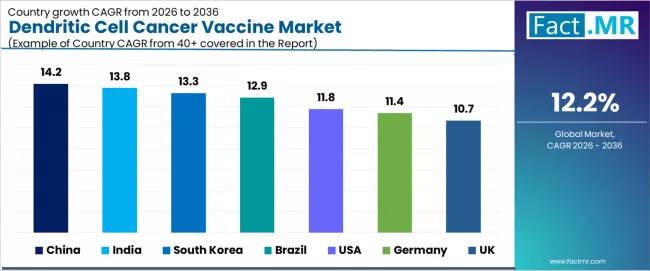
Dendritic Cell Cancer Vaccine Market Cagr Analysis By Country | Source: Fact.MR
| Country | CAGR (2026-2036) |
|---|---|
| China | 14.2% |
| India | 13.8% |
| Germany | 11.4% |
| Brazil | 12.9% |
| USA | 11.8% |
| UK | 10.7% |
| South Korea | 13.3% |
Source: Fact.MR analysis. Updated Dec 17, 2025
Why is Healthcare Modernization Accelerating Dendritic Cell Vaccine Demand in China?
China’s dendritic cell cancer vaccine market is projected to expand at a CAGR of 14.2% through 2036, driven by rapid healthcare modernization, supportive government policies, and standardized cancer treatment programs across urban regions.
Strong public investment and regulatory backing are reinforcing China’s position as a regional hub for advanced immunotherapies. Domestic and international manufacturers are expanding production, clinical capabilities, and distribution networks to meet rising institutional demand and export requirements.
- Expanding hospital capacity and rising cancer awareness are increasing vaccine adoption across urban healthcare systems.
- Infrastructure modernization and policy-led technology upgrades are supporting rapid uptake of premium vaccine platforms.
How are Infrastructure Expansion and Investment Shaping India’s Market Potential?
India’s dendritic cell cancer vaccine revenue is growing at a CAGR of 13.8%, supported by expanding healthcare infrastructure, rising oncology awareness, and increasing public and private investment.
Growth in tertiary hospitals and specialty cancer centers is driving demand for advanced immunotherapies. International suppliers and domestic distributors are strengthening logistics, clinical support, and regional reach to address uneven but expanding healthcare access.
- New hospital development and oncology capacity expansion are creating sustained vaccine adoption opportunities.
- Growing awareness initiatives and technology access are accelerating uptake of specialized cancer vaccines.
Why does South Korea’s Technology Leadership Support Consistent Market Expansion?
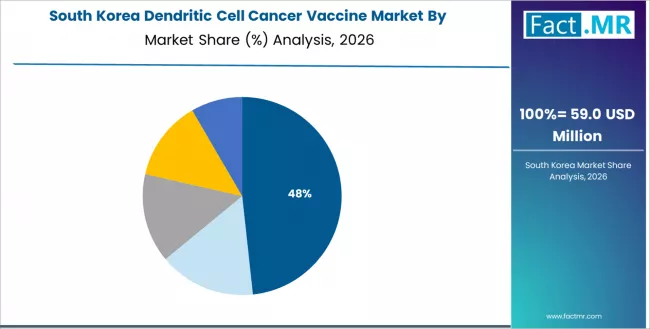
Dendritic Cell Cancer Vaccine Market South Korea Market Share Analysis By Application Sector | Source: Fact.MR
South Korea’s dendritic cell cancer vaccine market is projected to grow at a CAGR of 13.3% through 2036, supported by advanced healthcare standards, strong regulatory frameworks, and leadership in medical technology deployment. High clinical adoption readiness and government-backed innovation programs are sustaining demand for next-generation vaccine platforms. Manufacturers are aligning product development with domestic needs and broader regional opportunities.
- Advanced healthcare technology adoption is driving demand for high-performance vaccine systems.
- Regulatory clarity and clinical precision standards support steady uptake of innovative vaccine solutions
How is Healthcare Modernization Driving Brazil’s Vaccine Market Growth?
Brazil’s dendritic cell cancer vaccine market is expected to grow at a CAGR of 12.9% through 2036, driven by healthcare modernization efforts, expanding hospital infrastructure, and improving distributor capabilities. As a regional healthcare reference point, Brazil is witnessing increased demand for efficiency-oriented therapeutic solutions across public and private facilities.
- Expanding hospital networks and oncology services are increasing vaccine demand nationwide.
- Focus on operational efficiency and modernization is supporting adoption of specialty vaccine platforms.
Why does Advanced System Integration Sustain Growth in the USA?
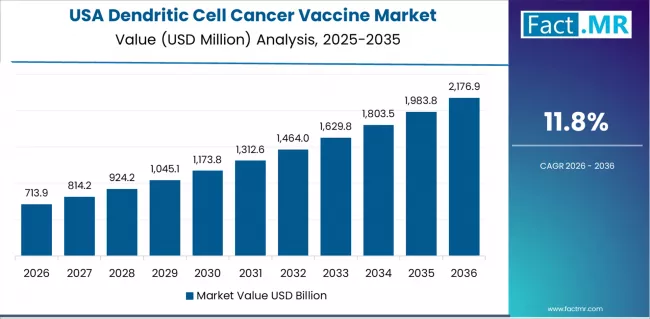
Dendritic Cell Cancer Vaccine Market Country Value Analysis | Source: Fact.MR
The USA’s dendritic cell cancer vaccine market is projected to expand at a CAGR of 11.8% through 2036, supported by advanced healthcare integration, precision medicine adoption, and strong clinical validation standards. Healthcare providers prioritize therapeutic reliability, regulatory compliance, and operational optimization, reinforcing steady demand for specialized vaccine systems.
- Precision medicine programs and technology-driven care models are increasing vaccine utilization.
- Strong quality benchmarks encourage adoption of clinically validated immunotherapy solutions.
How do Quality Standards and Efficiency Drive Germany’s Steady Expansion?
Germany’s dendritic cell cancer vaccine market is forecast to grow at a CAGR of 11.4% through 2036, supported by established healthcare systems, consistent funding, and strong emphasis on quality assurance. Demand remains steady across hospitals and specialty clinics prioritizing performance reliability and standardized care delivery.
- Mature healthcare infrastructure sustains consistent demand for premium vaccine systems.
- Emphasis on operational efficiency supports adoption of proven immunotherapy platforms.
Why is Precision-Focused Healthcare Supporting Growth in the UK?
The UK dendritic cell cancer vaccine market is projected to grow at a CAGR of 10.7% through 2036, driven by emphasis on clinical precision, technology integration, and standardized oncology care pathways. Healthcare providers increasingly prioritize accuracy, consistency, and regulatory alignment in vaccine adoption decisions.
- Precision medicine initiatives are driving demand across advanced oncology applications.
- Strong clinical governance supports uptake of high-reliability vaccine solutions.
Competitive Landscape of the Dendritic Cell Cancer Vaccine Market

Dendritic Cell Cancer Vaccine Market Analysis By Company | Source: Fact.MR
The dendritic cell cancer vaccine market is defined by competition among established biopharmaceutical companies, specialized immunotherapy developers, and integrated healthcare solution providers. Market participants are focusing on strengthening technological depth through investments in advanced vaccine platforms, cellular processing capabilities, and immune activation optimization. Emphasis on product reliability, clinical consistency, and regulatory alignment continues to shape competitive positioning across global healthcare systems.
Innovation remains central to market competition, particularly in areas such as personalized vaccine development, automation of cellular workflows, and integration of precision medicine approaches. Companies are expanding research pipelines and enhancing manufacturing scalability to support clinical trials, institutional adoption, and long-term therapeutic deployment. Strategic collaborations with hospitals, research institutions, and oncology centers are also influencing adoption patterns and technology validation.
Several players maintain differentiated positions based on platform specialization and clinical focus. Dendreon Pharmaceuticals LLC is recognized for its long-standing experience in therapeutic cancer vaccines and integrated treatment frameworks. Northwest Biotherapeutics Inc. emphasizes automated and patient-specific vaccine systems designed for clinical efficiency.
Argos Therapeutics Inc. focuses on operational optimization and targeted immunotherapy development. Immunocellular Therapeutics Ltd. concentrates on specialized dendritic cell technologies for oncology applications, while Medigene AG prioritizes advanced medical development and precision-oriented therapeutic design.
Key Players in the Dendritic Cell Cancer Vaccine Market
- Dendreon Pharmaceuticals LLC
- Northwest Biotherapeutics Inc.
- Argos Therapeutics Inc.
- Immunocellular Therapeutics Ltd.
- Medigene AG
- Batavia Biosciences B.V.
- Bellicum Pharmaceuticals Inc.
- JW CreaGene Corporation
- Kiromic BioPharma Inc.
- Asgard Therapeutics AB
- BioNTech SE
- CureVac N.V.
- Candel Therapeutics Inc.
- Elios Therapeutics Inc.
- Activartis Biotech GmbH
Segmentation
Scope of the Report
| Items | Values |
|---|---|
| Quantitative Units (2026) | USD 1.2 Billion |
| Vaccine Type | Sipuleucel-T Vaccines, CreaVax Vaccines, Autologous Vaccines, Allogeneic Vaccines, Other Vaccine Configurations |
| Application Sector | Hospitals, Cancer Treatment Centers, Specialty Oncology Clinics, Research Institutions, Others |
| Technology Platform | Cellular Immunotherapy, Neoantigen Targeting, Combination Therapy, Personalized Medicine, Other Technology Platforms |
| End-User Category | Public Hospitals, Private Healthcare Facilities, Cancer Research Centers, Other End-User Services |
| Regions Covered | North America, Europe, Asia Pacific, Latin America, MEA, Other Regions |
| Countries Covered | China, India, Germany, Brazil, USA, UK, South Korea, and 40+ countries |
| Key Companies Profiled | Dendreon Pharmaceuticals LLC, Northwest Biotherapeutics Inc., Argos Therapeutics Inc., Immunocellular Therapeutics Ltd., Medigene AG, and other leading vaccine development companies |
| Additional Attributes | Dollar sales by vaccine type, application sector, technology platform, end-user category, and region; regional demand trends, competitive landscape, technological advancements in vaccine engineering, operational performance optimization initiatives, therapeutic enhancement programs, and premium product development strategies |
Source: Fact.MR analysis. Updated Dec 17, 2025
Dendritic Cell Cancer Vaccine Market by Segments
-
Vaccine Type :
- Sipuleucel-T Vaccines
- CreaVax Vaccines
- Autologous Vaccines
- Allogeneic Vaccines
- Other Vaccine Configurations
-
Application Sector :
- Hospitals
- Cancer Treatment Centers
- Specialty Oncology Clinics
- Research Institutions
- Others
-
Technology Platform :
- Cellular Immunotherapy
- Neoantigen Targeting
- Combination Therapy
- Personalized Medicine
- Other Technology Platforms
-
End-User Category :
- Public Hospitals
- Private Healthcare Facilities
- Cancer Research Centers
- Other End-User Services
-
Region :
-
North America
- USA
- Canada
- Mexico
-
Europe
- Germany
- UK
- France
- Italy
- Spain
- Nordic Countries
- BENELUX
- Rest of Europe
-
Asia Pacific
- China
- India
- Japan
- South Korea
- Australia
- Rest of Asia Pacific
-
Latin America
- Brazil
- Argentina
- Rest of Latin America
-
MEA
- Saudi Arabia
- UAE
- South Africa
- Rest of MEA
-
Frequently Asked Questions
How big is the dendritic cell cancer vaccine market in 2026?
What will be the size of dendritic cell cancer vaccine market in 2036?
How much will be the dendritic cell cancer vaccine market growth between 2026 and 2036?
What are the key product types in the dendritic cell cancer vaccine market?
Which application sector segment to contribute significant share in the dendritic cell cancer vaccine market in 2026?
Who worked on this report


Preview the report firsthand - request a free sample
Free SampleGet the brochure for pricing and purchase details
Download PDF