- Base Value(2026): 2.4 Bn
- Estimated Value(2026): 2.4 Bn
- Forecast Value (2036): 3.9 Bn
- CAGR (2026 - 2036): 5.2%
Dental Anaesthetic Market Forecast and Outlook 2026 to 2036
In 2025, the dental anaesthetic market value crossed USD 2.3 billion. Based on Fact.MR analysis, demand for dental anaesthetics is estimated to grow to USD 2.4 billion in 2026 and USD 3.9 billion by 2036. Fact.MR projects a CAGR of 5.2% during the forecast period.
Between 2026 and 2036, the market is projected to generate an absolute dollar opportunity of USD 1.5 billion. This steady expansion reflects non-discretionary dental procedure volume growth across aging global populations combined with a gradual per-unit value uplift as articaine and computer-controlled delivery systems displace legacy lidocaine cartridges in premium dental practice segments. Structural constraints include generic competition compressing cartridge pricing, dentist shortage in low-income markets limiting procedure access, and allergenic epinephrine vasoconstrictor concerns moderating uptake in medically compromised patient populations.
Dan Scavilla, President and CEO of Dentsply Sirona, said, "In 2026, we are acting with urgency and accountability on our Return-to-Growth Action Plan, going deeper, moving faster and being bolder to enhance the customer experience, strengthen commercial performance and optimize capital allocation."
Country growth reflects dental procedure volume expansion, oral healthcare infrastructure investment, and premium formulation adoption. China leads at 7.5% CAGR, driven by national oral health plan implementation and rapid private dental chain expansion. India follows at 6.9%, supported by PMJAY dental coverage expansion and growing dental college infrastructure. Germany posts 6.2% as articaine and computer-controlled delivery systems achieve broad adoption within the established statutory dental reimbursement framework. Brazil registers 5.8% tied to Smiles Brazil Programme expansion and growing private dental insurance penetration. The United States posts 5.0% anchored by aging population procedure demand and premium delivery technology adoption at corporate dental service organisations. The United Kingdom grows at 4.8% as NHS dental contract reform drives private capacity investment and local anaesthetic consumption per visit increases with expanded treatment scope.
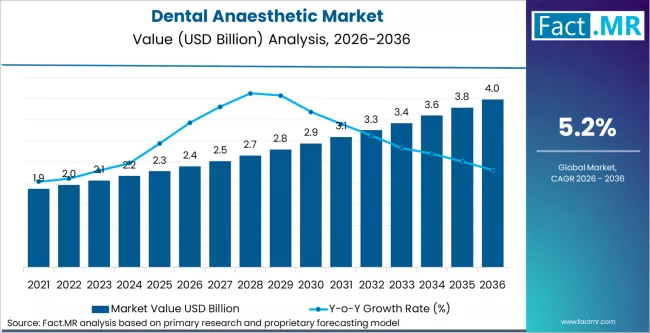
Dental Anaesthetic Market Market Value Analysis | Source: Fact.MR
| Metric | Value |
|---|---|
| Estimated Value in 2026 | USD 2.4 billion |
| Forecast Value in 2036 | USD 3.9 billion |
| Forecast CAGR (2026 to 2036) | 5.2% |
Source: Fact.MR analysis. Updated Mar 10, 2026
Market Definition
The dental anaesthetic market includes injectable and topical local anaesthetic drugs used to reduce pain during dental procedures. Common agents include lidocaine, articaine, mepivacaine, prilocaine, and bupivacaine supplied in dental cartridges for use with syringes or advanced delivery systems in clinics and hospital dental departments.
Market Inclusions
Includes global and regional revenue forecasts (2026-2036) by product type, administration method, duration of action, and distribution channel. Covers major anaesthetic formulations in cartridge and alternative delivery formats along with pricing trends, vasoconstrictor combinations, and adoption of computer-controlled injection systems.
Market Exclusions
Excludes general anaesthesia used in hospital operating rooms for dental surgery. Also excludes OTC topical anaesthetic gels, standalone delivery devices without cartridges, and sedation gases such as nitrous oxide.
Research Methodology
- Primary Research: Interviews with dentists, oral surgeons, dental clinic buyers, hospital dental departments, pharmaceutical wholesalers, and dental supply distributors across major regions.
- Desk Research: Analysis of manufacturer earnings reports, WHO oral health publications, dental association guidelines, FDA and EMA approval databases, reimbursement schedules, and dental industry procurement statistics.
- Market Sizing and Forecasting: A hybrid approach combining dental procedure volumes with average cartridge prices by product and distribution channel, incorporating shifts toward premium formulations and advanced delivery systems.
- Data Validation and Update Cycle: Forecasts validated using manufacturer revenues, dental procedure statistics, prescription data, and procurement benchmarks, with updates reflecting generic entries and new product approvals.
Summary
- Market Definition
- Dental anaesthetics are injectable amide-type local anaesthetic drugs used to control pain during restorative, periodontal, endodontic, surgical, and implant dental procedures in clinics and hospitals.
- Demand Drivers
- Aging populations and rising dental disease prevalence are increasing dental procedure volumes requiring local anaesthesia.
- Government oral health programmes in China and India are expanding public dental infrastructure and anaesthetic procurement.
- Adoption of computer-controlled anaesthetic delivery systems is raising per-procedure anaesthetic spending in advanced dental practices.
- Key Segments Analyzed
- By Product Type: Lidocaine holds about 31% share in 2026 due to long clinical use and low generic cost.
- By Mode of Administration: Local infiltration leads with around 38% share due to routine use in restorative procedures.
- By Duration of Action: Medium-duration agents hold about 52% share as they match typical dental procedure times.
- By Distribution Channel: Clinics dominate procurement through dental supply distributors and clinic chain purchasing.
- By Geography: North America leads revenue value, while Asia Pacific leads volume growth due to expanding dental care access.
- Analyst Opinion at FACT.MR
- Shambhu Nath Jha, Principal Consultant at Fact.MR, opines that CXOs will find this report highlights how the dental anaesthetic market will be driven by expanding dental procedure volumes in emerging markets and increasing adoption of premium agents such as articaine alongside advanced injection delivery system.
- Strategic Implications
- Manufacturers should expand regulatory approvals for premium anaesthetics in high-growth Asian markets.
- Distributors should strengthen supply partnerships with dental service organisations and clinic chains.
- Companies should invest in computer-controlled anaesthetic delivery technologies to support premium product adoption.
- Methodology
- Market size estimated using dental procedure volumes, cartridges per procedure, and product pricing by region.
- Reimbursement data, national oral health programmes, and dental licensing statistics informed demand projections.
- Forecasts validated using regulatory databases, supply chain data, and interviews with dental clinic buyers and wholesalers.
Segmental Analysis
Dental Anaesthetic Market Analysis by Product Type
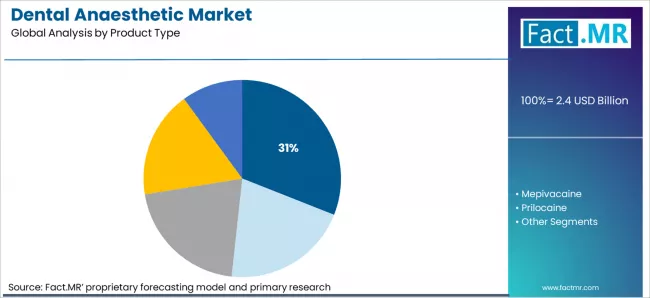
Dental Anaesthetic Market Analysis By Product Type | Source: Fact.MR
FACT.MR estimates lidocaine will hold about 31% share in 2026 due to its long clinical history, wide formulary inclusion, and low generic cost supporting large-scale procurement.
- Septodont Articaine Expansion: In 2025, Septodont expanded registration of its articaine products across several Asia Pacific markets to supply growing private dental clinic networks. [5]
- Laboratorios Inibsa Cartridge Launch: In 2024, Laboratorios Inibsa introduced a mepivacaine formulation without vasoconstrictor in a polymer cartridge format for medically sensitive patients. [6]
- Articaine Market Share Growth Trend: Clinical reports from European dental associations show articaine increasingly replacing lidocaine in procedures such as implantology and oral surgery. [7]
Dental Anaesthetic Market Analysis by Mode of Administration
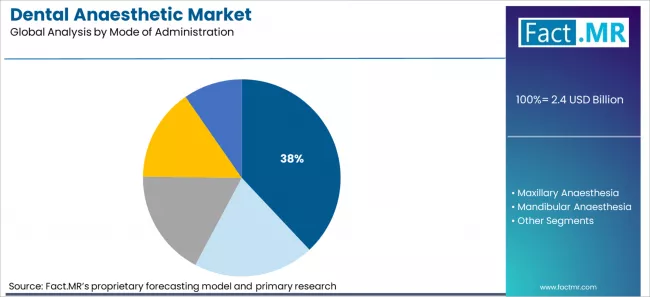
Dental Anaesthetic Market Analysis By Mode Of Administration | Source: Fact.MR
FACT.MR estimates local infiltration will account for about 38% share in 2026 as it remains the standard technique for most routine dental procedures.
- Milestone Scientific CCLAD Growth: Milestone Scientific reported strong sales of its computer-controlled anaesthesia delivery system used to improve patient comfort during dental procedures. [8]
- Nerve Block Training Initiative: Updated US dental education standards maintain mandatory training in nerve block techniques, sustaining demand for common anaesthetic formulations in dental schools. [9]
- Needle-Free Injection Trend: Dental manufacturers are investing in needle-free and safety-engineered injection systems to comply with occupational safety standards and reduce needle-stick injuries. [1]
Drivers, Restraints, and Opportunities
FACT.MR analysts view the dental anaesthetic market as a mature but steadily growing pharmaceutical consumable segment linked to rising dental procedure volumes worldwide. Growth is supported by routine anaesthetic use in restorative, periodontal, and surgical treatments, with moderate value gains from premium formulations and advanced delivery technologies.
- WHO Global Oral Health Action Plan: The WHO Global Oral Health Action Plan 2023-2030 promotes universal access to essential oral healthcare, including pain-free dental treatment. National implementation across several countries is increasing procurement of lidocaine cartridges for public dental facilities. [2]
- China Oral Health Action Plan: China’s Healthy China Oral Health Action Plan update aims to increase dental visit rates and upgrade hospital dental departments, expanding institutional procurement of dental anaesthetic cartridges. [3]
- US DSO Consolidation Procurement Impact: Dental service organisations now manage about 25% of US dental offices, concentrating anaesthetic purchasing through centralised formularies and increasing competition among suppliers for multi-year supply agreements. [4]
Regional Analysis
The dental anaesthetic market is analysed across Asia Pacific, Europe, North America, Latin America, and Middle East and Africa, spanning 40+ countries with distinct demand profiles shaped by dental procedure volumes, oral health programme reach, healthcare reimbursement frameworks, and premium formulation adoption maturity. The full report offers market attractiveness analysis across all segments and countries.
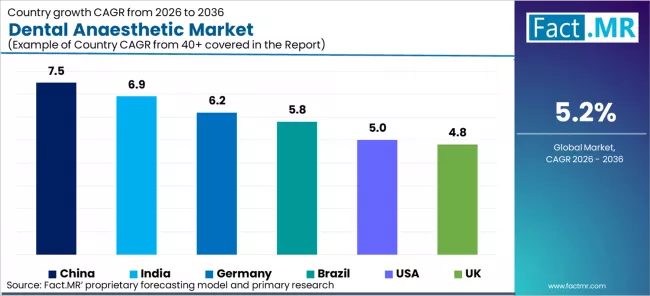
Dental Anaesthetic Market Cagr Analysis By Country | Source: Fact.MR
| Country | CAGR (2026-2036) |
|---|---|
| China | 7.5% |
| India | 6.9% |
| Germany | 6.2% |
| Brazil | 5.8% |
| USA | 5.0% |
| UK | 4.8% |
Source: Fact.MR analysis. Updated Mar 10, 2026
Source: Fact.MR (FACT.MR) analysis, based on proprietary forecasting model and primary research
Asia Pacific Dental Anaesthetic Market Analysis
Asia Pacific is the fastest growing market driven by expanding dental clinics, government oral health programmes, and increasing dental practitioner numbers. Septodont and Dentsply Sirona lead premium clinical supply, while domestic manufacturers compete strongly in low cost lidocaine cartridges.
- China: Demand for dental anaesthetics in China is projected to grow at around 7.5% CAGR through 2036. Government oral health programmes and hospital dental department upgrades are expanding procurement of anaesthetic cartridges across public facilities. Rapid growth of private dental chains is also increasing routine consumable demand. Septodont strengthened distribution of articaine and mepivacaine formulations to capture rising premium formulation adoption.
- India: Demand in India is forecast to expand at about 6.9% CAGR through 2036. Expansion of PMJAY dental coverage pilots and rising dental college output are increasing procedure volumes and anaesthetic procurement. Growth of private dental clinics and hospital dental departments is also supporting cartridge demand across major states.
FACT.MR's Asia Pacific analysis of the dental anaesthetic market covers China, India, Japan, South Korea, ASEAN, Australia and New Zealand, and Rest of Asia Pacific. Readers can find country growth forecasts, dental programme procurement data, clinic expansion trends, and formulation adoption benchmarks.
Europe Dental Anaesthetic Market Analysis
Europe represents a premium formulation market where reimbursement systems, strong clinical protocols, and strict pharmaceutical standards influence procurement. Septodont, Laboratorios Inibsa, and Pierre Pharma maintain strong positions through certified anaesthetic formulations and established distribution networks.
- Germany: Germany’s dental anaesthetic market is expected to grow at about 6.2% CAGR through 2036. Statutory dental insurance coverage ensures consistent treatment volumes and anaesthetic use. Updated dental clinical guidelines favour articaine formulations, accelerating adoption in routine procedures across dental clinics and specialist practices.
- United Kingdom: The United Kingdom market is projected to expand at nearly 4.8% CAGR through 2036. NHS dental recovery funding is increasing treatment activity across contracted practices. Updated procurement frameworks and infection control standards are also supporting steady anaesthetic cartridge demand.
FACT.MR's European analysis of the dental anaesthetic market covers Germany, United Kingdom, France, Italy, Spain, the Nordics, and Rest of Europe. Readers can find reimbursement impact data, guideline adoption trends, NHS procurement benchmarks, and country growth projections.
North America Dental Anaesthetic Market Analysis
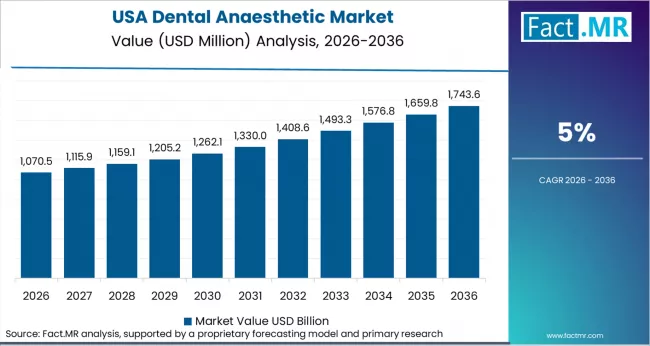
Dental Anaesthetic Market Country Value Analysis | Source: Fact.MR
North America is the highest revenue region due to premium pricing, strong dental service organisation consolidation, and growing use of advanced injection technologies. Dentsply Sirona and Septodont lead the market through large distributor networks and DSO supply contracts.
- United States: Demand for dental anaesthetics in the United States is projected to grow at around 5.0% CAGR through 2036. Consolidation of dental service organisations is centralising procurement decisions and increasing competition for multi-year supply contracts. Expansion of Medicaid dental benefits and adoption of computer controlled injection systems are also supporting higher per procedure anaesthetic spending.
FACT.MR's North American analysis of the dental anaesthetic market covers the United States and Canada. Readers can find DSO procurement trends, Medicaid dental coverage expansion data, advanced delivery system adoption benchmarks, and country growth projections.
Latin America Dental Anaesthetic Market Analysis
Latin America is an emerging market driven by expanding public oral health programmes, increasing dental practitioner numbers, and rising private dental insurance coverage.
- Brazil: Demand for dental anaesthetics in Brazil is expected to grow at approximately 5.8% CAGR through 2036. Government oral health programmes are expanding dental services across public health units. Brazil’s large dentist population and growing private clinic networks are generating strong anaesthetic cartridge procurement across both public and private healthcare settings.
FACT.MR's Latin American analysis of the dental anaesthetic market covers Brazil, Mexico, Colombia, and Rest of Latin America. Readers can find oral health programme procurement data, dentist registration statistics, insurance coverage trends, and country growth forecasts.
Competitive Aligners for Market Players
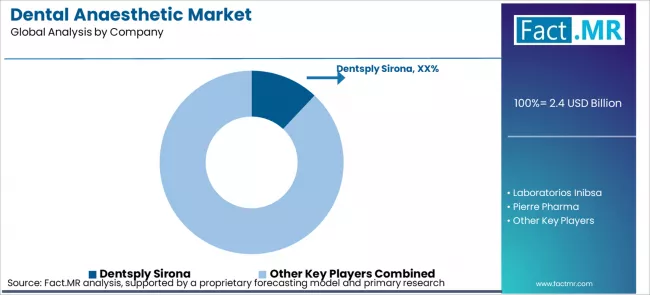
Dental Anaesthetic Market Analysis By Company | Source: Fact.MR
The global dental anaesthetic market is moderately concentrated, with a few specialised manufacturers controlling a large share of branded cartridge sales. Companies such as Septodont, Dentsply Sirona, and Laboratorios Inibsa together account for roughly 55-60% of branded dental anaesthetic revenue across major regions. Their competitive strength comes from broad formulation portfolios, strong regulatory approvals across multiple markets, and well-established dental distributor networks. In North America, inclusion in dental service organisation formularies is especially important, as DSOs manage procurement across large clinic networks.
Production structure also influences competitiveness. Manufacturers that operate vertically integrated pharmaceutical facilities, covering active ingredient production through sterile cartridge filling, benefit from better supply reliability and cost control. Septodont’s manufacturing base in France and Laboratorios Inibsa’s production infrastructure in Spain illustrate this integrated approach. Dentsply Sirona holds an additional advantage through its combined dental equipment and consumables portfolio, allowing the company to bundle anaesthetic cartridges with computer-controlled injection systems and other dental devices.
At the clinic level, purchasing behaviour often reflects practitioner familiarity. Dentists typically continue using the anaesthetic formulations they trained with unless clinical guidelines or significant price differences encourage switching.
Recent Developments
- In January 2025, Septodont and Premier Dental launched BufferPro, a single-use sterile sodium bicarbonate capsule designed to buffer dental anaesthetic cartridges before injection. The product helps reduce injection discomfort and improve patient experience during local anaesthesia procedures in dental clinics.
- In September 2025, Dentsply Sirona introduced an expanded AI-enabled digital dentistry workflow integrated with anesthesia management features within its CEREC platform to improve treatment precision and patient comfort during dental procedures.
Key Players
- Dentsply Sirona
- Laboratorios Inibsa
- Pierre Pharma
- Septodont
- Laboratorios Normon
- Primex Pharmaceuticals
- Aspen Group
- Dentalhitec
- Zeyco
Bibliography
- [1] Dentsply Sirona Inc. 2024. Q3 2024 Earnings Call Transcript: Consumables Division Performance and Dental Anaesthetic Product Portfolio Commentary. Dentsply Sirona Investor Relations, October 2024. dentsplysirona.com
- [2] World Health Organization. 2025. Global Oral Health Action Plan 2023-2030: Country Implementation Guidelines Update Including Local Anaesthetic Access as Primary Care Quality Indicator. WHO Oral Health Programme, January 2025. who.int
- [3] National Health Commission, People's Republic of China. 2024. Healthy China Oral Health Action Plan 2019-2025 Updated Implementation Report: County Hospital Dental Department Equipment Upgrade Programme. NHC Publications, June 2024. nhc.gov.cn
- [4] American Dental Association Health Policy Institute. 2024. Dental Practice Survey 2024: DSO Market Share, E-Commerce Procurement Growth, and Anaesthetic Formulation Preference Trends. ADA HPI Publications, November 2024. ada.org
- [5] Septodont SAS. 2025. Corporate Announcement: Articaine 4% Market Registration Expansion in Asia Pacific and Long-Duration Bupivacaine Product Demand Commentary. Septodont Corporate Communications, January 2025. septodont.com
- [6] Laboratorios Inibsa S.A. 2024. Product Launch Press Release: InibsaCaine Mepivacaine 3% Polymer Cartridge Format for Vasoconstrictor-Sensitive Patient Segments in European Dental Markets. Inibsa Corporate Communications, August 2024. inibsa.com
- [7] European Association for Osseointegration. 2024. Annual Congress Proceedings 2024: Dental Local Anaesthetic Formulation Preference Survey - Articaine Surpasses Lidocaine in Germany and Netherlands. EAO Publications, October 2024. eao.org
- [8] Milestone Scientific Inc. 2025. Q1 FY2025 Earnings Release: STA Single Tooth Anaesthesia System Sales Record and DSO Adoption Commentary. Milestone Scientific Investor Relations, February 2025. milestonescientific.com
- [9] American Dental Education Association. 2024. Curriculum Standards Update 2024: Mandatory Competency Requirements for Inferior Alveolar Nerve Block and Local Anaesthetic Administration. ADEA Publications, September 2024. adea.org
This Report Addresses
- Insights on DSO anaesthetic procurement in North America, articaine guideline adoption in Germany, NHS dental recovery funding in the UK, and oral health programme procurement in China, India, and Brazil.
- Market valued at USD 2.4 billion in 2026 and projected to reach USD 3.9 billion by 2036 at a 5.2% CAGR, segmented by product type, administration mode, duration, channel, and region.
- Opportunities in articaine expansion in Asia Pacific, computer-controlled delivery systems, DSO supply contracts, paediatric formulations, and government tenders in Brazil, India, and China.
- Country CAGR outlook including China (7.5%), India (6.9%), Germany (6.2%), Brazil (5.8%), United States (5.0%), and United Kingdom (4.8%).
- Competitive analysis of Septodont, Dentsply Sirona, Laboratorios Inibsa, Pierre Pharma, Laboratorios Normon, Primex Pharmaceuticals, and Aspen Group.
- Technology trends including articaine adoption, CCLAD-compatible cartridges, polymer cartridges, paediatric dosing updates, needle-free delivery systems, and vasoconstrictor-free formulations.
- Regulatory analysis covering WHO oral health plan implementation, EMA paediatric guidance, FDA articaine approvals, China NMPA registration updates, India Schedule H1 rules, and NHS procurement frameworks.
- Report delivered in Excel datasets, PowerPoint summary, and detailed PDF supported by WHO data, manufacturer disclosures, dental association statistics, regulatory databases, and industry interviews.
Segmentation
Scope of Report
| Items | Values |
|---|---|
| Quantitative Units | USD 2.4 billion (2026) to USD 3.9 billion (2036), at a CAGR of 5.2% |
| Market Definition | Dental anaesthetics are injectable amide-type local anaesthetic agents including lidocaine, articaine, mepivacaine, prilocaine, and bupivacaine, supplied in dental cartridges for administration via conventional syringe, computer-controlled delivery, or needle-free systems across restorative, periodontal, endodontic, surgical, and implantology procedures. |
| Product Type Segmentation | Lidocaine (31%), Mepivacaine, Prilocaine, Bupivacaine 0.5% with Epinephrine 1:200,000, Articaine |
| Mode of Administration | Local Infiltration (38%), Maxillary Anaesthesia, Supraperiosteal Injection, Intraseptal Injection, Periodontal Ligament Injection, Field Block, Periapical Injection, Nerve Block, Mandibular Anaesthesia, IAN, Akinosi, Gow-Gates, Tissue or Skin, Others |
| Duration of Action | Medium (52%), Short, Long |
| Distribution Channel | Clinics, Hospital Clinics, Pharmacies and Drug Stores, E-Commerce, Other |
| Application Coverage | Routine dental restorative procedures, crown and bridge preparation, periodontal scaling and root planing, tooth extraction and oral surgery, endodontic root canal treatment, dental implant placement, paediatric dental procedures, and oral surgery in hospital dental departments. |
| Regions Covered | Asia Pacific, Europe, North America, Latin America, Middle East and Africa |
| Countries Covered | United States, China, India, Germany, United Kingdom, Brazil, Japan, South Korea, Canada, France, Italy, Spain, ASEAN, Australia & New Zealand, Rest of regions |
| Key Companies Profiled | Dentsply Sirona, Laboratorios Inibsa, Pierre Pharma, Septodont, Laboratorios Normon, Primex Pharmaceuticals, Aspen Group, Dentalhitec, Zeyco |
| Forecast Period | 2026 to 2036 |
| Approach | A hybrid top-down and bottom-up model was used. Top-down inputs included national dental procedure volumes, dentist practitioner registration data, dental school graduate output, and national oral health programme procurement budgets. Bottom-up inputs covered average cartridge selling prices by product type and channel, formulation mix shift assumptions, CCLAD device adoption rates, and DSO formulary dynamics from primary research interviews with dental procurement managers and pharmaceutical distributors. |
Source: Fact.MR analysis. Updated Mar 10, 2026
Dental Anaesthetic Market by Segments
Product Type:
- Lidocaine
- Mepivacaine
- Prilocaine
- Bupivacaine 0.5% with Epinephrine 1:200,000
- Articaine
Mode of Administration:
- Local Infiltration
- Maxillary Anaesthesia
- Supraperiosteal Injection
- Intraseptal Injection
- Periodontal Ligament Injection
- Field Block
- Periapical Injection
- Nerve Block
- Posterior Superior Alveolar
- Middle Superior Alveolar
- Anterior Superior Alveolar
- Mandibular Anaesthesia
- Nerve Block
- IAN
- Akinosi
- Gow-Gates
- Tissue or Skin
- Others
Duration of Action:
- Medium
- Short
- Long
Distribution Channel:
- Clinics
- Hospital Clinics
- Pharmacies and Drug Stores
- E-Commerce
- Other
Region:
- North America
- USA
- Canada
- Mexico
- Latin America
- Brazil
- Chile
- Rest of Latin America
- Western Europe
- Germany
- UK
- Italy
- Spain
- France
- Nordic
- BENELUX
- Rest of Western Europe
- Eastern Europe
- Russia
- Poland
- Rest of Eastern Europe
- East Asia
- China
- Japan
- South Korea
- South Asia and Pacific
- India
- ASEAN
- Australia & New Zealand
- Rest of South Asia and Pacific
- Middle East & Africa
- Kingdom of Saudi Arabia
- Other GCC Countries
- Turkiye
- South Africa
- Rest of Middle East & Africa
Frequently Asked Questions
How large is the dental anaesthetic market in 2025?
What will the market size be in 2026?
What is the projected market size by 2036?
What is the expected CAGR for the forecast period 2026 to 2036?
Which product type segment holds the leading share?
Which mode of administration dominates the market?
Which country is projected to grow the fastest?
What is the expected growth rate for India?
What is the forecast CAGR for Germany's dental anaesthetic market?
How is the dental anaesthetic market in the United States expected to grow?
Who worked on this report


Preview the report firsthand - request a free sample
Free SampleGet the brochure for pricing and purchase details
Download PDF