- Market Value (2025): USD 2.81 Bn
- Estimated Value (2026): USD 2.97 Bn
- Forecast Value (2036): USD 5.17 Bn
- CAGR (2026-2036): 5.7%
What is the Die Cut Stickers Market forecast to be worth by 2036?
USD 3.0 billion in 2026 to USD 5.2 billion by 2036, at a 5.70% CAGR.
- As per Fact.MR analysis, the die cut stickers market reached USD 2.81 billion in 2025.
- Demand will increase from USD 2.97 billion in 2026 to USD 5.17 billion in 2036.
- The market is forecast to record a 5.7% CAGR during 2026 to 2036 as e-commerce direct-to-consumer packaging, craft consumer branding, and short-run on-demand digital printing accelerate sticker procurement.
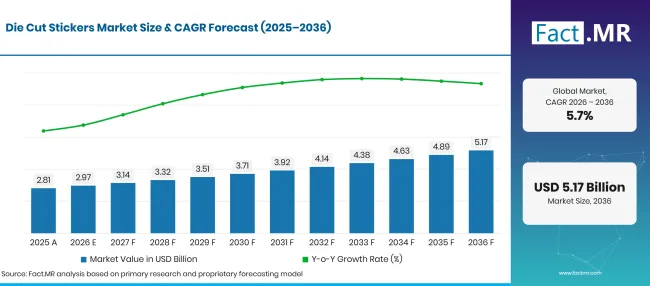
Factmr Die Cut Stickers Market Forecast Global | Source: Fact.MR
| Year | Basis | Market Value (USD billion) |
|---|---|---|
| 2025 | Actual | 2.81 |
| 2026 | Estimate | 2.97 |
| 2036 | Forecast | 5.17 |
| CAGR 2026 to 2036 | Forecast period | 5.7% |
Source: Fact.MR analysis. Updated Oct 19, 2026
What are the defining numbers behind Die Cut Stickers Market growth?
USD 2.2 billion absolute chance between 2026 and 2036, with vinyl face stocks and digital inkjet printing technologies driving the highest order velocity.
- Demand Drivers in the Market
- Direct-to-consumer lifestyle brands and craft food producers are incorporating custom-shaped die cut stickers inside shipping cartons to foster customer loyalty and unboxing engagement. Photochemical curing trials demonstrated that UV-cured acrylic pressure-sensitive adhesive formulations deposited on polymeric films exhibit exceptional shear resistance and peel adhesion across diverse low-surface-energy substrates [1]. Brand owners commission vibrant die cut stickers that recipients proudly affix to laptop lids, insulated beverage tumblers, and skateboards.
- Packaging sustainability mandates are pushing adhesive converters to formulate bio-derived, cleanly removable pressure-sensitive adhesives that do not contaminate post-consumer recycling streams. Synthesis evaluations of bio-based acrylic adhesives derived from plant fatty acids confirmed that eco-friendly tackifiers achieve equivalent holding power to petroleum elastomers while enabling clean wash-off during PET flake recycling [2]. Label converters partner with sustainable paper mills to offer FSC-certified kraft paper face stocks.
- Industrial equipment builders and electronics assemblers require ultra-durable vinyl and polypropylene stickers that resist outdoor weathering, abrasion, and solvent exposure. Polymer debonding research demonstrated that cleanly removable bio-based adhesive layers maintain high cohesive strength without leaving adhesive residue across flexible polymer substrates [3]. Manufacturing engineers specify laminated die cut warning decals and asset barcode tags capable of enduring persistent UV sunlight and mechanical washdowns.
- Promotional marketing agencies and independent creative artists leverage automated web-to-print digital platforms to execute on-demand, short-run sticker orders with zero tooling setup fees. Advanced adhesion studies revealed that stimulus-responsive liquid crystal elastomers can achieve switchable tack, paving the way for next-generation smart peelable label systems [4]. Online print portals offer instant digital proofing and vector cut-line generation, enabling creators to monetize sticker art collections within hours.
- Key Segments Analyzed
- By Material Type: Vinyl holds 32.4% share in 2026, preferred across automotive, outdoor gear, and beverage container applications for its exceptional waterproof durability and scratch-resistant lamination.
- By Printing Technology: Digital Printing accounts for 41.2% share in 2026, dominating commercial print fulfillment through rapid turnaround, zero die plate costs, and high-resolution multi-color reproduction.
- By Application: Packaging represents 35.6% share in 2026 as artisan food packagers, cosmetic brands, and e-commerce fulfillment hubs seal boxes and pouches with custom-contoured sticker seals.
- By End-User: Retail accounts for 28.5% share in 2026, supported by boutique apparel branding, artisan craft merchandising, and point-of-sale customer giveaway promotions.
- By Distribution Channel: Online Stores represents 64.3% share in 2026, driven by automated web-to-print portals, cloud-based design editors, and direct parcel delivery fulfillment.
- Analyst Opinion at Fact.MR
- Shambhu Nath Jha, Lead Consultant at Fact.MR, states, “The commercial die cut stickers sector has transitioned from an artisan promotional craft into an automated, high-precision web-to-print manufacturing vertical. Cloud-based vector contouring software integrated with digital UV-curable inkjet presses and laser cutting lines enables print factories to process thousands of unique custom shapes per hour. Converters that adopt recyclable face stocks, linerless formats, and certified compostable adhesives will capture superior margins as corporate packaging sustainability standards tighten.”
- Strategic Implications
- Label converters are investing in digital high-speed laser finishing systems and optical camera-guided flatbed cutters to bypass physical steel-rule die tooling. Surface property evaluations conducted by the National Institute of Standards and Technology using two-dimensional inverse gas chromatography confirmed that accurate surface energy characterization is critical to optimizing adhesive wetting and bond durability across thin polymer films [5].
- Digital print service providers are installing roll-to-roll UV-LED inkjet presses equipped with white and metallic ink channels, allowing intricate opaque graphics on transparent and holographic face stocks. Print managers evaluate certified face stock films to ensure consistent ink anchorage.
- Packaging developers are replacing traditional plastic tape seals with custom-shaped die cut stickers to communicate premium artisan provenance. Packaging engineers routinely benchmark peelable resealable films to improve consumer convenience across food pouches.
- Online printing platforms are deploying automated AI preflight software to identify vector cutline errors, bleed issues, and low-resolution artwork automatically, minimizing production reprints.
Germany is projected to lead European growth at a 6.67% CAGR, while Brazil advances at 6.09%, fueled by thriving artisan consumer brands and expanding domestic e-commerce packaging. The United States records a 5.51% CAGR, sustained by massive web-to-print e-commerce order volumes and corporate promotional merchandising. The United Kingdom achieves a 4.93% CAGR, supported by boutique craft beverage labeling and vibrant creative creator economies. Japan registers a 4.35% CAGR, driven by character merchandise culture, collectible stationery stickers, and precision printing technologies.
How does the Die Cut Stickers Market break down by segment?
Vinyl 32.4%; Digital Printing 41.2%; Packaging 35.6%; Retail 28.5%; Online Stores 64.3% in 2026.
Which Material Type dominates?
Vinyl holds 32.4% share in 2026.
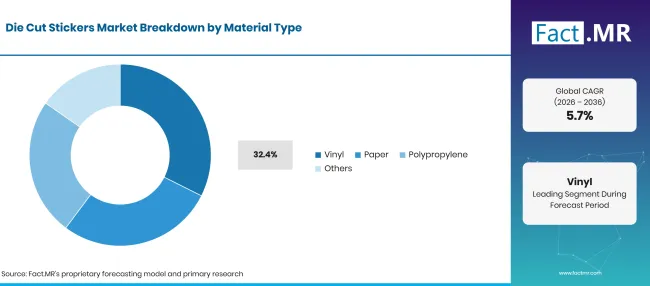
Factmr Die Cut Stickers Market Breakdown Material Type | Source: Fact.MR
| Material Type | Share (2026) |
|---|---|
| Vinyl (Leading segment) | 32.4% |
| Other segments combined | 67.6%* |
| Total | 100.0% |
Source: Fact.MR analysis. Updated Oct 19, 2026
Vinyl face stocks command the leading market share due to their superior outdoor weatherability, tear resistance, and conformability over curved surfaces. Calendered and cast PVC vinyl films withstand persistent UV radiation, automotive car washes, and temperature extremes without fading or edge peeling. Paper face stocks represent an economical and eco-friendly choice for dry indoor packaging, promotional box seals, and boutique craft jars. Polypropylene (BOPP) films capture significant volume in beverage and cosmetics labeling due to their moisture resistance and ultra-clear transparent backing. Converters also supply specialty holographic films, glitter laminates, and brushed metallic substrates. Retailers install modern electronic shelf label systems alongside sticker branding displays. Food packagers also utilize shelf stable packaging formats that demand strong sticker seal integrity.
What leads the Printing Technology segment?
Digital Printing accounts for 41.2% share in 2026.
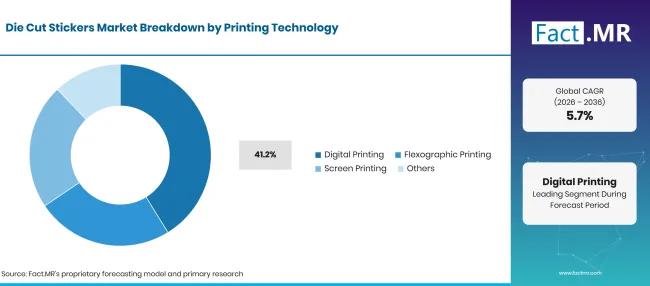
Factmr Die Cut Stickers Market Breakdown Printing Technology | Source: Fact.MR
| Printing Technology | Share (2026) |
|---|---|
| Digital Printing (Leading segment) | 41.2% |
| Other segments combined | 58.8%* |
| Total | 100.0% |
Source: Fact.MR analysis. Updated Oct 19, 2026
Digital inkjet printing represents the dominant and fastest-growing production method, driven by its ability to execute variable data, multi-color designs, and complex vector contours with zero upfront plate costs. Modern roll-fed UV and eco-solvent digital presses achieve photographic print resolutions exceeding 1200 DPI, reproducing fine linework and rich color gradients. Flexographic printing remains indispensable for multi-million-unit high-speed production runs where cost per square foot is critical. Screen printing continues to serve specialty outdoor applications requiring thick, opaque ink laydowns and extreme lightfastness. Converters heavily procure specialized pressure sensitive adhesives to match diverse substrate energies. Logistics operators consume massive quantities of adhesive tapes alongside branded die cut stickers.
How does Application shape demand?
Packaging represents 35.6% share in 2026.
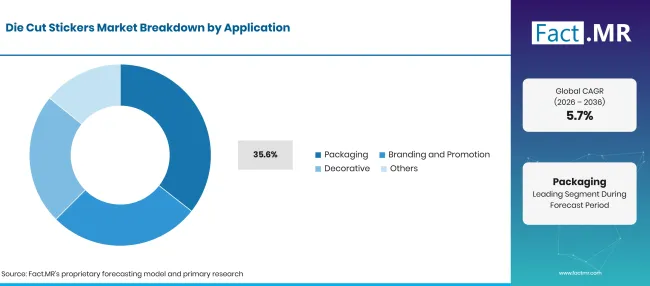
Factmr Die Cut Stickers Market Breakdown Application | Source: Fact.MR
| Application | Share (2026) |
|---|---|
| Packaging (Leading segment) | 35.6% |
| Other segments combined | 64.4%* |
| Total | 100.0% |
Source: Fact.MR analysis. Updated Oct 19, 2026
Packaging applications represent the primary commercial outlet for die cut stickers, propelled by the worldwide explosion in e-commerce home delivery boxes, subscription retail boxes, and artisan food containers. Brands utilize custom-shaped stickers as outer shipping box seals, inner tissue paper closures, and product container labels that communicate authenticity and artisanal care. Branding and promotional giveaways represent the second-largest sector, as software startups, music bands, and athletic brands distribute collectible stickers to build community. Decorative applications encompass personal consumer customization of laptops, water bottles, and automotive bumpers. Sourcing teams procure premium office printing papers for administrative operations. Converters also invest in advanced pp film blowing machine infrastructure to extrude in-house film stocks.
What is accelerating Die Cut Stickers Market adoption, and what is holding it back?
Proliferation of direct-to-consumer e-commerce brands, creator economy merchandising, and web-to-print automated fulfillment drive rapid market expansion. Plastic release liner landfill waste concerns, raw material price fluctuations for vinyl and acrylic monomers, and quality defects from poor digital cutting alignment impede operational margins.
Drivers Impact Analysis
| DRIVER | (~) % IMPACT ON CAGR | GEOGRAPHIC RELEVANCE | IMPACT TIMELINE |
|---|---|---|---|
| Direct-to-consumer brand unboxing packaging and custom carton seals | +1.2% | North America, Europe | Short term (<= 2 years) |
| Growth of creator economy merchandising and online artist marketplaces | +1.1% | Global | Short term (<= 2 years) |
| Web-to-print automation enabling instant cutline generation and proofing | +0.9% | Global | Medium term (2–4 years) |
| UV-curable inkjet advances eliminating plate setup fees for micro-orders | +0.8% | North America, East Asia | Medium term (2–4 years) |
| Durable weatherproof vinyl adoption on outdoor equipment and gear | +0.6% | Europe, North America | Long term (>= 4 years) |
Source: Fact.MR analysis. Updated Oct 19, 2026
Opportunity Impact Analysis
| OPPORTUNITY | (~) % IMPACT ON CAGR | GEOGRAPHIC RELEVANCE | IMPACT TIMELINE |
|---|---|---|---|
| Certified compostable paper stickers and bio-derived acrylic adhesives | +1.1% | Western Europe, USA | Short term (<= 2 years) |
| Digital laser contour cutting systems eliminating mechanical die wear | +0.9% | North America, Europe | Medium term (2–4 years) |
| Tamper-evident holographic destructible security vinyl labels | +0.7% | Global | Medium term (2–4 years) |
| Linerless die cut sticker formats reducing silicone backing paper waste | +0.5% | Europe, Japan | Long term (>= 4 years) |
Source: Fact.MR analysis. Updated Oct 19, 2026
Restraints Impact Analysis
| RESTRAINT | (~) % IMPACT ON CAGR | GEOGRAPHIC RELEVANCE | IMPACT TIMELINE |
|---|---|---|---|
| High silicone release liner waste and disposal regulatory costs | -0.9% | Western Europe, USA | Short term (<= 2 years) |
| PVC vinyl environmental restrictions pushing transition to polyolefins | -0.7% | Europe, North America | Short term (<= 2 years) |
| Raw material price volatility for petrochemical acrylic tackifiers | -0.6% | Global | Medium term (2–4 years) |
| High competitive price discounting across commoditized online print portals | -0.4% | North America, Europe | Long term (>= 4 years) |
Source: Fact.MR analysis. Updated Oct 19, 2026
Which countries are scaling the Die Cut Stickers Market through 2036?
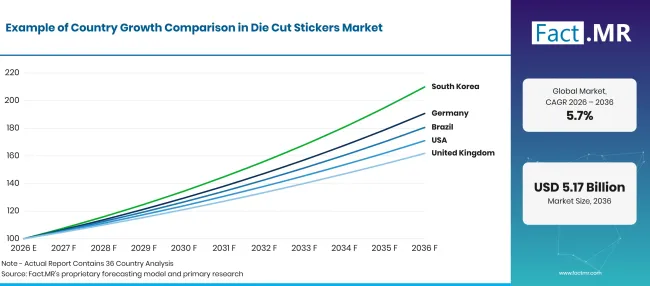
Factmr Die Cut Stickers Market Growth Index | Source: Fact.MR
| Country | CAGR (2026–2036) |
|---|---|
| Germany | 6.67% |
| Brazil | 6.09% |
| USA | 5.51% |
| UK | 4.93% |
| Japan | 4.35% |
Source: Fact.MR analysis. Updated Oct 19, 2026
Why is Germany leading European digital sticker expansion?
6.67% CAGR, driven by advanced digital printing automation, strict packaging sustainability mandates, and expanding craft consumer brand ecosystems.
German print converters and commercial packaging providers across North Rhine-Westphalia and Bavaria are aggressively investing in automated digital finishing and laser cutting workflows to deliver same-day custom sticker fulfillment. German consumer goods companies incorporate FSC-certified paper die cut stickers and solvent-free acrylic adhesives to comply with the national Packaging Act (VerpackG) and circular economy guidelines. Expanding German microbreweries, specialty roasters, and organic cosmetics producers utilize contoured stickers to establish distinct shelf appeal.
How is Brazil expanding its commercial printing adoption?
6.09% CAGR, propelled by e-commerce direct-to-consumer boom, vibrant small business entrepreneurship, and expanding domestic printing hubs.
Brazil's e-commerce sector in São Paulo and Rio de Janeiro is driving unprecedented demand for custom-shaped die cut stickers used as decorative seals for fashion apparel boxes and online food delivery bags. Brazilian micro-enterprises and independent craft entrepreneurs procure small-batch custom stickers through local digital printing hubs to brand artisanal cosmetics, packaged snacks, and homemade beverages. Domestic print service providers invest in versatile wide-format solvent and UV printers to offer cost-effective contour cutting across affordable vinyl and paper stocks.
What factors sustain massive volume procurement across the United States?
5.51% CAGR, supported by massive web-to-print e-commerce infrastructure, corporate promotional branding, and independent creator merchandise.
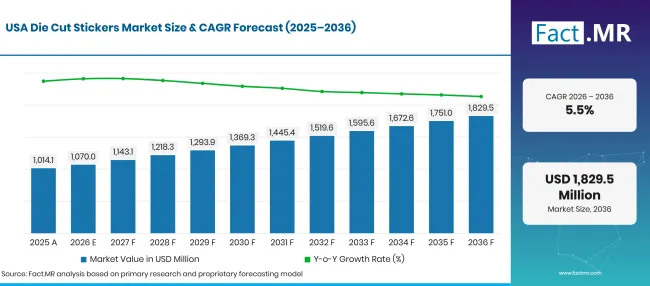
Factmr Die Cut Stickers Market Forecast Usa | Source: Fact.MR
The United States represents the largest commercial consumer of die cut stickers globally, anchored by leading web-to-print platforms that fulfill millions of custom orders weekly. American lifestyle brands, tech corporations, university athletics, and independent creators distribute die cut vinyl stickers as high-retention marketing assets. Sourcing managers across California, Texas, and New York procure heavy-duty weatherproof vinyl stickers for sports equipment, commercial vehicles, and outdoor architectural labeling. American print factories continuously automate warehouse dispatch through integrated robotic sorting and parcel packaging systems.
Why does the United Kingdom maintain active creator and craft demand?
4.93% CAGR, backed by artisan craft beverage labeling, vibrant music and street fashion culture, and boutique retail branding.
British craft breweries, specialty gin distilleries, and boutique cosmetic artisans in London, Manchester, and Bristol depend on custom die cut stickers to impart premium tactile luxury onto glass bottles and metal tins. UK independent graphic artists and fashion labels merchandise custom vinyl stickers through online social commerce platforms, driving steady reorders of collectible designs. British print converters prioritize water-based inks and recycled kraft release liners to satisfy eco-conscious consumers.
How does Japan sustain its leadership in precision sticker printing?
4.35% CAGR, steered by character pop-culture licensing, collectible stationery sticker culture, and ultra-high-definition printing technology.
Japan maintains a globally renowned stationery and character merchandising ecosystem, where precision die cut stickers representing iconic anime, manga, and corporate mascots generate billions in retail sales. Japanese printing houses in Tokyo and Osaka utilize ultra-fine resolution digital presses and micro-slitting dies to achieve flawless kiss cuts across miniature, intricate sticker geometries. Japanese packaging designers also utilize clean-peel removable stickers for luxury department store confectionery gift boxes and cosmetics packaging.
Who leads the Die Cut Stickers Market?
Sticker Mule holds a prominent global market share, operating massive automated digital printing and laser finishing facilities that offer high-speed custom sticker printing, proofing, and worldwide distribution. StickerYou delivers highly customizable web-to-print platforms enabling consumers and small businesses to order die cut stickers in any shape, size, and quantity. Vistaprint (Cimpress plc) leverages global scale to supply cost-effective promotional stickers, roll labels, and marketing collateral to millions of micro-businesses.
Moo Inc. and UPrinting provide premium design-forward sticker solutions, utilizing luxury paper stocks, metallic foil finishes, and durable vinyl coatings. StickerGiant and Jakprints specialize in high-capacity custom sticker manufacturing and bulk label printing for craft beverage, food packaging, and corporate promotional clients. Sticker Robot is celebrated for ultra-thick silkscreen vinyl sticker printing with extreme outdoor longevity. Redbubble and Zazzle operate global creator marketplaces that produce print-on-demand die cut stickers on behalf of independent digital artists. Food processors also evaluate microwaveable liquid food packaging solutions where heat-resistant sticker seals are required. Wholesalers regularly utilize club store packaging tray units to showcase sticker assortments in retail bulk stores.
Which companies are the key providers?
Key companies include Sticker Mule; StickerYou; Vistaprint; Moo Inc.; UPrinting; StickerGiant; Jakprints; Sticker Robot; Redbubble; and Zazzle.
- Sticker Mule
- StickerYou
- Vistaprint
- Moo Inc.
- UPrinting
- StickerGiant
- Jakprints
- Sticker Robot
- Redbubble
- Zazzle
Bibliography
- [1] PMC. (2024, November 18). UV-cured acrylic pressure-sensitive adhesives on polymer films: Adhesion kinetics and surface properties. PMC11598192.
- [2] PMC. (2024, December 04). Synthesis and performance of biobased acrylic pressure-sensitive adhesives derived from renewable fatty acids. PMC12461341.
- [3] PMC. (2025, May 20). Cleanly removable biobased adhesives for flexible packaging and labeling substrates. PMC12306394.
- [4] PMC. (2025, October 12). Switchable pressure-sensitive adhesion in liquid crystal elastomer networks for smart label systems. PMC12659420.
- [5] National Institute of Standards and Technology. (2024, June 14). Surface properties and adhesion phenomena in polymer thin films via two-dimensional inverse gas chromatography.
This Report Answers
- The report evaluates production turnaround economics across digital inkjet and flexographic die cutting systems.
- Application assessments detail why e-commerce packaging seals and brand promotion represent the highest-margin print sectors.
- Country-level analysis investigates the web-to-print adoption and packaging sustainability regulations enabling Germany and Brazil to lead regional growth.
- Material evaluations compare the outdoor weatherability, tear strength, and recyclability of vinyl versus bio-based paper face stocks.
- Competitive profiling benchmarks automated vector cutline software, printing press capacities, and parcel fulfillment infrastructure across top web-to-print platforms.
What does the Die Cut Stickers Market cover?
The market encompasses commercial shipments of custom-shaped pressure-sensitive adhesive stickers and decals cut through the face stock, adhesive, and backing liner along tailored vector outlines. It tracks products deployed across direct-to-consumer e-commerce packages, craft food and beverage containers, retail product packaging, corporate promotional giveaways, and consumer personal items. The analysis evaluates revenue generation across automated online web-to-print storefronts and traditional commercial printing networks.
What is included in the scope?
The scope covers merchant shipments of custom individually cut stickers, promotional sticker sheets, and kiss-cut decals sold to businesses, institutions, and individual consumers. Revenues reflect transaction pricing recognized by digital print converters, specialty label manufacturers, and online web-to-print platforms. UV-protective surface laminates, specialty holographic finishes, and custom adhesive formulations are fully evaluated within the market revenue boundaries.
What is excluded from the scope?
The scope excludes standard un-contoured rectangular roll labels, plain barcode logistics stickers, and thermal receipt paper. Industrial packaging stretch films, corrugated cardboard boxes, and raw unprinted adhesive tape rolls are excluded from die cut sticker totals. Digital printing presses, mechanical rotary die cutters, and wide-format cutting plotters are outside the scope of this printed product report.
How Was the Analysis Built?
The analysis draws on 120+ sources, 35+ company portfolios, 25+ countries, and more than 20 industry interviews.
- Primary Research: Primary research includes discussions with manufacturers, service providers, technology developers, distributors, end users, and subject-matter experts. These conversations examine purchasing priorities, product adoption, operational challenges, approval requirements, competitive positioning, and the factors that influence wider market acceptance.
- Desk Research: Desk research covers government statistics, regulatory publications, company filings, trade data, technical studies, industry associations, standards, public policy, and other authoritative sources. Every source used in the analysis is documented in the bibliography.
- Market Sizing and Forecasting: Market estimates combine historical performance, demand indicators, pricing and volume trends, segment shares, company participation, country-level growth, adoption patterns, investment activity, and barriers to market expansion.
- Data Validation and Update Cycle: Findings are validated by comparing primary interviews with public data, company activity, regulatory changes, trade patterns, and industry developments. Regular updates review new product launches, capacity changes, partnerships, approvals, and shifts in commercial adoption.
Segmentation
What is the report’s scope and coverage?
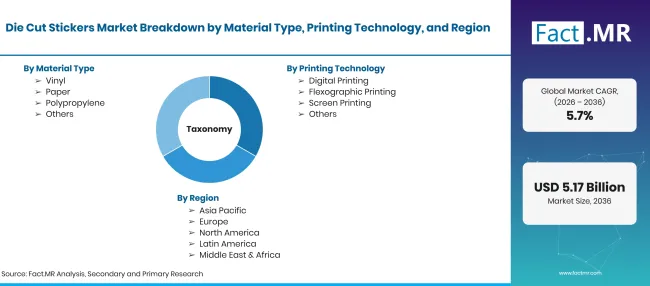
Factmr Die Cut Stickers Market Taxonomy | Source: Fact.MR
| Attribute | Details |
|---|---|
| Quantitative Units | USD billion in 2026 to USD billion by 2036 at 5.70% CAGR |
| Market Definition | Pressure-sensitive adhesive labels and decals precisely cut through both face stock and release liner backing along custom vector contours for packaging, branding, and decorative applications. |
| Material Type | Vinyl; Paper; Polypropylene; Others |
| Printing Technology | Digital Printing; Flexographic Printing; Screen Printing; Others |
| Application | Packaging; Branding and Promotion; Decorative; Others |
| End-User | Retail; Food and Beverage; Automotive; Electronics; Others |
| Distribution Channel | Online Stores; Offline Stores |
| Regions Covered | North America; Latin America; Western Europe; Eastern Europe; East Asia; South Asia & Pacific; Middle East & Africa |
| Countries Covered | Germany; Brazil; USA; UK; Japan |
| Companies Profiled | Sticker Mule; StickerYou; Vistaprint; Moo Inc.; UPrinting; StickerGiant; Jakprints; Sticker Robot; Redbubble; Zazzle |
| Forecast Period | 2026 to 2036 |
| Approach | Primary interviews with digital print converters, web-to-print platform operators, adhesive chemists, and packaging procurement managers combined with global commercial printing shipment datasets |
Source: Fact.MR analysis. Updated Oct 19, 2026
How is the market segmented?
-
By Material Type
- Vinyl
- Paper
- Polypropylene
- Others
-
By Printing Technology
- Digital Printing
- Flexographic Printing
- Screen Printing
- Others
-
By Application
- Packaging
- Branding and Promotion
- Decorative
- Others
-
By End-User
- Retail
- Food and Beverage
- Automotive
- Electronics
- Others
-
By Distribution Channel
- Online Stores
- Offline Stores
-
By Region
- North America
- Latin America
- Western Europe
- Eastern Europe
- East Asia
- South Asia & Pacific
- Middle East & Africa
Frequently Asked Questions
How big is the die cut stickers market in 2026?
What is the CAGR from 2026 to 2036?
Which material type leads?
Which printing technology leads?
Which companies participate in die cut stickers?
Who worked on this report


Preview the report firsthand - request a free sample
Free SampleGet the brochure for pricing and purchase details
Download PDF