Dielectric Cooling Fluids Market Size, Share, Growth and Forecast (2026 - 2036)
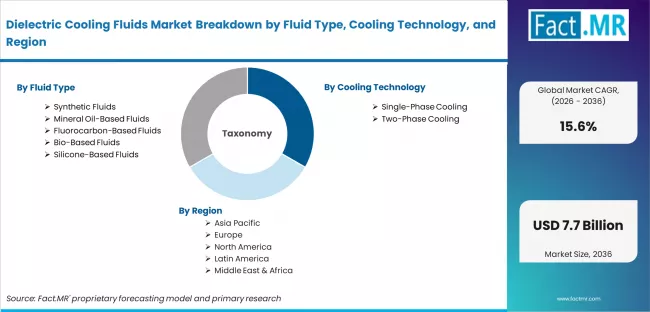
The Dielectric Cooling Fluids Market is segmented by Fluid Type, Cooling Technology, Chemical Properties, Environmental & Regulatory Compliance, End-Use Industry and Region. Forecast for 2026 to 2036.
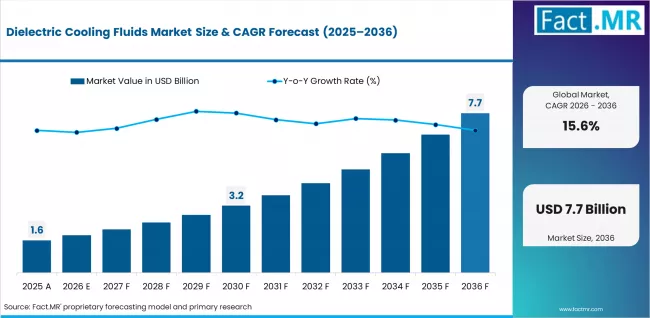
According to Fact.MR estimates, Global dielectric cooling fluids market revenue stood at USD 1.6 Bn in 2025 and is forecast to reach USD 7.7 Bn by 2036. At a 15.6% CAGR from 2026 to 2036
Dielectric Cooling Fluids Market Overview, Growth Outlook, and Forecast by Fact.MR
- Global dielectric cooling fluids market revenue stood at USD 1.6 Bn in 2025 and is forecast to reach USD 7.7 Bn by 2036.
- At a 15.6% CAGR from 2026 to 2036, this market is set to expand ~4.3x in value, adding USD 5.9 Bn in absolute opportunity.
Summary of the Dielectric Cooling Fluids Market
- Market Snapshot
- In 2025, the global Dielectric Cooling Fluids Market was valued at approximately USD 1.6 billion.
- The market is estimated to reach USD 1.8 billion in 2026 and is projected to attain USD 7.7 billion by 2036
- Dielectric Cooling Fluids Market is likely to expand at a CAGR of 15.6% during the forecast period.
- The market is anticipated to create an absolute dollar opportunity of USD 5.9 billion between 2026 and 2036.
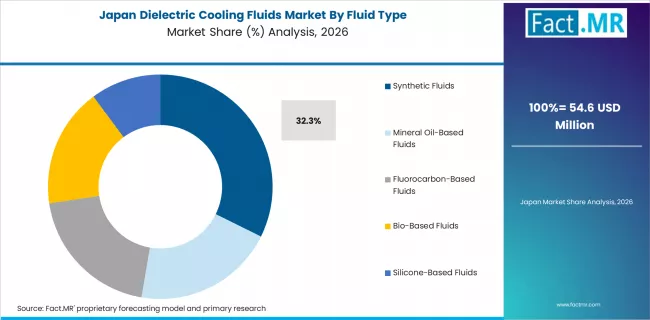
- Synthetic Fluids account for 32% of market share in 2026.
- India (17.8%) and China (18.6%) are the key growth markets during the forecast period
- Demand and Growth Drivers
- Increasing demand for energy-efficient cooling solutions in hyperscale data centers and AI infrastructure is driving adoption of dielectric cooling fluids.
- Rising power density in electronic systems and high-performance computing environments is increasing need for advanced thermal management technologies.
- Growing adoption of electric vehicles and battery cooling systems is supporting demand for dielectric fluids with high thermal stability and electrical insulation.
- Increasing focus on sustainability and regulatory compliance is encouraging development of PFAS-free and bio-based cooling fluids.
- Expansion of immersion cooling technologies is improving cooling efficiency and reducing energy consumption compared to traditional air cooling systems.
- Advancements in synthetic and fluorocarbon-based fluid technologies are enhancing performance characteristics and reliability.
- Product and Segment View
- Synthetic fluids hold 32% share of fluid type segment in 2025, driven by superior thermal performance, stability, and compatibility with advanced cooling systems.
- Fluorocarbon-based fluids account for 24% share, supported by high dielectric strength and excellent heat transfer properties.
- Mineral oil-based fluids represent 22% share, widely used in cost-sensitive industrial applications.
- Bio-based fluids contribute 12% share, reflecting increasing adoption of environmentally sustainable alternatives.
- Silicone-based fluids account for 10% share, used in specialized high-temperature applications.
- Single-phase cooling holds 68% share by cooling technology, supported by simpler system design and lower operational complexity.
- Two-phase cooling accounts for 32% share, driven by higher cooling efficiency in high-density computing environments.
- Thermal performance accounts for 30% importance among chemical properties, followed by dielectric strength (25%), fire & safety properties (25%), and viscosity level (20%).
- PFAS-free fluids hold 46% share under environmental compliance, reflecting growing regulatory restrictions on PFAS-based materials.
- PFAS-based fluids account for 28% share, while sustainability-focused fluids contribute 26% share.
- Geography and Competitive Outlook
- North America and Asia Pacific represent key markets supported by rapid expansion of data centers, electric vehicle production, and advanced manufacturing infrastructure.
- China and India are emerging as high-growth markets due to increasing investment in AI infrastructure, digital transformation, and industrial automation.
- Europe is witnessing strong growth driven by regulatory focus on sustainability and adoption of energy-efficient cooling technologies.
- Market growth is influenced by advancements in immersion cooling technologies, increasing use of PFAS-free fluids, and development of high-performance synthetic cooling solutions.
- Key companies active in this market include 3M Company, ExxonMobil Corporation, Shell plc, Dow Inc., and Engineered Fluids.
- Analyst Opinion
- Shambhu Nath Jha, Principal Consultant at Fact.MR, says, “The Dielectric Cooling Fluids Market is no longer defined solely by traditional transformer and industrial applications. Growth is increasingly driven by AI-powered data centers, rising EV thermal management needs, and the shift toward PFAS-free, high-performance fluid chemistries that enhance cooling efficiency, reduce energy consumption, and optimize lifecycle performance across advanced electronics and power systems.
PBAT Market — At a Glance
| Attribute | Details |
|---|---|
| Market Value 2025 | USD 1.6 billion |
| Market Value 2036 | USD 7.7 billion |
| Absolute Dollar Opportunity | USD 5.9 billion |
| CAGR | 15.6% |
| Growth Multiple | 4.3x |
| Key Demand Theme | Rising adoption of advanced cooling solutions for high-density electronics and data centers |
| Leading Fluid Type | Synthetic Fluids |
| Fluid Share | 32% |
| Leading Cooling Technology | Single-Phase Cooling |
| Technology Share | 68% |
| Key Environmental Trend | PFAS-free Fluids |
| Segment Share | 46% |
| Leading End-use Industry | IT & Telecom |
| Industry Share | 38% |
| Key Growth Regions | North America, Europe, Asia Pacific |
| Key Companies | 3M, ExxonMobil, Shell, Dow, Engineered Fluids |
| Segmentation by Fluid Type | Mineral Oil-Based Fluids, Synthetic Fluids, Fluorocarbon-Based Fluids, Bio-Based Fluids, Silicone-Based Fluids |
| Segmentation by Cooling Technology | Single-Phase Cooling, Two-Phase Cooling |
| Segmentation by Chemical Properties | Thermal Performance, Dielectric Strength, Viscosity Level, Fire & Safety Properties |
| Segmentation by Environmental Compliance | PFAS-Based Fluids, PFAS-Free Fluids, Sustainability Profile |
| Segmentation by End-use Industry | IT & Telecom, Automotive, Energy & Utilities, Manufacturing & Industrial, Aerospace & Defense |
| Segmentation by Region | North America, Latin America, Europe, East Asia, South Asia & Pacific, Middle East & Africa |
Key Growth Drivers, Constraints, and Opportunities
Key Factors Driving Growth
• Growing deployment of AI-powered data centers, hyperscale facilities, and dense computer systems is driving up demand for next-generation dielectric cooling fluids.
• Rising demand for effective cooling technologies for EVs and power electronics is boosting the use of dielectric fluids for efficiency enhancement and safety improvement.
• The transition towards highly performing and non-PFAS, low-energy consuming fluids is helping in broader application in advanced cooling technologies.
Key Market Constraints
• The expensive nature of advanced dielectric fluids, especially fluorocarbon and formulated fluids, restricts their adoption in price-sensitive applications.
• Lack of knowledge about immersion cooling technology is hindering their penetration in small data centers and conventional industries.
• Uncertainty regarding regulations of PFAS-containing fluids is creating barriers to the uptake of some types of dielectric fluids.
Key Opportunity Areas
• Growing investment in AI-powered infrastructure, edge computing, and digitalization will create demand opportunities for immersion cooling fluids worldwide.
• Significant room for growth remains in upgrading existing data center cooling systems through retrofitting with advanced dielectric fluids.
• Sustainability innovation in terms of bio-based and efficient fluids will help achieve a premium position in the market in the long run.
Segment-wise Analysis of the Dielectric Cooling Fluids Market
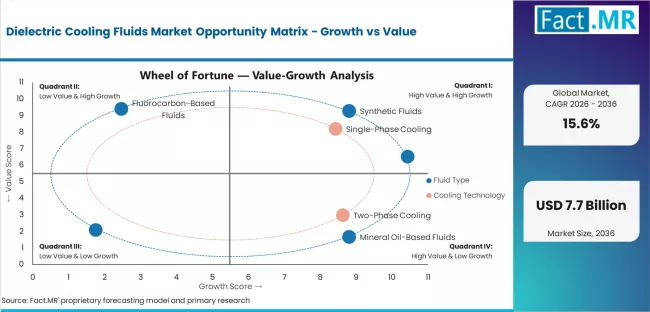
- Synthetic fluids account for 32% share of the fluid type segment in 2026, driven by their superior thermal stability, longer lifecycle, and increasing adoption in high-density data centers and advanced electronics cooling applications.
- Single-phase cooling holds 68% share of the cooling technology segment in 2026, supported by its cost-effectiveness, ease of deployment, and strong adoption across hyperscale and enterprise data centers.
- IT & Telecom dominates the end-use industry segment with 38% share in 2026, as rapid expansion of AI-driven data centers and cloud infrastructure significantly increases demand for efficient thermal management solutions.
The Dielectric Cooling Fluids Market is segmented by fluid type, cooling technology, chemical properties, environmental & regulatory compliance, end-use industry, and region. By fluid type, the market includes mineral oil-based fluids, synthetic fluids, fluorocarbon-based fluids, bio-based fluids, and silicone-based fluids. By cooling technology, it covers single-phase and two-phase cooling systems. IT & Telecom leads the end-use segment with 38% share, driven by hyperscale data center growth, while PFAS-free fluids are gaining strong traction due to regulatory pressure. Synthetic fluids and single-phase systems dominate due to their optimal balance of performance, scalability, and cost, while bio-based and advanced formulations are expected to drive future sustainable growth.
Which Fluid Type Segment Dominates the Dielectric Cooling Fluids Market?
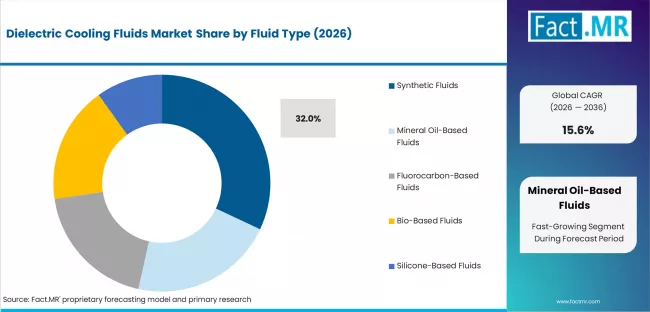
One of the leading segments based on fluid type is synthetic fluids, with a market share of 32% in 2026. The high market share is associated with the ability of these fluids to ensure excellent thermal stability, longer lifetime, and higher compatibility with electronics and immersion cooling systems. Synthetic fluids have a wide range of applications in hyperscale data centers and computing facilities powered by artificial intelligence due to high requirements to the performance stability.
Which Cooling Technology Segment Leads the Dielectric Cooling Fluids Market?
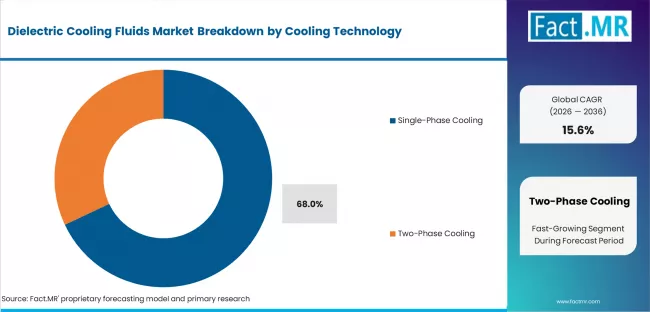
The largest segment related to cooling technology is a single-phase cooling solution, with a market share of 68% in 2026. This share can be explained by high simplicity and cost-effectiveness as well as by easier implementation compared to two-phase systems. Such types of cooling technologies are actively used in enterprise and hyperscale data centers because they do not require complicated phase change and are characterized by high efficiency and scalability.
Which Chemical Property Segment Holds the Largest Share in the Market?
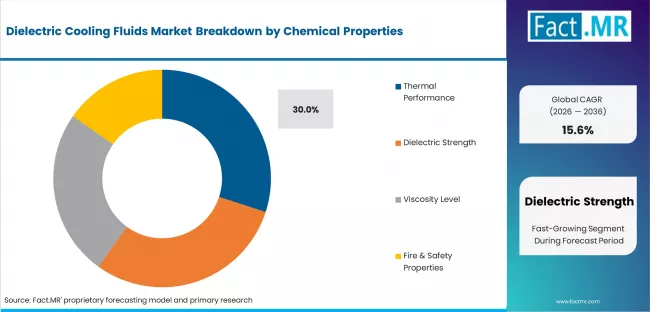
One of the dominating segments based on the chemical properties is thermal performance, with a market share of 30% in 2026. This segment will grow due to the increased importance of thermal performance in data centers and AI-powered computing facilities. Enhanced thermal performance allows reducing energy consumption and optimizing the performance of power electronics and computing systems.
Which Environmental & Regulatory Segment is Most Prominent in the Market?
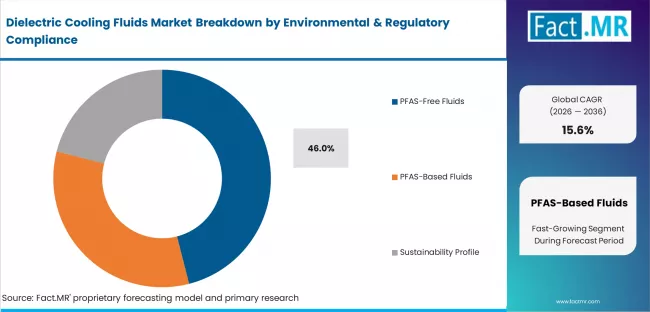
The largest market share is held by PFAS-free fluids with an estimated market share of 46% in 2026. The dominance is fueled by growing environmental awareness as well as stringent government regulations for fluorinated chemicals. PFAS-free fluids have been seeing a surge in adoption due to their environment-friendly nature that helps decrease pollution while ensuring sufficient performance. The demand for such fluids is especially high in countries with stringent regulatory policies where businesses prefer to use eco-friendly products to avoid future problems.
Which End-Use Industry Segment Dominates the Dielectric Cooling Fluids Market?
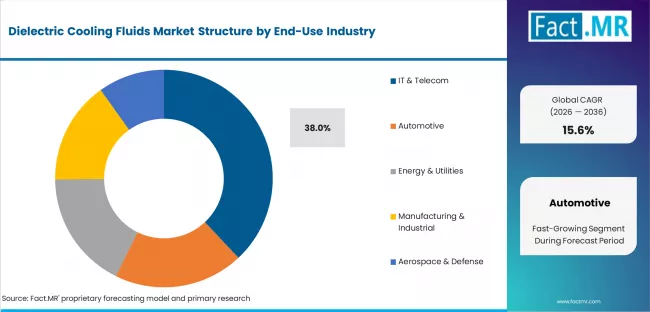
The largest end-user industry is IT & Telecom, occupying 38% of the market share in 2026. The segment's dominance is attributable to fast-paced development in the fields of data centers, cloud computing, and AI applications. Higher processing demands and increased server densities necessitate thermal management systems, resulting in greater consumption of dielectric cooling fluids. In technologically developed nations, the field of IT and telecom leads in infrastructure expansion; hence, these segments serve as the major source of demand.
Regional Outlook Across Key Markets
The market analysis covers key global regions, including South Asia and Pacific, Middle East & Africa, North America, Latin America, Western Europe, and Eastern Europe. It is segmented geographically, with specific market dynamics for each region. The full report provides a detailed market attractiveness analysis.
.webp)
CAGR Table
| Country | CAGR (%) |
|---|---|
| United States | 13.2% |
| Germany | 13.8% |
| Japan | 14.3% |
| United Kingdom | 14.7% |
| South Korea | 15.9% |
| India | 17.8% |
| China | 18.6% |
Source: Fact MR (FMR) analysis, based on proprietary forecasting model and primary research.
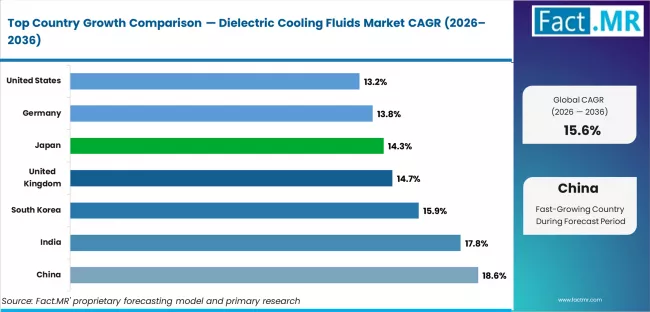
North America – The Innovation and Early Adoption Hub
North America represents the global innovation hub, driven by hyperscale data center expansion and early adoption of immersion cooling technologies. Key players such as ExxonMobil, Dow Inc., and Engineered Fluids hold strong positions through advanced product portfolios and partnerships with data center operators. The region benefits from strong R&D infrastructure and regulatory clarity, enabling faster commercialization of high-performance and PFAS-free dielectric fluids across enterprise and hyperscale deployments.
United States
Demand for dielectric cooling fluids in United States is projected to rise at 13.2% CAGR through 2036. Growth is driven by rapid hyperscale data center expansion and AI infrastructure investments. In January 2025, the U.S. Department of Energy expanded its Advanced Cooling Initiative supporting liquid cooling adoption. Regulatory focus on PFAS under the EPA’s updated reporting framework (February 2025) is also accelerating adoption of PFAS-free dielectric fluids across large-scale facilities.
Western Europe – The Global Regulatory Benchmark
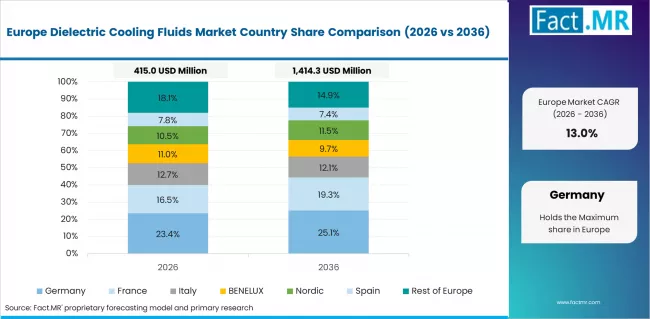
Western Europe acts as the global regulatory laboratory, with strict environmental frameworks driving the shift toward sustainable dielectric fluids. Leading companies such as Shell plc, TotalEnergies SE, and BASF SE are actively developing PFAS-free and bio-based alternatives. Strong regulatory oversight and sustainability mandates are accelerating innovation, making the region a key influencer in setting global standards for environmentally compliant cooling technologies.
Germany
Demand for dielectric cooling fluids in Germany is projected to rise at 13.8% CAGR through 2036. Growth is supported by strong industrial and data center expansion policies. In February 2025, the German Federal Ministry for Economic Affairs advanced funding for energy-efficient data centers under its digital infrastructure program. Additionally, in April 2025, Deutsche Telekom initiated liquid cooling adoption across selected facilities. Strict EU PFAS regulatory proposals under REACH (2025 updates) are also pushing rapid transition toward sustainable dielectric fluids in Germany [1].
East Asia – The High-Growth Technology Epicenter
East Asia is the global growth engine, driven by semiconductor manufacturing, AI infrastructure, and rapid digitalization. Companies such as ENEOS Corporation and SK Enmove are strengthening their presence through advanced fluid solutions. Strong government backing and industrial expansion are accelerating demand for high-performance dielectric fluids, particularly in high-density computing and electronics manufacturing environments.
Japan
Demand for dielectric cooling fluids in Japan is projected to rise at 14.3% CAGR through 2036. Growth is supported by advancements in semiconductor and electronics industries. In January 2025, Japan’s METI expanded support for next-generation data center efficiency programs. Strong focus on energy efficiency and sustainability is further driving adoption of advanced dielectric fluids across the country.
South Asia & Pacific – The Emerging Demand Powerhouse
South Asia & Pacific is the fastest-growing emerging region, fueled by digital transformation and increasing data center investments. Global and regional players are expanding their footprint to capture rising demand. The region benefits from cost advantages, favorable government policies, and rapid expansion of cloud infrastructure, making it a key growth frontier for dielectric cooling fluids.
India
Demand for dielectric cooling fluids in India is projected to rise at 17.8% CAGR through 2036. Growth is driven by rapid data center expansion and digitalization initiatives. In January 2025, the Indian government strengthened its Data Centre Policy promoting energy-efficient infrastructure. Increasing adoption of advanced cooling technologies is further boosting demand for dielectric fluids across the country.
Fact.MR Analysis: The dielectric cooling fluids market exhibits a dual-speed regional dynamic, with Asia-Pacific driving high-growth adoption through data center and EV expansion, while North America and Europe lead in innovation and regulatory alignment. Emerging regions are gradually accelerating demand, supported by digital infrastructure investments and increasing focus on energy-efficient cooling solutions.
Competitive Benchmarking and Company Positioning
Leading Companies Shaping the Dielectric Cooling Fluids Market
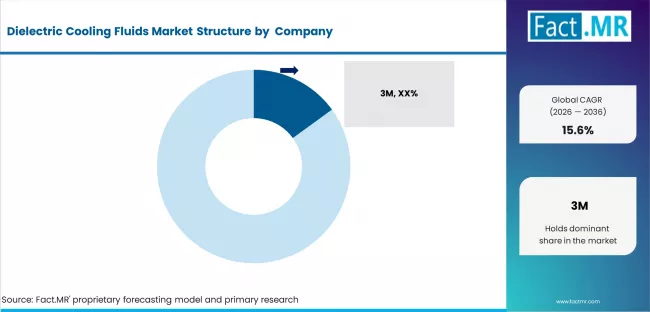
The dielectric coolant fluids industry is semi-consolidated with dominance from integrated firms like Shell plc, ExxonMobil Corporation, and 3M, as well as niche manufacturers. Competition results from fluid quality, efficiency, and adherence to regulations. The advantages for integrated firms include captive sourcing of raw materials and logistics on a worldwide scale, whereas companies such as The Chemours Company and Engineered Fluids rely on proprietary blends. Consumers, which include hyperscale data centers, adopt multiple supplier approaches, ensuring that superior-quality suppliers can enjoy reasonable pricing power.
Key Players of the Dielectric Cooling Fluids Market
- 3M
- Shell plc
- Exxon Mobil Corporation
- The Chemours Company
- Syensqo
- FUCHS
- Cargill, Incorporated
- TotalEnergies
- ENEOS Corporation
- Castrol Limited
- Valvoline Global Operations
- Engineered Fluids.
- GRC, Inc.
Recent Industry Developments
- ExxonMobil launches advanced immersion cooling fluids for data centers (March 2025): ExxonMobil introduced a new portfolio of dielectric cooling fluids aimed at high-density data centers, focusing on energy efficiency and thermal performance for AI workloads. The development strengthens its position in next-generation cooling solutions.
- Shell plc expands immersion cooling partnerships with data center operators (April 2025): Shell announced collaborations with hyperscale data center operators to deploy its immersion cooling fluids, targeting reduced energy consumption and improved sustainability outcomes across facilities.
- Castrol launches ON immersion cooling fluid for EVs and data centers (May 2025): Castrol introduced its ON dielectric fluid technology designed for electric vehicles and data centers, enhancing thermal management and supporting low-carbon cooling solutions.
- Castrol Limited partners with Airsys to accelerate liquid cooling adoption (September 2025): Castrol formalized a strategic partnership with Airsys to co-develop and integrate immersion cooling fluids with advanced cooling systems for AI-driven data centers. The collaboration focuses on enhancing thermal efficiency and enabling scalable deployment of liquid cooling technologies in high-density computing environments.
Sources and Research References
- [1] European Chemicals Agency (ECHA), PFAS restriction proposal under REACH regulation update, 2025
- [2] ExxonMobil Chemical Company, Data center immersion fluids portfolio overview, 2025
- [3] Shell plc, Shell cooling fluids certified by Intel for use in data centres worldwide, May 2025
- [4] DatacenterDynamics, Castrol launches fluid management service for data center liquid cooling, June 2025
- [5] Castrol Limited partners with Airsys to accelerate liquid cooling adoption
Dielectric Cooling Fluids Market Definition
Dielectric Coolants Market is made up of non-electrically conductive liquids that have high thermal stability and are used in cooling of high performance electronic and electric components. These fluids enable immersion cooling without short-circuiting, and they work as heat transfer fluids for data centers, electric vehicle batteries, power electronics and transformers. Typical types are mineral oils, synthetic fluids, fluorocarbons and bio-based liquids. They are designed to provide enhanced thermal management, energy efficiency and longer life for the equipment, in applications that include high-end computing and power infrastructure.
Dielectric Cooling Fluids Market Inclusions
This report provides top-level data and analysis covering the market size and growth outlook across the global and regional landscape for 2026 to 2036. Segment analysis by fluid type, cooling technology, chemical property, environmental regulation, and application industry is included. Furthermore, pricing trends, volume usage, and technology usage within important areas are examined in the report, in addition to the value chain analysis, regulatory framework, and competitive analysis of the major players.
Dielectric Cooling Fluids Market Exclusions
The scope does not include conventional air cooling systems and non-dielectric heat transfer fluids (such as water and glycol-based coolants) unless they are applied with other technologies in multi-component systems. It also excludes non-dielectric finished cooling products such as immersion tanks, pumps and heat exchangers – only dielectric fluids are considered. Niche laboratory scale fluids and other lubricants that are not used to thermally manage electronics or power systems are also excluded.
Dielectric Cooling Fluids MarketResearch Methodology
- Primary Research
- Interviews were held with fluid manufacturers, data center operators, EV OEMs and component suppliers as well as experts in the thermal management and power electronics industries.
- Desk Research
- To develop market context and to validate trends, public sources were reviewed including company filings, regulatory filings, industry journals, trade publications and government data.
- Market-Sizing and Forecasting
- The estimation of market size and forecast was performed through a combination of bottom-up (demand from end-use and volume consumed) and top-down (industry benchmark and macro-indicators) approaches.
- Data Validation and Update Cycle
- All figures were validated through triangulation of primary information and secondary data, with adjustments on a regular basis taking into account regulatory, technological, and market changes.
Scope of Analysis

| Parameter | Details |
|---|---|
| Quantitative Units | USD 1.6 billion in 2025 to USD 7.7 billion in 2036, at a CAGR of 15.6% |
| Market Definition | Dielectric cooling fluids are electrically non-conductive liquids used to dissipate heat in data centers, EVs, and electronics, enabling efficient immersion cooling, improving performance, energy efficiency, and equipment lifespan across applications. |
| Regions Covered | North America, Latin America, Europe, East Asia, South Asia and Pacific, MiddleEastand Africa |
| Countries Covered | USA, Canada, UK, Germany, China, India, 30 plus countries |
| Key Companies | 3M, Shell plc, Exxon Mobil Corporation, The Chemours Company, Syensqo, FUCHS, Cargill, TotalEnergies, ENEOS Corporation, Castrol Limited, Valvoline Global Operations, Engineered Fluids., GRC, Inc. |
| Forecast Period | 2026 to 2036 |
| Approach | Hybrid demand-side and top-downmethodologybuilt on country-level application demand, product benchmarking, pricing analysis, shipment validation, and primary interviews across manufacturers, distributors, retailers, and end users |
Analysis by Type, by Grade, by Product Form, by Processing Technology, by Application, by Sales Channel and by Region
-
Dielectric Cooling Fluids Market by Fluid Type
- Mineral Oil-Based Fluids
- Naphthenic Mineral Oil
- Paraffinic Mineral Oil
- Synthetic Fluids
- Polyalphaolefin (PAO)
- Synthetic Hydrocarbons (Non-PAO)
- Fluorocarbon-Based Fluids
- Perfluorocarbons (PFCs)
- Hydrofluoroethers (HFEs)
- Bio-Based Fluids
- Natural Ester Fluids
- Synthetic Ester Fluids
- Silicone-Based Fluids
- Polydimethylsiloxane (PDMS)
- Modified Silicone Fluids
- Mineral Oil-Based Fluids
-
Dielectric Cooling Fluids Market by Cooling Technology
- Single-Phase Cooling
- Direct Immersion Cooling
- Indirect Liquid Cooling
- Two-Phase Cooling
- Boiling Immersion Cooling
- Condensation-Based Systems
- Single-Phase Cooling
-
Dielectric Cooling Fluids Market by Chemical Properties
- Thermal Performance
- High Thermal Conductivity Fluids
- Standard Thermal Fluids
- Dielectric Strength
- High Dielectric Strength Fluids
- Moderate Dielectric Fluids
- Viscosity Level
- Low Viscosity Fluids
- High Viscosity Fluids
- Fire & Safety Properties
- High Flash Point Fluids
- Low Flammability Fluids
- Thermal Performance
-
Dielectric Cooling Fluids Market by Environmental & Regulatory Compliance
- PFAS-Based Fluids
- Legacy Fluids
- Regulated PFAS Fluids
- PFAS-Free Fluids
- Synthetic Alternatives
- Bio-Based Alternatives
- Sustainability Profile
- Biodegradable Fluids
- Low Carbon Footprint Fluids
- PFAS-Based Fluids
-
Dielectric Cooling Fluids Market By End-use Industry
- IT & Telecom
- Automotive
- Energy & Utilities
- Manufacturing & Industrial
- Aerospace & Defense
-
Dielectric Cooling Fluids Market By Region
- North America
- USA
- Canada
- Mexico
- Latin America
- Brazil
- Chile
- Rest of LATAM
- East Asia
- China
- Japan
- South Korea
- Western Europe
- Germany
- Italy
- France
- U.K.
- Spain
- BENELUX
- Nordic
- Rest of W. Europe
- Eastern Europe
- Russia
- Hungary
- Poland
- Balkan & Baltics
- Rest of E. Europe
- South Asia & Pacific
- India
- ASEAN
- ANZ
- Rest of SAP
- Middle East and Africa
- Kingdom of Saudi Arabia
- United Arab Emirates
- South Africa
- Rest of Middle East and Africa
- North America
- Frequently Asked Questions -
How large is the demand for Dielectric Cooling Fluids in the global market in 2026?
Demand for Dielectric Cooling Fluids in the global market is estimated to be valued at USD 1.8 billion in 2026.
What will be the market size of Dielectric Cooling Fluids in the global market by 2036?
The market size for Dielectric Cooling Fluids is projected to reach USD 7.7 billion by 2036.
What is the expected demand growth for Dielectric Cooling Fluids in the global market between 2026 and 2036?
Demand for Dielectric Cooling Fluids in the global market is expected to grow at a CAGR of 15.6% between 2026 and 2036, driven by increasing adoption of liquid cooling technologies in data centers and high-performance computing systems.
Which fluid type is expected to dominate the market?
Synthetic Fluids are expected to dominate the market, accounting for 32% of the market share in 2026, due to their superior thermal stability, dielectric strength, and compatibility with advanced cooling systems.
Which country is expected to show the highest growth rate for Dielectric Cooling Fluids?
China is projected to show the highest regional CAGR at 18.6%, supported by rapid expansion of hyperscale data centers and strong investments in AI infrastructure.
How significant is the growth outlook for India in this market?
India is expected to grow at a CAGR of 17.8%, reflecting increasing investments in cloud computing, digital infrastructure, and data center development.
Which company is identified as a leading player in the Dielectric Cooling Fluids market?
3M is recognized as a leading player in this market, offering advanced dielectric fluid solutions for immersion cooling and high-performance thermal management applications.
Table of Content
- Dielectric Cooling Fluids Market – Executive Summary
- Market Overview
- Market Definition & Introduction
- Market Taxonomy & Research Scope
- Global Dielectric Cooling Fluids Market Demand Analysis 2021-2025 and Forecast, 2026–2036
- Historical Market Volume (MT) Analysis, 2021-2025
- Current and Future Market Volume (MT) Projections, 2026–2036
- Y-o-Y Growth Trend Analysis
- Global Dielectric Cooling Fluids Market - Pricing Analysis
- Product Category and Country-Level Pricing Analysis
- Region Average Pricing Analysis Benchmark
- Price Trends and Forecasts
- Historical price trends
- Future price forecasts
- Factors Influencing Pricing
- Competitive Pricing Strategies
- Cost Structure Analysis: Elementary Deep Dive
- Global Dielectric Cooling Fluids Market Demand (in Value or Size in US$ Bn) Analysis 2021-2025 and Forecast, 2026–2036
- Historical Market Value (US$ Bn) Analysis, 2021-2025
- Current and Future Market Value (US$ Bn) Projections, 2026–2036
- Y-o-Y Growth Trend Analysis
- Absolute $ Opportunity Analysis
- Market Background and Foundational Data Points
- Installed base of immersion-cooled data centers (MW / number of facilities)
- Average fluid volume per system (liters per rack / tank)
- Data center rack density growth (kW per rack)
- Adoption rate of immersion cooling vs air/liquid cooling (%)
- Electric vehicle production volume (units)
- Penetration of dielectric cooling in EV batteries (%)
- Transformer and power equipment deployment (units / capacity)
- Replacement & refill cycle of dielectric fluids (years)
- Fluid type mix (synthetic vs mineral vs fluorocarbon share %)
- Regulatory impact (PFAS restrictions, environmental compliance shifts)
- R&D and innovation intensity (new formulations, efficiency improvements)
- Trade Scenario, 2025
- Imports and Export Analysis
- By Region
- By Country
- Imports and Export Analysis
- Start-up Ecosystem Analysis, 2021-2025
- Dielectric Cooling Fluids Market Opportunity Assessment
- Total Available Market (US$ Bn)
- Serviceable Addressable Market (US$ Bn)
- Serviceable Obtainable Market (US$ Bn)
- Porter’s Five Forces and PESTEL Analysis
- Investment Feasibility Analysis
- Macro-Economic Factors & Forecast Factors - Relevance & Impact
- Industry Value and Supply Chain Analysis
- List of Key Channel Partners
- Profit Margin & Operating Margin at Each Node of Supply Chain.
- Notes on Value Added at Each Node in the Value Chain
- Factors Influencing Value Chain
- Market Dynamics
- Drivers
- Restraints
- Opportunity Analysis
- Key Regulations & Certifications
- Dielectric Cooling Fluids Market Analysis 2021-2025 and Forecast 2026–2036, By Fluid Type
- Introduction / Key Findings
- Historical Market Size (US$ Bn) & Volume (MT) Trend Analysis By Fluid Type, 2021-2025
- Current and Future Market Size (US$ Bn) & Volume (MT) Analysis and Forecast By Fluid Type, 2026-2036
- Mineral Oil-Based Fluids
- Naphthenic Mineral Oil
- Paraffinic Mineral Oil
- Synthetic Fluids
- Polyalphaolefin (PAO)
- Synthetic Hydrocarbons (Non-PAO)
- Fluorocarbon-Based Fluids
- Perfluorocarbons (PFCs)
- Hydrofluoroethers (HFEs)
- Bio-Based Fluids
- Natural Ester Fluids
- Synthetic Ester Fluids
- Silicone-Based Fluids
- Polydimethylsiloxane (PDMS)
- Modified Silicone Fluids
- Mineral Oil-Based Fluids
- Market Attractiveness Analysis By Fluid Type
- Dielectric Cooling Fluids Market Analysis 2021-2025 and Forecast 2026–2036, By Cooling Technology
- Introduction / Key Findings
- Historical Market Size (US$ Bn) & Volume (MT) Trend Analysis By Cooling Technology, 2021-2025
- Current and Future Market Size (US$ Bn) & Volume (MT) Analysis and Forecast By Cooling Technology, 2026-2036
- Single-Phase Cooling
- Direct Immersion Cooling
- Indirect Liquid Cooling
- Two-Phase Cooling
- Boiling Immersion Cooling
- Condensation-Based Systems
- Single-Phase Cooling
- Market Attractiveness Analysis By Cooling Technology
- Dielectric Cooling Fluids Market Analysis 2021-2025 and Forecast 2026–2036, By Chemical Properties
- Introduction / Key Findings
- Historical Market Size (US$ Bn) & Volume (MT) Trend Analysis By Chemical Properties, 2021-2025
- Current and Future Market Size (US$ Bn) & Volume (MT) Analysis and Forecast By Chemical Properties, 2026-2036
- Thermal Performance
- High Thermal Conductivity Fluids
- Standard Thermal Fluids
- Dielectric Strength
- High Dielectric Strength Fluids
- Moderate Dielectric Fluids
- Viscosity Level
- Low Viscosity Fluids
- High Viscosity Fluids
- Fire & Safety Properties
- High Flash Point Fluids
- Low Flammability Fluids
- Thermal Performance
- Market Attractiveness Analysis By Chemical Properties
- Dielectric Cooling Fluids Market Analysis 2021-2025 and Forecast 2026–2036, By Environmental & Regulatory Compliance
- Introduction / Key Findings
- Historical Market Size (US$ Bn) & Volume (MT) Trend Analysis By Environmental & Regulatory Compliance, 2021-2025
- Current and Future Market Size (US$ Bn) & Volume (MT) Analysis and Forecast By Environmental & Regulatory Compliance, 2026-2036
- PFAS-Based Fluids
- Legacy Fluids
- Regulated PFAS Fluids
- PFAS-Free Fluids
- Synthetic Alternatives
- Bio-Based Alternatives
- Sustainability Profile
- Biodegradable Fluids
- Low Carbon Footprint Fluids
- PFAS-Based Fluids
- Market Attractiveness Analysis By Environmental & Regulatory Compliance
- Dielectric Cooling Fluids Market Analysis 2021-2025 and Forecast 2026–2036, By End-Use Industry
- Introduction / Key Findings
- Historical Market Size (US$ Bn) & Volume (MT) Trend Analysis By End-Use Industry, 2021-2025
- Current and Future Market Size (US$ Bn) & Volume (MT) Analysis and Forecast By End-Use Industry, 2026-2036
- IT & Telecom
- Automotive
- Energy & Utilities
- Manufacturing & Industrial
- Aerospace & Defense
- Market Attractiveness Analysis By End-Use Industry
- Global Dielectric Cooling Fluids Market Analysis and Forecast, by Region
- Introduction / Key Findings
- Historical Market Size (US$ Bn) & Volume (MT) Trend Analysis by Region, 2021-2025
- Current and Future Market Size (US$ Bn) & Volume (MT) Analysis and Forecast by Region, 2026-2036
- North America
- Latin America
- Western Europe
- Eastern Europe
- East Asia
- South Asia & Pacific
- Middle East & Africa
- Market Attractiveness Analysis by Region
- North America Dielectric Cooling Fluids Market Analysis and Forecast
- Introduction / Key Findings
- Pricing Analysis
- Historical Market Size (US$ Bn) & Volume (MT) Trend Analysis by Market Taxonomy, 2021-2025
- Current and Future Market Size (US$ Bn) and Volume (MT) Analysis & Forecast by Market Taxonomy, 2026-2036
- By Country
- United States
- Canada
- Mexico
- By Taxonomy
- Market Attractiveness Analysis By Country & Taxonomy
- Market Trends
- Key Market Participants – Intensity Mapping
- Drivers and Restraints - Impact Analysis
- Latin America Dielectric Cooling Fluids Market Analysis and Forecast
- Introduction / Key Findings
- Pricing Analysis
- Historical Market Size (US$ Bn) & Volume (MT) Trend Analysis by Market Taxonomy, 2021-2025
- Current and Future Market Size (US$ Bn) and Volume (MT) Analysis & Forecast by Market Taxonomy, 2026-2036
- By Country
- Brazil
- Chile
- Rest of LATAM
- By Taxonomy
- Market Attractiveness Analysis By Country & Taxonomy
- Market Trends
- Key Market Participants – Intensity Mapping
- Drivers and Restraints - Impact Analysis
- Western Europe Dielectric Cooling Fluids Market Analysis and Forecast
- Introduction / Key Findings
- Pricing Analysis
- Historical Market Size (US$ Bn) & Volume (MT) Trend Analysis by Market Taxonomy, 2021-2025
- Current and Future Market Size (US$ Bn) and Volume (MT) Analysis & Forecast by Market Taxonomy, 2026-2036
- By Country
- Germany
- Italy
- France
- United Kingdom
- Spain
- BENELUX
- Nordics
- Rest of Western Europe
- By Taxonomy
- Market Attractiveness Analysis By Country & Taxonomy
- Market Trends
- Key Market Participants – Intensity Mapping
- Drivers and Restraints - Impact Analysis
- Eastern Europe Dielectric Cooling Fluids Market Analysis and Forecast
- Introduction / Key Findings
- Pricing Analysis
- Historical Market Size (US$ Bn) & Volume (MT) Trend Analysis by Market Taxonomy, 2021-2025
- Current and Future Market Size (US$ Bn) and Volume (MT) Analysis & Forecast by Market Taxonomy, 2026-2036
- By Country
- Russia
- Hungary
- Poland
- Balkan & Baltics
- Rest of Eastern Europe
- By Taxonomy
- Market Attractiveness Analysis By Country & Taxonomy
- Market Trends
- Key Market Participants – Intensity Mapping
- Drivers and Restraints - Impact Analysis
- East Asia Dielectric Cooling Fluids Market Analysis and Forecast
- Introduction / Key Findings
- Pricing Analysis
- Historical Market Size (US$ Bn) & Volume (MT) Trend Analysis by Market Taxonomy, 2021-2025
- Current and Future Market Size (US$ Bn) and Volume (MT) Analysis & Forecast by Market Taxonomy, 2026-2036
- By Country
- China
- Japan
- South Korea
- By Taxonomy
- Market Attractiveness Analysis By Country & Taxonomy
- Market Trends
- Key Market Participants – Intensity Mapping
- Drivers and Restraints - Impact Analysis
- South Asia & Pacific Dielectric Cooling Fluids Market Analysis and Forecast
- Introduction / Key Findings
- Pricing Analysis
- Historical Market Size (US$ Bn) & Volume (MT) Trend Analysis by Market Taxonomy, 2021-2025
- Current and Future Market Size (US$ Bn) and Volume (MT) Analysis & Forecast by Market Taxonomy, 2026-2036
- By Country
- India
- ASEAN
- Australia & New Zealand
- Rest of South Asia & Pacific
- By Taxonomy
- Market Attractiveness Analysis By Country & Taxonomy
- Market Trends
- Key Market Participants – Intensity Mapping
- Drivers and Restraints - Impact Analysis
- Middle East & Africa Dielectric Cooling Fluids Market Analysis and Forecast
- Introduction / Key Findings
- Pricing Analysis
- Historical Market Size (US$ Bn) & Volume (MT) Trend Analysis by Market Taxonomy, 2021-2025
- Current and Future Market Size (US$ Bn) and Volume (MT) Analysis & Forecast by Market Taxonomy, 2026-2036
- By Country
- Kingdom of Saudi Arabia
- Other GCC Countries
- Turkiye
- South Africa
- Other African Union
- By Taxonomy
- Market Attractiveness Analysis By Country & Taxonomy
- Market Trends
- Key Market Participants – Intensity Mapping
- Drivers and Restraints - Impact Analysis
- Country-level Dielectric Cooling Fluids Market Analysis and Forecast
- Introduction
- Market Value Proportion Analysis, By Key Countries
- Global Vs. Country Growth Comparison
- United States Dielectric Cooling Fluids Market Analysis
- Market Size (US$ Bn) & Volume (MT) Analysis by Market Taxonomy, 2021–2036
- By Fluid Type
- By Cooling Technology
- By Chemical Properties
- By Environmental & Regulatory Compliance
- By End-Use Industry
- United States Dielectric Cooling Fluids Market Analysis
-
-
- Canada Dielectric Cooling Fluids Market Analysis
- Mexico Dielectric Cooling Fluids Market Analysis
- Brazil Dielectric Cooling Fluids Market Analysis
- Chile Dielectric Cooling Fluids Market Analysis
- Germany Dielectric Cooling Fluids Market Analysis
- France Dielectric Cooling Fluids Market Analysis
- Italy Dielectric Cooling Fluids Market Analysis
- Spain Dielectric Cooling Fluids Market Analysis
- United Kingdom Dielectric Cooling Fluids Market Analysis
- BENELUX Dielectric Cooling Fluids Market Analysis
- Nordics Dielectric Cooling Fluids Market Analysis
- Poland Dielectric Cooling Fluids Market Analysis
- Russia Dielectric Cooling Fluids Market Analysis
- Hungary Dielectric Cooling Fluids Market Analysis
- Balkan & Baltics Dielectric Cooling Fluids Market Analysis
- China Dielectric Cooling Fluids Market Analysis
- Japan Dielectric Cooling Fluids Market Analysis
- South Korea Dielectric Cooling Fluids Market Analysis
- India Dielectric Cooling Fluids Market Analysis
- ASEAN Dielectric Cooling Fluids Market Analysis
- ANZ Dielectric Cooling Fluids Market Analysis
- KSA Dielectric Cooling Fluids Market Analysis
- Other GCC Countries Dielectric Cooling Fluids Market Analysis
- South Africa Dielectric Cooling Fluids Market Analysis
- Turkiye Dielectric Cooling Fluids Market Analysis
-
- Dielectric Cooling Fluids Market Structure Analysis
- Market Analysis by Tier of Companies
- Market Concentration
- Market Share Analysis of Top Players
- Market Space for New Brands and Dollar Opportunity
- Market Presence Analysis
- Regional Footprint of Players
- Product Footprint by Players
- Mobile Optical Pluggable Competition Analysis
- Competition Dashboard
- Pricing Analysis by Competition
- Competition Benchmarking
- Competition Deep Dive
- 3M
- Overview
- Product Portfolio
- Sales Footprint
- Key Developments
- SWOT Analysis
- Strategy Overview
- Key Financials
- Shell plc
- Exxon Mobil Corporation
- The Chemours Company
- Syensqo
- FUCHS
- Cargill, Incorporated
- TotalEnergies
- ENEOS Corporation
- Castrol Limited
- Valvoline Global Operations
- Engineered Fluids.
- GRC, Inc.
- Other Prominent Players
- 3M
- Primary insights
- Assumptions & Acronyms Used
- Research Methodology & Data Sources
List Of Table
- Table 1: Global Market Value (USD Bn) Forecast by Region, 2021 to 2036
- Table 2: Global Market Volume (MT) Forecast by Region, 2021 to 2036
- Table 3: Global Market Value (USD Bn) Forecast by Fluid Type, 2021 to 2036
- Table 4: Global Market Volume (MT) Forecast by Fluid Type, 2021 to 2036
- Table 5: Global Market Value (USD Bn) Forecast by Cooling Technology, 2021 to 2036
- Table 6: Global Market Volume (MT) Forecast by Cooling Technology, 2021 to 2036
- Table 7: Global Market Value (USD Bn) Forecast by Chemical Properties, 2021 to 2036
- Table 8: Global Market Volume (MT) Forecast by Chemical Properties, 2021 to 2036
- Table 9: Global Market Value (USD Bn) Forecast by Environmental & Regulatory Compliance, 2021 to 2036
- Table 10: Global Market Volume (MT) Forecast by Environmental & Regulatory Compliance, 2021 to 2036
- Table 11: Global Market Value (USD Bn) Forecast by End-Use Industry, 2021 to 2036
- Table 12: Global Market Volume (MT) Forecast by End-Use Industry, 2021 to 2036
- Table 13: North America Market Value (USD Bn) Forecast by Country, 2021 to 2036
- Table 14: North America Market Volume (MT) Forecast by Country, 2021 to 2036
- Table 15: North America Market Value (USD Bn) Forecast by Fluid Type, 2021 to 2036
- Table 16: North America Market Volume (MT) Forecast by Fluid Type, 2021 to 2036
- Table 17: North America Market Value (USD Bn) Forecast by Cooling Technology, 2021 to 2036
- Table 18: North America Market Volume (MT) Forecast by Cooling Technology, 2021 to 2036
- Table 19: North America Market Value (USD Bn) Forecast by Chemical Properties, 2021 to 2036
- Table 20: North America Market Volume (MT) Forecast by Chemical Properties, 2021 to 2036
- Table 21: North America Market Value (USD Bn) Forecast by Environmental & Regulatory Compliance, 2021 to 2036
- Table 22: North America Market Volume (MT) Forecast by Environmental & Regulatory Compliance, 2021 to 2036
- Table 23: North America Market Value (USD Bn) Forecast by End-Use Industry, 2021 to 2036
- Table 24: North America Market Volume (MT) Forecast by End-Use Industry, 2021 to 2036
- Table 25: Latin America Market Value (USD Bn) Forecast by Country, 2021 to 2036
- Table 26: Latin America Market Volume (MT) Forecast by Country, 2021 to 2036
- Table 27: Latin America Market Value (USD Bn) Forecast by Fluid Type, 2021 to 2036
- Table 28: Latin America Market Volume (MT) Forecast by Fluid Type, 2021 to 2036
- Table 29: Latin America Market Value (USD Bn) Forecast by Cooling Technology, 2021 to 2036
- Table 30: Latin America Market Volume (MT) Forecast by Cooling Technology, 2021 to 2036
- Table 31: Latin America Market Value (USD Bn) Forecast by Chemical Properties, 2021 to 2036
- Table 32: Latin America Market Volume (MT) Forecast by Chemical Properties, 2021 to 2036
- Table 33: Latin America Market Value (USD Bn) Forecast by Environmental & Regulatory Compliance, 2021 to 2036
- Table 34: Latin America Market Volume (MT) Forecast by Environmental & Regulatory Compliance, 2021 to 2036
- Table 35: Latin America Market Value (USD Bn) Forecast by End-Use Industry, 2021 to 2036
- Table 36: Latin America Market Volume (MT) Forecast by End-Use Industry, 2021 to 2036
- Table 37: Western Europe Market Value (USD Bn) Forecast by Country, 2021 to 2036
- Table 38: Western Europe Market Volume (MT) Forecast by Country, 2021 to 2036
- Table 39: Western Europe Market Value (USD Bn) Forecast by Fluid Type, 2021 to 2036
- Table 40: Western Europe Market Volume (MT) Forecast by Fluid Type, 2021 to 2036
- Table 41: Western Europe Market Value (USD Bn) Forecast by Cooling Technology, 2021 to 2036
- Table 42: Western Europe Market Volume (MT) Forecast by Cooling Technology, 2021 to 2036
- Table 43: Western Europe Market Value (USD Bn) Forecast by Chemical Properties, 2021 to 2036
- Table 44: Western Europe Market Volume (MT) Forecast by Chemical Properties, 2021 to 2036
- Table 45: Western Europe Market Value (USD Bn) Forecast by Environmental & Regulatory Compliance, 2021 to 2036
- Table 46: Western Europe Market Volume (MT) Forecast by Environmental & Regulatory Compliance, 2021 to 2036
- Table 47: Western Europe Market Value (USD Bn) Forecast by End-Use Industry, 2021 to 2036
- Table 48: Western Europe Market Volume (MT) Forecast by End-Use Industry, 2021 to 2036
- Table 49: Eastern Europe Market Value (USD Bn) Forecast by Country, 2021 to 2036
- Table 50: Eastern Europe Market Volume (MT) Forecast by Country, 2021 to 2036
- Table 51: Eastern Europe Market Value (USD Bn) Forecast by Fluid Type, 2021 to 2036
- Table 52: Eastern Europe Market Volume (MT) Forecast by Fluid Type, 2021 to 2036
- Table 53: Eastern Europe Market Value (USD Bn) Forecast by Cooling Technology, 2021 to 2036
- Table 54: Eastern Europe Market Volume (MT) Forecast by Cooling Technology, 2021 to 2036
- Table 55: Eastern Europe Market Value (USD Bn) Forecast by Chemical Properties, 2021 to 2036
- Table 56: Eastern Europe Market Volume (MT) Forecast by Chemical Properties, 2021 to 2036
- Table 57: Eastern Europe Market Value (USD Bn) Forecast by Environmental & Regulatory Compliance, 2021 to 2036
- Table 58: Eastern Europe Market Volume (MT) Forecast by Environmental & Regulatory Compliance, 2021 to 2036
- Table 59: Eastern Europe Market Value (USD Bn) Forecast by End-Use Industry, 2021 to 2036
- Table 60: Eastern Europe Market Volume (MT) Forecast by End-Use Industry, 2021 to 2036
- Table 61: East Asia Market Value (USD Bn) Forecast by Country, 2021 to 2036
- Table 62: East Asia Market Volume (MT) Forecast by Country, 2021 to 2036
- Table 63: East Asia Market Value (USD Bn) Forecast by Fluid Type, 2021 to 2036
- Table 64: East Asia Market Volume (MT) Forecast by Fluid Type, 2021 to 2036
- Table 65: East Asia Market Value (USD Bn) Forecast by Cooling Technology, 2021 to 2036
- Table 66: East Asia Market Volume (MT) Forecast by Cooling Technology, 2021 to 2036
- Table 67: East Asia Market Value (USD Bn) Forecast by Chemical Properties, 2021 to 2036
- Table 68: East Asia Market Volume (MT) Forecast by Chemical Properties, 2021 to 2036
- Table 69: East Asia Market Value (USD Bn) Forecast by Environmental & Regulatory Compliance, 2021 to 2036
- Table 70: East Asia Market Volume (MT) Forecast by Environmental & Regulatory Compliance, 2021 to 2036
- Table 71: East Asia Market Value (USD Bn) Forecast by End-Use Industry, 2021 to 2036
- Table 72: East Asia Market Volume (MT) Forecast by End-Use Industry, 2021 to 2036
- Table 73: South Asia and Pacific Market Value (USD Bn) Forecast by Country, 2021 to 2036
- Table 74: South Asia and Pacific Market Volume (MT) Forecast by Country, 2021 to 2036
- Table 75: South Asia and Pacific Market Value (USD Bn) Forecast by Fluid Type, 2021 to 2036
- Table 76: South Asia and Pacific Market Volume (MT) Forecast by Fluid Type, 2021 to 2036
- Table 77: South Asia and Pacific Market Value (USD Bn) Forecast by Cooling Technology, 2021 to 2036
- Table 78: South Asia and Pacific Market Volume (MT) Forecast by Cooling Technology, 2021 to 2036
- Table 79: South Asia and Pacific Market Value (USD Bn) Forecast by Chemical Properties, 2021 to 2036
- Table 80: South Asia and Pacific Market Volume (MT) Forecast by Chemical Properties, 2021 to 2036
- Table 81: South Asia and Pacific Market Value (USD Bn) Forecast by Environmental & Regulatory Compliance, 2021 to 2036
- Table 82: South Asia and Pacific Market Volume (MT) Forecast by Environmental & Regulatory Compliance, 2021 to 2036
- Table 83: South Asia and Pacific Market Value (USD Bn) Forecast by End-Use Industry, 2021 to 2036
- Table 84: South Asia and Pacific Market Volume (MT) Forecast by End-Use Industry, 2021 to 2036
- Table 85: Middle East & Africa Market Value (USD Bn) Forecast by Country, 2021 to 2036
- Table 86: Middle East & Africa Market Volume (MT) Forecast by Country, 2021 to 2036
- Table 87: Middle East & Africa Market Value (USD Bn) Forecast by Fluid Type, 2021 to 2036
- Table 88: Middle East & Africa Market Volume (MT) Forecast by Fluid Type, 2021 to 2036
- Table 89: Middle East & Africa Market Value (USD Bn) Forecast by Cooling Technology, 2021 to 2036
- Table 90: Middle East & Africa Market Volume (MT) Forecast by Cooling Technology, 2021 to 2036
- Table 91: Middle East & Africa Market Value (USD Bn) Forecast by Chemical Properties, 2021 to 2036
- Table 92: Middle East & Africa Market Volume (MT) Forecast by Chemical Properties, 2021 to 2036
- Table 93: Middle East & Africa Market Value (USD Bn) Forecast by Environmental & Regulatory Compliance, 2021 to 2036
- Table 94: Middle East & Africa Market Volume (MT) Forecast by Environmental & Regulatory Compliance, 2021 to 2036
- Table 95: Middle East & Africa Market Value (USD Bn) Forecast by End-Use Industry, 2021 to 2036
- Table 96: Middle East & Africa Market Volume (MT) Forecast by End-Use Industry, 2021 to 2036
List Of Figures
- Figure 1: Global Market Volume (MT) Forecast 2021 to 2036
- Figure 2: Global Market Pricing Analysis
- Figure 3: Global Market Value (USD Bn) Forecast 2021 to 2036
- Figure 4: Global Market Value Share and BPS Analysis by Fluid Type, 2026 and 2036
- Figure 5: Global Market Y-o-Y Growth Comparison by Fluid Type, 2026 to 2036
- Figure 6: Global Market Attractiveness Analysis by Fluid Type
- Figure 7: Global Market Value Share and BPS Analysis by Cooling Technology, 2026 and 2036
- Figure 8: Global Market Y-o-Y Growth Comparison by Cooling Technology, 2026 to 2036
- Figure 9: Global Market Attractiveness Analysis by Cooling Technology
- Figure 10: Global Market Value Share and BPS Analysis by Chemical Properties, 2026 and 2036
- Figure 11: Global Market Y-o-Y Growth Comparison by Chemical Properties, 2026 to 2036
- Figure 12: Global Market Attractiveness Analysis by Chemical Properties
- Figure 13: Global Market Value Share and BPS Analysis by Environmental & Regulatory Compliance, 2026 and 2036
- Figure 14: Global Market Y-o-Y Growth Comparison by Environmental & Regulatory Compliance, 2026 to 2036
- Figure 15: Global Market Attractiveness Analysis by Environmental & Regulatory Compliance
- Figure 16: Global Market Value Share and BPS Analysis by End-Use Industry, 2026 and 2036
- Figure 17: Global Market Y-o-Y Growth Comparison by End-Use Industry, 2026 to 2036
- Figure 18: Global Market Attractiveness Analysis by End-Use Industry
- Figure 19: Global Market Value (USD Bn) Share and BPS Analysis by Region, 2026 and 2036
- Figure 20: Global Market Y-o-Y Growth Comparison by Region, 2026 to 2036
- Figure 21: Global Market Attractiveness Analysis by Region
- Figure 22: North America Market Incremental $ Opportunity, 2026 to 2036
- Figure 23: Latin America Market Incremental $ Opportunity, 2026 to 2036
- Figure 24: Western Europe Market Incremental $ Opportunity, 2026 to 2036
- Figure 25: Eastern Europe Market Incremental $ Opportunity, 2026 to 2036
- Figure 26: East Asia Market Incremental $ Opportunity, 2026 to 2036
- Figure 27: South Asia and Pacific Market Incremental $ Opportunity, 2026 to 2036
- Figure 28: Middle East & Africa Market Incremental $ Opportunity, 2026 to 2036
- Figure 29: North America Market Value Share and BPS Analysis by Country, 2026 and 2036
- Figure 30: North America Market Value Share and BPS Analysis by Fluid Type, 2026 and 2036
- Figure 31: North America Market Y-o-Y Growth Comparison by Fluid Type, 2026 to 2036
- Figure 32: North America Market Attractiveness Analysis by Fluid Type
- Figure 33: North America Market Value Share and BPS Analysis by Cooling Technology, 2026 and 2036
- Figure 34: North America Market Y-o-Y Growth Comparison by Cooling Technology, 2026 to 2036
- Figure 35: North America Market Attractiveness Analysis by Cooling Technology
- Figure 36: North America Market Value Share and BPS Analysis by Chemical Properties, 2026 and 2036
- Figure 37: North America Market Y-o-Y Growth Comparison by Chemical Properties, 2026 to 2036
- Figure 38: North America Market Attractiveness Analysis by Chemical Properties
- Figure 39: North America Market Value Share and BPS Analysis by Environmental & Regulatory Compliance, 2026 and 2036
- Figure 40: North America Market Y-o-Y Growth Comparison by Environmental & Regulatory Compliance, 2026 to 2036
- Figure 41: North America Market Attractiveness Analysis by Environmental & Regulatory Compliance
- Figure 42: North America Market Value Share and BPS Analysis by End-Use Industry, 2026 and 2036
- Figure 43: North America Market Y-o-Y Growth Comparison by End-Use Industry, 2026 to 2036
- Figure 44: North America Market Attractiveness Analysis by End-Use Industry
- Figure 45: Latin America Market Value Share and BPS Analysis by Country, 2026 and 2036
- Figure 46: Latin America Market Value Share and BPS Analysis by Fluid Type, 2026 and 2036
- Figure 47: Latin America Market Y-o-Y Growth Comparison by Fluid Type, 2026 to 2036
- Figure 48: Latin America Market Attractiveness Analysis by Fluid Type
- Figure 49: Latin America Market Value Share and BPS Analysis by Cooling Technology, 2026 and 2036
- Figure 50: Latin America Market Y-o-Y Growth Comparison by Cooling Technology, 2026 to 2036
- Figure 51: Latin America Market Attractiveness Analysis by Cooling Technology
- Figure 52: Latin America Market Value Share and BPS Analysis by Chemical Properties, 2026 and 2036
- Figure 53: Latin America Market Y-o-Y Growth Comparison by Chemical Properties, 2026 to 2036
- Figure 54: Latin America Market Attractiveness Analysis by Chemical Properties
- Figure 55: Latin America Market Value Share and BPS Analysis by Environmental & Regulatory Compliance, 2026 and 2036
- Figure 56: Latin America Market Y-o-Y Growth Comparison by Environmental & Regulatory Compliance, 2026 to 2036
- Figure 57: Latin America Market Attractiveness Analysis by Environmental & Regulatory Compliance
- Figure 58: Latin America Market Value Share and BPS Analysis by End-Use Industry, 2026 and 2036
- Figure 59: Latin America Market Y-o-Y Growth Comparison by End-Use Industry, 2026 to 2036
- Figure 60: Latin America Market Attractiveness Analysis by End-Use Industry
- Figure 61: Western Europe Market Value Share and BPS Analysis by Country, 2026 and 2036
- Figure 62: Western Europe Market Value Share and BPS Analysis by Fluid Type, 2026 and 2036
- Figure 63: Western Europe Market Y-o-Y Growth Comparison by Fluid Type, 2026 to 2036
- Figure 64: Western Europe Market Attractiveness Analysis by Fluid Type
- Figure 65: Western Europe Market Value Share and BPS Analysis by Cooling Technology, 2026 and 2036
- Figure 66: Western Europe Market Y-o-Y Growth Comparison by Cooling Technology, 2026 to 2036
- Figure 67: Western Europe Market Attractiveness Analysis by Cooling Technology
- Figure 68: Western Europe Market Value Share and BPS Analysis by Chemical Properties, 2026 and 2036
- Figure 69: Western Europe Market Y-o-Y Growth Comparison by Chemical Properties, 2026 to 2036
- Figure 70: Western Europe Market Attractiveness Analysis by Chemical Properties
- Figure 71: Western Europe Market Value Share and BPS Analysis by Environmental & Regulatory Compliance, 2026 and 2036
- Figure 72: Western Europe Market Y-o-Y Growth Comparison by Environmental & Regulatory Compliance, 2026 to 2036
- Figure 73: Western Europe Market Attractiveness Analysis by Environmental & Regulatory Compliance
- Figure 74: Western Europe Market Value Share and BPS Analysis by End-Use Industry, 2026 and 2036
- Figure 75: Western Europe Market Y-o-Y Growth Comparison by End-Use Industry, 2026 to 2036
- Figure 76: Western Europe Market Attractiveness Analysis by End-Use Industry
- Figure 77: Eastern Europe Market Value Share and BPS Analysis by Country, 2026 and 2036
- Figure 78: Eastern Europe Market Value Share and BPS Analysis by Fluid Type, 2026 and 2036
- Figure 79: Eastern Europe Market Y-o-Y Growth Comparison by Fluid Type, 2026 to 2036
- Figure 80: Eastern Europe Market Attractiveness Analysis by Fluid Type
- Figure 81: Eastern Europe Market Value Share and BPS Analysis by Cooling Technology, 2026 and 2036
- Figure 82: Eastern Europe Market Y-o-Y Growth Comparison by Cooling Technology, 2026 to 2036
- Figure 83: Eastern Europe Market Attractiveness Analysis by Cooling Technology
- Figure 84: Eastern Europe Market Value Share and BPS Analysis by Chemical Properties, 2026 and 2036
- Figure 85: Eastern Europe Market Y-o-Y Growth Comparison by Chemical Properties, 2026 to 2036
- Figure 86: Eastern Europe Market Attractiveness Analysis by Chemical Properties
- Figure 87: Eastern Europe Market Value Share and BPS Analysis by Environmental & Regulatory Compliance, 2026 and 2036
- Figure 88: Eastern Europe Market Y-o-Y Growth Comparison by Environmental & Regulatory Compliance, 2026 to 2036
- Figure 89: Eastern Europe Market Attractiveness Analysis by Environmental & Regulatory Compliance
- Figure 90: Eastern Europe Market Value Share and BPS Analysis by End-Use Industry, 2026 and 2036
- Figure 91: Eastern Europe Market Y-o-Y Growth Comparison by End-Use Industry, 2026 to 2036
- Figure 92: Eastern Europe Market Attractiveness Analysis by End-Use Industry
- Figure 93: East Asia Market Value Share and BPS Analysis by Country, 2026 and 2036
- Figure 94: East Asia Market Value Share and BPS Analysis by Fluid Type, 2026 and 2036
- Figure 95: East Asia Market Y-o-Y Growth Comparison by Fluid Type, 2026 to 2036
- Figure 96: East Asia Market Attractiveness Analysis by Fluid Type
- Figure 97: East Asia Market Value Share and BPS Analysis by Cooling Technology, 2026 and 2036
- Figure 98: East Asia Market Y-o-Y Growth Comparison by Cooling Technology, 2026 to 2036
- Figure 99: East Asia Market Attractiveness Analysis by Cooling Technology
- Figure 100: East Asia Market Value Share and BPS Analysis by Chemical Properties, 2026 and 2036
- Figure 101: East Asia Market Y-o-Y Growth Comparison by Chemical Properties, 2026 to 2036
- Figure 102: East Asia Market Attractiveness Analysis by Chemical Properties
- Figure 103: East Asia Market Value Share and BPS Analysis by Environmental & Regulatory Compliance, 2026 and 2036
- Figure 104: East Asia Market Y-o-Y Growth Comparison by Environmental & Regulatory Compliance, 2026 to 2036
- Figure 105: East Asia Market Attractiveness Analysis by Environmental & Regulatory Compliance
- Figure 106: East Asia Market Value Share and BPS Analysis by End-Use Industry, 2026 and 2036
- Figure 107: East Asia Market Y-o-Y Growth Comparison by End-Use Industry, 2026 to 2036
- Figure 108: East Asia Market Attractiveness Analysis by End-Use Industry
- Figure 109: South Asia and Pacific Market Value Share and BPS Analysis by Country, 2026 and 2036
- Figure 110: South Asia and Pacific Market Value Share and BPS Analysis by Fluid Type, 2026 and 2036
- Figure 111: South Asia and Pacific Market Y-o-Y Growth Comparison by Fluid Type, 2026 to 2036
- Figure 112: South Asia and Pacific Market Attractiveness Analysis by Fluid Type
- Figure 113: South Asia and Pacific Market Value Share and BPS Analysis by Cooling Technology, 2026 and 2036
- Figure 114: South Asia and Pacific Market Y-o-Y Growth Comparison by Cooling Technology, 2026 to 2036
- Figure 115: South Asia and Pacific Market Attractiveness Analysis by Cooling Technology
- Figure 116: South Asia and Pacific Market Value Share and BPS Analysis by Chemical Properties, 2026 and 2036
- Figure 117: South Asia and Pacific Market Y-o-Y Growth Comparison by Chemical Properties, 2026 to 2036
- Figure 118: South Asia and Pacific Market Attractiveness Analysis by Chemical Properties
- Figure 119: South Asia and Pacific Market Value Share and BPS Analysis by Environmental & Regulatory Compliance, 2026 and 2036
- Figure 120: South Asia and Pacific Market Y-o-Y Growth Comparison by Environmental & Regulatory Compliance, 2026 to 2036
- Figure 121: South Asia and Pacific Market Attractiveness Analysis by Environmental & Regulatory Compliance
- Figure 122: South Asia and Pacific Market Value Share and BPS Analysis by End-Use Industry, 2026 and 2036
- Figure 123: South Asia and Pacific Market Y-o-Y Growth Comparison by End-Use Industry, 2026 to 2036
- Figure 124: South Asia and Pacific Market Attractiveness Analysis by End-Use Industry
- Figure 125: Middle East & Africa Market Value Share and BPS Analysis by Country, 2026 and 2036
- Figure 126: Middle East & Africa Market Value Share and BPS Analysis by Fluid Type, 2026 and 2036
- Figure 127: Middle East & Africa Market Y-o-Y Growth Comparison by Fluid Type, 2026 to 2036
- Figure 128: Middle East & Africa Market Attractiveness Analysis by Fluid Type
- Figure 129: Middle East & Africa Market Value Share and BPS Analysis by Cooling Technology, 2026 and 2036
- Figure 130: Middle East & Africa Market Y-o-Y Growth Comparison by Cooling Technology, 2026 to 2036
- Figure 131: Middle East & Africa Market Attractiveness Analysis by Cooling Technology
- Figure 132: Middle East & Africa Market Value Share and BPS Analysis by Chemical Properties, 2026 and 2036
- Figure 133: Middle East & Africa Market Y-o-Y Growth Comparison by Chemical Properties, 2026 to 2036
- Figure 134: Middle East & Africa Market Attractiveness Analysis by Chemical Properties
- Figure 135: Middle East & Africa Market Value Share and BPS Analysis by Environmental & Regulatory Compliance, 2026 and 2036
- Figure 136: Middle East & Africa Market Y-o-Y Growth Comparison by Environmental & Regulatory Compliance, 2026 to 2036
- Figure 137: Middle East & Africa Market Attractiveness Analysis by Environmental & Regulatory Compliance
- Figure 138: Middle East & Africa Market Value Share and BPS Analysis by End-Use Industry, 2026 and 2036
- Figure 139: Middle East & Africa Market Y-o-Y Growth Comparison by End-Use Industry, 2026 to 2036
- Figure 140: Middle East & Africa Market Attractiveness Analysis by End-Use Industry
- Figure 141: Global Market – Tier Structure Analysis
- Figure 142: Global Market – Company Share Analysis