Aging-in-Place Orchestration Services Market Size, Share, Growth and Forecast (2026 - 2036)
The Aging-in-Place Orchestration Services Market is segmented by Service Type, by Technology Platform, by Care Coordination Model, by Care Setting, by Delivery Mode, by Age Group, by End User, by Pricing Model, and by Region. Forecast for 2026 to 2036.
What is the aging-in-place orchestration services market forecast to be worth by 2036?
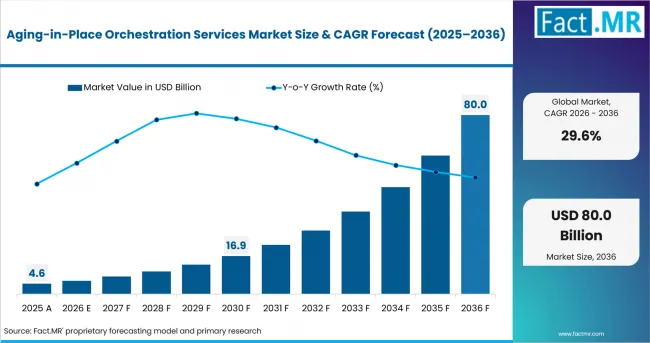
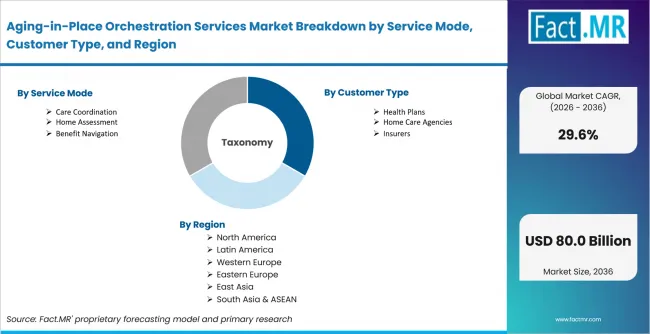
USD 6.0 billion in 2026 to USD 80.0 billion by 2036, at 29.6% CAGR.
- The aging-in-place orchestration services market crossed a valuation of USD 4.63 billion in 2025.
- Demand is expected to increase from USD 6.0 billion in 2026 to USD 80.0 billion by 2036.
- The market is forecast to record 29.6% CAGR during 2026 to 2036 as older adults, caregivers and payers shift more support work into the home.
What are the defining numbers behind aging-in-place orchestration services?
USD 74 billion absolute opportunity by 2036, led by China and payer-funded care coordination.
- Demand Drivers in the Market
- Health plans need a lower-cost way to route members toward home support before avoidable facility care begins.
- Home care agencies need referral intake and care scheduling that matches staff capacity with household needs.
- Families need one service layer that explains benefits, finds local providers and tracks whether help arrives.
- Public programs need navigation models that connect older adults with community services while preserving home residence.
- Key Segments Analyzed
- By Service Model: Care Coordination is expected to hold 31.0% share in 2026 because assessment, referral and follow-up are usually purchased together.
- By Customer Type: Health Plans are expected to hold 34.0% share in 2026 because payer-funded programs can place orchestration inside covered benefits.
- By Delivery Channel: Payer-Sponsored services are projected to hold 38.0% share in 2026 because reimbursed channels reduce out-of-pocket friction.
- By Technology Layer: Care Platform services are expected to hold 33.0% share in 2026 because eligibility checks and status notes need one operating layer.
- By Care Need: Daily Support is expected to hold 30.0% share in 2026 as transport, meals and household tasks create frequent coordination needs.
- By End User: Older Adults are expected to hold 46.0% share in 2026 while family caregivers influence most purchase and referral decisions.
- Analyst Opinion at Fact.MR
- Shambhu Nath Jha of Fact.MR states, "I view this market as a coordination problem first. I do not view it as a technology problem first. Older adults do not only need a device or a care visit. They need someone to connect benefits and home safety. Transport and meals must be connected. Family updates and provider follow-through must also be connected. Suppliers that prove this handoff discipline are expected to win payer contracts faster than firms selling isolated tools."
- Strategic Implications
- Health plans should define measurable service completion rules before expanding aging-at-home benefits.
- Home care agencies need intake tools that show which requests can be served with available staff.
- Age technology suppliers should pair devices with navigation and escalation support rather than selling isolated alerts.
- Public program administrators need referral partners that can document the path from assessment to completed support.
The service base covers care coordination and non-medical support routing. It also covers home assessment and recurring check-ins for older adults who prefer to remain at home. The United Nations Population Fund reported in June 2024 that the global share of people aged 65 and older reached 10.3% in 2024 and is projected to reach 20.7% by 2074. That curve gives orchestration providers a wider base of households that need practical help before institutional care becomes necessary. [1]
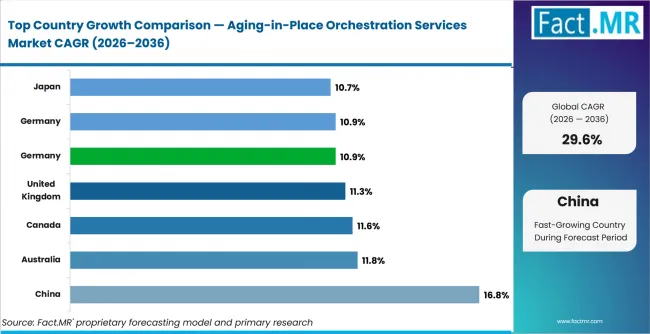
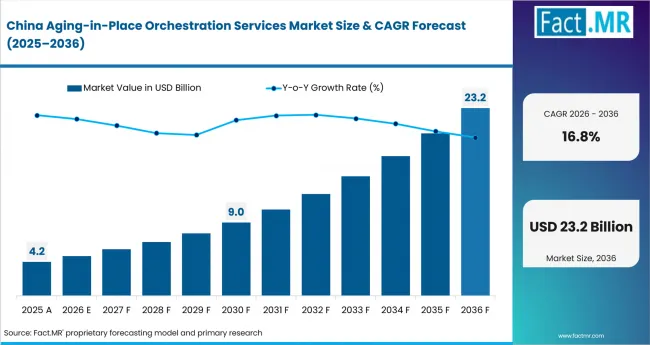
China is forecast to record 16.8% CAGR through 2036 because its older adult base is large and formal home support remains less developed than in the United States or Japan. Australia is expected to post 11.8% CAGR as public home care packages create a clear navigation need. Canada is forecast at 11.6% CAGR because home adaptation and provincial care routing needs are closely linked. The United States remains the largest 2026 revenue pool due to payer programs and home health infrastructure.
How does the aging-in-place orchestration services market break down by segment?
Care Coordination leads at 31.0%; Health Plans lead at 34.0%.
Platform value is clearest where agencies must coordinate people and records. That is why senior care technologies are moving closer to payer operations and agency workflow. Buyers do not want a directory alone. They want proof that an assessment becomes a completed visit or a safer household plan.
Which service model leads?
Care Coordination holds 31.0% share in 2026.
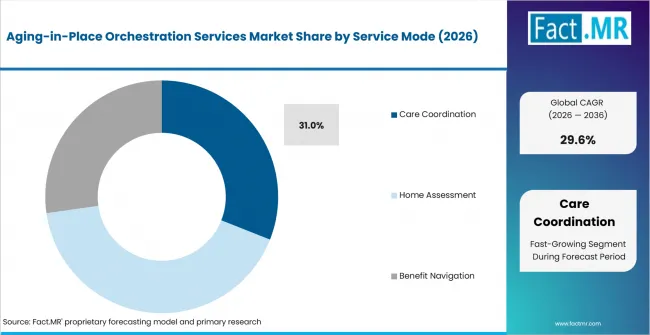
Care Coordination leads because the buyer problem is not one service. The buyer problem is knowing which service is needed first. Families need a structured intake path. Payers need documentation that the referral was useful. This service model wins when it turns scattered requests into one action plan.
Which customer type leads?
Health Plans hold 34.0% share in 2026.
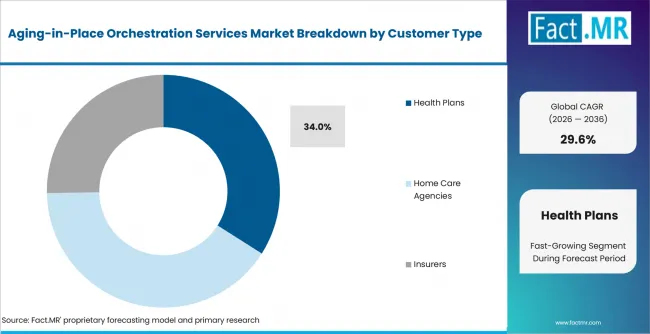
Health Plans lead because they can connect orchestration to member retention, home-based benefits and care management targets. Public and private payers already review medical case management as a way to manage care complexity. Aging-in-place orchestration extends that logic into non-medical support and family follow-through.
Which delivery channel leads?
Payer-Sponsored services hold 38.0% share in 2026.
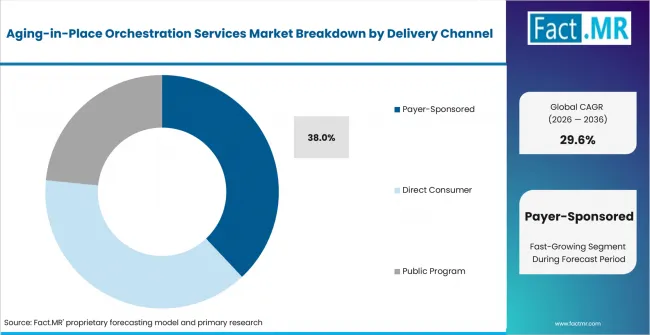
Payer-Sponsored services hold the largest channel share because covered benefits are easier for older adults to use than purely cash-paid coordination. This route also gives providers clearer data on eligibility, service authorization and completion. Family-paid options remain important, but payer-funded channels create steadier repeat volume.
Which technology layer leads?
Care Platform services hold 33.0% share in 2026.
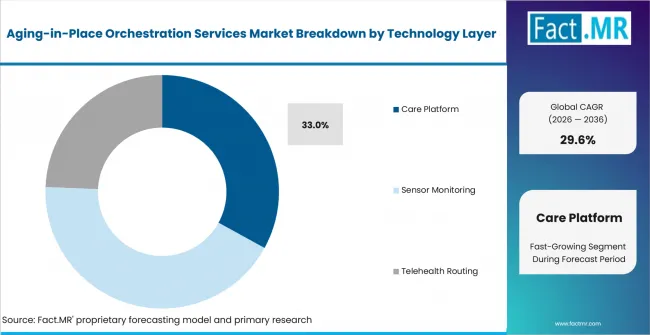
Care Platform services lead because orchestration must track intake notes and provider availability. Benefit rules and family updates also need one record. Remote monitoring can add context between visits. The service is different from remote patient monitoring systems because the core value is service routing rather than clinical readings alone.
Which care need leads?
Daily Support holds 30.0% share in 2026.
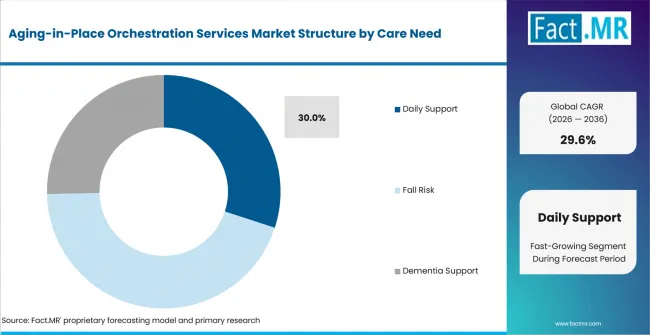
Daily Support leads because meals and transportation create frequent coordination needs. Housekeeping and personal help add repeat service volume. These needs are not always clinical. They often determine whether an older adult can remain at home.
Which end user leads?
Older Adults hold 46.0% share in 2026.
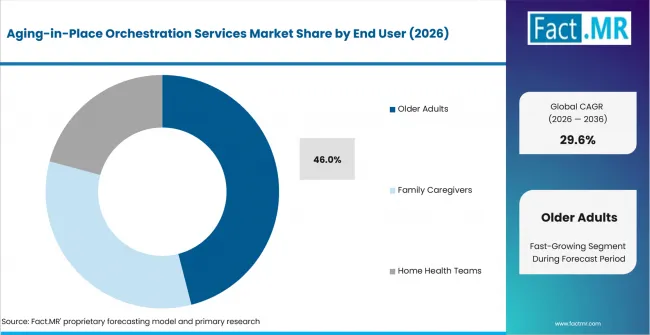
Older Adults lead because the service is built around home residence and day-to-day support. Family caregivers influence the purchase because they compare safety, cost and availability. This creates overlap with personal emergency response systems when alerts need human follow-up rather than device-only response.
What is accelerating aging-in-place orchestration demand, and what is holding it back?
Payer-funded navigation and home support needs drive it. Accountability and provider capacity restrain it.
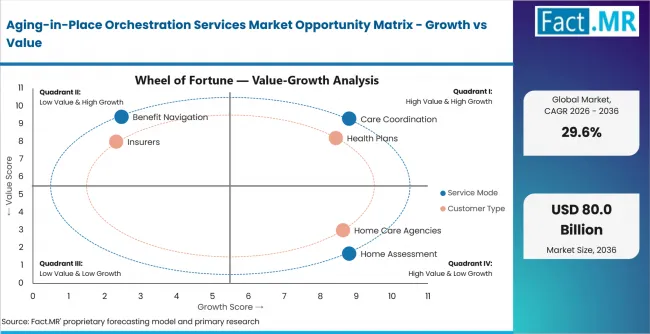
The main driver is payer-funded home navigation. The Centers for Medicare & Medicaid Services GUIDE Model includes care navigation and a 24/7 support line. It also includes respite services up to USD 2,500 annually for eligible patients. That structure supports a broader business case for coordinated home residence. [3]
The second driver is household-level service complexity. Older adults may need transport and meals in the same month. Fall-risk checks and benefit guidance can follow. Providers that connect these tasks to home healthcare pathways can reduce gaps between clinical and non-clinical support.
The main restraint is accountability. Buyers want proof that assessments lead to completed visits, safer homes and fewer avoidable escalations. This creates demand for verified providers and documented service closure. It also raises the operating standard for firms that only sell software.
Where do the biggest aging-in-place orchestration opportunities sit?
Payer benefits, home assessment and provider marketplace routing.
- Payer Benefits: Health plans can package navigation, service payments and evidence of completion inside supplemental or Medicaid-linked benefits.
- Home Assessment: Assessment providers can connect fall-risk checks with home modifications and elder care products when families need practical purchase guidance.
- Provider Marketplace Routing: Platforms can verify local providers, route cases and report whether the requested service was completed.
Which countries are scaling aging-in-place orchestration services fastest?
China leads at 16.8%. Australia follows at 11.8%. Canada records 11.6%. The United Kingdom records 11.3%. Germany and the United States record 10.9%. Japan records 10.7%.
Based on regional analysis, the market is segmented into North America and Europe. East Asia and South Asia and Pacific are also covered. Latin America and Middle East and Africa complete the regional view. The same need also overlaps with health caregiving because family and professional support must work around one household plan.
.webp)
| Country | CAGR |
|---|---|
| China | 16.8% |
| Australia | 11.8% |
| Canada | 11.6% |
| United Kingdom | 11.3% |
| Germany | 10.9% |
| United States | 10.9% |
| Japan | 10.7% |

What explains China’s faster rate?
16.8% CAGR, supported by older adult scale and city-level service routing.
China has a scale problem that requires organized home support before facility capacity can absorb all need. The National Bureau of Statistics of China reported in January 2026 that 223.65 million people were aged 65 and older in 2025, equal to 15.9% of the population. City eldercare portals, insurer-linked service bundles and community health centers are likely to shape commercial access. Ping An Good Doctor, JD Health and Taikang Community Services show how local platforms can connect family-facing service requests with verified providers. [13]
What supports Australia’s outlook?
11.8% CAGR, supported by package navigation and public home support channels.
Australia’s market is shaped by funded home care access and waiting lists. The Australian Government reported that 310,363 people had access to a Home Care Package at September 30 2025. It also reported that 121,909 people were waiting at their approved level. Feros Care and Bolton Clarke operate inside a care route where package guidance matters. Australian Unity and BaptistCare add provider choice to the same family decision. adult day care referrals can also sit inside that journey. [14]
How does Canada build demand?
11.6% CAGR, supported by home adaptation and provincial care routing.
Canada’s large geography makes service availability uneven. Statistics Canada reported in July 2025 that 51.9% of people aged 80 and older used home adaptations. This supports demand for coordinators that can link home safety needs with provincial eligibility. Agency referrals and family guidance are also needed. Bayshore HealthCare and CBI Health operate near home care delivery. AlayaCare and Closing the Gap Healthcare add workflow software or local coordination. [9]
Why does the United Kingdom matter?
11.3% CAGR, supported by aging housing stock and local care pressure.
The United Kingdom is shaped by housing suitability and care funding. The Office for National Statistics reported in April 2026 that the number of people of pensionable age is projected to rise by 1.8 million from mid-2024 to mid-2034. Home Instead United Kingdom and Cera Care can reach families that need practical help. Helping Hands Home Care and Age UK service partners add routes through local authority referrals and private-pay care. [7]
What underpins Germany’s growth?
10.9% CAGR, supported by long-term care structure and insurer documentation needs.
Germany has a structured long-term care system and a large provider base. The Federal Statistical Office of Germany reported in December 2025 that the share of people aged 67 and older is projected to rise from 20.0% in 2024 to 25.0% to 27.0% in 2038. Dussmann Group and Johanniter matter because suppliers need trusted links to insurers. Caritas care services and Diakonie care services add access to community providers and geriatric care services. [12]
What supports the United States revenue base?
10.9% CAGR, supported by payer coverage and home health infrastructure.
United States buyers compare orchestration providers on payer integration and service network coverage. They also want proof that referrals lead to completed household support. The Administration for Community Living reported in May 2024 that people aged 65 and older represented 17.3% of the population in 2022 and are expected to reach 22.0% by 2040. The Helper Bees and Best Buy Health connect payer benefits with senior tech services. Honor Technology and Home Instead add a care network route. [2]
Why is Japan an important aging-at-home market?
10.7% CAGR, supported by long-term care needs and household trust requirements.
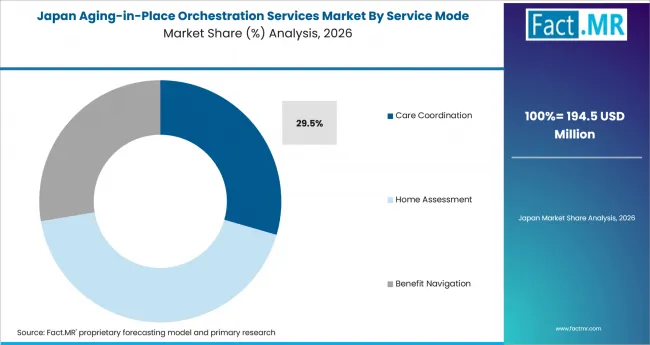
Japan has one of the highest older adult shares among major economies. The Statistics Bureau of Japan reported in its 2025 handbook that people aged 65 and older accounted for 29.3% of the population in 2024. SOMPO Care and Nichii Gakkan are relevant because Japanese buyers need respectful service design. Benesse Style Care and Panasonic Age-Free add familiar communication and care-plan discipline. [10]
Who leads the aging-in-place orchestration services landscape?
The Helper Bees and Best Buy Health lead through payer access and age technology. Honor Technology and Home Instead add care network reach.
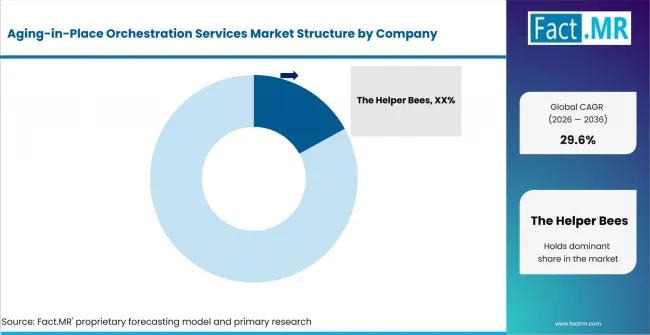
Competition is shaped by whether a supplier can own the handoff between assessment and completed support. The Helper Bees has the clearest payer and benefit-card orientation. Best Buy Health combines device access with human support and retail trust. Honor Technology and Home Instead give the field a care network reference point through home care delivery relationships.
Capability now matters more than brand visibility. Sensi.AI adds sensor-based care intelligence for agencies that need visibility between visits. WellSky and AlayaCare compete through workflow systems. Netsmart Technologies helps providers document care and report service activity.
The better-placed suppliers are those that can prove three things at once. They need verified local provider coverage, payer-ready reporting and a simple family experience. Firms that sell only software or only devices face weaker retention unless they also support case follow-through.
Which companies are the key players?
The Helper Bees. Best Buy Health. Honor Technology and Home Instead. Sensi.AI. WellSky. AlayaCare. Netsmart Technologies.
- The Helper Bees
- Best Buy Health
- Honor Technology and Home Instead
- Sensi.AI
- WellSky
- AlayaCare
- Netsmart Technologies
Recent Industry Developments
- In March 2024, Best Buy Health released Lively Mobile2 as a medical alert device with 24/7/365 access to help through Lively services. The launch shows how device entry points can be tied to human support for older adults at home. [16]
- In January 2025, The Helper Bees secured USD 35 million in Series C funding led by Centana Growth Partners. The company stated that the funding is earmarked for Medicaid expansion and payment innovation. [17]
- In October 2025, Sensi.AI raised USD 45 million in Series C funding led by Qumra Capital. The company stated that total funding exceeded USD 98 million after the round. [18]
- In February 2024, AlayaCare announced a USD 3.2 million project for artificial intelligence tools in Canadian home care with Acclaim Health and Bien Chez Soi. The project shows supplier interest in care routing and home support workflows. [19]
- In June 2024, AlayaCare launched AlayaCare Apps to let home-based care providers create custom workflows. The launch supports provider-specific intake, scheduling and care-plan processes. [20]
- In February 2024, Netsmart announced that VNAcare implemented the myUnity electronic health record solution. Netsmart stated that the expanded relationship supported hospice services and person-centered care in Southern California. [21]
- In January 2025, Home Instead reported that Honor Technology and its subsidiaries supported a large care professional network through Home Instead operations. The update shows how orchestration can be paired with direct care delivery relationships. [22]
Bibliography
- [1] United Nations Population Fund. (2024, June 19). Ageing. United Nations Population Fund. https://www.unfpa.org/ageing
- [2] Administration for Community Living. (2024, May 29). ACL releases 2023 Profile of Older Americans. United States Department of Health and Human Services. https://acl.gov/news-and-events/announcements/acl-releases-2023-profile-older-americans
- [3] Centers for Medicare & Medicaid Services. (2026, June 11). GUIDE Model. United States Department of Health and Human Services. https://www.cms.gov/priorities/innovation/innovation-models/guide
- [4] Medicare Payment Advisory Commission. (2026, March 12). Chapter 8: Home health care services. https://www.medpac.gov/document/chapter-8-home-health-care-services-march-2026-report/
- [5] Centers for Medicare & Medicaid Services. (2026, February). Home health services. United States Department of Health and Human Services. https://www.cms.gov/medicare/health-safety-standards/certification-compliance/home-health-agencies
- [6] Eurostat. (2025). Demography of Europe - 2025 edition. European Commission. https://ec.europa.eu/eurostat/web/interactive-publications/demography-2025
- [7] Office for National Statistics. (2026, April 28). National population projections: 2024-based. https://www.ons.gov.uk/peoplepopulationandcommunity/populationandmigration/populationprojections/bulletins/nationalpopulationprojections/2024based
- [8] Ministry of Housing, Communities and Local Government. (2024, November 26). Our future homes: Housing that promotes wellbeing and community for an ageing population. https://www.gov.uk/government/publications/the-older-peoples-housing-taskforce-report/our-future-homes-housing-that-promotes-wellbeing-and-community-for-an-ageing-population
- [9] Statistics Canada. (2025, July 16). Aging in the community: Factors associated with home adaptations and receipt of informal care, home care, and community support services among older Canadians. https://www150.statcan.gc.ca/n1/pub/82-003-x/2025007/article/00002-eng.htm
- [10] Statistics Bureau of Japan. (2025, September). Statistical handbook of Japan 2025. Ministry of Internal Affairs and Communications. https://www.stat.go.jp/english/data/handbook/pdf/2025all.pdf
- [11] Statistics Bureau of Japan. (2024, October 30). News bulletin: 2023 Housing and Land Survey. Ministry of Internal Affairs and Communications. https://www.stat.go.jp/english/info/news/20241030.html
- [12] Federal Statistical Office of Germany. (2025, December 11). By 2035, one quarter of Germany’s population will be aged 67 or over. https://www.destatis.de/EN/Press/2025/12/PE25_446_12.html
- [13] National Bureau of Statistics of China. (2026, January 19). National economy pushed forward amid steady progress in 2025. https://www.stats.gov.cn/english/PressRelease/202601/t20260119_1958090.html
- [14] Australian Government Department of Health, Disability and Ageing. (2025, September). Home Care Packages Program data report, Quarter 1 2025-26. GEN Aged Care Data. https://www.gen-agedcaredata.gov.au/resources/home-care-packages-program-data-report-q1-2025-26
- [15] Australian Institute of Health and Welfare. (2026, May). People using aged care. GEN Aged Care Data. https://www.gen-agedcaredata.gov.au/topics/people-using-aged-care
- [16] Best Buy. (2024, March 11). Lively from Best Buy Health releases Lively Mobile2. https://corporate.bestbuy.com/2024/lively-from-best-buy-health-releases-lively-mobile2/
- [17] The Helper Bees. (2025, January 28). The Helper Bees secures $35 million to expand aging-in-place platform. https://www.thehelperbees.com/content/the-helper-bees-secures-35-million-to-expand-aging-in-place-platform
- [18] Sensi.AI. (2025, October 9). Sensi.AI raises $45M Series C, extending care intelligence in senior care. https://www.sensi.ai/blog/sensi-ai-raises-45m-series-c-extending-its-dominance-of-care-intelligence-in-vertical-ai/
- [19] AlayaCare. (2024, February 29). AlayaCare announces new $3.2M project to drive AI solutions in Canadian home care. https://alayacare.com/alayacare-announces-new-dollar32m-project-to-drive-ai-solutions-in-canadian-home-care/
- [20] AlayaCare. (2024, June 27). AlayaCare launches AlayaCare Apps for personalized workflows. https://alayacare.com/alayacare-launches-alayacare-apps-revolutionizing-home-care-with-personalized-and-custom-built-solutions/
- [21] AlayaCare. (2025, March 4). AlayaCare selected by AccordCare. https://alayacare.com/alayacare-selected-by-accordcare/
- [22] Netsmart Technologies. (2024, February 1). VNAcare and Netsmart accelerate hospice services and value-based care in Southern California. https://www.ntst.com/company/news/news-release-vnacare-and-netsmart-accelerate-hospice-services
- [23] Home Instead. (2025, January 8). Honor Technology and its subsidiaries celebrate a year of accolades. https://www.homeinstead.com/news-and-media/honor-technology-and-its-subsidiaries-celebrate-a-year-of-accolades/
This Report Address
- Strategic intelligence on aging-in-place orchestration services across service model, customer type, delivery channel and care need.
- Segment analysis covering Care Coordination, Health Plans, Payer-Sponsored channels, Care Platform services and Daily Support.
- Country outlook covering China, Australia, Canada, the United Kingdom, Germany, the United States and Japan.
- Competitive assessment of The Helper Bees, Best Buy Health, Honor Technology and Home Instead, Sensi.AI, WellSky, AlayaCare and Netsmart Technologies.
- Service assessment covering benefit navigation, home assessment, provider marketplace matching, remote check-ins and emergency escalation.
- Methodology using official aging statistics, home health payment evidence, public care program data, company developments and primary interview validation.
What does the aging-in-place orchestration services market cover?
Care routing, benefit navigation and home support follow-up for older adults living at home.
The aging-in-place orchestration services market covers services that organize practical support for older adults who want to remain at home. It includes care coordination and benefit checks. Provider matching and home assessment also sit inside the scope. Status updates help families or care managers track follow-through. The market differs from direct home care because the service focus is planning and routing.
What is included in the scope?
Care coordination, home support navigation and technology-assisted follow-up.
The scope includes care navigation for older adults who live at home. It covers benefit guidance for payer programs and private insurance. Public support channels are also included. Home assessment and non-medical provider matching sit inside the scope. Family communication and recurring check-ins are included when they support aging-at-home coordination.
What is excluded from the scope?
Direct care labor, facility care and standalone device sales without orchestration.
The scope excludes hourly caregiver wages unless the revenue is charged as a coordination service fee. It excludes nursing homes, assisted living and residential care facilities. It also excludes standalone medical alert devices, sensors and applications when they are sold without care navigation or follow-up support.
How was the analysis built?
120+ sources. 45+ company portfolios. 30+ countries and 28+ primary interview touchpoints.
- Primary Research:
- Primary research includes interviews with payer benefit managers, home care agency operators and care coordinators. It also includes input from age technology providers and family caregiver benefit managers.
- Desk Research:
- Desk research reviews government aging statistics, public home care program data and company service portfolios. It also covers home health payment evidence and care platform launches.
- Market-Sizing and Forecasting:
- Forecasting uses older adult population pools, home support user counts and payer care management budgets. Service attach rates for assessment, navigation and recurring check-ins support the market assessment.
- Data Validation and Update Cycle:
- Forecasts are validated through provider checks, official program updates and company development tracking. Country assumptions are updated when public funding, home care access or payer benefit rules change.
What is the report’s scope and coverage?
| Attribute | Details |
|---|---|
| Quantitative Units | USD Billion in 2026 to USD Billion by 2036 |
| Market Definition | Care coordination, home support navigation and follow-up services that help older adults remain at home |
| Service Model | Care Coordination, Benefit Navigation, Home Assessment, Provider Marketplace, Remote Check-In, Emergency Escalation |
| Customer Type | Health Plans, Home Care Agencies, Insurers, Families, Government Programs, Senior Operators |
| Delivery Channel | Payer-Sponsored, Direct Consumer, Employer Benefit, Public Program, Agency Referral |
| Technology Layer | Care Platform, Sensor Monitoring, Telehealth Routing, Scheduling Automation, Payment Orchestration |
| Care Need | Daily Support, Fall Risk, Dementia Support, Medication Support, Social Isolation, Home Modification |
| End User | Older Adults, Family Caregivers, Care Managers, Home Health Teams, Community Agencies |
| Regions Covered | North America, Europe, East Asia, South Asia and Pacific, Latin America, Middle East and Africa |
| Countries Covered | China, Australia, Canada, United Kingdom, Germany, United States and Japan |
| Key Companies Profiled | The Helper Bees, Best Buy Health, Honor Technology and Home Instead, Sensi.AI, WellSky, AlayaCare and Netsmart Technologies |
| Forecast Period | 2026 to 2036 |
| Approach | Hybrid top-down and bottom-up approach using older adult populations, home support user counts, payer program evidence and provider validation |
How is the market segmented?
-
By Service Model:
- Care Coordination
- Benefit Navigation
- Home Assessment
- Provider Marketplace
- Remote Check-In
- Emergency Escalation
-
By Customer Type:
- Health Plans
- Home Care Agencies
- Insurers
- Families
- Government Programs
- Senior Operators
-
By Delivery Channel:
- Payer-Sponsored
- Direct Consumer
- Employer Benefit
- Public Program
- Agency Referral
-
By Technology Layer:
- Care Platform
- Sensor Monitoring
- Telehealth Routing
- Scheduling Automation
- Payment Orchestration
-
By Care Need:
- Daily Support
- Fall Risk
- Dementia Support
- Medication Support
- Social Isolation
- Home Modification
-
By End User:
- Older Adults
- Family Caregivers
- Care Managers
- Home Health Teams
- Community Agencies
-
By Region:
- North America:
- United States and Canada plus Mexico
- Latin America:
- Brazil and Argentina plus Rest of Latin America
- Europe:
- Germany and United Kingdom plus France and Italy. Spain and Rest of Europe are also covered.
- Asia Pacific:
- China and India plus Japan and South Korea. Australia and ASEAN are also covered.
- Middle East and Africa:
- Gulf Cooperation Council Countries and South Africa. United Arab Emirates and Rest of Middle East and Africa are also covered.
- North America:
- Frequently Asked Questions -
Which service model leads the market?
Care Coordination leads with 31.0% share in 2026 because buyers need one plan across assessment, benefits, referral and follow-up.
Which customer type holds the largest share?
Health Plans hold 34.0% share in 2026 as payer-funded home support becomes a stronger channel for navigation services.
Which delivery channel is largest?
Payer-Sponsored services hold 38.0% share in 2026 because covered channels reduce out-of-pocket friction.
Which country grows fastest?
China grows fastest at 16.8% CAGR through 2036 because its older adult base is large and formal home support penetration remains below developed-market levels.
Which country is largest in 2026?
The United States is the largest country market in 2026 due to payer activity, home health infrastructure and service network depth.
Who are the key companies?
The key companies are The Helper Bees, Best Buy Health, Honor Technology and Home Instead, Sensi.AI, WellSky, AlayaCare and Netsmart Technologies.
What is excluded from the market scope?
The scope excludes direct caregiver wages, facility care, standalone device sales and clinical monitoring sold without aging-at-home service coordination.
Table of Content
- Executive Summary
- Global Market Outlook
- Demand to side Trends
- Supply to side Trends
- Technology Roadmap Analysis
- Analysis and Recommendations
- Market Overview
- Market Coverage / Taxonomy
- Market Definition / Scope / Limitations
- Research Methodology
- Chapter Orientation
- Analytical Lens and Working Hypotheses
- Market Structure, Signals, and Trend Drivers
- Benchmarking and Cross-market Comparability
- Market Sizing, Forecasting, and Opportunity Mapping
- Research Design and Evidence Framework
- Desk Research Programme (Secondary Evidence)
- Company Annual and Sustainability Reports
- Peer-reviewed Journals and Academic Literature
- Corporate Websites, Product Literature, and Technical Notes
- Earnings Decks and Investor Briefings
- Statutory Filings and Regulatory Disclosures
- Technical White Papers and Standards Notes
- Trade Journals, Industry Magazines, and Analyst Briefs
- Conference Proceedings, Webinars, and Seminar Materials
- Government Statistics Portals and Public Data Releases
- Press Releases and Reputable Media Coverage
- Specialist Newsletters and Curated Briefings
- Sector Databases and Reference Repositories
- Fact.MR Internal Proprietary Databases and Historical Market Datasets
- Subscription Datasets and Paid Sources
- Social Channels, Communities, and Digital Listening Inputs
- Additional Desk Sources
- Expert Input and Fieldwork (Primary Evidence)
- Primary Modes
- Qualitative Interviews and Expert Elicitation
- Quantitative Surveys and Structured Data Capture
- Blended Approach
- Why Primary Evidence is Used
- Field Techniques
- Interviews
- Surveys
- Focus Groups
- Observational and In-context Research
- Social and Community Interactions
- Stakeholder Universe Engaged
- C-suite Leaders
- Board Members
- Presidents and Vice Presidents
- R&D and Innovation Heads
- Technical Specialists
- Domain Subject-matter Experts
- Scientists
- Physicians and Other Healthcare Professionals
- Governance, Ethics, and Data Stewardship
- Research Ethics
- Data Integrity and Handling
- Primary Modes
- Tooling, Models, and Reference Databases
- Desk Research Programme (Secondary Evidence)
- Data Engineering and Model Build
- Data Acquisition and Ingestion
- Cleaning, Normalisation, and Verification
- Synthesis, Triangulation, and Analysis
- Quality Assurance and Audit Trail
- Market Background
- Market Dynamics
- Drivers
- Restraints
- Opportunity
- Trends
- Scenario Forecast
- Demand in Optimistic Scenario
- Demand in Likely Scenario
- Demand in Conservative Scenario
- Opportunity Map Analysis
- Product Life Cycle Analysis
- Supply Chain Analysis
- Investment Feasibility Matrix
- Value Chain Analysis
- PESTLE and Porter’s Analysis
- Regulatory Landscape
- Regional Parent Market Outlook
- Production and Consumption Statistics
- Import and Export Statistics
- Market Dynamics
- Global Market Analysis 2021 to 2025 and Forecast, 2026 to 2036
- Historical Market Size Value (USD Million) Analysis, 2021 to 2025
- Current and Future Market Size Value (USD Million) Projections, 2026 to 2036
- Y to o to Y Growth Trend Analysis
- Absolute $ Opportunity Analysis
- Global Market Pricing Analysis 2021 to 2025 and Forecast 2026 to 2036
- Global Market Analysis 2021 to 2025 and Forecast 2026 to 2036, By Service Mode
- Introduction / Key Findings
- Historical Market Size Value (USD Million) Analysis By Service Mode , 2021 to 2025
- Current and Future Market Size Value (USD Million) Analysis and Forecast By Service Mode , 2026 to 2036
- Care Coordination
- Home Assessment
- Benefit Navigation
- Care Coordination
- Y to o to Y Growth Trend Analysis By Service Mode , 2021 to 2025
- Absolute $ Opportunity Analysis By Service Mode , 2026 to 2036
- Global Market Analysis 2021 to 2025 and Forecast 2026 to 2036, By Customer Type
- Introduction / Key Findings
- Historical Market Size Value (USD Million) Analysis By Customer Type, 2021 to 2025
- Current and Future Market Size Value (USD Million) Analysis and Forecast By Customer Type, 2026 to 2036
- Health Plans
- Home Care Agencies
- Insurers
- Health Plans
- Y to o to Y Growth Trend Analysis By Customer Type, 2021 to 2025
- Absolute $ Opportunity Analysis By Customer Type, 2026 to 2036
- Global Market Analysis 2021 to 2025 and Forecast 2026 to 2036, By Delivery Channel
- Introduction / Key Findings
- Historical Market Size Value (USD Million) Analysis By Delivery Channel, 2021 to 2025
- Current and Future Market Size Value (USD Million) Analysis and Forecast By Delivery Channel, 2026 to 2036
- Payer-Sponsored
- Direct Consumer
- Public Program
- Payer-Sponsored
- Y to o to Y Growth Trend Analysis By Delivery Channel, 2021 to 2025
- Absolute $ Opportunity Analysis By Delivery Channel, 2026 to 2036
- Global Market Analysis 2021 to 2025 and Forecast 2026 to 2036, By Technology Layer
- Introduction / Key Findings
- Historical Market Size Value (USD Million) Analysis By Technology Layer, 2021 to 2025
- Current and Future Market Size Value (USD Million) Analysis and Forecast By Technology Layer, 2026 to 2036
- Care Platform
- Sensor Monitoring
- Telehealth Routing
- Care Platform
- Y to o to Y Growth Trend Analysis By Technology Layer, 2021 to 2025
- Absolute $ Opportunity Analysis By Technology Layer, 2026 to 2036
- Global Market Analysis 2021 to 2025 and Forecast 2026 to 2036, By Care Need
- Introduction / Key Findings
- Historical Market Size Value (USD Million) Analysis By Care Need, 2021 to 2025
- Current and Future Market Size Value (USD Million) Analysis and Forecast By Care Need, 2026 to 2036
- Daily Support
- Fall Risk
- Dementia Support
- Daily Support
- Y to o to Y Growth Trend Analysis By Care Need, 2021 to 2025
- Absolute $ Opportunity Analysis By Care Need, 2026 to 2036
- Global Market Analysis 2021 to 2025 and Forecast 2026 to 2036, By End User
- Introduction / Key Findings
- Historical Market Size Value (USD Million) Analysis By End User, 2021 to 2025
- Current and Future Market Size Value (USD Million) Analysis and Forecast By End User, 2026 to 2036
- Older Adults
- Family Caregivers
- Home Health Teams
- Older Adults
- Y to o to Y Growth Trend Analysis By End User, 2021 to 2025
- Absolute $ Opportunity Analysis By End User, 2026 to 2036
- Global Market Analysis 2021 to 2025 and Forecast 2026 to 2036, By Region
- Introduction
- Historical Market Size Value (USD Million) Analysis By Region, 2021 to 2025
- Current Market Size Value (USD Million) Analysis and Forecast By Region, 2026 to 2036
- North America
- Latin America
- Western Europe
- Eastern Europe
- East Asia
- South Asia and Pacific
- Middle East & Africa
- Market Attractiveness Analysis By Region
- North America Market Analysis 2021 to 2025 and Forecast 2026 to 2036, By Country
- Historical Market Size Value (USD Million) Trend Analysis By Market Taxonomy, 2021 to 2025
- Market Size Value (USD Million) Forecast By Market Taxonomy, 2026 to 2036
- By Country
- USA
- Canada
- Mexico
- By Service Mode
- By Customer Type
- By Delivery Channel
- By Technology Layer
- By Care Need
- By End User
- By Country
- Market Attractiveness Analysis
- By Country
- By Service Mode
- By Customer Type
- By Delivery Channel
- By Technology Layer
- By Care Need
- By End User
- Key Takeaways
- Latin America Market Analysis 2021 to 2025 and Forecast 2026 to 2036, By Country
- Historical Market Size Value (USD Million) Trend Analysis By Market Taxonomy, 2021 to 2025
- Market Size Value (USD Million) Forecast By Market Taxonomy, 2026 to 2036
- By Country
- Brazil
- Chile
- Rest of Latin America
- By Service Mode
- By Customer Type
- By Delivery Channel
- By Technology Layer
- By Care Need
- By End User
- By Country
- Market Attractiveness Analysis
- By Country
- By Service Mode
- By Customer Type
- By Delivery Channel
- By Technology Layer
- By Care Need
- By End User
- Key Takeaways
- Western Europe Market Analysis 2021 to 2025 and Forecast 2026 to 2036, By Country
- Historical Market Size Value (USD Million) Trend Analysis By Market Taxonomy, 2021 to 2025
- Market Size Value (USD Million) Forecast By Market Taxonomy, 2026 to 2036
- By Country
- Germany
- UK
- Italy
- Spain
- France
- Nordic
- BENELUX
- Rest of Western Europe
- By Service Mode
- By Customer Type
- By Delivery Channel
- By Technology Layer
- By Care Need
- By End User
- By Country
- Market Attractiveness Analysis
- By Country
- By Service Mode
- By Customer Type
- By Delivery Channel
- By Technology Layer
- By Care Need
- By End User
- Key Takeaways
- Eastern Europe Market Analysis 2021 to 2025 and Forecast 2026 to 2036, By Country
- Historical Market Size Value (USD Million) Trend Analysis By Market Taxonomy, 2021 to 2025
- Market Size Value (USD Million) Forecast By Market Taxonomy, 2026 to 2036
- By Country
- Russia
- Poland
- Hungary
- Balkan & Baltic
- Rest of Eastern Europe
- By Service Mode
- By Customer Type
- By Delivery Channel
- By Technology Layer
- By Care Need
- By End User
- By Country
- Market Attractiveness Analysis
- By Country
- By Service Mode
- By Customer Type
- By Delivery Channel
- By Technology Layer
- By Care Need
- By End User
- Key Takeaways
- East Asia Market Analysis 2021 to 2025 and Forecast 2026 to 2036, By Country
- Historical Market Size Value (USD Million) Trend Analysis By Market Taxonomy, 2021 to 2025
- Market Size Value (USD Million) Forecast By Market Taxonomy, 2026 to 2036
- By Country
- China
- Japan
- South Korea
- By Service Mode
- By Customer Type
- By Delivery Channel
- By Technology Layer
- By Care Need
- By End User
- By Country
- Market Attractiveness Analysis
- By Country
- By Service Mode
- By Customer Type
- By Delivery Channel
- By Technology Layer
- By Care Need
- By End User
- Key Takeaways
- South Asia and Pacific Market Analysis 2021 to 2025 and Forecast 2026 to 2036, By Country
- Historical Market Size Value (USD Million) Trend Analysis By Market Taxonomy, 2021 to 2025
- Market Size Value (USD Million) Forecast By Market Taxonomy, 2026 to 2036
- By Country
- India
- ASEAN
- Australia & New Zealand
- Rest of South Asia and Pacific
- By Service Mode
- By Customer Type
- By Delivery Channel
- By Technology Layer
- By Care Need
- By End User
- By Country
- Market Attractiveness Analysis
- By Country
- By Service Mode
- By Customer Type
- By Delivery Channel
- By Technology Layer
- By Care Need
- By End User
- Key Takeaways
- Middle East & Africa Market Analysis 2021 to 2025 and Forecast 2026 to 2036, By Country
- Historical Market Size Value (USD Million) Trend Analysis By Market Taxonomy, 2021 to 2025
- Market Size Value (USD Million) Forecast By Market Taxonomy, 2026 to 2036
- By Country
- Kingdom of Saudi Arabia
- Other GCC Countries
- Turkiye
- South Africa
- Other African Union
- Rest of Middle East & Africa
- By Service Mode
- By Customer Type
- By Delivery Channel
- By Technology Layer
- By Care Need
- By End User
- By Country
- Market Attractiveness Analysis
- By Country
- By Service Mode
- By Customer Type
- By Delivery Channel
- By Technology Layer
- By Care Need
- By End User
- Key Takeaways
- Key Countries Market Analysis
- USA
- Pricing Analysis
- Market Share Analysis, 2025
- By Service Mode
- By Customer Type
- By Delivery Channel
- By Technology Layer
- By Care Need
- By End User
- Canada
- Pricing Analysis
- Market Share Analysis, 2025
- By Service Mode
- By Customer Type
- By Delivery Channel
- By Technology Layer
- By Care Need
- By End User
- Mexico
- Pricing Analysis
- Market Share Analysis, 2025
- By Service Mode
- By Customer Type
- By Delivery Channel
- By Technology Layer
- By Care Need
- By End User
- Brazil
- Pricing Analysis
- Market Share Analysis, 2025
- By Service Mode
- By Customer Type
- By Delivery Channel
- By Technology Layer
- By Care Need
- By End User
- Chile
- Pricing Analysis
- Market Share Analysis, 2025
- By Service Mode
- By Customer Type
- By Delivery Channel
- By Technology Layer
- By Care Need
- By End User
- Germany
- Pricing Analysis
- Market Share Analysis, 2025
- By Service Mode
- By Customer Type
- By Delivery Channel
- By Technology Layer
- By Care Need
- By End User
- UK
- Pricing Analysis
- Market Share Analysis, 2025
- By Service Mode
- By Customer Type
- By Delivery Channel
- By Technology Layer
- By Care Need
- By End User
- Italy
- Pricing Analysis
- Market Share Analysis, 2025
- By Service Mode
- By Customer Type
- By Delivery Channel
- By Technology Layer
- By Care Need
- By End User
- Spain
- Pricing Analysis
- Market Share Analysis, 2025
- By Service Mode
- By Customer Type
- By Delivery Channel
- By Technology Layer
- By Care Need
- By End User
- France
- Pricing Analysis
- Market Share Analysis, 2025
- By Service Mode
- By Customer Type
- By Delivery Channel
- By Technology Layer
- By Care Need
- By End User
- India
- Pricing Analysis
- Market Share Analysis, 2025
- By Service Mode
- By Customer Type
- By Delivery Channel
- By Technology Layer
- By Care Need
- By End User
- ASEAN
- Pricing Analysis
- Market Share Analysis, 2025
- By Service Mode
- By Customer Type
- By Delivery Channel
- By Technology Layer
- By Care Need
- By End User
- Australia & New Zealand
- Pricing Analysis
- Market Share Analysis, 2025
- By Service Mode
- By Customer Type
- By Delivery Channel
- By Technology Layer
- By Care Need
- By End User
- China
- Pricing Analysis
- Market Share Analysis, 2025
- By Service Mode
- By Customer Type
- By Delivery Channel
- By Technology Layer
- By Care Need
- By End User
- Japan
- Pricing Analysis
- Market Share Analysis, 2025
- By Service Mode
- By Customer Type
- By Delivery Channel
- By Technology Layer
- By Care Need
- By End User
- South Korea
- Pricing Analysis
- Market Share Analysis, 2025
- By Service Mode
- By Customer Type
- By Delivery Channel
- By Technology Layer
- By Care Need
- By End User
- Russia
- Pricing Analysis
- Market Share Analysis, 2025
- By Service Mode
- By Customer Type
- By Delivery Channel
- By Technology Layer
- By Care Need
- By End User
- Poland
- Pricing Analysis
- Market Share Analysis, 2025
- By Service Mode
- By Customer Type
- By Delivery Channel
- By Technology Layer
- By Care Need
- By End User
- Hungary
- Pricing Analysis
- Market Share Analysis, 2025
- By Service Mode
- By Customer Type
- By Delivery Channel
- By Technology Layer
- By Care Need
- By End User
- Kingdom of Saudi Arabia
- Pricing Analysis
- Market Share Analysis, 2025
- By Service Mode
- By Customer Type
- By Delivery Channel
- By Technology Layer
- By Care Need
- By End User
- Turkiye
- Pricing Analysis
- Market Share Analysis, 2025
- By Service Mode
- By Customer Type
- By Delivery Channel
- By Technology Layer
- By Care Need
- By End User
- South Africa
- Pricing Analysis
- Market Share Analysis, 2025
- By Service Mode
- By Customer Type
- By Delivery Channel
- By Technology Layer
- By Care Need
- By End User
- USA
- Market Structure Analysis
- Competition Dashboard
- Competition Benchmarking
- Market Share Analysis of Top Players
- By Regional
- By Service Mode
- By Customer Type
- By Delivery Channel
- By Technology Layer
- By Care Need
- By End User
- Competition Analysis
- Competition Deep Dive
- The Helper Bees
- Overview
- Product Portfolio
- Profitability by Market Segments (Product/Age /Sales Channel/Region)
- Sales Footprint
- Strategy Overview
- Marketing Strategy
- Product Strategy
- Channel Strategy
- Best Buy Health
- Honor Technology and Home Instead
- Sensi.AI
- WellSky
- AlayaCare
- Netsmart Technologies
- The Helper Bees
- Competition Deep Dive
- Assumptions & Acronyms Used
List Of Table
- Table 1: Global Market Value (USD Million) Forecast by Region, 2021 to 2036
- Table 2: Global Market Value (USD Million) Forecast by Service Mode , 2021 to 2036
- Table 3: Global Market Value (USD Million) Forecast by Customer Type, 2021 to 2036
- Table 4: Global Market Value (USD Million) Forecast by Delivery Channel, 2021 to 2036
- Table 5: Global Market Value (USD Million) Forecast by Technology Layer, 2021 to 2036
- Table 6: Global Market Value (USD Million) Forecast by Care Need, 2021 to 2036
- Table 7: Global Market Value (USD Million) Forecast by End User, 2021 to 2036
- Table 8: North America Market Value (USD Million) Forecast by Country, 2021 to 2036
- Table 9: North America Market Value (USD Million) Forecast by Service Mode , 2021 to 2036
- Table 10: North America Market Value (USD Million) Forecast by Customer Type, 2021 to 2036
- Table 11: North America Market Value (USD Million) Forecast by Delivery Channel, 2021 to 2036
- Table 12: North America Market Value (USD Million) Forecast by Technology Layer, 2021 to 2036
- Table 13: North America Market Value (USD Million) Forecast by Care Need, 2021 to 2036
- Table 14: North America Market Value (USD Million) Forecast by End User, 2021 to 2036
- Table 15: Latin America Market Value (USD Million) Forecast by Country, 2021 to 2036
- Table 16: Latin America Market Value (USD Million) Forecast by Service Mode , 2021 to 2036
- Table 17: Latin America Market Value (USD Million) Forecast by Customer Type, 2021 to 2036
- Table 18: Latin America Market Value (USD Million) Forecast by Delivery Channel, 2021 to 2036
- Table 19: Latin America Market Value (USD Million) Forecast by Technology Layer, 2021 to 2036
- Table 20: Latin America Market Value (USD Million) Forecast by Care Need, 2021 to 2036
- Table 21: Latin America Market Value (USD Million) Forecast by End User, 2021 to 2036
- Table 22: Western Europe Market Value (USD Million) Forecast by Country, 2021 to 2036
- Table 23: Western Europe Market Value (USD Million) Forecast by Service Mode , 2021 to 2036
- Table 24: Western Europe Market Value (USD Million) Forecast by Customer Type, 2021 to 2036
- Table 25: Western Europe Market Value (USD Million) Forecast by Delivery Channel, 2021 to 2036
- Table 26: Western Europe Market Value (USD Million) Forecast by Technology Layer, 2021 to 2036
- Table 27: Western Europe Market Value (USD Million) Forecast by Care Need, 2021 to 2036
- Table 28: Western Europe Market Value (USD Million) Forecast by End User, 2021 to 2036
- Table 29: Eastern Europe Market Value (USD Million) Forecast by Country, 2021 to 2036
- Table 30: Eastern Europe Market Value (USD Million) Forecast by Service Mode , 2021 to 2036
- Table 31: Eastern Europe Market Value (USD Million) Forecast by Customer Type, 2021 to 2036
- Table 32: Eastern Europe Market Value (USD Million) Forecast by Delivery Channel, 2021 to 2036
- Table 33: Eastern Europe Market Value (USD Million) Forecast by Technology Layer, 2021 to 2036
- Table 34: Eastern Europe Market Value (USD Million) Forecast by Care Need, 2021 to 2036
- Table 35: Eastern Europe Market Value (USD Million) Forecast by End User, 2021 to 2036
- Table 36: East Asia Market Value (USD Million) Forecast by Country, 2021 to 2036
- Table 37: East Asia Market Value (USD Million) Forecast by Service Mode , 2021 to 2036
- Table 38: East Asia Market Value (USD Million) Forecast by Customer Type, 2021 to 2036
- Table 39: East Asia Market Value (USD Million) Forecast by Delivery Channel, 2021 to 2036
- Table 40: East Asia Market Value (USD Million) Forecast by Technology Layer, 2021 to 2036
- Table 41: East Asia Market Value (USD Million) Forecast by Care Need, 2021 to 2036
- Table 42: East Asia Market Value (USD Million) Forecast by End User, 2021 to 2036
- Table 43: South Asia and Pacific Market Value (USD Million) Forecast by Country, 2021 to 2036
- Table 44: South Asia and Pacific Market Value (USD Million) Forecast by Service Mode , 2021 to 2036
- Table 45: South Asia and Pacific Market Value (USD Million) Forecast by Customer Type, 2021 to 2036
- Table 46: South Asia and Pacific Market Value (USD Million) Forecast by Delivery Channel, 2021 to 2036
- Table 47: South Asia and Pacific Market Value (USD Million) Forecast by Technology Layer, 2021 to 2036
- Table 48: South Asia and Pacific Market Value (USD Million) Forecast by Care Need, 2021 to 2036
- Table 49: South Asia and Pacific Market Value (USD Million) Forecast by End User, 2021 to 2036
- Table 50: Middle East & Africa Market Value (USD Million) Forecast by Country, 2021 to 2036
- Table 51: Middle East & Africa Market Value (USD Million) Forecast by Service Mode , 2021 to 2036
- Table 52: Middle East & Africa Market Value (USD Million) Forecast by Customer Type, 2021 to 2036
- Table 53: Middle East & Africa Market Value (USD Million) Forecast by Delivery Channel, 2021 to 2036
- Table 54: Middle East & Africa Market Value (USD Million) Forecast by Technology Layer, 2021 to 2036
- Table 55: Middle East & Africa Market Value (USD Million) Forecast by Care Need, 2021 to 2036
- Table 56: Middle East & Africa Market Value (USD Million) Forecast by End User, 2021 to 2036
List Of Figures
- Figure 1: Global Market Pricing Analysis
- Figure 2: Global Market Value (USD Million) Forecast 2021-2036
- Figure 3: Global Market Value Share and BPS Analysis by Service Mode,2026 and 2036
- Figure 4: Global Market Y-o-Y Growth Comparison by Service Mode,2026 to 2036
- Figure 5: Global Market Attractiveness Analysis by Service Mode
- Figure 6: Global Market Value Share and BPS Analysis by Customer Type,2026 and 2036
- Figure 7: Global Market Y-o-Y Growth Comparison by Customer Type,2026 to 2036
- Figure 8: Global Market Attractiveness Analysis by Customer Type
- Figure 9: Global Market Value Share and BPS Analysis by Delivery Channel,2026 and 2036
- Figure 10: Global Market Y-o-Y Growth Comparison by Delivery Channel,2026 to 2036
- Figure 11: Global Market Attractiveness Analysis by Delivery Channel
- Figure 12: Global Market Value Share and BPS Analysis by Technology Layer,2026 and 2036
- Figure 13: Global Market Y-o-Y Growth Comparison by Technology Layer,2026 to 2036
- Figure 14: Global Market Attractiveness Analysis by Technology Layer
- Figure 15: Global Market Value Share and BPS Analysis by Care Need,2026 and 2036
- Figure 16: Global Market Y-o-Y Growth Comparison by Care Need,2026 to 2036
- Figure 17: Global Market Attractiveness Analysis by Care Need
- Figure 18: Global Market Value Share and BPS Analysis by End User,2026 and 2036
- Figure 19: Global Market Y-o-Y Growth Comparison by End User,2026 to 2036
- Figure 20: Global Market Attractiveness Analysis by End User
- Figure 21: Global Market Value (USD Million) Share and BPS Analysis by Region,2026 and 2036
- Figure 22: Global Market Y-o-Y Growth Comparison by Region,2026 to 2036
- Figure 23: Global Market Attractiveness Analysis by Region
- Figure 24: North America Market Incremental Dollar Opportunity,2026 to 2036
- Figure 25: Latin America Market Incremental Dollar Opportunity,2026 to 2036
- Figure 26: Western Europe Market Incremental Dollar Opportunity,2026 to 2036
- Figure 27: Eastern Europe Market Incremental Dollar Opportunity,2026 to 2036
- Figure 28: East Asia Market Incremental Dollar Opportunity,2026 to 2036
- Figure 29: South Asia and Pacific Market Incremental Dollar Opportunity,2026 to 2036
- Figure 30: Middle East & Africa Market Incremental Dollar Opportunity,2026 to 2036
- Figure 31: North America Market Value Share and BPS Analysis by Country,2026 and 2036
- Figure 32: North America Market Value Share and BPS Analysis by Service Mode,2026 and 2036
- Figure 33: North America Market Y-o-Y Growth Comparison by Service Mode,2026 to 2036
- Figure 34: North America Market Attractiveness Analysis by Service Mode
- Figure 35: North America Market Value Share and BPS Analysis by Customer Type,2026 and 2036
- Figure 36: North America Market Y-o-Y Growth Comparison by Customer Type,2026 to 2036
- Figure 37: North America Market Attractiveness Analysis by Customer Type
- Figure 38: North America Market Value Share and BPS Analysis by Delivery Channel,2026 and 2036
- Figure 39: North America Market Y-o-Y Growth Comparison by Delivery Channel,2026 to 2036
- Figure 40: North America Market Attractiveness Analysis by Delivery Channel
- Figure 41: North America Market Value Share and BPS Analysis by Technology Layer,2026 and 2036
- Figure 42: North America Market Y-o-Y Growth Comparison by Technology Layer,2026 to 2036
- Figure 43: North America Market Attractiveness Analysis by Technology Layer
- Figure 44: North America Market Value Share and BPS Analysis by Care Need,2026 and 2036
- Figure 45: North America Market Y-o-Y Growth Comparison by Care Need,2026 to 2036
- Figure 46: North America Market Attractiveness Analysis by Care Need
- Figure 47: North America Market Value Share and BPS Analysis by End User,2026 and 2036
- Figure 48: North America Market Y-o-Y Growth Comparison by End User,2026 to 2036
- Figure 49: North America Market Attractiveness Analysis by End User
- Figure 50: Latin America Market Value Share and BPS Analysis by Country,2026 and 2036
- Figure 51: Latin America Market Value Share and BPS Analysis by Service Mode,2026 and 2036
- Figure 52: Latin America Market Y-o-Y Growth Comparison by Service Mode,2026 to 2036
- Figure 53: Latin America Market Attractiveness Analysis by Service Mode
- Figure 54: Latin America Market Value Share and BPS Analysis by Customer Type,2026 and 2036
- Figure 55: Latin America Market Y-o-Y Growth Comparison by Customer Type,2026 to 2036
- Figure 56: Latin America Market Attractiveness Analysis by Customer Type
- Figure 57: Latin America Market Value Share and BPS Analysis by Delivery Channel,2026 and 2036
- Figure 58: Latin America Market Y-o-Y Growth Comparison by Delivery Channel,2026 to 2036
- Figure 59: Latin America Market Attractiveness Analysis by Delivery Channel
- Figure 60: Latin America Market Value Share and BPS Analysis by Technology Layer,2026 and 2036
- Figure 61: Latin America Market Y-o-Y Growth Comparison by Technology Layer,2026 to 2036
- Figure 62: Latin America Market Attractiveness Analysis by Technology Layer
- Figure 63: Latin America Market Value Share and BPS Analysis by Care Need,2026 and 2036
- Figure 64: Latin America Market Y-o-Y Growth Comparison by Care Need,2026 to 2036
- Figure 65: Latin America Market Attractiveness Analysis by Care Need
- Figure 66: Latin America Market Value Share and BPS Analysis by End User,2026 and 2036
- Figure 67: Latin America Market Y-o-Y Growth Comparison by End User,2026 to 2036
- Figure 68: Latin America Market Attractiveness Analysis by End User
- Figure 69: Western Europe Market Value Share and BPS Analysis by Country,2026 and 2036
- Figure 70: Western Europe Market Value Share and BPS Analysis by Service Mode,2026 and 2036
- Figure 71: Western Europe Market Y-o-Y Growth Comparison by Service Mode,2026 to 2036
- Figure 72: Western Europe Market Attractiveness Analysis by Service Mode
- Figure 73: Western Europe Market Value Share and BPS Analysis by Customer Type,2026 and 2036
- Figure 74: Western Europe Market Y-o-Y Growth Comparison by Customer Type,2026 to 2036
- Figure 75: Western Europe Market Attractiveness Analysis by Customer Type
- Figure 76: Western Europe Market Value Share and BPS Analysis by Delivery Channel,2026 and 2036
- Figure 77: Western Europe Market Y-o-Y Growth Comparison by Delivery Channel,2026 to 2036
- Figure 78: Western Europe Market Attractiveness Analysis by Delivery Channel
- Figure 79: Western Europe Market Value Share and BPS Analysis by Technology Layer,2026 and 2036
- Figure 80: Western Europe Market Y-o-Y Growth Comparison by Technology Layer,2026 to 2036
- Figure 81: Western Europe Market Attractiveness Analysis by Technology Layer
- Figure 82: Western Europe Market Value Share and BPS Analysis by Care Need,2026 and 2036
- Figure 83: Western Europe Market Y-o-Y Growth Comparison by Care Need,2026 to 2036
- Figure 84: Western Europe Market Attractiveness Analysis by Care Need
- Figure 85: Western Europe Market Value Share and BPS Analysis by End User,2026 and 2036
- Figure 86: Western Europe Market Y-o-Y Growth Comparison by End User,2026 to 2036
- Figure 87: Western Europe Market Attractiveness Analysis by End User
- Figure 88: Eastern Europe Market Value Share and BPS Analysis by Country,2026 and 2036
- Figure 89: Eastern Europe Market Value Share and BPS Analysis by Service Mode,2026 and 2036
- Figure 90: Eastern Europe Market Y-o-Y Growth Comparison by Service Mode,2026 to 2036
- Figure 91: Eastern Europe Market Attractiveness Analysis by Service Mode
- Figure 92: Eastern Europe Market Value Share and BPS Analysis by Customer Type,2026 and 2036
- Figure 93: Eastern Europe Market Y-o-Y Growth Comparison by Customer Type,2026 to 2036
- Figure 94: Eastern Europe Market Attractiveness Analysis by Customer Type
- Figure 95: Eastern Europe Market Value Share and BPS Analysis by Delivery Channel,2026 and 2036
- Figure 96: Eastern Europe Market Y-o-Y Growth Comparison by Delivery Channel,2026 to 2036
- Figure 97: Eastern Europe Market Attractiveness Analysis by Delivery Channel
- Figure 98: Eastern Europe Market Value Share and BPS Analysis by Technology Layer,2026 and 2036
- Figure 99: Eastern Europe Market Y-o-Y Growth Comparison by Technology Layer,2026 to 2036
- Figure 100: Eastern Europe Market Attractiveness Analysis by Technology Layer
- Figure 101: Eastern Europe Market Value Share and BPS Analysis by Care Need,2026 and 2036
- Figure 102: Eastern Europe Market Y-o-Y Growth Comparison by Care Need,2026 to 2036
- Figure 103: Eastern Europe Market Attractiveness Analysis by Care Need
- Figure 104: Eastern Europe Market Value Share and BPS Analysis by End User,2026 and 2036
- Figure 105: Eastern Europe Market Y-o-Y Growth Comparison by End User,2026 to 2036
- Figure 106: Eastern Europe Market Attractiveness Analysis by End User
- Figure 107: East Asia Market Value Share and BPS Analysis by Country,2026 and 2036
- Figure 108: East Asia Market Value Share and BPS Analysis by Service Mode,2026 and 2036
- Figure 109: East Asia Market Y-o-Y Growth Comparison by Service Mode,2026 to 2036
- Figure 110: East Asia Market Attractiveness Analysis by Service Mode
- Figure 111: East Asia Market Value Share and BPS Analysis by Customer Type,2026 and 2036
- Figure 112: East Asia Market Y-o-Y Growth Comparison by Customer Type,2026 to 2036
- Figure 113: East Asia Market Attractiveness Analysis by Customer Type
- Figure 114: East Asia Market Value Share and BPS Analysis by Delivery Channel,2026 and 2036
- Figure 115: East Asia Market Y-o-Y Growth Comparison by Delivery Channel,2026 to 2036
- Figure 116: East Asia Market Attractiveness Analysis by Delivery Channel
- Figure 117: East Asia Market Value Share and BPS Analysis by Technology Layer,2026 and 2036
- Figure 118: East Asia Market Y-o-Y Growth Comparison by Technology Layer,2026 to 2036
- Figure 119: East Asia Market Attractiveness Analysis by Technology Layer
- Figure 120: East Asia Market Value Share and BPS Analysis by Care Need,2026 and 2036
- Figure 121: East Asia Market Y-o-Y Growth Comparison by Care Need,2026 to 2036
- Figure 122: East Asia Market Attractiveness Analysis by Care Need
- Figure 123: East Asia Market Value Share and BPS Analysis by End User,2026 and 2036
- Figure 124: East Asia Market Y-o-Y Growth Comparison by End User,2026 to 2036
- Figure 125: East Asia Market Attractiveness Analysis by End User
- Figure 126: South Asia and Pacific Market Value Share and BPS Analysis by Country,2026 and 2036
- Figure 127: South Asia and Pacific Market Value Share and BPS Analysis by Service Mode,2026 and 2036
- Figure 128: South Asia and Pacific Market Y-o-Y Growth Comparison by Service Mode,2026 to 2036
- Figure 129: South Asia and Pacific Market Attractiveness Analysis by Service Mode
- Figure 130: South Asia and Pacific Market Value Share and BPS Analysis by Customer Type,2026 and 2036
- Figure 131: South Asia and Pacific Market Y-o-Y Growth Comparison by Customer Type,2026 to 2036
- Figure 132: South Asia and Pacific Market Attractiveness Analysis by Customer Type
- Figure 133: South Asia and Pacific Market Value Share and BPS Analysis by Delivery Channel,2026 and 2036
- Figure 134: South Asia and Pacific Market Y-o-Y Growth Comparison by Delivery Channel,2026 to 2036
- Figure 135: South Asia and Pacific Market Attractiveness Analysis by Delivery Channel
- Figure 136: South Asia and Pacific Market Value Share and BPS Analysis by Technology Layer,2026 and 2036
- Figure 137: South Asia and Pacific Market Y-o-Y Growth Comparison by Technology Layer,2026 to 2036
- Figure 138: South Asia and Pacific Market Attractiveness Analysis by Technology Layer
- Figure 139: South Asia and Pacific Market Value Share and BPS Analysis by Care Need,2026 and 2036
- Figure 140: South Asia and Pacific Market Y-o-Y Growth Comparison by Care Need,2026 to 2036
- Figure 141: South Asia and Pacific Market Attractiveness Analysis by Care Need
- Figure 142: South Asia and Pacific Market Value Share and BPS Analysis by End User,2026 and 2036
- Figure 143: South Asia and Pacific Market Y-o-Y Growth Comparison by End User,2026 to 2036
- Figure 144: South Asia and Pacific Market Attractiveness Analysis by End User
- Figure 145: Middle East & Africa Market Value Share and BPS Analysis by Country,2026 and 2036
- Figure 146: Middle East & Africa Market Value Share and BPS Analysis by Service Mode,2026 and 2036
- Figure 147: Middle East & Africa Market Y-o-Y Growth Comparison by Service Mode,2026 to 2036
- Figure 148: Middle East & Africa Market Attractiveness Analysis by Service Mode
- Figure 149: Middle East & Africa Market Value Share and BPS Analysis by Customer Type,2026 and 2036
- Figure 150: Middle East & Africa Market Y-o-Y Growth Comparison by Customer Type,2026 to 2036
- Figure 151: Middle East & Africa Market Attractiveness Analysis by Customer Type
- Figure 152: Middle East & Africa Market Value Share and BPS Analysis by Delivery Channel,2026 and 2036
- Figure 153: Middle East & Africa Market Y-o-Y Growth Comparison by Delivery Channel,2026 to 2036
- Figure 154: Middle East & Africa Market Attractiveness Analysis by Delivery Channel
- Figure 155: Middle East & Africa Market Value Share and BPS Analysis by Technology Layer,2026 and 2036
- Figure 156: Middle East & Africa Market Y-o-Y Growth Comparison by Technology Layer,2026 to 2036
- Figure 157: Middle East & Africa Market Attractiveness Analysis by Technology Layer
- Figure 158: Middle East & Africa Market Value Share and BPS Analysis by Care Need,2026 and 2036
- Figure 159: Middle East & Africa Market Y-o-Y Growth Comparison by Care Need,2026 to 2036
- Figure 160: Middle East & Africa Market Attractiveness Analysis by Care Need
- Figure 161: Middle East & Africa Market Value Share and BPS Analysis by End User,2026 and 2036
- Figure 162: Middle East & Africa Market Y-o-Y Growth Comparison by End User,2026 to 2036
- Figure 163: Middle East & Africa Market Attractiveness Analysis by End User
- Figure 164: Global Market - Tier Structure Analysis
- Figure 165: Global Market - Company Share Analysis