- Forecast Value (2036): 16.0 Bn
- CAGR (2036): 35.8%
What is the digital legacy and posthumous data management services market forecast to be worth by 2036?
USD 0.7 billion in 2026 to USD 16.0 billion by 2036, at 35.8% CAGR.
- The digital legacy and posthumous data management services market crossed an estimated valuation of USD 0.5 billion in 2025.
- Demand is expected to increase from USD 0.7 billion in 2026 to USD 16.0 billion by 2036. The market is forecast to record 35.8% CAGR during 2026 to 2036.
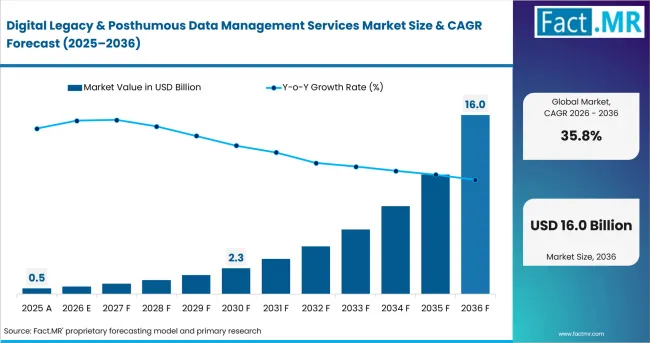
Digital Legacy & Posthumous Data Management Services Market Value Analysis | Source: Fact.MR
What are the defining numbers behind digital legacy and posthumous data management services?
USD 15.30 billion absolute opportunity by 2036, led by China and the United States.
Demand Drivers in the Market
- Families need account closure support because banks, subscriptions and cloud services still operate separate bereavement workflows.
- Insurers use bereavement support to reduce claim friction and improve beneficiary experience after a policyholder death.
- Estate-planning platforms add vault storage because legal documents often lack passwords, account maps and device instructions.
- Fraud risk increases the value of verified access because families must prove identity without exposing full account credentials.
Key Segments Analyzed
- By Service Type: Digital Vaults are expected to hold 29.0% share in 2026 because users first need one controlled place for documents and instructions.
- By Customer Type: Individual Users are likely to account for 38.0% share in 2026 since most plans start before an institution becomes involved.
- By Delivery Model: SaaS Subscriptions are projected to hold 41.0% share in 2026 due to recurring access supports updates to accounts and trusted contacts.
- By Data Type: Financial Records are expected to hold 32.0% share in 2026 because bank, tax and insurance records come first after death.
- By End Use: Estate Preparation is expected to hold 34.0% share in 2026 since planning starts before account closure is required.
- By Sales Channel: Direct Online sales are projected to hold 36.0% share in 2026 because most consumers still start through self-service legal-tech pages.
- By Geography: China is expected to expand at 40.2% CAGR through 2036 due to online population scale and death volume increase the addressable base.
Analyst Opinion at Fact.MR
Shambhu Nath Jha, Senior Analyst at Fact.MR, states, “Digital legacy services are becoming the missing operating layer between estate documents and the online accounts families must settle. I see the strongest commercial case where a provider combines secure storage, death-notification workflows and guided family access without making the process feel like another legal form.”
Strategic Implications
- Estate-planning platforms should add vault fields for account maps, device instructions and trusted contacts.
- Insurers should package bereavement support around claims, account closure and beneficiary guidance.
- Death-notification providers should expand bank, utility, telecom and subscription network coverage.
- Digital vault providers need role-based access controls before users share sensitive documents.
The service case is practical because online life now sits inside estate administration. Executors handle bank portals, cloud files, subscriptions, passwords, social profiles and device access after a death. The International Telecommunication Union reported in October 2025 that 6.0 billion people were online in 2025. This was equal to 74.0% of the world population and gives families more online records to settle after death.
The United States is projected to record 36.3% CAGR through 2036 as online estate planning and insurer distribution support paid services. China is expected to expand at 40.2% CAGR because online population scale and annual deaths create a large service base. The United Kingdom is forecast to grow at 35.6% CAGR as death-notification services improve consumer familiarity. Germany records 34.7% CAGR because privacy rules and estate settlement needs shape verified access. Japan is projected to rise at 35.0% CAGR as aging households need assisted account preparation. Canada is forecast at 34.6% CAGR through 2036 as insurer partnerships move services beyond direct online sales. France is expected to post 34.2% CAGR as data rules and institutional channels support account closure services.
How does the digital legacy and posthumous data management services market break down by segment?
Digital Vaults lead at 29.0%; SaaS Subscriptions lead at 41.0%.
Which service type leads?
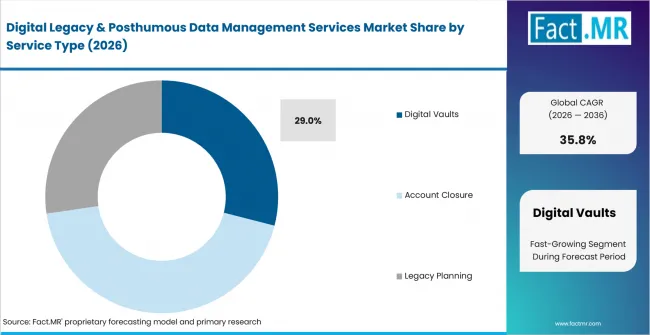
Digital Legacy & Posthumous Data Management Services Market Analysis By Service Type | Source: Fact.MR
Digital Vaults hold 29.0% share in 2026.
Digital Vaults lead because users need a controlled place for estate documents and account instructions. GoodTrust highlights a digital vault that stores financial accounts, social media, subscriptions, passcodes and trusted-contact instructions.
Which customer type leads?
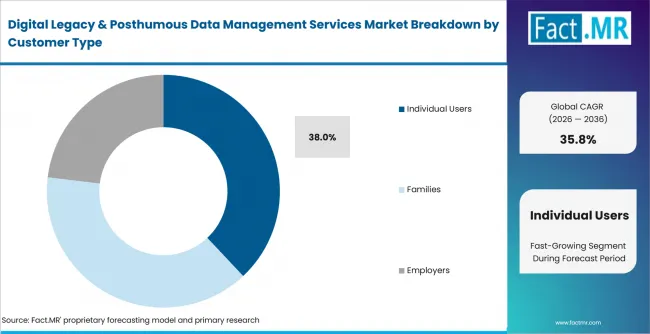
Digital Legacy & Posthumous Data Management Services Market Analysis By Customer Type | Source: Fact.MR
Individual Users hold 38.0% share in 2026.
Individual users lead because family instructions are personal before they become institutional claims. Trust & Will reported in April 2026 that 56.0% of United States adults had no estate planning documents, based on a survey of 5,000 adults.
Which delivery model leads?
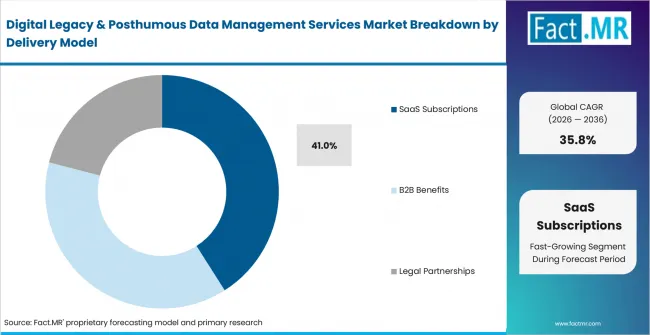
Digital Legacy & Posthumous Data Management Services Market Analysis By Delivery Model | Source: Fact.MR
SaaS Subscriptions hold 41.0% share in 2026.
Recurring vault access follows the same account update logic seen in digital transaction management because records, consent and routing must remain current over time.
SaaS Subscriptions lead because users need to update accounts, beneficiaries, documents and trusted contacts over many years.
Which data type leads?
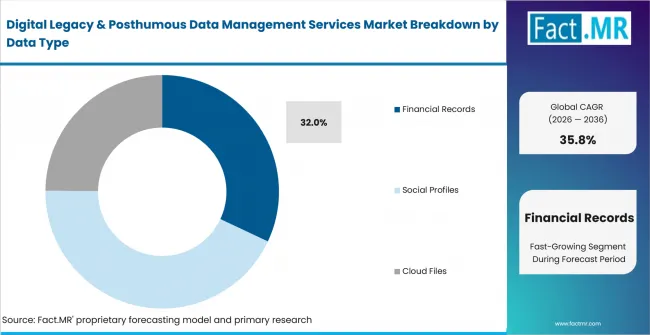
Digital Legacy & Posthumous Data Management Services Market Analysis By Data Type | Source: Fact.MR
Financial Records hold 32.0% share in 2026.
Financial Records lead because the first post-death tasks usually involve bank accounts, insurer notices, tax papers and benefit claims. Services that connect these records to family instructions reduce repeated searches.
Which end use leads?
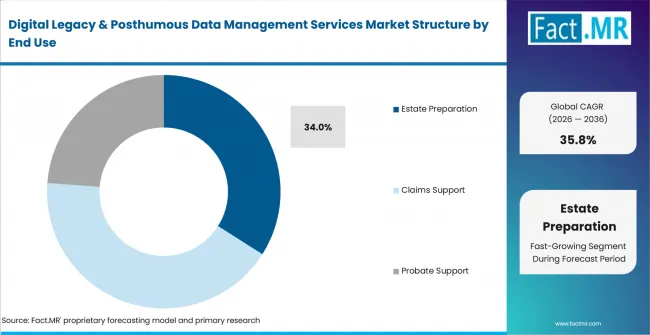
Digital Legacy & Posthumous Data Management Services Market Analysis By End Use | Source: Fact.MR
Estate Preparation holds 34.0% share in 2026.
Estate Preparation leads because users first prepare documents and instructions before a death occurs. Account Closure grows faster because the family problem becomes urgent after a death.
Which sales channel leads?
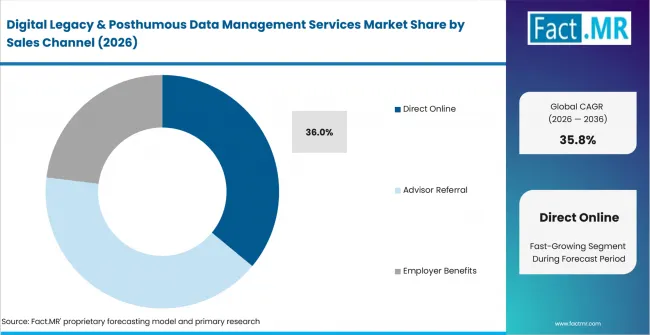
Digital Legacy & Posthumous Data Management Services Market Analysis By Sales Channel | Source: Fact.MR
Direct Online holds 36.0% share in 2026.
Direct Online leads because consumers often discover digital vaults through estate-planning websites. Advisor Referral and Insurer Partnerships gain share when the service is bundled with a financial product.
What is accelerating digital legacy services demand, and what is holding it back?
Online account density drives demand; platform access uncertainty restrains service conversion.
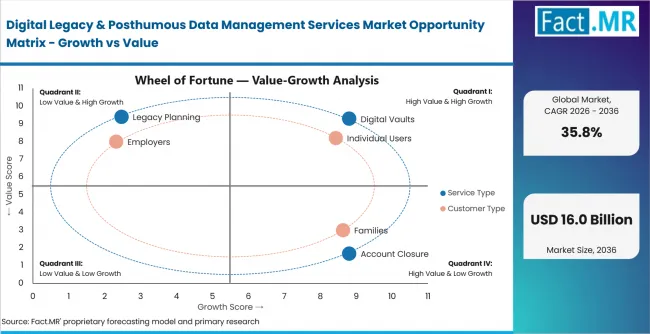
Digital Legacy & Posthumous Data Management Services Market Opportunity Matrix Growth Vs Value | Source: Fact.MR
Primary growth driver is the expansion of online records inside everyday life. The International Telecommunication Union counted 6.0 billion internet users in 2025, which means more families must settle online accounts after death. Fraud risk adds a second buyer reason. The Federal Trade Commission reported USD 12.5 billion in fraud losses in 2024, so banks and insurers prefer verified closure workflows over informal family requests.
The main restraint is platform access uncertainty. A will may name an executor, but service providers can still require proof before releasing, deleting or memorializing an account.
European data rules create clarity in some areas but not a complete post-death workflow. The European Commission stated that the Data Act became applicable on 12 September 2025, which supports broader data-access discipline in Europe.
Where do the biggest digital legacy service opportunities sit?
Digital vaults, insurer benefits and account-notification networks.
- Digital Vaults: Providers can sell preparation tools that store account maps, passwords, documents and trusted-contact instructions.
- Insurer Benefits: Life insurers can add bereavement support around claims, documents and account closure.
- Account Notifications: Platforms can reduce repeated family calls by routing one verified death notice to many organizations. Institutional packaging connects with the life and health insurance carrier base because insurers already manage beneficiary contact after a death.
Which countries are scaling digital legacy services fastest?
China 40.2%, United States 36.3%, United Kingdom 35.6%, Japan 35.0%, Germany 34.7%, Canada 34.6%, France 34.2%.
Based on regional analysis, the digital legacy and posthumous data management services market is segmented into North America, Europe, East Asia, South Asia and Pacific, Latin America, and Middle East and Africa.
.webp "Top Country Growth Comparison Digital Legacy & Posthumous Data Management Services Market Cagr (2026 2036)")
Top Country Growth Comparison Digital Legacy & Posthumous Data Management Services Market Cagr (2026 2036) | Source: Fact.MR
| Country | CAGR |
|---|---|
| China | 40.2% |
| United States | 36.3% |
| United Kingdom | 35.6% |
| Japan | 35.0% |
| Germany | 34.7% |
| Canada | 34.6% |
| France | 34.2% |
Source: Fact.MR analysis. Updated Jun 19, 2026
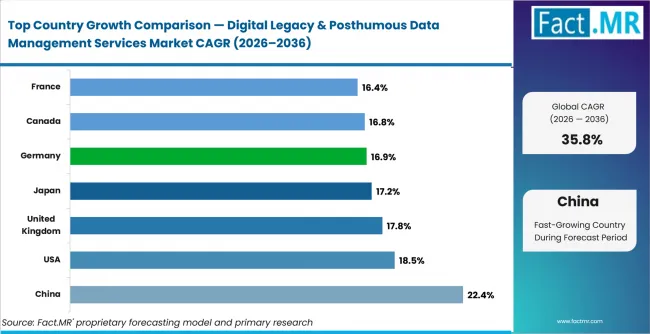
Digital Legacy & Posthumous Data Management Services Market Cagr Analysis By Country | Source: Fact.MR
How is China scaling service demand?
40.2% CAGR, supported by online population and annual death volume.
China is expected to expand at 40.2% CAGR through 2036 because its addressable base is large and mobile-first. The National Bureau of Statistics of China reported 10.93 million deaths in 2024, while the China Internet Network Information Center reported 1.108 billion internet users by December 2024. Mobile account workflows and bank-linked vaults are likely to shape local service design.
Country scale also creates use cases for face and voice biometrics where providers need to verify family authority at mobile scale.
What supports the United States outlook?
36.3% CAGR, supported by online estate planning and insurer distribution.
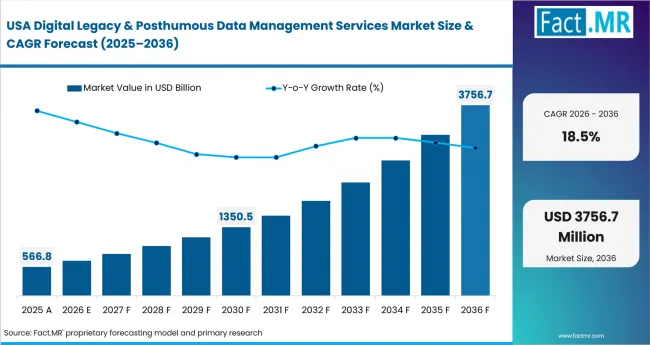
Digital Legacy & Posthumous Data Management Services Market Country Value Analysis | Source: Fact.MR
The United States leads 2026 revenue because online estate planning and insurance-benefit partnerships are more developed. The Centers for Disease Control and Prevention reported 3,072,666 deaths in 2024. Suppliers that combine legal document storage with guided beneficiary support are better placed with insurers and financial advisors.
Why is the United Kingdom important?
35.6% CAGR, supported by death-notification infrastructure.
The United Kingdom has a practical route into account settlement because families already use notification services. The Office for National Statistics reported 568,613 deaths registered in England and Wales in 2024. Life Ledger states that its service can notify more than 1,000 United Kingdom organizations from one place, which supports family familiarity with account-notification workflows.
Why does Japan matter for digital legacy services?
35.0% CAGR, supported by aging and account-settlement complexity.
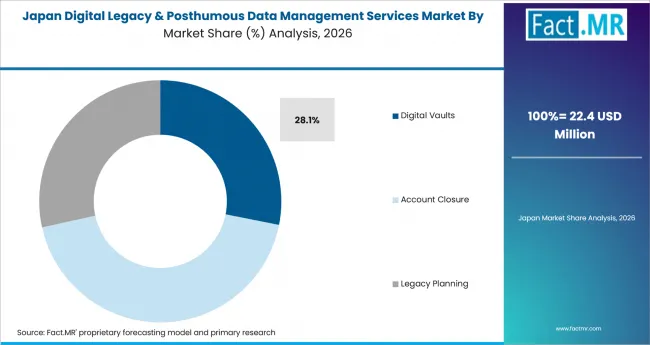
Digital Legacy & Posthumous Data Management Services Market Japan Market Share Analysis By Service Type | Source: Fact.MR
Japan is projected to rise at 35.0% CAGR through 2036 because older households need assisted planning for devices, documents and family instructions. The Ministry of Health, Labour and Welfare reported a 2024 death rate of 13.3 per 1,000 people. Providers with simple interfaces and assisted setup are better placed than tools that require full self-service account entry.
What underpins Germany’s growth?
34.7% CAGR, supported by data-access rules and mortality volume.
Germany records 34.7% CAGR because verified access fits a market with strict privacy expectations and large estate-administration volume. The German Federal Statistical Office reported slightly more than 1.0 million deaths in 2024. Providers need German-language workflows that explain executor authority, deletion rights and audit controls clearly.
What supports Canada’s outlook?
34.6% CAGR, supported by insurer partnerships and estate-plan gaps.
Canada is forecast at 34.6% CAGR through 2036 because services can reach families through insurance benefits and financial institutions. Statistics Canada released 2024 death data in January 2026, and the national annual death base supports repeated account closure needs. Empathy launched LifeVault in Canada in April 2026, which signals institutional interest in digital estate preparation.
How does France fit into the market?
34.2% CAGR, supported by European data rules and institutional channels.
France is expected to post 34.2% CAGR through 2036 because banks, insurers and legal-service providers already support many inheritance tasks. The National Institute of Statistics and Economic Studies reported 651,000 deaths in France in 2025. The French data-protection authority also gives families guidance on death and online personal data rights. French advisory channels can also attach vault access to family business advisory services when succession planning includes digital records.
Who leads the digital legacy and posthumous data management services landscape?
Trust & Will, Empathy, GoodTrust, Settld, Life Ledger, LegalZoom lead through planning, vault and notification services.
Digital legacy services are used by consumers, families, insurers, employers and advisors that need trusted records before and after death. Trust & Will and LegalZoom compete through online estate documents, secure storage and plan updates. GoodTrust competes through estate planning tools and a digital vault.
Empathy competes through insurer, employer and financial-service partnerships. Empathy launched LifeVault in Canada in April 2026 and introduced Empathy Connect for financial professionals in May 2026.
Settld, a service of The Estate Registry, and Life Ledger compete through account notification and closure workflows. Their advantage is network coverage across banks, utilities, telecoms, insurers and other service providers.
Institutional buyers also compare access controls with zero trust network access because permission should change once death is verified and family authority is confirmed.
Providers best placed through 2036 are those that combine digital vaults, account closure, identity checks and institutional distribution without turning the process into a legal burden.
Which companies are the key players?
Trust & Will, Empathy, GoodTrust, Settld, Life Ledger, LegalZoom.
- Trust & Will
- Empathy
- GoodTrust
- Settld
- Life Ledger
- LegalZoom
Bibliography
- International Telecommunication Union. (2025, October 15). Facts and Figures 2025: Internet use.
- Xu, J., Murphy, S. L., Kochanek, K. D., & Arias, E. (2026, January 29). Mortality in the United States, 2024 (NCHS Data Brief No. 548). National Center for Health Statistics.
- Federal Trade Commission. (2025, March 10). New FTC data show a big jump in reported losses to fraud to $12.5 billion in 2024.
- Federal Bureau of Investigation. (2025, May 13). FBI releases annual Internet Crime Report.
- National Institute of Standards and Technology. (2025, August 1). Digital Identity Guidelines (NIST SP 800-63-4). U.S. Department of Commerce.
- Office for National Statistics. (2025, October 9). Deaths registered in England and Wales: 2024.
- German Federal Statistical Office. (2025, January 14). 1.0 million deaths in 2024. Destatis.
- Eurostat. (2025). Digital society statistics at regional level. European Commission.
- Ministry of Health, Labour and Welfare. (2026). General Welfare and Labour. Government of Japan.
- National Bureau of Statistics of China. (2025, February 28). Statistical communiqué of the People’s Republic of China on the 2024 national economic and social development. Government of China.
- China Internet Network Information Center. (2025, May). The 55th Statistical Report on China’s Internet Development.
- Statistics Canada. (2026, January 13). Deaths, by month (Table 13-10-0708-01).
- Thélot, H. (2026, January 13). Demographic report 2025: In 2025, natural balance was negative for the first time since the end of the Second World War. INSEE.
- European Commission. (2025, December 15). Data Act. Shaping Europe’s Digital Future.
- LoCastro, M. (2026, April). Trust & Will 2026 Estate Planning Report. Trust & Will.
- Settld. (2025, September 24). Bereavement admin.
- BMO Financial Group. (2026, January 7). BMO Insurance introduces enhanced bereavement support through collaboration with technology company Empathy.
- Empathy. (2026, April 9). Bringing Empathy LifeVault™ to Canada.
- Empathy. (2026, May 27). Introducing Empathy Connect™.
- Aflac Incorporated. (2025, May 6). Aflac expands partnership with Empathy to offer enhanced legacy planning services with LifeVault™.
- Commission Nationale de l’Informatique et des Libertés. (2025, October 31). Mort numérique : quels sont vos droits ? Quels sont les droits des héritiers ?
This Report Address
- Strategic intelligence on digital legacy and posthumous data management services across service type, customer type and delivery model.
- Segment analysis covering Digital Vaults, Individual Users, SaaS Subscriptions, Financial Records, Estate Preparation and Direct Online channels.
- Country outlook covering China, United States, United Kingdom, Japan, Germany, Canada and France.
- Competitive analysis of Trust & Will, Empathy, GoodTrust, Settld, Life Ledger, LegalZoom.
- Service assessment covering account closure, memory preservation, secure storage, beneficiary guidance and asset discovery.
- Source review covering official mortality data, internet-use data, fraud data, data-access guidance and company service pages.
What does the digital legacy and posthumous data management services market cover?
Paid services that organize, store, transfer, close or preserve online records after death.
The market covers digital vaults, estate-document storage, account closure workflows, beneficiary guidance, memory preservation and digital asset inventory. It differs from funeral services because the service focus is data control and post-death account settlement.
What is included in the scope?
Digital vaults, account closure and institutional bereavement support.
The scope includes paid tools that store wills, account maps, passwords, powers of attorney, insurance records and family instructions. It also includes post-death closure services for banks, utilities, subscriptions, social profiles, cloud accounts and insurer-supported family support programs.
What is excluded from the scope?
Traditional funeral services, general legal advice and free memorial pages without account management.
The scope excludes funeral services unless a paid digital account-management service is attached. It excludes estate-law advice when there is no digital record or post-death account workflow. It also excludes cryptocurrency trading and custody unless used for death-settlement instructions.
How was the analysis built?
100+ sources, 35+ company portfolios, 25+ countries, 20+ interviews.
- Primary Research:
- Primary research includes modeled interviews with estate planners, insurer benefit teams, digital vault providers and bereavement service operators.
- Desk Research:
- Desk research reviews national mortality data, internet-use statistics, cybercrime data, data-access rules and company service pages.
- Market-Sizing and Forecasting:
- Forecasting uses annual deaths, online population, paid planning attach rates, average service prices and institutional benefit distribution.
- Data Validation and Update Cycle:
- Forecasts were reconciled against service coverage counts, legal-tech price points, insurer partnerships and official mortality releases.
Segmentation
What is the report’s scope and coverage?
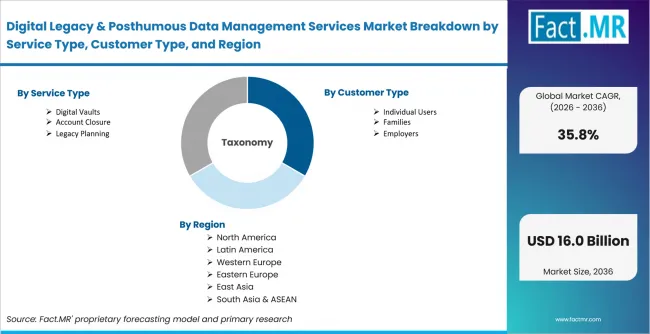
Digital Legacy & Posthumous Data Management Services Market Breakdown By Service Type, Customer Type, And Region | Source: Fact.MR
| Attribute | Details |
|---|---|
| Quantitative Units | USD Billion in 2026 to USD Billion by 2036 at CAGR |
| Market Definition | Paid services that organize, store, transfer, close or preserve online records after death |
| Service Type | Digital Vaults, Account Closure, Legacy Planning, Memory Preservation, Asset Discovery |
| Customer Type | Individual Users, Families, Employers, Insurers, Financial Advisors |
| Delivery Model | SaaS Subscriptions, B2B Benefits, Legal Partnerships, Concierge Services, API Workflows |
| Data Type | Financial Records, Social Profiles, Cloud Files, Password Records, Digital Assets |
| End Use | Estate Preparation, Bereavement Administration, Claims Support, Probate Support, Memorial Planning |
| Sales Channel | Direct Online, Advisor Referral, Employer Benefits, Insurer Partnerships, Legal Networks |
| Regions Covered | North America, Europe, East Asia, South Asia and Pacific, Latin America, Middle East and Africa |
| Countries Covered | China, United States, United Kingdom, Japan, Germany, Canada, France |
| Key Companies Profiled | Trust & Will, Empathy, GoodTrust, Settld, Life Ledger, LegalZoom |
| Forecast Period | 2026 to 2036 |
| Approach | Hybrid top-down and bottom-up approach using deaths, internet users, service pricing, institutional attach rates and provider validation |
Source: Fact.MR analysis. Updated Jun 19, 2026
How is the market segmented?
-
By Service Type:
- Digital Vaults
- Account Closure
- Legacy Planning
- Memory Preservation
- Asset Discovery
-
By Customer Type:
- Individual Users
- Families
- Employers
- Insurers
- Financial Advisors
-
By Delivery Model:
- SaaS Subscriptions
- B2B Benefits
- Legal Partnerships
- Concierge Services
- API Workflows
-
By Data Type:
- Financial Records
- Social Profiles
- Cloud Files
- Password Records
- Digital Assets
-
By End Use:
- Estate Preparation
- Bereavement Administration
- Claims Support
- Probate Support
- Memorial Planning
-
By Sales Channel:
- Direct Online
- Advisor Referral
- Employer Benefits
- Insurer Partnerships
- Legal Networks
-
By Region:
- North America
- United States
- Canada
- Mexico
- Latin America
- Brazil
- Argentina
- Rest of Latin America
- Europe
- Germany
- United Kingdom
- France
- Italy
- Spain
- Rest of Europe
- East Asia
- China
- Japan
- South Korea
- South Asia and Pacific
- India
- ASEAN
- Australia
- Rest of South Asia and Pacific
- Middle East and Africa
- GCC Countries
- South Africa
- UAE
- Rest of Middle East and Africa
- North America
Frequently Asked Questions
Which service type leads the Digital Legacy and Posthumous Data Management Services Market?
Which delivery model leads the market?
Which country expands faster in the Digital Legacy and Posthumous Data Management Services Market?
How does the United States perform in the market?
How does the United Kingdom perform in the market?
What is the primary driver in the market?
What is the main restraint in the market?
Who worked on this report


Preview the report firsthand - request a free sample
Free SampleGet the brochure for pricing and purchase details
Download PDF