- Market Value (2025): USD 1.2 Bn
- Estimated Value (2026): USD 1.4 Bn
- Forecast Value (2036): USD 5.1 Bn
- CAGR (2026-2036): 13.8%
What is the Digital Companion Diagnostics Software Market forecast to be worth by 2036?
USD 1.4 billion in 2026 to USD 5.1 billion by 2036 at a 13.8% CAGR.
- The digital companion diagnostics software market was valued at USD 1.2 billion in 2025.
- Demand is projected to increase from USD 1.4 billion in 2026 to USD 5.1 billion by 2036.
- The market is forecast to record a 13.8% CAGR from 2026 to 2036.
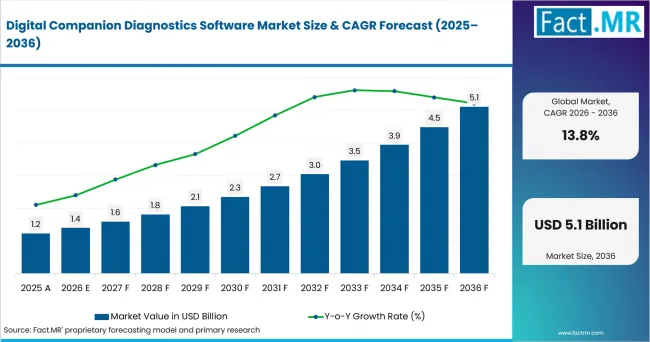
Digital Companion Diagnostics Software Market Value Analysis | Source: Fact.MR
What are the defining numbers behind Digital Companion Diagnostics Software Market growth?
USD 3.76 billion absolute opportunity by 2036.
- Demand Drivers in the Market
- Precision medicine workflows require software that turns biomarker results into usable treatment guidance without slowing clinical review.
- Companion diagnostics depend on clear therapy evidence. Clinical decision support software supports shared result history before patient approval.
- Pharmaceutical companies use diagnostic software to manage assay information during trials and therapy launch planning.
- Hospitals and cancer centers prefer tools that reduce handoffs between laboratories and oncologists. Faster interpreted results can improve targeted therapy review.
- Key Segments Analyzed
- By Software Platform: Cloud-based Companion Diagnostics Software is expected to hold 41.0% share in 2026 because multi-site users need secure access and easier updates.
- By Clinical Application: Oncology is projected to account for 46.0% share in 2026 as therapy selection often depends on biomarker interpretation.
- By End-use Setting: Hospitals & Cancer Centers are anticipated to capture 44.0% share in 2026 when treatment teams rely on structured diagnostic outputs.
- By Customer Type: Pharmaceutical Companies are estimated to represent 42.0% share in 2026 due to trial diagnostics and therapy launch planning.
- By Deployment Model: Cloud Deployment is forecast to hold 39.0% share in 2026 as buyers prioritize faster setup and central version control.
- Analyst Opinion at Fact.MR
- Shambhu Nath Jha, Principal Consultant at Fact.MR, states, “Digital Companion Diagnostics Software companies need to prove fit inside each clinical and commercial use case. Buyers are expected to reward suppliers that show documentation strength and measurable values.”
- Strategic Implications
- Product teams should frame offerings around use-case fit. Evidence for oncology, rare disease and trial workflows is expected to shorten review cycles.
- Suppliers can protect retention by documenting compliance needs and performance limits in simple customer materials. Clear specification reduces evaluation friction in regulated buying environments.
- Investors need to separate direct companion diagnostics software exposure from broader digital health activity. Providers with validated workflow depth are expected to gain better account access.
USA leads at 14.9% CAGR through oncology workflow depth and pharmaceutical software adoption. Germany follows at 14.3% with compliance-led purchasing. Japan reaches 13.7% through precision medicine programs. The UK posts 13.1% as hospital diagnostic pathways support review. Canada records 12.6% through cross-site care coordination. South Korea reaches 12.0% through oncology testing depth. Singapore posts 11.5% through specialist clinical services.
How does the Digital Companion Diagnostics Software Market break down by segment?
Cloud-based Companion Diagnostics Software leads Software Platform with 41.0% share in 2026. Oncology leads Clinical Application with 46.0% share.
Why does Cloud-based Companion Diagnostics Software lead Software Platform?
Cloud-based Companion Diagnostics Software is projected to account for 41.0% share in 2026.
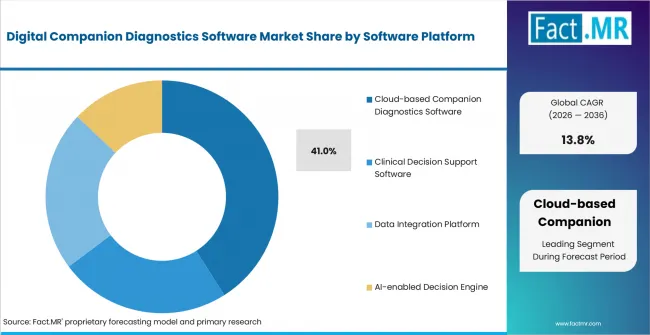
Digital Companion Diagnostics Software Market Analysis By Software Platform | Source: Fact.MR
Healthcare cloud computing makes the segment practical for teams that need shared access across laboratories and clinical sites. Cloud-based Companion Diagnostics Software reduces local setup work and supports faster updates. Buyers are expected to favor it when workflows require consistent versions and secure reporting.
Why does Oncology lead Clinical Application?
Oncology is expected to hold 46.0% share in 2026.
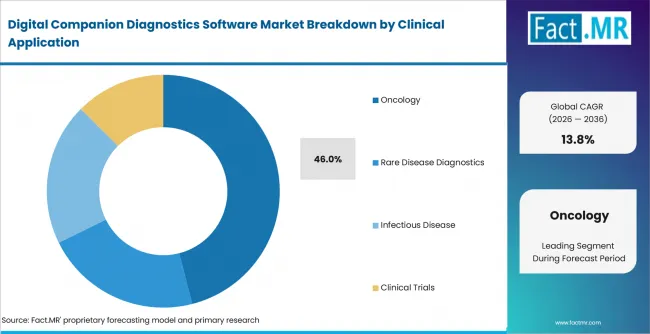
Digital Companion Diagnostics Software Market Analysis By Clinical Application | Source: Fact.MR
Oncology diagnostics has the clearest commercial fit because targeted therapies often require biomarker interpretation before treatment starts. Cancer care teams need software that can translate test results into structured review steps.
What supports Hospitals & Cancer Centers within End-use Setting?
Hospitals & Cancer Centers are anticipated to represent 44.0% share in 2026.
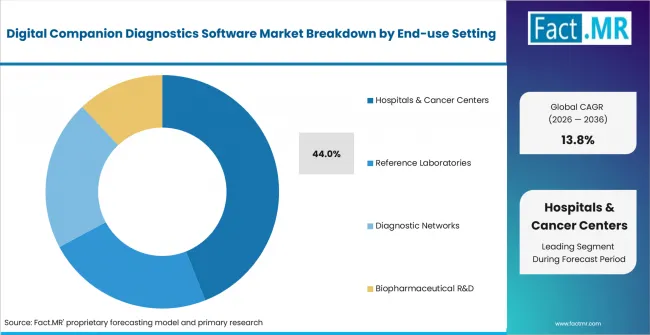
Digital Companion Diagnostics Software Market Analysis By End Use Setting | Source: Fact.MR
Hospitals & Cancer Centers handle treatment decisions that depend on diagnostic evidence and quick coordination. These sites need software that can move information from laboratories to clinicians without adding manual reporting work.
Why do Pharmaceutical Companies lead Customer Type?
Pharmaceutical Companies are estimated to account for 42.0% share in 2026.
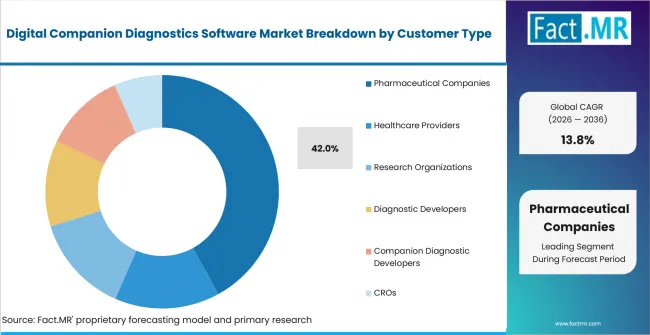
Digital Companion Diagnostics Software Market Analysis By Customer Type | Source: Fact.MR
Pharmaceutical companies use companion diagnostic software to organize assay evidence during trials and launch preparation. Their spending is shaped by the need to connect test outputs with therapy eligibility.
How does Cloud Deployment shape demand?
Cloud Deployment is forecast to lead with 39.0% share in 2026.
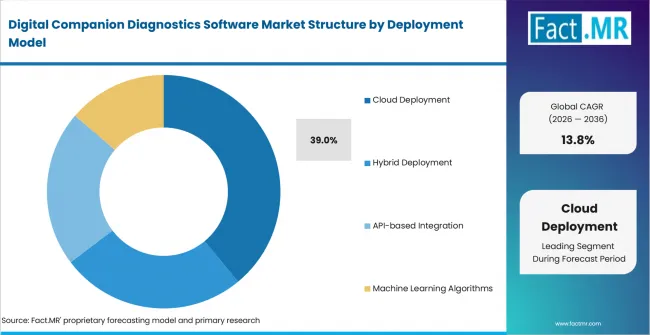
Digital Companion Diagnostics Software Market Analysis By Deployment Model | Source: Fact.MR
Cloud Deployment lowers the local infrastructure burden for buyers that manage several users and locations. It supports controlled access and steady software updates. This model appeals to teams that need consistent reporting across sites.
What is accelerating Digital Companion Diagnostics Software Market adoption, and what is holding it back?
Demand is expected to rise through therapy-related interpretation and easier software deployment. Adoption may be limited by integration cost and the work needed to prove clinical workflow value.
Drivers Impact Analysis
| DRIVER | (~) % IMPACT ON CAGR | GEOGRAPHIC RELEVANCE | IMPACT TIMELINE |
|---|---|---|---|
| Adoption and integration | +1.6% | Global | Short term (<= 2 years) |
| Regulatory and compliance support | +1.4% | USA, Germany, UK | Short term (<= 2 years) |
| Channel and access expansion | +1.1% | Global | Medium term (2-4 years) |
| Clear specification and documentation | +0.9% | USA, UK, Canada | Medium term (2-4 years) |
| Cost and efficiency gains | +0.6% | Global | Long term (>= 4 years) |
Source: Fact.MR analysis. Updated Aug 6, 2026
- Adoption and integration: Software tools are expected to gain priority when laboratories and treatment teams need a shared view of companion diagnostic evidence.
- Regulatory and compliance support: Buyers are expected to review traceability and approval documentation before they expand use across regulated diagnostic workflows.
- Clear specification and documentation: Suppliers that explain data handling and implementation limits early are expected to reduce procurement delays.
Opportunity Impact Analysis
| OPPORTUNITY | (~) % IMPACT ON CAGR | GEOGRAPHIC RELEVANCE | IMPACT TIMELINE |
|---|---|---|---|
| Emerging application expansion | +1.0% | Global | Medium term (2-4 years) |
| Premium and specialist positioning | +0.8% | USA, UK, Germany | Medium term (2-4 years) |
| Channel and partner expansion | +0.7% | Global | Long term (>= 4 years) |
| Standards and compliance alignment | +0.5% | USA, Canada, Singapore | Long term (>= 4 years) |
Source: Fact.MR analysis. Updated Aug 6, 2026
- Emerging application expansion: Rare disease diagnostics and clinical trial use cases are expected to create software demand outside core oncology programs.
- Premium and specialist positioning: Vendors with deep workflow knowledge can defend value when buyers compare validated use cases over broad feature lists.
- Channel and partner expansion: Diagnostic developers and pharmaceutical partners are expected to widen access when software is packaged with assay support.
Restraints Impact Analysis
| RESTRAINT | (~) % IMPACT ON CAGR | GEOGRAPHIC RELEVANCE | IMPACT TIMELINE |
|---|---|---|---|
| Cost and complexity | -1.1% | Global | Short term (<= 2 years) |
| Specification and compliance checks | -0.9% | USA, UK, Germany | Short term (<= 2 years) |
| Substitution by lower-cost alternatives | -0.7% | Import-dependent markets | Medium term (2-4 years) |
| Supply chain and pricing pressure | -0.5% | Global | Long term (>= 4 years) |
Source: Fact.MR analysis. Updated Aug 6, 2026
- Cost and complexity: Implementation work can slow purchasing when buyers must connect laboratory systems with clinical records and reporting tools.
- Specification and compliance checks: Regulated users are expected to delay approval until data controls and clinical responsibility are clearly documented.
- Substitution by lower-cost alternatives: Some buyers may rely on internal reporting tools when workflow volume does not justify specialist software spending.
Which countries are scaling the Digital Companion Diagnostics Software Market fastest?
- The country comparison spans 3.4 percentage points and forms a clear lead tier around the USA and Germany.
- The USA records 0.6 percentage point above Germany through oncology workflow depth and pharmaceutical software adoption.
- Germany records 0.6 percentage point above Japan with compliance-driven purchasing and structured laboratory networks.
- Japan records 0.6 percentage point above the UK through precision medicine programs and high documentation expectations.
- The UK records 0.5 percentage point above Canada as hospital diagnostic pathways support software review.
- Canada records 0.6 percentage point above South Korea with adoption shaped by cross-site care coordination.
- South Korea records 0.5 percentage point above Singapore through oncology testing depth and local technology readiness.
Comparable CAGRs can create different entry conditions due to clinical workflow depth and customer evidence needs. Full report coverage includes North America; Latin America; Europe; East Asia; South Asia and Pacific; Middle East and Africa.
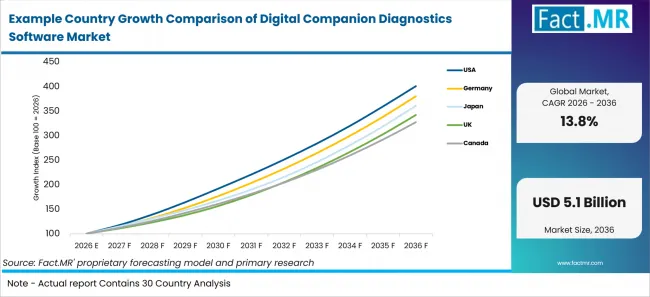
Example Country Growth Comparison Of Digital Companion Diagnostics Software Market | Source: Fact.MR
| Country | CAGR (2026-2036) |
|---|---|
| USA | 14.9% |
| Germany | 14.3% |
| Japan | 13.7% |
| UK | 13.1% |
| Canada | 12.6% |
| South Korea | 12.0% |
| Singapore | 11.5% |
Source: Fact.MR analysis. Updated Aug 6, 2026
What supports USA adoption?
14.9% CAGR, supported by oncology workflow depth and pharmaceutical software adoption.
USA buyers evaluate clinical evidence and integration readiness before approving new companion diagnostics software. Hospitals and cancer centers are expected to prefer platforms that turn test results into clear treatment review steps. Pharmaceutical companies add demand when trial evidence must be organized for therapy launch planning.
How is Germany scaling demand?
14.3% CAGR, driven by compliance-focused purchasing and structured laboratory networks.
Germany is expected to scale through buyers that place documentation quality at the center of procurement. Hospitals and reference laboratories compare data control and supplier accountability before wider use. This creates a careful buying route for vendors that can explain validation and reporting responsibilities in simple terms.
What is driving Japan’s growth from 2026 to 2036?
13.7% CAGR, backed by precision medicine programs and high documentation expectations.
Japan’s clinical users are expected to value reliable interpretation and careful supplier qualification. Oncology and rare disease applications need software that can organize diagnostic evidence without adding reporting pressure.
How is the UK developing demand?
13.1% CAGR, led by hospital diagnostic pathways and data governance review.
The UK develops demand through clinical networks that need consistent information flow between testing sites and treatment teams. Buyers are expected to assess interoperability before broader rollout.
What supports Canada adoption?
12.6% CAGR, supported by cross-site care coordination and cloud access.
Canada’s market reflects distributed care settings that need diagnostic information to stay consistent across locations. Hospitals and laboratories are expected to value accessible reporting and secure collaboration.
How is South Korea building demand?
12.0% CAGR, driven by oncology testing depth and local technology readiness.
South Korea builds demand through advanced clinical testing environments and practical interest in digital interpretation support. Buyers are expected to compare workflow fit before expanding use.
What supports Singapore’s growth?
11.5% CAGR, backed by specialist clinical services and regional digital health positioning.
Singapore’s compact healthcare market allows specialist centers and research-connected providers to review new software quickly. Procurement is expected to focus on security and support.
Who leads the Digital Companion Diagnostics Software Market?
Roche Diagnostics – Foundation Medicine shows the direct relevance. QIAGEN N.V. and Illumina, Inc. strengthen the molecular and sequencing data layer.
Guardant Health, Inc. add oncology testing depth. SOPHiA GENETICS SA contributes analytics exposure for genomic interpretation. PathAI, Inc. and Tempus AI, Inc. complete the provider set. Next-generation sequencing and artificial intelligence in healthcare remain relevant adjacencies when buyers compare diagnostic data scale and interpretation support.
Which companies are the key providers?
Key companies include QIAGEN N.V.; Illumina, Inc.; Agilent Technologies, Inc.; Thermo Fisher Scientific Inc.; Guardant Health, Inc.; Roche Diagnostics – Foundation Medicine; SOPHiA GENETICS SA; PathAI, Inc.; Tempus AI, Inc.
- QIAGEN N.V.
- Illumina, Inc.
- Agilent Technologies, Inc.
- Thermo Fisher Scientific Inc.
- Guardant Health, Inc.
- Roche Diagnostics – Foundation Medicine
- SOPHiA GENETICS SA
- PathAI, Inc.
- Tempus AI, Inc.
Bibliography
- European Medicines Agency. (2025). Companion Diagnostic Expert Group: Mandate, objectives, and rules of procedure.
- Illumina, Inc. (2025, May 28). Illumina expands clinical oncology portfolio, unlocking a new standard of care and access to precision therapies.
- QIAGEN N.V. (2025, June 15). QIAGEN and Incyte announce precision medicine collaboration to develop companion diagnostics for patients with mutant CALR-expressing myeloproliferative neoplasms.
This Report Answers
- The report provides strategic intelligence on the Digital Companion Diagnostics Software Market across software platform and clinical application choices that shape therapy-related diagnostic workflows.
- Segment analysis covers Cloud-based Companion Diagnostics Software and Oncology as the share leaders within the 2026 market.
- Country outlook evaluates the USA and Germany alongside Japan and the UK. Canada, South Korea and Singapore complete the growth comparison.
- Competitive analysis profiles QIAGEN N.V. alongside Illumina, Inc. and Agilent Technologies, Inc. Thermo Fisher Scientific Inc. and other named providers complete the set.
- Deployment assessment covers Cloud Deployment and Hybrid Deployment. API-based Integration and Machine Learning Algorithms complete the deployment view.
What does the Digital Companion Diagnostics Software Market cover?
Digital companion diagnostics software supports diagnostic interpretation when therapy selection depends on test results.
The Digital Companion Diagnostics Software Market covers software used across oncology and rare disease diagnostics. Coverage extends to clinical trials and infectious disease when interpretation supports a therapy-related decision. The market includes cloud platforms and molecular diagnostics workflow support. It also covers biomarker testing services when software organizes evidence for treatment teams.
What is included in the scope?
Digital Companion Diagnostics Software is assessed across covered segments and countries.
The scope includes Software Platform and Clinical Application alongside End-use Setting, Customer Type and Deployment Model. Coverage spans Cloud Deployment and Hybrid Deployment. API-based Integration and Machine Learning Algorithms complete the deployment view.
What is excluded from the scope?
Products outside therapy-related diagnostic software remain outside this market.
The scope excludes general electronic health record software and laboratory equipment. Diagnostic tests without companion diagnostic interpretation are excluded. General wellness apps and unrelated data platforms are not included.
How Was the Analysis Built?
The analysis draws on 120+ sources and 35+ company portfolios. It covers 25+ countries and more than 20 industry interviews.
- Primary Research: Primary research includes discussions with manufacturers; service providers; technology developers; distributors; end users; procurement teams; and subject-matter experts. These conversations examine purchasing priorities and approval requirements.
- Desk Research: Desk research covers government statistics and regulatory publications. It reviews company filings; trade data; technical studies; standards; public policy; and other authoritative sources. Every source used in the analysis is documented in the bibliography.
- Market Sizing and Forecasting: Market estimates combine historical performance and demand indicators. Pricing and volume trends are reviewed with segment shares; company participation; country-level growth; adoption patterns; and barriers to market expansion.
- Data Validation and Update Cycle: Findings are validated by comparing primary interviews with public data and company activity. Regulatory changes and industry developments are reviewed during updates. Regular checks cover product launches; partnerships; approvals; procurement trends; and adoption shifts.
Segmentation
What is the report’s scope and coverage?
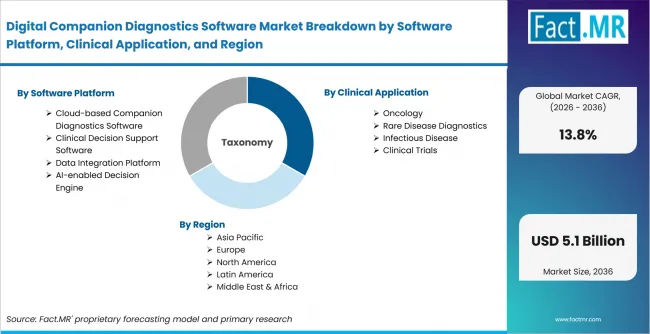
Digital Companion Diagnostics Software Market Breakdown By Software Platform, Clinical Application, And Region | Source: Fact.MR
| Attribute | Details |
|---|---|
| Quantitative Units | USD billion |
| Market Definition | Digital companion diagnostics software used to interpret therapy-related diagnostic evidence when patient selection and treatment planning depend on clear test outputs |
| Software Platform | Cloud-based Companion Diagnostics Software; Clinical Decision Support Software; Data Integration Platform; AI-enabled Decision Engine |
| Clinical Application | Oncology; Rare Disease Diagnostics; Infectious Disease; Clinical Trials |
| End-use Setting | Hospitals & Cancer Centers; Reference Laboratories; Diagnostic Networks; Biopharmaceutical R&D |
| Customer Type | Pharmaceutical Companies; Healthcare Providers; Research Organizations; Diagnostic Developers; Companion Diagnostic Developers; CROs |
| Deployment Model | Cloud Deployment; Hybrid Deployment; API-based Integration; Machine Learning Algorithms |
| Regions Covered | North America; Latin America; Europe; East Asia; South Asia and Pacific; Middle East and Africa |
| Countries Covered | USA; Germany; Japan; UK; Canada; South Korea; Singapore |
| Key Companies Profiled | QIAGEN N.V.; Illumina, Inc.; Agilent Technologies, Inc.; Thermo Fisher Scientific Inc.; Guardant Health, Inc.; Roche Diagnostics – Foundation Medicine; SOPHiA GENETICS SA; PathAI, Inc.; Tempus AI, Inc. |
| Forecast Period | 2026 to 2036 |
| Approach | Hybrid top-down and bottom-up approach using software demand; companion diagnostic workflow requirements; oncology and rare disease testing needs; pharmaceutical trial support; hospital adoption patterns; cloud deployment preference; compliance review; local purchasing behavior and company portfolio review |
Source: Fact.MR analysis. Updated Aug 6, 2026
How is the market segmented?
-
By Software Platform
- Cloud-based Companion Diagnostics Software
- Biomarker Analysis Platform
- Genomic Interpretation Software
- Clinical Decision Support Software
- AI-assisted Interpretation
- Real-time Clinical Analytics
- Data Integration Platform
- LIMS Integration
- EHR Connectivity
- AI-enabled Decision Engine
- Predictive Analytics
- Outcome Prediction
- Cloud-based Companion Diagnostics Software
-
By Clinical Application
- Oncology
- Solid Tumor Diagnostics
- Hematologic Malignancies
- Rare Disease Diagnostics
- Precision Medicine Programs
- Pharmacogenomics
- Infectious Disease
- Pathogen Genomics
- Antimicrobial Resistance
- Clinical Trials
- Patient Recruitment
- Trial Monitoring
- Oncology
-
By End-use Setting
- Hospitals & Cancer Centers
- Comprehensive Cancer Centers
- Academic Medical Centers
- Reference Laboratories
- Genomic Testing Laboratories
- Specialty Clinics
- Diagnostic Networks
- Public Health Laboratories
- Clinical Research Centers
- Biopharmaceutical R&D
- Drug Development Centers
- Precision Medicine Institutes
- Hospitals & Cancer Centers
-
By Customer Type
- Pharmaceutical Companies
- Biotechnology Companies
- Clinical Laboratories
- Healthcare Providers
- Research Organizations
- Diagnostic Developers
- Companion Diagnostic Developers
- Regulatory Organizations
- Payers & Insurers
- CROs
- Academic Institutions
- Research Consortia
- Pharmaceutical Companies
-
By Deployment Model
- Cloud Deployment
- Public Cloud
- Private Cloud
- Hybrid Deployment
- On-premise Integration
- Local Data Hosting
- API-based Integration
- HL7/FHIR Connectivity
- Interoperability Layer
- Machine Learning Algorithms
- NLP-based Clinical Engine
- Explainable AI Modules
- Cloud Deployment
-
By Region
- North America
- Latin America
- Europe
- East Asia
- South Asia and Oceania
- Middle East and Africa
Frequently Asked Questions
How big is the digital companion diagnostics software market in 2026?
What is the CAGR of the digital companion diagnostics software market from 2026 to 2036?
Which software platform leads the digital companion diagnostics software market?
Which clinical application leads the digital companion diagnostics software market?
Who are the leading companies in the digital companion diagnostics software market?
Who worked on this report


Preview the report firsthand - request a free sample
Free SampleGet the brochure for pricing and purchase details
Download PDF