Zero Trust Network Access Market Size, Share, Growth and Forecast (2026 - 2036)
The Zero Trust Network Access Market is Segmented by Component (Solution and Services), by Deployment (Cloud and On-Premise), by Enterprise Size (Large Enterprises and Small Enterprises), by Application, by End Use, by Access Mode, and Region. Forecast for 2026 to 2036.
Fact.MR states that the zero trust network access market is moving toward identity-checked private application access. Enterprises are replacing full network entry with user-level controls and device checks. Older VPN setups are losing use as high-risk access programs shift toward direct application checks.
Zero Trust Network Access Market Forecast and Outlook by Fact.MR
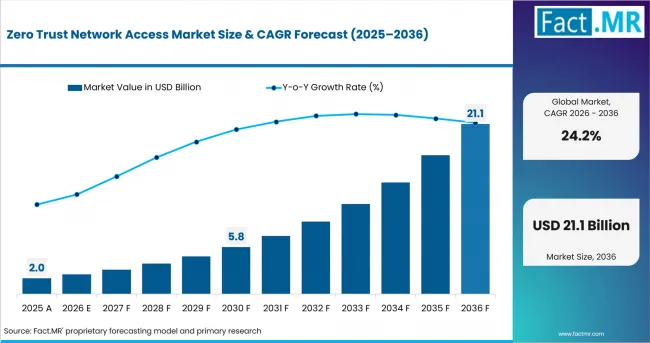
- The zero trust network access market was valued at USD 1.97 billion in 2025.
- Based on Fact.MR analysis, demand is estimated to grow to USD 2.42 billion in 2026 and USD 21.13 billion by 2036.
- Fact.MR projects a 24.2% CAGR during the forecast period as cloud application security budgets expand.
| Metric | Value |
|---|---|
| Estimated Value in 2026 | USD 2.42 billion |
| Forecast Value in 2036 | USD 21.13 billion |
| Forecast CAGR from 2026 to 2036 | 24.2% CAGR |
Summary of the Zero Trust Network Access Market
- Demand Drivers
- Cloud application migration is increasing demand for private access control as enterprises move from full network entry to direct application access.
- Identity-based checks are gaining share as Verizon reported that 42% of breaches involved credentials, vulnerability use or phishing in 2025. [3]
- Cost pressure supports board-level spending as IBM reported a USD 4.4 million global average breach cost in 2025. [4]
- Key Segments Analyzed
- By Component: Solution holds 67.8% share in 2026 because enterprises prefer packaged access control tools that combine identity checks and policy enforcement.
- By Deployment: Cloud holds 49.6% share in 2026 as hosted consoles help companies manage access rules across users and applications.
- By Enterprise Size: Large enterprises hold 71.4% share in 2026 because they manage more users and private applications than smaller firms.
- By Application: Application access control accounts for 31.6% share in 2026 as private application protection remains the core reason for ZTNA adoption.
- By End Use: BFSI holds 26.4% share in 2026 because financial institutions need strict access records for customer data and transaction systems.
- By Access Mode: Agent-based access holds 58.3% share in 2026 as managed devices allow stronger health checks before private application entry.
- Analyst Opinion at Fact.MR
- Shambhu Nath Jha, Principal Consultant at Fact.MR, opines, “CXOs will see ZTNA spending shift from remote access replacement to identity controlled application access. Cloud application use and partner access checks are creating a longer platform cycle.”
- Strategic Implications
- Vendors should focus on access policy control and device checks for large enterprises that already use cloud identity tools.
- Service providers should bundle migration support with ZTNA tools because policy mapping and user rollout can slow internal security teams.
- Suppliers should build partner access options for contractors and managed service providers that need limited application rights.
The market is projected to generate an incremental revenue opportunity of USD 18.71 billion between 2026 and 2036. Expansion is linked to cloud application use and identity-based access checks in large organizations. Security departments are reducing full network access for workers and outside partners through stricter application controls. Integration cost and policy redesign can slow adoption in smaller companies after old access rules are reviewed.
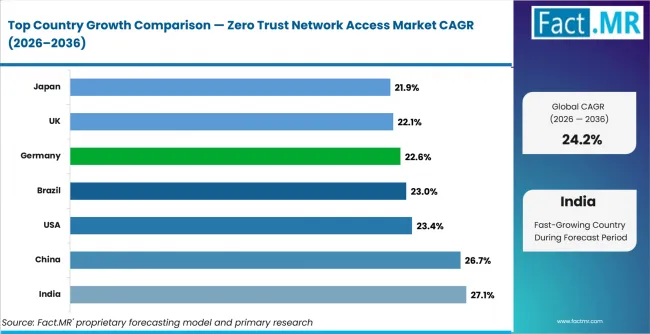
India is projected to record at 27.1% CAGR through 2036 as banks and technology service firms expand identity based private application access. China follows at 26.7% CAGR by 2036 driven by stronger user checks around cloud business applications and regulated enterprise systems. The United States records 23.4% CAGR from 2026 to 2036 as federal zero trust implementation and private cloud use lift platform spending. Brazil advances at 23.0% CAGR through 2036 as banks and online commerce firms secure customer systems and staff access. Germany is set to expand at 22.6% CAGR by 2036 as industrial groups and financial firms strengthen access review around cloud systems. The United Kingdom grows at 22.1% CAGR through 2036 as banks and public sector entities modernize private access for hybrid staff. Japan rises at 21.9% CAGR from 2026 to 2036 as financial institutions and manufacturers upgrade private application access for partner users.
Segmental Analysis
Zero Trust Network Access Market Analysis by Component

Solution is set to hold 67.8% share in 2026 as enterprises prefer packaged access control tools with identity checks and policy enforcement. Software platforms take a larger value share because they connect users to private applications and act as the main control point. Services continue to grow as complex rule design creates demand for migration support.
- Solution Demand Expansion: Enterprises choose ZTNA platforms to replace full VPN entry with application-level access and session checks.
- Services Uptake: Security teams use advisory and managed rollout services to convert old access rules into identity-based policies.
- Platform Bundling: Vendors combine ZTNA with software defined security as enterprises seek one policy view for user access and cloud assets.
Zero Trust Network Access Market Analysis by Deployment

Cloud is likely to hold 49.6% share in 2026 as companies prefer access control managed through hosted consoles. SaaS use and hybrid work patterns push security teams away from hardware access gateways. On-premise setups remain useful in highly controlled sectors with strict data rules.
- Cloud Access Preference: Hosted ZTNA platforms reduce hardware setup and help policy teams change access rules faster.
- Hybrid System Need: Enterprises keep some private applications in internal sites and use hybrid setup to avoid sudden full migration.
- Security Stack Link: Cloud-based ZTNA is often assessed with cloud security tools because both control SaaS and private application access.
Zero Trust Network Access Market Analysis by Enterprise Size
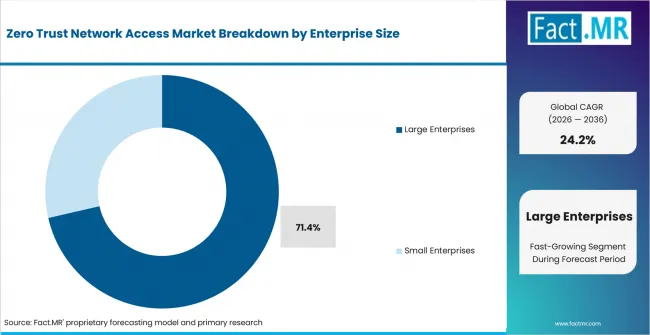
Large enterprises are set to hold 71.4% share in 2026 as they manage more users and private applications than smaller firms. Complex partner access and audit needs in banking and technology services support this position. Smaller firms adopt managed options because internal security staff capacity stays limited.
- Large Enterprise Control: Multi-office organizations need central policy checks that limit each user to approved private applications.
- Small Firm Migration: Smaller companies prefer managed ZTNA support because internal staff often lack access engineering depth.
- Device Mix Pressure: Bring-your-own-device use increases the role of mobile device management in ZTNA planning.
Zero Trust Network Access Market Analysis by Application

Application access control is set to hold 31.6% share in 2026 as private application protection remains the main reason companies buy ZTNA. This position is supported by the shift from full network entry to user-specific application rights. Remote access security and secure cloud connectivity form the next large use groups.
- Private Application Access: Security teams place ZTNA in front of finance and customer service systems to block full internal network entry.
- Monitoring Need: Access logs support audits and help detect unusual user behavior during private application sessions.
- Control Stack Link: Users compare application access control with network access control because both manage access to protected resources.
Zero Trust Network Access Market Analysis by End Use

BFSI is likely to hold 26.4% share in 2026 as financial institutions protect high-value customer records and transaction systems. Strict audit routines and cloud-based banking tools support this position. Healthcare and government use is rising as privacy rules increase access review needs.
- Banking System Protection: Financial institutions use ZTNA to limit staff and partner access to payment and customer service systems.
- Healthcare Access Control: Hospitals use private application access rules to reduce exposure around patient files and claims systems.
- Related Security Stack: Financial users often pair access tools with managed security services for monitoring and response support.
Zero Trust Network Access Market Analysis by Access Mode
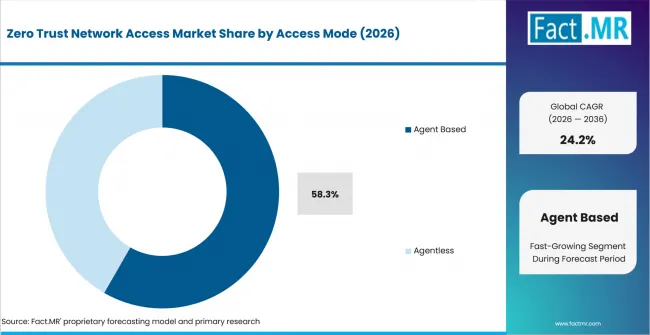
Agent-based access is expected to hold 58.3% share in 2026 as managed devices allow stronger health checks before application entry. Enterprises need to confirm device security status before each private session, which supports this share. Agentless access grows for contractor use and unmanaged devices.
- Agent-Based Control: Managed laptops support deeper device checks and make access decisions more precise for internal users.
- Agentless Contractor Use: Browser-based access reduces setup work for short-term partners and outside service providers.
- Edge Security Link: Device checks and browser-based access are often planned with edge security as applications move closer to users.
Drivers, Restraints, and Opportunities

The zero trust network access market is expanding as enterprises replace network-level access with application-level checks. Security teams want a simpler way to approve each session without exposing full internal systems. Interest in cyber security mesh supports this shift as controls move closer to users and applications.
Threat speed is a major driver for platform spending. CrowdStrike reported that average eCrime breakout time dropped to 29 minutes in 2025. This pushes enterprises toward session-level controls and faster policy changes because slow manual review can leave private applications exposed. [5]
The main restraint is migration effort. Existing access rules are often scattered across identity tools and network devices. Security teams need to rebuild policy groups before ZTNA can replace old VPN access. This slows rollout in companies with many legacy applications.
- Identity Attack Driver: Password-based attacks push enterprises toward continuous user checks and short access sessions.
- Cloud Access Opportunity: Public cloud use raises interest in public cloud management and security services with ZTNA bundles.
- Integration Cost Restraint: Complex legacy applications can increase service cost and delay access policy migration.
Regional Analysis
The zero trust network access market is assessed across North America and Europe and Asia. It covers 40+ country-level demand by component, deployment setup, enterprise size, application, end use and access mode. The full report includes market attractiveness analysis by region and country.
.webp)
| Country | CAGR (2026 to 2036) |
|---|---|
| India | 27.1% |
| China | 26.7% |
| United States | 23.4% |
| Brazil | 23.0% |
| Germany | 22.6% |
| United Kingdom | 22.1% |
| Japan | 21.9% |
Source: Fact.MR analysis, based on proprietary forecasting model and primary research.
Asia Pacific Zero Trust Network Access Market Analysis

Asia Pacific shows faster growth in zero trust network access as cloud application use and online banking expand across large enterprises. Cloud application use and online banking are expanding across large enterprises. Identity-based private application access is gaining faster use as banks and technology service firms reduce full network entry.
- India: India is projected to grow at 27.1% CAGR from 2026 to 2036. Banks and technology service firms are expanding identity-based private application access. Private application protection is gaining priority as organizations move from VPN access to user-level controls.
- China: China is forecast to expand at 26.7% CAGR through 2036. Cloud platform operators and regulated enterprises are strengthening user checks around business applications. Enterprise demand is rising as access control moves toward identity-verified application entry.
- Japan: Japan is projected to advance at 21.9% CAGR by 2036. Financial institutions and manufacturers are upgrading private application access for partner users. Stable security budgets after system audits are supporting steady buying.
North America Zero Trust Network Access Market Analysis
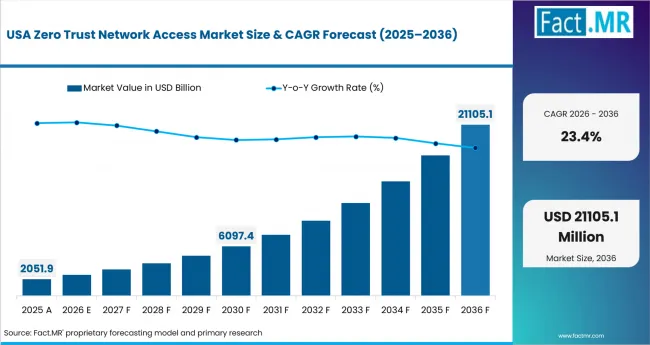
North America holds the largest revenue position in the zero trust network access market. Large enterprises and federal agencies already fund identity-based access programs. Public sector zero trust work and private cloud use continue to support platform spending.
- United States: The United States is projected to grow at 23.4% CAGR through 2036. Federal zero trust work and private cloud use are raising platform spending. The Cybersecurity and Infrastructure Security Agency published a zero trust architecture implementation update in January 2025, which keeps public sector demand active. [2]
Europe Zero Trust Network Access Market Analysis

Europe is moving toward access controls linked to privacy and critical service rules. Audit records and user rights review are important in enterprise buying. ZTNA platforms gain demand as companies need clear proof of who accessed each application.
- Germany: Germany is forecast to expand at 22.6% CAGR from 2026 to 2036. Industrial groups and financial firms are strengthening access review around cloud systems. Demand is supported by private application controls that can handle audit reporting and data residency needs.
- United Kingdom: The United Kingdom is projected to grow at 22.1% CAGR by 2036. Banks and public sector entities are modernizing private access for hybrid staff. Vendors with strong identity links and clear policy reporting are gaining more enterprise attention.
Latin America Zero Trust Network Access Market Analysis
Latin America is smaller than North America but has a clear adoption path for ZTNA. Cloud banking and telecom investment are creating steady demand for private application access. Managed security partners are helping regional firms reduce internal skill gaps.
- Brazil: Brazil is projected to grow at 23.0% CAGR through 2036. Banks and online commerce firms are securing customer systems and staff access. Large service providers and financial groups lead spending because many already use cloud identity tools.
Competitive Aligners for Market Players

ZTNA vendors compete on identity integrations and private application control. Zscaler and Cloudflare position wider security platforms around direct application access. Cisco and Palo Alto Networks use existing enterprise security relationships to extend access control into cloud security programs.
Product movement now links ZTNA with browser security and AI tool control. Cloudflare launched new Zero Trust tools in August 2025 to monitor AI usage and protect against shadow AI. This shows demand moving beyond basic remote access and into data control for new workplace tools. [6]
Akamai signed a strategic agreement with Seraphic Security in September 2025 to add secure enterprise browser technology to its Zero Trust security portfolio. The move strengthens access control for private applications and SaaS use on managed and unmanaged devices. [7]
Vendors that combine ZTNA with data center logical security can support private application control in cloud and data center environments. Suppliers that connect ZTNA with CDN security can serve firms needing application access and content protection in one stack.
Key Players
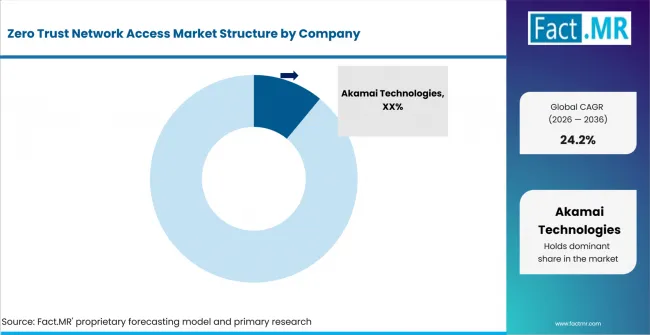
- Akamai Technologies
- Check Point Software Technologies
- Cisco Systems
- Cloudflare
- Fortinet
- Netskope
- Palo Alto Networks
- Zscaler
Bibliography
- [1] National Institute of Standards and Technology. (2025, June 10). Implementing a Zero Trust Architecture: NIST publishes SP 1800-35.
- [2] Cybersecurity and Infrastructure Security Agency. (2025, January 29). Zero Trust Architecture Implementation. U.S. Department of Homeland Security.
- [3] Verizon. (2025). 2025 Data Breach Investigations Report.
- [4] IBM. (2025). Cost of a Data Breach Report 2025.
- [5] CrowdStrike. (2026). CrowdStrike 2026 Global Threat Report.
- [6] Cloudflare. (2025, August 25). Cloudflare launches new Zero Trust tools for secure AI adoption at scale.
- [7] Akamai Technologies, Inc. (2025, September 15). Smarter security: Akamai and Seraphic team up to simplify SSE with secure enterprise browsing.
This Report Addresses
- Strategic demand analysis for zero trust network access across enterprise security, banking and financial services, healthcare, government, retail, energy, and education applications globally.
- Market forecast from USD 2.42 billion in 2026 to USD 21.13 billion by 2036 at 24.2% CAGR, with segment-level analysis by component, deployment, enterprise size, application, end use, and access mode.
- Opportunity mapping across India, China, the United States, Brazil, Germany, the United Kingdom, and Japan based on cloud application use and identity-based access adoption.
- Segment analysis by component, deployment setup, enterprise size, application area, end-use sector, and access mode with regional and country-level forecasts through 2036.
- Competitive analysis of Akamai Technologies, Check Point Software Technologies, Cisco Systems, Cloudflare, Fortinet, Netskope, Palo Alto Networks, and Zscaler covering identity integration, private application control, and enterprise security platform reach.
- Regulatory and framework impact analysis covering National Institute of Standards and Technology zero trust guidance, Cybersecurity and Infrastructure Security Agency implementation records, breach risk trends, and enterprise access policy updates.
- Report delivery in PDF, Excel, and presentation formats supported by vendor disclosures, security framework updates, enterprise security spending estimates, and primary interviews with security leaders.
Zero Trust Network Access Market Definition
The zero trust network access market covers software and services that verify each user and device before private application access is approved. The scope includes cloud delivered access gateways and policy engines that connect approved users to private applications. It excludes basic virtual private network tools sold without identity-based access control for general remote entry.
Zero Trust Network Access Market Inclusions
The report covers global and regional forecasts from 2026 to 2036 by component and delivery setup. It includes cloud access platforms and services that secure private applications for employees and partner users. Banking financial services and insurance are covered as high value sectors with strict access review needs. Healthcare and government users are treated as separate end use groups due to privacy and audit needs.
Zero Trust Network Access Market Exclusions
The report excludes endpoint antivirus tools and firewall appliances sold without private application access control. Identity software that only stores user records is excluded unless it controls application access decisions. General network monitoring software is excluded unless it controls access to private applications under a zero trust policy.
Zero Trust Network Access Market Research Methodology
- Primary Research
- Interviews with security architects, cloud operations heads, chief information security officers and enterprise access managers across the United States, India, China, Germany, the United Kingdom, Brazil and Japan. Discussions covered user migration from virtual private networks, access policy redesign, device posture checks and private application protection across large organizations.
- Desk Research
- Desk research reviewed official guidance from national cyber agencies and company releases from security vendors. The National Institute of Standards and Technology published final zero trust guidance in June 2025 with 24 vendors and 19 sample implementations. These implementation records were used to test platform scope and access policy depth for enterprise use. [1]
- Market-Sizing and Forecasting
- Hybrid model combining top-down enterprise security spending estimates with bottom-up ZTNA platform adoption checks by end-use sector. Revenue projections use the provided 2026 market value and the stated 2026 to 2036 CAGR. Segment shares are analyzed across component, deployment, enterprise size, application, end use, and access mode.
- Data Validation and Update Cycle
- Validated through vendor disclosures, security framework updates, enterprise access policy records, and primary interviews with security decision-makers. Updated annually as access rules, cloud security budgets, vendor portfolios, and regulatory guidance change.
Scope of the Report

| Attribute | Details |
|---|---|
| Quantitative Units | USD 2.42 billion (2026) to USD 21.13 billion (2036), at a CAGR of 24.2% |
| Market Definition | Zero trust network access tools and services that verify each user and device before private application access is approved through identity-based and device-based checks. |
| Component Segmentation | Solution, Services |
| Deployment Segmentation | Cloud, On-Premise, Hybrid |
| Enterprise Size Segmentation | Large Enterprises, Small Enterprises |
| Application Segmentation | Application Access Control, Remote Access Security, Secure Cloud Connectivity, Network Monitoring, Others |
| End Use Coverage | BFSI, IT and Telecommunications, Healthcare, Government and Defense, Retail and E-commerce, Energy and Utilities, Education, Others |
| Access Mode Segmentation | Agent-Based, Agentless |
| Regions Covered | North America, Western Europe, Eastern Europe, East Asia, South Asia and Pacific, Latin America, Middle East and Africa |
| Countries Covered | United States, Canada, Mexico, Germany, United Kingdom, France, Italy, Spain, Poland, Hungary, China, Japan, South Korea, India, ASEAN, Australia and New Zealand, Brazil, United Arab Emirates, Saudi Arabia, South Africa |
| Key Companies Profiled | Akamai Technologies, Check Point Software Technologies, Cisco Systems, Cloudflare, Fortinet, Netskope, Palo Alto Networks, and Zscaler |
| Forecast Period | 2026 to 2036 |
| Approach | Top-down validation and bottom-up segment checks using enterprise security spending estimates, ZTNA platform adoption checks, vendor disclosures, security framework updates, and primary interviews with security architects, cloud operations heads, chief information security officers, and enterprise access managers. |
Zero Trust Network Access Market by Segment
-
By Component
- Solution
- Services
-
By Deployment
- Cloud
- On-Premise
- Hybrid
-
By Enterprise Size
- Large Enterprises
- Small Enterprises
-
By Application
- Application Access Control
- Remote Access Security
- Secure Cloud Connectivity
- Network Monitoring
- Others
-
By End Use
- BFSI
- IT and Telecommunications
- Healthcare
- Government and Defense
- Retail and E-commerce
- Energy and Utilities
- Education
- Others
-
By Access Mode
- Agent-Based
- Agentless
-
By Region
- North America
- United States
- Canada
- Mexico
- Western Europe
- Germany
- United Kingdom
- France
- Italy
- Spain
- Netherlands
- Nordic Countries
- BENELUX
- Rest of Western Europe
- Eastern Europe
- Poland
- Hungary
- Balkan and Baltic
- Rest of Eastern Europe
- East Asia
- China
- Japan
- South Korea
- South Asia and Pacific
- India
- ASEAN
- Australia and New Zealand
- Rest of South Asia and Pacific
- Middle East and Africa
- Kingdom of Saudi Arabia
- Other GCC Countries
- Turkey
- South Africa
- Rest of Middle East and Africa
- North America

- Frequently Asked Questions -
How large is the global zero trust network access market in 2025?
The global zero trust network access market was valued at USD 1.97 billion in 2025.
What will the zero trust network access market size be in 2026?
Based on Fact.MR analysis, demand for zero trust network access is estimated to reach USD 2.42 billion in 2026.
What is the projected zero trust network access market size by 2036?
The market is projected to reach USD 21.13 billion by 2036, generating USD 18.71 billion in incremental revenue opportunity.
What is the expected CAGR for the zero trust network access market from 2026 to 2036?
Fact.MR projects 24.2% CAGR for the global zero trust network access market from 2026 to 2036.
Which component segment leads the zero trust network access market?
Solution leads with 67.8% share in 2026 because enterprises prefer packaged tools that combine identity checks with policy enforcement.
Which end-use sector leads the zero trust network access market?
Banking, financial services, and insurance lead with 26.4% share in 2026 due to strict access records for customer data and transaction systems.
Which country shows the fastest growth in the zero trust network access market?
India leads at 27.1% CAGR through 2036 as banks and technology service firms expand identity-based private application access.
Table of Content
- Executive Summary
- Global Market Outlook
- Demand to side Trends
- Supply to side Trends
- Technology Roadmap Analysis
- Analysis and Recommendations
- Market Overview
- Market Coverage / Taxonomy
- Market Definition / Scope / Limitations
- Research Methodology
- Chapter Orientation
- Analytical Lens and Working Hypotheses
- Market Structure, Signals, and Trend Drivers
- Benchmarking and Cross-market Comparability
- Market Sizing, Forecasting, and Opportunity Mapping
- Research Design and Evidence Framework
- Desk Research Programme (Secondary Evidence)
- Company Annual and Sustainability Reports
- Peer-reviewed Journals and Academic Literature
- Corporate Websites, Product Literature, and Technical Notes
- Earnings Decks and Investor Briefings
- Statutory Filings and Regulatory Disclosures
- Technical White Papers and Standards Notes
- Trade Journals, Industry Magazines, and Analyst Briefs
- Conference Proceedings, Webinars, and Seminar Materials
- Government Statistics Portals and Public Data Releases
- Press Releases and Reputable Media Coverage
- Specialist Newsletters and Curated Briefings
- Sector Databases and Reference Repositories
- Fact.MR Internal Proprietary Databases and Historical Market Datasets
- Subscription Datasets and Paid Sources
- Social Channels, Communities, and Digital Listening Inputs
- Additional Desk Sources
- Expert Input and Fieldwork (Primary Evidence)
- Primary Modes
- Qualitative Interviews and Expert Elicitation
- Quantitative Surveys and Structured Data Capture
- Blended Approach
- Why Primary Evidence is Used
- Field Techniques
- Interviews
- Surveys
- Focus Groups
- Observational and In-context Research
- Social and Community Interactions
- Stakeholder Universe Engaged
- C-suite Leaders
- Board Members
- Presidents and Vice Presidents
- R&D and Innovation Heads
- Technical Specialists
- Domain Subject-matter Experts
- Scientists
- Physicians and Other Healthcare Professionals
- Governance, Ethics, and Data Stewardship
- Research Ethics
- Data Integrity and Handling
- Primary Modes
- Tooling, Models, and Reference Databases
- Desk Research Programme (Secondary Evidence)
- Data Engineering and Model Build
- Data Acquisition and Ingestion
- Cleaning, Normalisation, and Verification
- Synthesis, Triangulation, and Analysis
- Quality Assurance and Audit Trail
- Market Background
- Market Dynamics
- Drivers
- Restraints
- Opportunity
- Trends
- Scenario Forecast
- Demand in Optimistic Scenario
- Demand in Likely Scenario
- Demand in Conservative Scenario
- Opportunity Map Analysis
- Product Life Cycle Analysis
- Supply Chain Analysis
- Investment Feasibility Matrix
- Value Chain Analysis
- PESTLE and Porter’s Analysis
- Regulatory Landscape
- Regional Parent Market Outlook
- Production and Consumption Statistics
- Import and Export Statistics
- Market Dynamics
- Global Market Analysis 2021 to 2025 and Forecast, 2026 to 2036
- Historical Market Size Value (USD Million) Analysis, 2021 to 2025
- Current and Future Market Size Value (USD Million) Projections, 2026 to 2036
- Y to o to Y Growth Trend Analysis
- Absolute $ Opportunity Analysis
- Global Market Pricing Analysis 2021 to 2025 and Forecast 2026 to 2036
- Global Market Analysis 2021 to 2025 and Forecast 2026 to 2036, By Form
- Introduction / Key Findings
- Historical Market Size Value (USD Million) Analysis By Form , 2021 to 2025
- Current and Future Market Size Value (USD Million) Analysis and Forecast By Form , 2026 to 2036
- Powdered Activated Carbon (PAC)
- Granular Activated Carbon (GAC)
- Pelletized Activated Carbon
- Extruded Activated Carbon
- Powdered Activated Carbon (PAC)
- Y to o to Y Growth Trend Analysis By Form , 2021 to 2025
- Absolute $ Opportunity Analysis By Form , 2026 to 2036
- Global Market Analysis 2021 to 2025 and Forecast 2026 to 2036, By Phase
- Introduction / Key Findings
- Historical Market Size Value (USD Million) Analysis By Phase, 2021 to 2025
- Current and Future Market Size Value (USD Million) Analysis and Forecast By Phase, 2026 to 2036
- Liquid Phase
- Gas Phase
- Liquid Phase
- Y to o to Y Growth Trend Analysis By Phase, 2021 to 2025
- Absolute $ Opportunity Analysis By Phase, 2026 to 2036
- Global Market Analysis 2021 to 2025 and Forecast 2026 to 2036, By Application
- Introduction / Key Findings
- Historical Market Size Value (USD Million) Analysis By Application, 2021 to 2025
- Current and Future Market Size Value (USD Million) Analysis and Forecast By Application, 2026 to 2036
- Water & Wastewater Treatment
- Food & Beverages
- Pharmaceutical & Medical
- Automotive
- Air Purification
- Gas Purification
- Industrial Processing
- Mining
- Others
- Water & Wastewater Treatment
- Y to o to Y Growth Trend Analysis By Application, 2021 to 2025
- Absolute $ Opportunity Analysis By Application, 2026 to 2036
- Global Market Analysis 2021 to 2025 and Forecast 2026 to 2036, By Raw Material
- Introduction / Key Findings
- Historical Market Size Value (USD Million) Analysis By Raw Material, 2021 to 2025
- Current and Future Market Size Value (USD Million) Analysis and Forecast By Raw Material, 2026 to 2036
- Coal-Based Activated Carbon
- Coconut Shell-Based Activated Carbon
- Wood-Based Activated Carbon
- Peat-Based Activated Carbon
- Other Feedstocks
- Coal-Based Activated Carbon
- Y to o to Y Growth Trend Analysis By Raw Material, 2021 to 2025
- Absolute $ Opportunity Analysis By Raw Material, 2026 to 2036
- Global Market Analysis 2021 to 2025 and Forecast 2026 to 2036, By End User
- Introduction / Key Findings
- Historical Market Size Value (USD Million) Analysis By End User, 2021 to 2025
- Current and Future Market Size Value (USD Million) Analysis and Forecast By End User, 2026 to 2036
- Municipal Water Utilities
- Industrial Manufacturing
- Food & Beverage Companies
- Pharmaceutical Companies
- Mining Operations
- Automotive Manufacturers
- Commercial Buildings & HVAC
- Others
- Municipal Water Utilities
- Y to o to Y Growth Trend Analysis By End User, 2021 to 2025
- Absolute $ Opportunity Analysis By End User, 2026 to 2036
- Global Market Analysis 2021 to 2025 and Forecast 2026 to 2036, By Region
- Introduction
- Historical Market Size Value (USD Million) Analysis By Region, 2021 to 2025
- Current Market Size Value (USD Million) Analysis and Forecast By Region, 2026 to 2036
- North America
- Latin America
- Western Europe
- Eastern Europe
- East Asia
- South Asia and Pacific
- Middle East & Africa
- Market Attractiveness Analysis By Region
- North America Market Analysis 2021 to 2025 and Forecast 2026 to 2036, By Country
- Historical Market Size Value (USD Million) Trend Analysis By Market Taxonomy, 2021 to 2025
- Market Size Value (USD Million) Forecast By Market Taxonomy, 2026 to 2036
- By Country
- USA
- Canada
- Mexico
- By Form
- By Phase
- By Application
- By Raw Material
- By End User
- By Country
- Market Attractiveness Analysis
- By Country
- By Form
- By Phase
- By Application
- By Raw Material
- By End User
- Key Takeaways
- Latin America Market Analysis 2021 to 2025 and Forecast 2026 to 2036, By Country
- Historical Market Size Value (USD Million) Trend Analysis By Market Taxonomy, 2021 to 2025
- Market Size Value (USD Million) Forecast By Market Taxonomy, 2026 to 2036
- By Country
- Brazil
- Chile
- Rest of Latin America
- By Form
- By Phase
- By Application
- By Raw Material
- By End User
- By Country
- Market Attractiveness Analysis
- By Country
- By Form
- By Phase
- By Application
- By Raw Material
- By End User
- Key Takeaways
- Western Europe Market Analysis 2021 to 2025 and Forecast 2026 to 2036, By Country
- Historical Market Size Value (USD Million) Trend Analysis By Market Taxonomy, 2021 to 2025
- Market Size Value (USD Million) Forecast By Market Taxonomy, 2026 to 2036
- By Country
- Germany
- UK
- Italy
- Spain
- France
- Nordic
- BENELUX
- Rest of Western Europe
- By Form
- By Phase
- By Application
- By Raw Material
- By End User
- By Country
- Market Attractiveness Analysis
- By Country
- By Form
- By Phase
- By Application
- By Raw Material
- By End User
- Key Takeaways
- Eastern Europe Market Analysis 2021 to 2025 and Forecast 2026 to 2036, By Country
- Historical Market Size Value (USD Million) Trend Analysis By Market Taxonomy, 2021 to 2025
- Market Size Value (USD Million) Forecast By Market Taxonomy, 2026 to 2036
- By Country
- Russia
- Poland
- Hungary
- Balkan & Baltic
- Rest of Eastern Europe
- By Form
- By Phase
- By Application
- By Raw Material
- By End User
- By Country
- Market Attractiveness Analysis
- By Country
- By Form
- By Phase
- By Application
- By Raw Material
- By End User
- Key Takeaways
- East Asia Market Analysis 2021 to 2025 and Forecast 2026 to 2036, By Country
- Historical Market Size Value (USD Million) Trend Analysis By Market Taxonomy, 2021 to 2025
- Market Size Value (USD Million) Forecast By Market Taxonomy, 2026 to 2036
- By Country
- China
- Japan
- South Korea
- By Form
- By Phase
- By Application
- By Raw Material
- By End User
- By Country
- Market Attractiveness Analysis
- By Country
- By Form
- By Phase
- By Application
- By Raw Material
- By End User
- Key Takeaways
- South Asia and Pacific Market Analysis 2021 to 2025 and Forecast 2026 to 2036, By Country
- Historical Market Size Value (USD Million) Trend Analysis By Market Taxonomy, 2021 to 2025
- Market Size Value (USD Million) Forecast By Market Taxonomy, 2026 to 2036
- By Country
- India
- ASEAN
- Australia & New Zealand
- Rest of South Asia and Pacific
- By Form
- By Phase
- By Application
- By Raw Material
- By End User
- By Country
- Market Attractiveness Analysis
- By Country
- By Form
- By Phase
- By Application
- By Raw Material
- By End User
- Key Takeaways
- Middle East & Africa Market Analysis 2021 to 2025 and Forecast 2026 to 2036, By Country
- Historical Market Size Value (USD Million) Trend Analysis By Market Taxonomy, 2021 to 2025
- Market Size Value (USD Million) Forecast By Market Taxonomy, 2026 to 2036
- By Country
- Kingdom of Saudi Arabia
- Other GCC Countries
- Turkiye
- South Africa
- Other African Union
- Rest of Middle East & Africa
- By Form
- By Phase
- By Application
- By Raw Material
- By End User
- By Country
- Market Attractiveness Analysis
- By Country
- By Form
- By Phase
- By Application
- By Raw Material
- By End User
- Key Takeaways
- Key Countries Market Analysis
- USA
- Pricing Analysis
- Market Share Analysis, 2025
- By Form
- By Phase
- By Application
- By Raw Material
- By End User
- Canada
- Pricing Analysis
- Market Share Analysis, 2025
- By Form
- By Phase
- By Application
- By Raw Material
- By End User
- Mexico
- Pricing Analysis
- Market Share Analysis, 2025
- By Form
- By Phase
- By Application
- By Raw Material
- By End User
- Brazil
- Pricing Analysis
- Market Share Analysis, 2025
- By Form
- By Phase
- By Application
- By Raw Material
- By End User
- Chile
- Pricing Analysis
- Market Share Analysis, 2025
- By Form
- By Phase
- By Application
- By Raw Material
- By End User
- Germany
- Pricing Analysis
- Market Share Analysis, 2025
- By Form
- By Phase
- By Application
- By Raw Material
- By End User
- UK
- Pricing Analysis
- Market Share Analysis, 2025
- By Form
- By Phase
- By Application
- By Raw Material
- By End User
- Italy
- Pricing Analysis
- Market Share Analysis, 2025
- By Form
- By Phase
- By Application
- By Raw Material
- By End User
- Spain
- Pricing Analysis
- Market Share Analysis, 2025
- By Form
- By Phase
- By Application
- By Raw Material
- By End User
- France
- Pricing Analysis
- Market Share Analysis, 2025
- By Form
- By Phase
- By Application
- By Raw Material
- By End User
- India
- Pricing Analysis
- Market Share Analysis, 2025
- By Form
- By Phase
- By Application
- By Raw Material
- By End User
- ASEAN
- Pricing Analysis
- Market Share Analysis, 2025
- By Form
- By Phase
- By Application
- By Raw Material
- By End User
- Australia & New Zealand
- Pricing Analysis
- Market Share Analysis, 2025
- By Form
- By Phase
- By Application
- By Raw Material
- By End User
- China
- Pricing Analysis
- Market Share Analysis, 2025
- By Form
- By Phase
- By Application
- By Raw Material
- By End User
- Japan
- Pricing Analysis
- Market Share Analysis, 2025
- By Form
- By Phase
- By Application
- By Raw Material
- By End User
- South Korea
- Pricing Analysis
- Market Share Analysis, 2025
- By Form
- By Phase
- By Application
- By Raw Material
- By End User
- Russia
- Pricing Analysis
- Market Share Analysis, 2025
- By Form
- By Phase
- By Application
- By Raw Material
- By End User
- Poland
- Pricing Analysis
- Market Share Analysis, 2025
- By Form
- By Phase
- By Application
- By Raw Material
- By End User
- Hungary
- Pricing Analysis
- Market Share Analysis, 2025
- By Form
- By Phase
- By Application
- By Raw Material
- By End User
- Kingdom of Saudi Arabia
- Pricing Analysis
- Market Share Analysis, 2025
- By Form
- By Phase
- By Application
- By Raw Material
- By End User
- Turkiye
- Pricing Analysis
- Market Share Analysis, 2025
- By Form
- By Phase
- By Application
- By Raw Material
- By End User
- South Africa
- Pricing Analysis
- Market Share Analysis, 2025
- By Form
- By Phase
- By Application
- By Raw Material
- By End User
- USA
- Market Structure Analysis
- Competition Dashboard
- Competition Benchmarking
- Market Share Analysis of Top Players
- By Regional
- By Form
- By Phase
- By Application
- By Raw Material
- By End User
- Competition Analysis
- Competition Deep Dive
- Osaka Gas Co. Ltd.
- Overview
- Product Portfolio
- Profitability by Market Segments (Product/Age /Sales Channel/Region)
- Sales Footprint
- Strategy Overview
- Marketing Strategy
- Product Strategy
- Channel Strategy
- Cabot Corporation
- Kuraray Co., Ltd.
- Calgon Carbon Corporation
- Haycarb PLC
- Osaka Gas Co. Ltd.
- Competition Deep Dive
- Assumptions & Acronyms Used
List Of Table
- Table 1: Global Market Value (USD Million) Forecast by Region, 2021 to 2036
- Table 2: Global Market Value (USD Million) Forecast by Form, 2021 to 2036
- Table 3: Global Market Value (USD Million) Forecast by Phase, 2021 to 2036
- Table 4: Global Market Value (USD Million) Forecast by Application, 2021 to 2036
- Table 5: Global Market Value (USD Million) Forecast by Raw Material, 2021 to 2036
- Table 6: Global Market Value (USD Million) Forecast by End User, 2021 to 2036
- Table 7: North America Market Value (USD Million) Forecast by Country, 2021 to 2036
- Table 8: North America Market Value (USD Million) Forecast by Form, 2021 to 2036
- Table 9: North America Market Value (USD Million) Forecast by Phase, 2021 to 2036
- Table 10: North America Market Value (USD Million) Forecast by Application, 2021 to 2036
- Table 11: North America Market Value (USD Million) Forecast by Raw Material, 2021 to 2036
- Table 12: North America Market Value (USD Million) Forecast by End User, 2021 to 2036
- Table 13: Latin America Market Value (USD Million) Forecast by Country, 2021 to 2036
- Table 14: Latin America Market Value (USD Million) Forecast by Form, 2021 to 2036
- Table 15: Latin America Market Value (USD Million) Forecast by Phase, 2021 to 2036
- Table 16: Latin America Market Value (USD Million) Forecast by Application, 2021 to 2036
- Table 17: Latin America Market Value (USD Million) Forecast by Raw Material, 2021 to 2036
- Table 18: Latin America Market Value (USD Million) Forecast by End User, 2021 to 2036
- Table 19: Western Europe Market Value (USD Million) Forecast by Country, 2021 to 2036
- Table 20: Western Europe Market Value (USD Million) Forecast by Form, 2021 to 2036
- Table 21: Western Europe Market Value (USD Million) Forecast by Phase, 2021 to 2036
- Table 22: Western Europe Market Value (USD Million) Forecast by Application, 2021 to 2036
- Table 23: Western Europe Market Value (USD Million) Forecast by Raw Material, 2021 to 2036
- Table 24: Western Europe Market Value (USD Million) Forecast by End User, 2021 to 2036
- Table 25: Eastern Europe Market Value (USD Million) Forecast by Country, 2021 to 2036
- Table 26: Eastern Europe Market Value (USD Million) Forecast by Form, 2021 to 2036
- Table 27: Eastern Europe Market Value (USD Million) Forecast by Phase, 2021 to 2036
- Table 28: Eastern Europe Market Value (USD Million) Forecast by Application, 2021 to 2036
- Table 29: Eastern Europe Market Value (USD Million) Forecast by Raw Material, 2021 to 2036
- Table 30: Eastern Europe Market Value (USD Million) Forecast by End User, 2021 to 2036
- Table 31: East Asia Market Value (USD Million) Forecast by Country, 2021 to 2036
- Table 32: East Asia Market Value (USD Million) Forecast by Form, 2021 to 2036
- Table 33: East Asia Market Value (USD Million) Forecast by Phase, 2021 to 2036
- Table 34: East Asia Market Value (USD Million) Forecast by Application, 2021 to 2036
- Table 35: East Asia Market Value (USD Million) Forecast by Raw Material, 2021 to 2036
- Table 36: East Asia Market Value (USD Million) Forecast by End User, 2021 to 2036
- Table 37: South Asia and Pacific Market Value (USD Million) Forecast by Country, 2021 to 2036
- Table 38: South Asia and Pacific Market Value (USD Million) Forecast by Form, 2021 to 2036
- Table 39: South Asia and Pacific Market Value (USD Million) Forecast by Phase, 2021 to 2036
- Table 40: South Asia and Pacific Market Value (USD Million) Forecast by Application, 2021 to 2036
- Table 41: South Asia and Pacific Market Value (USD Million) Forecast by Raw Material, 2021 to 2036
- Table 42: South Asia and Pacific Market Value (USD Million) Forecast by End User, 2021 to 2036
- Table 43: Middle East & Africa Market Value (USD Million) Forecast by Country, 2021 to 2036
- Table 44: Middle East & Africa Market Value (USD Million) Forecast by Form, 2021 to 2036
- Table 45: Middle East & Africa Market Value (USD Million) Forecast by Phase, 2021 to 2036
- Table 46: Middle East & Africa Market Value (USD Million) Forecast by Application, 2021 to 2036
- Table 47: Middle East & Africa Market Value (USD Million) Forecast by Raw Material, 2021 to 2036
- Table 48: Middle East & Africa Market Value (USD Million) Forecast by End User, 2021 to 2036
List Of Figures
- Figure 1: Global Market Pricing Analysis
- Figure 2: Global Market Value (USD Million) Forecast 2021-2036
- Figure 3: Global Market Value Share and BPS Analysis by Form, 2026 and 2036
- Figure 4: Global Market Y-o-Y Growth Comparison by Form, 2026 to 2036
- Figure 5: Global Market Attractiveness Analysis by Form
- Figure 6: Global Market Value Share and BPS Analysis by Phase, 2026 and 2036
- Figure 7: Global Market Y-o-Y Growth Comparison by Phase, 2026 to 2036
- Figure 8: Global Market Attractiveness Analysis by Phase
- Figure 9: Global Market Value Share and BPS Analysis by Application, 2026 and 2036
- Figure 10: Global Market Y-o-Y Growth Comparison by Application, 2026 to 2036
- Figure 11: Global Market Attractiveness Analysis by Application
- Figure 12: Global Market Value Share and BPS Analysis by Raw Material, 2026 and 2036
- Figure 13: Global Market Y-o-Y Growth Comparison by Raw Material, 2026 to 2036
- Figure 14: Global Market Attractiveness Analysis by Raw Material
- Figure 15: Global Market Value Share and BPS Analysis by End User, 2026 and 2036
- Figure 16: Global Market Y-o-Y Growth Comparison by End User, 2026 to 2036
- Figure 17: Global Market Attractiveness Analysis by End User
- Figure 18: Global Market Value (USD Million) Share and BPS Analysis by Region, 2026 and 2036
- Figure 19: Global Market Y-o-Y Growth Comparison by Region, 2026 to 2036
- Figure 20: Global Market Attractiveness Analysis by Region
- Figure 21: North America Market Incremental Dollar Opportunity, 2026 to 2036
- Figure 22: Latin America Market Incremental Dollar Opportunity, 2026 to 2036
- Figure 23: Western Europe Market Incremental Dollar Opportunity, 2026 to 2036
- Figure 24: Eastern Europe Market Incremental Dollar Opportunity, 2026 to 2036
- Figure 25: East Asia Market Incremental Dollar Opportunity, 2026 to 2036
- Figure 26: South Asia and Pacific Market Incremental Dollar Opportunity, 2026 to 2036
- Figure 27: Middle East & Africa Market Incremental Dollar Opportunity, 2026 to 2036
- Figure 28: North America Market Value Share and BPS Analysis by Country, 2026 and 2036
- Figure 29: North America Market Value Share and BPS Analysis by Form, 2026 and 2036
- Figure 30: North America Market Y-o-Y Growth Comparison by Form, 2026 to 2036
- Figure 31: North America Market Attractiveness Analysis by Form
- Figure 32: North America Market Value Share and BPS Analysis by Phase, 2026 and 2036
- Figure 33: North America Market Y-o-Y Growth Comparison by Phase, 2026 to 2036
- Figure 34: North America Market Attractiveness Analysis by Phase
- Figure 35: North America Market Value Share and BPS Analysis by Application, 2026 and 2036
- Figure 36: North America Market Y-o-Y Growth Comparison by Application, 2026 to 2036
- Figure 37: North America Market Attractiveness Analysis by Application
- Figure 38: North America Market Value Share and BPS Analysis by Raw Material, 2026 and 2036
- Figure 39: North America Market Y-o-Y Growth Comparison by Raw Material, 2026 to 2036
- Figure 40: North America Market Attractiveness Analysis by Raw Material
- Figure 41: North America Market Value Share and BPS Analysis by End User, 2026 and 2036
- Figure 42: North America Market Y-o-Y Growth Comparison by End User, 2026 to 2036
- Figure 43: North America Market Attractiveness Analysis by End User
- Figure 44: Latin America Market Value Share and BPS Analysis by Country, 2026 and 2036
- Figure 45: Latin America Market Value Share and BPS Analysis by Form, 2026 and 2036
- Figure 46: Latin America Market Y-o-Y Growth Comparison by Form, 2026 to 2036
- Figure 47: Latin America Market Attractiveness Analysis by Form
- Figure 48: Latin America Market Value Share and BPS Analysis by Phase, 2026 and 2036
- Figure 49: Latin America Market Y-o-Y Growth Comparison by Phase, 2026 to 2036
- Figure 50: Latin America Market Attractiveness Analysis by Phase
- Figure 51: Latin America Market Value Share and BPS Analysis by Application, 2026 and 2036
- Figure 52: Latin America Market Y-o-Y Growth Comparison by Application, 2026 to 2036
- Figure 53: Latin America Market Attractiveness Analysis by Application
- Figure 54: Latin America Market Value Share and BPS Analysis by Raw Material, 2026 and 2036
- Figure 55: Latin America Market Y-o-Y Growth Comparison by Raw Material, 2026 to 2036
- Figure 56: Latin America Market Attractiveness Analysis by Raw Material
- Figure 57: Latin America Market Value Share and BPS Analysis by End User, 2026 and 2036
- Figure 58: Latin America Market Y-o-Y Growth Comparison by End User, 2026 to 2036
- Figure 59: Latin America Market Attractiveness Analysis by End User
- Figure 60: Western Europe Market Value Share and BPS Analysis by Country, 2026 and 2036
- Figure 61: Western Europe Market Value Share and BPS Analysis by Form, 2026 and 2036
- Figure 62: Western Europe Market Y-o-Y Growth Comparison by Form, 2026 to 2036
- Figure 63: Western Europe Market Attractiveness Analysis by Form
- Figure 64: Western Europe Market Value Share and BPS Analysis by Phase, 2026 and 2036
- Figure 65: Western Europe Market Y-o-Y Growth Comparison by Phase, 2026 to 2036
- Figure 66: Western Europe Market Attractiveness Analysis by Phase
- Figure 67: Western Europe Market Value Share and BPS Analysis by Application, 2026 and 2036
- Figure 68: Western Europe Market Y-o-Y Growth Comparison by Application, 2026 to 2036
- Figure 69: Western Europe Market Attractiveness Analysis by Application
- Figure 70: Western Europe Market Value Share and BPS Analysis by Raw Material, 2026 and 2036
- Figure 71: Western Europe Market Y-o-Y Growth Comparison by Raw Material, 2026 to 2036
- Figure 72: Western Europe Market Attractiveness Analysis by Raw Material
- Figure 73: Western Europe Market Value Share and BPS Analysis by End User, 2026 and 2036
- Figure 74: Western Europe Market Y-o-Y Growth Comparison by End User, 2026 to 2036
- Figure 75: Western Europe Market Attractiveness Analysis by End User
- Figure 76: Eastern Europe Market Value Share and BPS Analysis by Country, 2026 and 2036
- Figure 77: Eastern Europe Market Value Share and BPS Analysis by Form, 2026 and 2036
- Figure 78: Eastern Europe Market Y-o-Y Growth Comparison by Form, 2026 to 2036
- Figure 79: Eastern Europe Market Attractiveness Analysis by Form
- Figure 80: Eastern Europe Market Value Share and BPS Analysis by Phase, 2026 and 2036
- Figure 81: Eastern Europe Market Y-o-Y Growth Comparison by Phase, 2026 to 2036
- Figure 82: Eastern Europe Market Attractiveness Analysis by Phase
- Figure 83: Eastern Europe Market Value Share and BPS Analysis by Application, 2026 and 2036
- Figure 84: Eastern Europe Market Y-o-Y Growth Comparison by Application, 2026 to 2036
- Figure 85: Eastern Europe Market Attractiveness Analysis by Application
- Figure 86: Eastern Europe Market Value Share and BPS Analysis by Raw Material, 2026 and 2036
- Figure 87: Eastern Europe Market Y-o-Y Growth Comparison by Raw Material, 2026 to 2036
- Figure 88: Eastern Europe Market Attractiveness Analysis by Raw Material
- Figure 89: Eastern Europe Market Value Share and BPS Analysis by End User, 2026 and 2036
- Figure 90: Eastern Europe Market Y-o-Y Growth Comparison by End User, 2026 to 2036
- Figure 91: Eastern Europe Market Attractiveness Analysis by End User
- Figure 92: East Asia Market Value Share and BPS Analysis by Country, 2026 and 2036
- Figure 93: East Asia Market Value Share and BPS Analysis by Form, 2026 and 2036
- Figure 94: East Asia Market Y-o-Y Growth Comparison by Form, 2026 to 2036
- Figure 95: East Asia Market Attractiveness Analysis by Form
- Figure 96: East Asia Market Value Share and BPS Analysis by Phase, 2026 and 2036
- Figure 97: East Asia Market Y-o-Y Growth Comparison by Phase, 2026 to 2036
- Figure 98: East Asia Market Attractiveness Analysis by Phase
- Figure 99: East Asia Market Value Share and BPS Analysis by Application, 2026 and 2036
- Figure 100: East Asia Market Y-o-Y Growth Comparison by Application, 2026 to 2036
- Figure 101: East Asia Market Attractiveness Analysis by Application
- Figure 102: East Asia Market Value Share and BPS Analysis by Raw Material, 2026 and 2036
- Figure 103: East Asia Market Y-o-Y Growth Comparison by Raw Material, 2026 to 2036
- Figure 104: East Asia Market Attractiveness Analysis by Raw Material
- Figure 105: East Asia Market Value Share and BPS Analysis by End User, 2026 and 2036
- Figure 106: East Asia Market Y-o-Y Growth Comparison by End User, 2026 to 2036
- Figure 107: East Asia Market Attractiveness Analysis by End User
- Figure 108: South Asia and Pacific Market Value Share and BPS Analysis by Country, 2026 and 2036
- Figure 109: South Asia and Pacific Market Value Share and BPS Analysis by Form, 2026 and 2036
- Figure 110: South Asia and Pacific Market Y-o-Y Growth Comparison by Form, 2026 to 2036
- Figure 111: South Asia and Pacific Market Attractiveness Analysis by Form
- Figure 112: South Asia and Pacific Market Value Share and BPS Analysis by Phase, 2026 and 2036
- Figure 113: South Asia and Pacific Market Y-o-Y Growth Comparison by Phase, 2026 to 2036
- Figure 114: South Asia and Pacific Market Attractiveness Analysis by Phase
- Figure 115: South Asia and Pacific Market Value Share and BPS Analysis by Application, 2026 and 2036
- Figure 116: South Asia and Pacific Market Y-o-Y Growth Comparison by Application, 2026 to 2036
- Figure 117: South Asia and Pacific Market Attractiveness Analysis by Application
- Figure 118: South Asia and Pacific Market Value Share and BPS Analysis by Raw Material, 2026 and 2036
- Figure 119: South Asia and Pacific Market Y-o-Y Growth Comparison by Raw Material, 2026 to 2036
- Figure 120: South Asia and Pacific Market Attractiveness Analysis by Raw Material
- Figure 121: South Asia and Pacific Market Value Share and BPS Analysis by End User, 2026 and 2036
- Figure 122: South Asia and Pacific Market Y-o-Y Growth Comparison by End User, 2026 to 2036
- Figure 123: South Asia and Pacific Market Attractiveness Analysis by End User
- Figure 124: Middle East & Africa Market Value Share and BPS Analysis by Country, 2026 and 2036
- Figure 125: Middle East & Africa Market Value Share and BPS Analysis by Form, 2026 and 2036
- Figure 126: Middle East & Africa Market Y-o-Y Growth Comparison by Form, 2026 to 2036
- Figure 127: Middle East & Africa Market Attractiveness Analysis by Form
- Figure 128: Middle East & Africa Market Value Share and BPS Analysis by Phase, 2026 and 2036
- Figure 129: Middle East & Africa Market Y-o-Y Growth Comparison by Phase, 2026 to 2036
- Figure 130: Middle East & Africa Market Attractiveness Analysis by Phase
- Figure 131: Middle East & Africa Market Value Share and BPS Analysis by Application, 2026 and 2036
- Figure 132: Middle East & Africa Market Y-o-Y Growth Comparison by Application, 2026 to 2036
- Figure 133: Middle East & Africa Market Attractiveness Analysis by Application
- Figure 134: Middle East & Africa Market Value Share and BPS Analysis by Raw Material, 2026 and 2036
- Figure 135: Middle East & Africa Market Y-o-Y Growth Comparison by Raw Material, 2026 to 2036
- Figure 136: Middle East & Africa Market Attractiveness Analysis by Raw Material
- Figure 137: Middle East & Africa Market Value Share and BPS Analysis by End User, 2026 and 2036
- Figure 138: Middle East & Africa Market Y-o-Y Growth Comparison by End User, 2026 to 2036
- Figure 139: Middle East & Africa Market Attractiveness Analysis by End User
- Figure 140: Global Market - Tier Structure Analysis
- Figure 141: Global Market - Company Share Analysis