- Market Value (2025): USD 170.1 Mn
- Estimated Value (2026): USD 178.9 Mn
- Forecast Value (2036): USD 295.6 Mn
- CAGR (2026-2036): 5.2%
What is the Dive Fin Market forecast to be worth by 2036?
USD 178.9 Million in 2026 to USD 295.6 Million by 2036 at a 5.2% CAGR.
- At USD 170.1 Million in 2025, the dive fin market drew baseline support from rental gear turnover across tropical dive resorts, technical diving club gear acquisitions, and individual purchases of travel-friendly full-foot fins.
- Sales will progress from USD 178.9 Million in 2026 to USD 295.6 Million by 2036 as divers prioritize ergonomic foot pockets, quick-release bungee heel straps, and lightweight composite blades.
- Compounding at a 5.2% CAGR through the 2026 to 2036 forecast timeframe, market value expansion is reinforced by widening participation in freediving, coral reef conservation expeditions, and commercial underwater inspections.
The revenue trajectory of the global market illustrates consistent commercial compounding anchored by regular replacement cycles and consumer trading up toward specialized hydrodynamic equipment. Technical divers maneuvering through tight cave systems and deep wreck penetrations increasingly mandate heavy-duty, negatively buoyant rubber paddle fins capable of precise frog kicking and reverse propulsion without stirring up silt. Concurrently, warm-water resort divers and snorkeling enthusiasts favor soft, flexible full-foot models that eliminate the need for heavy neoprene booties and minimize travel baggage weight during long-haul tropical transit.
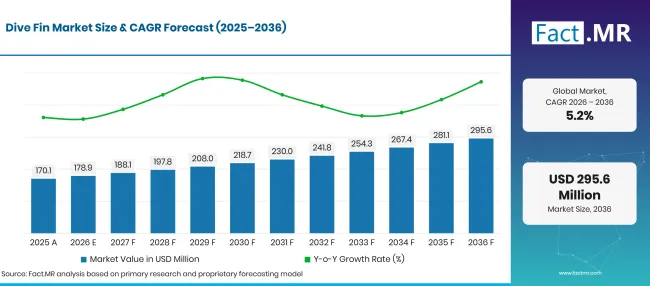
Dive Fin Market Forecast Global | Source: Fact.MR
| Year | Basis | Market Value (USD Million) |
|---|---|---|
| 2025 | Actual | 170.1 |
| 2026 | Estimate | 178.9 |
| 2036 | Forecast | 295.6 |
| CAGR 2026 to 2036 | Forecast period | 5.2% |
Source: Fact.MR analysis. Updated Oct 27, 2026
What are the defining numbers behind Dive Fin Market growth?
Between 2026 and 2036, the dive fin industry will unlock an absolute dollar opportunity of USD 116.7 Million, driven by expanding aquatic sports participation, composite material innovations, and the surging global popularity of freediving disciplines.
- Demand Drivers in the Market
- Fin demand spans more use cases than a single blade design can serve, encouraging distinct products for learners, travelers, freedivers, and technical users. In its 2025 annual report, DEMA describes an international membership base exceeding 1,400 businesses and organizations. [1].
- Instruction provides a recurring demand floor because propulsion control, trim, and maneuvering are assessed throughout diver development. BIS consolidated standards for diver training, guided excursions, enriched-air diving, and sustainable practice in its 2025 diving-services compendium. [2].
- As monitored marine access expands, efficient fins that reduce fatigue while preserving control become more valuable to both visitors and operators. A 2025 NOAA case study places the US National Marine Sanctuary System above 629,000 square miles while highlighting gaps in visitor-use measurement. [3].
- Liveaboard safety planning increases the importance of secure heel retention and predictable thrust during routine and emergency movement. The UK MAIB's 2025 Red Sea warning documents 16 liveaboard losses in five years and shortcomings in construction, escape routes, and emergency preparation. [4].
- A widely distributed diving economy supports separate product tiers for recreational, technical, travel, and freediving applications. Research highlighted by the UN Ocean Decade in 2025 links scuba to as many as 124,000 jobs in 170 countries, with about seven in ten marine dives occurring in protected areas. [5].
- Key Segments Analyzed
- By Product Type: Full Foot Fins lead the category with a 42.1% share in 2026, favored in warm-water resort environments for their bare-foot comfort, hydrodynamic streamlining, and lightweight portability.
- By Application: Recreational Diving generates 42.3% of total application revenue in 2026, anchored by worldwide dive resort excursions, coastal leisure tourism, and introductory scuba training certifications.
- By Material: Rubber commands 51.3% of 2026 material demand, remaining the gold standard for heavy-duty technical fins owing to its exceptional structural memory, negative buoyancy, and tear resistance.
- By Distribution Channel: Specialty Dive Shops capture 40.1% of commercial sales in 2026, serving as the essential fitting hub where divers verify foot pocket ergonomics and flex characteristics.
- By End-User: Adults represent 57.7% of total end-user demand in 2026, reflecting the primary demographic investing in certified diver education and international diving vacation packages.
- Analyst Opinion at Fact.MR
- Shambhu Nath Jha, Principal Consultant at Fact.MR, states, "The global dive fin market is undergoing a decisive shift from generic molded plastics toward application-tailored hydrodynamic propulsion systems. Modern divers understand that propulsion efficiency directly governs underwater air consumption and overall dive duration. Manufacturers are deploying advanced computational fluid dynamics to design variable-flex blades that channel water downward with minimal energy dispersion. In the technical diving segment, ruggedized natural and synthetic rubber formulations with stainless steel spring straps dominate, providing the precise directional thrust and backward propulsion required in overhead environments."
- Strategic Implications
- Fin demand spans more use cases than a single blade design can serve, encouraging distinct products for learners, travelers, freedivers, and technical users. In its 2025 annual report, DEMA describes an international membership base exceeding 1,400 businesses and organizations. [1].
- Instruction provides a recurring demand floor because propulsion control, trim, and maneuvering are assessed throughout diver development. BIS consolidated standards for diver training, guided excursions, enriched-air diving, and sustainable practice in its 2025 diving-services compendium. [2].
- Liveaboard safety planning increases the importance of secure heel retention and predictable thrust during routine and emergency movement. The UK MAIB's 2025 Red Sea warning documents 16 liveaboard losses in five years and shortcomings in construction, escape routes, and emergency preparation. [4].
- A widely distributed diving economy supports separate product tiers for recreational, technical, travel, and freediving applications. Research highlighted by the UN Ocean Decade in 2025 links scuba to as many as 124,000 jobs in 170 countries, with about seven in ten marine dives occurring in protected areas. [5].
German dive fin consumption will compound at a 6.4% CAGR through 2036, supported by cold-water technical divers investing in heavy-duty open-heel rubber fins designed for drysuit diving.
How does the Dive Fin Market break down by segment?
Full Foot Fins lead Product Type at 42.1%, Recreational Diving leads Application at 42.3%, Rubber commands Material at 51.3%, Specialty Dive Shops control Distribution Channel at 40.1%, and Adults account for 57.7% of End-User demand in 2026.
Which Product Type dominates?
Full Foot Fins capture 42.1% of 2026 product value.
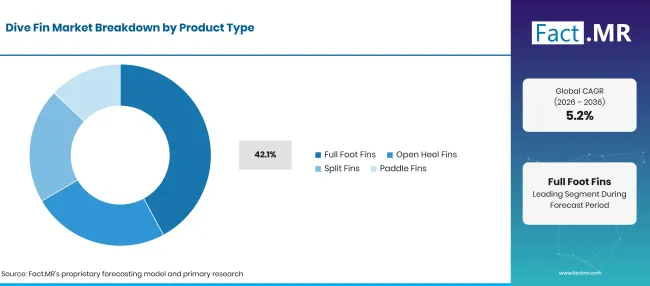
Dive Fin Market Breakdown Product Type | Source: Fact.MR
Full-foot fin architectures represent the dominant product format across global recreational diving and warm-water resort operations. Characterized by a completely enclosed, soft elastomer foot pocket that encases the heel and foot without requiring separate neoprene booties, full-foot designs deliver direct energy transfer from the diver's foot to the blade surface. This intimate mechanical coupling minimizes power loss and prevents foot chafing during relaxed swimming or snorkeling sessions. Furthermore, full-foot fins feature a streamlined hydrodynamic profile that reduces frontal resistance, making them exceptionally popular among tropical vacationers, reef snorkelers, and warm-water scuba enthusiasts. Because full-foot fins are substantially lighter and more compact than open-heel variants, traveling divers consistently favor them for international air transit where airline baggage limits apply. Manufacturers frequently adapt performance water sports equipment manufacturing methodologies to co-mold soft rubber foot pockets with resilient thermoplastic blades, optimizing flex points along the blade's central longitudinal axis.
| Product Type | Share (2026) |
|---|---|
| Full Foot Fins (Leading segment) | 42.1% |
| Other segments combined | 57.9%* |
| Total | 100.0% |
Source: Fact.MR analysis. Updated Oct 27, 2026
Which Application leads the market?
Recreational Diving generates 42.3% of 2026 application demand.
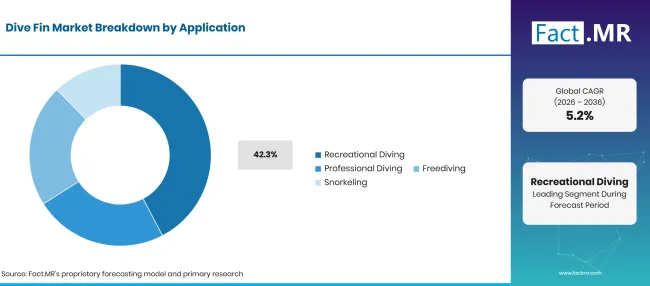
Dive Fin Market Breakdown Application | Source: Fact.MR
Recreational diving forms the commercial nucleus of the dive fin sector, encompassing guided reef excursions, introductory scuba courses, boat charters, and resort diving vacations worldwide. Recreational divers require versatile, forgiving fins that deliver adequate propulsion across variable currents without demanding extreme physical exertion or causing premature leg fatigue. Channeling technologies, where flexible central elastomer panels deflect during the kick stroke to form a U-shaped water trough, are specifically engineered for recreational users to capture and accelerate water off the blade tip. As international tourism expands across tropical island destinations supporting adventure travel and coastal recreation, dive operators and liveaboard vessels purchase large commercial inventories of durable recreational fins to equip newly certified divers and rental customers.
| Application | Share (2026) |
|---|---|
| Recreational Diving (Leading segment) | 42.3% |
| Other segments combined | 57.7%* |
| Total | 100.0% |
Source: Fact.MR analysis. Updated Oct 27, 2026
Which Material commands the largest share?
Rubber commands 51.3% of 2026 material demand.
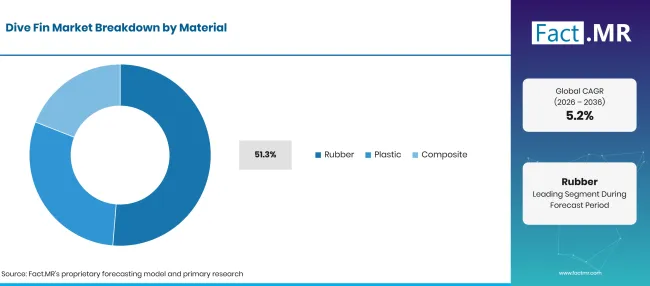
Dive Fin Market Breakdown Material | Source: Fact.MR
Vulcanized natural rubber and specialized synthetic rubber elastomers like monoprene dominate material consumption in the dive fin market. Rubber offers an unmatched combination of structural durability, elasticity, and negative buoyancy that cannot be replicated by basic rigid plastics. In technical, wreck, and cave diving environments, divers require negatively buoyant rubber fins that sink slightly, helping to trim the diver horizontally and keep their legs elevated above delicate silt beds. The material's inherent resistance to saltwater corrosion, ultraviolet exposure, ozone cracking, and physical abrasion ensures that a pair of rubber fins can endure decades of rigorous operational service. Furthermore, rubber enables the fabrication of deep side rails and flow-accelerating vents that redirect water turbulence, providing powerful backward and rotational thrust during technical frog kicks. Skirt and fin designers frequently leverage advanced polymer and composite compounds and engineered polymer resin formulations to tune the shore hardness of the rubber foot pocket, providing a plush, supportive fit that prevents pressure sores during long immersions.
| Material | Share (2026) |
|---|---|
| Rubber (Leading segment) | 51.3% |
| Other segments combined | 48.7%* |
| Total | 100.0% |
Source: Fact.MR analysis. Updated Oct 27, 2026
What is accelerating Dive Fin Market adoption, and what is holding it back?
Adoption is propelled by rising dive travel participation, split-blade hydrodynamic innovations, and the global boom in freediving sports, while growth is constrained by high raw material prices, long product replacement lifecycles, and intense competition from budget thermoplastic alternatives.
Drivers Impact Analysis
| DRIVER | (~) % IMPACT ON CAGR | GEOGRAPHIC RELEVANCE | IMPACT TIMELINE |
|---|---|---|---|
| Global expansion of coastal marine tourism and certified scuba training programs | +1.3% | North America, East Asia, Western Europe | Short term (<= 2 years) |
| Surging international popularity of freediving requiring long-blade propulsion fins | +1.1% | Global | Short term (<= 2 years) |
| Widespread integration of ergonomic bungee and stainless-steel spring heel straps | +0.8% | North America, Western Europe | Medium term (2-4 years) |
| Adoption of multi-compound co-injection molding to create variable-flex channels | +0.7% | North America, Western Europe | Medium term (2-4 years) |
| Growth of commercial underwater inspection, aquaculture, and scientific diving | +0.6% | North America, East Asia | Long term (>= 4 years) |
| Development of ultra-compact travel fins optimized for airline luggage constraints | +0.5% | Global | Short term (<= 2 years) |
Source: Fact.MR analysis. Updated Oct 27, 2026
Opportunity Impact Analysis
| OPPORTUNITY | (~) % IMPACT ON CAGR | GEOGRAPHIC RELEVANCE | IMPACT TIMELINE |
|---|---|---|---|
| Direct-to-consumer customization of carbon-fiber blade stiffness and angle profiles | +0.7% | Western Europe, North America | Medium term (2-4 years) |
| Development of circular, closed-loop recyclable thermoplastic elastomer formulations | +0.5% | Western Europe, East Asia | Long term (>= 4 years) |
| Fleet leasing and managed maintenance agreements with international dive resort chains | +0.4% | Latin America, South Asia & Pacific | Medium term (2-4 years) |
| Specialized hydrodynamic fin designs tailored for public safety and military divers | +0.3% | North America, Western Europe | Long term (>= 4 years) |
Source: Fact.MR analysis. Updated Oct 27, 2026
Restraints Impact Analysis
| RESTRAINT | (~) % IMPACT ON CAGR | GEOGRAPHIC RELEVANCE | IMPACT TIMELINE |
|---|---|---|---|
| Extreme physical durability of vulcanized rubber fins leading to long replacement cycles | -0.6% | Global | Long term (>= 4 years) |
| Volatility in natural rubber and specialty synthetic elastomer feedstock pricing | -0.5% | Western Europe, North America | Short term (<= 2 years) |
| Sizing complexity requiring substantial physical inventory holding across retail stores | -0.4% | Global | Medium term (2-4 years) |
| Proliferation of uncertified low-cost imitation fins sold through online marketplaces | -0.3% | Global | Short term (<= 2 years) |
Source: Fact.MR analysis. Updated Oct 27, 2026
Which countries are scaling the Dive Fin Market through 2036?
Sustained demand across premier coastal diving nations and growing outdoor recreation corridors propels country-level dive fin consumption through 2036.
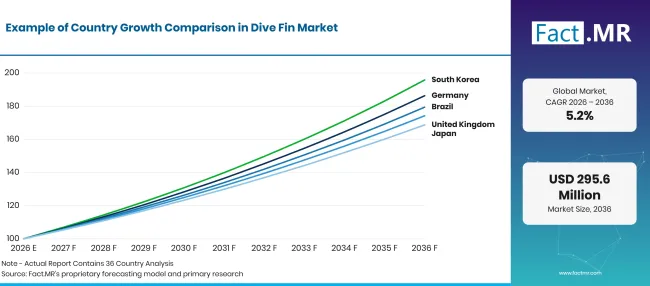
Dive Fin Market Growth Index | Source: Fact.MR
| Country | CAGR (2026 to 2036) |
|---|---|
| Germany | 6.4% |
| Brazil | 6.0% |
| United States | 4.3% |
| United Kingdom | 5.7% |
| Japan | 5.4% |
Source: Fact.MR analysis. Updated Oct 27, 2026
What supports Germany's adoption?
Fact.MR projects Germany's dive fin market to advance at 4.6% CAGR as cold-water clubs, lake diving, and outbound Mediterranean travel create demand for multiple fin formats. Open-heel models with spring or bungee straps suit boots and drysuits, while lightweight full-foot fins address travel users. Destatis registered 497.5 million overnight stays in Germany in 2025, including 4.2% growth in camping nights [6]. The scale of outdoor participation supports specialist fitting and replacement, but brands must clearly differentiate stiffness, blade efficiency, and weight to serve both local cold-water use and airline-conscious travelers.
How does Brazil perform?
Brazil is expected to lead the profiled countries with 6.0% CAGR as warm-water tourism, island excursions, training activity, and long coastal access strengthen fin demand. Full-foot fins suit resort rentals and casual users, whereas open-heel designs serve advanced divers and operators requiring more secure retention. India's 2025 Gas Cylinders amendment reflects a wider shift toward tighter oversight of professional dive equipment systems [7]. Brazilian distributors can respond by emphasizing durable foot pockets, abrasion-resistant blades, replaceable straps, and clear sizing, thereby reducing rental downtime and improving comfort across high-frequency boat and shore operations.
What is supporting United States adoption?
The United States dive fin market is forecast to grow at 5.2% CAGR, supported by large certification volumes, tropical travel, technical diving, public-safety users, and broad online and specialty distribution. Demand spans compact travel fins, high-thrust technical models, and freediving blades, making application-based merchandising important. NOAA's 2025 Gray's Reef condition report identifies visitation and vessel activity as management pressures and notes signs of increased recreational use [8]. Frequent activity at managed sites favors reliable straps, controlled propulsion, and blade materials that retain performance through repeated saltwater exposure and rental handling.
How is the United Kingdom developing demand?
The United Kingdom is projected to post 5.7% CAGR as wreck diving, cold-water clubs, and offshore training sustain demand for rugged open-heel fins. Divers using drysuits and thick boots typically require spacious foot pockets, secure heel systems, and stiffer blades that deliver control in currents without excessive fatigue. MAIB's 2025 Karin casualty investigation emphasizes lookout discipline, vessel coordination, and correct DSMB handling [9]. Within this safety-led environment, responsive fins support controlled ascents and surface positioning, while replaceable straps and durable construction help clubs and operators limit equipment failures during demanding trips.
How is Japan scaling demand?
Japan's dive fin market is forecast to expand at 5.4% CAGR, underpinned by Okinawa resort activity, domestic coastal diving, freediving participation, and strong preferences for compact, precisely fitted equipment. Rental operators need lightweight full-foot fins, while experienced users may select longer or stiffer blades for efficient propulsion. The Japan Tourism Agency's International Visitor Survey targets 131,640 annual responses across national, regional, and cruise modules [10]. These data can improve seasonal inventory planning, allowing suppliers to balance travel-friendly models, rental sizes, and premium performance fins without carrying excessive stock.
Who leads the Dive Fin Market?
The competitive landscape of the dive fin sector is led by prominent European and American diving equipment manufacturers who combine decades of hydrodynamic research with proprietary injection molding infrastructure. Market leaders protect their market standing through patented blade channeling technologies, specialized foot pocket compounds, and extensive global distribution channels spanning specialty dive shops, resort rental fleets, and e-commerce platforms. Key manufacturers routinely collaborate with naval research laboratories, professional freedivers, and commercial diving institutions to refine propulsion dynamics and maximize energy conservation underwater.
Strategic differentiation in the industry focuses on addressing the distinct propulsion requirements of diverse diver categories. Recreational market leaders emphasize lightweight thermoplastic materials, vibrant color palettes, quick-adjust bungee heel straps, and split-blade hydrodynamic foils that minimize joint strain for casual vacationers. In contrast, technical diving specialists concentrate on monoprene and vulcanized rubber construction, stiff paddle profiles, and stainless steel spring straps that withstand extreme physical abuse during deep wreck and cave exploration. Companies also supply commercial maritime maintenance divers operating around watercraft and boat production docks and commercial yards maintaining commercial marine vessel operations.
Which companies are the key providers?
Key companies include Scubapro; Aqua Lung; Mares; Cressi; TUSA; Atomic Aquatics; Sherwood Scuba; Oceanic; Seac Sub; Beuchat.
- Scubapro
- Aqua Lung
- Mares
- Cressi
- TUSA
- Atomic Aquatics
- Sherwood Scuba
- Oceanic
- Seac Sub
- Beuchat
Bibliography
- [1] Diving Equipment and Marketing Association. (2025). 2025 annual report.
- [2] Bureau of Indian Standards. (2025). Compendium of Indian standards on diving services.
- [3] Schwarzmann, D., & Burns, R. (2025). Sanctuary Count: Toward building a visitor use monitoring program in marine protected areas. NOAA Institutional Repository.
- [4] Marine Accident Investigation Branch. (2025, February 6). Safety warning following Egyptian liveaboard dive boat accidents in the Red Sea.
- [5] United Nations Ocean Decade. (2025, July 30). New study: Scuba diving generates up to $20 billion globally per year.
- [6] Statistisches Bundesamt. (2026, February 11). Tourismus in Deutschland im Jahr 2025: Erneut Rekordwert bei Gasteubernachtungen.
- [7] Petroleum and Explosives Safety Organisation. (2025). Gas Cylinders (Amendment) Rules, 2025.
- [8] National Oceanic and Atmospheric Administration. (2025). Gray's Reef National Marine Sanctuary 2025 condition report.
- [9] Marine Accident Investigation Branch. (2025, October 16). Fatal injury to a recreational diver following contact with the motor vessel Karin.
- [10] Japan Tourism Agency. (2026, October 21). International Visitor Survey.
This Report Answers
- The study analyzes how full-foot, open-heel, split-blade, and paddle-blade fin geometries influence thrust coefficient, kicking cadence, metabolic energy expenditure, and muscle fatigue.
- Application breakdown quantifies commercial demand across recreational scuba vacations, commercial harbor diving, freediving competitions, and mass-market resort snorkeling.
- Material benchmarking details performance trade-offs between vulcanized natural rubber, monoprene elastomers, polypropylene polymers, and high-modulus carbon-fiber weaves.
- Distribution analysis reveals the shifting balance of power between brick-and-mortar specialty dive shops, digital e-commerce channels, and institutional resort supply contracts.
- Country market assessments provide ten-year growth projections across Germany, Brazil, the United States, the United Kingdom, and Japan, linking equipment sales to regional dive demographics and tourism expansion.
What does the Dive Fin Market cover?
The dive fin market encompasses all specialized foot-worn propulsion hardware designed to augment human swimming efficiency and deliver directional mobility beneath the surface of the water. By expanding the effective surface area of the diver's foot and transferring leg power into directed water thrust, dive fins allow underwater enthusiasts, scientific researchers, and commercial operators to navigate oceanic currents while preserving air supply and minimizing fatigue. Market scope spans recreational scuba diving, technical overhead cave and wreck exploration, freediving, competitive spearfishing, commercial underwater inspection, and guided coastal snorkeling. Component designers routinely draw upon marine adhesive bonding solutions and oceanographic and underwater sensing systems data to test blade deflection angles in specialized flow channels.
Financial valuations evaluate wholesale and brand-level revenues generated through the commercial sale of finished fin pairs, including modular systems with detachable blades and specialized quick-release heel strap assemblies. The scope covers baseline entry-level snorkeling fins, multi-density recreational channel fins, heavy-duty negative-buoyancy technical rubber fins, and high-end carbon-fiber freediving bi-fins. Associated retail packaging, travel mesh carry bags, and factory-supplied replacement heel straps bundled at the point of sale are incorporated within overall product valuations.
What is included in the scope?
Included in the report's analytical perimeter are full-foot, open-heel, split-blade, and solid paddle dive fins manufactured from vulcanized rubber, thermoplastic elastomers, polypropylene, composite blends, and carbon-fiber laminates. Open-heel fin models featuring traditional adjustable rubber straps, modern elastic bungee cords, or corrosion-resistant marine-grade stainless-steel spring straps fall completely within the scope. In addition, elongated freediving blades measuring over 75 centimeters, short travel-friendly paddle fins, and specialized wide-blade technical fins are fully quantified. High-precision manufacturing procedures borrowing from athletic component engineering and hydrodynamic flow control assemblies are accounted for under composite and multi-material product categories.
Geographic mapping tracks market revenues across North America, Latin America, Western Europe, Eastern Europe, East Asia, South Asia & Pacific, and the Middle East & Africa. Sales channels analyzed include independent dive center retail shops, ocean sports specialty chains, military and municipal procurement contracts, commercial resort rental equipment fleets, and authorized digital direct-to-consumer platforms.
What is excluded from the scope?
Excluded from market scope are short rubber swim training fins and silicone pool kickboards designed exclusively for lap swimming in competitive swimming pools. Similarly, rigid carbon-fiber monofins used exclusively in competitive fin-swimming track events and dolphin-kick disciplines are excluded from this report's core revenue calculation. Motorized diver propulsion vehicles (DPVs), underwater sea-scooters, and battery-powered thruster units that attach to divers' legs or tanks are categorized under separate motorized marine equipment classifications.
Furthermore, standalone replacement foot pockets sold individually without blades, aftermarket spring straps purchased as separate repair items, and neoprene dive booties designed to be worn inside open-heel fins are excluded from primary fin valuations. Industrial underwater dredging machinery, commercial hydraulic propeller units, and ship propulsion systems fall entirely outside the consumer and technical sporting scope of this report.
How Was the Analysis Built?
The analysis draws on 120+ sources, 35+ company portfolios, 25+ countries, and more than 20 industry interviews.
- Primary Research: Primary research includes discussions with manufacturers, service providers, technology developers, distributors, end users, and subject-matter experts. These conversations examine purchasing priorities, product adoption, operational challenges, approval requirements, competitive positioning, and the factors that influence wider market acceptance.
- Desk Research: Desk research covers government statistics, regulatory publications, company filings, trade data, technical studies, industry associations, standards, public policy, and other authoritative sources. Every source used in the analysis is documented in the bibliography.
- Market Sizing and Forecasting: Market estimates combine historical performance, demand indicators, pricing and volume trends, segment shares, company participation, country-level growth, adoption patterns, investment activity, and barriers to market expansion.
- Data Validation and Update Cycle: Findings are validated by comparing primary interviews with public data, company activity, regulatory changes, trade patterns, and industry developments. Regular updates review new product launches, capacity changes, partnerships, approvals, and shifts in commercial adoption.
Segmentation
What is the report’s scope and coverage?
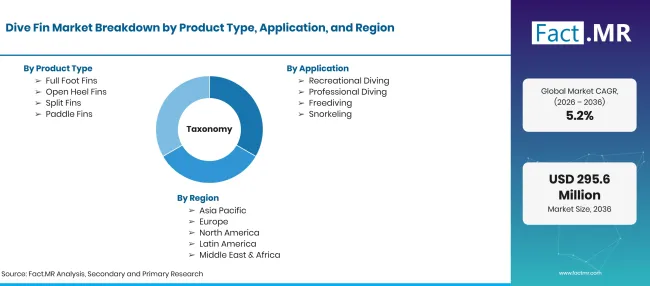
Dive Fin Market Taxonomy | Source: Fact.MR
| Attribute | Details |
|---|---|
| Quantitative Units | USD Million |
| Market Definition | Dive fins are underwater propulsion devices comprising full-foot, open-heel, split-blade, and paddle-blade configurations constructed from rubber, plastics, or composite materials. Revenue is measured at the primary manufacturer and brand wholesale shipment tier. |
| Product Type | Full Foot Fins; Open Heel Fins; Split Fins; Paddle Fins |
| Application | Recreational Diving; Professional Diving; Freediving; Snorkeling |
| Material | Rubber; Plastic; Composite |
| Distribution Channel | Specialty Dive Shops; Online Stores; Sporting Goods Stores |
| End-User | Adults; Children |
| Regional Coverage | North America; Latin America; Western Europe; Eastern Europe; East Asia; South Asia & Pacific; Middle East & Africa |
| Key Countries Analyzed | Germany; Brazil; United States; United Kingdom; Japan |
| Key Players Profiled | Scubapro; Aqua Lung; Mares; Cressi; TUSA; Atomic Aquatics; Sherwood Scuba; Oceanic; Seac Sub; Beuchat |
| Historical Base Year | 2025 (USD 170.1 Million) |
| Forecast Timeframe | 2026 (USD 178.9 Million) to 2036 (USD 295.6 Million) |
Source: Fact.MR analysis. Updated Oct 27, 2026
How is the market segmented?
-
By Product Type
- Full Foot Fins
- Open Heel Fins
- Split Fins
- Paddle Fins
-
By Application
- Recreational Diving
- Professional Diving
- Freediving
- Snorkeling
-
By Material
- Rubber
- Plastic
- Composite
-
By Distribution Channel
- Specialty Dive Shops
- Online Stores
- Sporting Goods Stores
-
By End-User
- Adults
- Children
-
By Region
- North America
- Latin America
- Western Europe
- Eastern Europe
- East Asia
- South Asia & Pacific
- Middle East & Africa
Frequently Asked Questions
How big is the dive fin market in 2026?
What is the CAGR of the dive fin market from 2026 to 2036?
Which product type leads the dive fin market?
Which application leads the dive fin market?
Which material commands the highest market share?
Which distribution channel accounts for the largest sales share?
Which country will expand at the fastest rate through 2036?
Who are the key players operating in the dive fin market?
Who worked on this report


Preview the report firsthand - request a free sample
Free SampleGet the brochure for pricing and purchase details
Download PDF