- Base Value(2025): 2.5 Bn
- Estimated Value(2026): 2.7 Bn
- Forecast Value (2036): 5.4 Bn
- CAGR (2026 - 2036): 7.4%
Drive Mode Selector Switch and Controller Systems Market Size, Share and Forecast and Outlook By FACT.MR
In 2025, the drive mode selector switch and controller systems market was valued at USD 2.5 billion. Fact MR analysis indicates demand for drive mode selector switch and controller systems is expected to reach USD 2.7 billion in 2026 and USD 5.4 billion by 2036. FMR estimates the market will expand at a CAGR of 7.4% across the forecast period.
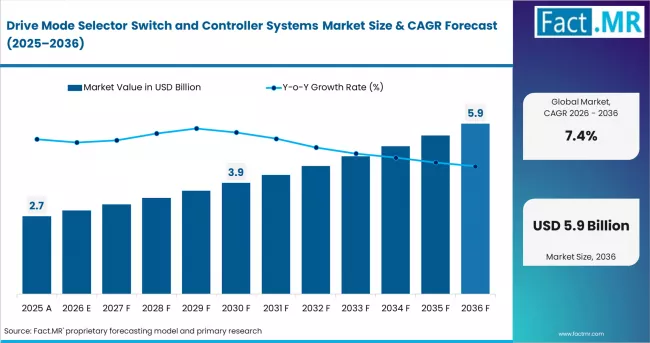
Drive Mode Selector Switch And Controller Systems Market Market Value Analysis | Source: Fact.MR
Summary of Drive Mode Selector Switch and Controller Systems Market
The drive mode selector switch and controller systems market refers to electronic interface modules enabling drivers to select predefined vehicle performance profiles such as eco, comfort, sport, off road, and custom driving modes. These selector systems transmit signals to vehicle control units that adjust throttle response, transmission calibration, steering sensitivity, suspension stiffness, and traction control parameters. Integration of drive mode selectors within vehicle electronic architecture enables adaptive vehicle behavior through software controlled performance mapping aligned with varying operating conditions.
- Demand Drivers
- Increasing adoption of configurable vehicle performance systems enabling adjustment of drivetrain response according to driver preference and road conditions.
- Growth in electronic control unit integration supporting centralized management of powertrain, suspension, steering, and traction parameters.
- Rising demand for adaptive driving dynamics supporting efficiency optimization and performance tuning across passenger and electric vehicle platforms.
- Expansion of software-defined vehicle architecture enabling programmable vehicle response characteristics through interface modules.
- Increasing incorporation of multifunction selector interfaces integrating rotary, push button, and touch-based interaction mechanisms.
- Integration of drive-by-wire systems supporting electronic signal transmission between selector interfaces and vehicle control systems.
- Key Segments Analyzed
- Vehicle Type: Passenger vehicles lead with 76.3% share supported by integration of configurable drive performance systems across mid-range and premium vehicle platforms.
- Sales Channel: OEM segment accounts for 71.5% share supported by direct incorporation of selector modules within vehicle design architecture.
- Switch Type: Rotary selectors and push button interfaces demonstrate strong demand supported by ergonomic interaction characteristics and compatibility with digital cockpit layouts.
- Drive Mode Type: Eco and sport mode selectors represent primary adoption areas supported by fuel efficiency optimization and performance configuration requirements.
- Geography: China, India, and South Korea demonstrate strong growth supported by expansion of electronically controlled vehicle platforms, while Germany and USA represent mature integration markets.
- Analyst Opinion at Fact MR
- Shambhu Nath Jha, Principal Consultant at Fact MR, states, "Drive mode selector systems represent an important interface layer connecting driver input with software-defined vehicle dynamics architecture. Market expansion reflects increasing integration of electronic control modules capable of adjusting multiple vehicle subsystems through unified control logic. Suppliers capable of improving interface durability, signal precision, and compatibility with centralized vehicle domain controllers will maintain competitive positioning as electronically configurable vehicle performance becomes standard across passenger and electric vehicle platforms."
- Strategic Implications
- Strengthen development capability for multifunction selector interfaces compatible with electronic control unit communication protocols.
- Expand integration of drive mode selector modules aligned with centralized vehicle domain controller architecture.
- Improve signal processing precision supporting accurate transmission of driver input commands to powertrain and chassis control systems.
- Enhance durability engineering supporting long lifecycle reliability under repeated switching cycles.
- Support modular interface design enabling compatibility with digital cockpit environments incorporating touch, rotary, and haptic control technologies.
- Increase collaboration with vehicle OEM engineering teams supporting integration of selector interfaces within software-configurable vehicle performance platforms.
- Methodology
- Developed using primary interviews with automotive electronics manufacturers, drivetrain system integrators, human machine interface engineers, and OEM vehicle architecture specialists.
- Supported through review of automotive engineering literature, patent filings, and technical documentation addressing drive-by-wire and vehicle control interface systems.
- Market estimation applied hybrid modeling combining supplier revenue benchmarking with assessment of electronic feature penetration across vehicle production volumes.
- Data validation conducted through triangulation using technical publications, supplier capability analysis, and expert consultation inputs.
- Periodic updates incorporate developments in software-defined vehicle platforms, electronic control module integration, and adaptive vehicle performance interface technologies.
Drive Mode Selector Switch and Controller Systems Market
| Metric | Details |
|---|---|
| Industry Size (2026E) | USD 2.7 billion |
| Industry Value (2036F) | USD 5.4 billion |
| CAGR (2026 to 2036) | 7.4% |
Source: Fact.MR analysis. Updated Apr 23, 2026
A CAGR of 7.4%, with value increasing from USD 2.7 billion to USD 5.4 billion, indicates steady growth momentum linked to electronic drivetrain management features across passenger and electric vehicles. Expansion is supported by demand for configurable driving dynamics, while moderated by platform standardization trends, integration with centralized vehicle control units, and cost optimization pressures among OEMs.
China records the fastest growth at 8.2%, supported by increasing integration of electronically controlled drive mode interfaces in passenger vehicle platforms. India follows at 7.9%, driven by rising adoption of selectable performance modes in mid-range vehicle segments. South Korea shows 7.6% growth, linked to expansion of electronic control module production for powertrain interface systems. Germany at 7.3% and the USA at 7.2% represent mature markets where demand is largely replacement-driven due to stable vehicle production volumes and standardized platform architectures. A structural constraint across mature markets is extended vehicle platform lifecycle duration, which slows integration of newly designed drive mode control interfaces.
Segmental Analysis
Drive Mode Selector Switch and Controller Systems Market Analysis by Vehicle Type
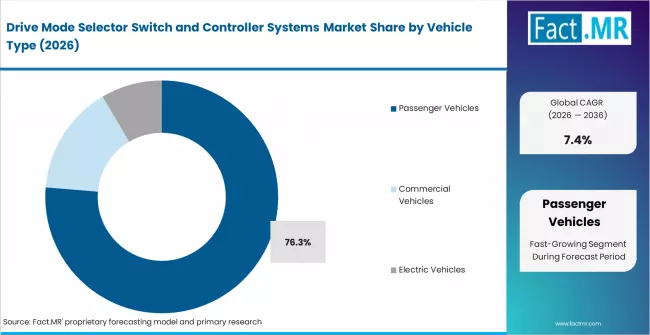
Drive Mode Selector Switch And Controller Systems Market Analysis By Vehicle Type | Source: Fact.MR
- Market Overview: Passenger vehicles are projected to hold 76.3% share of the drive mode selector switch and controller systems market in 2026. Demand concentration reflects integration of selectable driving modes within vehicle electronic control architectures enabling adjustment of throttle response, suspension settings, steering sensitivity, and transmission behavior according to operating conditions. Passenger vehicle platforms increasingly incorporate drive mode selector interfaces to support adaptive vehicle performance configuration.
- Demand Drivers:
- Vehicle Performance Customization: Drive mode selector systems enable adjustment of powertrain parameters supporting varied driving conditions including efficiency-oriented and performance-oriented operation modes.
- Electronic Control Integration: Modern vehicles incorporate drive mode control interfaces connected with engine control units, transmission modules, and chassis management systems.
- Driver Experience Optimization: Automotive manufacturers deploy selector interfaces allowing users to modify vehicle handling characteristics through simplified interface interaction mechanisms.
Drive Mode Selector Switch and Controller Systems Market Analysis by Sales Channel
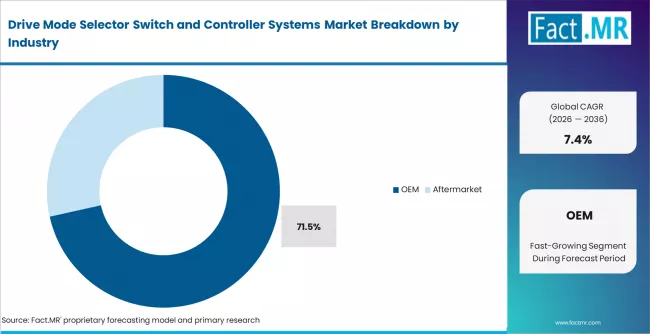
Drive Mode Selector Switch And Controller Systems Market Analysis By Sales Channel | Source: Fact.MR
- Market Overview: OEM sales channels are estimated to account for 71.5% share in 2026, supported by integration of drive mode selector modules directly within vehicle design and assembly processes aligned with electronic control architecture specifications. Automotive manufacturers coordinate component selection to ensure compatibility with vehicle software systems controlling performance parameter adjustments.
- Demand Drivers:
- Platform-Level Integration: OEM suppliers provide selector switch modules configured to interface with vehicle control software governing engine mapping, transmission shift patterns, and suspension response settings.
- Design Consistency Requirements: Automotive manufacturers maintain standardized interface layouts supporting consistent user interaction across vehicle model portfolios incorporating selectable driving modes.
- Production Volume Stability: OEM procurement agreements support continuous supply of selector control modules across passenger vehicle manufacturing programs integrating configurable driving dynamics features.
Key Dynamics
Drive Mode Selector Switch and Controller Systems Market Drivers, Restraints, and Opportunities
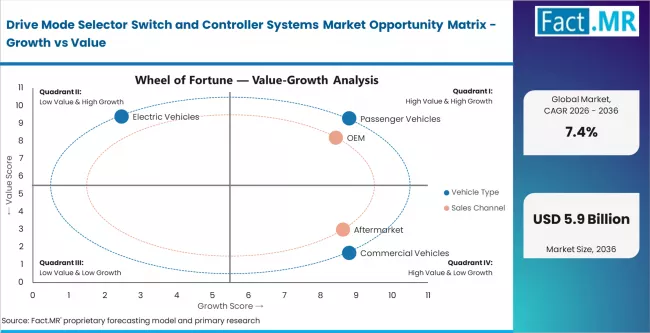
Drive Mode Selector Switch And Controller Systems Market Opportunity Matrix Growth Vs Value | Source: Fact.MR
Fact MR analysis indicates the market reflects a transitioning automotive electronic control interface segment shaped by the shift from mechanically defined vehicle dynamics toward software-calibrated performance profiles. Market size exists because drive mode selector systems allow drivers to modify throttle response, suspension stiffness, steering weight, and transmission logic through predefined operating modes such as Eco, Comfort, Sport, and Terrain. Historical demand has expanded alongside electronic control unit integration, where a single interface can adjust multiple vehicle subsystems simultaneously, improving driving adaptability across varying road and efficiency requirements.
Current market dynamics show declining reliance on fixed mechanical calibration settings as electric vehicles and hybrid platforms increasingly require software-managed energy optimization strategies. Multifunction selector switches and rotary controllers command higher per-unit pricing due to integration with ADAS modules, powertrain control software, and digital cockpit architectures. Market structure reflects gradual migration toward programmable vehicle behavior profiles, where software-defined performance replaces static mechanical tuning parameters, increasing value intensity per control interface despite stable vehicle production volumes.
- Emission Mode Regulation: UNECE Global Technical Regulation frameworks define driver-selectable modes that influence fuel consumption and emissions testing parameters, reinforcing standardized integration of selectable drive profiles across vehicle platforms.
- EV Calibration Demand: Europe and China electric vehicle adoption accelerates integration of energy optimization modes balancing battery efficiency, regenerative braking response, and thermal management performance.
- Software-Defined Dynamics: Integration of drive mode controllers with centralized vehicle domain controllers increases module complexity as vehicle performance characteristics become software-configurable rather than mechanically fixed.
Regional Analysis
The drive mode selector switch and controller systems market is assessed across Asia Pacific, Europe, and North America, segmented by country-level demand for electronic drive mode control modules used in powertrain response adjustment, vehicle dynamics management, terrain mode configuration, and driver interface systems. Geographic variation reflects adoption of electronically controlled vehicle platforms, performance optimization features, and integration of intelligent vehicle control architectures. The full report offers market attractiveness analysis.
.webp "Top Country Growth Comparison Drive Mode Selector Switch And Controller Systems Market Cagr (2026 2036)")
Top Country Growth Comparison Drive Mode Selector Switch And Controller Systems Market Cagr (2026 2036) | Source: Fact.MR
CAGR Table
| Country | CAGR (2026–2036) |
|---|---|
| China | 8.2% |
| India | 7.9% |
| South Korea | 7.6% |
| Germany | 7.3% |
| USA | 7.2% |
Source: Fact.MR analysis. Updated Apr 23, 2026
Source: Fact MR analysis, based on proprietary forecasting model and primary research
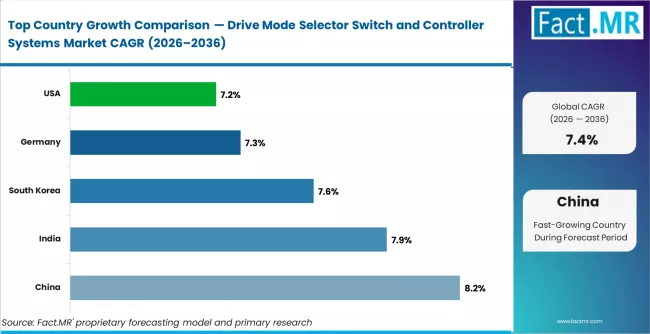
Drive Mode Selector Switch And Controller Systems Market Cagr Analysis By Country | Source: Fact.MR
Asia Pacific
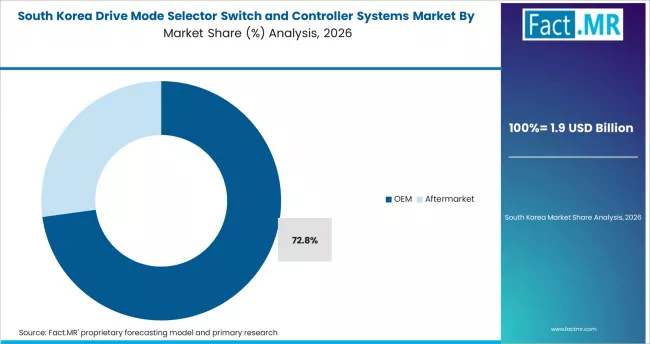
Drive Mode Selector Switch And Controller Systems Market South Korea Market Share Analysis By Sales Channel | Source: Fact.MR
Asia Pacific functions as the vehicle control electronics integration hub supported by expanding production of electronically controlled powertrain systems and increased adoption of adaptive driving technologies. Hyundai Mobis strengthens drive mode control electronics capability. Alps Alpine Co., Ltd. expands vehicle interface module portfolio depth. Panasonic Automotive Systems supports integrated control architecture innovation.
- China: China is projected to record 8.2% CAGR in drive mode selector switch and controller systems through 2036. New Energy Vehicle Development Plan update (Ministry of Industry and Information Technology, January 2023) supports intelligent vehicle control integration. Alps Alpine Co., Ltd. expanded drive mode interface component production capability (June 2023).
- India: India is expected to observe 7.9% CAGR in drive mode selector switch and controller systems through 2036. Automotive Mission Plan update (Ministry of Heavy Industries, March 2023) supports advanced vehicle electronics manufacturing expansion. Panasonic Automotive Systems expanded control module supply capability (July 2023).
- South Korea: South Korea is anticipated to expand at 7.6% CAGR in drive mode selector switch and controller systems through 2036. Future Mobility Strategy update (Ministry of Trade, Industry and Energy, February 2023) supports intelligent vehicle platform innovation. Hyundai Mobis expanded electronic control module investment (May 2023).
Europe
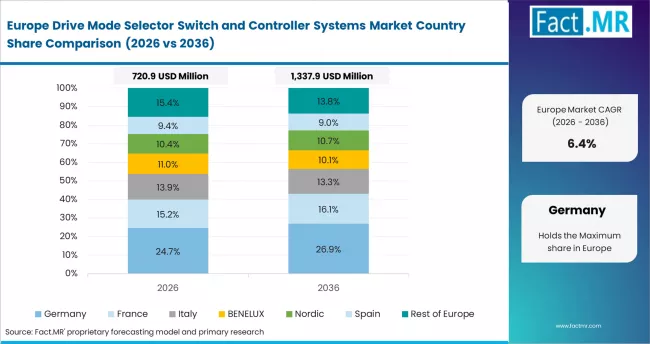
Drive Mode Selector Switch And Controller Systems Market Europe Country Market Share Analysis, 2026 & 2036 | Source: Fact.MR
Europe operates as the vehicle dynamics engineering laboratory supported by strict safety standards and increasing integration of adaptive driving technologies in passenger vehicles. Continental AG strengthens drive control electronics capability. ZF Friedrichshafen AG expands vehicle motion control portfolio depth. Valeo S.A. supports intelligent interface component innovation.
- Germany: Germany is forecast to grow at 7.3% CAGR in drive mode selector switch and controller systems through 2036. EU vehicle safety regulation update (European Commission, January 2023) supports advanced vehicle control system adoption. Continental AG expanded electronic drive control development capability (April 2023).
North America
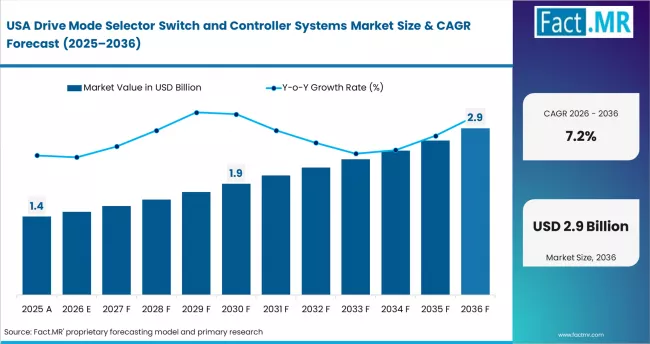
Drive Mode Selector Switch And Controller Systems Market Country Value Analysis | Source: Fact.MR
North America functions as the intelligent vehicle interface commercialization center supported by strong demand for adaptive driving technologies and electronically configurable vehicle performance settings. BorgWarner Inc. strengthens electronic control system capability. Visteon Corporation expands cockpit electronics portfolio depth. Aptiv PLC supports integrated vehicle control innovation.
- USA: The USA is projected to register 7.2% CAGR in drive mode selector switch and controller systems through 2036. U.S. vehicle safety standards update (National Highway Traffic Safety Administration, March 2023) supports integration of intelligent vehicle control interfaces. BorgWarner Inc. expanded electronic control module production capability (August 2023).
Fact MR's analysis of drive mode selector switch and controller systems market in global regions consists of country-wise assessment that includes China, India, South Korea, Germany, and USA. Readers can find vehicle control technology trends, electronic interface developments, regulatory positioning frameworks, and competitive component innovation insights.
Competitive Landscape
What is the Competitive Structure of the Drive Mode Selector Switch and Controller Systems Market?
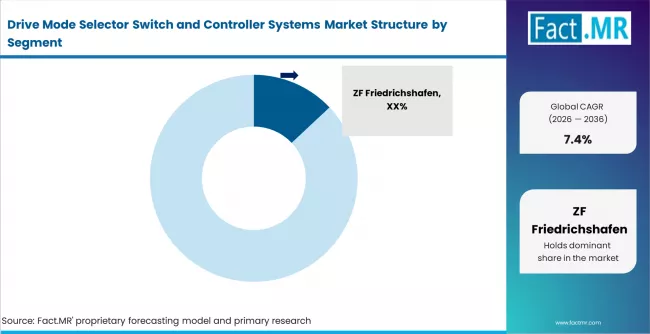
Drive Mode Selector Switch And Controller Systems Market Analysis By Company | Source: Fact.MR
The Drive Mode Selector Switch and Controller Systems Market demonstrates a moderately concentrated competitive structure, supported by automotive electronics suppliers with expertise in vehicle control interfaces and powertrain communication systems. Leading companies including ZF Friedrichshafen, Denso, Valeo, Bosch, Continental, Tokai Rika, Alps Alpine, Hyundai Mobis, Panasonic Automotive, and Toyodenso collectively account for nearly 60–70% of global market share, particularly in selector modules integrated with vehicle drive control and electronic stability systems. Competitive positioning is primarily determined by switching precision, signal reliability, durability under repeated mechanical cycles, and compatibility with electronic control unit architectures. High automotive validation requirements and platform-specific integration complexity create entry barriers, reinforcing the role of established Tier 1 suppliers with proven manufacturing and engineering capabilities.
Structural advantages are observed among companies possessing long-term development partnerships with automotive original equipment manufacturers and established expertise in electronic control integration. Bosch and Continental benefit from integrated portfolios covering sensors, control modules, and vehicle electronics aligned with evolving electrified powertrain architectures. Buyers typically manage supplier dependency through dual sourcing strategies and technical benchmarking of component reliability across multiple approved vendors. Procurement decisions often consider lifecycle durability, software compatibility with drive control systems, and compliance with automotive safety standards. Pricing power remains relatively balanced, though suppliers retain moderate leverage where platform-specific engineering validation and system integration requirements create switching constraints for vehicle manufacturers implementing advanced drive mode selection interfaces.
Key Players of the Drive Mode Selector Switch and Controller Systems Market
- ZF Friedrichshafen
- Denso
- Valeo
- Bosch
- Continental
- Tokai Rika
- Alps Alpine
- Hyundai Mobis
- Panasonic Automotive
- Toyodenso
Report Scope
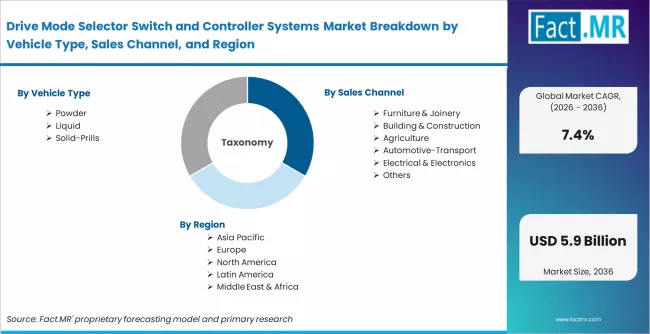
Drive Mode Selector Switch And Controller Systems Market Breakdown By Vehicle Type, Sales Channel, And Region | Source: Fact.MR
| Metric | Value |
|---|---|
| Quantitative Units | USD 2.7 billion (2026) to USD 5.4 billion (2036), at a CAGR of 7.4% |
| Market Definition | The drive mode selector switch and controller systems market includes electronic interface components that enable drivers to select vehicle performance configurations such as power response, suspension behavior, and traction settings. These systems integrate with vehicle control units to adjust drivetrain parameters, energy management strategies, and dynamic performance characteristics across different operating conditions. |
| Switch Type Segmentation | Rotary drive mode switches, Push button selectors, Toggle switches, Electronic gear selectors, Touch based selectors |
| Vehicle Type Segmentation | Passenger vehicles, Commercial vehicles, Electric vehicles |
| Drive Mode Type Segmentation | Eco mode selector, Sport mode selector, Comfort mode selector, Off road mode selector, Custom mode selector |
| Sales Channel Segmentation | OEM, Aftermarket |
| Regions Covered | North America, Latin America, Europe, East Asia, South Asia, Oceania, Middle East and Africa |
| Countries Covered | United States, Canada, Mexico, Brazil, Argentina, Germany, France, United Kingdom, Italy, Spain, China, India, Japan, South Korea, Indonesia, Australia, and 40+ countries |
| Key Companies Profiled | ZF Friedrichshafen, Denso, Valeo, Bosch, Continental, Tokai Rika, Alps Alpine, Hyundai Mobis, Panasonic Automotive, Toyodenso |
| Forecast Period | 2026 to 2036 |
| Approach | Hybrid top-down and bottom-up market estimation validated through primary interviews with automotive electronics manufacturers, vehicle OEM engineering teams, drivetrain system integrators, and human-machine interface developers, supported by vehicle production benchmarking, control system integration assessment, and evaluation of adoption trends across configurable vehicle performance interface technologies |
Source: Fact.MR analysis. Updated Apr 23, 2026
Drive Mode Selector Switch and Controller Systems Market Key Segments
-
Switch Type:
- Rotary Drive Mode Switches
- Push Button Selectors
- Toggle Switches
- Electronic Gear Selectors
- Touch Based Selectors
-
Vehicle Type:
- Passenger Vehicles
- Commercial Vehicles
- Electric Vehicles
-
Drive Mode Type:
- Eco Mode Selector
- Sport Mode Selector
- Comfort Mode Selector
- Off Road Mode Selector
- Custom Mode Selector
-
Sales Channel:
- OEM
- Aftermarket
-
Region:
- North America
- USA
- Canada
- Mexico
- Europe
- Germany
- UK
- France
- Italy
- Spain
- Nordic Countries
- BENELUX
- Rest of Europe
- Asia Pacific
- China
- Japan
- South Korea
- India
- Australia
- Rest of Asia Pacific
- Latin America
- Brazil
- Argentina
- Rest of Latin America
- Middle East and Africa
- Kingdom of Saudi Arabia
- United Arab Emirates
- South Africa
- Rest of Middle East and Africa
- Other Regions
- Oceania
- Central Asia
- Other Markets
- North America
Bibliographies
- [1] Apiele. (2025, August). The role of selector switches in automotive systems. Apiele.
- [2] Design News. (2025, February). How Volkswagen developed the ID.4 EV's gear selector. Design News.
- [3] Embitel. (2024, August). Automotive human machine interface (HMI) | An A-Z guide. Embitel.
- [4] Star Global. (2025, November). Exploring top automotive HMI trends for 2026. Star Global.
- [5] Chevrolet. (n.d.). Driver mode control feature | Vehicle support | Chevy. Chevrolet.
This Report Addresses
- Market size estimation and revenue forecasts from 2026 to 2036, supported by validated capacity and trade benchmarks.
- Growth opportunity mapping across gummy, extruded, and strip functional variants.
- Segment and regional revenue forecasts covering berry, citrus, and mixed fruit applications.
- Competition strategy assessment including integration models and compliance capability benchmarking.
- Regulatory impact analysis covering ingredient mandates and clean-label specification upgrades.
- Market report delivery in PDF, Excel, PPT, and interactive dashboard formats for executive and operational use.
- Supply chain vulnerability assessments identifying regional purification concentration risks.
Drive Mode Selector Switch and Controller Systems Market Definition
The drive mode selector switch and controller systems market refers to electronic interface components that allow drivers to select predefined vehicle performance settings such as eco, comfort, sport, or terrain modes. These systems transmit input signals to vehicle control units, adjusting parameters such as throttle response, transmission behavior, steering sensitivity, and suspension performance.
Drive Mode Selector Switch and Controller Systems Market Inclusions
The report covers global and regional market size assessment and forecast outlook across the defined study period. It includes segmentation by component such as rotary selectors, push button switches, electronic control units, and integrated HMI modules. Applications include passenger vehicles, electric vehicles, and commercial vehicles. Pricing structure, supply chain configuration, and trade flow analysis are included.
Drive Mode Selector Switch and Controller Systems Market Exclusions
The scope excludes mechanical gear shifters, transmission assemblies, and unrelated automotive electronic modules such as infotainment head units or body control systems. Standalone software algorithms without physical selector interfaces are not included. The analysis focuses strictly on electronic hardware and control modules used to select and manage vehicle drive modes.
Drive Mode Selector Switch and Controller Systems Market Research Methodology
- Primary Research
- Interviews were conducted with automotive HMI component manufacturers, electronic module suppliers, OEM engineers, and system integrators involved in vehicle control interface technologies.
- Desk Research
- Technical journals, patent databases, automotive engineering publications, and company product documentation were reviewed to evaluate technology architecture and adoption trends in drive mode control systems.
- Market-Sizing and Forecasting
- A hybrid model combining bottom-up supplier revenue analysis and top-down evaluation of vehicle production volumes and electronic feature penetration was applied to estimate market size and growth outlook.
- Data Validation and Update Cycle
- Outputs were verified through triangulation of technical literature, supplier specifications, and expert consultation. Periodic updates reflect developments in drive-by-wire systems, vehicle electrification, and advanced driver interface technologies.
Frequently Asked Questions
How large is the demand for Drive Mode Selector Switch and Controller Systems in the global market in 2026?
What will be the market size of Drive Mode Selector Switch and Controller Systems in the global market by 2036?
What is the expected demand growth for Drive Mode Selector Switch and Controller Systems in the global market between 2026 and 2036?
Which Vehicle Type is poised to lead global demand by 2026?
What is Driving Drive Mode Selector Switch and Controller System Demand in China?
What is the China Growth Outlook in this Report?
What is Driving Drive Mode Selector Switch and Controller System Demand in India?
What is the India Growth Outlook in this Report?
What is Driving Drive Mode Selector Switch and Controller System Demand in South Korea?
What is the South Korea Growth Outlook in this Report?
What is Driving Drive Mode Selector Switch and Controller System Demand in Germany?
What is the Germany Growth Outlook in this Report?
What is Driving Drive Mode Selector Switch and Controller System Demand in the United States?
What is the United States Growth Outlook in this Report?
Which Companies are Identified as Leading Participants in the Drive Mode Selector Switch and Controller Systems Market?
What are Drive Mode Selector Switch and Controller Systems and What are They Mainly Used For?
What does Drive Mode Selector Switch and Controller Systems Market Mean in this Report?
What is Included in the Scope of this Drive Mode Selector Switch and Controller Systems Market Report?
What is Excluded from the Scope of this Report?
What does Market Forecast Mean on this Page?
How is the Drive Mode Selector Switch and Controller Systems Market Forecast Developed in this Report?
What does Data Validation Approach Mean in this Report?
Who worked on this report


Preview the report firsthand - request a free sample
Free SampleGet the brochure for pricing and purchase details
Download PDF