- Base Value(2025): 920 Mn
- Estimated Value(2026): 1.0 Bn
- Forecast Value (2036): 3.1 Bn
- CAGR (2026 - 2036): 11.8%
Driveline Lubricants for EVs Market Forecast 2026 to 2036
In 2025, the driveline lubricants for EVs market was valued at USD 920 million. Based on Fact MR's analysis, demand for driveline lubricants for electric vehicles (EVs) is estimated to grow to USD 1.0 billion in 2026 and USD 3.1 billion by 2036. FMR projects a CAGR of 11.8% during the forecast period.
The absolute dollar growth from 2026 to 2036 is USD 2.1 billion. This rapid growth is driven by the increasing adoption of electric vehicles, where driveline lubricants play a crucial role in enhancing performance, reducing friction, and improving the efficiency of EV powertrains. However, market challenges such as supply chain complexities and evolving regulatory standards may affect growth in certain regions.
China leads with a CAGR of 13.5%, driven by its massive push for electric vehicle adoption and the rapidly expanding EV market. Brazil follows with a 12.6% CAGR, fueled by the increasing shift toward EVs and government incentives for electric mobility. South Korea grows at 11.9%, supported by significant investments in EV technology and the growing need for high-performance lubricants. Germany and Europe show growth rates of 11.6% and 11.5%, respectively, driven by the shift toward cleaner transportation and stricter environmental regulations. The USA grows at 11.2%, benefiting from rising EV sales and an increasing focus on energy-efficient vehicles. The United Kingdom shows a similar growth rate of 11.4%, supported by policy initiatives promoting electric mobility. Japan experiences the slowest growth at 10.1%, as it faces a more mature EV market with gradual adoption rates.
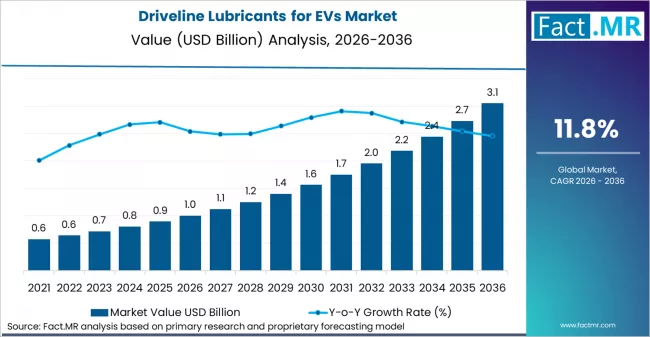
Driveline Lubricants For Evs Market Market Value Analysis | Source: Fact.MR
Driveline Lubricants for EVs Market Definition
The driveline lubricants for EVs market refers to the production and sale of specialized lubricant formulations designed for electric vehicle (EV) driveline systems. These lubricants reduce friction, dissipate heat, and protect gears, bearings, and differential components in EV transmissions and e‑axles. Their primary function is to ensure smooth torque transfer and long component life under high‑load, low‑speed conditions typical of electric powertrains. Key end uses include battery electric vehicles (BEVs), plug‑in hybrids (PHEVs), and commercial electric fleets requiring tailored lubricants for efficiency and durability.
Market Inclusions
This report covers global and regional market sizes for EV driveline lubricants with a defined forecast period. It includes segment breakdowns by lubricant type (synthetic, semi‑synthetic), viscosity grade, and vehicle application (passenger EVs, commercial EVs). Pricing trends, raw material supply, and trade flow data are also analyzed to reflect overall market dynamics.
Market Exclusions
The scope excludes conventional engine oils, transmission fluids for internal combustion vehicles, and unrelated automotive fluids such as brake or coolant fluids. Finished electric vehicles and complete driveline hardware are not covered. Niche lubricant specialties used outside EV drivelines, such as industrial gear oils not formulated for electric propulsion, are omitted.
Research Methodology
- Primary Research: Interviews were conducted with lubricant formulators, EV component suppliers, and OEM procurement specialists.
- Desk Research: Data was sourced from industry reports, material supplier publications, and automotive market statistics.
- Market‑Sizing and Forecasting: A hybrid model was used, combining top‑down vehicle electrification forecasts with bottom‑up shipment and revenue data.
- Data Validation and Update Cycle: Findings were validated through expert review and aligned with recent production and trade figures, with periodic updates.
Driveline Lubricants for EVs Market Summary
- Driveline Lubricants for EVs Market Definition
- The driveline lubricants for EVs market refers to the production and sale of lubricants specifically designed for the driveline systems of electric vehicles (EVs). These lubricants play a crucial role in reducing friction, dissipating heat, and protecting various driveline components, including gears, bearings, and e-axles. By ensuring smooth torque transfer and long component life under high load, low-speed conditions typical of electric powertrains, these lubricants help enhance the efficiency, performance, and durability of EVs. Key end uses include passenger electric vehicles (BEVs, PHEVs), light commercial EVs, and heavy-duty electric vehicles requiring specialized lubricants for their drivetrains.
- Demand Drivers in the Market
- EV Market Growth: The increasing global shift towards electric mobility is driving the need for specialized driveline lubricants tailored to electric powertrains, with growing demand from both OEMs and aftermarket suppliers.
- Efficiency and Longevity: Driveline lubricants are vital for reducing friction and heat in electric drivetrains, crucial for improving energy efficiency, battery performance, and extending the lifespan of EV components.
- Regulatory Pressures: Stricter environmental and performance regulations, such as those concerning fuel efficiency and emissions, are pushing OEMs to adopt specialized lubricants that can ensure low friction and high thermal stability.
- Technological Advancements in EVs: As electric vehicle technology continues to evolve, more advanced driveline lubricants are required to meet higher performance standards in terms of temperature resistance, load-bearing capacity, and friction control.
- Key Segments Analyzed in the FMR Report
- Product Type: E-Axle Gear Oils are expected to capture the largest market share by 2026 due to their essential role in the smooth functioning of electric drivetrains.
- Vehicle Class: Passenger BEVs are projected to hold 53% of the market share by 2026, driven by the continued dominance of battery electric vehicles in the EV market.
- Channel: OEM Factory Fill is expected to dominate, accounting for 61% of the market by 2026, as automakers increasingly supply driveline lubricants during vehicle production to ensure optimal performance.
- Analyst Opinion at FMR
- Fact MR analysts predict that "The driveline lubricants for EVs market will experience strong growth, driven by the electrification of the automotive sector. As the demand for efficient, high-performance EV drivetrains increases, so does the need for specialized lubricants that can meet the unique demands of electric powertrains, enhancing vehicle longevity and performance."
- Strategic Implications/Executive Takeaways
- Focus on Efficiency and Performance: OEMs should prioritize the development of high-efficiency driveline lubricants that minimize friction and heat generation in EV drivetrains, improving overall vehicle performance.
- Regional Growth Opportunities: Regions like China, Brazil, and the USA, where EV adoption is rising rapidly, offer significant growth opportunities for suppliers of driveline lubricants.
- Sustainability Integration: With the growing focus on environmental impact, there is a strong demand for eco-friendly and high-performance lubricant solutions that align with sustainability goals in the EV sector.
- Methodology
- Primary Research: Interviews were conducted with lubricant formulators, automotive OEMs, and EV component suppliers to gain insights into evolving lubricant needs and market dynamics.
- Desk Research: Data from industry reports, automotive market statistics, and regulatory filings were used to analyze trends in the EV sector and driveline lubricant usage.
- Market Sizing and Forecasting: A hybrid model combining top-down forecasts for EV production and bottom-up data on lubricant shipment and revenue was used to project market growth.
Segmental Analysis
Driveline Lubricants for EVs Market Analysis by Channel
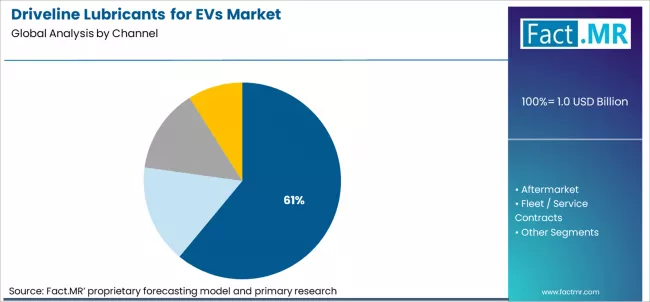
Driveline Lubricants For Evs Market Analysis By Channel | Source: Fact.MR
- Market Overview: OEM factory fill is expected to capture 61% of the driveline lubricants for EVs market by 2026. The majority of driveline lubricants for electric vehicles (EVs) are supplied directly by manufacturers during the vehicle production process. This ensures that the lubricants used are tailored to meet the specific needs of the vehicle’s driveline components, promoting optimal performance and longevity.
- Demand Drivers:
- Integration with EV Manufacturing Processes: OEM factory fill is the preferred channel due to its integration into the vehicle production process, which allows for streamlined operations and ensures that the lubricants meet manufacturer specifications for driveline efficiency and durability.
- Performance and Warranty Considerations: Using factory-approved lubricants during manufacturing ensures that the vehicle performs at its best and maintains manufacturer warranties, which encourages consumers to rely on OEM-supplied lubricants.
- Increased EV Production: As EV adoption grows, the demand for lubricants specifically designed for electric drivetrains increases, driving the growth of the OEM factory fill channel as automakers continue to optimize EV driveline systems.
Driveline Lubricants for EVs Market Analysis by Vehicle Class
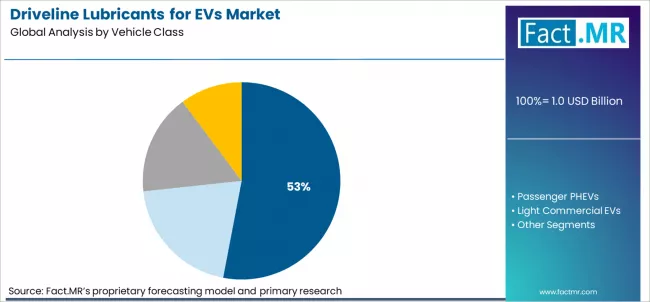
Driveline Lubricants For Evs Market Analysis By Vehicle Class | Source: Fact.MR
- Market Overview: Passenger BEVs (Battery Electric Vehicles) are projected to hold 53% of the market share by 2026. With the rising popularity of fully electric vehicles, BEVs are expected to remain the largest vehicle class in the EV market, driving the demand for specialized driveline lubricants designed to optimize the performance and efficiency of electric drivetrains.
- Demand Drivers:
- Growth in BEV Adoption: As BEVs continue to dominate the EV market, particularly in passenger vehicles, the need for driveline lubricants formulated to meet the specific demands of electric drivetrains increases. These lubricants are essential for reducing friction, ensuring efficient power transfer, and enhancing battery and motor longevity.
- Energy Efficiency and Longevity Requirements: Since BEVs are powered solely by electricity, the efficiency of the drivetrain is a critical factor in extending range and enhancing performance. Driveline lubricants designed for BEVs help achieve these goals by minimizing friction and heat generation.
- Technological Advancements in BEVs: As automakers introduce more advanced BEV models with higher performance standards, the demand for specialized driveline lubricants that can support these innovations is expected to grow, supporting the ongoing shift toward electric mobility.
Driveline Lubricants for EVs Market Drivers, Restraints, and Opportunities
FMR analysts observe that the driveline lubricants for EVs market is a growth‑transition segment shaped by the shift from internal combustion engines to electric drivetrains. Historically, conventional gear oils and transmission lubricants served ICE vehicles; EVs introduced radically different load profiles, lower speed gearsets, and thermal patterns, creating structural demand for specialized EV driveline fluids rather than legacy products. The 2026 valuation reflects this transition as OEMs and Tier 1 suppliers adopt EV‑specific formulations to meet performance, efficiency, and durability expectations tied to electrification.
While demand for traditional automotive gear oils is declining with EV penetration, advanced EV driveline lubricants are gaining share. These EV‑optimized fluids often command higher average selling prices, contributing to net market value growth even as unit volumes scale with broader EV adoption. The market exists at its current size because driveline lubrication remains critical for noise, vibration, and wear control in EV gearboxes, and regulatory/efficiency benchmarks increasingly push OEMs toward certified EV fluid systems.
- EV Powertrain Shift: As electrified drivetrains replace ICE systems, demand grows for lubricants formulated for electric gearsets and bearings that basic automotive oils cannot protect.
- Efficiency & Standards Pressure: Regulations like CAFE fuel economy standards and WLTP/Euro 7 targets drive OEM specification of low‑friction, thermally stable EV lubricants with higher performance requirements.
- Regional EV Adoption: In Europe and China, where EV penetration and OEM EV platforms are high, uptake of specialized EV driveline lubricants outpaces markets where ICE vehicles still dominate.
Regional Analysis
The market analysis covers key global regions, including North America, East Asia, South Korea, Western Europe, Latin America, and Germany. It is segmented geographically, with specific market dynamics for each region. The full report provides a detailed market attractiveness analysis.
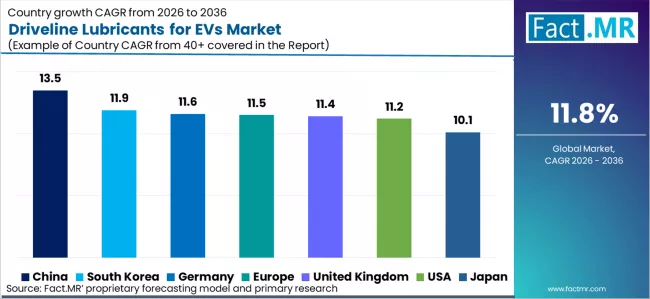
Driveline Lubricants For Evs Market Cagr Analysis By Country | Source: Fact.MR
| Country | CAGR (2026-2036) |
|---|---|
| USA | 11.2% |
| Japan | 10.1% |
| South Korea | 11.9% |
| Europe | 11.5% |
| Germany | 11.6% |
| China | 13.5% |
| United Kingdom | 11.4% |
| Brazil | 12.6% |
Source: Fact.MR analysis. Updated Feb 19, 2026
Source: Fact MR (FMR) analysis, based on proprietary forecasting model and primary research.
North America:
North America remains a "key region" for driveline lubricants in electric vehicles (EVs), with the USA leading the way due to increasing demand for EVs and a strong shift towards sustainable mobility solutions.
- USA: Demand for driveline lubricants for EVs in the U.S. is projected to rise at 11.2% CAGR through 2036. The growing adoption of electric vehicles and the expansion of EV infrastructure continue to drive demand for driveline lubricants in the U.S.
East Asia:
East Asia, particularly China, is a "global leader in EV production," with strong demand for driveline lubricants due to the country's dominance in the electric vehicle market.
- China: Demand for driveline lubricants for EVs in China is projected to rise at 13.5% CAGR through 2036. China's rapid growth in EV production and government incentives for electric vehicles continue to drive substantial demand for driveline lubricants in the region.
- Japan: Demand for driveline lubricants for EVs in Japan is projected to rise at 10.1% CAGR through 2036. Japan’s automotive industry and focus on eco-friendly vehicle technologies support steady growth in the demand for driveline lubricants.
South Korea:
South Korea is a "key player in the EV sector," with major automakers investing heavily in electric vehicle production, which drives demand for driveline lubricants.
- South Korea: Demand for driveline lubricants for EVs in South Korea is projected to rise at 11.9% CAGR through 2036. The growing shift to electric vehicles and strong automotive production in South Korea support demand for driveline lubricants.
Western Europe:
Western Europe remains a "mature market" for EVs, with countries like Germany and the UK leading in the adoption of electric vehicles and contributing to the demand for driveline lubricants.
- Germany: Demand for driveline lubricants for EVs in Germany is projected to rise at 11.6% CAGR through 2036. Germany’s strong automotive sector and regulatory push for electric vehicle adoption continue to fuel the demand for driveline lubricants.
- United Kingdom: Demand for driveline lubricants for EVs in the UK is projected to rise at 11.4% CAGR through 2036. The UK’s expanding EV market and government support for electric mobility contribute to steady market growth.
Latin America:
In Latin America, Brazil stands out with significant growth in the electric vehicle sector, further driving demand for driveline lubricants.
- Brazil: Demand for driveline lubricants for EVs in Brazil is projected to rise at 12.6% CAGR through 2036. Brazil's expanding EV infrastructure and government initiatives to promote electric mobility continue to drive demand for driveline lubricants.
Fact MR's analysis of the Driveline Lubricants for EVs Market in North America, East Asia, South Korea, Western Europe, Latin America, and Germany consists of country-wise assessments that include the USA, Japan, South Korea, Germany, China, the United Kingdom, and Brazil. Readers can find detailed trends, regulatory updates, and company-specific investments shaping the market’s growth in these countries.
How Are Key Players Competing in the Driveline Lubricants for EVs Market?
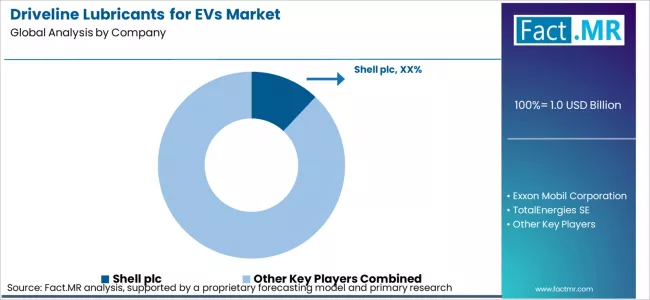
Driveline Lubricants For Evs Market Analysis By Company | Source: Fact.MR
The driveline lubricants for EVs market is highly competitive, with major oil and lubricant companies investing in products tailored to the needs of electric vehicles. Shell plc and Exxon Mobil Corporation are at the forefront, focusing on advanced EV-specific lubricants that improve efficiency and extend the life of electric drivetrains. TotalEnergies SE and BP p.l.c., through its Castrol brand, are also expanding their offerings to cater to the growing EV sector, ensuring lower friction and improved energy transfer for electric motors. Chevron Corporation and FUCHS SE are innovating to offer lubricants that meet the higher performance standards required by EV drivetrains. Valvoline Inc. is also targeting this market, positioning its products as reliable solutions for electric vehicle lubrication. PetroChina and Sinopec, leveraging their market presence in China, are aligning their product lines to support the booming EV industry. Idemitsu Kosan Co., Ltd. is focusing on high-performance formulations for driveline applications in electric and hybrid vehicles, ensuring compatibility with different EV systems. These companies are focusing on reducing friction, enhancing energy efficiency, and promoting sustainability within the EV sector.
Recent Industry Developments
- Total Energies Marketing Canada launched Quartz EV-Drive R 3.1 in July 2025, becoming the first major supplier in the region to offer a synthetic fluid specifically formulated for the mechanical and thermal stresses of modern electric drivetrain reducers.
- Castrol inaugurated a dedicated Driveline Technology Centre in Hamburg to accelerate the development of its Castrol ON range, including the industry-first "circular" EV transmission fluid re-refined from used oils to support the 2026 sustainability goals of automotive OEMs.
- Shell Lubricants retained its #1 global market position in November 2025 by expanding its EV portfolio to include DLC Fluid S3, a specialized driveline and immersion cooling solution designed for high-performance electric drive units (EDUs) and AI-driven thermal management.
Key Players of the Driveline Lubricants for EVs Market
- Shell plc
- Exxon Mobil Corporation
- TotalEnergies SE
- BP p.l.c. (Castrol is a brand of BP)
- Chevron Corporation
- FUCHS SE
- Valvoline Inc.
- PetroChina Company Limited
- China Petroleum & Chemical Corporation (Sinopec)
- Idemitsu Kosan Co., Ltd.
Report Scope
| Metric | Value |
|---|---|
| Quantitative Units | USD 1.0 billion (2026) to USD 3.1 billion (2036), at a CAGR of 11.8% |
| Market Definition | The Driveline Lubricants for EVs Market includes specialized lubricants for electric vehicle driveline systems, including gear oils, transmission fluids, and thermal fluids, enhancing performance and durability. |
| By Product Type | E-Axle Gear Oils, E-Transmission Fluids, Integrated E-Thermal Fluids, Other Driveline Fluids |
| By Base Oil | PAO, Group III, Esters, Glycols / Other |
| By Vehicle Class | Passenger BEVs, Passenger PHEVs, Light Commercial EVs, Heavy-Duty / Other EVs |
| By Channel | OEM Factory Fill, Aftermarket, Fleet / Service Contracts, Dealer Service |
| Regions Covered | North America, Latin America, Europe, East Asia, South Asia, Oceania, Middle East and Africa |
| Countries Covered | United States, Canada, Mexico, Brazil, Argentina, Germany, France, United Kingdom, Italy, Spain, China, India, Japan, South Korea, Indonesia, Australia, and 40+ countries |
| Key Companies Profiled | Shell plc, Exxon Mobil Corporation, TotalEnergies SE, BP p.l.c. (Castrol is a brand of BP), Chevron Corporation, FUCHS SE, Valvoline Inc., PetroChina Company Limited, China Petroleum & Chemical Corporation (Sinopec), Idemitsu Kosan Co., Ltd. |
| Forecast Period | 2026 to 2036 |
| Approach | Hybrid top-down and bottom-up market modeling validated through primary interviews with manufacturers and supported by trade data benchmarking and market research. |
Source: Fact.MR analysis. Updated Feb 19, 2026
Bibliographies
- TotalEnergies Marketing Canada Launches Quartz EV-Drive R 3.1: TotalEnergies. (2025, July). TotalEnergies Marketing Canada launches Quartz EV-Drive R 3.1. TotalEnergies.
- Castrol Inaugurates Dedicated Driveline Technology Centre in Hamburg: Castrol. (2025). Castrol inaugurates Driveline Technology Centre and introduces circular EV transmission fluid. Castrol.
- Shell Lubricants Retains #1 Global Market Position: Shell Global. (2025, November). Shell Lubricants retains #1 global market position and expands EV portfolio with DLC Fluid S3. Shell Global.
Segmentation
Driveline Lubricants for EVs Market Key Segments
-
By Product Type
- E-Axle Gear Oils
- E-Transmission Fluids
- Integrated E-Thermal Fluids
- Other Driveline Fluids
-
By Base Oil
- PAO
- Group III
- Esters
- Glycols / Other
-
By Vehicle Class
- Passenger BEVs
- Passenger PHEVs
- Light Commercial EVs
- Heavy-Duty / Other EVs
-
By Channel
- OEM Factory Fill
- Aftermarket
- Fleet / Service Contracts
- Dealer Service
-
Region
- North America
- USA
- Canada
- Mexico
- Europe
- Germany
- UK
- France
- Italy
- Spain
- Nordic Countries
- BENELUX
- Rest of Europe
- Asia Pacific
- China
- Japan
- South Korea
- India
- Australia
- Rest of Asia Pacific
- Latin America
- Brazil
- Argentina
- Rest of Latin America
- Middle East and Africa
- Kingdom of Saudi Arabia
- United Arab Emirates
- South Africa
- Rest of Middle East and Africa
- Other Regions
- Oceania
- Central Asia
- Other Markets
- North America
Frequently Asked Questions
How large is the demand for Driveline Lubricants for EVs in the global market in 2026?
What will be the market size of Driveline Lubricants for EVs in the global market by 2036?
What is the expected demand growth for Driveline Lubricants for EVs in the global market between 2026 and 2036?
Which channel is expected to dominate the market?
Which region is expected to show the highest growth rate for Driveline Lubricants for EVs?
How significant is the growth outlook for Brazil in this market?
What is the growth outlook for the United States in this report?
What is the growth forecast for Japan in the Driveline Lubricants for EVs market?
What is the growth forecast for South Korea in this market?
Which European market is highlighted in this analysis?
Which company is identified as a leading player in the Driveline Lubricants for EVs market?
What are Driveline Lubricants for EVs used for?
What does the Driveline Lubricants for EVs market include in this report?
How is the market forecast developed in this report?
What is meant by the Driveline Lubricants for EVs market in this report?
Who worked on this report


Preview the report firsthand - request a free sample
Free SampleGet the brochure for pricing and purchase details
Download PDF