- Base Value(2025): 2.6 Bn
- Estimated Value(2026): 3.3 Bn
- Forecast Value (2036): 21.3 Bn
- CAGR (2026 - 2036): 20.5%
Fused Deposition Modeling 3D Printing Market Forecast and Outlook By Fact.MR
- In 2025, the fused deposition modeling 3D printing market was valued at USD 2.6 billion.
- Based on Fact.MR analysis, demand for FDM 3D printing systems is estimated to grow to USD 3.3 billion in 2026 and USD 21.3 billion by 2036.
- FACT.MR projects a CAGR of 20.5% during the forecast period.
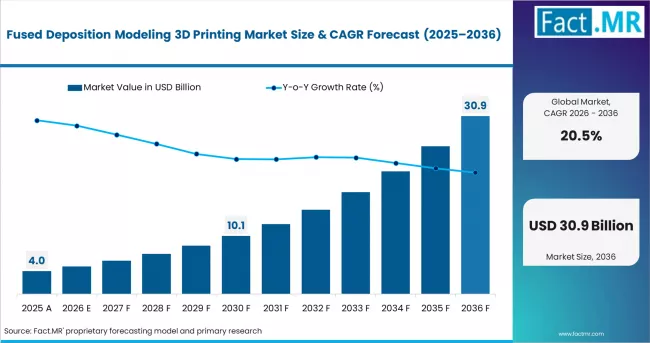
Fused Deposition Modeling 3d Printing Market Market Value Analysis | Source: Fact.MR
| Metric | Value |
|---|---|
| Estimated Value in 2026 | USD 3.3 billion |
| Forecast Value in 2036 | USD 21.3 billion |
| Forecast CAGR (2026 to 2036) | 20.5% |
Source: Fact.MR analysis. Updated May 15, 2026
Summary of Fused Deposition Modeling 3D Printing Market
- Market Definition
- The market covers industrial FDM systems and desktop printers producing thermoplastic parts for prototyping, tooling, and certified end-use manufacturing across aerospace, automotive, healthcare, and consumer goods industries globally.
- Demand Drivers
- U.S. aerospace and defence programmes are accelerating FDM adoption for certified tooling and jig production, driven by FAA approval pathways for additive manufactured components from 2024.
- China NEV platform expansion is generating demand for FDM-printed automotive tooling and fixture production as domestic OEMs scale assembly volumes through 2025.
- Healthcare sector qualification of FDM-printed surgical guides and custom implant components is creating high-margin, low-volume demand in regulated medical device markets globally.
- Key Segments Analyzed
- By Printer Type: Industrial FDM printers lead with approximately 66% share in 2026, driven by aerospace, automotive, and healthcare scale adoption of certified production systems.
- By Application: Prototyping holds approximately 50% share in 2026, with end-use parts the fastest-growing sub-segment as certification pathways mature in aerospace and medical.
- By End-Use Industry: Aerospace & defense and automotive combined account for approximately 40% share in 2026, anchoring industrial-grade FDM system procurement globally.
- By Geography: India leads growth at 24.0% CAGR through 2036, supported by PLI manufacturing incentives and rapid industrial base expansion.
- Analyst Opinion at FACT.MR
- Shambhu Nath Jha, Principal Consultant at Fact.MR, opines, CXOs should note that competition is no longer driven by hardware or price. The divide is between vendors with certified materials and those limited to prototyping. Vendors with validated materials and production-grade processes have a clear edge. Companies like Stratasys Ltd. and Markforged Holding Corporation are focused on end-use manufacturing.
- Strategic Implications
- Invest in end-use part certification programmes for aerospace and medical applications to access high-margin, specification-locked procurement contracts.
- Develop proprietary high-performance filament systems paired with industrial FDM hardware to reduce third-party material dependency and increase switching costs.
- Target India and China manufacturing programmes early with localised support and PLI-compatible system configurations to capture fastest-growth CAGR markets.
- Methodology
- Market sizing based on printer shipment volumes and ASP by system type, validated against Stratasys and Markforged revenue disclosures and industry shipment benchmarks.
- Incorporates FAA additive manufacturing guidance, EU aerospace qualification updates, and China NEV tooling procurement data from 2024 and 2025 filings.
- Forecasts factor in material certification timelines, operator skill constraints, aerospace qualification cycles, and primary interviews with manufacturing engineers and procurement executives.
Between 2026 and 2036, the market is projected to generate an absolute dollar opportunity of USD 18.0 billion. Growth is transformational rather than incremental. Aerospace, automotive, and healthcare adoption of certified end-use FDM parts drives high-value expansion. Primary constraints include material qualification timelines and machine operator skill gaps in industrial segments.
Industrial FDM printer adoption accelerated through 2024 and 2025 as aerospace and defense OEMs shifted from subtractive machining to additive tooling workflows. End-use part certification, rather than prototype volume, is now the primary commercial frontier. Vendors unable to demonstrate material qualification for regulated applications face exclusion from high-margin contracts.
India leads with 24.0% CAGR through 2036, driven by government manufacturing incentives and rapid industrial base expansion. China follows at 23.7%, anchored by domestic 3D printer manufacturing scale and NEV tooling adoption. The United States posts 22.3%, underpinned by aerospace and defense certification demand. Germany records 22.0%, supported by automotive end-use part qualification programmes. France grows at 21.5%, driven by aerospace supply chain localisation. Japan grows at 19.0%, reflecting steady industrial adoption with strict validation cycles as a structural constraint.
Segmental Analysis
Fused Deposition Modeling 3D Printing Market Analysis by Printer Type
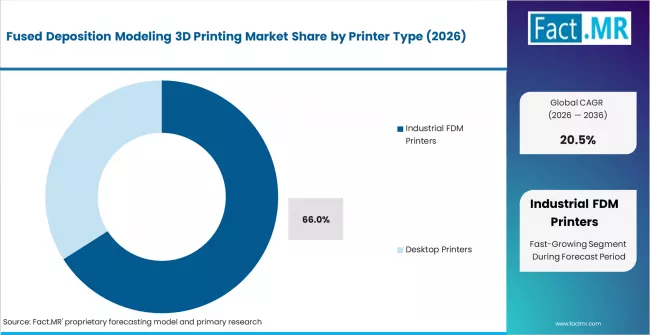
Fused Deposition Modeling 3d Printing Market Analysis By Printer Type | Source: Fact.MR
Based on FACT.MR, industrial FDM printers hold approximately 66% share in 2026. They lead due to aerospace, automotive, and healthcare programme adoption of certified production systems. Desktop printers account for the remainder, competing on price in education, consumer, and SME prototyping segments.
- Stratasys Investment: Stratasys Ltd. announced a USD 120 million capital investment in 2024 to expand industrial FDM system manufacturing capacity in Eden Prairie, Minnesota, targeting aerospace and defence programme growth. [4]
- Markforged Technology: Markforged launched the FX20 industrial FDM system in 2024. The platform prints continuous fibre-reinforced thermoplastics targeting aerospace tooling and automotive end-use part production with certified material traceability. [5]
- Desktop Segment Trend: Bambu Lab and Creality expanded desktop FDM product lines in 2024 and 2025, driving average selling price compression in the consumer and education segments. Desktop unit shipments grew but revenue contribution per unit declined as competition intensified. [6]
Fused Deposition Modeling 3D Printing Market Analysis by Application
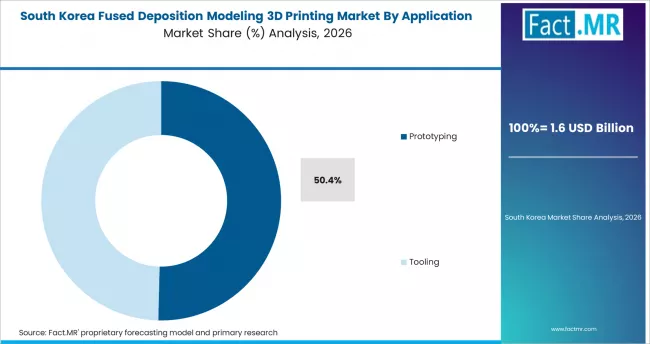
Fused Deposition Modeling 3d Printing Market South Korea Market Share Analysis By Application | Source: Fact.MR
Based on FACT.MR, prototyping holds approximately 50% share in 2026. It leads due to established engineering workflows and broad OEM adoption. End-use parts is the fastest-growing sub-segment as certification pathways mature. Tooling accounts for the remaining share across industrial and automotive applications.
- Aerospace End-Use Adoption: Boeing disclosed expansion of FDM-printed end-use bracket and duct production across commercial aircraft programmes in 2024. Over 60,000 3D-printed parts are deployed across Boeing aircraft as of 2025. [7]
- Automotive Tooling Development: Volkswagen Group expanded FDM tooling deployment at its Wolfsburg and Emden facilities in 2024. Assembly jigs and body fixtures are produced using Stratasys industrial systems, reducing tooling lead times by 40%. [8]
- Healthcare Prototyping Trend: Medtronic and Stryker expanded use of FDM prototyping for surgical device development in 2024, reducing design iteration cycles. Healthcare prototyping volumes increased as desktop FDM adoption grew within medical device R&D departments. [9]
Drivers, Restraints, and Opportunities
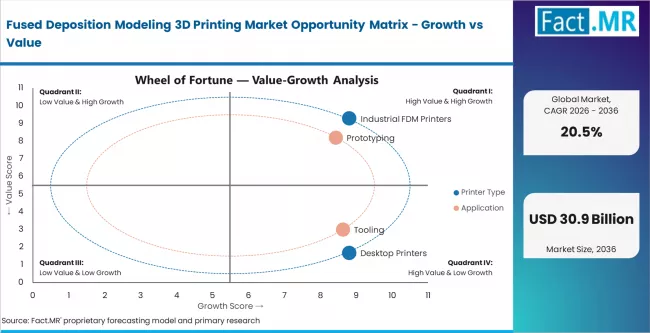
Fused Deposition Modeling 3d Printing Market Opportunity Matrix Growth Vs Value | Source: Fact.MR
FACT.MR analysis indicates the FDM 3D printing market is transitioning from a prototyping-dominant segment to a dual-function environment where end-use part production is becoming a primary revenue driver.
The core tension lies between hardware commoditisation in desktop segments and material-led differentiation in industrial tiers. Desktop printer average selling prices are declining. Industrial systems command premiums through certified material qualification and integrated workflow software.
- FAA Additive Manufacturing Guidance: FAA released updated airworthiness guidance for additive manufactured components in 2024. This created structured certification pathways for FDM-printed aircraft tooling and brackets. Stratasys reported aerospace revenue growth in 2024 linked to expanded OEM qualification engagements under the updated framework. [1]
- China NEV Tooling Adoption: China's NEV production exceeded 12 million units in 2024, generating demand for FDM-printed assembly fixtures and body tooling at domestic OEM facilities. BYD and NIO expanded additive manufacturing tooling programmes in 2024. Bambu Lab reported industrial system procurement increases from automotive supply chain customers. [2]
- Healthcare Part Qualification: EU Medical Device Regulation 2017/745 full enforcement from 2024 is driving demand for certified FDM-printed surgical guides and custom orthopaedic components. Stratasys and Markforged expanded medical-grade material portfolios in 2024 and 2025, targeting validated additive manufacturing workflows in European hospital procurement. [3]
Regional Analysis
The fused deposition modeling 3D printing market is assessed across Asia Pacific, North America, Europe, Latin America, and Middle East and Africa, covering 40+ countries segmented by industrial adoption maturity, aerospace and automotive programme scale, and regulatory certification frameworks. The full report offers market attractiveness analysis by region and country.
.webp "Top Country Growth Comparison Fused Deposition Modeling 3d Printing Market Cagr (2026 2036)")
Top Country Growth Comparison Fused Deposition Modeling 3d Printing Market Cagr (2026 2036) | Source: Fact.MR
| Country | CAGR (2026 to 2036) |
|---|---|
| India | 24.0% |
| China | 23.7% |
| United States | 22.3% |
| Germany | 22.0% |
| France | 21.5% |
| Japan | 19.0% |
Source: Fact.MR analysis. Updated May 15, 2026
Asia Pacific Fused Deposition Modeling 3D Printing Market Analysis
Asia Pacific is the volume and growth epicentre for FDM 3D printing. China leads on manufacturing scale and domestic printer production. India drives the fastest growth through PLI-linked industrial incentives. INTAMSYS and Bambu Lab are scaling regional supply. Procurement is increasingly tied to automotive tooling and electronics manufacturing workflows.
- China: Scale-driven manufacturing expansion and domestic printer supply support 23.7% CAGR through 2036. China's NEV production exceeded 12 million units in 2024, generating large-scale FDM tooling demand at BYD, NIO, and SAIC assembly facilities. The Ministry of Industry and Information Technology published additive manufacturing integration guidelines in early 2025, encouraging domestic FDM adoption in strategic manufacturing sectors.
- India: PLI-led manufacturing growth and industrial base expansion support 24.0% CAGR through 2036, the fastest among all profiled countries. The Production Linked Incentive scheme for advanced manufacturing attracted Tata Technologies and Mahindra's engineering divisions to expand FDM tooling adoption in 2024. India's aerospace manufacturing output is growing under DRDO and HAL procurement programmes, creating demand for certified FDM-printed tooling and fixture components.
- Japan: Validation-led adoption and precision manufacturing integration support 19.0% CAGR through 2036. Japan's strict material certification and process validation requirements create longer qualification timelines than other Asia Pacific markets. Toyota and Honda expanded FDM tooling workflows in 2024, deploying Stratasys industrial systems across powertrain assembly and body fixture production.
FACT.MR's analysis of the FDM 3D printing market in Asia Pacific consists of country-wise assessment that includes China, India, Japan, South Korea, ASEAN, and ANZ. Readers can find NEV tooling adoption trends, PLI incentive impacts, certification framework timelines, and industrial printer procurement benchmarks by country.
North America Fused Deposition Modeling 3D Printing Market Analysis
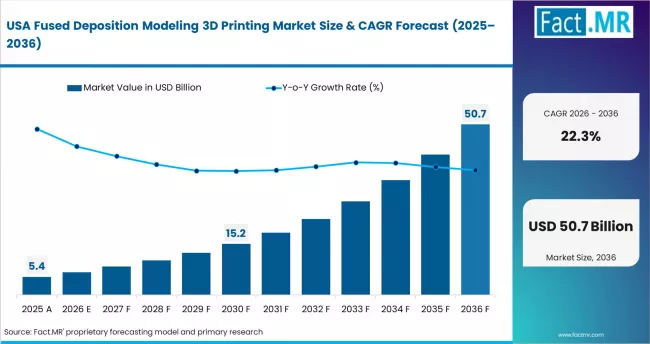
Fused Deposition Modeling 3d Printing Market Country Value Analysis | Source: Fact.MR
North America is the aerospace and defence certification hub for FDM 3D printing. U.S. programme scale and FAA qualification frameworks define the premium segment. Stratasys and Markforged anchor industrial supply. Defence and aerospace OEMs drive high-value end-use part production adoption through multi-year procurement contracts.
- United States: Aerospace and defence programme scale and FAA certification frameworks support 22.3% CAGR through 2036. The FAA released updated additive manufacturing airworthiness guidance in 2024, creating structured certification pathways for FDM-printed brackets, ducts, and interior components. Stratasys reported a 28% increase in aerospace revenue in 2024, linked to expanded Boeing and Lockheed Martin tooling programme engagements.
FACT.MR's analysis of the FDM 3D printing market in North America consists of country-wise assessment that includes the United States, Canada, and Mexico. Readers can find aerospace certification data, defence programme adoption trends, and industrial system procurement benchmarks.
Europe Fused Deposition Modeling 3D Printing Market Analysis
Fused Deposition Modeling 3d Printing Market Europe Country Market Share Analysis, 2026 & 2036 | Source: Fact.MR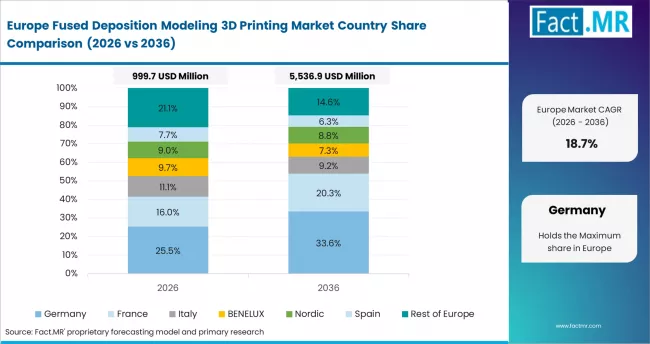
- Germany: Automotive end-use qualification and aerospace tooling expansion support 22.0% CAGR through 2036. Volkswagen Group expanded FDM tooling deployment at Wolfsburg and Emden in 2024, qualifying body assembly fixtures under internal additive manufacturing standards. BMW Group disclosed investment in FDM-produced end-use parts for EV powertrain assembly in 2024, working with Stratasys on material qualification.
- France: Aerospace supply chain localisation and medical device regulatory adoption support 21.5% CAGR through 2036. Airbus expanded its internal FDM part production programme in Toulouse in 2024, qualifying structural brackets and interior duct components under EASA additive manufacturing guidelines. Safran Group reported expanded FDM tooling adoption across engine nacelle assembly in 2024, reducing machining dependency for complex fixture geometries.
FACT.MR's analysis of the FDM 3D printing market in Europe consists of country-wise assessment that includes Germany, France, the United Kingdom, Italy, Spain, and Rest of Europe. Readers can find EASA and EU MDR regulatory impacts, automotive OEM programme timelines, and industrial system qualification benchmarks.
Competitive Aligners for Market Players
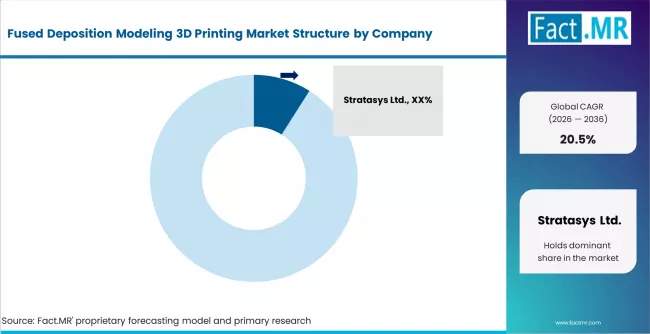
Fused Deposition Modeling 3d Printing Market Analysis By Company | Source: Fact.MR
Competition in the FDM 3D printing market is bifurcated between an industrial-grade tier and a consumer-desktop tier, with fundamentally different competitive variables in each. In the industrial segment, Stratasys and Markforged hold structural advantages through certified material portfolios, validated workflow software, and deep OEM qualification relationships in aerospace and defence. Their position is reinforced by the length and cost of aerospace certification cycles, which create high switching barriers once a system is qualified on a programme.
In the desktop segment, Bambu Lab, Creality, and Prusa Research compete primarily on hardware price and open-material compatibility. Bambu Lab's multi-axis and high-speed systems accelerated desktop market share gains in 2024 and 2025 through performance differentiation at accessible price points. This segment is experiencing rapid commoditisation as hardware costs decline and Chinese manufacturers scale global distribution.
Buyer behaviour diverges sharply across segments. Aerospace and automotive buyers prioritise material traceability, certification documentation, and technical support over unit price. These buyers manage supplier dependency through dual-qualification programmes, qualifying two system vendors for the same part specification. This limits pricing power for any single vendor but sustains premium positioning for certified system suppliers. Desktop buyers prioritise cost and material flexibility, creating a price-elastic market where Chinese entrants hold structural cost advantages over Western incumbents.
Key Players
- Stratasys Ltd.
- Markforged Holding Corporation
- Bambu Lab
- Shenzhen Creality 3D Technology Co., Ltd.
- Ultimaker B.V.
- MakerBot Industries LLC
- Prusa Research a.s.
- INTAMSYS Technology Co., Ltd.
Bibliography
- [1] Federal Aviation Administration. (2024). Engineering Brief No. 115: Airworthiness Considerations for Additive Manufacturing, Updated Guidance for FDM-Produced Aircraft Components Including Brackets, Ducts, and Interior Structural Parts. July 2024. faa.gov/aircraft/air_cert/design_approvals/additive_manufacturing
- [2] China Association of Automobile Manufacturers. (2025). NEV Market Statistics 2024: New Energy Vehicle Production Exceeding 12 Million Units and Additive Manufacturing Tooling Programme Adoption by Domestic OEMs. January 2025. caam.org.cn
- [3] European Commission. (2024). EU Medical Device Regulation 2017/745 Full Enforcement Status Update: Additive Manufactured Component Classification and Certified FDM Production Requirements for Class II and III Medical Devices. March 2024. ec.europa.eu/health/md_sector/overview_en
- [4] Stratasys Ltd. (2024). Press Release: USD 120 Million Industrial FDM Manufacturing Capacity Expansion at Eden Prairie Facility Targeting Aerospace and Defence Programme Growth. June 2024. investors.stratasys.com
- [5] Markforged Holding Corporation. (2024). Product Launch: FX20 Industrial FDM Platform with Continuous Fibre Reinforcement for Aerospace Tooling and Automotive End-Use Part Production with Certified Material Traceability. September 2024. markforged.com/resources
- [6] Bambu Lab. (2025). Product and Market Update: A1 Combo Multi-Material Desktop FDM Launch and Consumer Segment Shipment Growth Data for 2024. January 2025. bambulab.com/news
- [7] Boeing Company. (2025). Sustainability and Innovation Report 2024: Over 60,000 3D-Printed Parts Deployed Across Commercial Aircraft Programmes Including FDM-Produced End-Use Brackets and Duct Components. February 2025. boeing.com/investors
- [8] Volkswagen AG. (2024). Manufacturing Innovation Report: FDM Tooling Deployment at Wolfsburg and Emden Assembly Facilities 40% Lead Time Reduction for Body Fixture Production Using Stratasys Industrial Systems. October 2024. volkswagenag.com/en/news
- [9] Stryker Corporation. (2024). Annual Report 2024: Additive Manufacturing Programme Expansion for Surgical Device R&D Including FDM Prototyping for Orthopaedic Implant Design Iteration. December 2024. stryker.com/investors
This Report Addresses
- Strategic intelligence on FDM 3D printing demand across industrial and desktop printer segments in aerospace, automotive, healthcare, and consumer goods globally.
- Market forecast from USD 3.3 billion in 2026 to USD 21.3 billion by 2036 at a CAGR of 20.5%.
- Growth opportunity mapping across India PLI-led manufacturing, China NEV tooling adoption, U.S. aerospace certification demand, Germany automotive end-use qualification, and France aerospace localisation programmes.
- Segment analysis by printer type (industrial FDM, desktop), application (prototyping, tooling, end-use parts), and end-use industry (aerospace, automotive, healthcare, consumer goods).
- Regional outlook covering Asia Pacific volume and policy-led growth, North America aerospace and defence certification demand, and Europe regulatory-driven automotive and healthcare FDM adoption.
- Competitive landscape of Stratasys, Markforged, Bambu Lab, Creality, Ultimaker, Prusa, and INTAMSYS covering certification depth, material portfolio, OEM programme positions, and hardware pricing strategy.
- Regulatory analysis covering FAA additive manufacturing airworthiness guidance, EU Medical Device Regulation 2017/745, China MIIT additive manufacturing guidelines, and EASA certification frameworks.
- Report delivered in PDF, Excel, and presentation formats supported by validated shipment data, OEM procurement benchmarks, and industry expert inputs.
Fused Deposition Modeling 3D Printing Market Definition
The fused deposition modeling 3D printing market covers industrial and desktop printers that extrude thermoplastic filaments layer by layer to produce parts. These systems serve prototyping, tooling, and certified end-use manufacturing.
Fused Deposition Modeling 3D Printing Market Inclusions
Covers global and regional forecasts from 2026 to 2036 by printer type and application. Includes industrial FDM systems and desktop printers. Covers aerospace, automotive, healthcare, and consumer goods end-use industries. Includes OEM and aftermarket filament supply channels tied to FDM hardware procurement.
Fused Deposition Modeling 3D Printing Market Exclusions
Excludes stereolithography, selective laser sintering, and other additive manufacturing technologies. Omits finished manufactured goods produced by FDM printing. Also excludes standalone filament sales outside FDM system supply agreements and post-processing equipment not integrated with FDM printer platforms.
Fused Deposition Modeling 3D Printing Market Research Methodology
- Primary Research:Interviews with industrial FDM system buyers, aerospace and automotive manufacturing engineers, and healthcare procurement managers across key adoption markets.
- Desk Research:Uses Stratasys, Markforged, and Bambu Lab public filings. Includes additive manufacturing industry output data and aerospace certification standards from 2024 to 2025.
- Market-Sizing and Forecasting:Uses a hybrid top-down and bottom-up model. Based on printer shipment volumes, average selling prices by system type, and application-level adoption rates across end-use industries.
- Data Validation and Update Cycle:Validated using OEM procurement data, shipment statistics, and industry association output benchmarks. Cross-checked with expert interviews and updated regularly.
Segmentation
Scope of Report
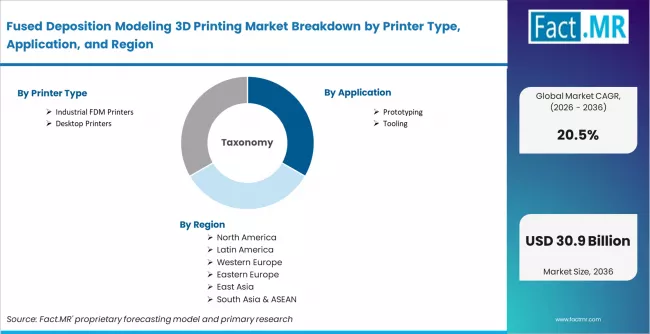
Fused Deposition Modeling 3d Printing Market Breakdown By Printer Type, Application, And Region | Source: Fact.MR
| Attribute | Details |
|---|---|
| Quantitative Units | USD 3.3 billion (2026) to USD 21.3 billion (2036), at a CAGR of 20.5% |
| Market Definition | Industrial and desktop FDM 3D printing systems producing thermoplastic parts for prototyping, tooling, and certified end-use manufacturing in aerospace, automotive, healthcare, and consumer goods globally. |
| Printer Type Segmentation | Industrial FDM Printers, Desktop Printers |
| Application Segmentation | Prototyping, Tooling, End-Use Parts |
| End-Use Industry Segmentation | Aerospace & Defense, Automotive, Healthcare, Consumer Goods |
| Application Coverage | Aerospace jig and bracket production, automotive assembly fixture tooling, medical surgical guide manufacturing, consumer product prototyping, and defence logistics part supply. |
| Regions Covered | North America, Europe, Asia Pacific, Latin America, Middle East and Africa |
| Countries Covered | USA, Canada, Mexico, Germany, UK, France, Italy, Spain, Nordic, BENELUX, China, Japan, South Korea, India, ASEAN, Australia and New Zealand, Brazil, Argentina, Chile, Saudi Arabia, UAE, South Africa, Rest of MEA |
| Key Companies Profiled | Stratasys Ltd., Markforged Holding Corporation, Bambu Lab, Shenzhen Creality 3D Technology Co., Ltd., Ultimaker B.V., MakerBot Industries LLC, Prusa Research a.s., INTAMSYS Technology Co., Ltd. |
| Forecast Period | 2026 to 2036 |
| Approach | Hybrid top-down and bottom-up model using printer shipment volumes, ASP by system type and application, Tier-1 supplier revenue data, aerospace certification adoption rates, and primary interviews with manufacturing engineers and OEM procurement executives. |
Source: Fact.MR analysis. Updated May 15, 2026
Fused Deposition Modeling 3D Printing Market by Segments
-
By Printer Type:
- Industrial FDM Printers
- Desktop Printers
-
By Application:
- Prototyping
- Tooling
- End-Use Parts
-
By End-Use Industry:
- Aerospace & Defense
- Automotive
- Healthcare
- Consumer Goods
-
By Region:
- North America
- United States
- Canada
- Mexico
- Latin America
- Brazil
- Argentina
- Chile
- Rest of Latin America
- Western Europe
- Germany
- United Kingdom
- France
- Italy
- Spain
- Nordic Countries
- BENELUX
- Rest of Western Europe
- Eastern Europe
- Russia
- Poland
- Hungary
- Balkan and Baltic
- Rest of Eastern Europe
- East Asia
- China
- Japan
- South Korea
- South Asia and Pacific
- India
- ASEAN
- Australia and New Zealand
- Rest of South Asia and Pacific
- Middle East and Africa
- Kingdom of Saudi Arabia
- UAE
- South Africa
- Rest of Middle East and Africa
- North America
Frequently Asked Questions
How large is the global FDM 3D printing market in 2025?
What will the market size be in 2026?
What is the projected market size by 2036?
What is the expected CAGR from 2026 to 2036?
Which printer type segment is poised to lead the market?
Which application segment holds the largest share?
Which country shows the fastest growth in the market?
What are the primary uses of FDM 3D printing in industrial settings?
Who worked on this report


Preview the report firsthand - request a free sample
Free SampleGet the brochure for pricing and purchase details
Download PDF