- Base Value(2025): 2.1 Bn
- Estimated Value(2026): 2.5 Bn
- Forecast Value (2036): 15.4 Bn
- CAGR (2026 - 2036): 19.5%
Heavy-Duty Truck Driver Information Display Systems Market Forecast and Outlook by Fact.MR
In 2025, the heavy-duty truck driver information display systems market was valued at USD 2.1 billion. Based on Fact.MR analysis, demand for heavy-duty truck driver information display systems is estimated to grow to USD 2.5 billion in 2026 and USD 15.4 billion by 2036. FACT.MR projects a CAGR of 19.5% during the forecast period.
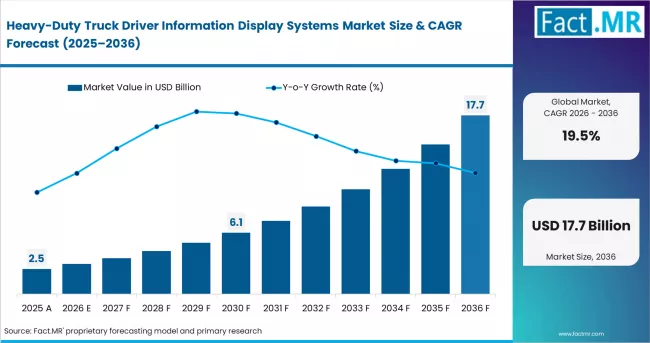
Heavy Duty Truck Driver Information Display Systems Market Value Analysis | Source: Fact.MR
Summary of Heavy-Duty Truck Driver Information Display Systems Market
- Market Definition
- The market covers digital instrument clusters, infotainment displays, and HUD systems integrated into Class 6 to Class 8 trucks for freight, construction, and specialty haulage globally.
- Demand Drivers
- U.S. FMCSA Electronic Logging Device mandates are accelerating digital cockpit adoption. Fleet operators require integrated compliance displays replacing paper-based records.
- China freight digitalization policy is scaling commercial vehicle display procurement. State-backed logistics infrastructure expansion supports OEM digital cockpit programs.
- EU General Safety Regulation II requirements are tightening driver information system specifications. Demand for validated ADAS-linked display suites is rising across European truck OEMs.
- Key Segments Analyzed
- By Display Type: Digital instrument clusters lead at 48% in 2026. Critical interface for speed, diagnostics, and ADAS alerts in long-haul applications.
- By Component: Control modules lead at 36% in 2026. System integration core enabling multi-screen cockpit coordination and telematics connectivity.
- By Vehicle Type: Long-haul trucks dominate at 62% in 2026. Highest display density driven by regulatory compliance and fleet telematics requirements.
- Analyst Opinion at FACT.MR
- Shambhu Nath Jha, Senior Research Analyst at Fact.MR, opines, CXOs will find that the key value divide in this market lies between standalone instrument clusters and software-defined cockpit systems. Advanced systems integrate live telematics, ADAS, and OTA updates. These platforms command premium pricing and enable long-term OEM lock-in.
- Strategic Implications
- Invest in telematics-integrated display platforms targeting fleet digitalisation mandates in the U.S. and EU.
- Develop ADAS-linked cockpit suites with real-time driver fatigue and lane departure alert integration for long-haul OEMs.
- Separate product lines for long-haul compliance applications and construction or vocational truck display systems.
- Methodology
- Market sizing based on OEM shipment volumes and display system pricing by grade. Validated with 2024 to 2025 procurement data.
- Supported by ELD mandate data, EU General Safety Regulation II standards, and China freight digitalization programme approvals.
- Forecasts include fleet digitalization growth, ADAS integration adoption, and regional OEM production trends.
| Metric | Value |
|---|---|
| Estimated Value in 2026 | USD 2.5 billion |
| Forecast Value in 2036 | USD 15.4 billion |
| Forecast CAGR (2026 to 2036) | 19.5% |
The market is expected to generate USD 12.9 billion in incremental revenue during the forecast period. Growth is transformational in scale, driven by mandatory ELD compliance mandates, fleet digitalization programs, and rapid integration of ADAS-linked cockpit architectures. Supply-side constraints from semiconductor sourcing and long OEM qualification cycles moderate short-term expansion.
Digital cockpit adoption in commercial trucking has accelerated beyond passenger vehicle precedent. Fleet operators are embedding telematics, driver fatigue monitoring, and lane departure alerts into display systems, shifting procurement away from standalone clusters toward integrated cockpit suites. Premium-grade systems command 2.5x to 3x the unit price of standard instrument clusters, and as volumes scale, the overall value pool expands significantly.
China leads with 20.3% CAGR through 2036, driven by largest freight network scale and state-backed digital cockpit adoption. India follows at 17.8%, supported by rapid logistics infrastructure expansion and PLI-linked commercial vehicle manufacturing. The United States records 14.2%, driven by fleet digitalisation and FMCSA safety compliance requirements. Germany records 13.6%, driven by premium truck OEM innovation in digital cockpits. Japan grows at 12.4%, supported by a strong Tier-1 supplier ecosystem for display and HMI systems. Mature European markets face qualification cycle and certification cost constraints.
Segmental Analysis
Heavy-Duty Truck Driver Information Display Systems Market Analysis by Display Type
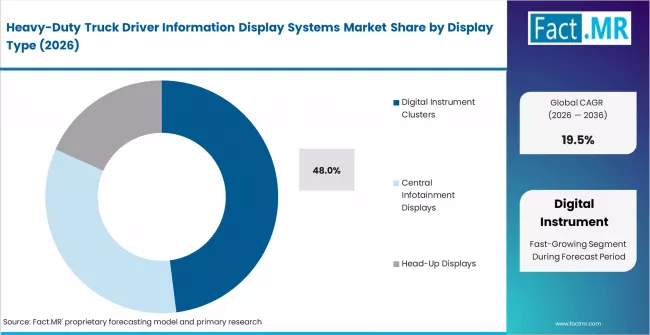
Heavy Duty Truck Driver Information Display Systems Market Analysis By Display Type | Source: Fact.MR
Based on FACT.MR, digital instrument clusters hold 48% share in 2026. They support real-time data, ADAS alerts, and compliance needs. They dominate long-haul truck platforms.
- Visteon Display Program Wins: Visteon secured USD 2.6 billion in display business in 2024. This includes commercial vehicle cockpit systems. Display revenue rose 11% YoY [1].
- Continental AG Cockpit Integration: Continental launched a new commercial vehicle cockpit platform in 2024. It integrates 5G telematics with display systems for fleet and safety use [4].
- Central Infotainment Adoption Trend: Central displays are growing with ELD integration. Fleets prefer multi-function screens combining navigation, telematics, and diagnostics [3].
Heavy-Duty Truck Driver Information Display Systems Market Analysis by Component
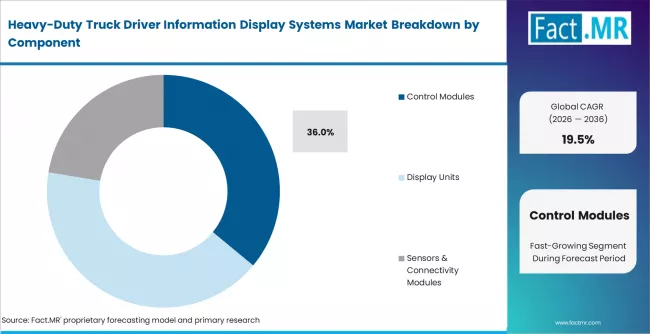
Heavy Duty Truck Driver Information Display Systems Market Analysis By Component | Source: Fact.MR
Based on FACT.MR, control modules hold 36% share in 2026. They enable integration across clusters, infotainment, and telematics systems.
- Denso Cockpit Manufacturing Expansion: Denso opened a new cockpit facility in Thailand in Q1 2025. It targets commercial vehicle control module production [5].
- Nippon Seiki Technology Development: Nippon Seiki showcased advanced TFT display systems in 2024. These support integrated cockpit architectures for commercial vehicles [6].
Control Module Integration Trend: Domain controller adoption increased in 2024. OEMs are consolidating multiple ECUs into single compute platforms. This reduces system complexity and improves efficiency.
Drivers, Restraints, and Opportunities
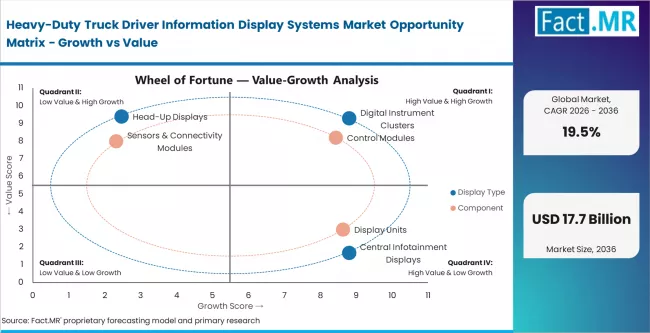
Heavy Duty Truck Driver Information Display Systems Market Opportunity Matrix Growth Vs Value | Source: Fact.MR
FACT.MR analysts observe that the heavy-duty truck display systems market is shifting from a component to a cockpit intelligence platform. Displays were earlier low-margin and standardised. Regulatory mandates and telematics needs have made them mission-critical. They now command OEM design control and recurring software revenue.
Analog clusters are losing relevance in long-haul trucks. Buyers prefer integrated systems with telematics, ADAS alerts, and ELD interfaces. Premium systems cost USD 800–2,500 per unit versus USD 150–400 for basic clusters. Expanding ELD and ADAS mandates are accelerating demand for advanced display platforms.
- Electronic Logging Device and Fleet Compliance Mandates: The U.S. FMCSA ELD mandate requires digital logging integrated with cab displays. Fleet upgrades are driving replacement demand. Visteon reported increased wins in 2024 linked to ELD-compliant systems.
- EU General Safety Regulation II Implementation: EU Regulation 2019/2144 mandates ADAS features including speed assistance and driver monitoring. OEMs such as Daimler Truck and MAN are integrating advanced display systems. This is increasing display content per vehicle [2].
- China Freight Digitalization and Commercial Vehicle Expansion: China’s 2024 digital freight plan mandates telematics and in-cab displays for long-haul routes. OEMs such as FAW and Sinotruk increased procurement of integrated cockpit systems.
Regional Analysis
The heavy-duty truck driver information display systems market is assessed across Asia Pacific, North America, Europe, Latin America, and Middle East and Africa, covering 40+ countries with distinct demand profiles shaped by freight regulatory frameworks, fleet digitalization intensity, commercial vehicle production scale, and OEM cockpit technology roadmaps. The full report offers market attractiveness analysis by region and country.
.webp "Top Country Growth Comparison Heavy Duty Truck Driver Information Display Systems Market Cagr (2026 2036)")
Top Country Growth Comparison Heavy Duty Truck Driver Information Display Systems Market Cagr (2026 2036) | Source: Fact.MR
| Country | CAGR (2026 to 2036) |
|---|---|
| China | 20.3% |
| India | 17.8% |
| United States | 14.2% |
| Germany | 13.6% |
| Japan | 12.4% |
Source: Fact.MR (FACT.MR) analysis, based on proprietary forecasting model and primary research
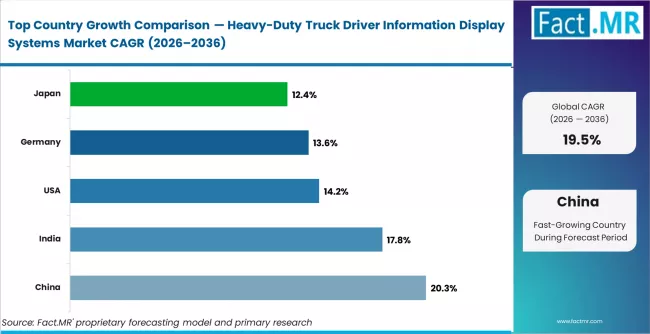
Heavy Duty Truck Driver Information Display Systems Market Cagr Analysis By Country | Source: Fact.MR
Asia Pacific Heavy-Duty Truck Driver Information Display Systems Market Analysis
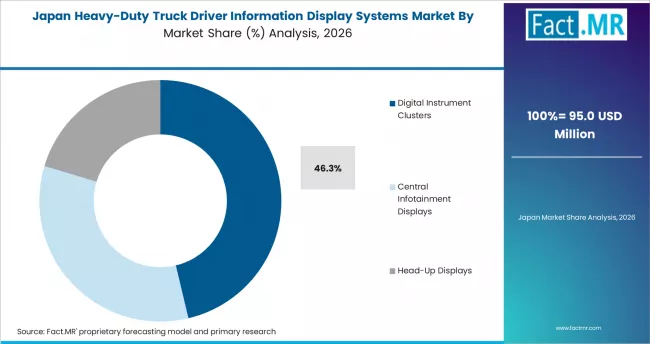
Heavy Duty Truck Driver Information Display Systems Market Japan Market Share Analysis By Display Type | Source: Fact.MR
Asia Pacific leads both in volume and growth momentum. China and India drive large-scale freight digitalisation. Japan contributes through advanced supplier innovation. Continental and Denso are expanding regional supply aligned with OEM hubs. Procurement is increasingly driven by integrated telematics specifications.
- China: China’s market is expanding rapidly at 20.3% CAGR through 2036, supported by policy-led freight digitalisation. The 2024 Digital Freight Plan mandated telematics-enabled displays on long-haul routes. OEMs such as FAW and Sinotruk increased procurement of integrated systems. Subsidies are accelerating fleet upgrades. Large freight volumes support both OEM and retrofit demand.
- India: India’s growth trajectory remains strong at 17.8% CAGR through 2036, driven by logistics expansion and localisation. PLI incentives are attracting Tier-1 display manufacturing. National Logistics Policy is accelerating telematics adoption. Nippon Seiki formed a joint venture in 2025 for TFT module production. Rising freight movement continues to expand demand for advanced cockpit systems.
- Japan: Japan’s market is progressing steadily at 12.4% CAGR through 2036, led by supplier-driven innovation. Nippon Seiki introduced harmonised display systems in 2024. Denso is increasing focus on software-led cockpit integration. Adoption is guided by performance optimisation rather than regulatory push.
FACT.MR’s analysis of heavy-duty truck driver information display systems market in Asia Pacific covers China, India, Japan, South Korea, ASEAN, and ANZ. Readers can find procurement benchmarks, telematics adoption trends, and freight digitalisation impact.
North America Heavy-Duty Truck Driver Information Display Systems Market Analysis
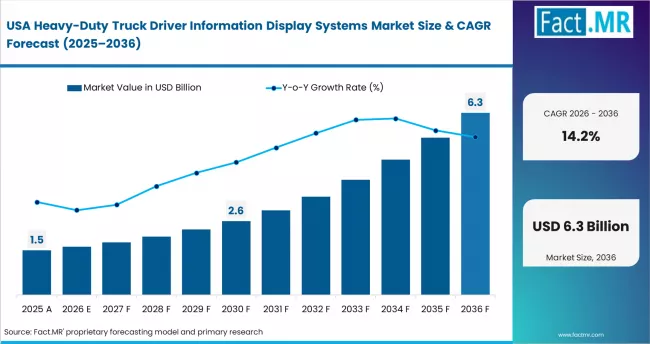
Heavy Duty Truck Driver Information Display Systems Market Country Value Analysis | Source: Fact.MR
North America is defined by compliance-driven demand and fleet digitalisation. ELD mandates and safety regulations shape procurement. Continental, Visteon, and Harman lead supply with certified platforms.
- United States: The U.S. market is advancing at 14.2% CAGR through 2036, driven by regulatory compliance and fleet upgrades. FMCSA ELD enforcement continues to push adoption. Visteon secured multiple commercial display contracts in 2024. Fleet operators are prioritising digital cockpit systems for safety and efficiency. Aftermarket demand is supporting additional growth.
FACT.MR covers the United States, Canada, and Mexico. Includes compliance data, fleet investment trends, and cockpit integration benchmarks.
Europe Heavy-Duty Truck Driver Information Display Systems Market Analysis
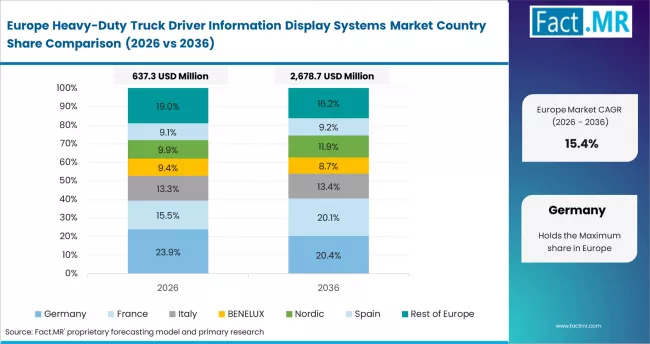
Heavy Duty Truck Driver Information Display Systems Market Europe Country Market Share Analysis, 2026 & 2036 | Source: Fact.MR
Europe remains a regulation-intensive and innovation-led market. Demand is shaped by GSR II and cybersecurity mandates. Daimler Truck, MAN, and Volvo lead OEM integration. Procurement is highly specification-driven.
- Germany: Germany’s market is expanding at 13.6% CAGR through 2036, supported by regulatory compliance and OEM leadership. GSR II mandates are driving ADAS-linked display integration. Continental introduced new cockpit systems aligned with compliance timelines. MAN and Daimler Truck are increasing digital content per vehicle. Strong production base supports sustained demand.
FACT.MR covers Germany, France, the UK, Italy, Spain, and Rest of Europe. Includes regulatory impact, adoption timelines, and OEM cockpit benchmarks.
Competitive Aligners for Market Players
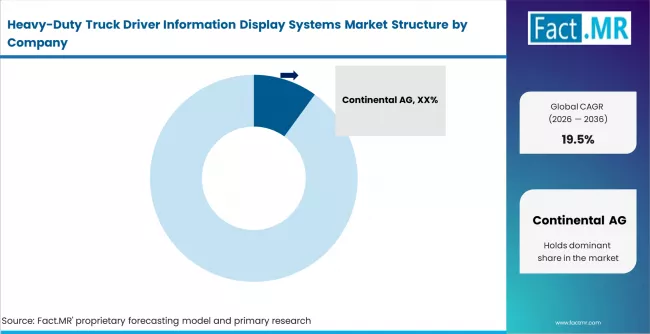
Heavy Duty Truck Driver Information Display Systems Market Analysis By Company | Source: Fact.MR
The heavy-duty truck driver information display systems market is becoming increasingly competitive as the role of displays shifts from basic instrumentation to intelligent cockpit platforms. What was once a low-value hardware segment is now evolving into a strategic battleground centred on software integration, telematics, and regulatory compliance. This transition is reshaping how suppliers compete and how OEMs select partners.
Continental AG and Denso Corporation remain dominant players due to their strong relationships with global truck OEMs and their ability to deliver fully integrated cockpit systems. Their strength lies in combining digital clusters, telematics, and ADAS interfaces into unified platforms that meet evolving regulatory requirements across regions. Visteon Corporation is gaining traction by positioning itself as a software-first cockpit provider. Its multi-display architectures and domain controller platforms are aligned with fleet digitalisation needs, particularly in North America. Similarly, Harman International is leveraging its expertise in connected systems to offer display platforms integrated with cloud-based fleet management and OTA capabilities.
Nippon Seiki continues to play a key role in instrument cluster technology, especially in Japan and emerging Asian markets. The company is focusing on improving display clarity and integration with broader cockpit systems.
Competition is also intensifying from regional players in China, where domestic suppliers are offering cost-optimised, telematics-ready display systems tailored to local freight regulations. These companies are rapidly improving in capability and benefiting from strong domestic OEM alignment. Overall, the market is moving toward a platform-based competition model. Suppliers that can combine hardware, software, and connectivity into a single scalable solution are likely to secure long-term OEM contracts and dominate future growth.
Key Players
- Continental AG
- Denso Corporation
- Visteon Corporation
- Panasonic Automotive Systems Co., Ltd.
- Harman International Industries, Inc.
- Nippon Seiki Co., Ltd.
Bibliography
- [1] Visteon Corporation. (FY2024). Annual Report: Commercial Vehicle Display Program Wins Including Instrument Clusters and Multi-Display Cockpit Contracts. Display Revenues Up 11% Year-Over-Year. 2024. visteon.com/investor-relations
- [2] European Commission. (2024). EU General Safety Regulation II (Regulation 2019/2144): Entry into Force for New Vehicle Registrations Including Mandatory ADAS Display and Intelligent Speed Assistance Visualization Requirements for Commercial Vehicles. 2024. eur-lex.europa.eu
- [3] Ministry of Transport, People's Republic of China. (2024). Digital Freight Plan 2024: Mandatory Telematics and In-Cab Display Integration Requirements for Inter-Provincial Heavy Freight Routes and Commercial Vehicle Digitalization Programme Approvals. 2024. mot.gov.cn
- [4] Continental AG. (June 2024). Press Release: Continental and Samsara Partnership for Data-Driven Fleet Management Solutions Integrating Truck Trailer Telematics with In-Cab Display Visualization. June 2024. continental.com/press-releases
- [5] Denso Corporation. (Q1 2025). Corporate Announcement: New Digital Cockpit Manufacturing Facility Opened in Thailand Targeting Commercial Vehicle Cockpit Control Module Production for Asian and Export Markets. March 2025. denso.com/global/en/news
- [6] Nippon Seiki Co., Ltd. (2024). Exhibition Report: 2024 JSAE Automotive Engineering Exposition Showcase of Interior Harmonized Display Systems Including TFT Cockpit Integration and Biomass Material Meter Products for Commercial Vehicle Applications. 2024. nipponseiki.co.jp
This Report Addresses
- Strategic intelligence on demand across long-haul ELD compliance, ADAS-integrated cockpit displays, construction truck digitalisation, and specialty vocational fleet display applications globally.
- Market forecast from USD 2.5 billion in 2026 to USD 15.4 billion by 2036 at a CAGR of 19.5%.
- Growth opportunities across China freight digitalization expansion, India PLI-supported commercial vehicle manufacturing, U.S. FMCSA ELD mandate demand, Japan supplier innovation, and Germany GSR II OEM compliance.
- Segment analysis by display type (digital instrument clusters, central infotainment displays, head-up displays), component (control modules, display units, sensors & connectivity modules), and vehicle type (long-haul, construction & mining, specialty & vocational trucks).
- Regional outlook covering Asia Pacific freight digitalization-led growth, North America ELD compliance and fleet demand, and Europe GSR II regulation-driven OEM upgrades.
- Competitive analysis of Continental AG, Denso, Visteon, Panasonic Automotive Systems, Harman International, and Nippon Seiki. Focus on OEM qualification depth, compliance certification, and fleet ecosystem integration.
- Regulatory analysis covering U.S. FMCSA ELD mandates, EU General Safety Regulation II, China Ministry of Transport Digital Freight Plan, and India PLI automotive programme.
- Report delivered in PDF, Excel, and presentation formats. Supported by primary interviews, commercial vehicle industry data, and fleet procurement benchmarks.
Heavy-Duty Truck Driver Information Display Systems Market Definition
The market covers digital instrument clusters, central infotainment displays, and head-up display systems fitted to heavy-duty trucks. These systems relay speed, engine diagnostics, navigation, telematics, and ADAS alerts to drivers. Primary end uses are long-haul freight, construction logistics, and specialized commercial haulage.
Heavy-Duty Truck Driver Information Display Systems Market Inclusions
Covers global and regional forecasts from 2026 to 2036. Includes display type and vehicle type segments. Covers OEM-installed and retrofit aftermarket supply. Includes telematics-integrated and standalone cockpit display systems across heavy freight and off-highway truck categories.
Heavy-Duty Truck Driver Information Display Systems Market Exclusions
Excludes passenger vehicle or light commercial van display systems. Omits finished truck assembly. Also excludes display components supplied exclusively to agriculture or railway vehicles. Focus remains on display systems and control modules within Class 6 to Class 8 truck segments.
Heavy-Duty Truck Driver Information Display Systems Market Research Methodology
- Primary Research
- Interviews with display system producers, fleet operators, and truck OEM procurement managers. Covers North America, Europe, and Asia Pacific commercial vehicle buyers.
- Desk Research
- Uses Continental AG, Visteon, Denso, and Nippon Seiki data. Includes commercial vehicle output and ELD compliance statistics from 2024 to 2025.
- Market-Sizing and Forecasting
- Uses a hybrid top-down and bottom-up model. Based on OEM revenues and fleet-level procurement volumes. Segmented by display type, component, and vehicle type.
- Data Validation and Update Cycle
- Validated using revenue data and commercial vehicle registration statistics. Cross-checked with fleet procurement volumes and OEM roadmaps. Updated regularly.
Scope of Report
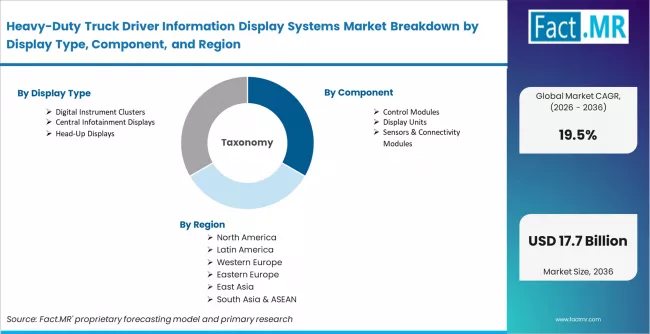
Heavy Duty Truck Driver Information Display Systems Market Breakdown By Display Type Component And Region | Source: Fact.MR
| Attribute | Details |
|---|---|
| Quantitative Units | USD 2.5 billion (2026) to USD 15.4 billion (2036), at a CAGR of 19.5% |
| Market Definition | Digital instrument clusters, central infotainment displays, and head-up display systems sold as OEM-installed and aftermarket units for Class 6 to Class 8 heavy-duty trucks globally, covering long-haul freight, construction, and specialty vocational applications. |
| Display Type Segmentation | Digital Instrument Clusters, Central Infotainment Displays, Head-Up Displays |
| Component Segmentation | Control Modules, Display Units, Sensors & Connectivity Modules |
| Vehicle Type Segmentation | Long-Haul Trucks, Construction & Mining Trucks, Specialty & Vocational Trucks |
| Application Coverage | ELD compliance display, ADAS alert visualization, fleet telematics integration, driver fatigue monitoring, navigation, and diagnostics for Class 6 to Class 8 commercial trucks. |
| Regions Covered | North America, Europe, Asia Pacific, Latin America, Middle East and Africa |
| Countries Covered | USA, Canada, Mexico, Germany, UK, France, Italy, Spain, Nordic, BENELUX, China, Japan, South Korea, India, ASEAN, Australia and New Zealand, Brazil, Argentina, Chile, Saudi Arabia, GCC, Turkey, South Africa, Rest of MEA |
| Key Companies Profiled | Continental AG, Denso Corporation, Visteon Corporation, Panasonic Automotive Systems, Harman International, Nippon Seiki Co., Ltd. |
| Forecast Period | 2026 to 2036 |
| Approach | Hybrid top-down and bottom-up model using display system OEM revenues, commercial vehicle production volumes, average selling prices by display type and grade, fleet procurement benchmarks, and primary interviews with truck OEM procurement managers and fleet operator technology directors. |
Heavy-Duty Truck Driver Information Display Systems Market by Segments
-
By Display Type:
- Digital Instrument Clusters
- Central Infotainment Displays
- Head-Up Displays
-
By Component:
- Control Modules
- Display Units
- Sensors & Connectivity Modules
-
By Vehicle Type:
- Long-Haul Trucks
- Construction & Mining Trucks
- Specialty & Vocational Trucks
-
By Region:
- North America
- United States
- Canada
- Mexico
- Latin America
- Brazil
- Mexico
- Argentina
- Chile
- Rest of Latin America
- Western Europe
- Germany
- United Kingdom
- France
- Italy
- Spain
- Nordic Countries
- BENELUX
- Rest of Western Europe
- Eastern Europe
- Russia
- Poland
- Hungary
- Balkan and Baltic
- Rest of Eastern Europe
- East Asia
- China
- Japan
- South Korea
- South Asia and Pacific
- India
- ASEAN
- Australia and New Zealand
- Rest of South Asia and Pacific
- Middle East and Africa
- Kingdom of Saudi Arabia
- Other GCC Countries
- Turkey
- South Africa
- North America