- Base Value(2025): 2.74 Bn
- Estimated Value(2026): 3.06 Bn
- Forecast Value (2036): 8.78 Bn
- CAGR (2026 - 2036): 11.1%
Driver Monitoring Camera and Sensor Systems Market Forecast and Outlook By Fact.MR
In 2025, the driver monitoring camera and sensor systems market was valued at USD 2.74 billion. Based on Fact.MR analysis, demand for driver monitoring camera and sensor systems is estimated to grow to USD 3.06 billion in 2026 and USD 8.78 billion by 2036. Fact.MR projects a CAGR of 11.1% during the forecast period.
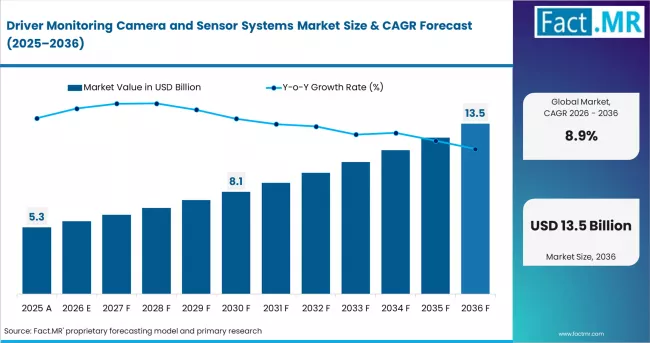
Driver Monitoring Camera And Sensor Systems Market Market Value Analysis | Source: Fact.MR
| Metric | Details |
|---|---|
| Industry Size (2026) | USD 3.06 billion |
| Industry Value (2036) | USD 8.78 billion |
| CAGR (2026 to 2036) | 11.12% |
Source: Fact.MR analysis. Updated May 6, 2026
Summary of Driver Monitoring Camera and Sensor Systems Market
- Market Definition
- The market includes in-cabin camera and sensor systems that assess driver alertness, distraction, and engagement and trigger warnings or safety responses when attention deteriorates.
- Demand Drivers
- European safety rules now make attention warning and advanced driver distraction warning part of mainstream vehicle compliance planning.
- Assisted-driving programs require stronger supervision of the human driver during shared-control operation.
- Interior-electronics architectures are becoming more capable of supporting camera-based sensing and real-time interpretation in larger vehicle volumes.
- Key Segments Analyzed
- By Component, Camera Modules are estimated to account for 41.8% share in 2026, supported by their central role in the sensing stack and their direct link to field-of-view, image quality, and packaging flexibility.
- By Monitoring Function, Distraction Monitoring is projected to hold 36.4% share in 2026 because compliance, warnings, and assisted-driving supervision depend heavily on whether driver attention remains on the road task.
- By Vehicle Type, Passenger Cars are likely to capture 82.1% share in 2026 due to far wider production volumes and faster migration of cockpit-safety features across trim levels.
- By Geography, China is anticipated to remain the fastest-growth country in this study at 12.8% CAGR through 2036, supported by large vehicle volumes, software-rich cockpits, and scale advantages in electronics integration.
- Analyst Opinion at Fact.MR
- Shambhu Nath Jha, Senior Analyst at Fact.MR, opines, “What many outsiders miss is that the commercial contest is not about adding another cabin camera. It is about how reliably the system distinguishes real inattention from normal driving behavior across lighting shifts, eyewear, posture changes, and driver diversity. OEM teams can tolerate a feature that is expensive before they tolerate one that interrupts the driver at the wrong time. That is why software maturity and validation discipline are becoming more decisive than the sensor bill of materials alone.”
- Strategic Implications
- Cockpit-electronics procurement teams must evaluate driver monitoring as a platform decision, not a feature purchase, because architecture reuse drives cost and rollout speed.
- Tier 1 suppliers should align camera, illumination, and processing choices early in the program cycle to reduce revalidation risk during vehicle integration.
- OEM safety teams face stronger pressure to balance compliance with user acceptance, since repeated false alerts can weaken both brand confidence and system credibility.
- Methodology
- Primary Research: Interviews focus on buyers and integrators who control cockpit sensing, safety architecture, and validation.
- Desk Research: Fact.MR combines regulatory, safety-assessment, production, and company-disclosure sources rather than relying on commercial aggregator estimates.
- Sizing Logic: Forecasts connect vehicle output, fitment penetration, regional safety timing, and estimated installed-system value.
- Validation: Install-base disclosures from specialist suppliers are used as a cross-check against the modelled adoption curve.
The market is projected to generate USD 5.72 billion in absolute opportunity between 2026 and 2036. Growth remains strong but structurally selective. Regulatory and safety assessment pressure is expanding the role of driver-state sensing across more vehicle programs. OEM adoption still depends on validation depth, software maturity, and the ability to deliver reliable monitoring across lighting variation, eyewear interference, and real-world driver behavior.
China is projected to expand at 12.8% CAGR through 2036, supported by scale in vehicle production and fast cockpit-electronics adoption. India is likely to record 12.2% CAGR, driven by a lower installed base and rising migration of safety features into broader passenger-vehicle offerings. South Korea is expected to post 11.6% CAGR, with growth linked to strong electronics integration and export-oriented vehicle platforms. Germany is estimated to advance at 11.0% CAGR as regulation and premium-vehicle engineering remain closely aligned. Japan is likely to grow at 10.4% CAGR, supported by established OEM engineering depth but moderated by slower rollout cadence across some mass-market programs.
Segmental Analysis
Driver Monitoring Camera and Sensor Systems Market Analysis by Component
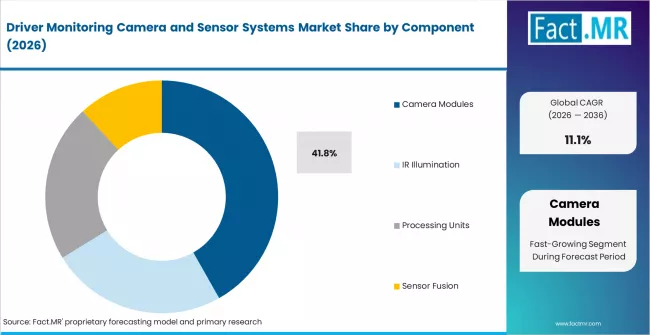
Driver Monitoring Camera And Sensor Systems Market Analysis By Component | Source: Fact.MR
System performance starts with image capture quality. That is why Camera Modules are estimated to hold 41.8% share in 2026. The camera remains the anchor component because every downstream interpretation depends on whether the system can reliably capture facial orientation, eyelid behavior, and gaze-related cues under real cabin conditions. In procurement terms, this makes camera selection more strategic than it looks. OEM engineering teams are not buying optics in isolation. They are choosing a hardware base that affects field-of-view stability, low-light usability, packaging flexibility, and future software headroom. Infrared support and processing hardware matter, though camera quality still shapes the practical ceiling of system usefulness. This is especially important as suppliers push driver monitoring into more price-sensitive programs, where packaging space is tighter and tolerance for calibration drift is lower. [3]
- Optical fidelity: Camera quality determines whether the system captures usable facial and eye data when lighting, posture, or eyewear conditions change inside the cabin.
- Packaging discipline: Smaller, easier-to-place modules support cleaner cockpit integration and reduce the chance that interior design compromises sensing performance.
- Upgrade path: A better camera foundation gives OEM teams more room to add richer driver-state functions later without replacing the full sensing stack.
Driver Monitoring Camera and Sensor Systems Market Analysis by Monitoring Function
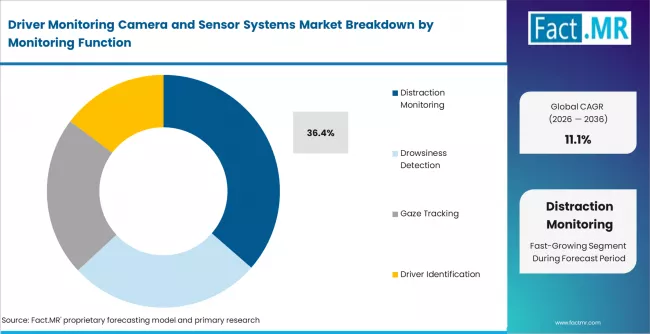
Driver Monitoring Camera And Sensor Systems Market Analysis By Monitoring Function | Source: Fact.MR
Attention supervision is becoming more operational than symbolic. Distraction Monitoring is projected to account for 36.4% share in 2026 because safety frameworks increasingly care whether the driver is still engaged with the road task, not merely whether fatigue signs appear late in the drive. That distinction matters. A drowsiness alert can help after deterioration begins. Distraction monitoring has to work earlier and more consistently, especially when vehicles add more screens, assisted-driving features, and digital cockpit interactions. Buyer preference therefore shifts toward systems that can identify attention loss without becoming intrusive during normal mirror checks or short glance shifts. This makes tuning discipline a central commercial variable. A system that warns too often can be harder to deploy than one with fewer features but cleaner driver acceptance.
- Behavior priority: Distraction monitoring supports immediate attention supervision, which is central to warning logic in modern cockpit-safety architectures.
- Alert credibility: OEMs prefer systems that separate genuine risk from ordinary glance behavior because user acceptance shapes long-term feature value.
- ADAS linkage: Driver-engagement supervision becomes more important as assisted-driving functions need confidence that the human driver remains ready to respond.
Driver Monitoring Camera and Sensor Systems Market Analysis by Vehicle Type
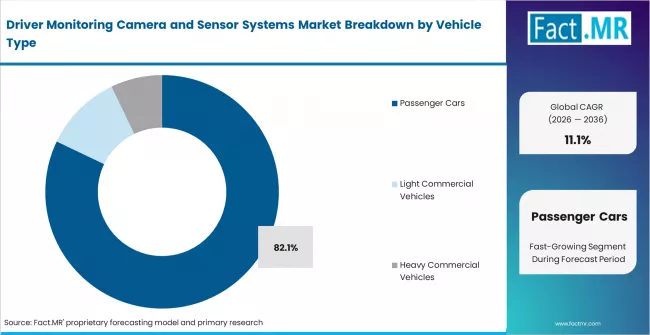
Driver Monitoring Camera And Sensor Systems Market Analysis By Vehicle Type | Source: Fact.MR
Volume still matters. Passenger Cars are expected to hold 82.1% share in 2026 because adoption is spreading across a far larger production base than the commercial-vehicle segment. Regulatory pull, safety-rating visibility, and cockpit digitization all move faster when passenger-car platforms are involved. Commercial vehicles offer a credible growth lane, especially for fatigue monitoring and fleet safety, yet the core revenue pool remains anchored in passenger vehicles because that is where consumer-safety expectations, platform scale, and cabin-electronics investment converge most strongly. This also affects supplier strategy. Winning a passenger-car program usually delivers better leverage for software reuse, validation scale, and manufacturing efficiency than piecemeal commercial deployment alone.
- Platform reach: Passenger cars offer the broadest route for feature standardization because vehicle families and trim hierarchies can spread sensing costs over larger volumes.
- Rating visibility: Safety performance in passenger vehicles carries stronger retail and brand consequences, which supports faster adoption of attention-monitoring features.
- Scale economics: Larger production runs help justify the validation effort and component optimization needed to push driver monitoring beyond premium trims. [1]
Driver Monitoring Camera and Sensor Systems Market Analysis by Installation
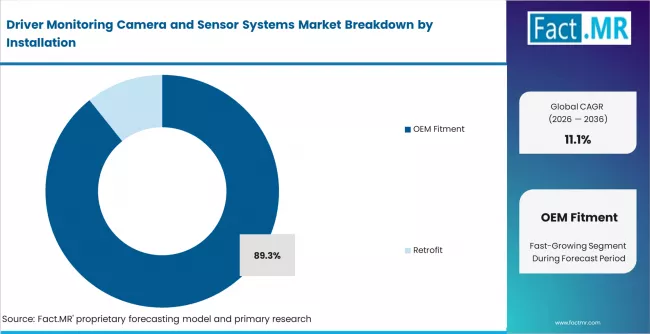
Driver Monitoring Camera And Sensor Systems Market Analysis By Installation | Source: Fact.MR
Factory integration remains the dominant route. OEM Fitment is estimated to command 89.3% share in 2026 because driver monitoring works best when the camera location, infrared support, human-machine interface, and alert logic are designed into the vehicle from the start. Retrofit demand exists in fleets and selected specialty use cases, yet retrofits rarely match the packaging precision, calibration quality, or legal clarity that OEM installation offers. This matters commercially because buyers are not just purchasing detection capability. They are purchasing a system whose warnings must make sense within the vehicle’s broader safety behavior. That coherence is harder to guarantee after production. OEM fitment therefore keeps its lead as compliance, validation, and user-experience expectations rise.
- Integration control: Factory installation allows camera placement, warning strategy, and electrical architecture to be optimized together instead of patched together later.
- Validation comfort: OEM-installed systems are easier to certify, test, and defend because the full vehicle environment is known from the start.
- Service consistency: Standardized factory fitment reduces lifecycle variability and supports more predictable performance across production volumes. [2]
Driver Monitoring Camera and Sensor Systems Market Drivers, Restraints, and Opportunities
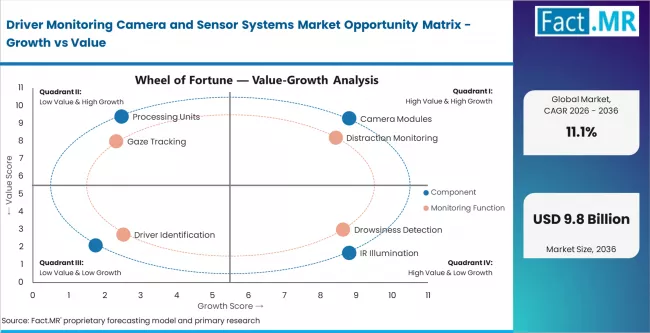
Driver Monitoring Camera And Sensor Systems Market Opportunity Matrix Growth Vs Value | Source: Fact.MR
A structural driver in this market comes from the way safety responsibility is shifting inside vehicle development. Automakers are no longer deciding only whether to add another warning feature. They are deciding how to supervise driver engagement when vehicle assistance becomes more capable and the cabin becomes more digitally distracting. European vehicle-safety rules now require attention warning and advanced driver distraction warning functions on new vehicles, while safety-assessment programs are placing greater emphasis on real-time driver engagement. This turns driver monitoring into a design requirement for more vehicle programs rather than a premium-option decision.
The main restraint is not simple hardware cost. It is validation burden. Driver monitoring must perform across lighting variation, sunglasses, hats, face-angle changes, and culturally varied driver behavior while still keeping nuisance alerts low. That combination makes supplier qualification slower than many adjacent in-cabin electronics categories. OEMs may want the function, yet they remain cautious about systems that create false warnings, inconsistent handover behavior, or poor acceptance among drivers. This slows scaling because a technically capable system still loses value if it interrupts normal driving behavior too often.
Opportunities in the Driver Monitoring Camera and Sensor Systems Market
- Platform standardization: Suppliers that help OEMs deploy one monitoring architecture across multiple vehicle lines can capture larger, stickier program value.
- Commercial fleets: Truck and bus applications create room for systems that blend safety supervision with fatigue management and operator-risk reduction.
- Interior sensing expansion: Vendors that start with driver monitoring and extend into wider cabin sensing gain a stronger path into next-generation cockpit programs.
Regional Analysis
Based on the regional analysis, the Driver Monitoring Camera and Sensor Systems Market is segmented into Asia Pacific, Europe, and North America across 40 plus countries.
.webp "Top Country Growth Comparison Driver Monitoring Camera And Sensor Systems Market Cagr (2026 2036)")
Top Country Growth Comparison Driver Monitoring Camera And Sensor Systems Market Cagr (2026 2036) | Source: Fact.MR
| Country | CAGR (2026 to 2036) |
|---|---|
| China | 12.8% |
| India | 12.2% |
| South Korea | 11.6% |
| Germany | 11.0% |
| Japan | 10.4% |
Source: Fact.MR analysis. Updated May 6, 2026
Source: Fact.MR analysis based on proprietary forecasting logic and primary research direction, supported by public regulatory, production, and supplier disclosures.
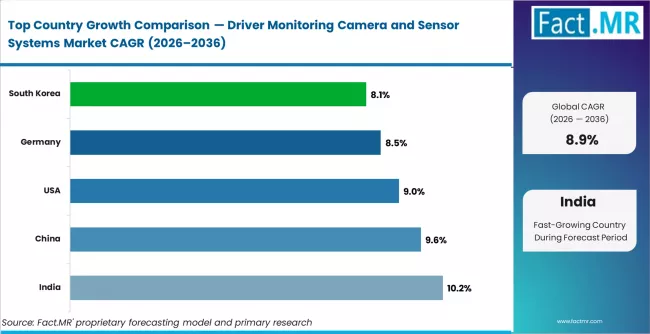
Driver Monitoring Camera And Sensor Systems Market Cagr Analysis By Country | Source: Fact.MR
Asia Pacific Driver Monitoring Camera and Sensor Systems Market Analysis
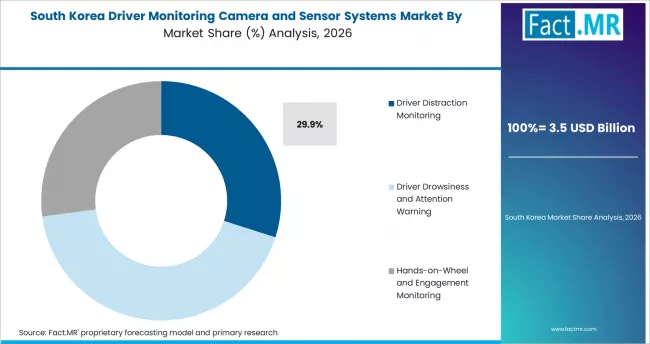
Driver Monitoring Camera And Sensor Systems Market South Korea Market Share Analysis By Function Type | Source: Fact.MR
Asia Pacific is the volume engine of this market because cockpit-electronics adoption sits on top of the world’s largest vehicle production base. China alone produced more than 31 million vehicles in 2024, while India exceeded 6 million and Japan remained above 8 million. South Korea also stays important because it combines electronics capability with export-oriented OEM programs. This matters because driver monitoring becomes easier to scale when domestic manufacturing volume, supplier proximity, and cockpit-integration capability align. The region is not uniform, though. China advances through scale and software-rich interiors, India through low-base expansion and feature migration, Japan through engineering depth, and South Korea through tight electronics integration.
- China: High vehicle output, strong digital-cockpit adoption, and rapid rollout across local and export programs position China as the fastest-growing country in this study. Demand for driver monitoring camera and sensor systems in China is projected to rise at a 12.8% CAGR through 2036, supported by scale advantages that help suppliers spread validation and manufacturing costs across large volumes.
- India: India’s growth reflects a lower installed base and broader migration of safety electronics into mainstream passenger vehicles. The Driver Monitoring Camera and Sensor Systems Market in India is expected to expand at a 12.2% CAGR through 2036 as OEMs progressively bring attention-monitoring capability into a wider portion of their portfolio.
- South Korea: Electronics integration remains a structural strength in South Korea. Sales of driver monitoring camera and sensor systems in South Korea are likely to record 11.6% CAGR through 2036, supported by export programs, advanced cockpit architectures, and quicker adoption of integrated safety-electronics packages.
- Japan: Japan retains deep engineering capabilities and strong vehicle output, though rollout tends to follow careful validation discipline. The market for driver monitoring camera and sensor systems in Japan is estimated to advance at a 10.4% CAGR through 2036, with growth supported by established OEM platforms and steady adoption rather than abrupt regulatory compression alone.
Fact.MR’s Asia Pacific view also considers ASEAN and Australia, where driver monitoring remains tied to premium or safety-led programs but benefits from the same supplier ecosystem that supports the larger regional manufacturing hubs.
Europe Driver Monitoring Camera and Sensor Systems Market Analysis
Europe remains the policy-led center of this market. EU rules now apply to all new motor vehicles sold in the bloc and include attention warning in case of driver drowsiness and advanced driver distraction warning for relevant vehicle classes. Euro NCAP is also placing greater emphasis on driver monitoring technologies that maintain engagement behind the wheel. This creates an environment where driver monitoring is harder to postpone, especially for OEMs selling into safety-sensitive passenger-vehicle segments. Europe may not match Asia Pacific on pure vehicle volume, yet it exerts outsized influence on system requirements, validation rigor, and program timing.
- Germany: Germany combines major vehicle output with strong premium-vehicle engineering and direct exposure to EU safety requirements. The Germany driver monitoring camera and sensor systems market is forecast to register 11.0% CAGR through 2036 because the country remains central to platform decisions where cockpit architecture, assisted driving, and compliance planning overlap.
Fact.MR’s European assessment also includes Italy, Spain, the Nordics, and the United Kingdom. Across these countries, the central issue is not whether driver monitoring matters. It is how quickly OEMs standardize the feature across more model lines without compromising user acceptance.
Competitive Aligners for Market Players
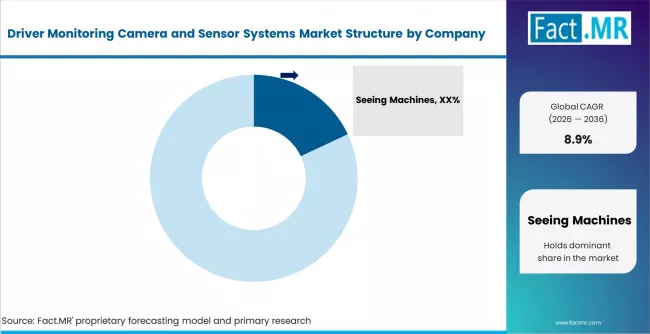
Driver Monitoring Camera And Sensor Systems Market Analysis By Company | Source: Fact.MR
The competitive structure is moderately concentrated. Entry into this market is possible, yet winning durable automotive business is difficult because driver monitoring sits at the intersection of sensing hardware, embedded interpretation, human-machine interaction, and long validation cycles. Buyers do not judge suppliers on camera presence alone. They judge whether the system behaves credibly in the cabin and whether it can be scaled across vehicle programs without repeated rework. That naturally favors suppliers with established automotive validation depth and prior design-win experience.
A second aligner is system breadth. Valeo, Bosch, Magna, FORVIA, Tobii, Smart Eye, and Seeing Machines [5] all remain visible in the space, though they approach it from different strengths. Some bring broader automotive hardware integration. Others bring stronger eye-tracking, perception, or interior-sensing specialization. The edge lies in making hardware, illumination, perception, and warning logic work together cleanly enough that an OEM can trust the package in real production conditions. That is why algorithm stability and program execution matter as much as the component set itself. [3]
By 2036, competition is likely to revolve less around who can claim driver monitoring capability and more around who can turn it into a scalable interior-sensing base. Suppliers that can expand from driver attention to broader cabin awareness will gain strategic leverage. Buyers, meanwhile, will keep resisting hard lock-in by seeking solutions that fit wider cockpit roadmaps and not just one narrow safety function.
Key Players in Driver Monitoring Camera and Sensor Systems Market
- Valeo
- Robert Bosch GmbH
- Magna International Inc.
- FORVIA
- Tobii AB
- Smart Eye AB
- Seeing Machines Limited
Bibliography
- [1] European Commission. Mandatory drivers’ assistance systems expected to help save over 25,000 lives by 2038.
- [2] Valeo. Driver Monitoring System.
- [3] Smart Eye. Annual Report 2024.
- [4] Tobii. Driver Monitoring System
- [5] Seeing Machines. Annual Financial Report for the year ended 30 June 2025.
Driver Monitoring Camera and Sensor Systems Market Definition
The market covers camera and sensor systems installed inside vehicles to observe the driver’s face, gaze direction, eyelid behavior, head pose, and attentiveness. These systems are used to detect distraction, drowsiness, and reduced engagement with the driving task, and they support alerts, warnings, and safety countermeasures. The market includes the physical sensing stack and embedded system elements that make driver-state monitoring operational inside the vehicle cabin.
Driver Monitoring Camera and Sensor Systems Market Inclusions
Market scope includes camera modules, infrared illumination units, sensor-processing hardware, and integrated monitoring assemblies used for driver attention supervision in passenger cars and commercial vehicles. The scope covers OEM-installed systems and selected retrofit deployments where a vehicle operator requires fatigue or attention monitoring. It also includes systems designed for distraction warning, drowsiness detection, gaze tracking, and closely related driver-state functions.
Driver Monitoring Camera and Sensor Systems Market Exclusions
The scope excludes broader occupant monitoring systems where driver-state sensing is only a small part of a larger cabin package unless the driver-monitoring stack is sold and evaluated as a distinct system. It excludes generic dashcams, telematics-only fatigue services without dedicated in-cabin sensing, and pure software-only analytics sold without associated camera or sensor hardware. Consumer driver-assist apps without integrated automotive-grade sensing also fall outside the market boundary.
Driver Monitoring Camera and Sensor Systems Market Research Methodology
- Primary Research
- Fact.MR would interview cockpit-electronics sourcing managers, active-safety architects, Tier 1 program managers, and validation leads involved in in-cabin sensing decisions.
- Desk Research
- Analysis draws on EU vehicle-safety rules, Euro NCAP protocol changes, NHTSA safety-roadmap documents, OICA production statistics, and public disclosures from listed monitoring-solution suppliers.
- Market Sizing and Forecasting
- Market sizing is built from global vehicle-production anchors, estimated DMS fitment penetration by region and vehicle class, and blended system value per installed vehicle.
- Data Validation and Update Cycle
- Estimates are cross-checked against supplier install-base disclosures, public design-win commentary, and regional regulatory timing for safety-feature rollout.
Segmentation
Scope of the Report
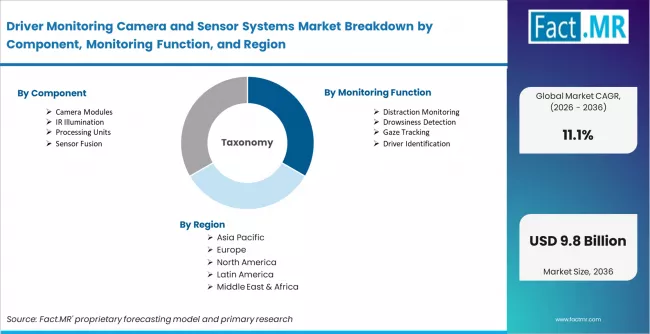
Driver Monitoring Camera And Sensor Systems Market Breakdown By Component, Monitoring Function, And Region | Source: Fact.MR
| Metric | Value |
|---|---|
| Quantitative Units | USD billion |
| Industry Size (2025) | USD 2.74 billion |
| Industry Size (2026) | USD 3.06 billion |
| Forecast Value (2036) | USD 8.78 billion |
| CAGR (2026 to 2036) | 11.12% |
| Component Segmentation | Camera Modules, IR Illumination, Processing Units, Sensor Fusion |
| Monitoring Function Segmentation | Distraction Monitoring, Drowsiness Detection, Gaze Tracking, Driver Identification |
| Vehicle Type Segmentation | Passenger Cars, Light Commercial Vehicles, Heavy Commercial Vehicles |
| Installation Segmentation | OEM Fitment, Retrofit |
| Regions Covered | Asia Pacific, Europe, North America |
| Countries Covered | China, India, South Korea, Germany, Japan, United States, France, and 40+ countries |
| Key Companies Profiled | Valeo, Robert Bosch GmbH, Magna International, FORVIA, Tobii, Smart Eye, Seeing Machines |
| Forecast Period | 2026 to 2036 |
| Approach | Model built from global vehicle-production anchors, regional safety-rule timing, DMS fitment penetration by vehicle type, and supplier install-base cross-checks |
Source: Fact.MR analysis. Updated May 6, 2026
Frequently Asked Questions
How large is the Driver Monitoring Camera and Sensor Systems Market in 2025?
What is the expected market size in 2026?
What is the forecast value by 2036?
What is the expected CAGR from 2026 to 2036?
Which component segment is expected to lead in 2026?
Which monitoring function holds the largest share?
Which vehicle type dominates the market?
Why does OEM fitment dominate this market?
Which country is likely to grow the fastest?
What is the main driver behind market expansion?
What is the main restraint in this market?
Which companies are shaping the competitive landscape?
Who worked on this report


Preview the report firsthand - request a free sample
Free SampleGet the brochure for pricing and purchase details
Download PDF