- Base Value(2025): 0.6 Bn
- Estimated Value(2026): 0.7 Bn
- Forecast Value (2036): 2.5 Bn
- CAGR (2026 - 2036): 15.9%
Interior Air Quality Monitoring Technology Market Size, Share and Forecast by Fact.MR
In 2025, the interior air quality monitoring technology market stood at USD 0.6 billion. Fact.MR analysis indicates demand is expected to reach USD 0.7 billion in 2026 and USD 2.5 billion by 2036. The market is projected to expand at a CAGR of 15.9% during the forecast period.
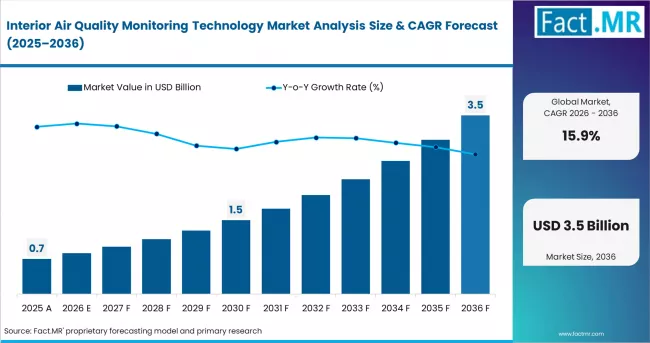
Interior Air Quality Monitoring Technology Market Value Analysis | Source: Fact.MR
Summary of Interior Air Quality Monitoring Technology Market
- Market Definition
- Interior air quality monitoring technology includes sensor-based systems that detect and manage pollutants in enclosed environments such as vehicle cabins and indoor spaces.
- Demand Drivers
- Increasing consumer awareness of in-cabin air pollution is driving adoption of real-time monitoring systems in passenger vehicles.
- Regulatory standards targeting indoor air quality are pushing integration of monitoring technologies in smart buildings.
- Growth in electric vehicles is accelerating deployment of advanced cabin air management systems.
- Key Segments Analyzed
- By Connectivity: Telematics cloud-connected systems lead with 52.9% share due to real-time data integration and remote monitoring capability.
- By Deployment: OEM embedded systems dominate with 66.7% share driven by factory-installed sensor integration.
- By Geography: High growth observed in emerging economies due to rising vehicle production and urban air pollution concerns.
- Analyst Opinion at FACT.MR
- Shambhu Nath Jha, Principal Consultant at Fact.MR, states, 'In this updated edition of the interior air quality monitoring technology market report, CXOs will observe accelerated integration of sensor-driven air quality solutions aligned with health-focused mobility and smart infrastructure evolution.'
- Strategic Implications
- Invest in multi-parameter sensor integration for enhanced monitoring accuracy.
- Align product development with automotive OEM requirements for embedded systems.
- Expand capabilities in cloud connectivity and real-time analytics platforms.
- Methodology
- Validated through primary interviews across sensor and automotive value chains.
- Benchmarked against environmental standards and regulatory frameworks.
- Cross-verified using company disclosures and technology adoption trends.
| Metric | Value |
|---|---|
| Estimated Value in 2026 | USD 0.7 billion |
| Forecast Value in 2036 | USD 2.5 billion |
| Forecast CAGR (2026 to 2036) | 15.9% |
Source: Fact.MR analysis. Updated Apr 28, 2026
The market is projected to increase from USD 0.7 billion in 2026 to USD 2.5 billion by 2036 reflects rapid expansion driven by rising awareness of in-cabin air pollution, regulatory focus on occupant health, and integration of smart sensor technologies in vehicles and indoor environments. Growth is supported by increasing adoption in passenger vehicles, commercial fleets, and smart building ecosystems, alongside advancements in real-time monitoring and filtration control systems.
Brazil leads with a projected CAGR of 18.1% through 2036, driven by rapid urbanization, increasing vehicle ownership, and growing awareness of in-cabin air pollution across major metropolitan regions. The United States follows at 15.2%, supported by advanced automotive integration and rising adoption of smart cabin technologies aligned with occupant health standards. South Korea grows at 15.1%, underpinned by strong electronics manufacturing capabilities and increasing deployment of sensor-integrated vehicle systems. Germany records 15.0% growth, driven by stringent environmental regulations and continued innovation in automotive safety technologies. The United Kingdom grows at 14.8%, supported by clean air initiatives and expanding adoption of indoor air quality monitoring across smart buildings and connected mobility platforms.
Segment Analysis
Interior Air Quality Monitoring Technology Market Analysis by Connectivity
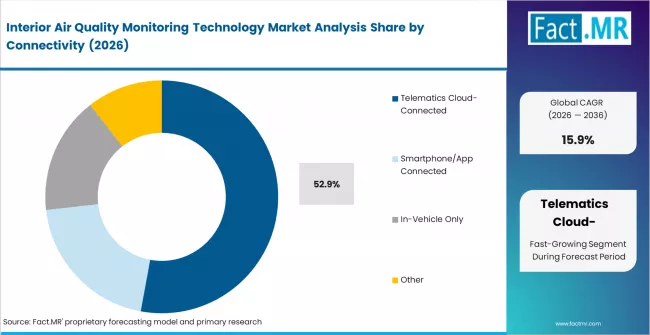
Interior Air Quality Monitoring Technology Market Analysis Analysis By Connectivity | Source: Fact.MR
Based on FACTMR's interior air quality monitoring technology market report, consumption of telematics cloud-connected systems is estimated to hold 52.9% share in 2026. This dominance is driven by the ability to provide real-time monitoring, remote diagnostics, and integration with vehicle and building management systems.
- Strategic Investment: Bosch strengthened its sensor technology and connected mobility portfolio in 2024 by advancing cloud-enabled air quality monitoring and integrated sensor platforms within its mobility solutions segment [1]. The company continues to leverage its expertise in IoT, AI, and cross-domain connectivity to enhance real-time data acquisition and diagnostics capabilities. This strategic direction supports scalable deployment of air quality monitoring systems across automotive and smart infrastructure ecosystems, reinforcing Bosch’s position in connected sensing technologies.
- Product Innovation: Honeywell introduced advanced multi-sensor indoor air quality monitoring solutions with integrated cloud connectivity in 2024 [2]. These systems enable simultaneous tracking of particulate matter, VOCs, and CO₂ levels with centralized data analytics. The development reflects a shift toward intelligent monitoring platforms that enhance user control and predictive air quality management.
- Industry Adoption: Accelerated deployment of connected vehicle platforms in 2025 is significantly driving integration of telematics-enabled air quality monitoring systems across automotive segments [3]. Automakers are increasingly embedding cloud-linked and AI-enabled sensors within vehicle architectures to enable real-time air quality detection and predictive cabin environment control. This trend is reinforced by growing consumer preference for health-focused in-cabin features, alongside the expansion of connected car ecosystems and regulatory attention on vehicle safety and data-driven diagnostics.
Interior Air Quality Monitoring Technology Market Analysis by Deployment
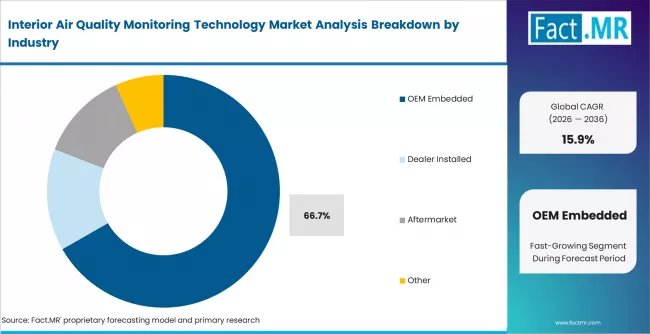
Interior Air Quality Monitoring Technology Market Analysis Analysis By Deployment | Source: Fact.MR
Based on FACTMR's interior air quality monitoring technology market report, consumption of OEM embedded systems is estimated to hold 66.7% share in 2026. OEM integration ensures seamless system functionality, reliability, and compliance with automotive standards.
- OEM Integration: Continental strengthened its OEM integration capabilities in 2024 by advancing embedded sensing and in-cabin monitoring technologies within its automotive solutions portfolio [4]. The company focused on integrating sensor-driven systems into vehicle architectures, including climate control and cabin monitoring platforms, enabling seamless functionality and over-the-air system enhancements. This approach enhances system reliability, supports compliance with evolving safety and environmental standards, and reinforces Continental’s position as a key supplier of integrated automotive sensing solutions.
- Technology Development: Denso developed advanced integrated air quality sensors for vehicle climate control systems in 2024 [5]. These sensors are designed to operate seamlessly within existing vehicle electronics architectures. The innovation improves detection accuracy and enables automated air purification responses within enclosed cabin environments.
- Supply Chain Trend: Increasing OEM preference for factory-installed systems is reducing reliance on aftermarket installations. Automakers are prioritizing embedded solutions to ensure quality consistency and regulatory compliance. This shift is reshaping supplier strategies, with greater emphasis on long-term OEM contracts and integrated system delivery.
Drivers, Restraints, and Opportunities
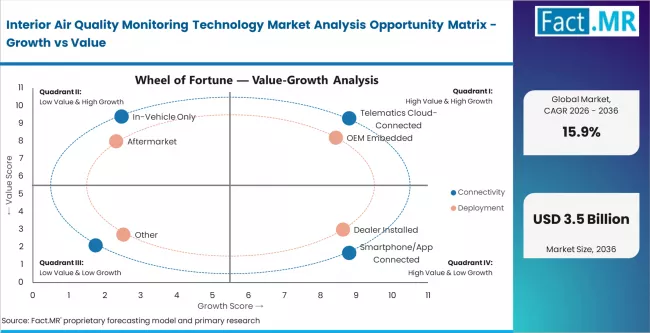
Interior Air Quality Monitoring Technology Market Analysis Opportunity Matrix Growth Vs Value | Source: Fact.MR
Fact.MR analysis indicates that the market reflects a high-growth technology-driven segment shaped by increasing focus on occupant health and environmental awareness. The current valuation is supported by integration of air quality sensors in automotive cabins and smart indoor environments, where real-time monitoring enhances safety and comfort standards.
The market is undergoing a transition from standalone sensing devices to integrated, connected systems. Traditional basic sensors are being replaced by advanced multi-parameter monitoring solutions with cloud connectivity. While these advanced systems carry higher unit costs, their value-added features such as predictive alerts and automated air control justify pricing, resulting in overall revenue expansion.
- Regulatory Push: Standards such as WHO indoor air quality guidelines and regional automotive cabin air quality norms are driving mandatory adoption of monitoring systems.
- Connected Ecosystems: Increasing penetration of IoT platforms enables integration of air quality monitoring with broader smart systems, enhancing value proposition.
- Urban Pollution Impact: High pollution levels in urban regions across Asia and Latin America are accelerating adoption of in-cabin air monitoring technologies.
Regional Analysis
The interior air quality monitoring technology market is segmented across North America, Europe, East Asia, South Asia & Pacific, and Latin America. Regional variation reflects differences in automotive production volumes, regulatory enforcement intensity, urban pollution exposure levels, and adoption of connected technologies. Developed regions emphasize compliance-driven integration, while emerging regions reflect pollution-led demand expansion. The full report offers market attractiveness analysis.
.webp "Top Country Growth Comparison Interior Air Quality Monitoring Technology Market Analysis Cagr (2026 2036)")
Top Country Growth Comparison Interior Air Quality Monitoring Technology Market Analysis Cagr (2026 2036) | Source: Fact.MR
CAGR Table (2026-2036)
| Country | CAGR (2026–2036) |
|---|---|
| Brazil | 18.1% |
| U.S. | 15.2% |
| South Korea | 15.1% |
| Germany | 15.0% |
| UK | 14.8% |
Source: Fact.MR analysis. Updated Apr 28, 2026
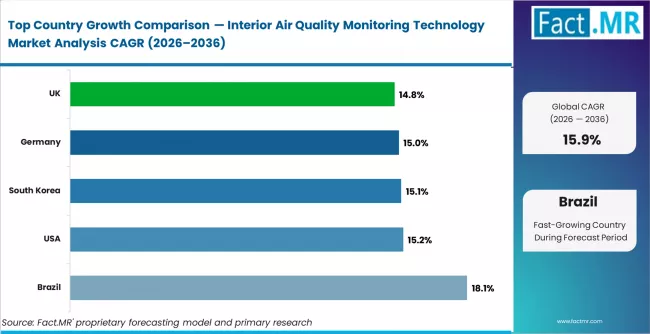
Interior Air Quality Monitoring Technology Market Analysis Cagr Analysis By Country | Source: Fact.MR
Source: Fact.MR (FACTMR) analysis, based on proprietary forecasting model and primary research
North America
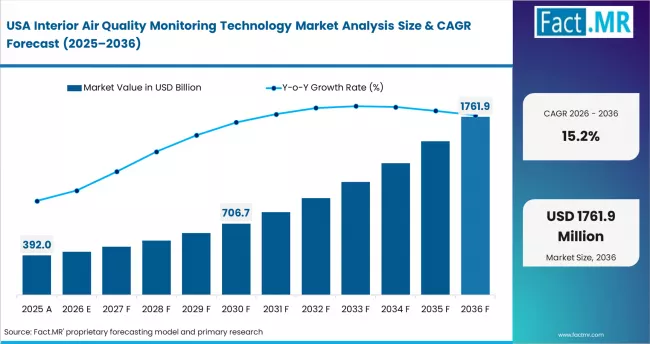
Interior Air Quality Monitoring Technology Market Analysis Country Value Analysis | Source: Fact.MR
North America represents the global innovation hub for interior air quality monitoring technologies, characterized by early adoption of regulatory standards and high penetration of connected vehicle platforms. The region benefits from strong presence of technology providers such as Honeywell, Aptiv, and Sensata, which leverage advanced sensor integration capabilities and long-standing OEM relationships. Market growth is closely tied to increasing electrification of vehicles and integration of smart cabin systems aligned with occupant health and safety expectations.
- U.S.: Demand for interior air quality monitoring technology in the U.S. is projected to rise at 15.2% CAGR through 2036. Growth is supported by Environmental Protection Agency (EPA) indoor air quality initiatives (March 2024), which emphasize monitoring and mitigation of particulate exposure in enclosed environments. In parallel, rising electric vehicle adoption is accelerating integration of advanced cabin air monitoring systems linked with climate control units. Fleet operators and shared mobility providers are increasingly adopting IAQ systems to enhance passenger safety standards.
Latin America
Latin America operates as a high-growth adoption region where urban pollution exposure and expanding mobility demand drive the need for air quality monitoring technologies. Market development is supported by increasing collaboration between global sensor manufacturers and regional automotive suppliers. Adoption patterns are influenced by urban congestion, rising middle-class vehicle ownership, and growing awareness of health risks associated with poor air quality.
- Brazil: Interior air quality monitoring technology demand in Brazil is anticipated to rise at 18.1% CAGR from 2026 to 2036. Increasing domestic vehicle production and expansion of ride-hailing fleets are creating additional demand for in-cabin monitoring solutions. Bosch strengthened its automotive sensor deployment capabilities in Brazil (April 2024), enhancing local supply and integration support. Furthermore, rising adoption of connected vehicle technologies is enabling gradual transition toward cloud-enabled air quality monitoring systems.
Europe
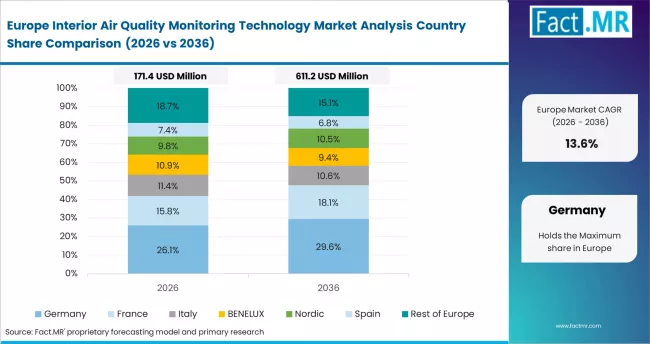
Interior Air Quality Monitoring Technology Market Analysis Europe Country Market Share Analysis, 2026 & 2036 | Source: Fact.MR
Europe functions as the global regulatory benchmark region, where stringent environmental standards and sustainability mandates drive adoption of advanced air quality monitoring technologies. The region is characterized by strong automotive engineering capabilities and presence of leading suppliers such as Continental and Valeo. Demand is shaped by regulatory compliance requirements, electrification trends, and increasing emphasis on occupant health within vehicle cabins and indoor environments.
- Germany: The interior air quality monitoring technology market size in Germany is expected to expand at a CAGR of 15.0% over the assessment period. Growth is driven by enforcement of European Union air quality directives (January 2024), which mandate stricter monitoring of particulate matter and emissions exposure. Germany’s strong automotive manufacturing base enables rapid integration of IAQ systems into next-generation vehicles. Continental enhanced its air quality sensor integration capabilities, supporting OEM demand for advanced cabin monitoring solutions. Additionally, increasing deployment of smart building technologies is contributing to demand beyond automotive applications.
- UK: The demand for the market in the UK is projected to rise at 14.8% CAGR by 2036, as the UK Clean Air Strategy (February 2024), emphasizes monitoring and improvement of indoor and urban air quality. Adoption is further driven by expansion of smart buildings and connected infrastructure projects incorporating environmental monitoring systems. Sensata expanded its sensor production capabilities, strengthening supply chain support for both automotive and indoor applications. Public sector initiatives, including schools and healthcare facilities, are also contributing to demand for indoor air monitoring solutions.
East Asia
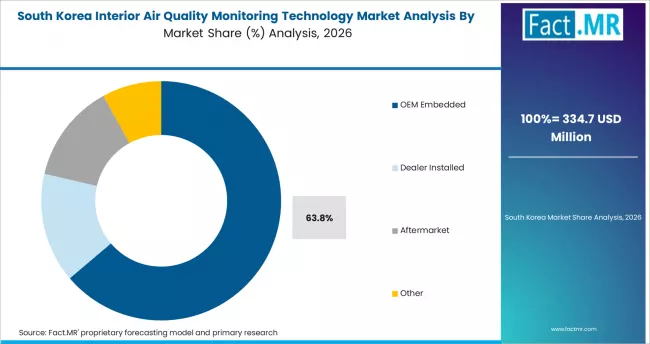
Interior Air Quality Monitoring Technology Market Analysis South Korea Market Share Analysis By Deployment | Source: Fact.MR
East Asia represents a technology-driven manufacturing hub with strong integration of electronics and automotive systems. The region benefits from high production volumes, advanced semiconductor capabilities, and government-driven environmental policies. Market growth is supported by rapid adoption of smart mobility solutions and increasing regulatory focus on indoor and in-cabin air quality.
- South Korea: Demand for interior air quality monitoring technology in South Korea is projected to rise at 15.1% CAGR by 2036. South Korea’s strong automotive and electronics manufacturing ecosystem enables seamless integration of advanced sensor technologies into vehicles and smart devices. Denso expanded its sensor technology deployment in the region, supporting OEM integration of IAQ systems. Additionally, high consumer awareness of air pollution and adoption of smart technologies are accelerating demand for real-time monitoring solutions.
FACTMR's analysis of interior air quality monitoring technology market consists of country-wise assessment that includes U.S., Brazil, Germany, UK, and South Korea. Readers can find regulatory trends, technology adoption patterns, competitive positioning insights, and region-specific demand drivers influencing market expansion through 2036.
Competitive Aligners for Market Players
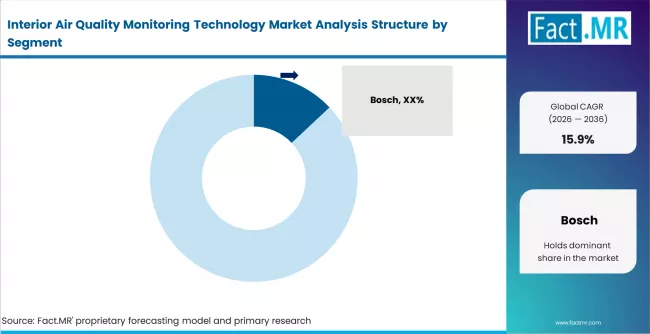
Interior Air Quality Monitoring Technology Market Analysis Analysis By Company | Source: Fact.MR
The interior air quality monitoring technology market demonstrates a moderately concentrated competitive structure, with leading automotive technology providers and sensor manufacturers accounting for a significant share of overall revenue. Market competition is primarily shaped by sensor accuracy, multi-parameter detection capability, connectivity integration, and the ability to align with OEM platform requirements. Companies are increasingly differentiating through advanced sensing technologies capable of real-time monitoring of particulate matter, CO₂, and volatile organic compounds, while also enabling seamless integration with vehicle climate control and infotainment systems.
Key players such as Bosch, Continental, and Denso benefit from long-standing relationships with global automotive OEMs and strong investment in research and development. Their structural advantage lies in their ability to deliver fully integrated solutions that combine hardware, software, and connectivity within broader vehicle architectures. This integration capability allows them to meet stringent automotive performance standards while ensuring scalability across vehicle segments, including electric and connected vehicles.
On the demand side, buyers, particularly automotive OEMs, maintain a high level of control over supplier selection through multi-vendor sourcing strategies and standardized component specifications. This approach reduces dependency on single suppliers and ensures consistent product quality across platforms. As a result, pricing power remains relatively balanced, with suppliers required to demonstrate continuous innovation, cost efficiency, and compliance with evolving regulatory and performance requirements to secure long-term contracts.
Key Players
- Bosch
- Continental
- Denso
- Aptiv
- HARMAN
- Sensata Technologies
- TE Connectivity
- Honeywell International Inc.
- Panasonic Corporation
- Valeo
Bibliography
- [1] Bosch. (2024, January). Connected mobility and sensor-based technology solutions for smart environments.
- [2] Honeywell. Indoor Air Quality Monitoring Solutions. June 2024.
- [3] SkyQuest Technology. (2025). Automotive cabin air quality sensor market insights and technology trends.
- [4] Continental AG. (2024, December). Integrated vehicle technologies and cabin sensing solutions for next-generation mobility.
- [5] Denso Corporation. Air Quality Sensor Development. September 2024.
This Report Addresses
- Provides market intelligence for strategic decision-making across automotive and indoor air quality technology sectors
- Includes market size estimation and forecasts from 2026 to 2036
- Identifies growth opportunities across connectivity and deployment segments
- Delivers segment-wise and region-wise demand forecasts
- Assesses competitive strategies and company positioning
- Tracks product innovation and compliance trends
- Analyzes regulatory impact on adoption of monitoring technologies
- Offers report delivery in multiple formats including PDF and data sheets
Interior Air Quality Monitoring Technology Market Definition
The interior air quality monitoring technology market refers to systems and sensors designed to detect, measure, and manage air pollutants within enclosed environments such as vehicle cabins and indoor spaces. These technologies monitor parameters such as particulate matter, carbon dioxide, volatile organic compounds, and humidity levels. Their primary function is to ensure healthier air conditions by enabling filtration, ventilation adjustments, or alerts. The key end-use includes automotive cabin systems and smart indoor environments where maintaining safe and comfortable air quality is essential for occupant health and regulatory compliance.
Interior Air Quality Monitoring Technology Market Inclusions
The report covers global and regional market size, historical trends, and forecast outlook from 2026 to 2036. It includes segmentation by connectivity type, deployment model, application environment, and end-use industries such as automotive and smart buildings. The analysis incorporates pricing trends, supply chain structure, technology adoption patterns, and regulatory influence on air quality monitoring standards.
Interior Air Quality Monitoring Technology Market Exclusions
The scope excludes standalone industrial air purification equipment and large-scale HVAC systems unless integrated with monitoring technologies. It also omits outdoor air quality monitoring infrastructure and environmental surveillance networks. Consumer air purifiers without embedded sensing or monitoring capability are excluded, focusing strictly on sensor-based monitoring technologies and their immediate integration into enclosed environments.
Interior Air Quality Monitoring Technology Market Research Methodology
- Primary Research
- Interviews were conducted with sensor manufacturers, automotive OEMs, IoT solution providers, and air quality technology integrators.
- Desk Research
- Public data sources including environmental standards publications, automotive technology reports, company filings, and sensor technology databases were analyzed.
- Market-Sizing and Forecasting
- A hybrid model combining bottom-up unit installation analysis and top-down demand estimation across automotive and building sectors was applied.
- Data Validation and Update Cycle
- Estimates were validated using supplier disclosures, regulatory benchmarks, and expert interviews, with periodic updates reflecting technology adoption trends.
Segmentation
Scope of the Report
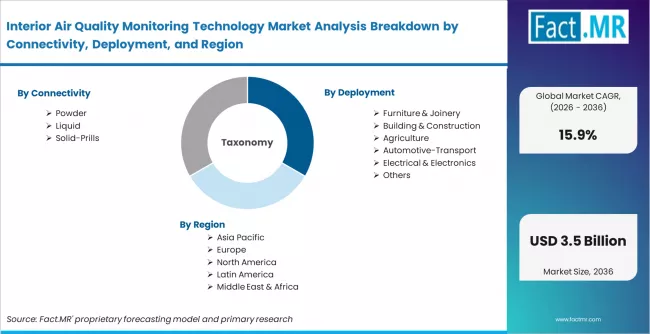
Interior Air Quality Monitoring Technology Market Analysis Breakdown By Connectivity Deployment And Region | Source: Fact.MR
| Metric | Value |
|---|---|
| Quantitative Units | USD 0.7 billion (2026) to USD 2.5 billion (2036), at a CAGR of 15.9% |
| Market Definition | The interior air quality monitoring technology market includes sensor-based systems designed to monitor and manage air quality within enclosed environments such as vehicle cabins and indoor spaces, measuring pollutants like particulate matter, CO₂, VOCs, and humidity levels. |
| Connectivity Segmentation | Telematics Cloud-Connected, Smartphone/App Connected, In-Vehicle Only, Other |
| Deployment Segmentation | OEM Embedded, Dealer Installed, Aftermarket, Other |
| Regions Covered | North America, Latin America, Europe, East Asia |
| Countries Covered | U.S., Brazil, Germany, UK, South Korea |
| Key Companies Profiled | Bosch, Continental, Denso, Aptiv, HARMAN, Sensata Technologies, TE Connectivity, Honeywell International Inc., Panasonic Corporation, Valeo |
| Forecast Period | 2026 to 2036 |
| Approach | Hybrid top-down and bottom-up market estimation supported by primary interviews with sensor manufacturers, automotive OEMs, and IoT solution providers, complemented by regulatory analysis, technology adoption trends, and supply chain assessment. |
Source: Fact.MR analysis. Updated Apr 28, 2026
Interior Air Quality Monitoring Technology Market by Segments
-
Connectivity
- Telematics Cloud-Connected
- Smartphone/App Connected
- In-Vehicle Only
- Other
-
Deployment
- OEM Embedded
- Dealer Installed
- Aftermarket
- Other
-
By Region:
- North America
- United States
- Canada
- Mexico
- Latin America
- Brazil
- Argentina
- Chile
- Rest of Latin America
- Western Europe
- Germany
- France
- United Kingdom
- Italy
- Spain
- Nordic Countries
- BENELUX
- Rest of Western Europe
- Eastern Europe
- Russia
- Poland
- Hungary
- Balkan and Baltic
- Rest of Eastern Europe
- East Asia
- China
- Japan
- South Korea
- South Asia and Pacific
- India
- ASEAN
- Australia and New Zealand
- Rest of South Asia and Pacific
- Middle East and Africa
- Kingdom of Saudi Arabia
- Other GCC Countries
- Turkey
- South Africa
- Rest of Middle East and Africa
- North America
Frequently Asked Questions
How large is the interior air quality monitoring technology market in 2026?
What will be the market size by 2036?
What is the expected CAGR for the market between 2026 and 2036?
What factors are driving growth in this market?
Which connectivity segment is expected to dominate the market?
Why are telematics cloud-connected systems gaining traction?
Which deployment type holds the largest market share?
Why do OEM embedded systems dominate the market?
Which country is expected to grow the fastest in this market?
What is driving demand in the United States?
What factors are supporting growth in Germany?
How is South Korea contributing to market expansion?
What role do smart buildings play in this market?
What challenges does the market face?
What opportunities exist for market players?
Who worked on this report


Preview the report firsthand - request a free sample
Free SampleGet the brochure for pricing and purchase details
Download PDF