- Base Value(2025): 0.9 Bn
- Forecast Value (2035): 5.3 Bn
- CAGR (2035): 18.8%
Drone Motor Market In Europe Outlook 2025 to 2035
The drone motor market in Europe is forecast to reach from USD 0.9 billion in 2025 to USD 5.3 billion by 2035, with a CAGR of 18.8% during the forecast period. Growth is driven by the growing adoption of UAVs in agriculture and defense, demand for efficient brushless motors, and EU funding.
Ongoing advances in lightweight and miniaturized motor technologies, combined with the increasing adoption of drones across logistics, monitoring, and emergency response, are expected to further accelerate market expansion and support new high-value applications throughout the region.
Quick Facts about Europe Drone Motor Market
- Industry Value (2025): USD 0.9 Billion
- Projected Value (2035): USD 5.3 Billion
- Forecast CAGR (2025 to 2035): 18.8%
- Leading Segment (2025): AC (36% Market Share)
- Country Growth Rate (2025 to 2035): U.K. (16.7% CAGR)
- Top Key Players: Sunnysky Motors, MAD Components, Konrad Motors, Hacker Motor, and DYS Motors
What are the Drivers of Drone Motor Market in Europe?
The growing use of drones in agriculture, logistics, defense, and infrastructure inspection is a significant driver of the drone motor market in Europe. Precision farming and smart logistics in Germany and France rely on high-efficiency motors to support long flight durations and payload capacity.
Government funding and supportive regulations are also driving market growth. The EU's Horizon Europe program provides substantial research grants for UAV innovation, such as motor development and electrification.
Moreover, the growing interest in autonomous flight and AI-powered navigation systems has fueled the demand for motors with integrated sensors and real-time performance capabilities. This trend is particularly evident in Northern Europe, where environmental monitoring necessitates intelligent, weather-resistant drone systems.
| Metric | Value |
|---|---|
| Industry Size (2025E) | USD 0.9 billion |
| Industry Size (2035F) | USD 5.3 billion |
| CAGR (2025-2035) | 18.8% |
Source: Fact.MR analysis. Updated Jul 31, 2025
What are the Regional Trends of Drone Motor Market in Europe?
Rapid drone adoption in infrastructure inspection, public safety, and agriculture is driving the UK market growth. Government initiatives like the Future Flight Challenge and drone corridors for advanced air mobility have created a strong, regulatory, and innovative environment. Public sector involvement is evident in drone logistics trials, such as remote medical delivery. Drone startups and academic partnerships are increasing R&D and commercial deployment nationwide. These factors should boost UK unmanned aerial vehicle sales.
The drone market in Germany will grow steadily due to government support, advanced manufacturing, and industrial demand. German efforts to link drones to Industry 4.0 have increased adoption in agriculture, construction, logistics, and infrastructure inspection. Safety regulations and pilot training are structuring and scaling the drone ecosystem in the country. Germany leads Europe in commercial and industrial drone (UAV) innovation with investments in UAV traffic management systems and public-private partnerships.
Agriculture, infrastructure inspection, logistics, and public safety drive French drone adoption. Government drone innovation and streamlined drone regulations, and demand for urban and rural aerial data collection and surveillance are driving market growth. Enterprise and municipal drone use is rising due to autonomous flight technologies, AI-based analytics, and battery efficiency.
What are the Challenges and Restraining Factors of Drone Motor Market in Europe?
One of the most significant obstacles is strict regulatory compliance. The European Union's drone regulations are complex and constantly evolving, requiring motors and related components to meet safety, electromagnetic compatibility, and noise standards. This increases development time and costs for manufacturers, particularly small and medium-sized businesses.
High production costs are still a significant barrier, particularly in Western Europe. Advanced drone motors, such as brushless DC models with integrated sensors or thermal management systems, necessitate precise engineering and high-quality materials. This raises the cost of European-made motors compared to those imported from Asia, reducing competitiveness.
Supply chain disruptions and reliance on imports for rare earth materials, electronic components, and battery systems are additional challenges. The Ukraine conflict and geopolitical tensions have strained supply chains and raised prices, disproportionately affecting smaller businesses without diverse sourcing strategies. According to Eurostat, the cost of electronic component imports in 2023 increased by nearly 15% across the EU.
Country-Wise Outlook
| Countries | CAGR (2025 to 2035) |
|---|---|
| United Kingdom | 16.7% |
| Germany | 20.0% |
| France | 17.5% |
Source: Fact.MR analysis. Updated Jul 31, 2025
U.K. Driving the European Drone Motor Market Through Aerospace Excellence and BVLOS Regulation
The U.K. drives the European drone motor market, owing to a strong aerospace sector, progressive drone regulations, and active investment in unmanned aerial technologies. The UK Civil Aviation Authority (CAA) has adopted flexible rules for Beyond Visual Line of Sight (BVLOS) trials, establishing the country as a prime testing ground for advanced UAV systems. This regulatory support has accelerated the use of high-performance motors in autonomous and long-distance drone applications.
Drones are becoming increasingly popular in agriculture, defense, and infrastructure inspection in the United Kingdom. For instance, the U.K. government invested £30 million in drone innovation through programs such as the Future Flight Challenge, which encourages the development of electric propulsion systems, including motors for vertical take-off and landing (VTOL) drones.
Urban air mobility and drone-based delivery services are becoming more popular, with companies such as Skyports and Vertical Aerospace pioneering the development of drone taxi and cargo platforms. This surge in UAV use is increasing demand for motors that are quieter, more efficient, and thermally robust. Furthermore, collaborations between UK universities and aerospace companies are encouraging R&D in hybrid electric propulsion and intelligent motor control systems.
Germany: A Key Hub for High-Efficiency Drone Motor Development in Europe
Germany is a key player in the European drone motor market, owing to its strong engineering heritage, industrial automation capabilities, and robust research ecosystem. The country is a major hub for precision drone production, particularly in logistics, energy inspection, and agriculture. German drone manufacturers are prioritizing the use of high-efficiency motors, particularly brushless DC types, to meet the demand for performance, dependability, and durability.
One of the primary drivers in Germany is the widespread use of drones in industrial operations. Major infrastructure and energy companies use drones to inspect power lines, pipelines, and wind turbines, which require motors that can withstand long flight hours and harsh conditions.
Germany's regulations are both supportive and strict. The country follows EU drone laws but requires rigorous testing and safety standards, particularly for UAV components such as motors. The Luftfahrt-Bundesamt (LBA) ensures that all drone propulsion systems adhere to strict noise, safety, and electromagnetic compatibility standards. This drives up demand for EU-certified motors with advanced sensor integration and smart ESCs.
France Expanding UAV Applications and Defense Funding Drive Growth
Drones are increasingly being used in agriculture, surveillance, and civil security, which is a major driver in the French market. The French Ministry of Armed Forces, for instance, has allocated over €5 billion in its "Drone Strategy 2023" to expand military UAV fleets, resulting in high demand for rugged, high-efficiency motors with advanced thermal and vibration control. This has increased the production of brushless DC motors and servo systems specifically designed for tactical UAVs.
France follows EU drone regulations but has strict oversight from its national aviation authority (DGAC). The country has one of the most thorough drone registration and certification systems in Europe. These regulations have a direct impact on motor design because components must meet French noise limits and electromagnetic compatibility standards, resulting in increased investment in quieter, more energy-efficient motors.
France is seeing a shift toward smart motor integration, with embedded diagnostics and adaptive power management to support autonomous operations. French UAV manufacturers are increasingly working with research institutions to create lightweight, intelligent propulsion systems for indoor surveillance and urban mobility drones.
Category-wise Analysis
DC to Exhibit Leading by Motor Type
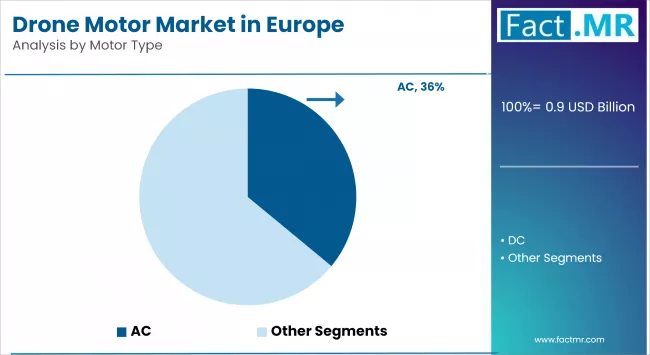
Drone Motor Market In Europe By Motor Type | Source: Fact.MR
DC motors dominates the market as these are most popular in European drones due to their battery compatibility, controllability, and efficiency. They are ideal for multirotor drones that need responsive speed control. BLDC motors dominate European drones. Their high thrust-to-weight ratio, low maintenance, and efficiency make them popular in commercial, industrial, and defense drones. European manufacturers are adding real-time monitoring and smart ESCs to BLDC systems.
European drone applications that require heavier payloads or precise control use AC Motors. They are less common than DC motors but important in some sectors. Fixed-wing or hybrid drones that need stable flight for mapping or surveying use synchronous motors for their consistent speed. Superior UAVs from European aerospace companies use them for accuracy.
<50W to Exhibit Leading by Power Capacity
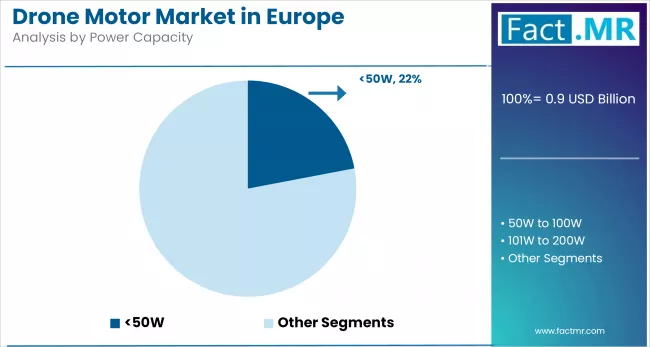
Drone Motor Market In Europe By Power Capacity | Source: Fact.MR
<50W dominates the market due to their increasing use as small consumer and toy drones require lightweight and cost-effective solutions. These motors offer adequate performance for basic applications and are popular due to their simplicity and low cost. Despite their limited power and efficiency, demand for low-power motors is expected to remain stable, owing primarily to the growth of the consumer segment.
Commercial and industrial drones frequently use motors with power ratings ranging from 50W to 100W, which provide a good balance of performance and efficiency. These motors can be used for a variety of applications, including delivery, inspection, mapping, and surveying. As drone adoption grows in the commercial and industrial sectors, so will the demand for motors with this power rating. The development of more efficient and durable motors within this range is critical to meeting the changing needs of these industries.
Below 1,000 RPM to Exhibit Leading by Velocity Constant
Large fixed-wing or hybrid drones dominate the market as these are designed for long-duration missions such as aerial mapping, environmental monitoring, and military reconnaissance, typically use motors with speeds below 1,000 RPM. These low-RPM motors generally are larger, with high torque and efficiency ratings, allowing for slow and stable flight with longer battery life. In Europe, such drones are widely used for border patrol, offshore wind farm monitoring, and cross-country surveying, where consistent, smooth propulsion is essential.
Motors with above 3,000 RPM are the fastest-growing segment as these are most commonly found in small to medium-sized multirotor drones that require quick maneuverability, fast throttle response, and strong lift. These motors are ideal for commercial UAVs used for surveillance, inspection, and delivery, where vertical takeoff, rapid direction change, and hovering are common. In Europe, the growing use of delivery drones and UAVs for urban infrastructure inspection has increased the demand for high-RPM motors, particularly brushless DC variants with smart controllers and heat dissipation features.
Rotary Wing to Exhibit Leading By Drone Type
Rotary Wing generate the most revenue due to their versatility and maneuverability, making them ideal for aerial mapping, surveillance, and search-and-rescue. Modern rotor blade technology, energy-efficient batteries, and flight control systems have improved drone performance and efficiency. Advanced energy management systems and longer battery life allow rotary blade drones to fly longer and further in demanding applications.
The hybrid is the fastest-growing segment due to rising demand for multi-role drones that can perform multiple tasks in a mission. The benefits of electric and fuel-based propulsion systems allow hybrid drones to fly longer and cover larger areas without recharging. They are versatile for infrastructure inspection, logistics, and environmental monitoring. The EU's Green Deal and sustainability initiatives promote hybrid propulsion systems, which reduce carbon emissions and support environmental goals.
Military Segment to Exhibit Leading by the Drone Category
The military segment dominates the market as European defense forces demand more advanced surveillance, intelligence, and tactical capabilities. Increased geopolitical tensions, defense modernization investments, and cross-border security concerns have accelerated UAV reconnaissance adoption. Leading defense manufacturers and government agencies collaborate and develop indigenous UAV platforms under European defense initiatives to strengthen the military segment's regional market leadership.
The consumer segment is the fastest-growing segment due to rising use of recreational drones, aerial photography, and consumer-grade surveillance. More affordable, user-friendly drones with high-resolution cameras and GPS-based flight stabilization are driving growth. Digital registration systems and geofencing regulations are creating public confidence and enabling drone adoption. Improvements in battery life and autonomous flying are improving consumer drone experiences and accelerating market growth in Europe.
OEMs to Exhibit Leading by Sales Channel
OEMs dominate the drone motor market, as they are the primary suppliers of motors directly to drone manufacturers. Their critical position is reinforced by rising demand for high-quality, reliable components to support expanding production across commercial, industrial, and military UAV sectors.
As drone capabilities continue to advance, manufacturers increasingly rely on OEMs for motors that deliver superior performance, endurance, and efficiency. This dynamic ensures that OEMs command a significant share of the market, shaping technology standards and fueling innovation to meet evolving sector requirements.
The aftermarket segment for drone motors is the fastest-growing segment, due to the rising number of drone installations and the increasing need for maintenance, replacements, and performance upgrades. As both businesses and consumers seek to enhance drone efficiency, endurance, and functionality, demand for high-quality specialized motors continues to rise.
The aftermarket not only extends the operational lifespan of drones but also enables tailored solutions for diverse applications, making it a critical factor in the evolving commercial, industrial, and recreational drone landscape.
Competitive Analysis
The European drone motor market is becoming increasingly competitive, fueled by rising demand across agriculture, logistics, surveillance, and environmental monitoring sectors. The region’s robust manufacturing base and supportive regulatory environment have attracted both established players and innovative new entrants.
Key companies in the market differentiate themselves through advanced motor technologies, such as high-efficiency brushless designs and intelligent control systems, as well as strong service and distribution networks across Europe.
Competitive fragmentation is moderate. Regional and motor component manufacturers compete in industrial drones, while a few global firms dominate consumer drones. Lightweight materials, higher thrust-to-weight ratios, and quieter motor technologies are being prioritized for urban and defense applications. EU companies also collaborate with academic and research institutions to innovate.
Companies seeking to expand their motor portfolios or enter new drone categories like VTOL and fixed-wing hybrids often merge or acquire. EU safety and green energy standards affect product design and manufacturing.
Key players in the market includes Sunnysky Motors, MAD Components, Konrad Motors, Hacker Motor, and DYS Motors.
Recent Development
- In March 2025, Airbus announced the development of LOAD (Low-Cost Air Defence), a European anti-drone drone for intercepting low-cost aerial threats. LOAD, unveiled at an unmanned systems trade show in Bonn, Germany, is based on the Do-DT25 platform, an early 2000s target drone, making it cheap and disposable.
- In January 2023, Delair-Tech SA acquired underwater drone manufacturer Notilo Plus and created DELAIR MARINE. Delair's underwater industrial inspection and defense capabilities are improved by this strategic move.
Segmentation
Segmentation of Drone Motor Market in Europe
-
By Motor Type :
- AC
- DC
-
By Power Capacity :
- <50W
- 50W to 100W
- 101W to 200W
- >200W
-
By Velocity Constant (KV) :
- Below 1,000
- 1,000 to 2,000
- 2,001 to 3,000
- Above 3,000
-
By Drone Type :
- Fixed Wing
- Rotary Wing
- Hybrid
-
By Drone Category :
- Consumer/Civil
- Commercial
- Military
-
By Sales Channel :
- OEMs
- Aftermarket
- Online Sales
- Company Websites
- e-Commerce Websites
- Electronics Stores
- Others
-
By Region :
- Germany
- France
- Italy
- Spain
- United Kingdom
- BENELUX
- Russia
- Rest of Europe
Frequently Asked Questions
What is the Global Drone Motor Market In Europe size in 2025?
Who are the Major Players Operating in the Drone Motor Market in Europe?
What is the Estimated Valuation of the Drone Motor Market in Europe by 2035?
What Value CAGR Did the Drone Motor Market Exhibit over the Last Five Years?
Who worked on this report


Preview the report firsthand - request a free sample
Free SampleGet the brochure for pricing and purchase details
Download PDF