- Base Value(2025): 0.3 Bn
- Forecast Value (2035): 2.2 Bn
- CAGR (2035): 22%
Drone Motor Market in South Asia & Oceania Outlook (2025 to 2035)
The drone motor market in South Asia & Oceania is projected to increase from USD 0.3 billion in 2025 to USD 2.2 billion by 2035, with a CAGR of 22%, driven by increased defense spending due to geopolitical tensions, rising adoption in precision agriculture, expanding industrial applications, higher disposable incomes fueling consumer drone sales, and ongoing innovation in drone motor technology.
A thriving startup ecosystem, driven by government grants and drone policies, fosters innovation in lightweight, durable, and cost-effective drone motor solutions.
Quick Facts about South Asia & Oceania Drone Motor Market
- Industry Value (2025): USD 0.3 Billion
- Projected Value (2035): USD 2.2 Billion
- Forecast CAGR (2025 to 2035): 22%
- Leading Segment (2025): DC (68% Market Share)
- Country Growth Rate (2025 to 2035): Indonesia (23.1% CAGR)
- Top Key Players: Skylark Drones, InnovaDrone, Terra Drone India Private Limited, Prodrone, and Aerodrone
What are the Drivers of Drone Motor Market in South Asia & Oceania?
The increasing use of drones in agriculture in India and Australia is a significant driver of the drone motor market. Farmers are increasingly using UAVs for crop health monitoring, pesticide spraying, and soil analysis, creating a demand for efficient and lightweight motors capable of long flight durations and harsh field conditions.
Rising defense spending and surveillance needs in South Asia, particularly in border-sensitive areas, are driving up demand for high-performance drone motors. Armed forces use tactical and reconnaissance drones with brushless DC motors that have increased thrust, heat resistance, and require little maintenance.
Government policies and startup incentives in countries such as India and New Zealand promote local production of UAV components, including motors. This has resulted in a surge in indigenous development and innovation, increasing regional competitiveness.
| Metric | Value |
|---|---|
| Industry Size (2025E) | USD 0.3 billion |
| Industry Size (2035F) | USD 2.2 billion |
| CAGR (2025-2035) | 22% |
Source: Fact.MR analysis. Updated Aug 1, 2025
What are the Regional Trends of Drone Motor Market in South Asia & Oceania?
India's drone industry is rapidly expanding as a result of favorable policies, increased agricultural drone usage, and defense modernization programs. The Indian government's Production-Linked Incentive (PLI) program and liberalized drone regulations have boosted domestic motor manufacturing and UAV startups. This has created a demand for dependable, low-cost brushless DC motors for spraying, mapping, and military applications.
Precision agriculture, mining inspections, and environmental monitoring are key market drivers in Australia. Drones operating in remote and rugged environments require motors with increased durability and thermal resistance. Australia also sees significant academic and research involvement in drone motor innovation, which contributes to the development of lightweight, long-duration propulsion systems.
New Zealand is using drones for conservation, disaster monitoring, and smart farming, creating a demand for small and efficient motors. The country's innovative environment and pilot-friendly airspace policies facilitate drone motor testing and deployment.
What are the Challenges and Restraining Factors of Drone Motor Market in South Asia & Oceania?
The drone motor industry in South Asia and Oceania faces a number of challenges that impede its full potential growth. One of the most significant barriers is the absence of a mature regulatory framework in many countries. Although countries such as India and Australia have adopted drone policies, inconsistent enforcement, bureaucratic delays, and changing airspace rules create uncertainty for drone operators and manufacturers, particularly those who supply motors for commercial and defense UAVs.
The region also lacks the necessary R&D infrastructure and skilled labor to support the development of advanced propulsion systems. Many indigenous startups and small-scale manufacturers encounter technical challenges when scaling up production or customizing motors for specialized applications such as high-altitude flight or heavy payloads.
Cost sensitivity in agriculture and civil engineering further restricts the use of high-end motors. Farmers and small businesses frequently choose low-cost drone models, limiting the market potential for premium motor technologies. Furthermore, extreme weather conditions in parts of Australia and South Asia present technical challenges, necessitating ruggedized motor designs that not all local suppliers can provide affordably.
Country-Wise Outlook
| Countries | CAGR (2025-35) |
|---|---|
| Thailand | 19.5% |
| Indonesia | 23.1% |
| Malaysia | 20.3% |
Source: Fact.MR analysis. Updated Aug 1, 2025
Thailand Advancing Drone Motor Use in Emergency Response and Infrastructure Monitoring
The Thai government has encouraged drone use through initiatives like the Thailand 4.0 strategy, which promotes agricultural mechanization and smart farming. This shift enables local motor integration for drones that are tailored to local field conditions, such as humidity resistance and temperature adaptability.
Thailand is also investing in drones to inspect infrastructure, manage disasters, and provide surveillance. With frequent flooding and difficult terrain in rural areas, long-endurance drones with low-RPM, high-torque motors are preferred for dependable, extended flight during emergencies.
On the regulatory front, Thailand's Civil Aviation Authority has simplified drone laws by requiring UAV registration for both commercial and recreational use, thereby encouraging the formalization and expansion of drone services. However, restrictions on flight zones and privacy concerns continue to limit widespread urban use.
Indonesia Driving Drone Motor Growth with Agricultural and Geographic Demands
Indonesia is becoming a major player in the South Asia and Oceania drone motor industry, owing to its vast archipelago, strong agricultural base, and demand for advanced aerial solutions in forestry and disaster-prone areas. The use of drones in agriculture is a major driver, as large-scale palm oil, rice, and coffee plantations rely on UAVs for crop spraying, monitoring, and yield assessment. This increases the demand for long-lasting, lightweight brushless DC motors that can operate in humid, tropical environments and provide long flight durations over vast terrains.
Forestry management and environmental monitoring are expanding application areas, particularly as Indonesia works to combat illegal logging and monitor deforestation. UAVs with high torque motors and thermal sensors are used to cover remote jungle areas, and low-power motors are critical for maximizing flight time in these missions.
Indonesia also uses drones for disaster response, particularly in flood-prone and earthquake-prone areas. UAVs are used for aerial mapping, victim search, and aid delivery, all of which require motors that are optimized for payload lifting and stable maneuvering in unstable weather conditions.
Government agencies such as BNPB (Indonesia's National Disaster Management Authority) have incorporated drones into rapid response protocols, increasing motor deployment in public sector UAVs.
Malaysia Boosting Drone Motor Adoption Through Precision Agriculture and Innovation Initiatives
Malaysia is gaining traction in the drone motor industry in South Asia and Oceania, due to a combination of strategic agricultural needs, national innovation programs, and increased commercial drone use. Precision agriculture is a key driver, especially in large oil palm and paddy plantations. Drones used for spraying and monitoring require efficient, weather-resistant motors, particularly brushless DC motors that can fly in hot, humid tropical climates.
The Malaysian government actively promotes drone technology through initiatives such as the National Technology and Innovation Sandbox (NTIS) and the Malaysia Drone Technology Action Plan 2022-2030. These policies promote local UAV startups, field trials, and technology integration, while also encouraging domestic development and deployment of drone components such as motors.
Commercial and industrial applications are growing, particularly in infrastructure inspection, mapping, and logistics, where drones require high-thrust, stable motors with optimized energy efficiency for long-range flights. Urban development zones like Kuala Lumpur and Penang serve as test sites for UAV use in building surveys and traffic monitoring.
Category-wise Analysis
DC Motors to Exhibit Leading by Motor Type
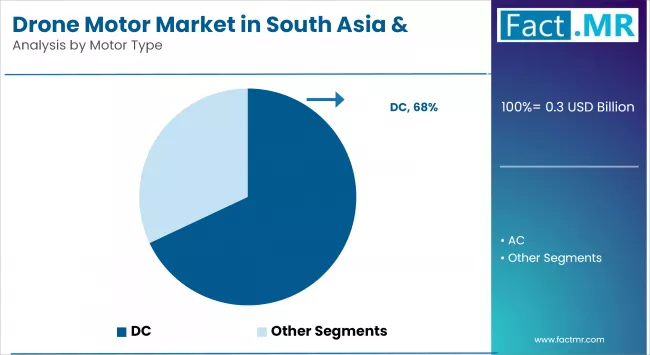
Drone Motor Market In South Asia & Oceania By Motor Type | Source: Fact.MR
DC motors, especially Brushless DC (BLDC) motors, dominate the drone motor market as these are the most popular in South Asia and Oceania drones due to their lightweight, high efficiency, and battery functionality. Indian, Australian, and Indonesian drones use BLDC motors for agriculture, surveillance, and mapping due to their precise speed control and long flight durations. For tropical or remote commercial and defense UAV applications, their low maintenance and high thrust-to-weight ratio make them ideal.
Industrial or long-duty drones are the fastest-growing segment, as these drones use synchronous AC motors for consistent speed and torque under load. A few heavy-lift or specialized drones for infrastructure inspection or logistics in Australia and Southeast Asia use these. Although they require more complex power systems, their precise control and smooth operation make them ideal for drones that need flight stability and motor synchronization.
51100 W to Exhibit Leading by Power Capacity
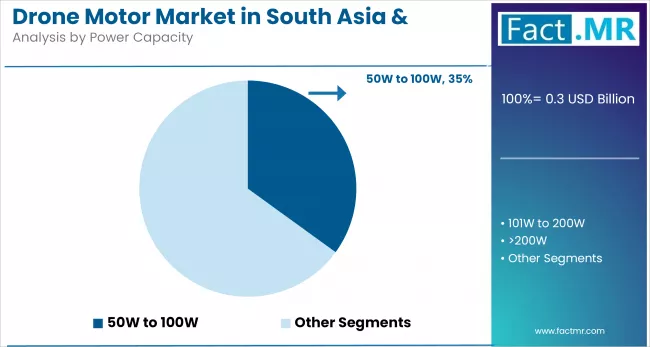
Drone Motor Market In South Asia & Oceania By Power Capacity | Source: Fact.MR
The 51100 W power range dominates the drone motor market as these offer a lightweight design essential for optimal flight and maneuverability. Excess weight can hinder drone performance, making efficiency critical—especially for extended commercial operations such as infrastructure inspection, agricultural monitoring, and delivery services. These demands are driving market segmentation toward lightweight, power-efficient motor solutions.
200 W is the fastest-growing segment in the drone motor market. It is expected that power capacity above 200 W will grow moderately during the study. Drones with motors above 200 W have higher payloads, longer flight times, and better performance, driving increasing demand. To carry heavy weights while flying efficiently and steadily, heavy-lift drones need powerful motors like these.
Below 1,000 KV to Exhibit leading by Velocity Constant
Motors below 1,000 KV dominate the drone motor market as these are used in large, heavy-lift drones for military surveillance, environmental monitoring, and disaster response in South Asia and Oceania. UAVs in Australia and Indonesia cover vast, rugged areas, and these motors generate high torque at low RPM, making them ideal for carrying heavy payloads or using larger propellers. Remote operations require stable, energy-efficient flight with extended endurance.
Commercial multirotor drones are the fastest-growing segment due to their use for agriculture, inspection, and delivery in India, Malaysia, and Thailand use 1,0002,000 KV range. This range contains motors with balanced torque and speed for moderate payload and long flight times. They are a key growth area in the regional drone motor market because they support agile and efficient drones for crop spraying, solar panel inspection, and last-mile logistics.
Hybrid to Exhibit Leading by Drone Type
Hybrid drones dominates the drone mototr market as these drones integrate fixed-wing and multi-rotor designs for VTOL flexibility and fixed-wing endurance and efficiency. The adaptability of hybrid drones to different environments and advances in hybrid product systems and energy management technologies drive this segment's growth. Manufacturers innovate to optimize electric and combustion power sources in the efficiency, reliability, and performance of hybrid product systems.
The rotary wing segment is the fastest-growing segment in the drone motors market. These are valued for their dependability and portability, making them ideal for tasks that require precise navigation and close-quarters operations. Industries such as construction, energy, telecommunications, and utilities are increasingly using multi-rotor drones for routine inspections, preventive maintenance, and asset monitoring.
Military to Exhibit Leading by Drone Category
The military segment holds the largest revenue share in the Drone Motor Market in South Asia & Oceania. Defense forces around the world widely use military drones for investigations, intelligence gathering, surveillance, target acquisition, and combat. The growing emphasis on improving military capabilities, border security, and counterterrorism efforts is encouraging countries to invest in developing and acquiring advanced drone technologies.
The consumer segment is the fastest-growing segment in the Drone Motor Market in South Asia & Oceania due to the' affordability and accessibility of recreational drones. Technology has made compact, user-friendly drones with high-definition cameras, intuitive controls, and automated flight features appealing to hobbyists, enthusiasts, and amateur photographers. As consumer drones improve and become cheaper, they will be used for aerial photography, videography, and recreational flying.
OEMs to Exhibit Leading by Sales Channel
OEMs (Original Equipment Manufacturers) dominate the Drone Motor Market in South Asia & Oceania as they supply motors directly to drone manufacturers for integration during production. Domestic UAV production is rising in India, Australia, and Malaysia, driving demand for customized, high-efficiency motors for agriculture, surveillance, and industrial drones. OEMs are focusing on lightweight brushless DC motors with integrated ESCs, and several regional governments support local production to reduce imports.
Aftermarket is the fastest-growing segment in the Drone Motor Market in South Asia & Oceania. Drone fleet sizes and the need for routine maintenance, upgrades, and component replacement are driving growth in the aftermarket. Operators in Indonesia and Thailand, where drones are used in agriculture and environmental monitoring, often replace motors due to tropical wear. This increases demand for affordable, durable replacement motors and service kits for commercial small and medium UAVs.
Competitive Analysis
The Drone Motor Market in South Asia and Oceania is becoming increasingly competitive due to demand from defense, agriculture, logistics, and environmental monitoring. Global manufacturers, emerging local players, and investments in UAV technology shape the competitive landscape. India, Australia, and New Zealand are leading regional growth with strategic government initiatives and public-private partnerships.
The global players who export motors or have local assembly operations compete. These companies offer advanced propulsion systems with real-time telemetry, integrated ESCs, and low-noise operation, which are preferred by both civil and military sectors. Their presence has raised technology standards, prompting regional firms to invest more in R&D.
Aftermarket and OEM channels are competitive, with OEM supply dominating larger contracts and e-commerce and distributor networks supporting DIY and educational drones. Oceania universities and research institutes collaborate with manufacturers to develop UAV propulsion systems.
Key players in the South Asia & Oceania drone motor industry include Skylark Drones, InnovaDrone, Terra Drone India Private Limited, Prodrone, Aerodrone, Quantum Systems, AeroVironment, and other players.
Recent Development
- In October 2023, Optiemus Infracom Limited (OIL), a well-known Indian electronics manufacturer, announced at the India Mobile Congress in 2023 that it would enter the unmanned systems space by launching high-precision drones designed and manufactured entirely in India.
- In May 2024, Droneshield announced the release of DroneSentry C2 Next-Gen v1.00, an advanced command-and-control system that improves anti-drone capabilities by providing centralized monitoring and control functionalities. It enables users to effectively manage multiple sensors and countermeasures in order to safeguard critical infrastructure, public events, military installations, and other sensitive areas from potential drone threats.
- In August 2023, Indonesia finalized a deal with Turkish Aerospace Industries (TAI) to acquire 12 ANKA surveillance and reconnaissance drones for its military. The agreement, valued at USD 300 million, aims to bolster Indonesia's defense capabilities. The purchase is part of a broader effort to modernize the country's military and address security concerns.
Segmentation
Segmentation of Drone Motor Market in South Asia & Oceania
-
By Motor Type :
- AC
- DC
-
By Power Capacity :
- <50W
- 50W to 100W
- 101W to 200W
- >200W
-
By Velocity Constant (KV) :
- Below 1,000
- 1,000 to 2,000
- 2,001 to 3,000
- Above 3,000
-
By Drone Type :
- Fixed Wing
- Rotary Wing
- Hybrid
-
By Drone Category :
- Consumer/Civil
- Commercial
- Military
-
By Sales Channel :
- OEMs
- Aftermarket
- Online Sales
- Company Websites
- e-Commerce Websites
- Electronics Stores
- Others
- Online Sales
-
By Region :
- India
- Malaysia
- Thailand
- Indonesia
- Australia & New Zealand
- Rest of South Asia & Oceania
Frequently Asked Questions
What is the Global Drone Motor Market in South Asia & Oceania size in 2025?
Who are the Major Players Operating in the Drone Motor Market in South Asia & Oceania?
What is the Estimated Valuation of the Drone Motor Market in South Asia & Oceania by 2035?
What Value CAGR is the Drone Motor Market in South Asia & Oceania Exhibit over the Last Five Years?
Who worked on this report


Preview the report firsthand - request a free sample
Free SampleGet the brochure for pricing and purchase details
Download PDF