- Base Value(2025): 85.6 Mn
- Forecast Value (2035): 495.7 Mn
- CAGR (2035): 19.2%
Drone Motor Market in Middle East & Africa Outlook (2025 to 2035)
The drone motor market in Middle East & Africa is projected to increase from USD 85.6 million in 2025 to USD 495.7 million by 2035, with a CAGR of 19.2%, is driven by rising demand for regional security and food. Their durability and heat resistance make these motors ideal for reliable drone operations in the Middle East & Africa’s harsh, extreme climate conditions.
Quick Facts about the Middle East & Africa Drone Motor Market
- Industry Value (2025): USD 85.6 Million
- Projected Value (2035): USD 495.7 Million
- Forecast CAGR (2025 to 2035): 19.2%
- Leading Segment (2025): DC (67% Market Share)
- Country Growth Rate (2025 to 2035): South Africa (18.4% CAGR)
- Top Key Players: SunnySky Motors, T-Motor, and EMAX MODEL Store
What are the Drivers of Drone Motor Market in Middle East & Africa?
The growing emphasis on defense modernization and surveillance is a major factor driving demand for drone motors in the Middle East. Countries such as the UAE and Saudi Arabia are using UAVs for border security, reconnaissance, and tactical operations, necessitating high-performance motors with improved thermal resistance and durability in desert environments.
The agriculture sector in Africa is rapidly adopting drone technology for crop monitoring, spraying, and yield optimization. Countries such as Kenya, Nigeria, and South Africa are incorporating UAVs into farming practices, necessitating the use of lightweight, efficient motors capable of longer flight durations and precise maneuvering over large fields.
Infrastructure monitoring and oil and gas inspection are also driving growth. Drones are increasingly being used for real-time inspections in large pipelines and remote industrial zones. This increases demand for motors that provide stable flight, dependability, and compatibility with sensor-heavy drone platforms used in hot climates throughout the Gulf and North Africa.
| Metric | Value |
|---|---|
| Industry Size (2025E) | USD 85.6 million |
| Industry Size (2035F) | USD 495.7 million |
| CAGR (2025-2035) | 19.2% |
Source: Fact.MR analysis. Updated Jul 31, 2025
What are the Regional Trends of Drone Motor Market in Middle East & Africa?
Geographic, economic, and industrial factors influence the MEA drone motor market. GCC countries, particularly the UAE and Saudi Arabia, are rapidly adopting UAVs for defense, infrastructure monitoring, and smart city projects. Given the harsh desert conditions and long missions, these countries prioritize advanced drone systems with high-end brushless DC motors for thermal tolerance. Demand for locally integrated, high-performance motor systems is driven by the UAE's drone tech hub ambitions.
In North Africa, especially Egypt and Morocco, multirotor drones are being used in agriculture and construction, driving demand for affordable, efficient motors. The region is gradually regulating drones for commercial use.
The aftermarket and maintenance services are expanding across MEA, especially in regions with growing commercial and defense drone fleets. Online distribution and regional drone tech hubs are making supply gaps smaller, while localized manufacturing is growing in the Middle East & Africa.
What are the Challenges and Restraining Factors of Drone Motor Market in Middle East & Africa?
One major barrier is a lack of standardized drone regulations across the region. While some countries, such as the UAE, have advanced UAV policies, many others have either restrictive laws or no clear frameworks, causing uncertainty about drone adoption and market demand in sectors such as agriculture, logistics, and surveillance.
Another constraint is the high reliance on imports, as most drone motors, particularly high-performance brushless DC variants, are sourced in Asia or Europe. This leads to longer lead times, higher costs, and supply chain vulnerabilities, particularly in remote or underdeveloped African countries. Local manufacturing is still in its early stages and has limited scale.
Furthermore, the harsh climatic conditions in the Gulf and parts of Africa necessitate drone motors that are highly durable and thermally resistant. However, many motors in the market are not designed for prolonged use in extreme heat, dust, or humidity, resulting in performance degradation or failure. This reduces reliability and increases the need for maintenance.
Limited technical expertise and servicing infrastructure also impede market development. Many regions lack skilled personnel for drone assembly, repair, or motor integration, discouraging large-scale drone deployment, particularly among small and medium-sized enterprises.
Country-Wise Outlook
| Countries | CAGR (2025 to 2035) |
|---|---|
| Nigeria | 17.6% |
| GCC Countries | 20.0% |
| South Africa | 18.4% |
Source: Fact.MR analysis. Updated Jul 31, 2025
Nigeria Rising Demand for Efficient Drone Motors in Agricultural Expansion
Nigeria is emerging as a key player in the Middle East & Africa drone motor industry, owing to its large population, vast agricultural landscape, and growing interest in UAV-enabled services. Drone adoption for precision agriculture is rapidly increasing, particularly for crops such as cassava, maize, and rice. This increase is driving demand for brushless DC motors that are lightweight and efficient, allowing for longer flight durations and high-resolution imaging payloads.
The Nigerian Civil Aviation Authority (NCAA) has begun to streamline drone regulations, providing greater clarity for commercial drone use. While some operations remain restricted, approvals are becoming more structured, allowing for the commercialization of drone services in both urban and rural areas.
Drones are increasingly being used in the infrastructure and energy sectors of Nigeria to inspect pipelines and monitor the country's extensive oil and gas installations. This necessitates rugged, high-performance motors capable of withstanding harsh conditions such as high temperatures and volatile environments.
GCC Countries Leading Drone Motor Innovation through Defense and Smart City Initiatives
GCC countries (Gulf Cooperation Council nations, which include the UAE, Saudi Arabia, Qatar, Oman, Kuwait, and Bahrain) are at the forefront of Middle Eastern drone motor industry development due to their advanced economies, defense priorities, and smart city initiatives. The UAE and Saudi Arabia, in particular, are leaders in drone adoption for military, civil, and commercial applications.
Regulatory frameworks in GCC countries have improved in recent years. The UAE's General Civil Aviation Authority (GCAA) and Saudi Arabia's General Authority of Civil Aviation (GACA) have both implemented structured policies for recreational and commercial drone use. These clear guidelines enable OEMs and component manufacturers, including motor producers, to enter the market with greater confidence.
Smart city projects such as Saudi Arabia's NEOM and the UAE's drone delivery pilots are increasing demand for motors designed for urban UAVs. These applications require motors that are compact, low-noise, and energy-efficient, particularly for last-mile delivery and infrastructure inspection.
South Africa Driving Drone Motor Demand through Agriculture, Conservation, and Infrastructure Surveillance
South Africa is a leading hub for drone motor adoption in Africa due to its diverse terrain, advanced agricultural sector, and robust research capabilities. The country is actively using drones for precision farming, wildlife conservation, and infrastructure surveillance, all of which require efficient and long-lasting motor solutions.
South Africa also has a significant commercial drone service industry, which provides aerial mapping and inspections for mining, utilities, and construction. The use of high-performance motors in rotary-wing and fixed-wing drones enables safe operation in harsh mining environments and urban areas.
The South African Civil Aviation Authority (SACAA) regulates drone use through RPAS (Remotely Piloted Aircraft Systems) legislation. While the licensing process is considered stringent, it has resulted in a well-organized environment for commercial drone operations. This regulatory maturity encourages original equipment manufacturers and component suppliers to enter the market with certified, compliant motor technologies.
Category-wise Analysis
DC to Exhibit Leading by Motor Type
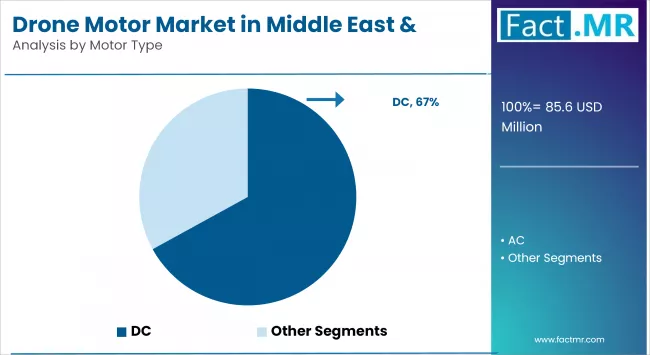
Drone Motor Market In Middle East & Africa By Motor Type | Source: Fact.MR
DC motors, especially Brushless DC (BLDC) types, dominate regional drone applications due to their efficiency, compact size, and battery compatibility. Agriculture, infrastructure inspection, and defense surveillance favor these motors. Drones used for crop monitoring and security patrols in Nigeria and South Africa use BLDC motors due to their extended flight capability and low maintenance in remote or rugged environments.
AC motors are the fastest-growing segment in the drone motor market in the Middle East & Africa, as AC motors, such as synchronous and induction motors, are rare but used in heavier, industrial-grade drones for high power and constant speed. AC motors' durability and load-handling capacity benefit large fixed-wing drones used for military and oil infrastructure surveillance in the GCC. Some hybrid or tethered UAV systems use these motors for continuous, powerful propulsion in harsh conditions.
<50W to Exhibit Leading by Power Capacity
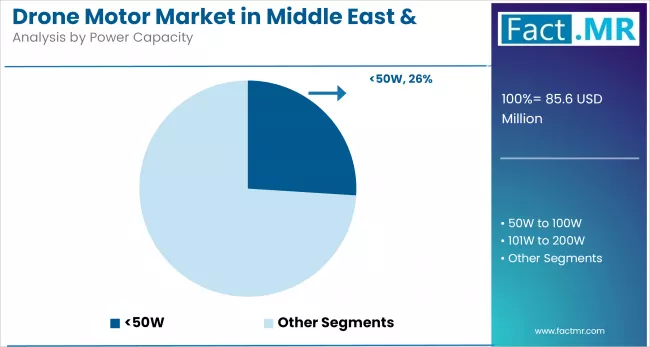
Drone Motor Market In Middle East & Africa By Power Capacity | Source: Fact.MR
<50W motors dominate the Drone Motor Market in the Middle East & Africa, as these are commonly used in small consumer and training drones throughout the region. Because of their light weight and low cost, they are ideal for hobbyists and basic aerial photography. These drones are popular in educational programs and among new drone startups in countries like Kenya and Morocco, where affordability and simplicity are important.
101W to 200W is the fastest-growing segment in the Drone Motor Market in the Middle East & Africa, as these are used in precision agriculture, infrastructure monitoring, and wildlife surveillance drones. For medium-to-heavy payloads and longer flights, these motors balance power and efficiency. The UAE and South Africa use drones with motors in this range for anti-poaching, border monitoring, and crop health assessment over large farmlands. Trustworthiness and adaptability make them popular in commercial and semi-industrial settings.
Below 1,000 KV to Exhibit Leading by Velocity Constant
1,000 KV dominates the drone motor market in the Middle East & Africa due to the increasing use of large fixed-wing or hybrid drones for long-duration missions, as they use motors below 1,000 KV. High torque at low speeds makes these motors ideal for surveillance, environmental monitoring, and agriculture. These motors support oil pipeline inspection and border patrol in Nigeria and the UAE, which require stability, heavy payloads, and long flights.
1,000 to 2,000 KV motors are the fastest-growing segment in the Drone Motor Market in the Middle East & Africa, as these are used in multirotor drones performing agility and moderate endurance tasks like infrastructure inspection, delivery, and mapping. Their balanced torque and RPM make them popular for commercial and industrial UAVs. Wildlife tracking and power line inspection in remote South Africa are increasingly using KV drones.
Fixed-wing to Exhibit Leading by Drone Type
Fixed-wing drones dominate the Drone Motor Market in the Middle East & Africa due to their ability to cover long distances with minimal energy consumption. These drones are ideal for large-scale agricultural monitoring in Nigeria and long-range surveillance missions in the UAE. Their aerodynamic design and high-efficiency motors make them ideal for long-duration flights over deserts, forests, and agricultural fields.
Rotary-wing drones are the fastest-growing segment due to their rising use in urban and industrial applications due to their vertical take-off and landing (VTOL) capabilities. In South Africa, they are used for infrastructure inspections, mining surveys, and security missions. Their maneuverability in tight spaces, as well as compatibility with powerful brushless DC motors, makes them suitable for applications in both cities and remote industrial sites.
Military Sector to Exhibit Leading in the Drone Category
The military sector is dominant due to increased security concerns and defense modernization in countries such as the UAE and Saudi Arabia. These countries invest in tactical UAVs with tough, high-thrust motors for surveillance, border patrol, and ISR missions in desert and high-temperature environments.
Consumer and civil drones are the fastest-growing segment as these are rapidly spreading throughout the Middle East & Africa for recreational, aerial photography, and educational purposes. Drone motors, particularly <50W BLDC types, are popular in urban areas and startup ecosystems, such as Kenya, Egypt, and South Africa.
OEMs to Exhibit Leading by Sales Channel
OEMs (Original Equipment Manufacturers) dominate the Drone Motor Market in the Middle East & Africa as they provide motors directly to drone manufacturers in countries such as the UAE, South Africa, and Nigeria. Growing domestic drone production, particularly for defense and agriculture, has boosted demand for lightweight, high-efficiency brushless DC motors that can be integrated during initial drone assembly.
Commercial and military are the fastest-growing segments in the Drone Motor Market in the Middle East & Africa. As commercial and military drone fleets grow, the aftermarket segment expands as well. Due to harsh environmental conditions such as sand, heat, and moisture, motors and components must be replaced frequently. Local repair and customization needs in Saudi Arabia and Kenya are opening up new opportunities for aftermarket service providers.
Competitive Analysis
The drone motor market in the Middle East & Africa is becoming increasingly competitive, characterized by a mix of global manufacturers, regional suppliers, and emerging drone startups. Key players differentiate themselves through advanced motor technologies, such as high-efficiency brushless DC motors and integrated ESC systems tailored for harsh climatic conditions common in the region. Global service networks and compliance with aviation safety standards also serve as critical competitive differentiators.
Pipeline inspection, border monitoring, and aerial surveying by drones in the Gulf require motors with high thermal tolerance. In sub-Saharan Africa, especially Kenya and Nigeria, agricultural drone use is rising. These applications need lightweight, energy-efficient motors for longer flights over large farms and rugged terrain.
Aftermarket opportunities are growing with drone services. Drones used in harsh conditions need replacement motors, upgraded ESCs, and cooling upgrades. Regional electronic distributors and online sales channels are helping countries with limited drone hardware market access fill supply gaps.
Key players in the market include Sunshine Motors, T-Motor, EMAX MODEL Store, and others.
Recent Development
-
In January, 2025, Red Cat Holdings, Inc., a drone technology company, secured new orders for its Edge 130 drone from the Army National Guard and another U.S. Government Agency (OGA). These combined orders totaled $518,000 and represented the purchase of 12 Edge 130 drones.
-
In May 2024, Droneshield announced the release of DroneSentry C2 Next-Gen v1.00, an advanced command-and-control system that improves anti-drone capabilities by providing centralized monitoring and control functionalities. It enables users to effectively manage multiple sensors and countermeasures in order to safeguard critical infrastructure, public events, military installations, and other sensitive areas from potential drone threats.
Segmentation
Segmentation of Drone Motor Market in Middle East & Africa
-
By Motor Type :
- AC
- DC
- By Power Capacity :
- <50W
- 50W to 100W
- 101W to 200W
- >200W
- By Velocity Constant (KV) :
- Below 1,000
- 1,000 to 2,000
- 2,001 to 3,000
- Above 3,000
- By Drone Type :
- Fixed Wing
- Rotary Wing
- Hybrid
- By Drone Category :
- Consumer/Civil
- Commercial
- Military
- By Sales Channel :
- OEMs
- Aftermarket
- Online Sales
- Company Websites
- e-Commerce Websites
- Electronics Stores
- Others
- Online Sales
- By Region :
- GCC Countries
- South Africa
- Northern Africa
- Türkiye
- Rest of Middle East & Africa
Frequently Asked Questions
What is the Global Drone Motor Market in Middle East & Africa size in 2025?
Who are the Major Players Operating in the Drone Motor Market in Middle East & Africa?
What is the Estimated Valuation of the Drone Motor Market in Middle East & Africa by 2035?
What Value CAGR Did the Drone Motor Market in Middle East & Africa Exhibit over the Last five Years?
Who worked on this report


Preview the report firsthand - request a free sample
Free SampleGet the brochure for pricing and purchase details
Download PDF