Drug Delivery Succinic Acid Derivatives Market

Drug Delivery Succinic Acid Derivatives Market Size and Share Forecast Outlook 2026 to 2036

Drug delivery succinic acid derivatives market is projected to grow from USD 1.8 billion in 2026 to USD 4.4 billion by 2036, at a CAGR of 9.4%. Succinic Acid Esters will dominate with a 33.7% market share, while oral drug delivery will lead the delivery route segment with a 36.8% share.

Drug Delivery Succinic Acid Derivatives Market Forecast and Outlook 2026 to 2036

The global market for drug delivery succinic acid derivatives is projected to rise from USD 1.78 billion in 2026 to USD 4.37 billion by 2036, advancing at a 9.4% CAGR. This growth is underpinned by the strategic role of succinic acid as a versatile, biocompatible building block in pharmaceutical science, enabling the precise engineering of drug properties. These derivatives are crucial for overcoming significant therapeutic challenges, primarily by enhancing the solubility, stability, and targeted delivery of potent but poorly bioavailable APIs.

Key Takeaways from the Drug Delivery Suric Acid Derivatives Market

  • Market Value for 2026: USD 1.78 Billion
  • Market Value for 2036: USD 4.37 Billion
  • Forecast CAGR (2026-2036): 9.4%
  • Leading Derivative Type Segment (2026): Succinic Acid Esters (34%)
  • Leading Delivery Route Segment (2026): Oral Drug Delivery (37%)
  • Leading Therapeutic Area Segment (2026): Oncology (39%)
  • Key Growth Countries: India (11.20% CAGR), USA (10.60% CAGR), China (9.80% CAGR), Germany (8.90% CAGR), Japan (8.40% CAGR)
  • Key Players in the Market: Evonik Industries, BASF SE, Merck KGaA, Croda International, Dow Inc.

Drug Delivery Succinic Acid Derivatives Market Market Value Analysis

The market's expansion is driven by the escalating complexity of new drug molecules, especially in oncology and biologics, which demand sophisticated formulation technologies to become viable medicines. Derivatives such as esters, amides, and PEGylates serve as functional linkers and modifiers, facilitating oral bioavailability, prolonging systemic circulation, and enabling targeted release at disease sites.

India's exceptional 11.20% CAGR highlights its evolving role from a generic manufacturing hub to an innovator in cost-effective, advanced drug delivery systems for both domestic and global markets. This market represents the critical chemical interface between drug discovery and clinical efficacy, where derivative chemistry transforms therapeutic potential into patient-ready treatments.

Metric

Metric Value
Market Value (2026) USD 1.78 Billion
Market Forecast Value (2036) USD 4.37 Billion
Forecast CAGR (2026-2036) 9.4%

Category

Category Segments
Derivative Type Succinic Acid Esters, Succinic Acid Amides, Succinic Acid PEGylates, Succinic Acid Conjugates, Others
Delivery Route Oral Drug Delivery, Injectable Formulations, Transdermal Systems, Targeted Nanocarrier Systems, Others
Therapeutic Area Oncology, Cardiovascular, Neurological Disorders, Infectious Diseases, Others
Region North America, Latin America, Western Europe, Eastern Europe, East Asia, South Asia & Pacific, MEA

Segmental Analysis

By Derivative Type, Which Chemistry Provides Maximum Versatility?
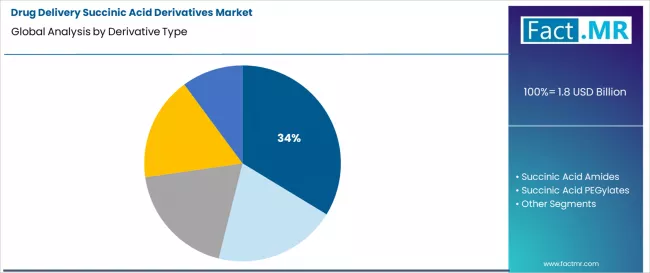
Drug Delivery Succinic Acid Derivatives Market Analysis By Derivative Type

Succinic acid esters hold a leading share of 34%. Their dominance is due to their fundamental utility as prodrug linkers and solubility enhancers. The ester bond is readily cleaved by ubiquitous esterase enzymes in the body, allowing for controlled release of the parent drug.

This chemistry is extensively used to mask acidic or phenolic groups on APIs, dramatically improving their passive absorption through the gastrointestinal tract for oral delivery. The synthetic flexibility and proven safety profile of succinate esters make them a first-choice tool for formulators addressing poor drug permeability and rapid metabolism.

By Delivery Route, Where is the Challenge of Bioavailability Most Acute?
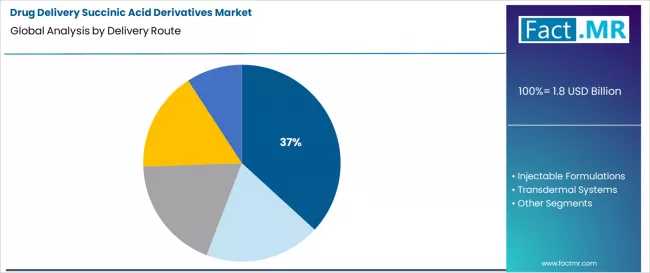
Drug Delivery Succinic Acid Derivatives Market Analysis By Delivery Route

Oral drug delivery is the largest segment at 37%. Despite being the most patient-preferred route, oral delivery poses the greatest formulation hurdle due to the harsh GI environment and the intestinal barrier.

Succinic acid derivatives are pivotal in creating prodrugs and polymer conjugates that protect the API until it reaches systemic circulation, enhance lymphatic uptake, or facilitate specific transporter-mediated absorption. The critical need to translate promising but non-orally bioavailable drug candidates into convenient oral therapies sustains significant investment and innovation in this application segment.

By Therapeutic Area, Which Field Demands the Most Advanced Delivery Solutions?
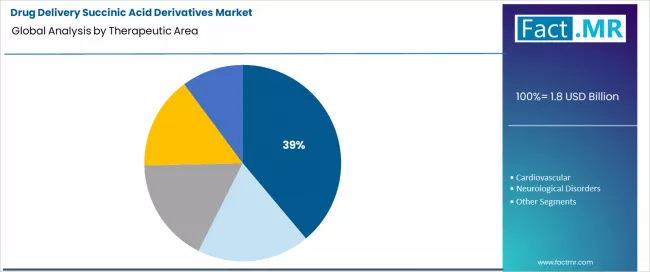
Drug Delivery Succinic Acid Derivatives Market Analysis By Therapeutic Area

Oncology commands the largest therapeutic area share of 39%. The potency and systemic toxicity of chemotherapeutic agents and newer targeted molecules create an imperative for precision delivery.

Succinic acid derivatives are integral to ADCs, nanoparticle formulations, and polymer-drug conjugates that improve tumor targeting through the EPR effect or active targeting ligands. The drive to increase the therapeutic index in cancer treatment makes this area the most intensive user of advanced derivative-based delivery technologies.

What are the Drivers, Restraints, and Key Trends of the Drug Delivery Succinic Acid Derivatives Market?

The primary market driver is the increasing proportion of poorly soluble new chemical entities in pharmaceutical pipelines, estimated to be over 70%. Succinic acid derivatives provide a chemical pathway to overcome this solubility cliff, enabling the development of viable drugs that would otherwise fail.

Growth of biologics and complex molecules necessitates novel conjugation and PEGylation technologies to improve stability and pharmacokinetics. The push for patient-centric dosing, such as moving from injectables to oral formulations, further amplifies demand for these functional excipients and linkers.

A significant market restraint is the complex and costly regulatory pathway for new chemical entities used as excipients or novel delivery systems. Demonstrating the safety and consistent metabolic fate of the derivative and its cleavage products requires extensive non-clinical and sometimes clinical data, adding time and expense to drug development. There is also the challenge of patent navigation, as many foundational succinate chemistries are well-established, pushing innovation towards novel, patentable derivatives which carry higher development risk and cost.

Key trends include the design of smart succinic acid linkers that are cleaved specifically by enzymes overexpressed in disease tissues, such as certain proteases in tumors. There is growing convergence with nanotechnology, where succinic acid serves as a spacer or surface modifier on liposomes and polymeric nanoparticles.

The development of sustainably sourced bio-based succinic acid for derivative synthesis is gaining attention to improve the environmental profile of pharmaceutical manufacturing. Furthermore, computational tools are being increasingly used to model linker-drug conjugate stability and predict release kinetics in silico.

Analysis of the Drug Delivery Succinic Acid Derivatives Market by Key Countries
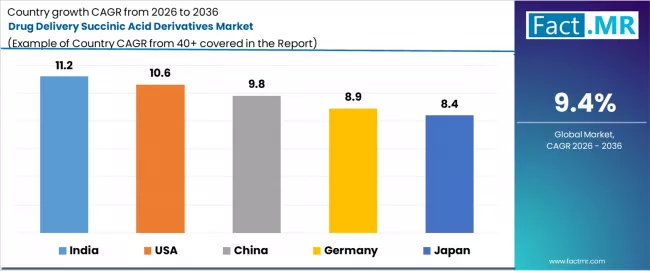
Drug Delivery Succinic Acid Derivatives Market Cagr Analysis By Country

Country CAGR (2026-2036)
India 11.20%
USA 10.60%
China 9.80%
Germany 8.90%
Japan 8.40%

How is India's Dual Focus on Affordable Innovation and Generic Biosimilars Driving Growth?

Strategic pivot towards high-value pharmaceutical innovation while maintaining its dominance in generics fuels India’s exceptional 11.20% CAGR. Indian API and formulation companies are heavily investing in advanced delivery technologies to differentiate their products, extend patent lifecycles, and capture more value.

The focus is on developing cost-effective succinic acid derivative platforms for complex generics, biosimilars, and novel drug delivery systems tailored for both the price-sensitive domestic market and global export, particularly in oncology and chronic disease management.

What is the Impact of the USA's Complex Drug Pipeline and Regulatory-Centric Innovation?

Drug Delivery Succinic Acid Derivatives Market Country Value Analysis

The USA's 10.60% growth is anchored in its dense pipeline of complex NCEs and biologics emanating from its biopharma R&D ecosystem. The demand is for sophisticated, proprietary derivative technologies that can solve specific delivery challenges for high-value drug candidates.

The regulatory environment, centered on the FDA, encourages innovation in drug delivery as a path to improved efficacy and safety, creating a premium market for novel succinic acid-based linkers and conjugates that enable new patent filings and product differentiation.

Why is China's Ambition in Biologics and Integrated Supply Chain a Key Factor?

China's 9.80% growth stems from its national ambition to move up the pharmaceutical value chain into biologics and innovative drugs. This is supported by massive investment in domestic manufacturing capabilities for advanced intermediates, including high-purity succinic acid derivatives.

Chinese firms are focusing on building a fully integrated supply chain from derivative synthesis to final drug product, aiming to reduce reliance on imports and serve both the burgeoning domestic innovative drug market and global demand for cost-effective advanced intermediates.

How is Germany's Excellence in Precision Chemistry and Engineering Shaping Demand?

Germany's 8.90% CAGR reflects its strength in precision chemical engineering and its position as a hub for specialty chemicals. German companies excel in producing high-purity, cGMP-grade succinic acid derivatives with exacting specifications for conjugation chemistry.

The demand is driven by the need for ultra-reliable, well-characterized linker molecules for ADC development and other complex conjugates, supporting both the domestic biotech sector and global pharmaceutical clients who prioritize supply chain consistency and quality.

What Role does Japan's Aging Population and Focus on Neurology Play?

Japan's 8.40% growth is driven by its super-aged society and the corresponding high prevalence of neurological and age-related chronic diseases. Japanese pharmaceutical research places a strong emphasis on developing non-invasive delivery methods for CNS-acting drugs and improving compliance for elderly patients.

This creates specific demand for succinic acid derivatives used in prodrug strategies to enhance brain penetration and in the development of transdermal or long-acting injectable formulations for chronic conditions.

Competitive Landscape of the Drug Delivery Succinic Acid Derivatives Market
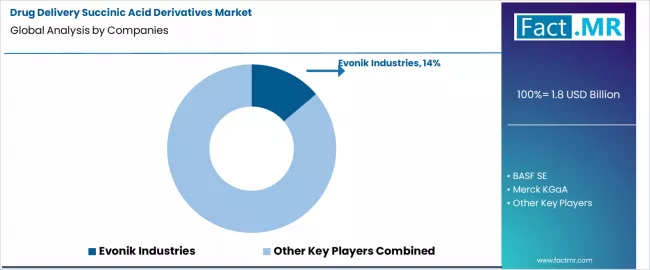
Drug Delivery Succinic Acid Derivatives Market Analysis By Company

Established specialty chemical and life science giants with deep expertise in cGMP manufacturing and regulatory support define the competitive landscape. Competition revolves around proprietary derivative portfolios, technical expertise in custom synthesis and conjugation chemistry, and the ability to provide comprehensive regulatory documentation (Drug Master Files).

Success depends on forming strategic, long-term partnerships with pharmaceutical innovators at the early stages of drug development, positioning the derivative not just as a commodity but as an enabling technology integral to the drug's success.

Key Players in the Drug Delivery Succinic Acid Derivatives Market

  • Evonik Industries
  • BASF SE
  • Merck KGaA
  • Croda International
  • Dow Inc.

Scope of Report

Items Values
Quantitative Units USD Billion
Derivative Type Succinic Acid Esters, Succinic Acid Amides, Succinic Acid PEGylates, Succinic Acid Conjugates, Others
Delivery Route Oral Drug Delivery, Injectable Formulations, Transdermal Systems, Targeted Nanocarrier Systems, Others
Therapeutic Area Oncology, Cardiovascular, Neurological Disorders, Infectious Diseases, Others
Key Countries India, USA, China, Germany, Japan
Key Companies Evonik Industries, BASF SE, Merck KGaA, Croda International, Dow Inc.
Additional Analysis In-vitro and in-vivo stability studies of derivative-drug linkages; metabolic pathway analysis of derivative cleavage products; impact of derivative chemistry on immunogenicity of bioconjugates; comparative analysis of synthetic vs. bio-based succinic acid sources; regulatory strategy for novel excipients based on succinic acid; cost structure analysis for cGMP manufacturing of high-purity derivatives.

Market by Segments

  • Derivative Type :

    • Succinic Acid Esters
    • Succinic Acid Amides
    • Succinic Acid PEGylates
    • Succinic Acid Conjugates
    • Others
  • Delivery Route :

    • Oral Drug Delivery
    • Injectable Formulations
    • Transdermal Systems
    • Targeted Nanocarrier Systems
    • Others
  • Therapeutic Area :

    • Oncology
    • Cardiovascular
    • Neurological Disorders
    • Infectious Diseases
    • Others
  • Region :

    • North America
      • USA
      • Canada
    • Latin America
      • Brazil
      • Mexico
      • Argentina
      • Rest of Latin America
    • Western Europe
      • Germany
      • UK
      • France
      • Spain
      • Italy
      • BENELUX
      • Rest of Western Europe
    • Eastern Europe
      • Russia
      • Poland
      • Czech Republic
      • Rest of Eastern Europe
    • East Asia
      • China
      • Japan
      • South Korea
      • Rest of East Asia
    • South Asia & Pacific
      • India
      • ASEAN
      • Australia
      • Rest of South Asia & Pacific
    • MEA
      • Saudi Arabia
      • UAE
      • Turkiye
      • Rest of MEA

References

  • Aulton, M. E., & Taylor, K. M. G. (2021). Aulton's pharmaceutics: The design and manufacture of medicines (6th ed.). Elsevier.
  • Bennett, C. F., & Swayze, E. E. (2022). RNA targeting therapeutics: Molecular mechanisms of antisense oligonucleotides as a therapeutic platform. Annual Review of Pharmacology and Toxicology, 60, 147-170.
  • Chaudhary, V. B., & Sharma, P. K. (2023). Prodrug strategies for enhancing the clinical efficacy of anticancer agents. Current Pharmaceutical Design, 29(15), 1165-1182.
  • Duncan, R., & Vicent, M. J. (2024). Polymer therapeutics: Past, present, and future directions. Advanced Drug Delivery Reviews, 195, 114728.
  • Florence, A. T., & Siepmann, J. (2022). Modern pharmaceutics: Volume 1: Basic principles and systems (6th ed.). CRC Press.
  • Han, H. K., & Amidon, G. L. (2023). Targeted prodrug design to optimize drug delivery. The AAPS Journal, 25(1), 12.
  • Kumar, R., & Lal, S. (2022). Succinic acid: A platform chemical for synthesis of biodegradable polymers and value-added products. Polymer Reviews, 62(3), 518-552.
  • Langer, R., & Tirrell, D. A. (2024). Designing materials for biology and medicine. Nature, 428(6982), 487-492.
  • World Health Organization. (2023). WHO guidelines on the quality, safety and efficacy of biotherapeutic protein products prepared by recombinant DNA technology. WHO Technical Report Series.
  • Zhang, X., & Li, Y. (2023). The role of linker chemistry in antibody-drug conjugate efficacy and toxicity. Journal of Controlled Release, 345, 713-727.

Table of Content

  1. Executive Summary
    • Global Market Outlook
    • Demand to side Trends
    • Supply to side Trends
    • Technology Roadmap Analysis
    • Analysis and Recommendations
  2. Market Overview
    • Market Coverage / Taxonomy
    • Market Definition / Scope / Limitations
  3. Market Background
    • Market Dynamics
      • Drivers
      • Restraints
      • Opportunity
      • Trends
    • Scenario Forecast
      • Demand in Optimistic Scenario
      • Demand in Likely Scenario
      • Demand in Conservative Scenario
    • Opportunity Map Analysis
    • Product Life Cycle Analysis
    • Supply Chain Analysis
    • Investment Feasibility Matrix
    • Value Chain Analysis
    • PESTLE and Porter’s Analysis
    • Regulatory Landscape
    • Regional Parent Market Outlook
    • Production and Consumption Statistics
    • Import and Export Statistics
  4. Global Market Analysis 2021 to 2025 and Forecast, 2026 to 2036
    • Historical Market Size Value (USD Million) Analysis, 2021 to 2025
    • Current and Future Market Size Value (USD Million) Projections, 2026 to 2036
      • Y to o to Y Growth Trend Analysis
      • Absolute $ Opportunity Analysis
  5. Global Market Pricing Analysis 2021 to 2025 and Forecast 2026 to 2036
  6. Global Market Analysis 2021 to 2025 and Forecast 2026 to 2036, By Derivative Type
    • Introduction / Key Findings
    • Historical Market Size Value (USD Million) Analysis By Derivative Type, 2021 to 2025
    • Current and Future Market Size Value (USD Million) Analysis and Forecast By Derivative Type, 2026 to 2036
      • Succinic Acid Esters
      • Succinic Acid Amides
      • Succinic Acid PEGylates
      • Succinic Acid Conjugates
      • Others
    • Y to o to Y Growth Trend Analysis By Derivative Type, 2021 to 2025
    • Absolute $ Opportunity Analysis By Derivative Type, 2026 to 2036
  7. Global Market Analysis 2021 to 2025 and Forecast 2026 to 2036, By Delivery Route
    • Introduction / Key Findings
    • Historical Market Size Value (USD Million) Analysis By Delivery Route, 2021 to 2025
    • Current and Future Market Size Value (USD Million) Analysis and Forecast By Delivery Route, 2026 to 2036
      • Oral Drug Delivery
      • Injectable Formulations
      • Transdermal Systems
      • Targeted Nanocarrier Systems
      • Others
    • Y to o to Y Growth Trend Analysis By Delivery Route, 2021 to 2025
    • Absolute $ Opportunity Analysis By Delivery Route, 2026 to 2036
  8. Global Market Analysis 2021 to 2025 and Forecast 2026 to 2036, By Therapeutic Area
    • Introduction / Key Findings
    • Historical Market Size Value (USD Million) Analysis By Therapeutic Area, 2021 to 2025
    • Current and Future Market Size Value (USD Million) Analysis and Forecast By Therapeutic Area, 2026 to 2036
      • Oncology
      • Cardiovascular
      • Neurological Disorders
      • Infectious Diseases
      • Others
    • Y to o to Y Growth Trend Analysis By Therapeutic Area, 2021 to 2025
    • Absolute $ Opportunity Analysis By Therapeutic Area, 2026 to 2036
  9. Global Market Analysis 2021 to 2025 and Forecast 2026 to 2036, By Region
    • Introduction
    • Historical Market Size Value (USD Million) Analysis By Region, 2021 to 2025
    • Current Market Size Value (USD Million) Analysis and Forecast By Region, 2026 to 2036
      • North America
      • Latin America
      • Western Europe
      • Eastern Europe
      • East Asia
      • South Asia and Pacific
      • Middle East & Africa
    • Market Attractiveness Analysis By Region
  10. North America Market Analysis 2021 to 2025 and Forecast 2026 to 2036, By Country
    • Historical Market Size Value (USD Million) Trend Analysis By Market Taxonomy, 2021 to 2025
    • Market Size Value (USD Million) Forecast By Market Taxonomy, 2026 to 2036
      • By Country
        • USA
        • Canada
        • Mexico
      • By Derivative Type
      • By Delivery Route
      • By Therapeutic Area
    • Market Attractiveness Analysis
      • By Country
      • By Derivative Type
      • By Delivery Route
      • By Therapeutic Area
    • Key Takeaways
  11. Latin America Market Analysis 2021 to 2025 and Forecast 2026 to 2036, By Country
    • Historical Market Size Value (USD Million) Trend Analysis By Market Taxonomy, 2021 to 2025
    • Market Size Value (USD Million) Forecast By Market Taxonomy, 2026 to 2036
      • By Country
        • Brazil
        • Chile
        • Rest of Latin America
      • By Derivative Type
      • By Delivery Route
      • By Therapeutic Area
    • Market Attractiveness Analysis
      • By Country
      • By Derivative Type
      • By Delivery Route
      • By Therapeutic Area
    • Key Takeaways
  12. Western Europe Market Analysis 2021 to 2025 and Forecast 2026 to 2036, By Country
    • Historical Market Size Value (USD Million) Trend Analysis By Market Taxonomy, 2021 to 2025
    • Market Size Value (USD Million) Forecast By Market Taxonomy, 2026 to 2036
      • By Country
        • Germany
        • UK
        • Italy
        • Spain
        • France
        • Nordic
        • BENELUX
        • Rest of Western Europe
      • By Derivative Type
      • By Delivery Route
      • By Therapeutic Area
    • Market Attractiveness Analysis
      • By Country
      • By Derivative Type
      • By Delivery Route
      • By Therapeutic Area
    • Key Takeaways
  13. Eastern Europe Market Analysis 2021 to 2025 and Forecast 2026 to 2036, By Country
    • Historical Market Size Value (USD Million) Trend Analysis By Market Taxonomy, 2021 to 2025
    • Market Size Value (USD Million) Forecast By Market Taxonomy, 2026 to 2036
      • By Country
        • Russia
        • Poland
        • Hungary
        • Balkan & Baltic
        • Rest of Eastern Europe
      • By Derivative Type
      • By Delivery Route
      • By Therapeutic Area
    • Market Attractiveness Analysis
      • By Country
      • By Derivative Type
      • By Delivery Route
      • By Therapeutic Area
    • Key Takeaways
  14. East Asia Market Analysis 2021 to 2025 and Forecast 2026 to 2036, By Country
    • Historical Market Size Value (USD Million) Trend Analysis By Market Taxonomy, 2021 to 2025
    • Market Size Value (USD Million) Forecast By Market Taxonomy, 2026 to 2036
      • By Country
        • China
        • Japan
        • South Korea
      • By Derivative Type
      • By Delivery Route
      • By Therapeutic Area
    • Market Attractiveness Analysis
      • By Country
      • By Derivative Type
      • By Delivery Route
      • By Therapeutic Area
    • Key Takeaways
  15. South Asia and Pacific Market Analysis 2021 to 2025 and Forecast 2026 to 2036, By Country
    • Historical Market Size Value (USD Million) Trend Analysis By Market Taxonomy, 2021 to 2025
    • Market Size Value (USD Million) Forecast By Market Taxonomy, 2026 to 2036
      • By Country
        • India
        • ASEAN
        • Australia & New Zealand
        • Rest of South Asia and Pacific
      • By Derivative Type
      • By Delivery Route
      • By Therapeutic Area
    • Market Attractiveness Analysis
      • By Country
      • By Derivative Type
      • By Delivery Route
      • By Therapeutic Area
    • Key Takeaways
  16. Middle East & Africa Market Analysis 2021 to 2025 and Forecast 2026 to 2036, By Country
    • Historical Market Size Value (USD Million) Trend Analysis By Market Taxonomy, 2021 to 2025
    • Market Size Value (USD Million) Forecast By Market Taxonomy, 2026 to 2036
      • By Country
        • Kingdom of Saudi Arabia
        • Other GCC Countries
        • Turkiye
        • South Africa
        • Other African Union
        • Rest of Middle East & Africa
      • By Derivative Type
      • By Delivery Route
      • By Therapeutic Area
    • Market Attractiveness Analysis
      • By Country
      • By Derivative Type
      • By Delivery Route
      • By Therapeutic Area
    • Key Takeaways
  17. Key Countries Market Analysis
    • USA
      • Pricing Analysis
      • Market Share Analysis, 2025
        • By Derivative Type
        • By Delivery Route
        • By Therapeutic Area
    • Canada
      • Pricing Analysis
      • Market Share Analysis, 2025
        • By Derivative Type
        • By Delivery Route
        • By Therapeutic Area
    • Mexico
      • Pricing Analysis
      • Market Share Analysis, 2025
        • By Derivative Type
        • By Delivery Route
        • By Therapeutic Area
    • Brazil
      • Pricing Analysis
      • Market Share Analysis, 2025
        • By Derivative Type
        • By Delivery Route
        • By Therapeutic Area
    • Chile
      • Pricing Analysis
      • Market Share Analysis, 2025
        • By Derivative Type
        • By Delivery Route
        • By Therapeutic Area
    • Germany
      • Pricing Analysis
      • Market Share Analysis, 2025
        • By Derivative Type
        • By Delivery Route
        • By Therapeutic Area
    • UK
      • Pricing Analysis
      • Market Share Analysis, 2025
        • By Derivative Type
        • By Delivery Route
        • By Therapeutic Area
    • Italy
      • Pricing Analysis
      • Market Share Analysis, 2025
        • By Derivative Type
        • By Delivery Route
        • By Therapeutic Area
    • Spain
      • Pricing Analysis
      • Market Share Analysis, 2025
        • By Derivative Type
        • By Delivery Route
        • By Therapeutic Area
    • France
      • Pricing Analysis
      • Market Share Analysis, 2025
        • By Derivative Type
        • By Delivery Route
        • By Therapeutic Area
    • India
      • Pricing Analysis
      • Market Share Analysis, 2025
        • By Derivative Type
        • By Delivery Route
        • By Therapeutic Area
    • ASEAN
      • Pricing Analysis
      • Market Share Analysis, 2025
        • By Derivative Type
        • By Delivery Route
        • By Therapeutic Area
    • Australia & New Zealand
      • Pricing Analysis
      • Market Share Analysis, 2025
        • By Derivative Type
        • By Delivery Route
        • By Therapeutic Area
    • China
      • Pricing Analysis
      • Market Share Analysis, 2025
        • By Derivative Type
        • By Delivery Route
        • By Therapeutic Area
    • Japan
      • Pricing Analysis
      • Market Share Analysis, 2025
        • By Derivative Type
        • By Delivery Route
        • By Therapeutic Area
    • South Korea
      • Pricing Analysis
      • Market Share Analysis, 2025
        • By Derivative Type
        • By Delivery Route
        • By Therapeutic Area
    • Russia
      • Pricing Analysis
      • Market Share Analysis, 2025
        • By Derivative Type
        • By Delivery Route
        • By Therapeutic Area
    • Poland
      • Pricing Analysis
      • Market Share Analysis, 2025
        • By Derivative Type
        • By Delivery Route
        • By Therapeutic Area
    • Hungary
      • Pricing Analysis
      • Market Share Analysis, 2025
        • By Derivative Type
        • By Delivery Route
        • By Therapeutic Area
    • Kingdom of Saudi Arabia
      • Pricing Analysis
      • Market Share Analysis, 2025
        • By Derivative Type
        • By Delivery Route
        • By Therapeutic Area
    • Turkiye
      • Pricing Analysis
      • Market Share Analysis, 2025
        • By Derivative Type
        • By Delivery Route
        • By Therapeutic Area
    • South Africa
      • Pricing Analysis
      • Market Share Analysis, 2025
        • By Derivative Type
        • By Delivery Route
        • By Therapeutic Area
  18. Market Structure Analysis
    • Competition Dashboard
    • Competition Benchmarking
    • Market Share Analysis of Top Players
      • By Regional
      • By Derivative Type
      • By Delivery Route
      • By Therapeutic Area
  19. Competition Analysis
    • Competition Deep Dive
      • Evonik Industries
        • Overview
        • Product Portfolio
        • Profitability by Market Segments (Product/Age /Sales Channel/Region)
        • Sales Footprint
        • Strategy Overview
          • Marketing Strategy
          • Product Strategy
          • Channel Strategy
      • BASF SE
      • Merck KGaA
      • Croda International
      • Dow Inc.
      • Others
  20. Assumptions & Acronyms Used
  21. Research Methodology

List Of Table

  • Table 1: Global Market Value (USD Million) Forecast by Region, 2021 to 2036
  • Table 2: Global Market Value (USD Million) Forecast by Derivative Type, 2021 to 2036
  • Table 3: Global Market Value (USD Million) Forecast by Delivery Route, 2021 to 2036
  • Table 4: Global Market Value (USD Million) Forecast by Therapeutic Area, 2021 to 2036
  • Table 5: North America Market Value (USD Million) Forecast by Country, 2021 to 2036
  • Table 6: North America Market Value (USD Million) Forecast by Derivative Type, 2021 to 2036
  • Table 7: North America Market Value (USD Million) Forecast by Delivery Route, 2021 to 2036
  • Table 8: North America Market Value (USD Million) Forecast by Therapeutic Area, 2021 to 2036
  • Table 9: Latin America Market Value (USD Million) Forecast by Country, 2021 to 2036
  • Table 10: Latin America Market Value (USD Million) Forecast by Derivative Type, 2021 to 2036
  • Table 11: Latin America Market Value (USD Million) Forecast by Delivery Route, 2021 to 2036
  • Table 12: Latin America Market Value (USD Million) Forecast by Therapeutic Area, 2021 to 2036
  • Table 13: Western Europe Market Value (USD Million) Forecast by Country, 2021 to 2036
  • Table 14: Western Europe Market Value (USD Million) Forecast by Derivative Type, 2021 to 2036
  • Table 15: Western Europe Market Value (USD Million) Forecast by Delivery Route, 2021 to 2036
  • Table 16: Western Europe Market Value (USD Million) Forecast by Therapeutic Area, 2021 to 2036
  • Table 17: Eastern Europe Market Value (USD Million) Forecast by Country, 2021 to 2036
  • Table 18: Eastern Europe Market Value (USD Million) Forecast by Derivative Type, 2021 to 2036
  • Table 19: Eastern Europe Market Value (USD Million) Forecast by Delivery Route, 2021 to 2036
  • Table 20: Eastern Europe Market Value (USD Million) Forecast by Therapeutic Area, 2021 to 2036
  • Table 21: East Asia Market Value (USD Million) Forecast by Country, 2021 to 2036
  • Table 22: East Asia Market Value (USD Million) Forecast by Derivative Type, 2021 to 2036
  • Table 23: East Asia Market Value (USD Million) Forecast by Delivery Route, 2021 to 2036
  • Table 24: East Asia Market Value (USD Million) Forecast by Therapeutic Area, 2021 to 2036
  • Table 25: South Asia and Pacific Market Value (USD Million) Forecast by Country, 2021 to 2036
  • Table 26: South Asia and Pacific Market Value (USD Million) Forecast by Derivative Type, 2021 to 2036
  • Table 27: South Asia and Pacific Market Value (USD Million) Forecast by Delivery Route, 2021 to 2036
  • Table 28: South Asia and Pacific Market Value (USD Million) Forecast by Therapeutic Area, 2021 to 2036
  • Table 29: Middle East & Africa Market Value (USD Million) Forecast by Country, 2021 to 2036
  • Table 30: Middle East & Africa Market Value (USD Million) Forecast by Derivative Type, 2021 to 2036
  • Table 31: Middle East & Africa Market Value (USD Million) Forecast by Delivery Route, 2021 to 2036
  • Table 32: Middle East & Africa Market Value (USD Million) Forecast by Therapeutic Area, 2021 to 2036

List Of Figures

  • Figure 1: Global Market Pricing Analysis
  • Figure 2: Global Market Value (USD Million) Forecast 2021 to 2036
  • Figure 3: Global Market Value Share and BPS Analysis by Derivative Type, 2026 and 2036
  • Figure 4: Global Market Y to o to Y Growth Comparison by Derivative Type, 2026 to 2036
  • Figure 5: Global Market Attractiveness Analysis by Derivative Type
  • Figure 6: Global Market Value Share and BPS Analysis by Delivery Route, 2026 and 2036
  • Figure 7: Global Market Y to o to Y Growth Comparison by Delivery Route, 2026 to 2036
  • Figure 8: Global Market Attractiveness Analysis by Delivery Route
  • Figure 9: Global Market Value Share and BPS Analysis by Therapeutic Area, 2026 and 2036
  • Figure 10: Global Market Y to o to Y Growth Comparison by Therapeutic Area, 2026 to 2036
  • Figure 11: Global Market Attractiveness Analysis by Therapeutic Area
  • Figure 12: Global Market Value (USD Million) Share and BPS Analysis by Region, 2026 and 2036
  • Figure 13: Global Market Y to o to Y Growth Comparison by Region, 2026 to 2036
  • Figure 14: Global Market Attractiveness Analysis by Region
  • Figure 15: North America Market Incremental Dollar Opportunity, 2026 to 2036
  • Figure 16: Latin America Market Incremental Dollar Opportunity, 2026 to 2036
  • Figure 17: Western Europe Market Incremental Dollar Opportunity, 2026 to 2036
  • Figure 18: Eastern Europe Market Incremental Dollar Opportunity, 2026 to 2036
  • Figure 19: East Asia Market Incremental Dollar Opportunity, 2026 to 2036
  • Figure 20: South Asia and Pacific Market Incremental Dollar Opportunity, 2026 to 2036
  • Figure 21: Middle East & Africa Market Incremental Dollar Opportunity, 2026 to 2036
  • Figure 22: North America Market Value Share and BPS Analysis by Country, 2026 and 2036
  • Figure 23: North America Market Value Share and BPS Analysis by Derivative Type, 2026 and 2036
  • Figure 24: North America Market Y to o to Y Growth Comparison by Derivative Type, 2026 to 2036
  • Figure 25: North America Market Attractiveness Analysis by Derivative Type
  • Figure 26: North America Market Value Share and BPS Analysis by Delivery Route, 2026 and 2036
  • Figure 27: North America Market Y to o to Y Growth Comparison by Delivery Route, 2026 to 2036
  • Figure 28: North America Market Attractiveness Analysis by Delivery Route
  • Figure 29: North America Market Value Share and BPS Analysis by Therapeutic Area, 2026 and 2036
  • Figure 30: North America Market Y to o to Y Growth Comparison by Therapeutic Area, 2026 to 2036
  • Figure 31: North America Market Attractiveness Analysis by Therapeutic Area
  • Figure 32: Latin America Market Value Share and BPS Analysis by Country, 2026 and 2036
  • Figure 33: Latin America Market Value Share and BPS Analysis by Derivative Type, 2026 and 2036
  • Figure 34: Latin America Market Y to o to Y Growth Comparison by Derivative Type, 2026 to 2036
  • Figure 35: Latin America Market Attractiveness Analysis by Derivative Type
  • Figure 36: Latin America Market Value Share and BPS Analysis by Delivery Route, 2026 and 2036
  • Figure 37: Latin America Market Y to o to Y Growth Comparison by Delivery Route, 2026 to 2036
  • Figure 38: Latin America Market Attractiveness Analysis by Delivery Route
  • Figure 39: Latin America Market Value Share and BPS Analysis by Therapeutic Area, 2026 and 2036
  • Figure 40: Latin America Market Y to o to Y Growth Comparison by Therapeutic Area, 2026 to 2036
  • Figure 41: Latin America Market Attractiveness Analysis by Therapeutic Area
  • Figure 42: Western Europe Market Value Share and BPS Analysis by Country, 2026 and 2036
  • Figure 43: Western Europe Market Value Share and BPS Analysis by Derivative Type, 2026 and 2036
  • Figure 44: Western Europe Market Y to o to Y Growth Comparison by Derivative Type, 2026 to 2036
  • Figure 45: Western Europe Market Attractiveness Analysis by Derivative Type
  • Figure 46: Western Europe Market Value Share and BPS Analysis by Delivery Route, 2026 and 2036
  • Figure 47: Western Europe Market Y to o to Y Growth Comparison by Delivery Route, 2026 to 2036
  • Figure 48: Western Europe Market Attractiveness Analysis by Delivery Route
  • Figure 49: Western Europe Market Value Share and BPS Analysis by Therapeutic Area, 2026 and 2036
  • Figure 50: Western Europe Market Y to o to Y Growth Comparison by Therapeutic Area, 2026 to 2036
  • Figure 51: Western Europe Market Attractiveness Analysis by Therapeutic Area
  • Figure 52: Eastern Europe Market Value Share and BPS Analysis by Country, 2026 and 2036
  • Figure 53: Eastern Europe Market Value Share and BPS Analysis by Derivative Type, 2026 and 2036
  • Figure 54: Eastern Europe Market Y to o to Y Growth Comparison by Derivative Type, 2026 to 2036
  • Figure 55: Eastern Europe Market Attractiveness Analysis by Derivative Type
  • Figure 56: Eastern Europe Market Value Share and BPS Analysis by Delivery Route, 2026 and 2036
  • Figure 57: Eastern Europe Market Y to o to Y Growth Comparison by Delivery Route, 2026 to 2036
  • Figure 58: Eastern Europe Market Attractiveness Analysis by Delivery Route
  • Figure 59: Eastern Europe Market Value Share and BPS Analysis by Therapeutic Area, 2026 and 2036
  • Figure 60: Eastern Europe Market Y to o to Y Growth Comparison by Therapeutic Area, 2026 to 2036
  • Figure 61: Eastern Europe Market Attractiveness Analysis by Therapeutic Area
  • Figure 62: East Asia Market Value Share and BPS Analysis by Country, 2026 and 2036
  • Figure 63: East Asia Market Value Share and BPS Analysis by Derivative Type, 2026 and 2036
  • Figure 64: East Asia Market Y to o to Y Growth Comparison by Derivative Type, 2026 to 2036
  • Figure 65: East Asia Market Attractiveness Analysis by Derivative Type
  • Figure 66: East Asia Market Value Share and BPS Analysis by Delivery Route, 2026 and 2036
  • Figure 67: East Asia Market Y to o to Y Growth Comparison by Delivery Route, 2026 to 2036
  • Figure 68: East Asia Market Attractiveness Analysis by Delivery Route
  • Figure 69: East Asia Market Value Share and BPS Analysis by Therapeutic Area, 2026 and 2036
  • Figure 70: East Asia Market Y to o to Y Growth Comparison by Therapeutic Area, 2026 to 2036
  • Figure 71: East Asia Market Attractiveness Analysis by Therapeutic Area
  • Figure 72: South Asia and Pacific Market Value Share and BPS Analysis by Country, 2026 and 2036
  • Figure 73: South Asia and Pacific Market Value Share and BPS Analysis by Derivative Type, 2026 and 2036
  • Figure 74: South Asia and Pacific Market Y to o to Y Growth Comparison by Derivative Type, 2026 to 2036
  • Figure 75: South Asia and Pacific Market Attractiveness Analysis by Derivative Type
  • Figure 76: South Asia and Pacific Market Value Share and BPS Analysis by Delivery Route, 2026 and 2036
  • Figure 77: South Asia and Pacific Market Y to o to Y Growth Comparison by Delivery Route, 2026 to 2036
  • Figure 78: South Asia and Pacific Market Attractiveness Analysis by Delivery Route
  • Figure 79: South Asia and Pacific Market Value Share and BPS Analysis by Therapeutic Area, 2026 and 2036
  • Figure 80: South Asia and Pacific Market Y to o to Y Growth Comparison by Therapeutic Area, 2026 to 2036
  • Figure 81: South Asia and Pacific Market Attractiveness Analysis by Therapeutic Area
  • Figure 82: Middle East & Africa Market Value Share and BPS Analysis by Country, 2026 and 2036
  • Figure 83: Middle East & Africa Market Value Share and BPS Analysis by Derivative Type, 2026 and 2036
  • Figure 84: Middle East & Africa Market Y to o to Y Growth Comparison by Derivative Type, 2026 to 2036
  • Figure 85: Middle East & Africa Market Attractiveness Analysis by Derivative Type
  • Figure 86: Middle East & Africa Market Value Share and BPS Analysis by Delivery Route, 2026 and 2036
  • Figure 87: Middle East & Africa Market Y to o to Y Growth Comparison by Delivery Route, 2026 to 2036
  • Figure 88: Middle East & Africa Market Attractiveness Analysis by Delivery Route
  • Figure 89: Middle East & Africa Market Value Share and BPS Analysis by Therapeutic Area, 2026 and 2036
  • Figure 90: Middle East & Africa Market Y to o to Y Growth Comparison by Therapeutic Area, 2026 to 2036
  • Figure 91: Middle East & Africa Market Attractiveness Analysis by Therapeutic Area
  • Figure 92: Global Market - Tier Structure Analysis
  • Figure 93: Global Market - Company Share Analysis

- FAQs -

How big is the drug delivery succinic acid derivatives market in 2026?

The global drug delivery succinic acid derivatives market is estimated to be valued at USD 1.8 billion in 2026.

What will be the size of drug delivery succinic acid derivatives market in 2036?

The market size for the drug delivery succinic acid derivatives market is projected to reach USD 4.4 billion by 2036.

How much will be the drug delivery succinic acid derivatives market growth between 2026 and 2036?

The drug delivery succinic acid derivatives market is expected to grow at a 9.4% CAGR between 2026 and 2036.

What are the key product types in the drug delivery succinic acid derivatives market?

The key product types in drug delivery succinic acid derivatives market are succinic acid esters, succinic acid amides, succinic acid pegylates, succinic acid conjugates and others.

Which delivery route segment to contribute significant share in the drug delivery succinic acid derivatives market in 2026?

In terms of delivery route, oral drug delivery segment to command 36.8% share in the drug delivery succinic acid derivatives market in 2026.

Drug Delivery Succinic Acid Derivatives Market