- Market Value (2025): USD 339.9 Mn
- Estimated Value (2026): USD 160.0 Mn
- Forecast Value (2036): USD 938.3 Mn
- CAGR (2026-2036): 9.8%
Protein-Fiber Edible Coatings Market Forecast and Outlook 2026 to 2036
The protein-fiber edible coatings market was valued at approximately USD 339.9 million in 2025 and USD 160.0 million in 2026. It is set to reach USD 938.3 million by 2036, registering a 9.8% CAGR during the 2026–2036 assessment period.
Food manufacturers are turning to protein-fiber edible coatings to protect products without relying heavily on synthetic glazes or plastic barriers. Blends containing proteins, cellulose and pectin help retain moisture, improve surface appearance and carry flavors or colors across baked goods; snacks and fresh-cut foods. The EU Packaging and Packaging Waste Regulation, which applies from August 2026, adds pressure on food companies to cut packaging waste. This shift is creating room for edible coatings as an alternative to conventional protective materials.
Key Takeaways from the Protein-Fiber Edible Coatings Market
- Sales of protein-fiber edible coatings stood at USD 339.9 million in 2025
- Protein-Fiber Edible Coatings Market Value (2026): USD 160.0 million
- Protein-Fiber Edible Coatings Market Forecast Value (2036): USD 938.3 million
- Protein-Fiber Edible Coatings Market Forecast CAGR (2026-2036): 9.8%
- Leading Protein-fiber coating matrix: Whey protein-cellulose (30.6%)
- Key Market Participants: Arla Foods Ingredients, Glanbia Nutritionals, Fonterra; Kerry Group; Roquette; Ingredion
- Key Growth Regions: Netherlands, United States, India; Spain; China
Dairy and plant-protein companies are placing greater emphasis on specialty ingredients and new applications. In April 2025, Arla Foods and DMK Group announced plans to merge, highlighting this shift toward larger ingredient portfolios. Companies such as Arla Foods Ingredients, Roquette and Ingredion are also exploring functional uses for whey and plant proteins through application research. Their work is opening new possibilities for edible coatings that protect food while adding functional value.
Protein-Fiber Edible Coatings Market
| Metric | Value |
|---|---|
| Estimated Value in (2025) | USD 339.9 million |
| Estimated Value in (2026) | USD 160.0 million |
| Forecast Value in (2036) | USD 938.3 million |
| Forecast CAGR (2026 to 2036) | 9.8% |
Source: Fact.MR analysis. Updated Nov 19, 2026
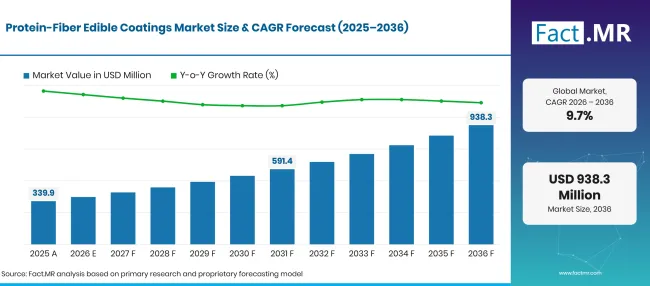
Protein Fiber Edible Coatings Forecast Global | Source: Fact.MR
Category
| Category | Segments |
|---|---|
| Protein-fiber coating matrix | Whey protein-cellulose, Pea protein-cellulose, Soy protein-fiber; Pectin-protein; Hybrid biopolymer |
| Commercial form | Powder, Liquid concentrate, Granulate; Encapsulated bead; Ready-to-use premix |
| Food application | Bakery, Dairy / alternatives, Beverage; Meat / savory; Confectionery / snacks |
| Primary function | Shelf-life, Texture / rheology, Taste / color; Nutritional functionality; Processing stability |
| Region | Netherlands; United States; India; Spain; China |
Source: Fact.MR analysis. Updated Nov 19, 2026
Segmental Analysis
Why does Whey protein-cellulose lead matrix demand in the Protein-Fiber Edible Coatings Market?
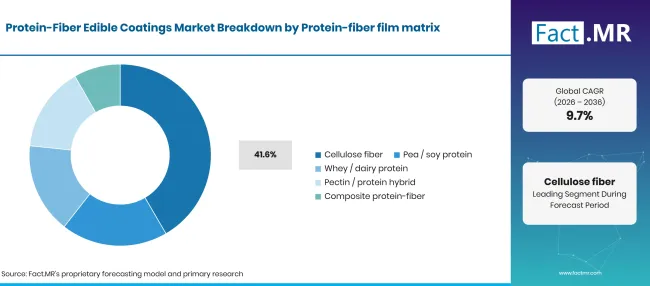
Protein Fiber Edible Coatings Breakdown Protein Fiber Film Matrix | Source: Fact.MR
Whey protein-cellulose holds 41.6% of market revenue in 2026, valued at approximately USD 49.0 million. Its appeal comes from the combination of whey protein's film-forming properties and cellulose's ability to improve coating strength and moisture control. Hybrid biopolymer and pea protein-cellulose blends also attract interest, particularly where manufacturers want alternatives to conventional synthetic coatings. A relevant regulatory milestone came in February 2025, when the US FDA made a microfibrillated cellulose food-contact notification effective for specified coating applications on fruits and vegetables.
Why do Ready-to-use premix formats lead commercial-form demand in the Protein-Fiber Edible Coatings Market?
Food processors are showing a preference for ready-to-use premixes, which hold 29.0% of market revenue in 2026, equivalent to USD 46.4 million. Pre-blended formulations reduce preparation work, limit inconsistencies between batches and make coating application easier across production lines. Granulates serve processors that prioritize storage flexibility. The European Food Safety Authority updated its food additive application guidance in January 2026, placing emphasis on ingredient identity, composition; stability and intended conditions of use. Such scrutiny makes formulation consistency an important consideration for commercial coating products.
Why does Bakery lead application demand in the Protein-Fiber Edible Coatings Market?
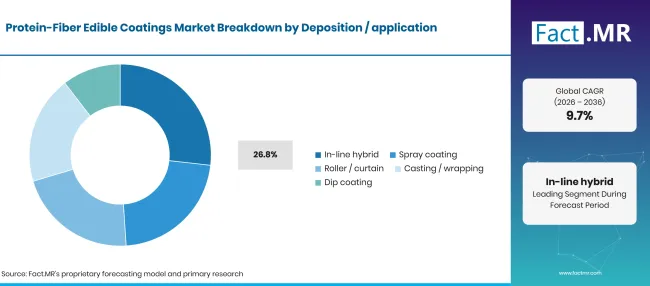
Protein Fiber Edible Coatings Breakdown Deposition Application | Source: Fact.MR
Bakery applications generate 26.8% of market revenue in 2026, reaching approximately USD 41.3 million. Bread, pastries and biscuits offer several opportunities for edible coatings, from surface gloss and browning to moisture retention and alternatives to conventional egg washes. Dairy alternatives and beverages also create application opportunities, although bakery has a wider range of established surface-treatment uses. A December 2025 FDA inspection report documented egg-wash handling during challah production, illustrating the practical role of surface treatments in commercial baking.
Why does Taste / color lead function demand in the Protein-Fiber Edible Coatings Market?
Visual appeal and flavor influence how consumers perceive packaged and freshly prepared foods, helping taste and color applications secure 25.8% of market revenue in 2026, worth around USD 41.3 million. Edible coatings can carry natural colors, improve surface gloss and help maintain product appearance. Nutritional enrichment and texture modification serve other formulation needs. In February 2026, the European Commission reiterated the functional roles of food additives, including colouring; preservation and flavour enhancement; while emphasizing their approved conditions of use. This regulatory focus keeps formulation safety alongside appearance and taste considerations.
Protein-Fiber Edible Coatings Market-Drivers, Restraints & Trends
driver
The sharp rise in egg prices during 2025 pushed commercial bakeries to reconsider their dependence on conventional egg washes. Protein-fiber coatings offer an alternative for achieving surface gloss, browning and moisture retention without relying entirely on eggs. This matters particularly for large food processors, where ingredient price fluctuations affect production costs. USDA reported that average US retail egg prices reached USD 6.23 per dozen in March 2025, highlighting the cost pressures behind the shift towards alternative coating formulations.
Restraint
Milk- and soy-based proteins can limit coating applications in foods intended for consumers with allergies. Manufacturers must also manage ingredient declarations, cross-contact risks and production-line cleaning, adding operational costs. New coating ingredients may need safety assessments and regulatory clearance before commercial use, extending development timelines. In January 2025, the FDA issued updated industry guidance on declaring major food allergens, including milk and soy; reinforcing these compliance obligations.
Trend: Egg-free coating development creates room for alternative formulations
Food manufacturers are exploring protein-based alternatives to conventional egg washes, particularly for bakery products where surface finish and moisture retention matter. The opportunity extends beyond direct egg replacement to coatings that work across different food categories and production conditions. USDA reported that US egg-laying hen losses reached 50.7 million during the avian influenza outbreak spanning October 2024 to March 2025, highlighting the vulnerability of egg-dependent supply chains.
Trend: Upcycled fibers bring circular-economy thinking into coating development
Citrus peel, oat hulls and other food-processing residues are attracting attention as potential sources of functional fibers. Turning these materials into usable ingredients could help coating manufacturers reduce dependence on conventional raw materials while creating value from processing waste. In April 2025, an EU-backed Agro2Circular project reported methods for recovering fibers, antioxidants and natural colorants from fruit and vegetable waste. This creates scope for more resource-efficient coating formulations as food processors pursue waste-reduction goals.
Protein-Fiber Edible Coatings Market by Analysis by Key Country
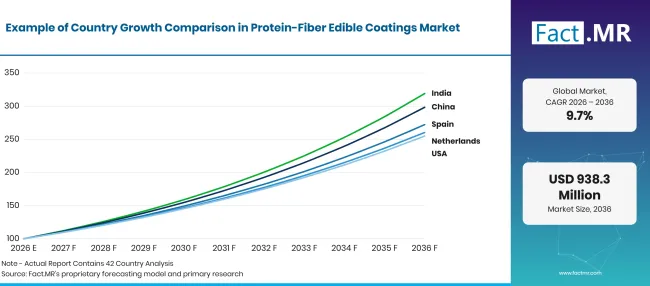
Protein Fiber Edible Coatings Growth Index | Source: Fact.MR
| Country | CAGR (2026-2036) |
|---|---|
| Netherlands | 14.0% |
| United States | 13.9% |
| India | 12.1% |
| Spain | 11.9% |
| China | 11.4% |
Source: Fact.MR analysis. Updated Nov 19, 2026
Why is the Netherlands the fastest-growing market for protein-fiber edible coatings?
The Netherlands has a strong base in food technology research, dairy processing and sustainable ingredient innovation.
These industries create room for protein-fiber coatings, particularly in applications that help preserve food quality and reduce reliance on conventional packaging. In September 2026, Wageningen University & Research opened its CIBIA food innovation facility to help businesses and research organizations develop and scale food technologies. This research infrastructure can encourage commercial trials and support sales of advanced edible coating formulations.
What is shaping protein-fiber edible coating sales in the United States?
Dairy processing and the search for higher-value uses of food-industry by-products are creating opportunities for protein-based coatings in the United States.
USDA's Agricultural Research Service reported a 2025 research project focused on producing edible coatings from dairy proteins and waste dairy streams. This work directly connects dairy ingredient recovery with coating applications. Commercial sales can gain traction as food processors explore moisture barriers, shelf-life improvement and alternatives to conventional packaging materials.
What is driving protein-fiber edible coating demand in India?
India's expanding food-processing industry is creating opportunities for edible coatings, particularly as manufacturers look for ways to reduce spoilage and improve product shelf life.
On April 16, 2025, FSSAI organized a national consultation on sustainable food packaging; bringing together more than 1;500 stakeholders from food businesses; packaging and regulatory organizations. This policy attention, combined with investment in food-processing infrastructure, can encourage sales of protein-fiber coatings across packaged foods; bakery products and fresh produce.
What is shaping protein-fiber edible coating demand in Spain?
Spain's fruit and vegetable processing industry offers a useful base for edible coating applications, particularly where moisture retention and post-harvest preservation influence product quality.
A June 2026 study involving researchers from Spain's CSIC-affiliated food technology institutes examined an antifungal edible coating developed from avocado processing residues. Such research highlights the commercial potential of converting agricultural by-products into functional coating ingredients. Sales opportunities are emerging around fresh produce preservation and waste-based ingredient development.
Why is protein-fiber edible coating growth slower in China?
China's large fresh-produce and packaged-food industries create opportunities for coatings that help protect food during storage and distribution.
The country introduced GB/T 46685-2025 on October 31, 2025, with implementation beginning May 1; 2026. The standard establishes technical guidelines for packaging fresh edible agricultural products. Greater attention to packaging quality and produce protection can encourage food processors to explore protein-fiber coatings, particularly for fresh fruits and vegetables.
Competitive Landscape for Protein-Fiber Edible Coatings Market
The protein-fiber edible coatings market includes dairy ingredient specialists such as Arla Foods Ingredients, Glanbia Nutritionals and Fonterra, alongside plant-based ingredient groups Kerry Group; Roquette and Ingredion. Their work spans whey proteins, plant proteins and functional fibers, with product suitability depending on film strength; allergen content; clean-label positioning and formulation costs.
Since 2025, interest in egg-free bakery glazes and simpler ingredient labels has opened new avenues for coating applications. Manufacturers offering consistent formulations that fit existing food-processing lines have an advantage in converting trials into commercial sales.
Recent Developments
- Arla Foods Ingredients and Valley Queen announced a Nutrilac® ProteinBoost manufacturing agreement in March 2025. The arrangement illustrates how dairy-protein processing partnerships can extend ingredient availability for formulated food uses.
- Kerry's Smart Taste™ launch in September 2025 is relevant to edible coating formulations where taste management can influence the use of functional ingredients. The launch broadens the formulation context for food manufacturers working with protein and fiber systems.
- On May 21, 2026, Fonterra introduced Anchor Essence Cream at Bakery China 2026; expanding its dairy ingredient portfolio for professional bakeries and cake manufacturers.
- On February 23, 2026, Roquette launched NUTRALYS® Pea 850F; a pea protein isolate developed to deliver a cleaner; more neutral taste in plant-based food formulations.
- On August 1, 2025, Glanbia acquired Brazilian nutritional ingredient company Sweetmix for USD 41.4 million; expanding its premix and ingredient business in Latin Americ
Key Players in Protein-Fiber Edible Coatings Market
Key companies profiled include Arla Foods Ingredients; Glanbia Nutritionals; Fonterra; Kerry Group plc; Roquette Frères; Ingredion Incorporated; Cargill, Incorporated; and Archer Daniels Midland Company (ADM).
- Arla Foods Ingredients
- Glanbia Nutritionals
- Fonterra
- Kerry Group plc
- Roquette Frères
- Ingredion Incorporated
- Cargill, Incorporated
- Archer Daniels Midland Company (ADM)
Bibliography
- European Commission. (2026, February 5). Food additives. Food Safety.
- European Commission. (n.d.). Territorial circular systemic solution for the upcycling of residues from the agrifood sector (Agro2Circular). CORDIS
- European Food Safety Authority. (2026a, January 27). Food additive application procedure.
- European Parliament & Council of the European Union. (2025, January 22). Regulation (EU) 2025/40 on packaging and packaging waste. Official Journal of the European Union.
- Food Safety and Standards Authority of India. (2025). Events 2025–26: National stakeholder consultation on sustainable packaging for food business
- State Administration for Market Regulation & Standardization Administration of China. (2025, October 31). GB/T 46685-2025: Technical guidelines for packaging of fresh edible agricultural products. National Public Service Platform for Standards Information.
- U.S. Department of Agriculture, Agricultural Research Service. (2025). Reclaiming value from coproducts of dairy food manufacture: 2025 annual report
- U.S. Department of Agriculture, Economic Research Service. (2025a, April). Livestock, dairy, and poultry outlook: April 2025 (LDP-M-370).
- U.S. Department of Agriculture, Economic Research Service. (2025b, June 3). Retail egg prices fall, following declining wholesale prices.
- U.S. Food and Drug Administration. (2025a). Inventory of effective food contact substance notifications: FCN No. 2412.
- U.S. Food and Drug Administration. (2025b, December 18). RSV Pita, Inc. DBA Pita Pan Bakery: Warning letter 719561
- U.S. Food and Drug Administration. (2025c, January). Guidance for industry: Questions and answers regarding food allergen labeling (Edition 5)
- Villanova-Estors, R., Settier-Ramírez; L.; Heras-Mozos; R.; López-Carballo; G.; Pérez-Gago; M. B., Palou, L.; Hernández-Muñoz; P.; & Gavara; R. (2026). Development of an antifungal edible coating for avocado fruit from avocado residues by-products through a circular economy approach. Foods, 15(11), 1951.
- Wageningen University & Research. (2026, September 30). CIBIA, a new Wageningen facility, helps bring food innovations into practice
Segmentation
Scope of Report
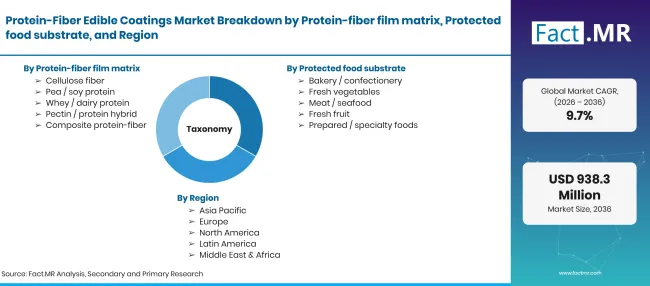
Protein Fiber Edible Coatings Taxonomy | Source: Fact.MR
| Items | Values |
|---|---|
| Quantitative Units (2026) | USD 160.0 Million |
| Protein-fiber coating matrix | Whey protein-cellulose, Pea protein-cellulose, Soy protein-fiber; Pectin-protein; Hybrid biopolymer |
| Commercial form | Powder, Liquid concentrate, Granulate; Encapsulated bead; Ready-to-use premix |
| Food application | Bakery, Dairy / alternatives, Beverage; Meat / savory; Confectionery / snacks |
| Primary function | Shelf-life, Texture / rheology, Taste / color; Nutritional functionality; Processing stability |
| Regions Covered | North America, Latin America, Europe; East Asia; South Asia and Pacific; Middle East & Africa |
| Countries Covered | Netherlands, United States, India; Spain; China; and other countries |
| Key Companies Profiled | Arla Foods Ingredients, Glanbia Nutritionals, Fonterra; Kerry Group; Roquette; Ingredion |
| Additional Attributes | Dollar revenue in the Protein-Fiber Edible Coatings Market is segmented by protein-fiber coating matrix (whey protein-cellulose, pea protein-cellulose, soy protein-fiber; pectin-protein; hybrid biopolymer); commercial form (powder; liquid concentrate; granulate; encapsulated bead; ready-to-use premix); food application (bakery; dairy / alternatives; beverage; meat / savory; confectionery / snacks); primary function (shelf-life; texture / rheology; taste / color; nutritional functionality; processing stability) and region. |
Source: Fact.MR analysis. Updated Nov 19, 2026
Protein-Fiber Edible Coatings Market by Segments
-
Protein-fiber coating matrix
- Whey protein-cellulose
- Pea protein-cellulose
- Soy protein-fiber
- Pectin-protein
- Hybrid biopolymer
-
Commercial form
- Powder
- Liquid concentrate
- Granulate
- Encapsulated bead
- Ready-to-use premix
-
Food application
- Bakery
- Dairy / alternatives
- Beverage
- Meat / savory
- Confectionery / snacks
-
Primary function
- Shelf-life
- Texture / rheology
- Taste / color
- Nutritional functionality
- Processing stability
-
Region:
- North America
- United States
- Canada
- Mexico
- Europe
- Germany
- United Kingdom
- France
- Italy
- Spain
- Rest of Europe
- Asia Pacific
- China
- India
- Japan
- South Korea
- Australia
- Rest of Asia Pacific
- Latin America
- Brazil
- Mexico
- Argentina
- Rest of Latin America
- Middle East & Africa
- GCC Countries
- South Africa
- Rest of Middle East & Africa
- North America
Frequently Asked Questions
How big is the global Protein-Fiber Edible Coatings Market in 2026?
What will be the size of the Protein-Fiber Edible Coatings Market by 2036?
How fast will the Protein-Fiber Edible Coatings Market grow during the forecast period?
Which protein-fiber coating matrix segment holds the largest share of the Protein-Fiber Edible Coatings Market?
Who worked on this report


Preview the report firsthand - request a free sample
Free SampleGet the brochure for pricing and purchase details
Download PDF