- Market Value (2025): USD 705.1 Mn
- Estimated Value (2026): USD 782.7 Mn
- Forecast Value (2036): USD 2222.3 Mn
- CAGR (2026-2036): 11.0%
What is the Early Stage Lung Cancer Detection Market forecast to be worth by 2036?
USD 782.7 million in 2026 to USD 2,222.3 million by 2036, at 11.0% CAGR.
- The Early Stage Lung Cancer Detection Market crossed a valuation of USD 705.1 million in 2025, supported by screening activity and diagnostic follow-up.
- Demand is projected to increase from USD 782.7 million in 2026 to USD 2,222.3 million by 2036.
- The market is forecast to record an 11.0% CAGR from 2026 to 2036 as LDCT screening and nodule management become more closely connected with selective molecular testing.
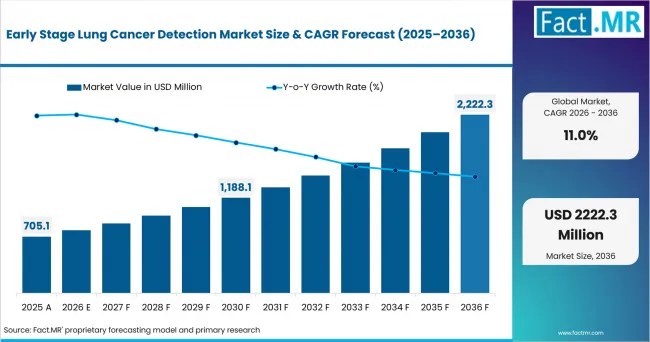
Early Stage Lung Cancer Detection Market Value Analysis | Source: Fact.MR
What are the defining numbers behind Early Stage Lung Cancer Detection Market growth?
USD 1,439.6 million absolute opportunity by 2036, led by LDCT and NGS alongside NSCLC and Hospitals.
- Demand Drivers in the Market
- Doctors require a clear LDCT screening process because eligible patients return for scans each year. Any suspicious finding also has to move into a recorded follow-up plan.
- Hospitals benefit from simple rules for handling lung nodules. This helps reduce delays caused by false alarms or missed handoffs between departments.
- Clinical laboratories require tests that can find very small signs of cancer in blood. Early tumors often release only a small amount of material into the sample.
- Imaging and cancer care staffs work better when CT findings move smoothly into biopsy review, genetic testing and joint medical discussion. Clear responsibility at each step helps prevent patients from being lost during follow-up.
- Key Segments Analyzed
- By Detection Method: Low-Dose Computed Tomography (LDCT) is expected to hold 25.0% share in 2026 supported by established use in defined high-risk screening groups.
- By Technology: Next-Generation Sequencing (NGS) is projected to account for 25.0% share in 2026 owing to its role in reading multiple cancer-relevant genes from tissue or blood workflows.
- By Cancer Type: Non-Small Cell Lung Cancer (NSCLC) is anticipated to represent 45.0% share in 2026 because most molecular testing and therapy-routing decisions are built around NSCLC classification.
- By End User: Hospitals are estimated to capture 25.0% share in 2026 as they connect imaging and pathology with pulmonology and oncology planning.
- Analyst Opinion at Fact.MR
- Shambhu Nath Jha, Senior Analyst at Fact.MR, states, “Early lung cancer detection depends on how well a test fits into the full care process. A strong result alone is not enough. Hospitals are likely to prefer systems that connect scan findings, software review and selected blood or genetic tests with a clear next step. Providers that return easy-to-understand results in time for treatment decisions are expected to see wider use.”
- Strategic Implications
- Hospital staffs first identify which patients qualify for LDCT screening. Clear responsibility for yearly recall helps keep follow-up on track after a positive scan.
- Imaging centers use Lung-RADS rules to guide repeat scans. The same process should work across every site before screening is expanded.
- Clinical laboratories test ctDNA and methylation methods on early-stage samples before wider use. This is important because small tumors often release very little material into the blood.
- Technology vendors have to show that their tools work with radiology and lung-care systems. AI and risk-score claims carry more value when they fit the daily work of doctors.
The evidence base is moving through screening guidance and national programmes as controlled validation replaces broad commercial claims. In January 2025, the National Cancer Institute said its Vanguard Study is set to enroll up to 24,000 people to test how multi-cancer detection assays should be studied in larger randomized trials. That scale is relevant because lung cancer blood tests need evidence on follow-up burden as well as detection signal.
Germany is projected to record a 14.9% CAGR from 2026 to 2036, supported by screening organization and specialist referral depth. Brazil is anticipated to post a 13.8% CAGR through 2036 as access expands across public and private care. The USA is estimated to advance at a 12.7% CAGR by 2036 owing to screening guidance and diagnostic innovation. South Korea is forecast to record an 11.6% CAGR from 2026 to 2036 as hospital concentration supports precision-medicine infrastructure. The United Kingdom is expected to register a 10.5% CAGR by 2036 as national screening work expands. Japan is projected to post a 9.4% CAGR through 2036 as adoption remains careful around overdiagnosis and follow-up burden.
How does the Early Stage Lung Cancer Detection Market break down by segment?
Non-Small Cell Lung Cancer (NSCLC) is anticipated at 45.0% by Cancer Type, and Hospitals are estimated at 25.0% by End User in 2026.
Which Detection Method dominates?
Low-Dose Computed Tomography (LDCT) holds 25.0% share in 2026.
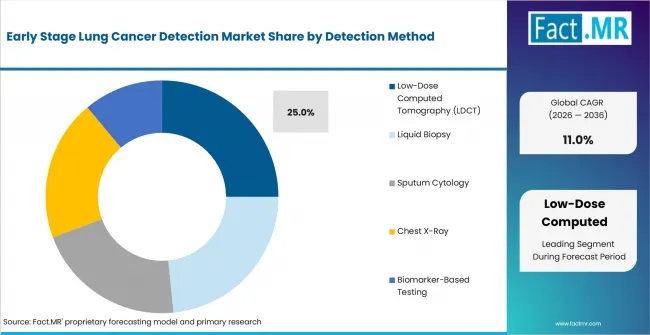
Early Stage Lung Cancer Detection Market Analysis By Detection Method | Source: Fact.MR
Low-Dose Computed Tomography (LDCT) gives clinicians a visible lung image that can be compared across repeat screening rounds. Liquid Biopsy becomes more useful after imaging identifies a suspicious finding and the care pathway needs a less invasive molecular signal. Sputum Cytology and Chest X-Ray remain limited to narrower triage settings, while Biomarker-Based Testing depends on evidence that it improves follow-up decisions instead of adding another isolated result.
What leads the Technology segment?
Next-Generation Sequencing (NGS) accounts for 25.0% share in 2026.
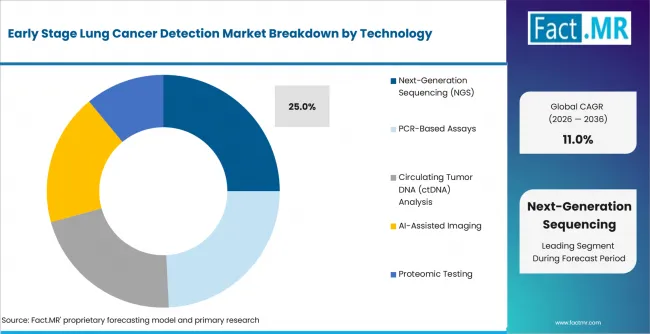
Early Stage Lung Cancer Detection Market Analysis By Technology | Source: Fact.MR
Broader molecular review gives Next-Generation Sequencing (NGS) an important role when suspicious nodules move toward diagnosis and treatment planning. PCR-Based Assays answer more focused mutation questions and suit cases where the clinical target is already known. Circulating Tumor DNA Analysis adds a blood-based route, while AI-Assisted Imaging supports scan review before tissue confirmation. Proteomic Testing remains more dependent on validation that connects the signal with a clear diagnostic action.
How does Cancer Type shape demand?
Non-Small Cell Lung Cancer (NSCLC) leads with 45.0% share in 2026.
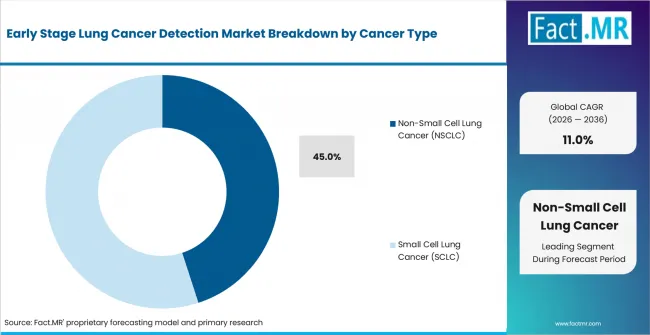
Early Stage Lung Cancer Detection Market Analysis By Cancer Type | Source: Fact.MR
Most screening, nodule assessment and molecular classification pathways are designed around finding Non-Small Cell Lung Cancer before it reaches an advanced stage. Small Cell Lung Cancer follows a faster clinical course, which leaves less time for early-stage testing. In January 2026, the American Cancer Society reported that NSCLC accounts for about 77% of lung cancers, compared with about 13% for SCLC. This disease mix gives NSCLC a larger role across imaging and molecular follow-up.
What supports Hospitals within End User?
Hospitals capture 25.0% share in 2026.
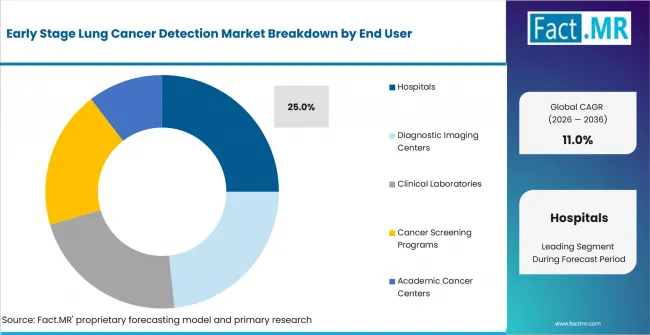
Early Stage Lung Cancer Detection Market Analysis By End User | Source: Fact.MR
A positive screening result often moves through radiology, pulmonology, pathology and oncology before a final decision is made. Hospitals can bring these services together and review scan findings, biopsy results and molecular evidence within one care pathway. Diagnostic Imaging Centers contribute screening capacity, while Clinical Laboratories provide assay depth. Cancer Screening Programs widen access, and Academic Cancer Centers generate evidence on how newer detection methods fit into routine care.
What is accelerating Early Stage Lung Cancer Detection Market adoption, and what is holding it back?
Screening eligibility and pathway buildout are expected to accelerate adoption. False positives and follow-up gaps are anticipated to restrain adoption alongside early-stage assay sensitivity when the next step is unclear.
Drivers Impact Analysis
| DRIVER | (~) % IMPACT ON CAGR | GEOGRAPHIC RELEVANCE | IMPACT TIMELINE |
|---|---|---|---|
| Screening eligibility expansion | +2.0% | Germany and USA | Short term (<= 2 years) |
| National screening programme rollout | +1.5% | U.K. and Germany | Medium term (2-4 years) |
| Multimodal molecular and AI-assisted risk validation | +1.1% | U.K. and South Korea | Medium term (2-4 years) |
| NSCLC-focused NGS adoption | +0.8% | USA and South Korea | Long term (>= 4 years) |
| Hospital-based screening infrastructure buildout | +0.6% | Germany and Brazil | Long term (>= 4 years) |
Source: Fact.MR analysis. Updated Jul 20, 2026
- Screening eligibility expansion: CDC guidance updated in May 2026 points to yearly LDCT for people aged 50 to 80 with a 20 pack-year or heavier smoking history. That wider group is expected to raise demand where hospitals can invite and recall patients reliably.
- National screening programme rollout: NHS England reported in March 2025 that about 995,000 people were invited in 2024/25. That programme is projected to support U.K. demand because mobile CT and referral routes move screening closer to high-risk communities.
- Multimodal molecular and AI-assisted risk validation: ctDNA and methylation tools are expected to gain room where they sharpen triage without replacing LDCT.
- NSCLC-focused NGS adoption: NGS is anticipated to support follow-up decisions because NSCLC care often depends on molecular classification after imaging confirms suspicion.
- Hospital-based screening infrastructure buildout: Hospitals are estimated to gain demand when they connect imaging capacity with biopsy and pathology access.
Opportunity Impact Analysis
| OPPORTUNITY | (~) % IMPACT ON CAGR | GEOGRAPHIC RELEVANCE | IMPACT TIMELINE |
|---|---|---|---|
| Liquid-biopsy and multimodal test expansion | +0.6% | South Korea and U.K. | Medium term (2-4 years) |
| AI-assisted imaging and nodule-management software | +0.5% | USA and Germany | Medium term (2-4 years) |
| Screening capacity build-out in mixed public-private systems | +0.4% | Brazil | Long term (>= 4 years) |
| Academic and specialty cancer-center partnerships | +0.3% | Germany and South Korea | Long term (>= 4 years) |
Source: Fact.MR analysis. Updated Jul 20, 2026
- Liquid-biopsy and multimodal test expansion: Blood-based testing is projected to grow where providers need a second signal after imaging or risk assessment.
- AI-assisted imaging and nodule-management software: Radiology teams are expected to use software when it reduces measurement burden and fits existing PACS workflows.
- Screening capacity build-out in mixed public-private systems: Brazil is anticipated to create demand where regional access gaps make screening and follow-up coordination difficult.
- Academic and specialty cancer-center partnerships: Specialist centers are estimated to support validation because they connect imaging and molecular testing with outcome tracking.
Restraints Impact Analysis
| RESTRAINT | (~) % IMPACT ON CAGR | GEOGRAPHIC RELEVANCE | IMPACT TIMELINE |
|---|---|---|---|
| Incomplete pathway linkage from screen to treatment | -0.9% | Global | Short term (<= 2 years) |
| False positives and overdiagnosis with incidental findings | -0.6% | Japan | Short term (<= 2 years) |
| Risk-model and eligibility limitations | -0.5% | USA | Medium term (2-4 years) |
| Liquid-biopsy sensitivity limits in early-stage disease | -0.4% | South Korea | Medium term (2-4 years) |
Source: Fact.MR analysis. Updated Jul 20, 2026
- Incomplete pathway linkage from screen to treatment: Adoption is expected to slow where positive scans do not move quickly into diagnostic workup and treatment planning.
- False positives and overdiagnosis: Screening programs are anticipated to face caution where harmless nodules lead to anxiety or invasive procedures.
- Risk-model and eligibility limitations: U.S. adoption is estimated to remain sensitive to smoking history rules and differences between guideline groups.
- Liquid-biopsy sensitivity limits in early-stage disease: Early tumors often shed little analyte, so assay adoption is projected to depend on clear validation in low-burden disease.
Which countries are scaling Early Stage Lung Cancer Detection Market fastest?
The global growth rate includes every country covered in the market study. Germany, Brazil, the USA and South Korea grow faster than the worldwide rate of 11.0%. The U.K. and Japan grow at a slower pace. Results from other countries help balance the global figure. The six markets shown are examples and do not cover the full geographic study.
- The main difference between these countries comes from how lung screening and follow-up care are organized.
- Germany benefits from clear screening steps, university hospitals and specialist referral centers. These systems help move a suspicious LDCT result into nodule review and treatment planning. Brazil follows a wider access model. Growth depends on connecting public and private screening services with reliable referral support across different regions.
- The USA has established screening guidance, molecular tests and a large base of diagnostic companies. South Korea depends more on major cancer centers that bring imaging, NGS testing and digital review into one setting.
- The U.K. is expanding through national lung screening work and NHS referral routes. Mobile CT services also bring screening closer to people at higher risk. Japan is taking a more careful approach as hospitals consider false alarms, unrelated findings and unnecessary follow-up.
Countries with similar growth rates can still offer different business openings. Screening rules, access to imaging, nodule review, test sensitivity and referral speed all affect when demand appears. The complete report covers North America, Latin America, Western Europe, Eastern Europe, East Asia, South Asia and Pacific, and the Middle East and Africa.
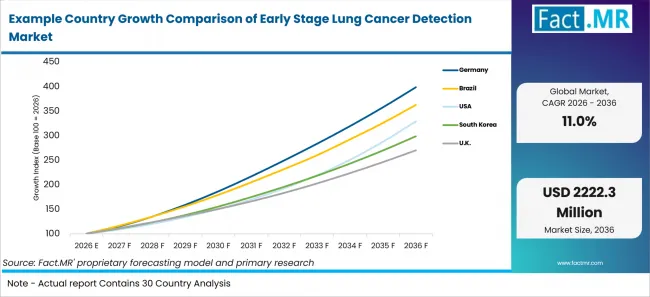
Example Country Growth Comparison Of Early Stage Lung Cancer Detection Market | Source: Fact.MR
| COUNTRY | CAGR 2026 TO 2036 |
|---|---|
| Germany | 14.9% |
| Brazil | 13.8% |
| USA | 12.7% |
| South Korea | 11.6% |
| U.K. | 10.5% |
| Japan | 9.4% |
Source: Fact.MR analysis. Updated Jul 20, 2026
What is driving Germany’s growth through 2036?
14.9% CAGR, driven by organized screening and specialist nodule-review capacity.
Germany’s opportunity depends on turning LDCT findings into a defined clinical decision instead of treating screening as a single scan. University hospitals and radiology networks can connect nodule classification with repeat imaging, biopsy review and oncology referral. The market is projected to record a 14.9% CAGR through 2036 as screening services adopt clearer rules for patient recall and follow-up.
How is Brazil scaling demand?
13.8% CAGR, supported by wider screening access across public and private care.
Brazil faces a delivery challenge created by uneven access to CT equipment and specialist lung-care services across regions. Growth is expected to come from programs that identify high-risk patients locally and provide a dependable route to imaging and diagnostic review. This need for connected screening and referral services supports a 13.8% CAGR through 2036.
How does the USA perform?
12.7% CAGR, backed by annual LDCT guidance and molecular follow-up capacity.
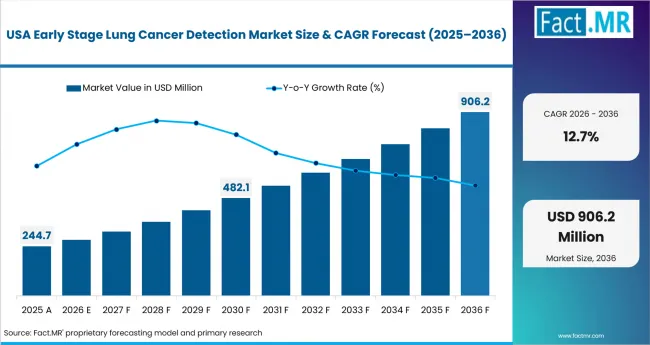
Early Stage Lung Cancer Detection Market Country Value Analysis | Source: Fact.MR
The U.S. market has a defined screening population rather than relying on broad testing of all adults. Current CDC guidance recommends annual LDCT for people aged 50 to 80 who meet high-risk smoking-history criteria. The commercial opening extends into software review, biopsy planning and selected molecular testing after a suspicious scan, supporting a 12.7% CAGR through 2036.
How does South Korea perform?
11.6% CAGR, driven by national screening infrastructure and concentrated hospital care.
South Korea already includes lung cancer within its national cancer-screening system. Major hospitals can connect LDCT results with digital imaging records, pathology and molecular analysis within one care setting. This concentration is expected to support an 11.6% CAGR through 2036 as imaging AI and NGS move first through specialist centers with strong follow-up capacity.
How does the U.K. perform?
10.5% CAGR, led by targeted community screening and NHS referral pathways.
England is taking screening closer to high-risk groups through lung health checks and mobile CT services instead of depending only on hospital attendance. NHS England reported that approximately 995,000 people were invited during 2024/25, while more than 75% of cancers detected through the program were found at an early stage. Wider rollout is expected to sustain a 10.5% CAGR through 2036 as invitation, scanning and referral operate within one national pathway.
How does Japan perform?
9.4% CAGR, shaped by imaging capacity and caution over unnecessary follow-up.
Japan has strong access to imaging and specialist medical review, but wider early-detection use depends on managing false positives and incidental nodules carefully. A screening result has limited value when it leads to avoidable repeat scans or invasive procedures without a clear risk threshold. The market is projected to post a 9.4% CAGR through 2036 as providers strengthen local validation and nodule-management rules before broader adoption.
Who leads the Early Stage Lung Cancer Detection Market?
Guardant Health; Exact Sciences; F. Hoffmann-La Roche Ltd.; Illumina; Thermo Fisher Scientific; QIAGEN; Siemens Healthineers; GE HealthCare Technologies Inc.; Philips; Fujifilm.
Guardant Health is active in blood-based cancer detection through Shield and research on tests for several cancers. Exact Sciences works across cancer testing and molecular residual disease. F. Hoffmann-La Roche Ltd. and Thermo Fisher Scientific support laboratory testing, while QIAGEN and Illumina provide assay tools and sequencing systems for oncology work.
Siemens Healthineers and GE HealthCare Technologies Inc. supply imaging equipment and hospital diagnostic systems. Philips and Fujifilm support radiology work and imaging access. Their role is different from blood-test companies because LDCT quality and careful lung nodule review directly affect screening.
Each company is included only where official company or regulator information shows a clear link to early cancer detection, oncology testing, imaging or hospital diagnosis. Revenue and sales shares are not added without direct proof. Product claims are also left out unless official evidence supports them.
Which companies are the key providers?
- Guardant Health, Inc.
- Exact Sciences Corporation
- F. Hoffmann-La Roche Ltd.
- Illumina, Inc.
- Thermo Fisher Scientific Inc.
- QIAGEN N.V.
- Siemens Healthineers AG
- GE HealthCare Technologies Inc.
- Koninklijke Philips N.V.
- FUJIFILM Holdings Corporation
Bibliography
- Centers for Disease Control and Prevention. (2026, May 12). Screening for lung cancer.
- Guardant Health, Inc. (2025, July 15). First patient enrolled in National Cancer Institute’s Vanguard Study evaluating Guardant Health’s Shield multi-cancer detection test.
- Illumina, Inc. (2025, May 28). Illumina expands clinical oncology portfolio, unlocking new standard of care and access to precision therapies.
- National Cancer Institute. (2025, January 7). NCI selects two assays for the Vanguard Study on multi-cancer detection tests.
This Report Addresses
- The report provides strategic intelligence on Low-Dose Computed Tomography (LDCT) and Liquid Biopsy. It also covers Sputum Cytology and Chest X-Ray alongside Biomarker-Based Testing within early lung cancer detection.
- Segment analysis covers Next-Generation Sequencing (NGS) and PCR-Based Assays. It also covers Circulating Tumor DNA (ctDNA) Analysis and AI-Assisted Imaging alongside Proteomic Testing.
- Regional outlook evaluates Germany and Brazil as well as the USA and South Korea. It also covers the U.K. and Japan while preserving the stated country CAGR hierarchy from the market.
- Competitive analysis profiles Guardant Health and Exact Sciences alongside F. Hoffmann-La Roche Ltd. and Illumina. It also covers Thermo Fisher Scientific and QIAGEN with Siemens Healthineers and GE HealthCare Technologies Inc.. Philips and Fujifilm are included without assigning unsupported company share.
- Use-case assessment covers Hospitals and Diagnostic Imaging Centers. It also covers Clinical Laboratories and Cancer Screening Programs alongside Academic Cancer Centers.
What does the Early Stage Lung Cancer Detection Market cover?
Low-dose CT screening and imaging analytics are included alongside liquid biopsy and molecular assays. Related services are covered when they help identify lung cancer before symptoms or advanced-stage spread.
The Early Stage Lung Cancer Detection Market covers clinical tools that help providers find suspicious lung cancer signals early and move patients toward follow-up. Coverage includes imaging and molecular testing as well as biomarker workflows and screening-program support across the listed segment names.
The market differs from lung cancer treatment because commercial value starts before confirmed advanced disease management. Therapeutics and full hospital care expenditure remain outside the boundary unless they support early detection.
What is included in the scope?
Detection methods and technologies are included alongside cancer types and end users without changing segment names or subsegment names.
The scope includes Low-Dose Computed Tomography (LDCT) and Liquid Biopsy. It also covers Sputum Cytology and Chest X-Ray alongside Biomarker-Based Testing. The technology scope covers NGS and PCR-based assays as well as ctDNA analysis and AI-assisted imaging. Proteomic testing is included when it supports early lung cancer detection or follow-up decisions.
What is excluded from the scope?
Therapeutics and general oncology care expenditure are outside the scope. Unrelated imaging procedures and unsupported company share claims are also excluded.
The scope excludes unsupported market values and company announcements that are not backed by official releases. Claims that cannot be tied to named sources are also excluded. Public sources provide context for market interpretation and do not replace Fact.MR market values.
How Was the Analysis Built?
The analysis draws on 120+ sources, 35+ company portfolios, 25+ countries, and more than 20 industry interviews.
- Primary Research: Primary research includes discussions with manufacturers, service providers, technology developers, distributors, end users, procurement teams, and subject-matter experts. These conversations examine purchasing priorities, product adoption, operational challenges, approval requirements, competitive positioning, and the factors that influence wider market acceptance.
- Desk Research: Desk research covers government statistics, regulatory publications, company filings, trade data, technical studies, industry associations, standards, public policy, and other authoritative sources. Every source used in the analysis is documented in the bibliography.
- Market Sizing and Forecasting: Market estimates combine historical performance, demand indicators, pricing and volume trends, segment shares, company participation, country-level growth, adoption patterns, investment activity, and barriers to market expansion.
- Data Validation and Update Cycle: Findings are validated by comparing primary interviews with public data, company activity, regulatory changes, trade patterns, and industry developments. Regular updates review new product launches, capacity changes, partnerships, approvals, procurement trends, and shifts in commercial adoption.
Segmentation
What is the report’s scope and coverage?
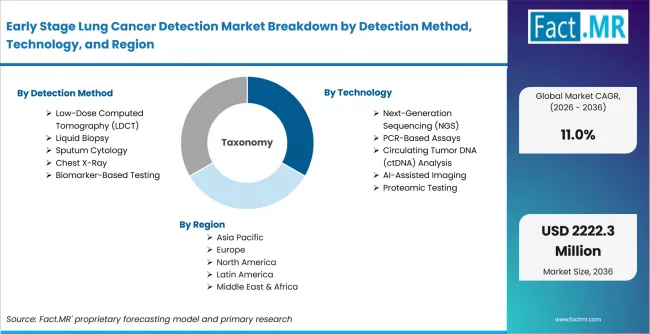
Early Stage Lung Cancer Detection Market Breakdown By Detection Method, Technology, And Region | Source: Fact.MR
| Attribute | Details |
|---|---|
| Quantitative Units | USD Million in 2026 to USD Million by 2036 at a CAGR |
| Market Definition | Clinical imaging, molecular testing, biomarker workflows, screening tools, and related services used to identify lung cancer at an early stage and guide patients from initial screening through diagnostic follow-up |
| Detection Method | Low-Dose Computed Tomography (LDCT); Liquid Biopsy; Sputum Cytology; Chest X-Ray; Biomarker-Based Testing |
| Technology | Next-Generation Sequencing (NGS); PCR-Based Assays; Circulating Tumor DNA (ctDNA) Analysis; AI-Assisted Imaging; Proteomic Testing |
| Cancer Type | Non-Small Cell Lung Cancer (NSCLC); Small Cell Lung Cancer (SCLC) |
| End User | Hospitals; Diagnostic Imaging Centers; Clinical Laboratories; Cancer Screening Programs; Academic Cancer Centers |
| Regions Covered | North America; Latin America; Western Europe; Eastern Europe; East Asia; South Asia and Pacific; Middle East and Africa |
| Countries Covered | United States; Canada; Brazil; Mexico; Argentina; Chile; Germany; United Kingdom; France; Italy; Spain; Russia; Poland; China; Japan; South Korea; India; Australia; ASEAN Countries; GCC Countries; South Africa |
| Key Companies Profiled | Guardant Health, Inc.; Exact Sciences Corporation; F. Hoffmann-La Roche Ltd.; Illumina, Inc.; Thermo Fisher Scientific Inc.; QIAGEN N.V.; Siemens Healthineers AG; GE HealthCare Technologies Inc.; Koninklijke Philips N.V.; FUJIFILM Holdings Corporation |
| Forecast Period | 2026 to 2036 |
| Approach | Hybrid top-down and bottom-up approach using screening activity; LDCT adoption; diagnostic follow-up volumes; molecular and liquid-biopsy testing uptake; cancer incidence and screening eligibility; technology adoption; end-user demand; country-level growth; company participation; pricing and volume trends; primary interviews and supplier validation |
Source: Fact.MR analysis. Updated Jul 20, 2026
How is the market segmented?
-
By Detection Method
- Low-Dose Computed Tomography (LDCT)
- Liquid Biopsy
- Sputum Cytology
- Chest X-Ray
- Biomarker-Based Testing
-
By Technology
- Next-Generation Sequencing (NGS)
- PCR-Based Assays
- Circulating Tumor DNA (ctDNA) Analysis
- AI-Assisted Imaging
- Proteomic Testing
-
By Cancer Type
- Non-Small Cell Lung Cancer (NSCLC)
- Small Cell Lung Cancer (SCLC)
-
By End User
- Hospitals
- Diagnostic Imaging Centers
- Clinical Laboratories
- Cancer Screening Programs
- Academic Cancer Centers
-
By Region
- North America
- United States
- Canada
- Latin America
- Brazil
- Mexico
- Argentina
- Chile
- Western Europe
- Germany
- U.K.
- France
- Italy
- Spain
- Eastern Europe
- Russia
- Poland
- East Asia
- China
- Japan
- South Korea
- South Asia and Pacific
- India
- Australia
- ASEAN
- Middle East and Africa
- GCC Countries
- South Africa
- North America
Frequently Asked Questions
Which Detection Method leads the Early Stage Lung Cancer Detection Market?
Which Technology leads the market?
Which Cancer Type leads the market?
Which End User leads the market?
Which country records the highest CAGR?
What is the main restraint?
Why does liquid biopsy need careful validation?
What makes hospitals central to demand?
Who worked on this report


Preview the report firsthand - request a free sample
Free SampleGet the brochure for pricing and purchase details
Download PDF