- Market Value (2025): USD 180 Mn
- Estimated Value (2026): USD 205 Mn
- Forecast Value (2036): USD 610 Mn
- CAGR (2026-2036): 11.5%
What is the elastomeric pump cartridges market forecast to be worth by 2036?
USD 205 million in 2026 to USD 610 million by 2036 at 11.5% CAGR.
- The Elastomeric Pump Cartridges Market was valued at USD 180 million in 2025. The market is estimated at USD 205 million in 2026. It is projected to reach USD 610 million by 2036.
- The market is forecast to expand at 11.5% CAGR during the forecast period as demand for home infusion therapy and outpatient drug delivery continues increasing.
- Elastomeric pump cartridges are disposable reservoirs used in elastomeric infusion pumps to deliver medications at controlled flow rates. They support portable infusion therapy without requiring electronic power.
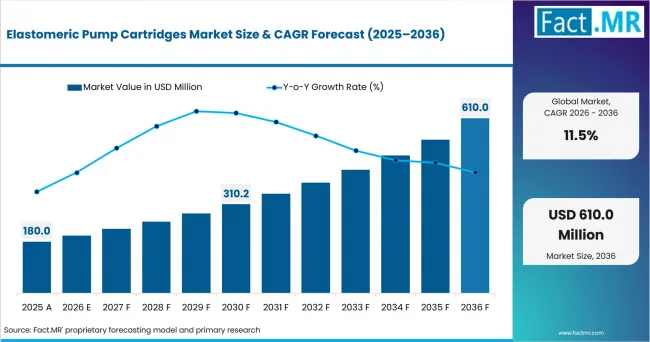
Elastomeric Pump Cartridges Market Market Value Analysis | Source: Fact.MR
What are the defining numbers behind elastomeric pump cartridges growth?
USD 405 million absolute opportunity by 2036 led by the United States and Germany.
- Demand Drivers in the Market
- Home infusion therapy continues expanding.
- Ambulatory care services continue growing.
- Disposable infusion systems improve patient convenience.
- Healthcare providers continue adopting portable drug delivery technologies.
- Key Segments Analyzed
- By Reservoir Size: 100-250 ml is expected to hold 34.0% share in 2026 because it supports a wide range of infusion therapies.
- By Flow Type: Fixed-Rate is projected to account for 41.0% share in 2026 because it provides simple and reliable medication delivery.
- By Application: Pain Management is expected to hold 36.0% share in 2026 because elastomeric pumps are widely used after surgery.
- By End User: Hospital are projected to account for 47.0% share in 2026 because they remain the primary users of infusion therapy systems.
- By Geography: The United States is projected to record 11.9% CAGR through 2036.
- Analyst Opinion at Fact.MR
- Shambhu Nath Jha, Senior Analyst at Fact.MR, states, "Elastomeric pump cartridges are becoming an important part of portable infusion therapy. Healthcare providers continue adopting disposable infusion systems that improve patient comfort and support treatment outside traditional hospital settings. Continued growth in home healthcare will strengthen long-term market demand."
- Strategic Implications
- Expand production of disposable pump cartridges.
- Improve compatibility across elastomeric pump platforms.
- Strengthen partnerships with hospitals and home healthcare providers.
- Invest in advanced infusion control technologies.
The United States is projected to record 11.9% CAGR through 2036 because ambulatory infusion therapy continues expanding. Germany is expected to grow at 11.6% CAGR due to wider adoption of home healthcare services. Japan is forecast to expand at 11.3% CAGR because the aging population continues increasing demand for long-term infusion therapy. China is projected to register 11.1% CAGR through 2036 as healthcare infrastructure continues improving. South Korea is expected to grow at 10.8% CAGR due to rising investment in outpatient care.
How is the elastomeric pump cartridges market segmented?
100-250 ml leads at 34.0%. Hospitals lead at 47.0%.
Which reservoir size accounts for the largest market share?
100-250 ml holds 34.0% share in 2026.
The 100-250 ml segment leads because it supports a broad range of infusion therapies. It provides sufficient capacity for post-operative pain management, antibiotic therapy and chemotherapy while remaining comfortable for patients to carry. Healthcare providers prefer this reservoir size because it balances portability with treatment duration. Avanos Medical announced that its ON-Q® Elastomeric Infusion Pump and ambIT® Disposable Electronic Infusion Pump will receive separate Medicare payment under the U.S. Centers for Medicare & Medicaid Services (CMS) NOPAIN Act beginning January 1, 2025. The reimbursement supports broader adoption of disposable infusion pump systems used for post-operative pain management, including elastomeric pumps that incorporate single-use medication reservoirs (cartridges).
Why does fixed-rate technology dominate the market?
Fixed-Rate leads with 41.0% share in 2026.
Fixed-rate cartridges generate the highest demand because they provide consistent drug delivery without electronic programming. Their simple design reduces operating complexity and supports dependable treatment. Healthcare providers continue selecting fixed-rate systems for routine infusion therapy. Easy operation also improves adoption across outpatient settings. The Centers for Medicare & Medicaid Services (CMS) implemented the NOPAIN Act payment policy beginning January 1, 2025, providing separate Medicare payment for qualifying non-opioid pain management devices used in hospital outpatient departments and ambulatory surgery centers.
Which application creates the highest demand?
Pain Management holds 36.0% share in 2026.
Pain management remains the largest application because elastomeric pumps are widely used after surgical procedures. Continuous medication delivery helps improve patient comfort while reducing dependence on inpatient care. Hospitals continue expanding enhanced recovery programs. This supports greater use of disposable pump cartridges. Demand remains high across orthopedic and general surgery.
Which end-user segment leads market demand?
Hospitals account for 47.0% share in 2026.
Hospitals remain the largest end users because they perform the highest number of infusion procedures. They also initiate many treatments that continue through outpatient or home healthcare services. Healthcare facilities continue adopting portable infusion technologies to improve patient mobility. Progressive Medical, Inc. introduced SMARTeZ™ disposable elastomeric pumps, intended for intermittent and continuous antibiotic infusion, chemotherapy infusion, and general infusion therapies. The pumps are individually calibrated for accuracy and exert pressure to administer medication at predetermined flow rates.
What is driving market growth?
Home based infusion therapy supports expansion while reimbursement remains a challenge.
Healthcare providers continue shifting suitable treatments from hospitals to outpatient and home settings. Elastomeric pump cartridges support this transition through portable and disposable drug delivery. Growing cancer treatment, long-term antibiotic therapy, and post-operative pain management continue supporting market demand. Rising preference for patient-centered care also encourages product adoption.
Reimbursement differences across healthcare systems remain a challenge. Cost pressure may slow adoption in some regions. The pumps were designed for improved accuracy and patient comfort, with enhanced durability and user-friendly interfaces.
Where are future opportunities emerging?
- Home Healthcare:
- More patients are receiving long-term infusion therapy at home. Disposable cartridges improve convenience and treatment continuity.
- Oncology Centers:
- Chemotherapy treatment continues expanding. Portable infusion systems improve patient comfort during therapy.
- Ambulatory Infusion Centers:
- Outpatient infusion services continue growing. Elastomeric cartridges support efficient medication delivery.
- Post-Operative Care:
- Enhanced recovery programs continue encouraging portable pain management solutions. This supports wider product adoption.
Which countries are creating the strongest opportunities for elastomeric pump cartridges?
United States 11.9%, Germany 11.6%, Japan 11.3%, China 11.1%, South Korea 10.8%.
Regional demand continues expanding as healthcare systems increase the use of ambulatory infusion therapy and home based treatment. North America leads regional demand, while Asia Pacific continues recording strong growth through healthcare modernization.
| Country | CAGR (2026-2036) |
|---|---|
| United States | 11.9% |
| Germany | 11.6% |
| Japan | 11.3% |
| China | 11.1% |
| South Korea | 10.8% |
Source: Fact.MR analysis. Updated Jun 29, 2026
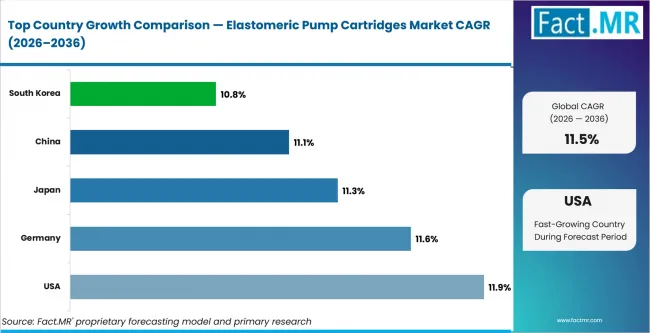
Elastomeric Pump Cartridges Market Cagr Analysis By Country | Source: Fact.MR
What supports the United States lead?
11.9% CAGR, supported by expanding home infusion services
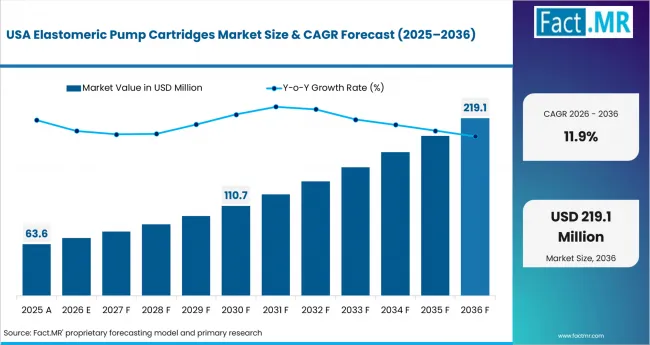
Elastomeric Pump Cartridges Market Country Value Analysis | Source: Fact.MR
The United States is projected to expand at an 11.9% CAGR through 2036 because healthcare providers continue shifting infusion therapy toward outpatient and home care settings. Hospitals are increasingly adopting elastomeric pump cartridges to improve patient mobility and reduce hospital stays. Rising demand for chemotherapy, antibiotic therapy and post-operative pain management also supports market expansion. The country leads global revenue contribution.
What is driving demand across Germany?
11.6% CAGR, driven by ambulatory care expansion
Germany is expected to grow at an 11.6% CAGR because ambulatory infusion services continue expanding across the healthcare system. Hospitals and specialty clinics are increasing the use of portable infusion devices to improve treatment efficiency and patient comfort. Growing acceptance of home healthcare also supports steady product demand. Germany is one of the key markets in Western Europe.
How is Japan strengthening the market for portable infusion therapy?
11.3% CAGR, backed by an aging population
Japan is forecast to register an 11.3% CAGR through 2036 because long-term infusion therapy continues increasing among elderly patients. Healthcare providers are adopting elastomeric pump cartridges to support treatment outside traditional hospital settings. Demand is also supported by greater focus on patient convenience and healthcare efficiency. The market continues expanding steadily across the country.
Why is China becoming a high-growth market?
11.1% CAGR, supported by healthcare infrastructure development
China is projected to expand at an 11.1% CAGR by 2036 because hospitals continue investing in advanced infusion technologies. Home healthcare services are also becoming more widely available across major cities. Rising oncology treatment volumes and better access to healthcare continue supporting market demand. China remains one of Asia’s higher-growth markets.
How is South Korea expanding adoption of elastomeric pump cartridges?
10.8% CAGR, backed by outpatient treatment growth
South Korea is expected to record a 10.8% CAGR because outpatient infusion services continue expanding across the country. Hospitals are adopting portable infusion systems to improve patient care and shorten hospital stays. Home healthcare providers are also increasing the use of disposable cartridges for long-term therapy. Continued healthcare investment supports sustained market growth.
How are companies strengthening their competitive position?
Baxter, B. Braun, Avanos Medical, Nipro, Leventon, Daiken Medical main lead positions
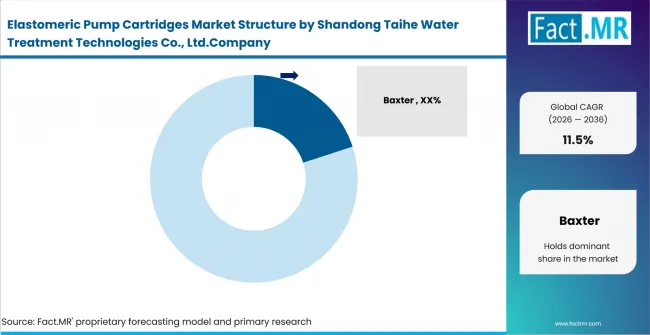
Elastomeric Pump Cartridges Market Analysis By Company | Source: Fact.MR
Manufacturers are expanding their infusion therapy portfolios with portable drug delivery systems that improve patient comfort and treatment flexibility. Product development focuses on accurate flow control, dependable reservoir performance and compatibility with multiple infusion therapies.
Hospitals remain the largest customer group because they initiate most infusion treatments. Home healthcare providers are steadily increasing purchases as more patients receive long-term therapy outside hospitals. Ambulatory infusion centers are also adopting elastomeric pump cartridges to improve treatment efficiency.
Pain management continues generating the highest demand because portable infusion pumps support recovery after surgery. Chemotherapy and home infusion also contribute to stable product demand across healthcare settings. Baxter and B. Braun maintain strong positions through broad infusion therapy portfolios. Avanos Medical continue expanding portable drug delivery solutions. Nipro, Leventon and Woo Young Medical continue strengthening their market presence through product innovation, wider distribution and clinical support. Manufacturers that deliver reliable infusion performance, broad product compatibility and dependable technical support are expected to strengthen their competitive position through 2036.
Who are the leading companies in the Elastomeric Pump Cartridges Market?
Baxter, B. Braun, Avanos Medical, Nipro, Leventon, Daiken Medical
- Baxter
- B. Braun
- Avanos Medical
- Nipro
- Leventon
- Daiken Medical Co., Ltd.
- Woo Young Medical Co., Ltd.
Bibliography
- Avanos Medical, Inc. (2024, November 11). ON-Q® Elastomeric Infusion Pump and ambIT® Disposable Electronic Infusion Pump to receive separate payment under NOPAIN Act starting January 1, 2025. Avanos Medical.
- Avanos Medical, Inc. (2026, February 3). CMS maintains NOPAIN Act eligibility for ON-Q® and ambIT® infusion pumps and adds Game Ready® in 2026. Avanos Medical.
- Centers for Medicare & Medicaid Services. (2026). Non-opioid treatments for pain relief. CMS.
- Progressive Medical, Inc. (2025). SMARTeZ® disposable elastomeric infusion pump. Progressive Medical.
- Baxter. (2026). Infusor ambulatory systems. Baxter.
- B. Braun. (2026). Easypump® II ST/LT elastomeric infusion pump. B. Braun.
- Daiken Medical Co., Ltd. (2026). COOPDECH product list: Disposable infusion pump. Daiken Medical.
- Vygon. (2026). Accufuser® elastomeric infusion pump. Vygon.
This Report Addresses
- Strategic assessment of elastomeric pump cartridge technologies.
- Analysis of reservoir size and flow type trends.
- Evaluation of application and end-user demand.
- Regional outlook covering the United States, Germany, Japan, China, and South Korea.
- Competitive assessment of major infusion therapy manufacturers.
- Analysis of home infusion and ambulatory care trends.
- Evaluation of hospital purchasing and outpatient treatment demand.
- Primary interviews and supplier benchmarking supporting market estimates.
- Assessment of innovation in portable infusion and disposable cartridge technologies.
- Analysis of future opportunities across infusion therapy applications.
How is the market defined?
Disposable cartridges designed for elastomeric infusion pumps.
The market covers sterile cartridges that store and deliver medications through portable elastomeric infusion systems used across hospitals and home healthcare.
Which products are included?
Disposable elastomeric pump cartridges.
The scope includes cartridges designed for fixed-rate, variable-rate, multi-rate and bolus-enabled infusion systems.
What falls outside the scope?
Electronic infusion pumps and reusable pump components.
The scope excludes programmable infusion pumps, syringe pumps, and reusable infusion reservoirs.
What methodology supports this study?
100+ sources, 30+ company assessments, 25+ countries, and industry interviews.
- Primary Research: Interviews with infusion specialists, hospital pharmacists, home healthcare providers and medical device manufacturers.
- Desk Research: Analysis of infusion therapy trends, outpatient care expansion and healthcare investment.
- Market Sizing and Forecasting: Estimates based on infusion procedure volumes, disposable cartridge adoption and healthcare purchasing trends.
- Data Validation and Update Cycle: Forecasts validated through supplier benchmarking and expert interviews.
Segmentation
What is the report's scope and coverage?
| Attribute | Details |
|---|---|
| Quantitative Units | USD Million in 2026 to USD Million by 2036 |
| Market Definition | Disposable elastomeric pump cartridges designed for controlled medication delivery through portable infusion pumps |
| Reservoir Sizes Covered | Below 50 ml, 50-100 ml, 100-250 ml, 250-500 ml, Above 500 ml |
| Flow Types Covered | Fixed-Rate, Variable-Rate, Multi-Rate, Bolus-Enabled, Disposable Cartridge |
| Applications Covered | Pain Management, Chemotherapy, Antibiotics, Post-Operative Care, Home Infusion |
| End Users Covered | Hospitals, Ambulatory Infusion Centers, Home Healthcare, Oncology Centers, ASCs |
| Regions Covered | North America, Western Europe, Asia Pacific, Latin America, Middle East & Africa |
| Key Countries Covered | United States, Germany, Japan, China, South Korea |
| Companies Covered | Baxter, B. Braun, Avanos Medical, Nipro, Leventon, Daiken Medical, Woo Young Medical |
| Forecast Period | 2026 to 2036 |
| Research Approach | Hybrid top-down and bottom-up methodology using infusion procedure volumes, ambulatory care adoption and healthcare purchasing analysis |
Source: Fact.MR analysis. Updated Jun 29, 2026
How is the market segmented?
-
By Reservoir Size
- Below 50 ml
- 50-100 ml
- 100-250 ml
- 250-500 ml
- Above 500 ml
-
By Flow Type
- Fixed-Rate
- Variable-Rate
- Multi-Rate
- Bolus-Enabled
- Disposable Cartridge
-
By Application
- Pain Management
- Chemotherapy
- Antibiotics
- Post-Operative Care
- Home Infusion
-
By End User
- Hospitals
- Ambulatory Infusion Centers
- Home Healthcare
- Oncology Centers
- ASCs
-
Region:
- North America
- United States
- Canada
- Europe
- Germany
- United Kingdom
- France
- Italy
- Spain
- Asia Pacific
- China
- Japan
- South Korea
- India
- Singapore
- Latin America
- Brazil
- Mexico
- Argentina
- Middle East & Africa
- GCC Countries
- South Africa
- Israel
- North America
Frequently Asked Questions
Which reservoir size accounts for the largest market share?
Why does pain management generate the highest demand?
What is driving market growth?
What is the biggest challenge for manufacturers?
Which end-user segment generates the highest demand?
Why are fixed-rate cartridges widely preferred?
How is home healthcare influencing market demand?
What opportunities are emerging for manufacturers?
Who worked on this report


Preview the report firsthand - request a free sample
Free SampleGet the brochure for pricing and purchase details
Download PDF