- Market Value (2025): USD 2.3 Bn
- Estimated Value (2026): USD 2.8 Bn
- Forecast Value (2036): USD 19.7 Bn
- CAGR (2026-2036): 21.4%
What is the Electrified Pickup Inverters Market forecast to be worth by 2036?
USD 2.8 billion in 2026 to USD 19.7 billion by 2036 at 21.4% CAGR.
- The Electrified Pickup Inverters Market crossed a valuation of USD 2.3 billion in 2025.
- Demand is projected to increase from USD 2.8 billion in 2026 to USD 19.7 billion by 2036.
- The market is forecast to record 21.4% CAGR from 2026 to 2036 as pickup OEMs and e-axle teams specify higher-output inverter systems.
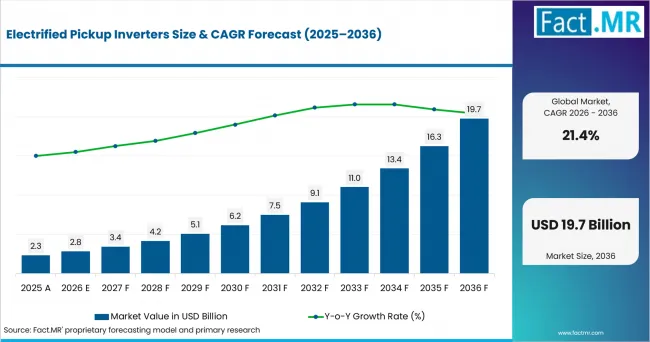
Electrified Pickup Inverters Value Analysis | Source: Fact.MR
What are the defining numbers behind Electrified Pickup Inverters Market growth?
An absolute opportunity of USD 16.9 billion is expected between 2026 and 2036.
- Demand Drivers in the Market
- Fleet operators need lower conversion losses because towing and payload duty cycles expose range loss quickly. Inverter efficiency therefore carries weight in commercial pickup programs where duty cycle data is used to compare usable range.
- Power-module suppliers need robust cooling paths as high-output inverter platforms combine high power density with demanding duty cycles. Buyers evaluate silicon carbide switching, coolant routing and package reliability together before approving inverter platforms.
- Accessory power teams need auxiliary inverters as worksite tools and onboard equipment enter electric pickup positioning. Power export features make inverter stability more visible to utility users and lifestyle pickup owners.
- Key Segments Analyzed
- By Drive Layout: Dual-motor AWD is expected to hold 44.0% share in 2026, supported by towing traction needs and wider traction inverter systems integration.
- By Voltage: 800 V is projected to account for 51.0% share in 2026 owing to faster charging targets and higher-power 800V inverter modules.
- By Power Class: 200-350 kW is anticipated to capture 34.0% share in 2026 due to mainstream pickup fit across work and lifestyle use.
- By Vehicle Segment: Full-size pickups are estimated to represent 48.0% share in 2026 because large platforms carry the clearest case for high-output electrified drivetrains.
- Analyst Opinion at Fact.MR
- Shambhu Nath Jha, Principal Consultant at Fact.MR, states, “Electrified pickup inverter programs are being judged on heat, software control and repeatable torque delivery. Suppliers are expected to gain share when they prove the same platform across towing, fast charging and accessory-power loads. The stronger offers combine silicon carbide power modules, validation depth and packaging that fits dual-motor pickup layouts.”
- Strategic Implications
- OEMs should validate inverter performance under trailer towing, steep-grade acceleration and repeated DC fast-charge events before platform release.
- Tier-1 suppliers should build modular housings that support single rear e-axle and dual-motor AWD programs from the same control architecture.
- Semiconductor vendors should document switching efficiency and thermal behavior for pickup duty cycles. Bosch announced the introduction in India of its third-generation silicon carbide chips in June 2026, stating that the new generation delivers about 20% higher performance and supports more efficient EV power electronics, particularly inverter applications.
- Thermal-system partners should align coolant routing with inverter location because underbody protection and service access shape pickup packaging choices.
South Korea is forecast to record 21.9% CAGR through 2036, supported by local EV component capability and electrified vehicle registration growth. The USA is projected to post 21.5% CAGR as full-size truck platforms make inverter output more visible. Germany is anticipated to advance at 21.1% CAGR owing to e-drive engineering depth. Canada is estimated to reach 20.8% CAGR through truck-heavy vehicle sales. The UK is forecast to record 15.1% CAGR as zero-emission light commercial vehicles widen the base for inverter adoption.
How does the Electrified Pickup Inverters Market break down by segment?
Dual-motor AWD leads Drive Layout at 44.0%; 800 V leads Voltage at 51.0%.
Which Drive Layout dominates?
Dual-motor AWD is expected to hold 44.0% share in 2026.
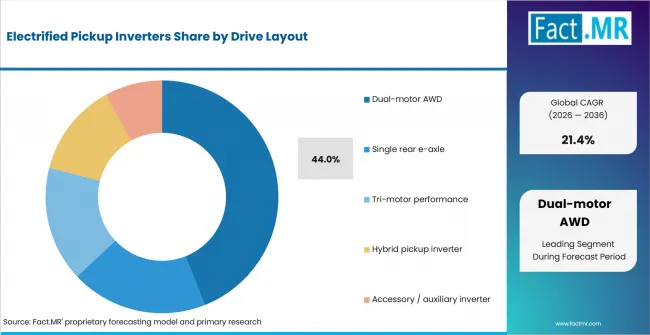
Electrified Pickup Inverters Analysis By Drive Layout | Source: Fact.MR
Dual-motor AWD leads because electrified pickups must deliver traction under trailer load and mixed road conditions. Front and rear drive units give OEMs more freedom to tune torque split while protecting range and tire wear.
This layout also fits the image of premium full-size electric trucks. It pairs naturally with EV traction motor development because each axle requires coordinated control between motor, inverter and vehicle software. Single rear e-axle designs remain relevant for lower-cost pickup variants.
What leads the Voltage segment?
800 V is projected to account for 51.0% share in 2026.
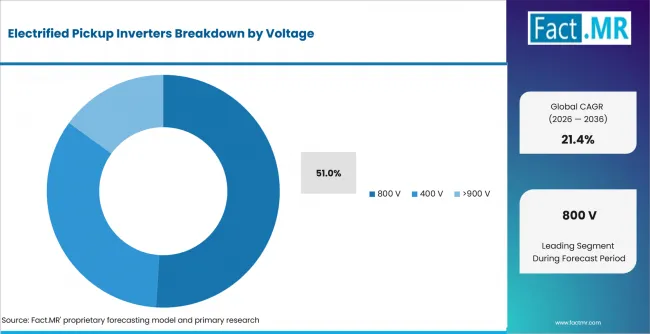
Electrified Pickup Inverters Analysis By Voltage | Source: Fact.MR
800 V architectures lead because higher voltage lowers current for a given power output. That helps reduce heat in cables and inverter power stages when electric pickups accelerate, tow or recharge at high power.
ZF introduced SELECT in June 2025 with inverter technology covering 400 V to 800 V in the 100 to 650 A range. The platform shows why inverter suppliers are building scalable voltage families instead of one-off units for each vehicle program.
How does Power Class shape demand?
200-350 kW is anticipated to capture 34.0% share in 2026.
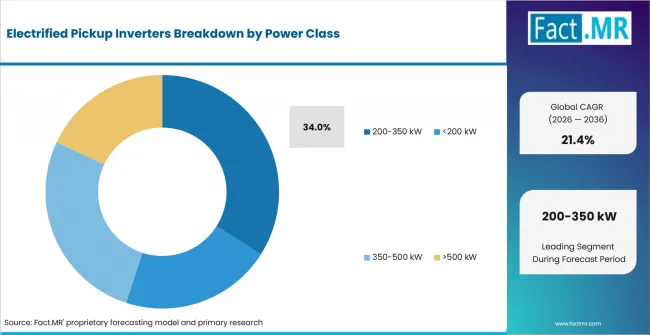
Electrified Pickup Inverters Analysis By Power Class | Source: Fact.MR
The 200-350 kW class aligns with mainstream electrified pickups because it balances launch torque, battery cost and thermal load. It gives work trucks enough acceleration and grade capability while keeping inverter sizing realistic for volume production.
Higher power classes remain necessary for tri-motor performance pickups and premium lifestyle variants. The 200-350 kW band carries wider commercial use because it fits dual-motor AWD layouts and avoids the thermal burden of extreme-output systems.
What supports Full-size pickups within Vehicle Segment?
Full-size pickups are estimated to represent 48.0% share in 2026.
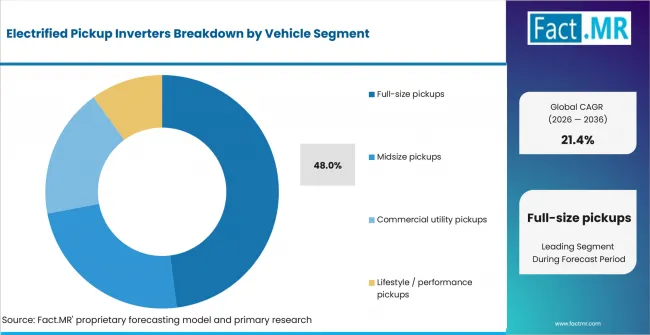
Electrified Pickup Inverters Analysis By Vehicle Segment | Source: Fact.MR
Full-size pickups lead because their larger frames can absorb battery mass and power-electronics packaging more easily than midsize vehicles. Their customers also expect towing, payload capacity and onboard power features that place direct load on inverter design.
The full-size segment is expected to remain the clearest proving ground for high-output inverter systems. Midsize pickups and commercial utility pickups are anticipated to expand as component costs improve and platform sharing becomes easier.
What is accelerating Electrified Pickup Inverters Market adoption, and what is holding it back?
Demand is expected to rise through higher-voltage pickup platforms and dual-motor traction needs. Growth is constrained by thermal validation, cost and vehicle-platform timing.
Drivers Impact Analysis
| DRIVER | (~) % IMPACT ON CAGR | GEOGRAPHIC RELEVANCE | IMPACT TIMELINE |
|---|---|---|---|
| Dual-motor AWD pickup programs | +2.4% | North America, East Asia | Short term (<= 2 years) |
| 800 V charging and power conversion | +1.9% | North America, Europe, South Korea | Medium term (2-4 years) |
| SiC switching and thermal integration | +1.5% | Global | Medium term (2-4 years) |
| Worksite accessory power and range-extender use | +0.9% | USA, Canada, UK | Long term (>= 4 years) |
- Dual-motor AWD pickup programs: Dual-motor layouts raise inverter count and software coordination needs per vehicle. They are expected to add value where towing traction and off-road control influence trim positioning.
- 800 V charging and power conversion: Higher voltage is projected to increase demand for lower-loss inverter designs. The driver is concentrated in full-size pickups where fast charging and peak output shape consumer comparison.
- SiC switching and thermal integration: Silicon carbide devices are anticipated to support faster switching and lower losses. Cooling design remains central because pickup load cycles sustain high current for longer periods.
Opportunity Impact Analysis
| OPPORTUNITY | (~) % IMPACT ON CAGR | GEOGRAPHIC RELEVANCE | IMPACT TIMELINE |
|---|---|---|---|
| Shared inverter platforms across pickup trims | +1.3% | Global | Medium term (2-4 years) |
| Range-extender electric pickup architectures | +1.0% | North America, Europe | Long term (>= 4 years) |
| Auxiliary inverter demand for onboard power | +0.7% | USA, Canada | Short term (<= 2 years) |
- Shared inverter platforms across pickup trims: Tier-1 suppliers are expected to gain scale by adapting one inverter family across single rear e-axle, dual-motor AWD and hybrid pickup programs.
- Range-extender electric pickup architectures: REEV pickups create a route for inverter suppliers that can link generator modules, traction drive and battery systems within one controlled powertrain package.
- Auxiliary inverter demand for onboard power: Worksite power outlets and vehicle-to-load features are anticipated to widen inverter content beyond traction drive alone.
Restraints Impact Analysis
| RESTRAINT | (~) % IMPACT ON CAGR | GEOGRAPHIC RELEVANCE | IMPACT TIMELINE |
|---|---|---|---|
| High thermal validation burden | -0.8% | Global | Short term (<= 2 years) |
| SiC module and packaging cost | -0.6% | North America, Europe | Medium term (2-4 years) |
| Pickup platform launch timing | -0.5% | USA, Canada, UK | Long term (>= 4 years) |
- High thermal validation burden: Electric pickups sustain high inverter loads during towing and repeated fast charging. Qualification work is therefore expected to lengthen launch cycles for new inverter families.
- SiC module and packaging cost: Silicon carbide helps efficiency but raises cost pressure in volume pickup trims. Suppliers are expected to balance device selection with cooling design and warranty targets.
- Pickup platform launch timing: Inverter demand is tied to vehicle launch cadence. Delays in electric or range-extended pickup programs are expected to slow the timing of component revenue conversion.
Which countries are scaling the Electrified Pickup Inverters Market through 2036?
- The country comparison spans 6.8 percentage points and forms three practical growth bands across the forecast period.
- South Korea remains 0.4 percentage point above the USA through EV component capability and fast zero-emission vehicle expansion.
- The USA remains 0.4 percentage point above Germany through full-size pickup electrification and high-output drivetrain requirements.
- Germany remains 0.3 percentage point above Canada through e-drive engineering depth and 800 V platform work.
- Canada remains 5.7 percentage points above the UK, alongside a sales mix heavily weighted toward Statistics Canada’s broad truck category.
- The UK closes the displayed range as zero-emission light commercial vehicles widen the inverter base from a smaller pickup platform pool.
Comparable CAGRs create different entry conditions due to vehicle mix, charging behavior, supplier localization and pickup platform timing. Full report coverage includes North America, Latin America, Western Europe, Eastern Europe, East Asia, South Asia & Pacific, Middle East & Africa.
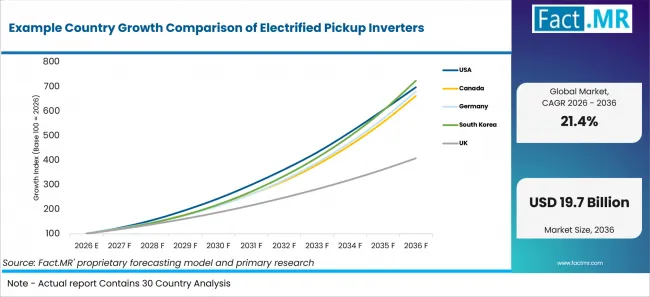
Example Country Growth Comparison Of Electrified Pickup Inverters | Source: Fact.MR
| Country | CAGR (2026-2036) |
|---|---|
| South Korea | 21.9% |
| USA | 21.5% |
| Germany | 21.1% |
| Canada | 20.8% |
| UK | 15.1% |
How is South Korea scaling demand?
21.9% CAGR, supported by electrified vehicle registration growth.
South Korea’s vehicle mix gives inverter suppliers a high-growth base. The Ministry of Climate, Energy and Environment reported in January 2026 that South Korea’s registered electric-vehicle fleet reached 899,101 vehicles in 2025. The 21.9% CAGR reflects local component capability and stronger demand for compact high-output power electronics in electric and hybrid utility platforms.
What supports USA adoption?
21.5% CAGR, supported by full-size pickup electrification.
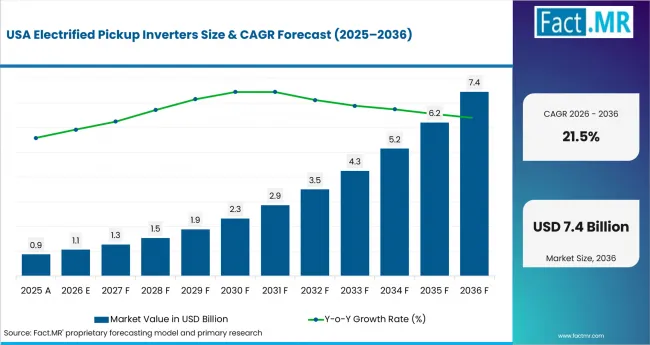
Electrified Pickup Inverters Country Value Analysis | Source: Fact.MR
USA electric pickup inverter demand is anchored in truck-size platforms and high-output duty cycles. The U.S. EPA reported in February 2026 that 66% of model year 2024 new vehicles were classified as trucks under NHTSA regulations, a regulatory category that includes pickups, minivans/vans and truck SUVs. The 21.5% CAGR reflects a market where inverter efficiency is tied directly to towing confidence and charging-speed claims.
How does Germany perform?
21.1% CAGR, supported by BEV registrations and e-drive engineering depth.
Germany’s inverter position is tied to local e-drive engineering and BEV recovery. The Federal Ministry for Economic Affairs and Energy reported in January 2026 that BEVs reached 19.1% of passenger-car registrations in 2025. The 21.1% CAGR reflects technical demand for 400 V and 800 V systems with validated SiC packaging.
How is Canada scaling demand?
20.8% CAGR, driven by a truck-category-heavy sales mix.
Canada’s broader truck-category sales mix provides context for electrified utility-vehicle powertrains. Statistics Canada reported in April 2026 that trucks, including minivans, SUVs, light and heavy trucks, vans and buses, accounted for 88.0% of total new motor vehicle sales in 2025. The 20.8% CAGR reflects a market where utility-vehicle electrification places a premium on cold-weather range management and durable power conversion.
What supports the United Kingdom’s growth?
15.1% CAGR, backed by zero-emission light commercial vehicle registrations.
UK demand builds from zero-emission van and utility vehicle growth. The Department for Transport reported in April 2026 that 31,000 road-using zero-emission LGVs were registered for the first time in 2025. The 15.1% CAGR reflects a smaller pickup base and rising inverter relevance in light commercial electrification.
Who leads the Electrified Pickup Inverters Market?
BorgWarner, Bosch, DENSO, and ZF in the competitive set based on their inverter, e-drive and related electrification capabilities.
BorgWarner is active through high-voltage integrated drive modules and dual-inverter technologies for electrified truck and SUV platforms. In February 2026, the company announced an 800 V integrated drive module and a generator module incorporating a dual inverter for range-extended electric trucks and large-frame SUVs, combining electric-drive, generator and inverter functions in compact propulsion systems.
Bosch participates through silicon carbide semiconductors, inverter technologies and power modules for electric-vehicle power electronics. Its SiC-based inverter solutions improve efficiency and provide the power-electronics connection and motor-control function between the high-voltage battery and electric motor.
DENSO has direct pickup application evidence through eAxle technology. In August 2025, DENSO, AISIN and BluE Nexus announced that their jointly developed front and rear eAxles had been installed in Isuzu’s D-MAX EV battery-electric pickup, which entered production in April 2025.
ZF competes through scalable inverter platforms and modular e-drive components, including its in:SELECT inverter architecture covering 400 V to 800 V and 100 A to 650 A.
Which companies are the key providers?
Key companies profiled include BorgWarner; Bosch; DENSO; and ZF.
- BorgWarner
- Bosch
- DENSO
- ZF
Bibliography
- U.S. Environmental Protection Agency. (2026, February 19). Highlights of the Automotive Trends Report.
- U.S. Environmental Protection Agency. (2026, February 19). About the Automotive Trends Data.
- Federal Ministry for Economic Affairs and Energy. (2026, January 27). Great prospects for electric mobility.
- Statistics Canada. (2026, April 30). Springing into a new motor vehicle.
- Department for Transport. (2026, April 29). Vehicle licensing statistics, United Kingdom: 2025.
- BorgWarner Inc. (2026, February 11). BorgWarner set to deliver power-packed integrated drive module and generator module with dual inverter to major North American OEM.
- Bosch Limited. (2026, June 9). Bosch introduces third generation SiC chips for EV growth and local ecosystem enablement.
- BluE Nexus Corporation, AISIN Corporation, & DENSO Corporation. (2025, August 1). Isuzu’s first battery-electric pickup “D-MAX EV” adopts eAxle.
- ZF Friedrichshafen AG. (2025, June 3). The basis of the SELECT platform: Innovative components make ZF’s e-drive portfolio powerful and variable.
This Report Answers
- The report explains where electrified pickup inverters are used across drive layout and voltage. It also covers power class and vehicle segment, together with adjacent electric vehicle components.
- Segment analysis identifies the subsegments that account for the greatest share and the operating reasons behind them. It links inverter choice with automotive semiconductors where chip selection affects efficiency.
- Country analysis examines the listed markets and the vehicle-mix factors supporting inverter demand in pickup and light commercial platforms.
- Competitive analysis reviews providers active across high-voltage inverters, silicon carbide devices and integrated e-drive modules. It also considers electric commercial vehicle battery pack demand where power electronics scale with battery capacity.
- Application analysis assesses how towing load, charging speed and auxiliary power influence inverter selection. It also connects pickup programs with wider electric commercial vehicle electrification.
What does the Electrified Pickup Inverters Market cover?
The Electrified Pickup Inverters Market covers traction and auxiliary inverters used in battery-electric, hybrid and range-extended pickup platforms. It includes power electronics that manage motor drive, regenerative braking and energy flow between battery systems and electric motors.
The assessment covers dual-motor AWD, single rear e-axle, tri-motor performance, hybrid pickup inverter and accessory inverter designs. Demand is assessed across voltage, power class, vehicle segment and country-level growth patterns.
What is included in the scope?
The scope includes inverter hardware, embedded control software and integrated drive modules used in electrified pickup applications. It includes high-voltage traction inverters, auxiliary power inverters and e-drive inverter packages aligned with pickup and light commercial platforms.
It includes components sold into battery-electric and hybrid pickup programs. Adjacent coverage includes electric vehicle components and automotive power electronics where inverter value is part of the broader electrified powertrain bill of materials.
What is excluded from the scope?
The scope excludes standalone battery cells, charging stations, complete vehicles, base traction motors sold separately and general vehicle electronics outside inverter control. Semiconductor wafers are excluded when sold outside an inverter or power-module context.
General software platforms are excluded unless they directly control inverter switching, thermal behavior or vehicle power flow. Non-pickup passenger-car inverters are covered only where they share a platform with pickup or utility-vehicle programs.
How Was the Analysis Built?
The analysis draws on 120+ sources, 35+ company portfolios, 25+ countries, and more than 20 industry interviews.
- Primary Research: Primary research includes discussions with manufacturers, service providers, technology developers, distributors, end users, and subject-matter experts. These conversations examine purchasing priorities, product adoption, operational challenges, approval requirements, competitive positioning, and the factors that influence wider market acceptance.
- Desk Research: Desk research covers government statistics, regulatory publications, company filings, trade data, technical studies, industry associations, standards, public policy, and other authoritative sources. Every source used in the analysis is documented in the bibliography.
- Market Sizing and Forecasting: Market estimates combine historical performance, demand indicators, pricing and volume trends, segment shares, company participation, country-level growth, adoption patterns, investment activity, and barriers to market expansion.
- Data Validation and Update Cycle: Findings are validated by comparing primary interviews with public data, company activity, regulatory changes, trade patterns, and industry developments. Regular updates review new product launches, capacity changes, partnerships, approvals, and shifts in commercial adoption.
What is the report’s scope and coverage?
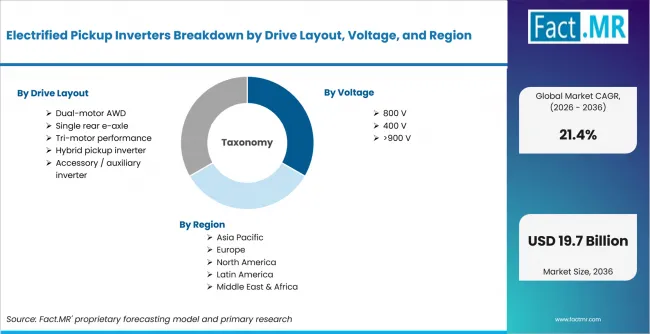
Electrified Pickup Inverters Breakdown By Drive Layout, Voltage, And Region | Source: Fact.MR
| Attribute | Details |
|---|---|
| Quantitative Units | USD billion. |
| Market Definition | Inverters used in electrified pickup platforms to convert battery or generator power into controlled AC output for traction motors and auxiliary vehicle functions. |
| Drive Layout | Dual-motor AWD; Single rear e-axle; Tri-motor performance; Hybrid pickup inverter; Accessory or auxiliary inverter |
| Voltage | 800 V; 400 V; above 900 V |
| Power Class | 200-350 kW; below 200 kW; 350-500 kW; above 500 kW |
| Vehicle Segment | Full-size pickups; Midsize pickups; Commercial utility pickups; Lifestyle or performance pickups |
| Regions Covered | North America; Latin America; Western Europe; Eastern Europe; East Asia; South Asia & Pacific; Middle East & Africa |
| Countries Covered | South Korea; USA; Germany; Canada; UK |
| Key Companies Profiled | BorgWarner; Bosch; DENSO; ZF |
| Forecast Period | 2026 to 2036 |
| Approach | Hybrid top-down and bottom-up approach using electrified pickup platforms; inverter voltage mix; power class fit; vehicle-segment demand; country adoption; and provider portfolio review. |
How is the market segmented?
-
By Drive Layout
- Dual-motor AWD
- Single rear e-axle
- Tri-motor performance
- Hybrid pickup inverter
- Accessory or auxiliary inverter
-
By Voltage
- 800 V
- 400 V
- Above 900 V
-
By Power Class
- 200-350 kW
- Below 200 kW
- 350-500 kW
- Above 500 kW
-
By Vehicle Segment
- Full-size pickups
- Midsize pickups
- Commercial utility pickups
- Lifestyle or performance pickups
-
By Region
- North America
- Latin America
- Western Europe
- Eastern Europe
- East Asia
- South Asia & Pacific
- Middle East & Africa