- Market Value (2025): USD 3.6 Bn
- Estimated Value (2026): USD 4.2 Bn
- Forecast Value (2036): USD 17.5 Bn
- CAGR (2026-2036): 15.4%
What is the Vehicle Twin Blueprints Market forecast to be worth by 2036?
USD 4.2 billion in 2026 to USD 17.5 billion by 2036 at a 15.4% CAGR.
- The Vehicle Twin Blueprints Market reached USD 3.6 billion in 2025.
- Demand is projected to increase from USD 4.2 billion in 2026 to USD 17.5 billion by 2036.
- The market is projected to expand at a 15.4% CAGR from 2026 to 2036.
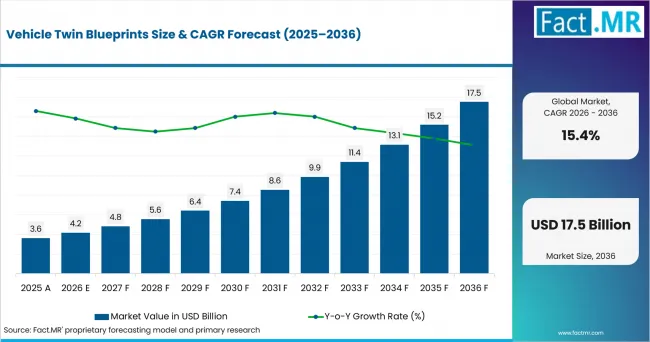
Vehicle Twin Blueprints Value Analysis | Source: Fact.MR
What are the defining numbers behind Vehicle Twin Blueprints Market growth?
An absolute opportunity of USD 13.3 billion is expected between 2026 and 2036.
- Demand Drivers in the Market
- Software-defined vehicle programs are moving integration work earlier in the development cycle. Siemens describes its PAVE360 Automotive environment as a system-level SDV digital twin blueprint that supports hardware and software co-design before the final physical vehicle is available. This reduces the need to wait for every electronic control unit, network and software stack before system integration begins.
- Automotive software complexity raises the value of reusable system models. Engineering teams working across automotive software need a common representation of E/E architecture, embedded software and vehicle behavior so changes can be tested against system interactions rather than in isolated tools.
- UNECE Regulations No. 155 and No. 156 place formal requirements around cybersecurity management and software-update management for applicable vehicle approvals. These controls increase the need for traceable configurations and repeatable validation evidence when software changes can affect safety-relevant vehicle functions.
- Virtual testing is becoming a practical response to scenario volume. The U.S. Department of Energy notes that building every advanced vehicle configuration physically is impractical, while virtual vehicles allow more configurations to be evaluated at lower development cost. The same logic supports automotive simulation environments that can reuse models across software-in-the-loop, hardware-in-the-loop and vehicle testing.
- Lifecycle continuity increases the value of blueprints that survive beyond design release. NIST research on digital twins and digital threads shows that lifecycle information can improve twin interoperability and reuse across design, manufacturing and support. This creates demand for digital twin market capabilities that retain model identity as the vehicle moves from architecture into production and service.
- Key Segments Analyzed
- Full-vehicle architecture twin accounts for 31.0% of Blueprint Scope in 2026 because vehicle programs need one system view across E/E architecture, software, sensors and physical behavior before integration decisions are frozen.
- Virtual validation represents 29.0% of Lifecycle Stage in 2026 as software and system behavior can be tested before complete physical prototypes are available.
- Simulation-led accounts for 33.0% of Data Basis in 2026 because early architecture decisions occur before enough test or connected-vehicle data exists to support a live-data-led twin.
- Passenger cars account for 43.0% of Vehicle Type in 2026 because shared platforms carry multiple trims, software releases and ADAS configurations that require repeated system-level validation.
- Analyst Opinion at Fact.MR
- Shambhu Nath Jha, Senior Consultant, Fact.MR, states, “Vehicle twin blueprints become commercially useful when engineering teams can reuse the same system logic across architecture decisions, virtual validation and later physical correlation. Buyers will place more weight on model fidelity, interface openness and traceability as vehicle software changes more frequently. A blueprint that shortens integration setup while preserving a clear path to test evidence can reduce duplicated engineering work across vehicle programs.”
- Strategic Implications
- Mixed-fidelity support is important because vehicle programs need detailed physics for selected subsystems while running faster behavioral models across broader scenario sets.
- At program start, OEM engineering teams need clear ownership of interfaces and model-correlation rules. Without that discipline, a reusable twin can fragment into disconnected model repositories.
- Validation value increases when software-in-the-loop, hardware-in-the-loop and physical testing share model context, allowing evidence from one stage to inform the next without rebuilding the test environment.
- For vehicle software teams, twin governance needs to move with the automotive OS release process so architecture changes, software dependencies and validation status remain synchronized across variants.
How does the Vehicle Twin Blueprints Market break down by segment?
The market is segmented by Blueprint Scope, Lifecycle Stage, Data Basis and Vehicle Type.
Why does Full-vehicle architecture twin lead Blueprint Scope?
Full-vehicle architecture twin is projected to account for a 31.0% share of Blueprint Scope in 2026.
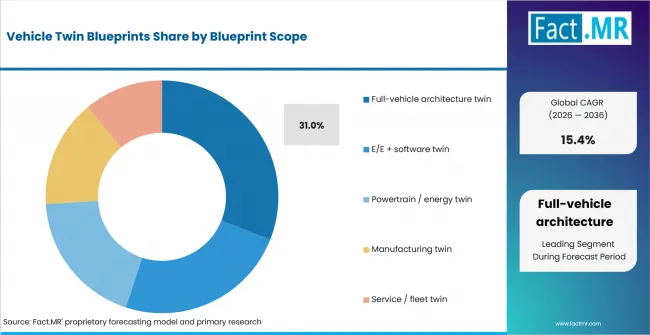
Vehicle Twin Blueprints Analysis By Blueprint Scope | Source: Fact.MR
- Vehicle-level architecture models concentrate value because software behavior increasingly depends on interactions among compute platforms, networks, sensors, actuators and physical vehicle systems. A blueprint that represents these dependencies gives architecture teams a common place to test partitioning decisions before hardware and software are fully mature.
- Siemens positions PAVE360 Automotive as a pre-integrated system-level SDV digital twin blueprint for hardware and software co-design. The model supports system-of-systems validation and mixed fidelity, which illustrates why vehicle twins are purchased around cross-domain integration rather than one isolated component model.
Why does Virtual validation lead Lifecycle Stage?
Virtual validation is projected to account for a 29.0% share of Lifecycle Stage in 2026.
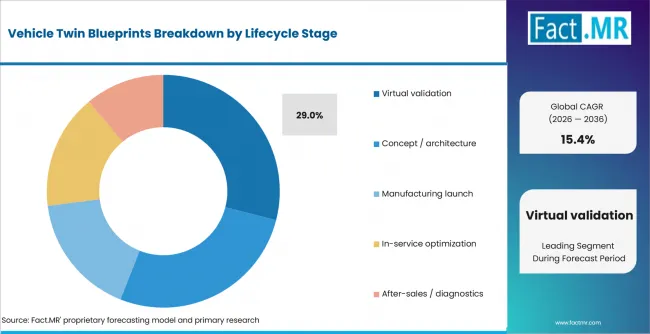
Vehicle Twin Blueprints Analysis By Lifecycle Stage | Source: Fact.MR
- The commercial advantage appears before complete prototypes exist. Engineers can run software, network and control scenarios against a representative vehicle model while physical benches are still limited or changing. This catches interaction faults when architecture changes are still less disruptive.
- The UK DRIVE35 Innovation guidance for software-defined vehicle and E/E architecture projects explicitly includes vehicle and system-level simulation, digital twins and xIL methods for rapid simulation, optimization and validation. That public funding scope reflects the engineering move toward virtual evidence before late-stage vehicle testing.
Why does Simulation-led lead Data Basis?
Simulation-led is projected to account for a 33.0% share of Data Basis in 2026.
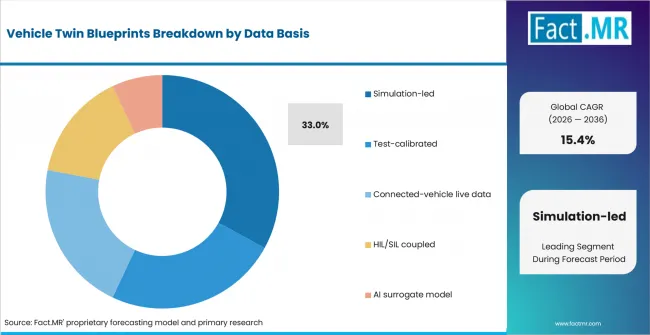
Vehicle Twin Blueprints Analysis By Data Basis | Source: Fact.MR
- At concept and architecture stages, a program does not yet have large volumes of calibrated test data or live fleet telemetry. Physics models, behavioral models and scenario libraries therefore provide the first usable basis for comparing system choices and testing edge cases.
- The U.S. Department of Energy has long used modeling and simulation to evaluate advanced vehicle configurations that would be impractical to build physically. As prototypes arrive, test results can calibrate the model, but simulation remains the practical starting point for broad design-space exploration.
Why do Passenger cars lead Vehicle Type?
Passenger cars are projected to account for a 43.0% share of Vehicle Type in 2026.
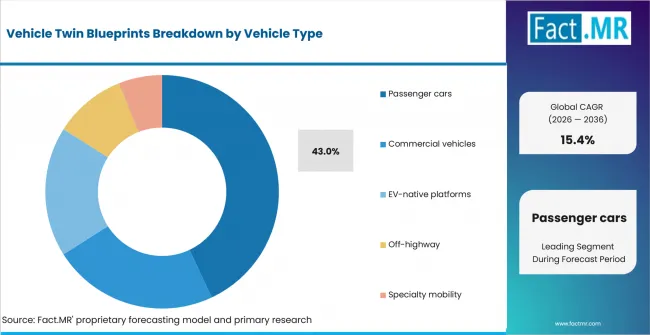
Vehicle Twin Blueprints Analysis By Vehicle Type | Source: Fact.MR
- Passenger vehicle platforms carry frequent feature changes across infotainment, ADAS, energy management and connected services. The same underlying architecture can support multiple trims and regional variants, so a reusable blueprint can reduce repeated setup work as software and hardware combinations change.
- Dassault Systèmes announced in February 2025 that Volkswagen Group would deploy the 3DEXPERIENCE platform across Volkswagen, Audi and Porsche vehicle development. The program connects engineering through a cloud platform and virtual twin approach, showing how passenger-vehicle programs are moving toward shared digital engineering environments across brands and vehicle projects.
What is accelerating Vehicle Twin Blueprints Market adoption, and what is holding it back?
Adoption is being accelerated by software-defined vehicle programs that need earlier integration testing and by validation workloads that cannot be covered economically with physical prototypes alone. The main restraints are model credibility, integration effort and data ownership.
Drivers Impact Analysis
| DRIVER | (~) % IMPACT ON CAGR | GEOGRAPHIC RELEVANCE | IMPACT TIMELINE |
|---|---|---|---|
| Earlier SDV integration and defect discovery | +2.2% | Germany, USA, Japan, UK | Short term (<= 2 years) |
| Reusable virtual validation across software releases | +1.8% | Global automotive engineering | Medium term (2-4 years) |
| Software-update governance and traceability | +1.3% | Europe, Japan, South Korea | Medium term (2-4 years) |
| Lifecycle reuse across manufacturing and service | +1.0% | Germany, UK, USA | Long term (>= 4 years) |
Source: Fact.MR analysis. Updated Sep 8, 2026
Earlier SDV integration moves defect discovery ahead of late physical integration, while virtual validation lets engineering teams reuse the same system model across repeated software and architecture changes. Software-update governance adds ongoing demand for traceable release evidence, and lifecycle reuse extends the blueprint into manufacturing and service workflows.
Opportunity Impact Analysis
| OPPORTUNITY | (~) % IMPACT ON CAGR | GEOGRAPHIC RELEVANCE | IMPACT TIMELINE |
|---|---|---|---|
| Reusable full-vehicle blueprints across programs | +1.4% | Global | Medium term (2-4 years) |
| Model-correlation services linking simulation and physical evidence | +1.1% | Germany, USA, UK | Medium term (2-4 years) |
| Live-data extensions for in-service engineering | +0.9% | USA, Japan, South Korea | Long term (>= 4 years) |
| AI surrogate models for broader scenario coverage | +0.8% | USA, South Korea, Japan | Medium term (2-4 years) |
Source: Fact.MR analysis. Updated Sep 8, 2026
Reusable vehicle-level blueprints create value when the same architecture can be configured across programs instead of rebuilt for each validation cycle. Model-correlation services address buyers that need tighter links between simulation and physical evidence, while live-data extensions support in-service engineering. Surrogate models can expand scenario coverage when full-physics computation is too slow for repeated testing.
Restraints Impact Analysis
| RESTRAINT | (~) % IMPACT ON CAGR | GEOGRAPHIC RELEVANCE | IMPACT TIMELINE |
|---|---|---|---|
| Weak correlation between simulated and physical behavior | -1.0% | Global | Short term (<= 2 years) |
| OEM-supplier data ownership and access constraints | -0.8% | Global automotive programs | Medium term (2-4 years) |
| Legacy CAE, PLM and test-tool integration burden | -0.7% | Europe, Japan, USA | Medium term (2-4 years) |
Source: Fact.MR analysis. Updated Sep 8, 2026
Adoption slows when model behavior cannot be correlated reliably with physical tests or when OEM-supplier data rules prevent architecture and test context from moving across organizations. Legacy CAE, PLM and test environments add another barrier because engineering teams must keep model versions synchronized across tools before the twin can support release decisions.
Which countries are scaling the Vehicle Twin Blueprints Market through 2036?
- Germany: Federal mobility programs explicitly support digital twins, simulation-based engineering, integrated hardware and software development, and software-defined intelligent vehicles. This gives automotive engineering teams a policy-backed route to move more validation work into shared digital environments.
- USA: Oak Ridge National Laboratory operates the CAVE platform to connect real vehicles and controls with virtual traffic conditions. That hardware-plus-simulation model supports test workflows in which vehicle behavior can be evaluated across repeatable virtual scenarios before wider road deployment.
- Japan: METI’s Mobility DX Strategy promotes software-defined vehicles, digitized development processes and common development infrastructure. The policy direction favors reusable simulation environments that can shorten repeated engineering work across vehicle programs.
- South Korea: Automotive R&D programs are supporting vehicle-level integrated E/E systems, AI-based autonomous-driving models, synthetic data and advanced simulation. These priorities increase demand for blueprint environments that can join software, compute and vehicle behavior during validation.
- UK: DRIVE35 funding guidance places digital twins, vehicle and system simulation, and xIL within software-defined vehicle and E/E architecture development. Suppliers can therefore position blueprint tools around demonstrable engineering workflows rather than general digitalization claims.
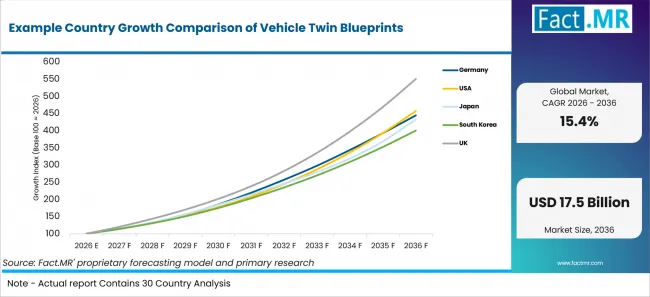
Example Country Growth Comparison Of Vehicle Twin Blueprints | Source: Fact.MR
| Country | CAGR (2026-2036) |
|---|---|
| Germany | 16.1% |
| USA | 16.4% |
| Japan | 15.8% |
| South Korea | 14.9% |
| UK | 18.6% |
Source: Fact.MR analysis. Updated Sep 8, 2026
What is driving Germany's growth through 2036?
Germany is projected to expand at a 16.1% CAGR from 2026 to 2036.
- Federal automotive programs are funding digital methods as part of vehicle development. Germany’s mobility funding framework includes digital twins, simulation-based methods and integrated hardware-software development, which aligns directly with vehicle blueprint use in architecture and validation.
- BMWK project examples also include collaborative engineering and manufacturing data environments for digital twins. For OEMs and suppliers, that creates a practical requirement for models that can move across company and lifecycle boundaries while preserving configuration context.
What is driving USA's growth through 2036?
USA is projected to expand at a 16.4% CAGR from 2026 to 2036.
- U.S. national-laboratory work is pushing vehicle validation toward connected physical and virtual environments. Oak Ridge National Laboratory’s CAVE platform places real vehicle hardware and controls inside virtual traffic conditions, which supports repeatable testing without recreating every road scenario physically.
- ORNL research on adaptive dynamic digital twins also uses fresh trajectory data to update vehicle models and generate additional test scenarios for highly automated vehicles and ADAS. This supports demand for twins that can evolve as test evidence accumulates rather than remain static design models.
What is driving Japan's growth through 2036?
Japan is projected to expand at a 15.8% CAGR from 2026 to 2036.
- METI’s 2025 Mobility DX Strategy update keeps software-defined vehicles at the center of automotive competitiveness and calls for investment in SDVs, common vehicle requirements and digital development processes. These measures increase the value of shared system models that help engineering teams coordinate software and vehicle architecture.
- The earlier Mobility DX Strategy also identified simulation environments as a way to improve development efficiency. That makes vehicle twin blueprints relevant to Japanese OEM and supplier programs that need to test software and system choices before committing to full physical builds.
What is driving South Korea's growth through 2036?
South Korea is projected to expand at a 14.9% CAGR from 2026 to 2036.
- South Korean automotive R&D support is moving into the technical layers that make vehicle twins useful: software-defined vehicle electronics, integrated E/E systems and AI-based driving functions. These systems increase the number of cross-domain interactions that must be evaluated before road testing.
- Government-backed projects also reference synthetic data and simulation for autonomous-driving development. Blueprint vendors can serve this workflow by connecting system architecture with scenario models and validation assets instead of offering isolated simulation models.
What is driving UK's growth through 2036?
UK is projected to expand at an 18.6% CAGR from 2026 to 2036.
- UK industrial funding is directly linking digital twins to software-defined vehicle development. DRIVE35 guidance for E/E architectures includes vehicle and system simulation, digital twins and xIL, which creates a commercial route for tools that can be demonstrated inside funded engineering programs.
- UK government guidance published in 2025 defines a digital twin around a digital representation with two-way real-world data flow appropriate to the decision being made. That framing supports a progression from development twins toward manufacturing and in-service use when data governance and model fidelity are sufficient.
Who Leads the Vehicle Twin Blueprints Market?
Key players in the Vehicle Twin Blueprints Market include Siemens, Dassault Systèmes, Ansys, Altair, AVL and Hexagon. Competition centers on the ability to connect vehicle architecture, software behavior and physical simulation within a reusable workflow that can be correlated with test evidence.
Siemens is positioning PAVE360 Automotive as a pre-integrated SDV digital twin blueprint. Dassault Systèmes combines virtual twins with collaborative vehicle engineering environments, while AVL connects simulation with physical test and vehicle demonstrators. Hexagon brings manufacturing simulation, metrology and process data into the vehicle lifecycle.
Competitive positioning should account for recent corporate consolidation. Siemens completed its acquisition of Altair in March 2025, so Altair is now part of Siemens. Synopsys completed its acquisition of Ansys in July 2025, so Ansys now operates within Synopsys. These brands remain technically relevant to engineering workflows, but they should not be interpreted as fully independent corporate groups.
Which companies are the key providers?
Key providers are Siemens, Dassault Systèmes, Ansys, Altair, AVL and Hexagon.
- Siemens
- Dassault Systèmes
- Ansys
- Altair
- AVL
- Hexagon
Bibliography
- National Institute of Standards and Technology. (2025). Definitions and State of the Art. U.S. Department of Commerce.
- National Institute of Standards and Technology. (2023). A Methodology for Digital Twins of Product Lifecycle Supported by Digital Thread. U.S. Department of Commerce.
- National Institute of Standards and Technology. (2022). Digital Thread for Manufacturing. U.S. Department of Commerce.
- U.S. Department of Energy. (2014). Modeling and Simulation. Vehicle Technologies Office.
- United Nations Economic Commission for Europe. (2021). UN Regulation No. 155: Cyber Security and Cyber Security Management System. United Nations.
- United Nations Economic Commission for Europe. (2021). UN Regulation No. 156: Software Update and Software Update Management System. United Nations.
- Federal Ministry for Economic Affairs and Climate Action, Germany. (2024). Förderprogramm DNS der zukunftsfähigen Mobilität. Federal Government of Germany.
- Federal Ministry for Economic Affairs and Climate Action, Germany. (2024). Fahrzeughersteller und Zulieferindustrie für die Zukunft stärken. Federal Government of Germany.
- Ministry of Economy, Trade and Industry, Japan. (2025, June 9). Mobility Digital Transformation (DX) Strategy Updated. Government of Japan.
- Ministry of Economy, Trade and Industry, Japan. (2024, May 24). Mobility Digital Transformation (DX) Strategy Formulated. Government of Japan.
- Ministry of Trade, Industry and Energy, Republic of Korea. (2025, June 4). Expanded Investment in Advanced Technology Development for Electric, Hydrogen and Autonomous Vehicles. Government of the Republic of Korea.
- Innovate UK and Advanced Propulsion Centre UK. (2026). DRIVE35 Innovation: Demonstrate 2 Applicant Briefing. UK Government.
- UK Government. (2025, October 29). Digital twin: definition and guiding principles. Department for Business and Trade.
- Oak Ridge National Laboratory. (2025). Adaptive Dynamic Digital Twin for Test Scenario Generation. U.S. Department of Energy.
- Oak Ridge National Laboratory. (2026). Rethinking Rush Hour with Vehicle Automation. U.S. Department of Energy.
- Siemens. (2025, December 18). PAVE360 Automotive: What is an SDV Digital Twin Blueprint and Why Do You Need One? Siemens Digital Industries Software.
- Siemens. (2025, March 26). Siemens completes acquisition of Altair Engineering. Siemens AG.
- Dassault Systèmes. (2025, February 4). Dassault Systèmes and Volkswagen Group Implement the 3DEXPERIENCE Platform to Optimize Vehicle Development. Dassault Systèmes.
- Synopsys. (2025, July 17). Synopsys Completes Acquisition of Ansys. Synopsys, Inc.
- AVL. (2026). AVL Virtual Studio. AVL List GmbH.
- Hexagon. (2024, October 16). Hexagon and SEAT S.A. Partner to Transform Manufacturing Efficiency and Accelerate the Industrialisation of New Cars. Hexagon AB.
This Report Answers
- What is the Vehicle Twin Blueprints Market value in 2026 and what value is projected for 2036?
- Why do full-vehicle architecture twins lead Blueprint Scope in 2026?
- Why is virtual validation a core lifecycle use case for vehicle twin blueprints?
- How does a simulation-led data basis support architecture decisions before physical prototypes are complete?
- Why do passenger-car programs create recurring demand for reusable vehicle-level models?
- How do cybersecurity and software-update requirements affect twin governance and traceability?
- How do Germany, USA, Japan, South Korea and UK differ in vehicle-twin adoption mechanisms?
- Which providers bring system simulation, virtual twins, test correlation or manufacturing data into vehicle twin workflows?
What does the Vehicle Twin Blueprints Market cover?
The market covers commercial software licenses, subscriptions and engineering environments that provide reusable vehicle-level digital twin blueprints for automotive system architecture, virtual validation, manufacturing launch and in-service engineering. Revenue is counted where a product provides a configurable twin framework or system model that can be applied across vehicle programs, variants or lifecycle stages.
What is included in the scope?
Included offerings cover full-vehicle architecture twins, E/E and software twins, powertrain or energy twins, manufacturing twins, and service or fleet twins.
The scope includes concept and architecture use, virtual validation, manufacturing launch, in-service optimization and after-sales diagnostics across the stated vehicle categories and data-basis models.
What is excluded from the scope?
Excluded are stand-alone CAD or CAE tools that do not provide a reusable vehicle-twin workflow, generic PLM systems without vehicle-twin functionality, physical test equipment sold separately, raw sensor hardware, and telemetry platforms that collect vehicle data without maintaining a corresponding vehicle model.
Adjacent autonomous-driving simulation is included only where it is part of the vehicle twin blueprint offering.
How Was the Analysis Built?
- Primary research is structured around automotive OEM systems engineers, E/E and software architects, validation leaders, CAE and simulation teams, Tier-1 engineering suppliers, test organizations and digital twin software providers. Interviews focus on how system models are purchased, reused, correlated and governed across vehicle programs.
- Desk research uses vehicle regulation, national mobility strategies, public research laboratories, technical standards and first-party provider material to assess adoption conditions, engineering workflows and current provider status.
- Market sizing considers provider revenue exposure, engineering software spend, vehicle-program volume, blueprint deployment breadth, license or subscription structure, model reuse across variants and the share of development work moving into virtual validation. Country analysis considers automotive engineering activity, SDV policy, simulation infrastructure and public R&D programs.
- Validation checks focus on current provider ownership, product releases, regulatory requirements, vehicle-development workflows and changes in the balance between simulation and physical testing. Forecast assumptions are updated as vehicle architectures, software release practices and digital engineering adoption change.
Segmentation
What is the report's scope and coverage?
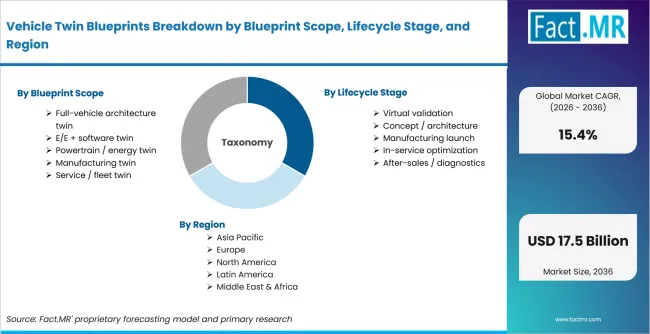
Vehicle Twin Blueprints Breakdown By Blueprint Scope, Lifecycle Stage, And Region | Source: Fact.MR
| Field | Coverage |
|---|---|
| Quantitative Units | USD billion |
| Market Definition | Reusable vehicle-level digital twin blueprint software and engineering environments for architecture, validation, manufacturing and service workflows |
| Segments Covered | Blueprint Scope; Lifecycle Stage; Data Basis; Vehicle Type |
| Countries Covered | Germany; USA; Japan; South Korea; UK |
| Key Companies | Siemens; Dassault Systèmes; Ansys; Altair; AVL; Hexagon |
| Forecast Period | 2026-2036 |
| Base Year | 2026 |
| Market Value, 2026 | USD 4.2 billion |
| Market Value, 2036 | USD 17.5 billion |
| CAGR, 2026-2036 | 15.4% |
| Absolute Opportunity | USD 13.3 billion |
| Approach | Bottom-up and top-down market sizing using provider revenue, vehicle-program activity, deployment breadth and engineering-workflow variables |
Source: Fact.MR analysis. Updated Sep 8, 2026
How is the market segmented?
-
By Blueprint Scope
- Full-vehicle architecture twin
- E/E + software twin
- Powertrain / energy twin
- Manufacturing twin
- Service / fleet twin
-
By Lifecycle Stage
- Virtual validation
- Concept / architecture
- Manufacturing launch
- In-service optimization
- After-sales / diagnostics
-
By Data Basis
- Simulation-led
- Test-calibrated
- Connected-vehicle live data
- HIL/SIL coupled
- AI surrogate model
-
By Vehicle Type
- Passenger cars
- Commercial vehicles
- EV-native platforms
- Off-highway
- Specialty mobility
Frequently Asked Questions
What is the Vehicle Twin Blueprints Market value in 2026?
At what CAGR is the Vehicle Twin Blueprints Market projected to grow?
What is the projected Vehicle Twin Blueprints Market value by 2036?
Which Blueprint Scope segment leads in 2026?
Which Lifecycle Stage segment leads in 2026?
Which Data Basis segment leads in 2026?
Which Vehicle Type segment leads in 2026?
What is supporting demand for vehicle twin blueprints?
What restrains adoption of vehicle twin blueprints?
Which companies provide vehicle twin blueprint capabilities?
Which country CAGRs are included for 2026 to 2036?
Who worked on this report


Preview the report firsthand - request a free sample
Free SampleGet the brochure for pricing and purchase details
Download PDF