- Base Value(2025): 230 Mn
- Estimated Value(2026): 243 Mn
- Forecast Value (2036): 274 Bn
- CAGR (2026 - 2036): 4.5%
Electrosynthesis Service Market Forecast and Outlook By Fact.Mr
In 2025, the global electrosynthesis service market was valued at USD 230 million. Based on Fact.MR analysis, demand for electrosynthesis services is estimated to grow to USD 243 million in 2026 and USD 274 billion by 2036. FACT.MR projects a CAGR of 4.5% during the forecast period.
Between 2026 and 2036, the market is expected to generate USD 31 million in absolute opportunity. Growth remains steady, not transformational. Demand is supported by pharmaceutical green chemistry mandates and increasing materials research outsourcing. However, expansion is constrained by high instrument capital costs, limited availability of skilled electrochemists, and low awareness among traditional chemical manufacturers.
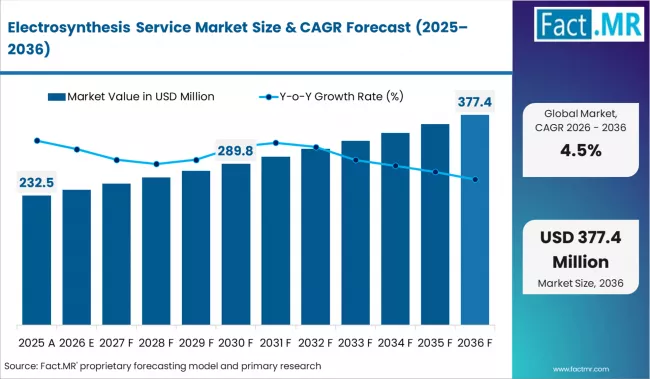
Electrosynthesis Service Market Market Value Analysis | Source: Fact.MR
Summary of Electrosynthesis Service Market
- Market Definition
- The market covers contract electrochemical synthesis services for organic and inorganic compounds, electrode materials, nanomaterials, and specialty composites, delivered at lab-scale, pilot-scale, and industrial scale to pharmaceutical, materials science, and chemical manufacturing customers globally.
- Demand Drivers
- Pharmaceutical companies are mandating green chemistry synthesis routes. Electrosynthesis replaces hazardous reagents in API manufacturing.
- Government-funded materials science programmes in China and the USA are directing electrochemical synthesis into battery and semiconductor feedstock development.
- Academic-industry CRO collaboration in the UK and Germany is expanding electrosynthesis service capacity for specialty chemical and nanomaterial customers.
- Key Segments Analyzed
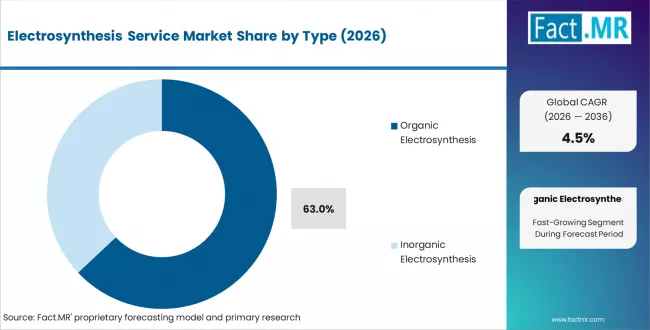
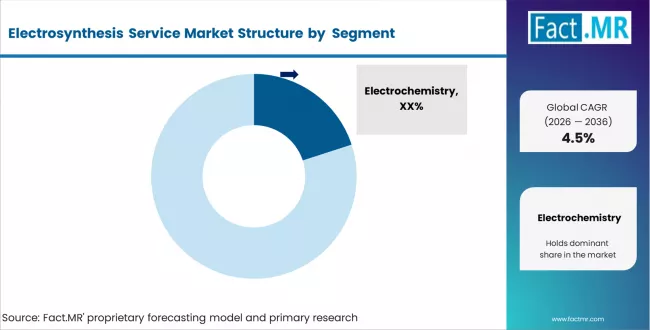
- By Type: Organic Electrosynthesis leads at 63% in 2026, driven by pharmaceutical and fine chemical contract synthesis demand for selective, reagent-free reactions.
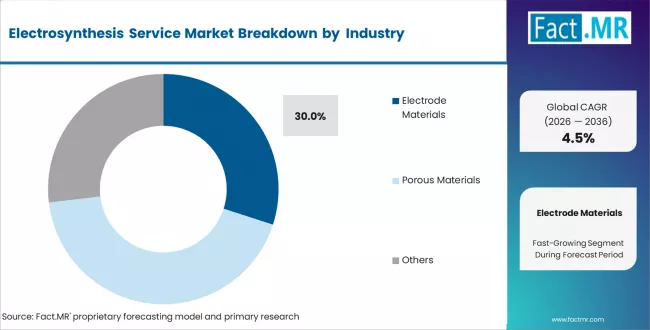
- By Application: Electrode Materials lead at 30% share in 2026, driven by battery and semiconductor material development outsourcing requirements.
- By Geography: The USA leads at 5.3% CAGR through NIH-funded research and pharmaceutical EHS-driven synthesis substitution demand.
- Analyst Opinion at FACT.MR
- Shambhu Nath Jha, Principal Consultant at Fact.MR, opines, 'CXOs in pharma and specialty materials will find electrosynthesis services transitioning from niche academic outsourcing toward strategic API and electrode material supply chain capability, with validated scale-up services commanding premium contract pricing.'
- Strategic Implications
- Invest in validated scale-up capability from lab to pilot. This enables access to pharmaceutical process development contracts.
- Develop electrode material electrosynthesis service lines targeting battery and semiconductor customers. Supports high-growth application demand.
- Methodology
- Based on service contract volumes and project fees by reaction scale. Validated using 2024–2025 provider revenue and CRO procurement data.
- Uses NIH, UKRI, EU Horizon, and NSFC programme data. Supports regional research investment demand analysis.
- Forecasts include pharmaceutical green chemistry adoption, materials science outsourcing trends, and government R&D funding data.
| Metric | Value |
|---|---|
| Estimated Value in 2026 | USD 243 million |
| Forecast Value in 2036 | USD 274 billion |
| Forecast CAGR (2026 to 2036) | 4.5% |
Source: Fact.MR analysis. Updated Mar 31, 2026
Industry feedback highlights a gradual shift in synthesis preferences. While no formal executive statements are available, contract laboratories reported in 2024 that pharmaceutical clients are increasingly specifying electrosynthesis routes. This is driven by the need to reduce hazardous reagent handling under internal EHS compliance frameworks.
Country-level growth reflects differences in research infrastructure, adoption of green chemistry, and R&D funding intensity. The USA leads at 5.3% CAGR, supported by NIH-funded programmes and pharmaceutical demand. The UK follows at 5.0% through UKRI-backed initiatives. China grows at 4.8% with government-led materials research investment. India records 4.5% driven by API outsourcing and academic adoption. South Korea posts 4.0%, supported by semiconductor and display materials demand.
Segmental Analysis
Electrosynthesis Service Market Analysis by Type
Electrosynthesis Service Market Analysis By Type | Source: Fact.MR
Based on FACT.MR's electrosynthesis service market report, consumption of Organic Electrosynthesis services is estimated to hold 63% share in 2026. Organic electrosynthesis dominates because pharmaceutical and fine chemical buyers require selective, reagent-free reactions that conventional synthesis cannot replicate cleanly. Electrochemical routes eliminate hazardous reagents while achieving high selectivity for complex organic intermediates.
- ESy-Labs Expansion: ESy-Labs expanded its organic electrosynthesis service capacity in early 2025, adding flow electrochemistry reactors for pharmaceutical API intermediate synthesis. The expansion targeted EU and North American pharma clients requiring ICH Q11-compliant process documentation. [1]
- Innoverda Development: Innoverda developed proprietary paired electrolysis workflows in 2024 for simultaneous oxidation-reduction in organic synthesis, reducing energy input per reaction. The technology targets fine chemical customers seeking cost-efficient green synthesis alternatives to hazardous reagent-based routes. [2]
- Organic Service Trend: Organic electrosynthesis contracts are growing in pharmaceutical outsourcing as CROs document reagent elimination and process reproducibility. Pharmaceutical procurement teams specified electrochemical routes in 2024 RFPs to meet internal EHS reduction targets. [3]
Electrosynthesis Service Market Analysis by Application
Electrosynthesis Service Market Analysis By Application | Source: Fact.MR
Based on FACT.MR's electrosynthesis service market report, Electrode Materials holds 30% share in 2026. This application leads because battery and semiconductor supply chain demand for precision electrode material synthesis is outsourced at high project value. Electrosynthesis enables controlled nanoscale morphology that conventional deposition methods cannot achieve.
- VoltaChem Investment: VoltaChem expanded its electrode material electrosynthesis pilot line in the Netherlands in 2024, targeting EV battery cathode material developers. The programme was co-funded under EU Horizon and positioned VoltaChem as a scale-up partner for European battery material manufacturers. [4]
- Meikuflo Technology Launch: Meikuflo Microfluidic Technology launched microfluidic electrosynthesis modules for nanomaterial and electrode material production in 2025. The platform reduces reagent consumption and improves particle size control for porous material synthesis. Targets materials science research customers in China and South Korea. [5]
- Electrode Material Outsourcing Trend: Battery material manufacturers are outsourcing electrode synthesis process development to specialist service providers. In 2024, EV supply chain investment drove materials science research lab capacity utilisation above 85% at key electrosynthesis service facilities, creating a backlog that incentivises new capacity investment. [6]
Drivers, Restraints, and Opportunities
Electrosynthesis Service Market Opportunity Matrix Growth Vs Value | Source: Fact.MR
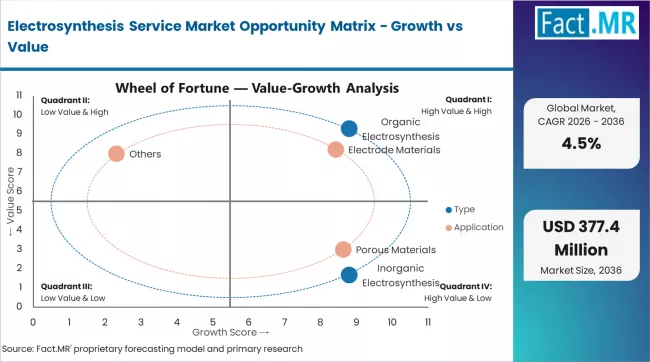
FACT.MR analysts observe that the electrosynthesis service market has grown from a largely academic niche into a viable contract service segment over 2020–2025, driven by pharmaceutical green chemistry mandates and materials science outsourcing. The market exists at USD 230 million because electrochemical synthesis adoption remains early-stage among mainstream chemical manufacturers, with awareness and validated scale-up capability limiting faster uptake.
The core tension is the divergence between growing demand for specialised, validated electrosynthesis capability and the commodity-tier electrochemical contract services that are stagnating. Standard bulk electrochemical batch services are losing ground to precision, documented, scale-up-capable service providers. New service models carry higher per-project fees but generate stronger margins for qualified providers, netting revenue growth even at modest volume expansion.
- Pharmaceutical Green Chemistry Mandates: The FDA's updated Q11 guidance and ICH Q12 framework increasingly favour documented, reproducible synthesis routes. In 2024, pharmaceutical companies accelerated EHS-driven substitution of hazardous oxidants and reductants with electrochemical equivalents. This generates sustained CRO electrosynthesis contract demand in the USA and EU.
- Government Materials Science Investment: China's 14th Five-Year Plan allocated targeted electrochemistry research funding in 2024 for battery and semiconductor materials. NSFC-funded programmes at major research institutes expanded electrosynthesis service contracts. This positions China-based service providers as strategic suppliers for domestic EV and semiconductor supply chains.
- UK and EU Academic-Industry CRO Collaboration: UKRI's Faraday Battery Challenge and EU Horizon 2020 successor programmes funded industrial electrochemistry scale-up projects in 2024–2025. German and UK academic-industry consortia enabled service providers like ESy-Labs and VoltaChem to expand validated pilot-scale capacity, reducing service costs and attracting new chemical manufacturer clients.
Regional Analysis
The electrosynthesis service market is assessed across North America, Europe, Asia Pacific, Latin America, and Middle East and Africa, covering 40+ countries with demand profiles shaped by pharmaceutical green chemistry adoption, government R&D investment intensity, and materials science outsourcing maturity. The full report offers market attractiveness analysis by region and country.
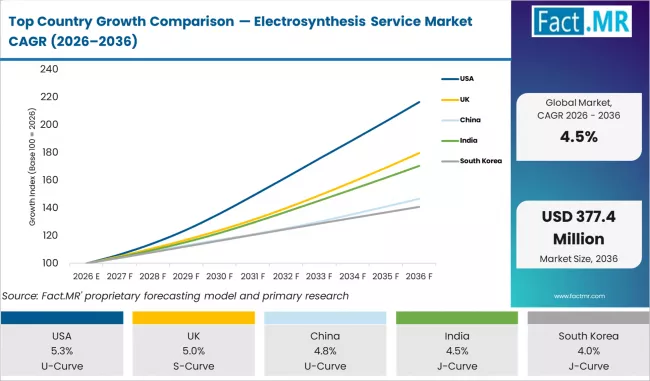
Top Country Growth Comparison Electrosynthesis Service Market Cagr 2026 To 2036 | Source: Fact.MR
| Country | CAGR (2026 to 2036) |
|---|---|
| USA | 5.3% |
| UK | 5.0% |
| China | 4.8% |
| India | 4.5% |
| South Korea | 4.0% |
Source: Fact.MR analysis. Updated Mar 31, 2026
Source: Fact.MR (FACT.MR) analysis, based on proprietary forecasting model and primary research
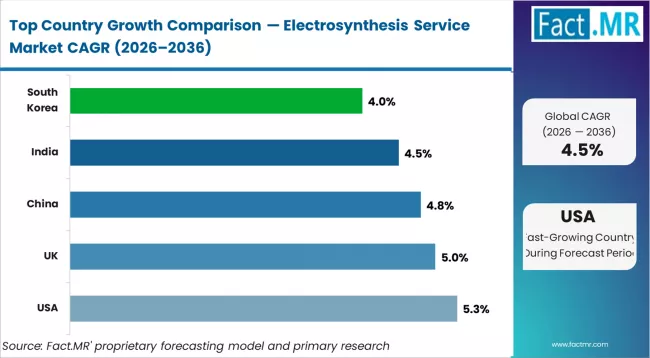
Electrosynthesis Service Market Cagr Analysis By Country | Source: Fact.MR
North America Electrosynthesis Service Market Analysis
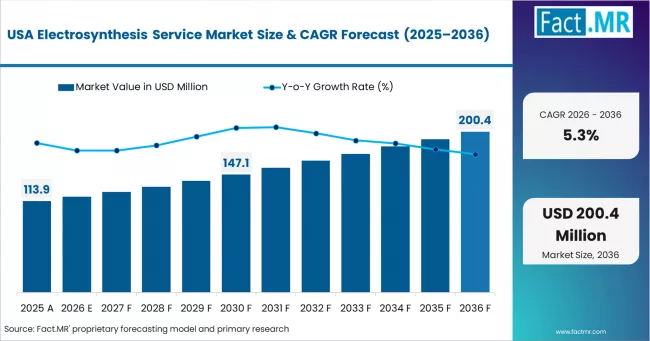
Electrosynthesis Service Market Country Value Analysis | Source: Fact.MR
North America is the largest market by value, supported by strong pharmaceutical demand and advanced research infrastructure. Growth is driven by EHS compliance requirements and NIH-funded electrochemistry programmes. Leading players such as Gamry Instruments and Pine Research benefit from close collaboration with academic institutions and CROs, which enables faster commercialization of electrochemical processes.
USA: The USA is projected to grow at 5.3% CAGR through 2036. FDA emphasis on green chemistry and ICH Q11 compliance has increased demand for validated electrochemical synthesis routes. NIH-funded research at institutions like MIT and Stanford is translating into commercial contracts. Pharmaceutical companies are increasingly adopting electro synthesis to replace hazardous reagents, supporting steady CRO demand.
FACT.MR covers the USA, Canada, and Mexico, including CRO demand trends, NIH funding impact, and procurement shifts toward green chemistry.
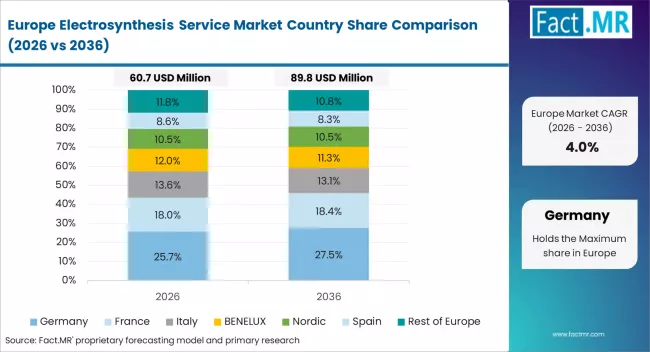
Electrosynthesis Service Market Europe Country Market Share Analysis, 2026 & 2036 | Source: Fact.MR
Europe Electrosynthesis Service Market Analysis
Europe acts as a regulatory and innovation hub, with strong policy support through EU Horizon programmes and REACH compliance requirements. Service providers such as VoltaChem, ESy-Labs, and Innoverda are investing in certified pilot-scale facilities. Academic-industry consortia in Germany and the Netherlands play a key role in defining process standards and scaling capabilities.
UK: The UK is projected to grow at 5.0% CAGR through 2036. UKRI programmes, including the Faraday Battery Challenge, are supporting electrochemical scale-up projects. Universities are expanding partnerships with specialty chemical companies, while pharmaceutical manufacturers are adopting electrosynthesis to meet internal sustainability and net-zero targets.
FACT.MR covers the UK, Germany, France, Italy, Spain, and Europe, including funding trends, regulatory drivers, and pilot-scale capacity expansion.
Asia Pacific Electrosynthesis Service Market Analysis
Asia Pacific is the fastest-growing region, driven by government investment, industrial demand, and expanding research capabilities. China leads in materials science applications, South Korea in semiconductor and battery materials, and India in pharmaceutical outsourcing. Regional academic labs and emerging service providers are scaling commercial capacity.
- China: China is projected to grow at 4.8% CAGR through 2036. Government funding under national programmes supports electro synthesis for battery cathode and semiconductor materials. Strong EV supply chain demand is driving outsourcing to specialised service providers for rapid process optimization.
- India: India is projected to grow at 4.5% CAGR through 2036. Growth is supported by IIT-led electrochemistry research and increasing pharmaceutical API outsourcing. Electrosynthesis is being adopted as a compliant alternative to hazardous reagents, particularly for regulated export markets.
- South Korea: South Korea is projected to grow at 4.0% CAGR through 2036. Growth is driven by semiconductor, display, and battery materials demand. Collaboration between universities and companies such as Samsung SDI and LG Energy Solution is supporting pilot-scale electro synthesis development.
FACT.MR covers China, Japan, South Korea, India, ASEAN, and ANZ, including government funding, industrial demand trends, and technology adoption patterns.
Competitive Aligners for Market Players
Electrosynthesis Service Market Analysis By Company | Source: Fact.MR
The electrosynthesis service market remains highly fragmented, with no single provider dominating globally. Competition is shaped less by scale and more by technical capability. Service providers that can demonstrate reliable scale-up, advanced electrode design, and high-quality process documentation tend to stand out. These capabilities are especially important for pharmaceutical and advanced materials clients, who require precision, repeatability, and regulatory-ready processes. As a result, specialised providers with proven pilot-scale expertise are able to charge premium fees and often become preferred partners for high-value projects.
In more advanced segments, competition narrows to a smaller group of highly capable providers. This is particularly visible in pharmaceutical CRO electrosynthesis in North America and Europe, and in battery material applications across Asia. These areas demand strict validation standards and detailed documentation, which limits participation to experienced players. Companies such as ESy-Labs and VoltaChem benefit from this dynamic, as their established track record and accumulated process knowledge create strong barriers for new entrants offering only basic electrochemical services.
On the demand side, buyers take a cautious and structured approach. Pharmaceutical companies typically work with multiple service providers to reduce dependency risks and ensure continuity. At the same time, materials science organisations often maintain in-house electrochemistry expertise while outsourcing scale-up work to specialised partners. This approach prevents full supplier exclusivity but supports a stable ecosystem where both premium providers and mid-tier players can sustain consistent project volumes.
Key Players of Electrosynthesis Service Market
- Electrochemistry
- Innoverda
- Merck
- ESy-Labs
- IKA
- VoltaChem
- Meikuflo Microfluidic Technology (Changzhou) Co., Ltd.
- BioLogic
- Pine Research Instrumentation
- Gamry Instruments
- Metrohm
Bibliography
- [1] ESy-Labs GmbH. (2025). Service Capacity Expansion: Flow Electrochemistry Reactor Scale-Up for Pharmaceutical API Intermediate Electrosynthesis with ICH Q11-Compliant Process Documentation. January 2025. esy-labs.com
- [2] Innoverda BV. (2024). Technology Development: Paired Electrolysis Workflow for Simultaneous Oxidation-Reduction in Fine Chemical Organic Electrosynthesis with Reduced Energy Input per Reaction Cycle. 2024. innoverda.com
- [3] American Chemical Society. (2024). Green Chemistry in Pharmaceutical Manufacturing Survey: Electrochemical Synthesis Route Adoption Among U.S. and European Pharmaceutical CRO Customers for Hazardous Reagent Substitution Under Internal EHS Reduction Programmes. October 2024. acs.org
- [4] VoltaChem. (2024). Pilot-Scale Electrode Material Electrosynthesis Expansion: EU Horizon Co-Funded Battery Cathode Material Development Service Line for European EV Battery Manufacturer Supply Chains. Q3 2024. voltachem.com
- [5] Meikuflo Microfluidic Technology (Changzhou) Co. Ltd. (2025). Product Launch: Commercial Microfluidic Electrosynthesis Modules for Nanomaterial and Porous Electrode Material Production Targeting Materials Science Research Customers in China and South Korea. January 2025. meikuflo.com
- [6] BloombergNEF. (2024). EV Battery Supply Chain Materials Outsourcing Report: Electrosynthesis Service Facility Capacity Utilisation Data for Electrode Material Process Development in Asia Pacific Battery Material Supply Chains. 2024. about.bnef.com
This Report Addresses
- Strategic insights on electrosynthesis service demand across pharmaceutical API green chemistry outsourcing, EU and USA regulatory-driven reagent substitution, China materials science government investment, UK UKRI-funded scale-up collaboration, and South Korea semiconductor material development.
- Market forecast from USD 243 million in 2026 to USD 274 billion by 2036 at a CAGR of 4.5%.
- Growth opportunity mapping across USA pharmaceutical CRO electrosynthesis demand, UK UKRI-funded academic-industry scale-up, China government materials science contract investment, India pharma API outsourcing, and South Korea semiconductor electrode material development.
- Segment-wise analysis by type (inorganic, organic), application (nanomaterials, electrode materials, porous, superconducting, composites, others), end user (pharmaceutical, materials research, chemical manufacturers), and reaction scale (lab, pilot, industrial).
- Regional outlook covering North America pharmaceutical green chemistry CRO demand, Europe REACH and EU Horizon-funded pilot-scale investment, and Asia Pacific government-directed materials science and pharma API electrosynthesis outsourcing growth.
- Competitive landscape analysis of ESy-Labs, VoltaChem, Innoverda, Merck, BioLogic, Gamry Instruments, Pine Research Instrumentation, and Metrohm covering scale-up capability, process documentation depth, and pharmaceutical and materials science customer positioning strategies.
- Technology tracking including flow electrochemistry reactor advances, microfluidic electrosynthesis platform development, pilot-scale potentiostat-galvanostat systems, and ICH Q11-compatible process documentation methodology.
- Report delivery in PDF, Excel datasets, and presentation formats supported by primary interviews, provider revenue disclosures, NIH and UKRI programme data, EU Horizon project records, and pharmaceutical green chemistry procurement data.
Electrosynthesis Service Market Definition
The electrosynthesis service market includes contract and fee-for-service electrochemical synthesis of organic and inorganic compounds, electrode materials, nanomaterials, and specialty composites. Service providers supply reactor design, process scale-up, and analytical characterisation for pharmaceutical, materials science, and specialty chemical customers.
Electrosynthesis Service Market Inclusions
Includes global and regional forecasts from 2026 to 2036 segmented by type, application, end user, and reaction scale. Covers lab-scale, pilot-scale, and industrial electrosynthesis services across pharmaceutical, materials science, and chemical manufacturing sectors.
Electrosynthesis Service Market Exclusions
Excludes electroplating, electrolysis for water treatment, and battery cell manufacturing services. Omits standalone electrochemical instrument sales and electrode component supply without synthesis service bundling. Focuses strictly on contract electrosynthesis and process development services.
Electrosynthesis Service Market Research Methodology
-
Primary Research: Interviews with electrosynthesis service providers, pharma process chemists, and materials science lab managers. Inputs from electrode material developers and CRO procurement teams across North America, Europe, and Asia.
-
Desk Research : Uses NIH, UKRI, and NSFC grant databases. Includes EU Horizon programme project data and pharmaceutical green chemistry regulatory guidance from 2024–2025.
-
Market-Sizing and Forecasting : Based on service contract volumes and average project fee by scale. Uses bottom-up approach from lab-scale to industrial project value benchmarks and end-user demand data.
-
Data Validation and Update Cycle : Validated using service provider revenue disclosures and published project data. Cross-checked with regulatory programme databases. Updated regularly.
Segmentation
Scope of Report
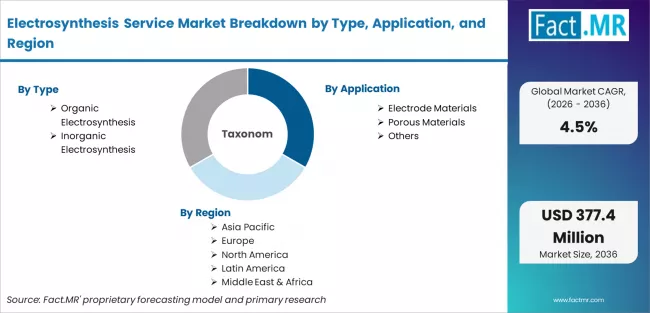
Electrosynthesis Service Market Breakdown By Type, Application, And Region | Source: Fact.MR
| Attribute | Details |
|---|---|
| Quantitative Units | USD 243 million (2026) to USD 274 billion (2036), at a CAGR of 4.5% |
| Market Definition | The market covers contract electrochemical synthesis services for organic and inorganic compounds, electrode materials, nanomaterials, and specialty composites delivered at lab-scale, pilot-scale, and industrial scale to pharmaceutical, materials science, and chemical manufacturing customers globally. |
| Type Segmentation | Inorganic Electrosynthesis, Organic Electrosynthesis |
| Application Segmentation | Nanomaterials, Electrode Materials, Porous Materials, Superconducting Materials, Composite Materials, Others |
| End User Segmentation | Pharmaceutical Companies, Materials Science Research, Chemical Manufacturers |
| Reaction Scale Segmentation | Lab-scale Development, Pilot-scale Optimization, Industrial Production |
| Application Coverage | Pharmaceutical API intermediate electrochemical synthesis, battery and semiconductor electrode material development, nanomaterial and porous material production, specialty composite synthesis, and pilot-scale process optimisation services. |
| Regions Covered | North America, Europe, Asia Pacific, Latin America, Middle East and Africa |
| Countries Covered | USA, Canada, Mexico, Germany, UK, France, Italy, Spain, Nordic, BENELUX, China, Japan, South Korea, India, ASEAN, Australia and New Zealand, Brazil, Argentina, Chile, Saudi Arabia, GCC, Turkey, South Africa, Rest of MEA |
| Key Companies Profiled | Electrochemistry, Innoverda, Merck, ESy-Labs, IKA, VoltaChem, Meikuflo Microfluidic Technology (Changzhou) Co. Ltd., BioLogic, Pine Research Instrumentation, Gamry Instruments, Metrohm |
| Forecast Period | 2026 to 2036 |
| Approach | Hybrid top-down and bottom-up model using service contract volumes by type and application, average project fees by reaction scale and end user, pharmaceutical green chemistry demand benchmarks, materials science outsourcing data, and primary interviews with electrosynthesis service providers and CRO procurement teams. |
Source: Fact.MR analysis. Updated Mar 31, 2026
Electrosynthesis Service Market by Segments
-
By Type:
- Inorganic Electrosynthesis
- Organic Electrosynthesis
-
By Application:
- Nanomaterials
- Electrode Materials
- Porous Materials
- Superconducting Materials
- Composite Materials
- Others
-
By End User:
- Pharmaceutical Companies
- Materials Science Research
- Chemical Manufacturers
-
By Reaction Scale:
- Lab-scale Development
- Pilot-scale Optimization
- Industrial Production
-
By Region:
-
North America
- United States
- Canada
- Mexico
-
Latin America
- Brazil
- Mexico
- Argentina
- Chile
- Rest of Latin America
-
Western Europe
- Germany
- France
- UK
- Italy
- Spain
- Nordic Countries
- BENELUX
- Rest of Western Europe
-
Eastern Europe
- Russia
- Poland
- Hungary
- Balkan and Baltic
- Rest of Eastern Europe
-
East Asia
- China
- Japan
- South Korea
-
South Asia and Pacific
- India
- ASEAN
- Australia and New Zealand
- Rest of South Asia and Pacific
-
Middle East and Africa
- Kingdom of Saudi Arabia
- Other GCC Countries
- Turkey
- South Africa
- Rest of Middle East and Africa
-
Frequently Asked Questions
How large is the electrosynthesis service market in 2025?
What will the market size be in 2026?
What is the projected market size by 2036?
What is the expected CAGR of the electrosynthesis service market?
What is the absolute dollar opportunity in this market?
Which type segment leads the market?
Which application segment holds the largest share?
Which country shows the fastest growth?
What defines competition in this market?
Why is the market fragmented?
Which services command premium pricing?
Who are the key customers?
Why are specialised providers preferred?
What limits new entrants?
How do buyers reduce supplier risk?
Who worked on this report


Preview the report firsthand - request a free sample
Free SampleGet the brochure for pricing and purchase details
Download PDF