- Market Value (2025): USD 207.4 Mn
- Estimated Value (2026): USD 280.0 Mn
- Forecast Value (2036): USD 5630.0 Mn
- CAGR (2026-2036): 35.0%
What is the Embodied AI Batteries Market forecast to be worth by 2036?
USD 280.0 million in 2026 to USD 5,630.0 million by 2036 at a 35.0% CAGR.
- The Embodied AI Batteries Market crossed a valuation of USD 207.4 million in 2025.
- Demand is projected to increase from USD 280.0 million in 2026 to USD 5,630.0 million by 2036.
- The market is forecast to record 35.0% CAGR from 2026 to 2036 as robot OEMs specify packs for runtime, charging safety and in-machine fit.
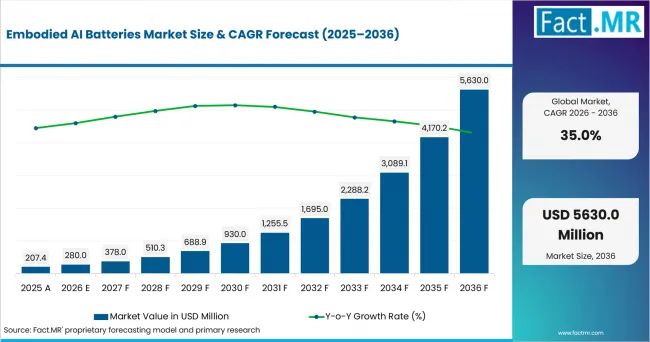
Embodied Ai Batteries Market Value Analysis | Source: Fact.MR
What are the defining numbers behind Embodied AI Batteries Market growth?
An absolute opportunity of USD 5,350.0 million is expected between 2026 and 2036.
- Demand Drivers in the Market
- Robot OEMs need batteries that fit compact joints and mobile bases while carrying compute loads for perception, navigation and onboard decision-making.
- Factory automation teams need longer runtime. The International Federation of Robotics reported in September 2025 that 542,000 industrial robots were installed worldwide in 2024.
- Battery engineering teams need safer high-output chemistries since embodied AI systems combine motion power with electronics that are sensitive to heat and voltage instability.
- Industrial fleet operators need pack telemetry that supports charging discipline, replacement planning and uptime tracking across mixed robot fleets.
- Aerospace and UAS developers need energy-dense cells for payload-sensitive platforms where endurance losses weaken mission economics.
- Key Segments Analyzed
- By Chemistry: Sulfide is expected to hold 42.0% share in 2026 because high ionic-conductivity chemistry suits compact packs that need fast charge transfer.
- By Module Format: Pouch is projected to account for 46.0% share in 2026 owing to thin form factors that fit robot torsos, arms and mobile bases.
- By Power Class: Below 1 kWh is anticipated to capture 48.0% share in 2026 since many humanoid and light industrial robots use modular packs.
- By Application: Industrial robots are estimated to represent 30.0% share in 2026, supported by factory automation programs that value uptime evidence.
- Analyst Opinion at Fact.MR
- Shambhu Nath Jha, Principal Consultant at Fact.MR, states, "Embodied AI changes the battery conversation because the pack becomes part of the robot architecture. Space, heat, discharge behavior and telemetry are evaluated together during robot design. Suppliers with cell chemistry depth, module design discipline and robot-specific validation are expected to gain preference as fleets move from trials to repeated deployment."
- Strategic Implications
- Battery manufacturers should document cycle life under robot-like load profiles before positioning packs for embodied AI fleets.
- Robot OEMs should align pack geometry with service access so replacement work fits normal factory maintenance windows.
- Systems integrators should connect battery telemetry with fleet-management software to detect runtime losses before they interrupt shifts.
- Material suppliers should qualify sulfide, oxide and polymer hybrid systems against moisture control, safety testing and manufacturability constraints.
Germany is projected to record 38.7% CAGR through 2036, supported by automation depth and battery-system engineering. The USA is anticipated to post 29.8% CAGR as durable-goods orders keep automation spending active. The UK is forecast to advance at 27.8% CAGR due to smart-machine policy and factory digitalization support. Japan is estimated to reach 26.5% CAGR through robot production strength. South Korea is projected to record 25.0% CAGR, shaped by ICT exports and precision manufacturing demand.
How does the Embodied AI Batteries Market break down by segment?
Below 1 kWh leads at 48.0% share; Pouch leads at 46.0% share.
Which Chemistry dominates?
Sulfide is expected to hold 42.0% share in 2026.
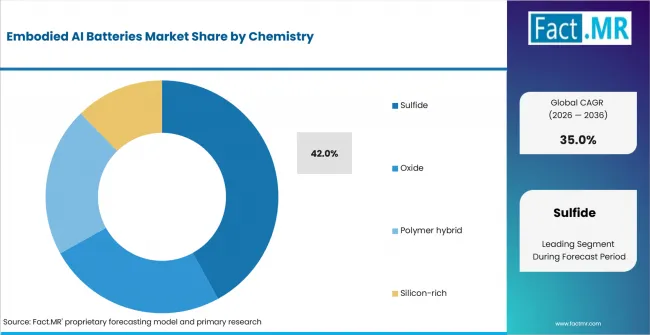
Embodied Ai Batteries Market Analysis By Chemistry | Source: Fact.MR
Sulfide chemistry leads because high ionic conductivity helps compact packs deliver power quickly within small robot housings. Moisture handling and manufacturing control remain qualification constraints, so adoption depends on suppliers that prove stable pack behavior under industrial operating cycles.
Sulfide selection affects separator choice, sealing approach and dry-room handling. Suppliers that pair electrolyte stability with repeatable coating quality are better placed for robot packs where vibration and charge surges are routine.
What leads the Module Format segment?
Pouch is projected to account for 46.0% share in 2026.
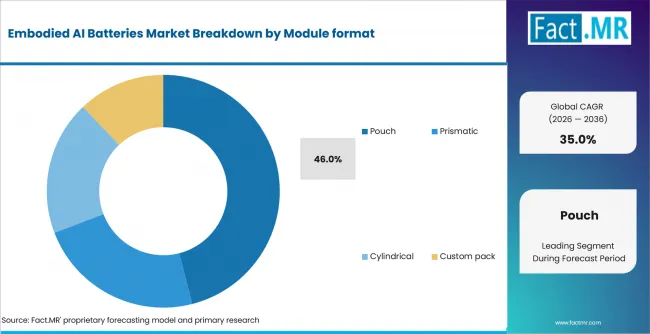
Embodied Ai Batteries Market Analysis By Module Format | Source: Fact.MR
Pouch modules lead because robot designers need thin packs that fit curved frames and narrow service cavities. Shape flexibility helps split energy storage across a robot body while keeping weight distribution under control.
Samsung SDI and Hyundai Motor Group focused their February 2025 robot-battery program on packs optimized for limited robot space. The program covers charge-discharge behavior, usage time and qualification life for robot applications.
How does Power Class shape demand?
Below 1 kWh is anticipated to capture 48.0% share in 2026.
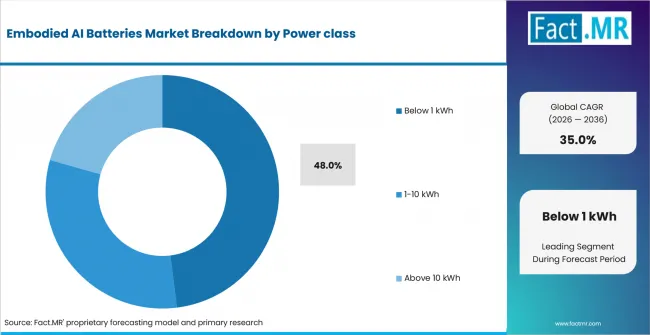
Embodied Ai Batteries Market Analysis By Power Class | Source: Fact.MR
Below 1 kWh systems lead because many embodied AI platforms run as mobile or human-scale machines. Smaller packs reduce weight and allow quicker service cycles, which suits robots assigned to warehouse handling, inspection and indoor manufacturing tasks.
Industrial teams evaluate this power class through runtime per shift, charging interval and pack replacement time. The commercial test is practical: the robot must finish its assigned work with safe reserve capacity.
What supports Industrial robots within Application?
Industrial robots are estimated to represent 30.0% share in 2026.
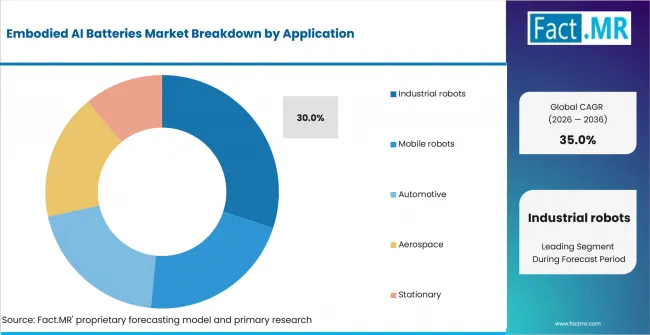
Embodied Ai Batteries Market Analysis By Application | Source: Fact.MR
Industrial robots lead applications because factories already have the maintenance teams, safety practices and uptime metrics needed to evaluate higher-performance battery systems. Embodied AI batteries fit this setting when robots move between work cells and draw power for sensing, compute and actuation.
Factory robots create repeatable duty cycles that help battery suppliers validate thermal behavior, charging intervals and module replacement timing. Industrial deployment is therefore a practical proving ground before wider use in aerospace or stationary systems.
What is accelerating Embodied AI Batteries Market adoption, and what is holding it back?
Demand is expected to rise through robot runtime needs and compact pack design. Growth is constrained by qualification cycles, safety validation and cost.
Drivers Impact Analysis
| DRIVER | (~) % IMPACT ON CAGR | GEOGRAPHIC RELEVANCE | IMPACT TIMELINE |
|---|---|---|---|
| Robot fleet runtime requirements | +3.0% | East Asia, North America, Europe | Short term (<= 2 years) |
| Compact pack design for embodied AI systems | +2.3% | Global | Medium term (2-4 years) |
| Industrial automation and logistics robot deployments | +1.7% | Germany, Japan, USA, South Korea | Medium term (2-4 years) |
| High-energy cells for UAS and mobile robotics | +1.1% | USA, Europe, East Asia | Long term (>= 4 years) |
Source: Fact.MR analysis. Updated Aug 27, 2026
- Robot fleet runtime requirements: Factories and warehouses need batteries that hold performance across repeated movement, sensing and charging cycles.
- Compact pack design: Embodied AI robots leave limited space for cells, wiring and thermal paths, so module shape affects supplier selection.
- Automation deployment: Industrial robot installations widen the base of machines needing predictable uptime and battery service planning.
Opportunity Impact Analysis
| OPPORTUNITY | (~) % IMPACT ON CAGR | GEOGRAPHIC RELEVANCE | IMPACT TIMELINE |
|---|---|---|---|
| Robot-specific validation programs | +1.6% | Global | Short term (<= 2 years) |
| Fast-charge and silicon-rich cell adoption | +1.2% | USA, Israel, South Korea | Medium term (2-4 years) |
| Battery telemetry linked to fleet software | +0.8% | North America, Europe, East Asia | Long term (>= 4 years) |
Source: Fact.MR analysis. Updated Aug 27, 2026
- Robot-specific validation programs: Samsung SDI, Hyundai Motor and Kia provide a model for testing batteries against space, lifetime and charging needs.
- Fast-charge and silicon-rich cells: Faster charge acceptance improves uptime for humanoid robots and drones assigned to short duty cycles.
- Telemetry-linked fleet software: Battery data becomes more valuable when operators use it to schedule swaps and manage charging windows.
Restraints Impact Analysis
| RESTRAINT | (~) % IMPACT ON CAGR | GEOGRAPHIC RELEVANCE | IMPACT TIMELINE |
|---|---|---|---|
| Qualification time for robot-specific packs | -0.8% | Global | Short term (<= 2 years) |
| Thermal and safety validation burden | -0.6% | Europe, North America, East Asia | Medium term (2-4 years) |
| Cell cost and material availability | -0.5% | Global | Long term (>= 4 years) |
Source: Fact.MR analysis. Updated Aug 27, 2026
- Qualification time: Robot OEMs need test evidence for pack life, charge-discharge cycles and abuse conditions before changing production designs.
- Thermal and safety validation: Compact packs operate close to sensors and actuators, making heat control and certification a longer engineering task.
- Cell cost and material availability: Sulfide, silicon-rich and high-performance cylindrical cells carry sourcing risk as production capacity scales.
Which countries are scaling the Embodied AI Batteries Market through 2036?
- The country comparison spans 13.7 percentage points and forms three practical growth bands across the forecast period.
- Germany remains 8.9 percentage points above the USA through automation depth and robot-pack qualification needs.
- The USA remains 2.0 percentage points above the UK as durable-goods orders sustain industrial automation spending.
- The UK remains 1.3 percentage points above Japan with advanced-manufacturing programs and factory digitalization support.
- Japan remains 1.5 percentage points above South Korea through robot order recovery and machinery-production depth.
- South Korea closes the displayed range as ICT exports and battery manufacturing scale support embodied AI supply chains.
Comparable CAGRs create different entry conditions due to robot density, manufacturing mix, battery supply and qualification routes. Full report coverage includes North America, Latin America, Western Europe, Eastern Europe, East Asia, South Asia & Pacific, Middle East & Africa.
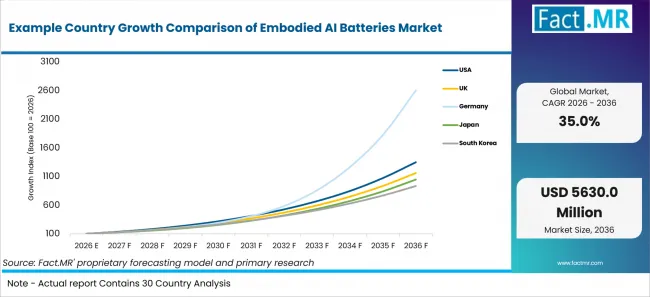
Example Country Growth Comparison Of Embodied Ai Batteries Market | Source: Fact.MR
| Country | CAGR (2026-2036) |
|---|---|
| USA | 29.8% |
| UK | 27.8% |
| Germany | 38.7% |
| Japan | 26.5% |
| South Korea | 25.0% |
Source: Fact.MR analysis. Updated Aug 27, 2026
What supports USA adoption?
29.8% CAGR, supported by durable-goods orders and factory robot use.
The USA has a large base of durable-goods customers relevant to factory automation investment. The U.S. Census Bureau reported in July 2026 that June durable-goods new orders reached USD 334.8 billion, with computers and electronic products up 3.1% to USD 31.1 billion.
What supports the United Kingdom's growth?
27.8% CAGR, backed by smart-machine support and selective factory upgrades.
The UK market is shaped by selective factory upgrades in high-value production settings. The Office for National Statistics reported in August 2026 that UK manufacturing output grew 1.0% in the three months to June 2026 compared with the three months to March 2026. Output of computer, electronic and optical products increased 3.0% over the same period, providing a current production backdrop for electronics-intensive manufacturing.
What is supporting Germany's adoption?
38.7% CAGR, supported by industrial robotics and manufacturing-order depth.
Germany benefits from a dense industrial buyer base that evaluates battery systems through production uptime and pack-safety evidence. Destatis reported in August 2026 that the real stock of manufacturing orders rose 0.8% month over month in June 2026. The increase provides current order-book context for Germany’s manufacturing and machinery sectors.
How does Japan perform?
26.5% CAGR, led by robot production and machinery-order recovery.
Japan has an established robot manufacturing base and a deep electronics supply chain for compact power systems. The Japan Robot Association reported in July 2026 that robot order value rose 40.0% year on year in April-June 2026, while production value increased 24.3%.
How is South Korea developing demand?
25.0% CAGR, shaped by ICT exports and battery manufacturing scale.
South Korea links battery production scale with electronics and precision manufacturing activity. MOTIR and MSIT reported in July 2026 that Korea’s ICT exports reached USD 253.9 billion in the first half of 2026, up 120.5% year on year. The figure indicates the scale and momentum of Korea’s ICT export sector.
Who leads the Embodied AI Batteries Market?
CATL is profiled for robot-duty battery deployment and cell chemistry depth. Its portfolio position connects battery design with production-line robots that need pack safety, runtime proof and service planning.
LG Energy Solution participates through cylindrical batteries for robotics. In its January 29, 2026 financial-results release, the company said it was already supplying cylindrical batteries to six leading global robotics companies and providing samples for next-generation models, with battery specifications and mass-production timelines under discussion. Samsung SDI supports robot-specific battery development, including a February 2025 collaboration with Hyundai Motor and Kia to develop batteries optimized for the limited installation space of service robots.
Panasonic Energy participates through cylindrical lithium-ion cells, including a November 2025 agreement to supply 2170 cells for Zoox’s robotaxi fleet beginning in early 2026. StoreDot provides adjacent extreme-fast-charging battery-cell technology, while Amprius Technologies supplies high-energy and high-power silicon-anode batteries for unmanned-aircraft applications.
Competition centers on chemistry depth, cell-to-module integration and proof that a pack holds performance under robot-specific duty cycles. Battery suppliers also need service models for replacement, diagnostics and warranty support as embodied AI fleets move into repeated factory or logistics use.
Which companies are the key providers?
Key companies include CATL; LG Energy Solution; Samsung SDI; Panasonic Energy; StoreDot; and Amprius Technologies.
- CATL
- LG Energy Solution
- Samsung SDI
- Panasonic Energy
- StoreDot
- Amprius Technologies
Bibliography
- International Federation of Robotics. (2025, September 25). Global robot demand in factories doubles over 10 years.
- CATL. (2026, June 24). First heavy-duty humanoid robot powered by CATL batteries goes live in CATL factory.
- LG Energy Solution. (2026, January 29). LG Energy Solution releases 2025 financial results.
- Samsung SDI. (2025, February 25). Samsung SDI to develop high-performance robot batteries with Hyundai Motor, Kia.
- StoreDot. (2025, March 6). StoreDot and JR Energy Solution forge alliance to accelerate extreme fast charging (XFC) battery production.
- Amprius Technologies, Inc. (2025, October 14). Amprius’ high-power silicon batteries selected by ESAero to power next-generation UAVs.
- U.S. Census Bureau. (2026, July 27). Monthly advance report on durable goods manufacturers’ shipments, inventories and orders.
- Federal Statistical Office (Destatis). (2026, August 19). Stock of orders in manufacturing in June 2026: +0.8% on the previous month.
- Office for National Statistics. (2026, August 13). GDP monthly estimate, UK: June 2026.
- Ministry of Trade, Industry and Resources, & Ministry of Science and ICT. (2026, July 14). Korea’s ICT exports reach record $253.9 billion in first half of 2026.
This Report Answers
- The report explains where embodied AI batteries are used across chemistry, module format, power class and application.
- Segment analysis identifies the leading subsegments and the operating reasons robot OEMs prioritize them.
- Country analysis examines the listed markets and the factory automation or battery supply conditions supporting demand.
- Competitive analysis reviews providers across robot-specific packs, cylindrical cells, silicon-rich batteries and fast-charge systems.
- Application analysis assesses how runtime, pack shape and qualification evidence influence purchase decisions in industrial robotics.
What does the Embodied AI Batteries Market cover?
The Embodied AI Batteries Market covers cells, modules and packs built for robots that combine physical movement with onboard AI computing. It includes power systems for humanoid robots, mobile industrial robots, automated guided platforms, UAS and stationary embodied AI systems where battery design affects uptime.
Related analysis of factory robots places battery packs inside automated cells where uptime and replacement access guide procurement. Mobile industrial robot platforms connects pack sizing with indoor transport, charging windows and route availability.
What is included in the scope?
The scope includes robot-specific battery packs, custom modules, battery-management electronics when bundled with the pack, charging interfaces and telemetry features needed for runtime monitoring. It covers sulfide, oxide, polymer hybrid and silicon-rich chemistries when these are configured for embodied AI systems.
Related coverage of solid battery modules helps align pack format with chemistry and power class. Work on lithium-ion battery packs supports the boundary around module-level integration and battery-management electronics.
What is excluded from the scope?
The scope excludes general lithium-ion cells sold only for consumer electronics, passenger EV battery packs outside embodied AI use and raw battery materials sold without module or pack integration. It also excludes robot hardware sold separately from battery systems.
General charging infrastructure sits outside the scope when it is sold separately from robot-battery management or fleet battery telemetry. Standalone AI software is also outside the scope unless it controls battery behavior inside the robot platform.
How Was the Analysis Built?
The analysis draws on 120+ sources, 35+ company portfolios, 25+ countries, and more than 20 industry interviews.
- Primary Research: Primary research includes discussions with battery manufacturers, robot OEMs, module assemblers, automation integrators, distributors, procurement teams and subject-matter experts. These conversations examine operating requirements, product adoption, validation needs, approval processes, competitive positioning and the factors that influence wider market acceptance.
- Desk Research: Desk research covers government statistics, robotics association data, company announcements, technical studies, industry associations, standards, public policy and other authoritative sources. Every source used in the analysis is documented in the bibliography.
- Market Sizing and Forecasting: Market estimates combine historical performance, demand indicators, pricing and volume trends, segment shares, company participation, country-level growth, adoption patterns, investment activity and barriers to market expansion.
- Data Validation and Update Cycle: Findings are validated by comparing primary interviews with public data, company activity, regulatory changes, trade patterns and industry developments. Regular updates review product launches, capacity changes, partnerships, approvals, procurement trends and shifts in commercial adoption.
Segmentation
What is the report's scope and coverage?
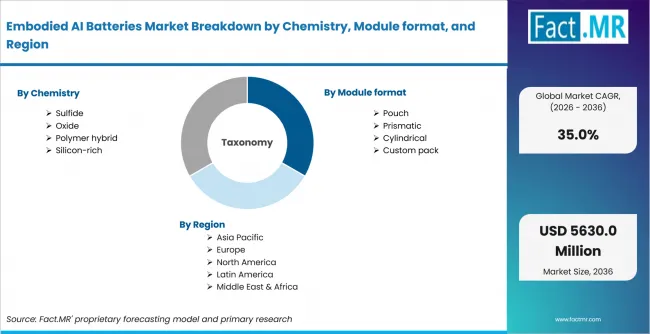
Embodied Ai Batteries Market Breakdown By Chemistry, Module Format, And Region | Source: Fact.MR
| Attribute | Details |
|---|---|
| Quantitative Units | USD million |
| Market Definition | Battery cells, modules and packs designed for embodied AI robots and mobile autonomous systems that need compact energy storage, high power delivery, thermal control and battery telemetry. |
| Chemistry | Sulfide; Oxide; Polymer hybrid; Silicon-rich |
| Module Format | Pouch; Prismatic; Cylindrical; Custom pack |
| Power Class | Below 1 kWh; 1-10 kWh; Above 10 kWh |
| Application | Industrial robots; Mobile robots; Automotive; Aerospace; Stationary |
| Regions Covered | North America; Latin America; Western Europe; Eastern Europe; East Asia; South Asia & Pacific; Middle East & Africa |
| Countries Covered | USA; UK; Germany; Japan; South Korea |
| Key Companies Profiled | CATL; LG Energy Solution; Samsung SDI; Panasonic Energy; StoreDot; Amprius Technologies |
| Forecast Period | 2026 to 2036 |
| Approach | Hybrid top-down and bottom-up approach using robot deployment indicators, battery module requirements, power-class mix, application adoption, country-level automation activity and provider portfolio review. |
Source: Fact.MR analysis. Updated Aug 27, 2026
How is the market segmented?
-
By Chemistry:
- Sulfide
- Oxide
- Polymer hybrid
- Silicon-rich
-
By Module Format:
- Pouch
- Prismatic
- Cylindrical
- Custom pack
-
By Power Class:
- Below 1 kWh
- 1-10 kWh
- Above 10 kWh
-
By Application:
- Industrial robots
- Mobile robots
- Automotive
- Aerospace
- Stationary
-
By Region:
- North America
- Latin America
- Western Europe
- Eastern Europe
- East Asia
- South Asia & Pacific
- Middle East & Africa
Frequently Asked Questions
How big is the embodied AI batteries market in 2026?
What is the CAGR of the embodied AI batteries market from 2026 to 2036?
Which chemistry leads the embodied AI batteries market?
Which module format leads the embodied AI batteries market?
Who are the leading companies in the embodied AI batteries market?
Who worked on this report


Preview the report firsthand - request a free sample
Free SampleGet the brochure for pricing and purchase details
Download PDF