- Market Value (2025): USD 4.16 Bn
- Estimated Value (2026): USD 4.74 Bn
- Forecast Value (2036): USD 17.5 Bn
- CAGR (2026-2036): 14.0%
What is the Robotic Floor Cleaners Market forecast to be worth by 2036?
USD 4.7 billion in 2026 to USD 17.5 billion by 2036 at a 14.0% CAGR.
- The robotic floor cleaners market was valued at USD 4.16 billion in 2025, with robotic vacuums and online orders carrying most of that revenue.
- By 2036, revenue will reach USD 17.5 billion, up from USD 4.74 billion in 2026, as autonomous cleaning spreads from premium homes to mass-market buyers.
- A 14.0% CAGR will hold from 2026 to 2036, since smarter navigation and self-maintaining docks lower the barrier to a first purchase.
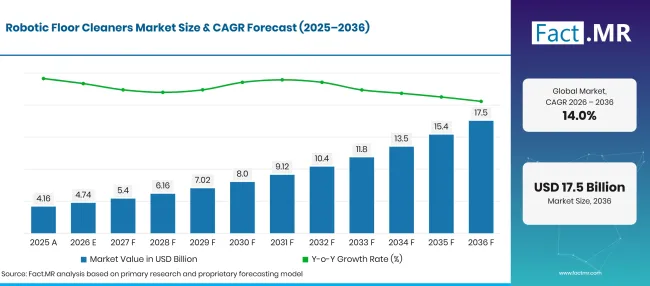
Robotic Floor Cleaners Market Forecast Global | Source: Fact.MR
| Year | Basis | Market Value (USD billion) |
|---|---|---|
| 2025 | Actual | 4.16 |
| 2026 | Estimate | 4.74 |
| 2036 | Forecast | 17.5 |
| CAGR 2026 to 2036 | Forecast period | 14.0% |
Source: Fact.MR analysis. Updated Oct 23, 2026
What are the defining numbers behind Robotic Floor Cleaners Market growth?
The 2026 to 2036 period adds USD 12.8 billion in new value, led by residential demand and online sales.
- Demand Drivers in the Market
- Navigation keeps getting better. LiDAR and camera mapping, obstacle recognition and app-based zone control now let robots clean a whole home without supervision. Dependable results will carry adoption past early adopters.
- Online shopping has become the main route to market. Eurostat reported that 78% of EU internet users aged 16 to 74 bought or ordered goods or services online in 2025 [1]. Buyers compare robotic cleaners on product pages, and brands with strong digital storefronts will capture most of the gain.
- Price competition is pulling entry costs down. Chinese specialists release feature-rich models at each price tier, and established brands answer with lower-cost lines of their own. Cheaper entry models will keep drawing first-time buyers.
- Hybrid machines cut the upkeep that once put buyers off. Robots that vacuum and mop, paired with self-emptying and self-washing docks, take over most of the manual work. Owners will trade up from older single-function units as these features reach mid-priced models.
- Commercial operators are automating routine floor care. The U.S. Bureau of Labor Statistics projects about 321,800 openings a year for janitors and building cleaners over 2025 to 2035 [2]. Hotels, hospitals and retail chains deploy robots to cover large floor areas outside opening hours and to ease hiring pressure.
- Key Segments Analyzed
- By Product Type: Vacuum Cleaners will command 52.3% share in 2026, since suction cleaning on mapped routes is the core chore most buyers want off their list.
- By Application: Residential will take 68.4% share in 2026 as busy households hand daily floor care to a scheduled machine.
- By End-User: Households will account for 68.4% share in 2026, owing to the wide appeal of hands-free cleaning in small and mid-sized homes.
- By Distribution Channel: Online Retail will capture 68.0% share in 2026, given that buyers check specifications, prices and reviews before ordering.
- Analyst Opinion at Fact.MR
- Shambhu Nath Jha, Principal Consultant at Fact.MR, states, “Buyers now judge robotic floor cleaners on navigation accuracy, upkeep and smart home links, not on suction figures alone. Price pressure from Chinese specialists has pushed every established brand to rethink its cost base and its sourcing. Through the forecast years, brands that pair dependable mapping and hybrid cleaning with strong online reach and local service will gain ground as hotels, hospitals and stores adopt fleets.”
- Strategic Implications
- Robot makers should widen their hybrid ranges and dock features, as shoppers now compare machines on how little manual upkeep they need.
- Online sellers can lift conversion by investing in product videos, verified reviews and fast delivery, since Online Retail will generate 68.0% of 2026 sales.
- Commercial sales teams need fleet-ready models backed by service contracts to win hotel, hospital and retail chain accounts.
- Brands selling into tariff-exposed markets will protect margins by spreading assembly across more than one country.
Brazil heads the five-country group at 18.0% CAGR, where fast online retail growth carries robots into a large urban household base. The United Kingdom follows at 14.9%, edging past the global 14.0% pace on high online shopping penetration. Germany at 13.2% grows a little below the global rate, with many single-person homes and a mature appliance trade. Japan posts 12.7%, as an ageing population favors quiet, low-effort cleaners. The United States trails at 9.9%, where a mature base and tariff-driven cost pressure hold growth back.
How does the Robotic Floor Cleaners Market break down by segment?
Vacuum Cleaners will lead Product Type at 52.3%; Residential will head Application at 68.4%; Households will top End-User at 68.4%; Online Retail will take first place in Distribution Channel at 68.0%.
Which Product Type dominates?
Vacuum Cleaners hold 52.3% of 2026 sales.
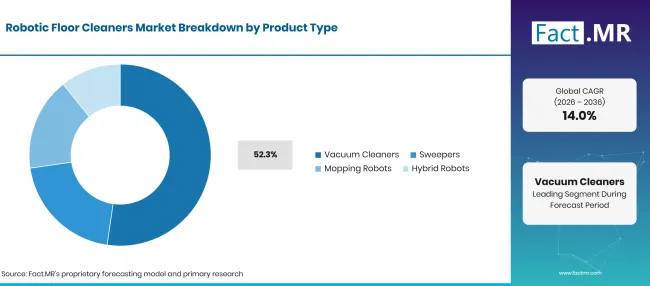
Robotic Floor Cleaners Market Breakdown Product Type | Source: Fact.MR
| Product Type | Share (2026) |
|---|---|
| Vacuum Cleaners (Leading segment) | 52.3% |
| Other segments combined | 47.7%* |
| Total | 100.0% |
Source: Fact.MR analysis. Updated Oct 23, 2026
Dust, crumbs and pet hair make up the most frequent floor chore in any home, so a robot that clears them daily proves its worth within the first week. The vacuum segment also has the longest sales history and the widest price range. Mapping now relies on a compact LiDAR sensor that scans each room on the first run. Sweepers serve mainly commercial floors such as lobbies and warehouses. Mopping robots and hybrid robots add water tanks, spinning pads and washing docks, which raise the unit price but remove a second chore. Front cameras linked to a robot vision system help these machines spot cables, socks and liquid spills.
What supports Residential within Application?
Residential takes 68.4% of 2026 revenue.
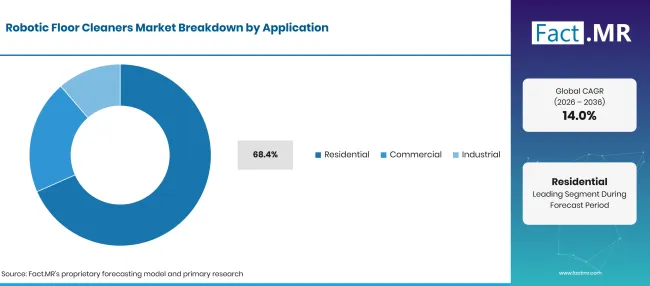
Robotic Floor Cleaners Market Breakdown Application | Source: Fact.MR
| Application | Share (2026) |
|---|---|
| Residential (Leading segment) | 68.4% |
| Other segments combined | 31.6%* |
| Total | 100.0% |
Source: Fact.MR analysis. Updated Oct 23, 2026
A single household makes the buying decision, with no tender, approval chain or procurement cycle to slow it. Home floor care is frequent and predictable, which suits scheduled automation. Smaller homes need little setup, and the ONS reported that one-person households made up 29.5% of UK households in 2025 [3]. Commercial and industrial buyers order fewer units but run them for longer shifts across larger areas. Warehouse operators often weigh floor robots against a mobile industrial robot fleet that already moves goods, and they favor machines that share charging and mapping tools.
What leads the End-User segment?
Households account for 68.4% of 2026 demand.
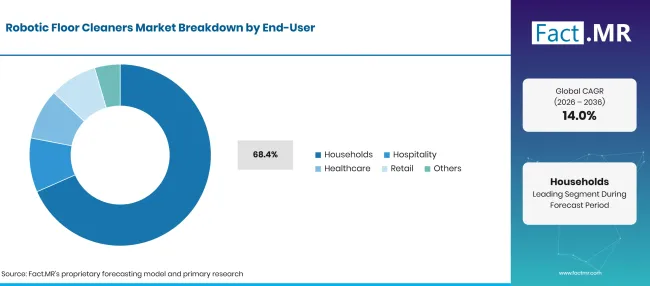
Robotic Floor Cleaners Market Breakdown End User | Source: Fact.MR
| End-User | Share (2026) |
|---|---|
| Households (Leading segment) | 68.4% |
| Other segments combined | 31.6%* |
| Total | 100.0% |
Source: Fact.MR analysis. Updated Oct 23, 2026
Millions of homes make separate purchases, and together they outweigh the bulk orders placed by a much smaller group of commercial and institutional buyers. Homes also replace and upgrade more often, while organizations face budget approvals that stretch purchase cycles. Hospitality groups buy robots to clean corridors and lobbies overnight. Healthcare sites look for machines that log cleaning runs for hygiene audits. Retail chains use them to keep sales floors tidy between shifts without closing aisles.
How does Distribution Channel shape demand?
Online Retail represents 68.0% of the 2026 market.
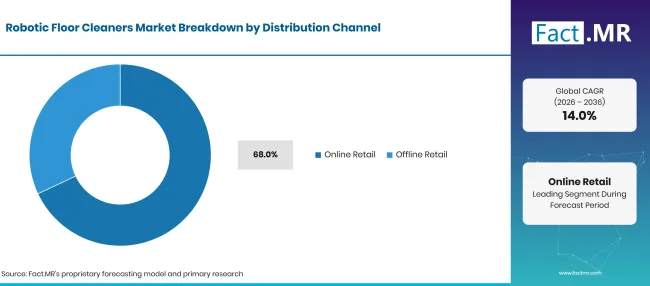
Robotic Floor Cleaners Market Breakdown Distribution Channel 1 | Source: Fact.MR
| Distribution Channel | Share (2026) |
|---|---|
| Online Retail (Leading segment) | 68.0% |
| Other segments combined | 32.0%* |
| Total | 100.0% |
Source: Fact.MR analysis. Updated Oct 23, 2026
Shoppers can compare prices, specifications and reviews in a few minutes, which a physical store cannot match without effort. IBGE reported that 52.7% of Brazilian internet users bought or ordered goods or services online in 2025, the first time the share passed half [4]. Round-the-clock ordering and doorstep delivery appeal most to time-pressed urban buyers. Without shopfront costs, online platforms offer sharper prices, wider ranges and frequent promotions. Offline retail still serves buyers who want a live demonstration, and electronics chains use in-store displays to sell premium docks and hybrid models.
What is accelerating Robotic Floor Cleaners Market adoption, and what is holding it back?
Better navigation, wider online availability and lower entry prices are moving buyers toward robotic floor cleaners. High prices for premium models, tariff-driven cost swings and data-privacy concerns slow uptake among cost-sensitive households.
Drivers Impact Analysis
| DRIVER | (~) % IMPACT ON CAGR | GEOGRAPHIC RELEVANCE | IMPACT TIMELINE |
|---|---|---|---|
| Improved AI-based navigation, mapping and obstacle avoidance in home cleaning robots | +3.8% | Global | Short term (<= 2 years) |
| Rapid growth of online sales of connected home appliances | +3.4% | Global | Short term (<= 2 years) |
| Rising use of automated floor cleaning in hotels, hospitals and retail spaces | +1.7% | North America, Western Europe, East Asia | Medium term (2-4 years) |
| Time-saving demand from busy urban households | +1.5% | Global | Short term (<= 2 years) |
Source: Fact.MR analysis. Updated Oct 23, 2026
Opportunity Impact Analysis
| OPPORTUNITY | (~) % IMPACT ON CAGR | GEOGRAPHIC RELEVANCE | IMPACT TIMELINE |
|---|---|---|---|
| Hybrid vacuum and mop robots with self-emptying and self-washing docks | +2.6% | Global | Medium term (2-4 years) |
| Fleet-based cleaning robots for hospitality, healthcare and retail | +1.0% | North America, Western Europe, East Asia | Medium term (2-4 years) |
| Rising online retail in fast-growing markets such as Brazil | +0.8% | Latin America | Medium term (2-4 years) |
| App-based services, accessories and consumables | +0.3% | Global | Long term (>= 4 years) |
Source: Fact.MR analysis. Updated Oct 23, 2026
Restraints Impact Analysis
| RESTRAINT | (~) % IMPACT ON CAGR | GEOGRAPHIC RELEVANCE | IMPACT TIMELINE |
|---|---|---|---|
| Price premium of advanced models over manual and basic cleaners | -0.5% | Global | Medium term (2-4 years) |
| Tariffs and supply-chain disruption raising import costs | -0.4% | North America | Short term (<= 2 years) |
| Data-privacy and connectivity concerns over camera- and map-enabled devices | -0.2% | Western Europe, North America | Long term (>= 4 years) |
Source: Fact.MR analysis. Updated Oct 23, 2026
Which countries are scaling the Robotic Floor Cleaners Market through 2036?
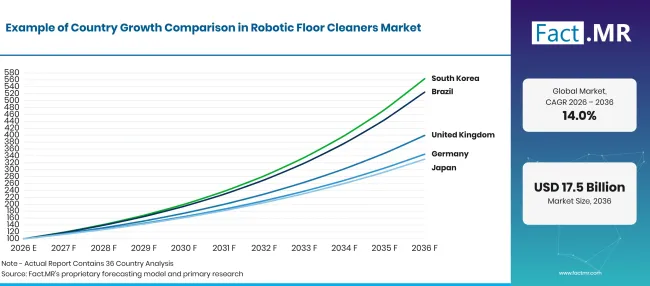
Robotic Floor Cleaners Market Growth Index | Source: Fact.MR
| Country | CAGR (2026 to 2036) |
|---|---|
| Brazil | 18.0% |
| United Kingdom | 14.9% |
| Germany | 13.2% |
| Japan | 12.7% |
| United States | 9.9% |
Source: Fact.MR analysis. Updated Oct 23, 2026
What supports adoption in Brazil?
18.0% CAGR, driven by fast-growing online retail and a large urban consumer base.
Internet access now reaches almost every Brazilian adult. IBGE reported that 90.5% of people aged 10 and over used the internet in 2025, or 168.7 million people [4]. That reach gives robot brands a direct route to new households through marketplaces. Instalment payments ease first purchases, and apartment living favors compact models.
How is the United Kingdom developing demand?
14.9% CAGR, helped by high online shopping penetration.
The Office for National Statistics reported that online sales made up 28.3% of retail sales in Great Britain in July 2026, with online spending 6.5% higher than a year earlier [5]. Compact urban homes and widespread pet ownership support unit sales. Seasonal promotions lift orders, and buyers increasingly choose combined vacuum and mop models.
What is supporting Germany’s adoption?
13.2% CAGR, backed by a high share of small households.
Destatis reported that single-person households made up 42.1% of all households in Germany in 2025, up from 36.8% in 2005 [6]. About 17.3 million people lived alone [6]. These residents often lack time for daily floor care and buy compact robots. Buyers weigh durability, energy use and data-protection compliance, which favors well-reviewed models.
How is Japan developing demand?
12.7% CAGR, on the back of an ageing population and steady online goods sales.
METI put business-to-consumer online sales of goods at JPY 15.2 trillion in 2024, up 3.70%, with an online share of 9.78% [7]. That low share leaves room for the channel to grow, though appliance stores remain important. The Statistics Bureau estimated that people aged 65 and over made up 29.6% of the population in September 2026 [8]. Small dwellings favor quiet, space-saving machines.
How does the United States perform?
9.9% CAGR, reflecting a mature market and tariff-driven cost pressure.
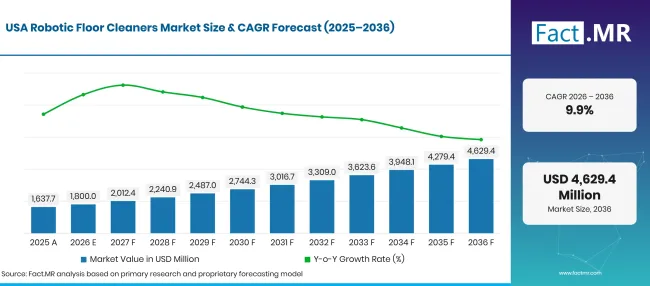
Robotic Floor Cleaners Market Forecast Usa | Source: Fact.MR
The U.S. Census Bureau reported second-quarter 2026 retail e-commerce sales of USD 340.2 billion, up 12.2% year on year and equal to 17.1% of total retail [9]. Import duties on Asian-assembled appliances raise shelf prices and narrow promotional room. Smart home adoption and frequent retailer discounting support replacement purchases and partly offset that pressure.
Who leads the Robotic Floor Cleaners Market?
Three groups compete for the same floor.
Category pioneers and Chinese robotics specialists fight on navigation and dock features, and they release new models at a fast pace. iRobot sells Roomba vacuums, Roomba combo robots and Braava mops, and it said in June 2025 that it had introduced a new Roomba lineup earlier that year [10]. Ecovacs (DEEBOT) and Roborock push hybrid cleaning and self-washing docks. At CES in January 2026, Roborock unveiled the Saros Rover, a wheel-leg robot designed to clean stairs step by step [11]. Appliance groups lean on brand trust and connected-home ecosystems. Samsung showed its Bespoke AI Jet Bot Steam Ultra at CES 2026 with AI object and liquid recognition [12]. LG adds robot vacuums to its ThinQ range, and Dyson sells the Spot+Scrub Ai wet and dry robot. Value brands such as SharkNinja, Xiaomi and ILIFE compete on price and online reach. Mapping accuracy, low upkeep and local after-sales service will separate the winners.
Which companies are the key providers?
Key companies include iRobot Corporation; Ecovacs Robotics; Roborock; Samsung Electronics Co., Ltd.; LG Electronics Inc.; Dyson Ltd.; SharkNinja, Inc.; Xiaomi Corporation; and ILIFE.
- iRobot Corporation
- Ecovacs Robotics
- Roborock
- Samsung Electronics Co., Ltd.
- LG Electronics Inc.
- Dyson Ltd.
- SharkNinja, Inc.
- Xiaomi Corporation
- ILIFE
Bibliography
- [1] Eurostat. (2026, June 2). E-commerce statistics for individuals.
- [2] U.S. Bureau of Labor Statistics. (2026, August 27). Janitors and Building Cleaners: Occupational Outlook Handbook.
- [3] Office for National Statistics. (2026, April 17). Families and households in the UK: 2025.
- [4] Instituto Brasileiro de Geografia e Estatística. (2026, July 2). Proporção de usuários da internet no país ultrapassou 90% da população de 10 anos ou mais, em 2025 [The share of internet users in the country exceeded 90% of the population aged 10 and over in 2025].
- [5] Office for National Statistics. (2026, August 21). Retail sales, Great Britain: July 2026.
- [6] Statistisches Bundesamt (Destatis). (2026, June 24). 17,3 Millionen Menschen in Deutschland leben allein [17.3 million people in Germany live alone].
- [7] Ministry of Economy, Trade and Industry, Japan. (2025, August 26). Results of FY2024 E-Commerce Market Survey Compiled.
- [8] Statistics Bureau of Japan. (2026, September). 統計からみた我が国の高齢者 [Japan’s elderly population in statistics].
- [9] U.S. Census Bureau. (2026, August 18). Quarterly Retail E-Commerce Sales: 2nd Quarter 2026.
- [10] iRobot Corporation. (2025, June 13). iRobot Debuts New Marketing Campaign Roomba. Made for This.
- [11] Roborock. (2026, January 6). CES 2026: Roborock releases the world’s first robotic vacuum with wheel-leg architecture as it joins hands with Real Madrid Football Club.
- [12] Samsung Electronics. (2026, January 5). Vom Hausgerät zum Home Companion: Samsung zeigt auf der CES 2026, wie Hausgeräte zu smarten Begleitern werden [From home appliance to home companion: Samsung shows at CES 2026 how appliances become smart companions].
This Report Answers
- Robot sales are split by product type, application, end-user and distribution channel.
- Each segment shows which subsegment leads and the buyer needs behind its 2026 share.
- Online retail growth, home size and import costs frame the comparison of the five listed countries.
- Global appliance groups, robotics specialists and value brands are profiled by how they compete.
- Navigation, dock design and pricing trends are traced to show where adoption goes next.
What does the Robotic Floor Cleaners Market cover?
Autonomous machines that vacuum, sweep or mop floors without a human operator form this market. Its main products are robotic vacuum cleaners, sweeping robots, mopping robots and hybrid vacuum and mop robots.
Sales are tracked across residential, commercial and industrial applications. Machines reach buyers through online and offline retail, and revenue is counted at the point of sale to the end user.
What is included in the scope?
Self-navigating floor cleaning robots sold as complete units are counted, including vacuum, sweeping, mopping and hybrid models for household, commercial and industrial use. Docking stations such as self-emptying and self-washing bases count when sold with the robot.
Robot value includes onboard parts such as the suction motor, battery and navigation module. Cliff and wall detection built on infrared sensors is likewise counted within the unit price.
What is excluded from the scope?
Manually operated vacuum cleaners, mops and sweepers are left out. Handheld and upright units such as the cordless vacuum cleaner need a human operator and are not counted.
Robotic lawn mowers, window-cleaning robots and pool-cleaning robots add nothing to revenue here. Replacement brushes, filters, mop pads and other consumables sold separately are also left out.
How Was the Analysis Built?
The analysis draws on 120+ sources, 35+ company portfolios, 25+ countries, and more than 20 industry interviews.
- Primary Research: Primary research includes discussions with manufacturers, service providers, technology developers, distributors, end users, and subject-matter experts. These conversations examine purchasing priorities, product adoption, operational challenges, approval requirements, competitive positioning, and the factors that influence wider market acceptance.
- Desk Research: Desk research covers government statistics, regulatory publications, company filings, trade data, technical studies, industry associations, standards, public policy, and other authoritative sources. Every source used in the analysis is documented in the bibliography.
- Market Sizing and Forecasting: Market estimates combine historical performance, demand indicators, pricing and volume trends, segment shares, company participation, country-level growth, adoption patterns, investment activity, and barriers to market expansion.
- Data Validation and Update Cycle: Findings are validated by comparing primary interviews with public data, company activity, regulatory changes, trade patterns, and industry developments. Regular updates review new product launches, capacity changes, partnerships, approvals, and shifts in commercial adoption.
Segmentation
What is the report’s scope and coverage?
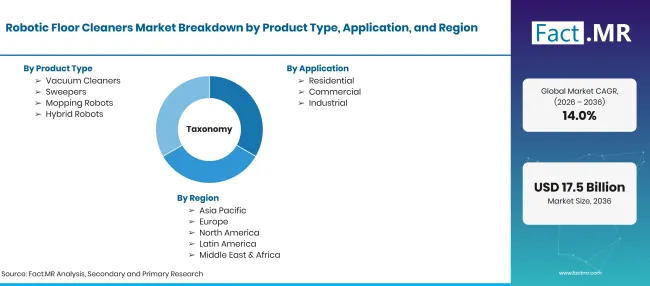
Robotic Floor Cleaners Market Taxonomy | Source: Fact.MR
| Attribute | Details |
|---|---|
| Quantitative Units | USD billion in 2026 to USD billion by 2036 at CAGR |
| Market Definition | Autonomous robotic machines that vacuum, sweep or mop floors, including hybrid models, sold for household, commercial and industrial use. |
| Product Type | Vacuum Cleaners; Sweepers; Mopping Robots; Hybrid Robots |
| Application | Residential; Commercial; Industrial |
| End-User | Households; Hospitality; Healthcare; Retail |
| Distribution Channel | Online Retail; Offline Retail |
| Regions Covered | North America; Latin America; Western Europe; Eastern Europe; East Asia; South Asia & Pacific; Middle East & Africa |
| Countries Covered | Brazil; United Kingdom; Germany; Japan; United States |
| Companies Profiled | iRobot Corporation; Ecovacs Robotics; Roborock; Samsung Electronics Co., Ltd.; LG Electronics Inc.; Dyson Ltd.; SharkNinja, Inc.; Xiaomi Corporation; ILIFE |
| Forecast Period | 2026 to 2036 |
| Approach | Top-down and bottom-up approach using robot unit shipments and average selling prices by product type; channel split between online and offline retail; household and commercial adoption by country; and brand portfolio review. |
Source: Fact.MR analysis. Updated Oct 23, 2026
How is the market segmented?
-
By Product Type
- Vacuum Cleaners
- Sweepers
- Mopping Robots
- Hybrid Robots
-
By Application
- Residential
- Commercial
- Industrial
-
By End-User
- Households
- Hospitality
- Healthcare
- Retail
-
By Distribution Channel
- Online Retail
- Offline Retail
-
By Region
- North America
- Latin America
- Western Europe
- Eastern Europe
- East Asia
- South Asia & Pacific
- Middle East & Africa
Frequently Asked Questions
How large is the robotic floor cleaners market in 2026?
What growth rate will the robotic floor cleaners market record from 2026 to 2036?
Which product type leads the robotic floor cleaners market?
Which application holds the greatest share of the robotic floor cleaners market?
Which end-user contributes the most to the robotic floor cleaners market?
Which distribution channel leads the robotic floor cleaners market?
Which country will record the strongest growth in the robotic floor cleaners market?
Who are the main companies in the robotic floor cleaners market?
Who worked on this report


Preview the report firsthand - request a free sample
Free SampleGet the brochure for pricing and purchase details
Download PDF