- Market Value (2025): USD 12.7 Bn
- Estimated Value (2026): USD 13.4 Bn
- Forecast Value (2036): USD 22.2 Bn
- CAGR (2026-2036): 5.2%
What is the DPT Vaccines Market forecast to be worth by 2036?
USD 13.4 billion in 2026 to USD 22.2 billion by 2036 at a 5.2% CAGR.
- The DPT vaccines market was valued at USD 12.7 billion in 2025, with infant primary series accounting for most doses administered.
- Revenue will move from USD 13.4 billion in 2026 to USD 22.2 billion by 2036 as hexavalent products replace older pentavalent presentations in more schedules.
- Annual growth will average 5.2% CAGR over 2026 to 2036, helped by catch-up campaigns for missed children and booster doses in pregnancy and adulthood.
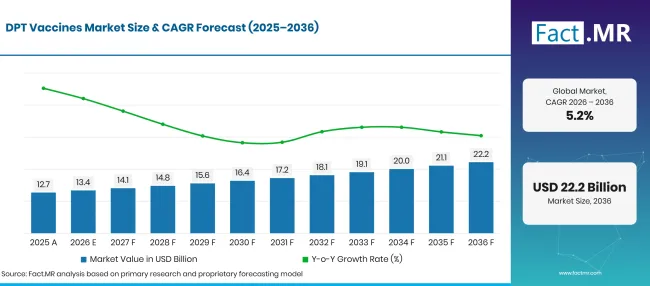
Dpt Vaccines Market Forecast Global | Source: Fact.MR
| Year | Basis | Market Value (USD billion) |
|---|---|---|
| 2025 | Actual | 12.7 |
| 2026 | Estimate | 13.4 |
| 2036 | Forecast | 22.2 |
| CAGR 2026 to 2036 | Forecast period | 5.2% |
Source: Fact.MR analysis. Updated Oct 22, 2026
What are the defining numbers behind DPT Vaccines Market growth?
The decade to 2036 opens USD 8.8 billion in new value, concentrated in combination vaccines bought for national programmes.
- Demand Drivers in the Market
- Missed children remain the main target for immunization programmes. UNICEF and WHO estimated that 13.5 million infants received no vaccine in their first year during 2025, and a further 7.3 million began DTP vaccination but dropped out before their first measles dose [1]. Catch-up and outreach campaigns convert these gaps into extra procurement volume.
- Combination products carry the DTP antigens into more doses per visit. WHO reported global three-dose DTP coverage of 85% in 2025, against 78% for three doses of Hib vaccine [2]. Ministries that switch to hexavalent presentations close that gap with one injection and one procurement line.
- Pertussis outbreaks after the pandemic years renewed attention on booster timing. Health authorities have widened maternal vaccination and adolescent boosters to protect infants too young to finish their primary series.
- Supply agencies pool demand for lower-income countries through long-term agreements. Manufacturers with WHO-prequalified whole-cell combinations win multi-year volumes that reduce price swings for buyers.
- Key Segments Analyzed
- By Vaccine Type: Acellular Pertussis will hold 58.4% share in 2026, given that higher-income schedules and every adolescent and adult booster use acellular formulations.
- By Age Group: Pediatric will account for 72.3% share in 2026, since three primary doses and up to three childhood boosters fall before school leaving age.
- By Distribution Channel: Public will capture 64.2% share in 2026 through ministry tenders and pooled purchases by supply agencies.
- By End-User: Clinics will represent 41.5% share in 2026, as well-baby visits in family practices and health posts deliver most routine doses.
- Analyst Opinion at Fact.MR
- Shambhu Nath Jha, Principal Consultant at Fact.MR, states, “Ministries now judge DTP suppliers on how many antigens they can place in one syringe and how reliably they deliver on a tender. Hexavalent formats will gain ground in both acellular and whole-cell schedules as countries try to cut visits and missed doses. Suppliers with qualified capacity and stable cold chain partners will be best placed when outbreak years push governments to add boosters.”
- Strategic Implications
- Vaccine manufacturers should plan antigen capacity around tender calendars, since a missed delivery window can cost a multi-year award.
- Health ministries should weigh hexavalent switches against cold chain volume and training needs before tendering.
- Obstetric and primary care providers should build maternal pertussis doses into routine antenatal visits to lift uptake.
- Distributors should invest in temperature-monitored storage near district depots, where most potency losses occur.
At 6.0% CAGR, Germany will lead the group, where a booster-heavy schedule and pregnancy vaccination widen the dose count. Brazil follows at 5.5% as the national programme recovers infant coverage across its states. The United States will grow at 4.9% with DTaP and Tdap ordered across childhood, adolescence and pregnancy. In the United Kingdom, a 4.4% pace reflects an added hexavalent dose at 18 months. Japan rounds out the list at 3.9%, where a shrinking birth cohort offsets renewed interest after a pertussis surge.
How does the DPT Vaccines Market break down by segment?
Acellular Pertussis will lead Vaccine Type at 58.4%; Pediatric will top Age Group at 72.3%; Public will head Distribution Channel at 64.2%; Clinics will hold first place in End-User at 41.5%.
Which Vaccine Type dominates?
Acellular Pertussis takes 58.4% of 2026 revenue.
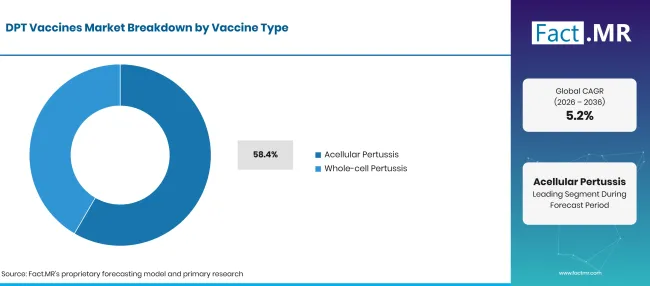
Dpt Vaccines Market Breakdown Vaccine Type | Source: Fact.MR
| Vaccine Type | Share (2026) |
|---|---|
| Acellular Pertussis (Leading segment) | 58.4% |
| Other segments combined | 41.6%* |
| Total | 100.0% |
Source: Fact.MR analysis. Updated Oct 22, 2026
Higher-income countries buy acellular combinations at a premium price per dose, so their weight in revenue exceeds their weight in volume. All Tdap boosters for adolescents, adults and pregnant women use acellular pertussis, which extends the segment beyond infancy. Many of these products ship in disposable prefilled syringes that cut preparation time in clinics. Whole-cell pertussis combinations serve most programmes supported by pooled procurement. They cost less to produce and are offered in multi-dose vials, which suits high-volume outreach. Antigen yield, adsorption on aluminium-based vaccine adjuvants and lot release timelines shape supplier output in both formats.
What leads the Age Group segment?
Pediatric doses make up 72.3% of 2026 revenue.
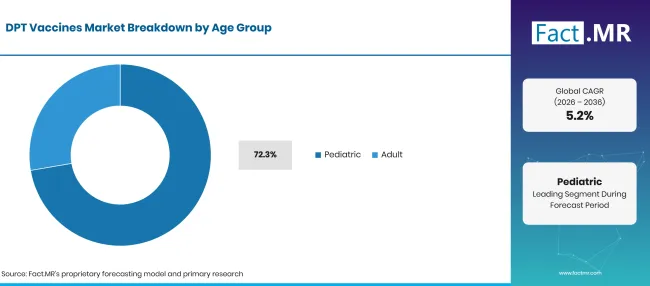
Dpt Vaccines Market Breakdown Age Group | Source: Fact.MR
| Age Group | Share (2026) |
|---|---|
| Pediatric (Leading segment) | 72.3% |
| Other segments combined | 27.7%* |
| Total | 100.0% |
Source: Fact.MR analysis. Updated Oct 22, 2026
Infants typically receive three primary doses in the first months of life, followed by boosters in the second year and at school entry. Each extra dose added to a national schedule lifts demand without any change in the birth cohort. Falling births weigh on this segment in several markets. Sanofi said lower sales of its polio, pertussis and Hib vaccines in 2025 reflected fewer babies born in multiple countries, including China [3]. Adult demand rests on Tdap boosters and pregnancy doses, which link the category to the wider adult vaccines business.
How does Distribution Channel shape demand?
Public buyers account for 64.2% of 2026 revenue.
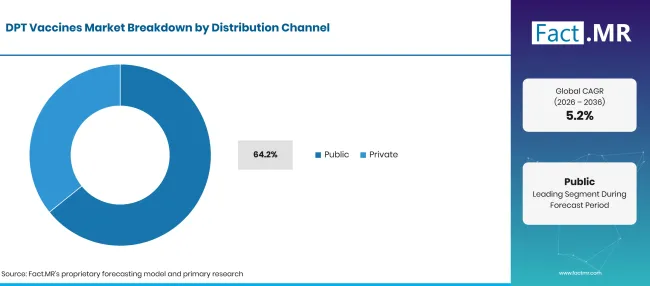
Dpt Vaccines Market Breakdown Distribution Channel | Source: Fact.MR
| Distribution Channel | Share (2026) |
|---|---|
| Public (Leading segment) | 64.2% |
| Other segments combined | 35.8%* |
| Total | 100.0% |
Source: Fact.MR analysis. Updated Oct 22, 2026
National immunization programmes fund routine childhood doses, so governments and their procurement agencies set volumes, presentations and delivery dates. Tender awards often cover two to five years. The UNICEF Supply Division publishes price data for DTwP-HepB-IPV-Hib hexavalent vaccine by supplier, last updated in September 2026 [4]. Such pooled purchasing gives lower-income countries access to WHO-prequalified products. Private channels carry travel boosters, adult Tdap and optional combinations paid by insurers or households.
What supports Clinics within End-User?
Clinics hold 41.5% of 2026 revenue.
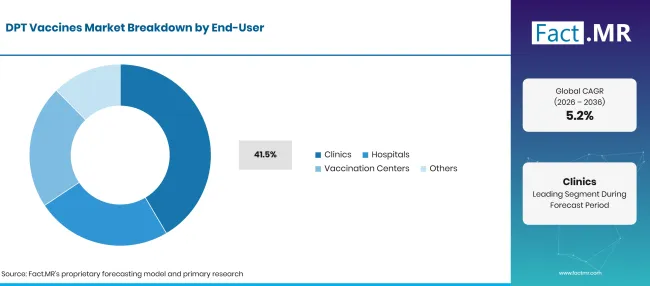
Dpt Vaccines Market Breakdown End User | Source: Fact.MR
| End-User | Share (2026) |
|---|---|
| Clinics (Leading segment) | 41.5% |
| Other segments combined | 58.5%* |
| Total | 100.0% |
Source: Fact.MR analysis. Updated Oct 22, 2026
Family doctors, pediatric practices and primary health posts give most well-baby doses during scheduled check-ups. Parents return to the same site for each dose, which supports series completion. Hospitals give catch-up vaccinations and treat severe pertussis in infants. Vaccination centres run school and campaign rounds, often with outreach teams carrying doses in pharmaceutical cold chain packaging to remote areas.
What is accelerating DPT Vaccines Market adoption, and what is holding it back?
Wider use of hexavalent combinations, maternal pertussis doses and catch-up work for missed children will lift demand through 2036. Shrinking birth cohorts, tender price pressure and vaccine hesitancy in some high-income countries will hold volumes back.
Drivers Impact Analysis
| DRIVER | (~) % IMPACT ON CAGR | GEOGRAPHIC RELEVANCE | IMPACT TIMELINE |
|---|---|---|---|
| Government funding of routine infant immunization schedules | +1.6% | Global | Short term (<= 2 years) |
| Switch from pentavalent to hexavalent combinations | +1.3% | South Asia & Pacific, Latin America, Middle East & Africa | Medium term (2-4 years) |
| Maternal and adolescent acellular pertussis boosters | +1.0% | North America, Western Europe, East Asia | Medium term (2-4 years) |
| Catch-up campaigns for zero-dose and under-vaccinated children | +0.8% | Middle East & Africa, South Asia & Pacific | Long term (>= 4 years) |
Source: Fact.MR analysis. Updated Oct 22, 2026
Opportunity Impact Analysis
| OPPORTUNITY | (~) % IMPACT ON CAGR | GEOGRAPHIC RELEVANCE | IMPACT TIMELINE |
|---|---|---|---|
| Added booster doses in national schedules after pertussis outbreaks | +0.8% | Western Europe, East Asia | Medium term (2-4 years) |
| Fully liquid whole-cell hexavalent presentations for pooled procurement | +0.6% | Global | Medium term (2-4 years) |
| Prefilled syringe formats for private clinics | +0.4% | North America, Western Europe | Long term (>= 4 years) |
Source: Fact.MR analysis. Updated Oct 22, 2026
Restraints Impact Analysis
| RESTRAINT | (~) % IMPACT ON CAGR | GEOGRAPHIC RELEVANCE | IMPACT TIMELINE |
|---|---|---|---|
| Declining birth cohorts in mature markets | -0.6% | East Asia, Western Europe | Long term (>= 4 years) |
| Tender price pressure on whole-cell combinations | -0.4% | South Asia & Pacific, Middle East & Africa | Short term (<= 2 years) |
| Vaccine hesitancy and rising exemptions | -0.3% | North America, Western Europe | Medium term (2-4 years) |
Source: Fact.MR analysis. Updated Oct 22, 2026
Which countries are scaling the DPT Vaccines Market through 2036?
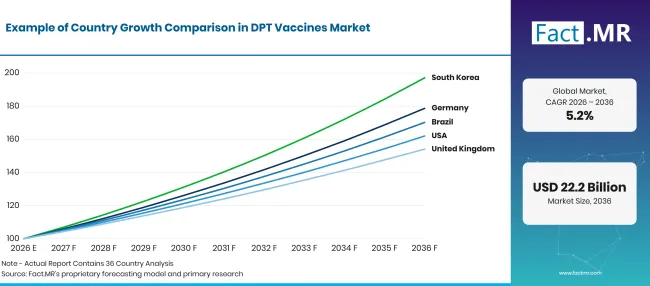
Dpt Vaccines Market Growth Index | Source: Fact.MR
| Country | CAGR (2026 to 2036) |
|---|---|
| Germany | 6.0% |
| Brazil | 5.5% |
| United States | 4.9% |
| United Kingdom | 4.4% |
| Japan | 3.9% |
Source: Fact.MR analysis. Updated Oct 22, 2026
What supports Germany’s adoption?
6.0% CAGR, backed by a booster-heavy schedule and pertussis vaccination in pregnancy.
STIKO recommends a primary series in infancy, boosters at school entry and in adolescence, and a pertussis dose in each pregnancy. Timely completion still has room to rise. WHO and UNICEF estimated Germany’s three-dose DTP coverage at 89% in 2025 [5], below several European neighbours. Closing that gap adds infant doses, while adult Td-containing boosters every ten years extend demand across the lifespan.
How is Brazil developing demand?
5.5% CAGR, driven by the recovery of infant coverage under the National Immunization Program.
Brazil’s Ministry of Health reported that the number of zero-dose children fell from 255,000 in 2024 to about 50,000 in 2025 [6]. WHO and UNICEF placed Brazil’s three-dose DTP coverage at 86% in 2025 [5]. The Unified Health System buys pentavalent and DTP booster doses centrally and distributes them free through public health units.
What is supporting the United States’ adoption?
4.9% CAGR, on the back of DTaP and Tdap doses recommended from infancy through pregnancy.
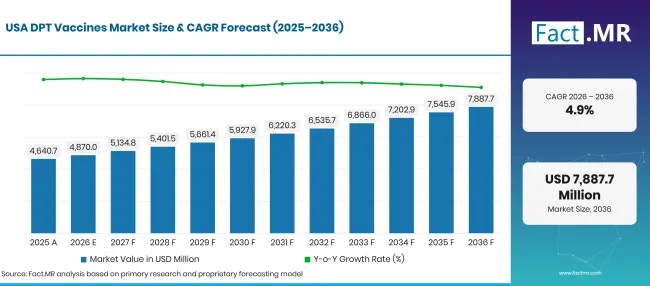
Dpt Vaccines Market Forecast Usa | Source: Fact.MR
CDC data show DTaP coverage among kindergartners at 92.0% for the 2025 to 2026 school year, with exemptions from one or more vaccines rising to 4.2% from 3.6% [7]. Five DTaP doses in childhood, a Tdap booster at 11 to 12 years and a Tdap dose in each pregnancy keep demand spread across age groups and private and public payers.
How is the United Kingdom scaling demand?
4.4% CAGR, helped by an added hexavalent dose and maternal pertussis vaccination.
UKHSA added a fourth dose of DTaP/IPV/Hib/HepB at a new 18-month appointment from 1 January 2026 for children born on or after 1 July 2024 [8]. Prenatal pertussis coverage in England reached 75.0% in October to December 2025, 7.5 percentage points above the same quarter a year earlier [9]. Both changes raise the number of acellular doses bought by the NHS.
How does Japan perform?
3.9% CAGR, reflecting a shrinking birth cohort against renewed pertussis concern.
The Japan Institute for Health Security recorded 84,911 pertussis notifications in weeks 1 to 44 of 2025, well above any previous annual total [10]. Since April 2024, the routine infant schedule has used a DPT-IPV-Hib combination. Three-dose DTP coverage in Japan stood at 91% in 2025, according to WHO and UNICEF estimates [5]. Fewer births limit volume growth.
Who leads the DPT Vaccines Market?
The field splits into multinational acellular suppliers and Indian whole-cell producers. Sanofi, GSK plc and Merck & Co., Inc. compete in higher-income schedules with acellular pediatric combinations and Tdap boosters. Merck and Sanofi offer the hexavalent Vaxelis in the United States through MSP Vaccine Company, approved for children from 6 weeks through 4 years of age [11].
GSK cited favourable CDC stockpile movements for Boostrix in the United States in its July 2026 results [12], while Sanofi linked weaker pediatric combination sales in 2025 to lower birth numbers [3]. Serum Institute of India, Biological E Limited, Bharat Biotech and Panacea Biotec supply whole-cell pentavalent and hexavalent vaccines to Indian and pooled international tenders. Serum Institute holds WHO prequalification for its fully liquid hexavalent HEXASIIL. Winning tenders will depend on prequalified capacity, liquid hexavalent formats and on-time delivery.
Which companies are the key providers?
Key companies include Sanofi; GSK plc; Merck & Co., Inc.; Serum Institute of India Pvt. Ltd.; Biological E Limited; Bharat Biotech International Limited; and Panacea Biotec Limited.
- Sanofi
- GSK plc
- Merck & Co., Inc.
- Serum Institute of India Pvt. Ltd.
- Biological E Limited
- Bharat Biotech International Limited
- Panacea Biotec Limited
Bibliography
- [1] UNICEF and World Health Organization. (2026, July 15). Global childhood immunization coverage inches forward despite conflict and hesitancy.
- [2] World Health Organization. (2026, July 15). Immunization coverage.
- [3] Sanofi. (2026, January 29). 2025: strong sales and EPS growth. Continued profitable growth expected in 2026.
- [4] UNICEF Supply Division. (2026, September 3). DTwP-HepB-IPV-Hib (hexavalent) vaccine price data.
- [5] World Health Organization. (2026, July 14). Diphtheria tetanus toxoid and pertussis (DTP3) immunization coverage among 1-year-olds (%).
- [6] Agência Gov, Ministério da Saúde, Brazil. (2026, July 15). Organização Mundial da Saúde e Unicef comprovam avanço do Brasil em vacinação infantil [WHO and UNICEF confirm Brazil’s progress in childhood vaccination].
- [7] Centers for Disease Control and Prevention. (2026, August 17). Vaccination Coverage and Exemptions among Kindergartners.
- [8] UK Health Security Agency. (2026, August 25). Childhood schedule changes 2025 and 2026: information for healthcare practitioners.
- [9] UK Health Security Agency. (2026, April 2). Prenatal pertussis vaccination coverage in England from October to December 2025.
- [10] Japan Institute for Health Security. (2026, January). 百日咳 2025年11月現在 [Pertussis as of November 2025].
- [11] MSP Vaccine Company. (2026, March). VAXELIS (Diphtheria and Tetanus Toxoids and Acellular Pertussis, Inactivated Poliovirus, Haemophilus b Conjugate and Hepatitis B Vaccine).
- [12] GSK plc. (2026, July 28). GSK delivers strong Q2 core results performance and continued momentum.
This Report Answers
- What revenue do acellular and whole-cell pertussis products generate across pediatric and adult use?
- Leading subsegments in each category are traced to the schedule, buyer or setting that sustains them.
- Germany, Brazil, the United States, the United Kingdom and Japan are compared on booster policy, coverage and birth trends.
- Suppliers are grouped by pertussis technology and by the tenders they serve.
- How hexavalent switches and maternal programmes change dose counts per child is set out for each region.
What does the DPT Vaccines Market cover?
Revenue in this market comes from vaccines that protect against diphtheria, pertussis and tetanus in one product. Standalone DTwP and DTaP, Tdap boosters and combinations that add polio, hepatitis B or Hib antigens all count.
Demand is tracked for infants, children, adolescents and adults, through public and private buyers. Sales are valued at manufacturer selling price across clinics, hospitals and vaccination centres.
What is included in the scope?
Pentavalent and hexavalent combinations are counted at full product value because the pertussis component sets the schedule. Maternal Tdap doses and adult boosters are included under the adult group.
Doses bought through national tenders and pooled international procurement are included at contract price. Doses shipped through specialist biopharmaceutical cold chain logistics providers are counted at the vaccine value only.
What is excluded from the scope?
Tetanus toxoid, Td and DT vaccines without a pertussis antigen are left out. Pertussis treatments such as antibiotics are also excluded.
Vaccines against other childhood diseases sold without DTP antigens belong to the wider vaccine market and are not counted here. Administration fees, syringes and storage equipment are excluded.
How Was the Analysis Built?
The analysis draws on 120+ sources, 35+ company portfolios, 25+ countries, and more than 20 industry interviews.
- Primary Research: Primary research includes discussions with manufacturers, service providers, technology developers, distributors, end users, and subject-matter experts. These conversations examine purchasing priorities, product adoption, operational challenges, approval requirements, competitive positioning, and the factors that influence wider market acceptance.
- Desk Research: Desk research covers government statistics, regulatory publications, company filings, trade data, technical studies, industry associations, standards, public policy, and other authoritative sources. Every source used in the analysis is documented in the bibliography.
- Market Sizing and Forecasting: Market estimates combine historical performance, demand indicators, pricing and volume trends, segment shares, company participation, country-level growth, adoption patterns, investment activity, and barriers to market expansion.
- Data Validation and Update Cycle: Findings are validated by comparing primary interviews with public data, company activity, regulatory changes, trade patterns, and industry developments. Regular updates review new product launches, capacity changes, partnerships, approvals, and shifts in commercial adoption.
Segmentation
What is the report’s scope and coverage?
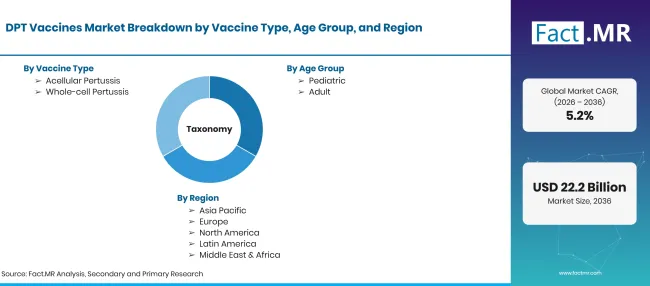
Dpt Vaccines Market Taxonomy | Source: Fact.MR
| Attribute | Details |
|---|---|
| Quantitative Units | USD billion |
| Market Definition | Vaccines containing diphtheria toxoid, tetanus toxoid and pertussis antigens, sold as standalone DTP products or within pentavalent, hexavalent and booster combinations. |
| Vaccine Type | Acellular Pertussis; Whole-cell Pertussis |
| Age Group | Pediatric; Adult |
| Distribution Channel | Public; Private |
| End-User | Clinics; Hospitals; Vaccination Centers |
| Regions Covered | North America; Latin America; Western Europe; Eastern Europe; East Asia; South Asia & Pacific; Middle East & Africa |
| Countries Covered | Germany; Brazil; United States; United Kingdom; Japan |
| Companies Profiled | Sanofi; GSK plc; Merck & Co., Inc.; Serum Institute of India Pvt. Ltd.; Biological E Limited; Bharat Biotech International Limited; Panacea Biotec Limited |
| Forecast Period | 2026 to 2036 |
| Approach | Dose-based model using birth cohorts, national schedules and booster ages; coverage by country; split of acellular and whole-cell products; tender and private price levels; and supplier portfolio review. |
Source: Fact.MR analysis. Updated Oct 22, 2026
How is the market segmented?
-
By Vaccine Type
- Acellular Pertussis
- Whole-cell Pertussis
-
By Age Group
- Pediatric
- Adult
-
By Distribution Channel
- Public
- Private
-
By End-User
- Clinics
- Hospitals
- Vaccination Centers
-
By Region
- North America
- Latin America
- Western Europe
- Eastern Europe
- East Asia
- South Asia & Pacific
- Middle East & Africa
Frequently Asked Questions
How big is the DPT vaccines market in 2026?
What CAGR will the DPT vaccines market record?
Which vaccine type leads the DPT vaccines market?
Which age group generates most demand?
Which distribution channel leads the DPT vaccines market?
Which end-user leads the DPT vaccines market?
Which country will grow the most in the DPT vaccines market?
Who supplies DPT vaccines?
Who worked on this report


Preview the report firsthand - request a free sample
Free SampleGet the brochure for pricing and purchase details
Download PDF