- Market Value (2025): USD 420.0 Mn
- Estimated Value (2026): USD 435.1 Mn
- Forecast Value (2036): USD 619.0 Mn
- CAGR (2026-2036): 3.6%
What is the Betamethasone Ointment Market forecast to be worth by 2036?
USD 435.1 million in 2026 to USD 619.0 million by 2036 at a 3.6% CAGR.
- The betamethasone ointment market was valued at USD 420.0 million in 2025, with repeat prescriptions for psoriasis and eczema making up most of the volume.
- By 2036, sales will reach USD 619.0 million, up from USD 435.1 million in 2026, as generic tubes reach more patients through pharmacy counters.
- A 3.6% CAGR over 2026 to 2036 reflects a mature, low-priced molecule whose volume grows with dermatology caseloads more than with price.
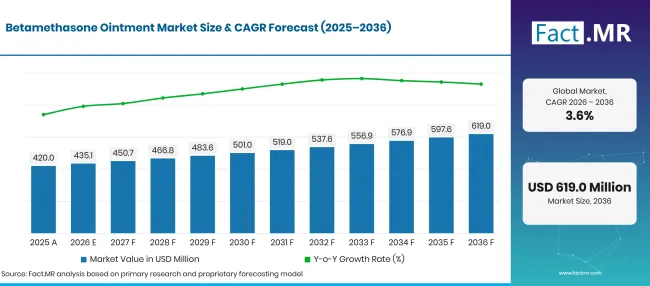
Betamethasone Ointment Market Forecast Global | Source: Fact.MR
| Year | Basis | Market Value (USD million) |
|---|---|---|
| 2025 | Actual | 420.0 |
| 2026 | Estimate | 435.1 |
| 2036 | Forecast | 619.0 |
| CAGR 2026 to 2036 | Forecast period | 3.6% |
Source: Fact.MR analysis. Updated Oct 22, 2026
What are the defining numbers behind Betamethasone Ointment Market growth?
The decade to 2036 adds USD 183.9 million in new value, most of it from refills dispensed in community pharmacies.
- Demand Drivers in the Market
- Chronic skin disease keeps prescribers returning to potent steroid ointments. Psoriasis and atopic eczema flare repeatedly, so one diagnosis often produces several tubes a year. Ointment bases suit the dry, scaly lesions typical of both conditions.
- Clear label limits make augmented betamethasone a controlled option for thick plaques. The Diprolene ointment label, updated by Organon in November 2025, classes the product as super-high potency and caps use at 50 g per week for no more than 2 consecutive weeks [1]. Those rules give dermatologists a defined short course before they step down to a milder steroid.
- Generic copies of the augmented grade broaden access at lower prices. Lupin’s label for its augmented ointment, revised in November 2025, restricts use to patients 13 years of age and older [2]. Multiple approved sources let pharmacies switch suppliers without disrupting therapy.
- Primary care handles a large share of skin complaints. General practitioners prescribe betamethasone for moderate eczema and dermatitis before any referral, which keeps steady volume flowing into community pharmacies.
- Public payers favor low-cost generic steroids. Reimbursement lists in Europe and Japan keep betamethasone priced well below newer topical and systemic agents, so it stays a first choice for cost-conscious formularies.
- Key Segments Analyzed
- By Product Type: Non-Augmented Betamethasone Ointment will hold 58.7% share in 2026, since standard strengths treat most eczema and dermatitis without the tight dose caps of the augmented grade.
- By Application: Dermatology will account for 42.3% share in 2026 on the back of psoriasis, eczema and lichen planus, which need repeated courses.
- By Distribution Channel: Retail Pharmacies will capture 59.2% share in 2026 as outpatient prescriptions and monthly refills are filled close to home.
- By End-User: Hospitals will represent 38.5% share in 2026, given that dermatology departments start severe cases and supply ointment at discharge.
- Analyst Opinion at Fact.MR
- Shambhu Nath Jha, Principal Consultant at Fact.MR, states, “Betamethasone ointment has outlived many newer topical drugs because it is cheap, familiar and effective on dry, thick lesions. Value will build slowly, since most supply is generic and price reviews in Japan and Europe trim unit revenue. Suppliers that keep tubes in stock across both standard and augmented grades will win pharmacy shelf space as volumes rise.”
- Strategic Implications
- Generic manufacturers should keep dual sources of betamethasone dipropionate and valerate active ingredient, since a single plant outage can empty pharmacy shelves for weeks.
- Originator brand owners should support dermatologists with clear step-down guidance from augmented to standard strength, which protects patient safety and brand trust.
- Pharmacy chains should stock both 15 g and larger tube sizes, matching short acute courses and long-term maintenance use.
- Online pharmacies should build prescription verification into checkout, given that betamethasone ointment is a prescription-only steroid in most covered countries.
With a 4.6% CAGR, the United States heads the group, where high eczema rates and wide generic choice keep scripts flowing. Brazil follows at 4.2%, with growing private health plan membership bringing more patients to dermatologists. A 3.8% pace in the United Kingdom reflects heavy NHS primary care prescribing. Germany posts 3.4%, as statutory insurers pay for generic steroids on a stable base. Japan trails at 2.5% because regular price revisions cut the value of long-listed products.
How does the Betamethasone Ointment Market break down by segment?
Non-Augmented Betamethasone Ointment will lead Product Type at 58.7%; Dermatology will head Application at 42.3%; Retail Pharmacies will top Distribution Channel at 59.2%; Hospitals will rank first in End-User at 38.5%.
Which Product Type dominates?
Non-Augmented Betamethasone Ointment makes up 58.7% of 2026 sales.
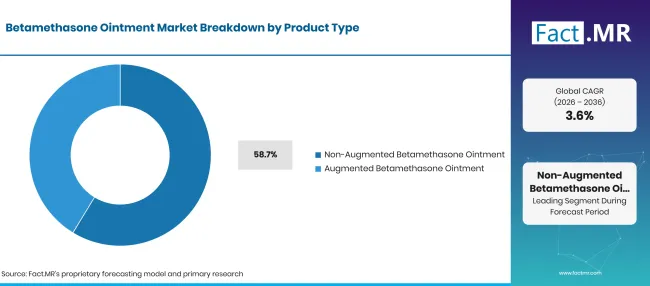
Betamethasone Ointment Market Breakdown Product Type | Source: Fact.MR
| Product Type | Share (2026) |
|---|---|
| Non-Augmented Betamethasone Ointment (Leading segment) | 58.7% |
| Other segments combined | 41.3%* |
| Total | 100.0%\ |
Source: Fact.MR analysis. Updated Oct 22, 2026
Most patients with eczema or contact dermatitis need a potent steroid, but not the super-high potency of the augmented grade. Standard dipropionate 0.05% and valerate 0.1% ointments can be used on more body sites and for longer courses. That flexibility lets general practitioners prescribe them without specialist input. Treatment choices for atopic dermatitis still start with topical steroids of this class. A standard generic ointment contains 0.64 mg of betamethasone dipropionate per gram, equivalent to 0.5 mg of betamethasone, according to the Padagis label published in April 2025 [3]. The augmented grade uses a propylene glycol base that raises skin penetration. It is reserved for short courses on resistant psoriasis plaques in patients aged 13 and over.
What leads the Application segment?
Dermatology takes 42.3% of 2026 revenue.
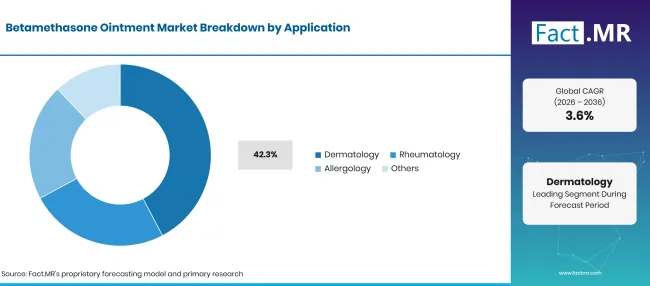
Betamethasone Ointment Market Breakdown Application | Source: Fact.MR
| Application | Share (2026) |
|---|---|
| Dermatology (Leading segment) | 42.3% |
| Other segments combined | 57.7%* |
| Total | 100.0% |
Source: Fact.MR analysis. Updated Oct 22, 2026
Skin conditions produce the bulk of betamethasone prescriptions because they recur and need repeated courses. Psoriasis, chronic hand eczema, lichen planus and discoid lupus all respond to potent steroid ointments. Dermatology clinics often pair the ointment with emollients and use it as a bridge before or alongside phototherapy. Rheumatology uses the ointment for skin signs linked to joint disease, such as psoriatic lesions in arthritis patients. Allergology covers allergic contact dermatitis and insect bite reactions. Both need shorter courses, so they add fewer tubes per patient. Wider inflammatory skin disease treatment guidelines still place topical steroids first for mild to moderate disease.
How does Distribution Channel shape demand?
Retail Pharmacies fill 59.2% of 2026 demand.
| Distribution Channel | Share (2026) |
|---|---|
| Retail Pharmacies (Leading segment) | 59.2% |
| Other segments combined | 40.8%* |
| Total | 100.0% |
Source: Fact.MR analysis. Updated Oct 22, 2026
Patients collect most prescriptions near home, often every month during a flare or maintenance phase. Community pharmacists also check for overuse, since steroid ointments carry limits on duration and body area. Generic substitution at the counter keeps the price per tube low for both payers and patients. Pack sizes reflect this retail pattern. The Fougera augmented ointment label, published in April 2026, lists 15 g and 50 g tubes [4]. Hospital pharmacies supply inpatients and discharge packs. Online pharmacies are growing in the United States and the United Kingdom but still need a valid prescription for each order.
What supports Hospitals within End-User?
Hospitals command 38.5% of 2026 use.
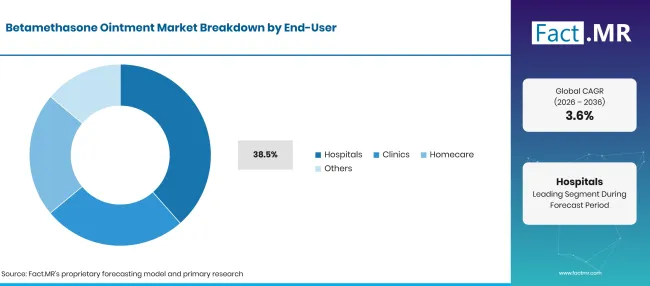
Betamethasone Ointment Market Breakdown End User | Source: Fact.MR
| End-User | Share (2026) |
|---|---|
| Hospitals (Leading segment) | 38.5% |
| Other segments combined | 61.5%* |
| Total | 100.0% |
Source: Fact.MR analysis. Updated Oct 22, 2026
Severe or widespread disease usually starts treatment in a hospital dermatology clinic. Specialists set the strength, the duration and the step-down plan, then send the patient home with a first supply. Inpatient wards also use the ointment for drug rashes and acute dermatitis. Hospital medicine budgets are large and closely watched. In England, medicines issued in hospitals cost £11.1 billion out of £21.6 billion in total prescribing costs in 2024/25 [5]. Clinics and homecare settings handle follow-up, with homecare growing as patients manage long-term eczema with dermatological products at home.
What is accelerating Betamethasone Ointment Market adoption, and what is holding it back?
Repeat prescribing for psoriasis and eczema, wide generic supply and low cost to payers lift adoption. Steroid side-effect warnings, price revisions and newer non-steroid topicals limit how fast value can grow.
Drivers Impact Analysis
| DRIVER | (~) % IMPACT ON CAGR | GEOGRAPHIC RELEVANCE | IMPACT TIMELINE |
|---|---|---|---|
| Recurring psoriasis and eczema flares that need repeated steroid courses | +1.3% | Global | Short term (<= 2 years) |
| Multiple generic sources of standard and augmented ointment | +0.9% | North America, Western Europe | Medium term (2-4 years) |
| Primary care prescribing for dermatitis before specialist referral | +0.6% | Western Europe, North America | Short term (<= 2 years) |
| Wider private health plan coverage for outpatient dermatology | +0.4% | Latin America | Medium term (2-4 years) |
Source: Fact.MR analysis. Updated Oct 22, 2026
Opportunity Impact Analysis
| (~) % IMPACT ON CAGR | GEOGRAPHIC RELEVANCE | IMPACT TIMELINE | |
|---|---|---|---|
| Larger maintenance packs for long-term eczema and psoriasis care | +0.5% | Global | Medium term (2-4 years) |
| Online prescription refills for stable chronic patients | +0.4% | North America, Western Europe | Short term (<= 2 years) |
| Contract manufacturing of semi-solid steroid generics for regional brands | +0.3% | South Asia & Pacific, Eastern Europe | Long term (>= 4 years) |
Source: Fact.MR analysis. Updated Oct 22, 2026
Restraints Impact Analysis
| RESTRAINT | (~) % IMPACT ON CAGR | GEOGRAPHIC RELEVANCE | IMPACT TIMELINE |
|---|---|---|---|
| Regular drug price revisions for long-listed and generic products | -0.5% | East Asia, Western Europe | Short term (<= 2 years) |
| Concern over skin thinning and steroid withdrawal limiting course length | -0.3% | Global | Medium term (2-4 years) |
| Uptake of non-steroid topicals for facial and long-term use | -0.2% | North America, Western Europe | Long term (>= 4 years) |
Source: Fact.MR analysis. Updated Oct 22, 2026
Which countries are scaling the Betamethasone Ointment Market through 2036?
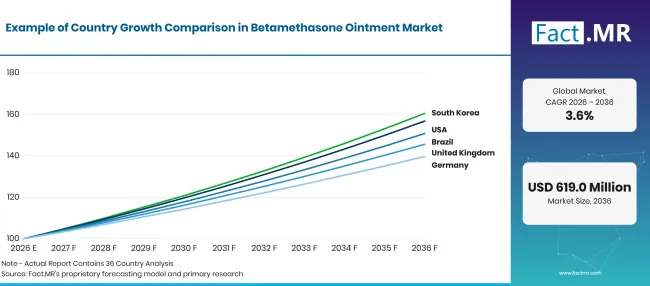
Betamethasone Ointment Market Growth Index | Source: Fact.MR
| Country | CAGR (2026 to 2036) |
|---|---|
| United States | 4.6% |
| Brazil | 4.2% |
| United Kingdom | 3.8% |
| Germany | 3.4% |
| Japan | 2.5% |
Source: Fact.MR analysis. Updated Oct 22, 2026
What supports United States adoption?
4.6% CAGR, driven by high eczema prevalence and a deep bench of generic suppliers.
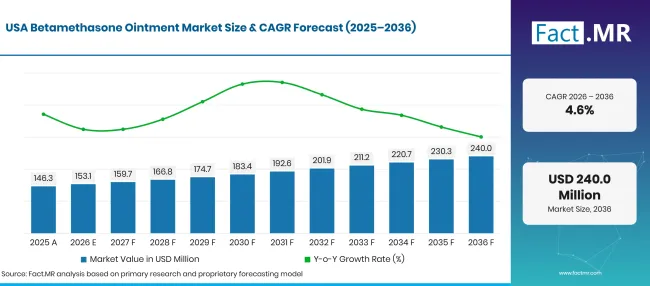
Betamethasone Ointment Market Forecast Usa | Source: Fact.MR
Eczema starts early in many American patients and often persists into adult life. The National Center for Health Statistics reported that 12.7% of children aged 0 to 17 had diagnosed eczema in 2024 [6]. Pediatricians and dermatologists treat flares with topical steroids, moving older teenagers to potent ointments when milder creams fail. Several generic labels for standard and augmented ointment keep pharmacy prices competitive.
How is Brazil scaling demand?
4.2% CAGR, backed by rising private health plan membership.
Private health plans give patients faster access to dermatologists than the public system. Brazil’s National Supplementary Health Agency counted 53,055,406 beneficiaries in medical and hospital plans in June 2026 [7]. Plan members visit specialists more often, which turns untreated rashes into diagnosed dermatitis and written prescriptions. Large pharmacy chains then supply generic ointment at affordable prices.
What is supporting the United Kingdom’s adoption?
3.8% CAGR, helped by high-volume NHS primary care prescribing.
General practitioners issue most steroid ointment prescriptions in the United Kingdom, following stepwise eczema guidance. The NHS Business Services Authority reported that 1.26 billion prescription items were dispensed in community settings in England in 2024/25, at a cost of £11.2 billion [8]. Betamethasone valerate and dipropionate ointments are standard potent options in this system, with community pharmacies handling the dispensing.
How is Germany developing demand?
3.4% CAGR, reflecting stable statutory insurance funding for generic medicines.
Statutory insurers fund most prescription drugs in Germany. Destatis reported that statutory health insurance paid €300.8 billion in 2024, or 55.9% of health spending, while spending on pharmaceuticals rose 9.3% to €85.1 billion [9]. A later release showed that prices for health goods and services rose 3.5% in 2024 [10]. Generic steroid ointments win reimbursement because they cost little per course.
How does Japan perform?
2.5% CAGR, as scheduled price revisions limit value gains.
Japan revises listed drug prices on a regular cycle, which trims revenue for older molecules such as betamethasone. A Ministry of Health, Labour and Welfare briefing from July 2026 showed that the FY2025 revision covered 9,320 of 17,440 listed products, including about 5,860 generic products [11]. Hospital and clinic dermatologists still prescribe betamethasone ointments widely, often combined with emollients for older patients with dry skin.
Who leads the Betamethasone Ointment Market?
Originator brands and generic suppliers compete for different parts of the market. Organon owns Diprolene and Diprosone, and the updated Diprolene label from November 2025 reinforces the dosing limits that shape specialist use [1]. GSK keeps Betnovate in its portfolio; its Brazilian product leaflet was approved by Anvisa in September 2025 [12].
These brands win on clinician familiarity and trust in quality. A second group of generic makers wins on price and supply reliability. Lupin revised its augmented ointment label in November 2025 [2], while Aurobindo Pharma and Zydus Lifesciences supply equivalent generics to the United States. Padagis and Fougera Pharmaceuticals bring dermatology-focused semi-solid manufacturing, a capability also offered by topical drug CDMOs. Through 2036, the suppliers that hold pharmacy listings will be those that keep tubes in stock while absorbing price revisions in Japan and Europe.
Which companies are the key providers?
Key companies include Organon & Co.; GSK plc; Lupin Limited; Aurobindo Pharma Limited; Zydus Lifesciences Limited; Padagis; and Fougera Pharmaceuticals Inc.
- Organon & Co.
- GSK plc
- Lupin Limited
- Aurobindo Pharma Limited
- Zydus Lifesciences Limited
- Padagis
- Fougera Pharmaceuticals Inc.
Bibliography
- [1] National Library of Medicine, DailyMed. (2025, November 19). DIPROLENE (betamethasone dipropionate) ointment, Organon LLC.
- [2] National Library of Medicine, DailyMed. (2025, November 13). Betamethasone dipropionate ointment, augmented, Lupin Pharmaceuticals, Inc..
- [3] National Library of Medicine, DailyMed. (2025, April 29). Betamethasone dipropionate ointment, Padagis Israel Pharmaceuticals Ltd.
- [4] National Library of Medicine, DailyMed. (2026, April 8). Betamethasone dipropionate ointment, augmented, E. Fougera & Co..
- [5] NHS Business Services Authority. (2025, November 20). Prescribing Costs in Hospitals and the Community: England 2024/25.
- [6] National Center for Health Statistics. (2026, January 8). Diagnosed Allergic Conditions in Children Ages 0 to 17: United States, 2024 (NCHS Data Brief No. 546).
- [7] Agência Nacional de Saúde Suplementar. (2026, October 5). Dados Gerais [General data].
- [8] NHS Business Services Authority. (2025, June 5). Prescription Cost Analysis: England 2024/25.
- [9] Statistisches Bundesamt (Destatis). (2026, April 2). Gesundheitsausgaben im Jahr 2024 auf 538 Milliarden Euro gestiegen [Health expenditure rose to 538 billion euros in 2024].
- [10] Statistisches Bundesamt (Destatis). (2026, July 21). Gesundheitsausgaben 2024 preisbereinigt um 3,9 % gestiegen [Price-adjusted health expenditure rose 3.9% in 2024].
- [11] Ministry of Health, Labour and Welfare, Japan. (2026, July 8). 令和9年度薬価改定について [On the FY2027 drug price revision].
- [12] GSK Brasil. (2025, September 2). Betnovate (valerato de betametasona) creme: bula [Betnovate cream: package leaflet].
This Report Answers
- How large will betamethasone ointment sales be each year from 2026 to 2036?
- Which product grade, clinical use, channel and care setting take the biggest slice of 2026 revenue, and why?
- How do payer rules and pharmacy access in the five profiled countries change growth prospects?
- Where do originator brands and generic makers each hold an advantage?
- What label limits and price revisions restrict value growth through 2036?
What does the Betamethasone Ointment Market cover?
This market tracks prescription ointments in which betamethasone dipropionate or betamethasone valerate is the active steroid. Standard grades come in 0.05% and 0.1% strengths, while augmented dipropionate uses an optimized base for higher penetration.
Revenue follows the tube from manufacturer to retail, hospital and online pharmacies, and on to hospitals, clinics and homecare patients. Both branded and generic products count.
What is included in the scope?
Single-ingredient betamethasone ointments sold on prescription are in scope, whether branded or generic. Hospital pack sizes and pharmacy tubes are both counted.
Ointments used across dermatology, rheumatology and allergology care fall inside the market, as do products dispensed against online prescriptions. Ointments made by contract manufacturers are recorded under the brand or generic holder that sells them.
What is excluded from the scope?
Betamethasone creams, lotions, foams, scalp solutions, injections and tablets lie outside this report. Fixed combinations with calcipotriol, clotrimazole, gentamicin or salicylic acid are also excluded, because their value depends on the partner drug.
Over-the-counter emollients and eczema relief creams without a steroid are left out, as are other topical steroids such as clobetasol and mometasone.
How Was the Analysis Built?
The analysis draws on 120+ sources, 35+ company portfolios, 25+ countries, and more than 20 industry interviews.
- Primary Research: Primary research includes discussions with manufacturers, service providers, technology developers, distributors, end users, and subject-matter experts. These conversations examine purchasing priorities, product adoption, operational challenges, approval requirements, competitive positioning, and the factors that influence wider market acceptance.
- Desk Research: Desk research covers government statistics, regulatory publications, company filings, trade data, technical studies, industry associations, standards, public policy, and other authoritative sources. Every source used in the analysis is documented in the bibliography.
- Market Sizing and Forecasting: Market estimates combine historical performance, demand indicators, pricing and volume trends, segment shares, company participation, country-level growth, adoption patterns, investment activity, and barriers to market expansion.
- Data Validation and Update Cycle: Findings are validated by comparing primary interviews with public data, company activity, regulatory changes, trade patterns, and industry developments. Regular updates review new product launches, capacity changes, partnerships, approvals, and shifts in commercial adoption.
Segmentation
What is the report’s scope and coverage?
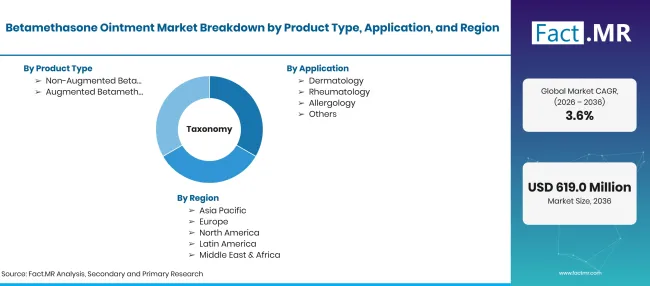
Betamethasone Ointment Market Taxonomy | Source: Fact.MR
| Attribute | Details |
|---|---|
| Quantitative Units | USD million |
| Market Definition | Prescription ointments containing betamethasone dipropionate or betamethasone valerate as the active steroid, in standard and augmented grades. Revenue is counted at manufacturer selling prices. |
| Product Type | Non-Augmented Betamethasone Ointment; Augmented Betamethasone Ointment |
| Application | Dermatology; Rheumatology; Allergology; Others |
| Distribution Channel | Retail Pharmacies; Hospital Pharmacies; Online Pharmacies |
| End-User | Hospitals; Clinics; Homecare |
| Regions Covered | North America; Latin America; Western Europe; Eastern Europe; East Asia; South Asia & Pacific; Middle East & Africa |
| Countries Covered | United States; Brazil; United Kingdom; Germany; Japan |
| Companies Profiled | Organon & Co.; GSK plc; Lupin Limited; Aurobindo Pharma Limited; Zydus Lifesciences Limited; Padagis; Fougera Pharmaceuticals Inc. |
| Forecast Period | 2026 to 2036 |
| Approach | Prescription volumes for psoriasis and eczema by country, combined with tube size, generic price trends, payer price revisions and a review of approved product labels. |
Source: Fact.MR analysis. Updated Oct 22, 2026
How is the market segmented?
-
By Product Type
- Non-Augmented Betamethasone Ointment
- Augmented Betamethasone Ointment
-
By Application
- Dermatology
- Rheumatology
- Allergology
- Others
-
By Distribution Channel
- Retail Pharmacies
- Hospital Pharmacies
- Online Pharmacies
-
By End-User
- Hospitals
- Clinics
- Homecare
-
By Region
- North America
- Latin America
- Western Europe
- Eastern Europe
- East Asia
- South Asia & Pacific
- Middle East & Africa
Frequently Asked Questions
How big is the betamethasone ointment market in 2026?
What is the CAGR of the betamethasone ointment market from 2026 to 2036?
Which product type leads the betamethasone ointment market?
Which application leads the betamethasone ointment market?
Which distribution channel leads the betamethasone ointment market?
Which end-user leads the betamethasone ointment market?
Which country will grow the most in the betamethasone ointment market?
Who are the main companies in the betamethasone ointment market?
Who worked on this report


Preview the report firsthand - request a free sample
Free SampleGet the brochure for pricing and purchase details
Download PDF