- Market Value (2025): USD 2.47 Bn
- Estimated Value (2026): USD 2.6 Bn
- Forecast Value (2036): USD 4.3 Bn
- CAGR (2026-2036): 5.2%
What is the Slanting Sanitary Paper Machines Market forecast to be worth by 2036?
USD 2.6 billion in 2026 to USD 4.3 billion by 2036 at a 5.2% CAGR.
- The slanting sanitary paper machines market was valued at USD 2.47 billion in 2025, with automatic lines for household tissue grades making up most orders.
- Mill owners replacing old crescent formers and Yankee sections will lift revenue from USD 2.6 billion in 2026 to USD 4.3 billion by 2036.
- Through 2036 the market will compound at 5.2% CAGR, as new tissue capacity in emerging economies adds to rebuild work in mature ones.
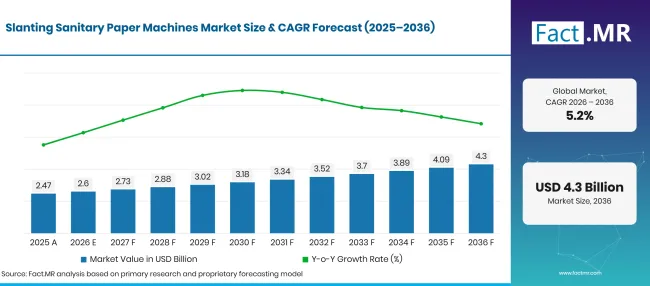
Slanting Sanitary Paper Machines Market Forecast Global | Source: Fact.MR
| Year | Basis | Market Value (USD billion) |
|---|---|---|
| 2025 | Actual | 2.47 |
| 2026 | Estimate | 2.6 |
| 2036 | Forecast | 4.3 |
| CAGR 2026 to 2036 | Forecast period | 5.2% |
Source: Fact.MR analysis. Updated Oct 23, 2026
What are the defining numbers behind Slanting Sanitary Paper Machines Market growth?
The decade from 2026 to 2036 will open USD 1.7 billion in new revenue, drawn mostly from capacity additions and line replacements.
- Demand Drivers in the Market
- Tissue makers in Asia keep ordering machines in series. In February 2026 Valmet booked a fourth consecutive order from China’s Yusen Group for three IntelliTissue 1600 machines, each designed for 1,650 m/min and 30,000 tonnes a year, with start-ups from late 2026 [1]. Repeat orders of this kind give builders a steady backlog.
- Fuel cost shapes every drying decision on a tissue machine. Eurostat reported that non-household gas in Germany averaged EUR 7.13 per 100 kWh in the second half of 2025, against an EU average of EUR 6.05 [2]. Steel Yankees, shoe presses and heat recovery hoods therefore weigh heavily in tender scoring.
- Mills want fewer sheet breaks and less manual tuning. Valmet launched a non-contact, nuclear-free quality control system for tissue in June 2026 that reads basis weight, moisture and softness in real time [3]. Measurement of this kind lets automatic lines hold grade targets at high speed.
- Hotels, offices, hospitals and caterers buy towels and toilet rolls on fixed contracts. Converters serving these accounts need parent reels of steady quality, which pushes them toward newer, wider machines.
- Graphic paper producers are looking for new uses for idle sites. Converting a printing paper mill to tissue often calls for a new machine or a deep rebuild of forming and drying sections.
- Key Segments Analyzed
- By Product Type: Automatic will hold 58.3% share in 2026, since integrated drives and quality control keep high-speed lines running without constant operator input.
- By Application: Toilet Paper will account for 38.2% share in 2026, reflecting the daily, non-deferrable use of bathroom tissue in homes and public washrooms.
- By Distribution Channel: Distributors will capture 64.3% share in 2026 on the strength of local installation crews, spare parts stock and after-sales service.
- Analyst Opinion at Fact.MR
- Shambhu Nath Jha, Principal Consultant at Fact.MR, states, “Tissue mills now judge a machine on energy per tonne and uptime as much as on speed. The gap between a modern Yankee line and a twenty-year-old one is wide enough to justify replacement even where tissue volumes grow slowly. Builders that pair efficient drying with service close to the mill will win the larger share of rebuild and new-line work.”
- Strategic Implications
- Machine builders should publish verified energy-per-tonne figures for drying and pressing sections, since buyers in Europe now score tenders on fuel use.
- Tissue producers weighing a new line should first price a rebuild of the forming and Yankee sections, which can lift speed at a fraction of the capital cost.
- Distributors can widen margins by bundling erection, spare parts and operator training with each machine they place.
- Automation suppliers should design quality control and drive packages that retrofit onto older semi-automatic machines.
Germany will set the pace at 6.0% CAGR, where mill owners swap older lines for faster machines to curb gas bills. Brazil follows at 5.5% on new tissue capacity built close to eucalyptus pulp. In the United States, a 4.9% rate rests on premium through-air-dried tissue projects. The United Kingdom will expand at 4.4% as converters rely on recycled fibre and domestic parent reels. Japan rounds off the group at 3.9%, with graphic paper mills seeking tissue uses for spare capacity.
How does the Slanting Sanitary Paper Machines Market break down by segment?
Automatic will lead Product Type at 58.3%; Toilet Paper will head Application at 38.2%; Distributors will hold first place in Distribution Channel at 64.3%.
Which Product Type leads?
Automatic machines take 58.3% of 2026 sales.
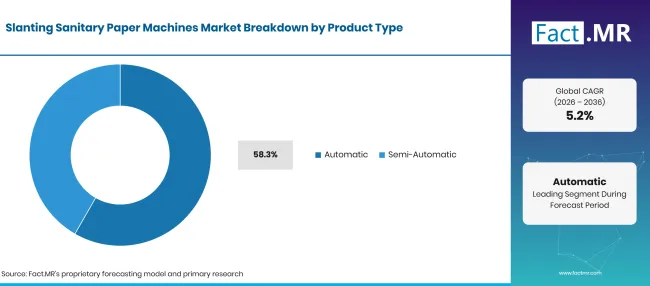
Slanting Sanitary Paper Machines Market Breakdown Product Type | Source: Fact.MR
| Product Type | Share (2026) |
|---|---|
| Automatic (Leading segment) | 58.3% |
| Other segments combined | 41.7%* |
| Total | 100.0% |
Source: Fact.MR analysis. Updated Oct 23, 2026
Large tissue mills run around the clock, and every unplanned stop costs reel tonnage. Fully automatic machines link headbox, press and Yankee controls so that speed changes and grade changes happen without manual resets. Builders sell these lines alongside wider paper machinery platforms, reusing drives and control software. Semi-automatic machines still serve small mills in South Asia, Africa and Latin America. Their lower price and simpler maintenance suit sites that produce a few thousand tonnes a year. Labor needs are higher, and sheet quality varies more at speed.
What supports Toilet Paper within Application?
Toilet Paper represents 38.2% of 2026 revenue.
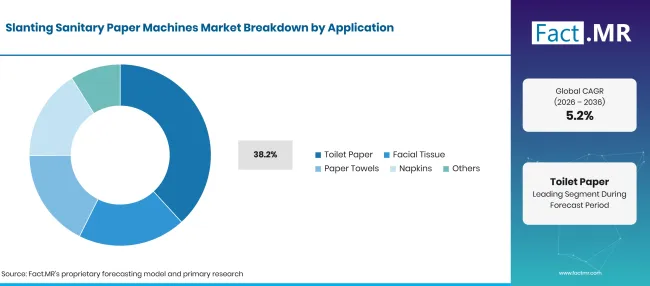
Slanting Sanitary Paper Machines Market Breakdown Application | Source: Fact.MR
| Application | Share (2026) |
|---|---|
| Toilet Paper (Leading segment) | 38.2% |
| Other segments combined | 61.8%* |
| Total | 100.0% |
Source: Fact.MR analysis. Updated Oct 23, 2026
Bathroom tissue is bought every week by almost every household, so mills plan capacity around it first. Toscotec’s PM15 order from Lucart in France, announced in October 2026, uses an AHEAD 1.8 machine running up to 1,800 m/min for toilet and towel grades [4]. Demand trends in tissue and hygiene products guide how mills split time between grades. Facial tissue calls for lighter, softer sheets, often on dedicated machines. Paper towels need wet strength and bulk. Napkins and folded tissues run at lower basis weights and feed separate converting lines.
How does Distribution Channel shape demand?
Distributors move 64.3% of 2026 machine value.
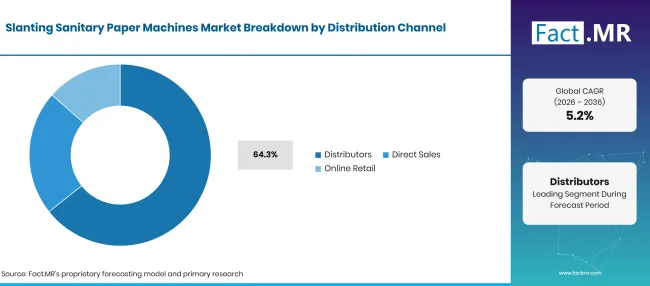
Slanting Sanitary Paper Machines Market Breakdown Distribution Channel | Source: Fact.MR
| Distribution Channel | Share (2026) |
|---|---|
| Distributors (Leading segment) | 64.3% |
| Other segments combined | 35.7%* |
| Total | 100.0% |
Source: Fact.MR analysis. Updated Oct 23, 2026
Small and mid-sized mills seldom keep their own erection teams. A regional distributor arranges shipping, installation, commissioning and a parts store. It also stays on call once the machine is running. This support counts heavily in markets far from the builder’s home plant. Direct sales cover large turnkey projects, where the builder handles stock preparation, controls and erection itself. Toscotec’s PM2 contract with GrandBay Group in Mexico, announced in October 2026, includes stock preparation, a DCS and full erection for start-up in 2027 [5]. Online retail is limited to small machines and spare components.
What is accelerating Slanting Sanitary Paper Machines Market adoption, and what is holding it back?
Line replacement, graphic mill conversions and fixed institutional demand keep orders moving toward faster, more automated tissue machines. High capital cost, swings in pulp and energy prices, and flat per-capita use in mature countries delay a share of projects.
Drivers Impact Analysis
| DRIVER | (~) % IMPACT ON CAGR | GEOGRAPHIC RELEVANCE | IMPACT TIMELINE |
|---|---|---|---|
| Replacement of aging tissue machines with high-speed lines that use less gas and power per tonne | +1.8% | Global | Short term (<= 2 years) |
| Rising household and away-from-home use of toilet paper, towels, facial tissue and napkins | +1.2% | Global | Medium term (2-4 years) |
| Conversion of graphic paper mills and sites to tissue production | +0.8% | Western Europe, East Asia | Medium term (2-4 years) |
| Fixed supply contracts from offices, hotels and food service for towels and napkins | +0.4% | North America, Western Europe | Short term (<= 2 years) |
Source: Fact.MR analysis. Updated Oct 23, 2026
Opportunity Impact Analysis
| OPPORTUNITY | (~) % IMPACT ON CAGR | GEOGRAPHIC RELEVANCE | IMPACT TIMELINE |
|---|---|---|---|
| Automation and online quality control that cut sheet breaks and raise uptime | +0.7% | Global | Medium term (2-4 years) |
| Low-energy pressing and drying technology for premium tissue | +0.5% | Global | Long term (>= 4 years) |
| Turnkey lines that bundle stock preparation, tissue machine and controls | +0.4% | Latin America, North America | Medium term (2-4 years) |
| Exports of compact machines from Asian builders to emerging markets | +0.2% | South Asia & Pacific, Middle East & Africa | Short term (<= 2 years) |
Source: Fact.MR analysis. Updated Oct 23, 2026
Restraints Impact Analysis
| RESTRAINT | (~) % IMPACT ON CAGR | GEOGRAPHIC RELEVANCE | IMPACT TIMELINE |
|---|---|---|---|
| High capital cost of complete tissue lines | -0.4% | Global | Short term (<= 2 years) |
| Pulp and energy price swings that delay mill investment decisions | -0.3% | Global | Short term (<= 2 years) |
| Flat per-capita tissue use in mature markets | -0.1% | Western Europe, North America, East Asia | Long term (>= 4 years) |
Source: Fact.MR analysis. Updated Oct 23, 2026
Which countries are scaling the Slanting Sanitary Paper Machines Market through 2036?
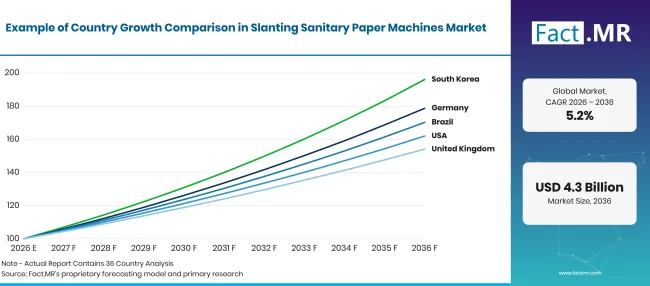
Slanting Sanitary Paper Machines Market Growth Index | Source: Fact.MR
| Country | CAGR (2026 to 2036) |
|---|---|
| Germany | 6.0% |
| Brazil | 5.5% |
| United States | 4.9% |
| United Kingdom | 4.4% |
| Japan | 3.9% |
Source: Fact.MR analysis. Updated Oct 23, 2026
What supports Germany’s adoption?
6.0% CAGR, driven by replacement of older tissue lines with faster, gas-saving machines.
German hygiene paper relies heavily on virgin pulp. The Umweltbundesamt reported a recovered paper input rate of 39% for hygiene papers in 2024, against 84% for all paper and board [6]. In July 2025 Fripa awarded ANDRITZ an EPC contract for a PrimeLine TM S2200 machine for its Miltenberg mill, rated at 2,200 m/min and 37,000 tonnes a year, with start-up planned for late 2026 [7]. Mills of this size buy on gas use per tonne and on speed.
How is Brazil developing demand?
5.5% CAGR, backed by tissue capacity built at fibre-integrated pulp producers.
Suzano began operating a Valmet Advantage DCT 200 tissue machine at Aracruz in early September 2025, with 60,000 tonnes of annual capacity [8]. Fibre supply is ample. Mato Grosso do Sul alone exported 6.89 million tonnes of pulp worth USD 3.11 billion in 2025, a 17.3% rise in value over 2024, according to the state economic office [9]. Domestic access to eucalyptus pulp lowers the cost of new tissue lines.
What is supporting the United States’ adoption?
4.9% CAGR, helped by premium through-air-dried tissue projects at large producers.
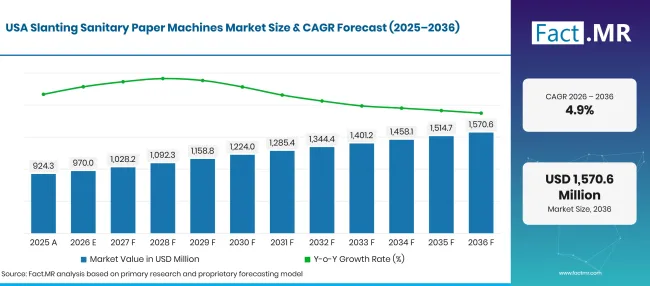
Slanting Sanitary Paper Machines Market Forecast Usa | Source: Fact.MR
Valmet will deliver a third Advantage ThruAir machine to Irving Consumer Products in Macon, Georgia, adding 75,000 tonnes a year from 2027 within a USD 600 million expansion [10]. Pricing has held firm. The Bureau of Labor Statistics producer price index for sanitary paper product manufacturing stood at 140.1 in December 2025, up from 134.1 in January 2025 [11]. Firm prices support returns on premium lines.
How is the United Kingdom scaling demand?
4.4% CAGR, on the back of recycled-fibre tissue and domestic parent reel supply.
UK tissue mills draw on a strong recycled fibre stream. DEFRA reported that 80.3% of paper and card packaging waste was recycled in 2025, with 3.90 million tonnes recovered [12]. Converters that buy imported parent reels are adding their own machines to secure supply and cut freight. Most UK projects are rebuilds or single-machine additions at existing sites.
How does Japan perform?
3.9% CAGR, reflecting graphic paper mills that seek tissue uses for spare capacity.
Graphic paper demand keeps falling in Japan. METI reported that pulp, paper and paper products output fell 5.9% year on year in December 2025, with newsprint and uncoated printing paper among the main decliners [13]. Paper groups are moving sites and labor toward household tissue. Domestic builders supply most of the machines and rebuild sections.
Who leads the Slanting Sanitary Paper Machines Market?
Full-line European builders win most large orders by supplying everything from stock preparation to the reel.
Valmet’s repeat IntelliTissue business with Yusen in China [1] and its ThruAir line for Irving in the United States [10] show reach at both ends of the price range. ANDRITZ competes with its PrimeLine machines, as in the Fripa contract in Germany [7]. Toscotec sells AHEAD machines with steel Yankees, including the Lucart [4] and GrandBay [5] orders in 2026. Voith offers ATMOS for premium tissue and its NipcoFlex T shoe press for conventional lines. Regional builders compete on proximity. Kawanoe Zoki makes the Best Former Yankee machines behind most tissue produced in Japan. Hergen supplies forming, press, Yankee and reel sections from Brazil. Proven energy savings, reliable controls and a service crew close to the mill will separate the winners.
Which companies are the key providers?
Key companies include ANDRITZ AG; Valmet Oyj; Voith GmbH & Co. KGaA; Toscotec S.p.A.; Kawanoe Zoki Co., Ltd.; and Hergen S.A.
- ANDRITZ AG
- Valmet Oyj
- Voith GmbH & Co. KGaA
- Toscotec S.p.A.
- Kawanoe Zoki Co., Ltd.
- Hergen S.A.
Bibliography
- [1] Valmet. (2026, February 12). Valmet increases Yusen Groups’s production capacity for high-quality tissue with three additional IntelliTissue machines.
- [2] Eurostat. (2026, May 8). Non-household gas prices in 2nd half of 2025: -8.3%.
- [3] Valmet. (2026, June 16). Valmet is revolutionizing tissue production by introducing the world’s first fully non-contact, nuclear-free quality control system.
- [4] Toscotec. (2026, October 1). Toscotec to supply new PM15 tissue line to Lucart.
- [5] Toscotec. (2026, October 6). Toscotec to supply PM2 tissue line for GrandBay Group in Mexico.
- [6] Umweltbundesamt. (2025, December 17). Altpapiereinsatzquoten [Recovered paper input rates].
- [7] ANDRITZ. (2025, July 11). Fripa, Germany, awards ANDRITZ a contract for a new high-speed tissue machine.
- [8] Valmet. (2025, September 30). New high-performance tissue production at Suzano.
- [9] SEMADESC, Government of Mato Grosso do Sul. (2026, January). Comércio Exterior de Mato Grosso do Sul: Dezembro 2025 [Foreign trade of Mato Grosso do Sul: December 2025].
- [10] Valmet. (2025, January 16). Valmet to deliver an Advantage ThruAir Drying tissue machine to Irving Consumer Products in Macon, Georgia, USA.
- [11] U.S. Bureau of Labor Statistics. (2026, October 15). Producer Price Index by Industry: Sanitary Paper Product Manufacturing (PCU322291322291).
- [12] Department for Environment, Food & Rural Affairs. (2026, September 23). UK statistics on waste.
[13] Ministry of Economy, Trade and Industry, Japan. (2026). 2025 [Industrial production, shipments and inventories index, December 2025: final report]
This Report Answers
- Machine sales are split by product type, tissue grade and route to the buyer.
- For each segment, the leading subsegment is named along with the mill practices behind its 2026 share.
- Gas prices, fibre access and graphic mill closures explain why the five listed countries grow at different rates.
- Full-line European builders and regional machine makers are compared on technology, service reach and recent orders.
- Drying, pressing and quality control advances are reviewed for their effect on energy use per tonne.
What does the Slanting Sanitary Paper Machines Market cover?
Sanitary paper machines turn pulp or recycled fibre into parent reels of tissue. Each machine combines a former, a press section, a hooded Yankee dryer and a reel. Lines are sold in automatic or semi-automatic form.
Value is tracked across toilet paper, facial tissue, paper towels and napkins. Sales reach mills through distributors, direct contracts with builders and online channels for small units.
What is included in the scope?
New tissue machines and their core sections are counted at the value of the equipment sold. Rebuilds that replace a former, press or Yankee on an existing line are also included.
Where a builder supplies a turnkey line, only the tissue machine portion counts toward market value. Stock preparation for the furnish, including pulpers and screens that handle recovered paper, is treated as a separate system.
What is excluded from the scope?
Machines for graphic grades, board and paper packaging materials are outside the study. So is pulp mill equipment, including lines that make fluff pulp for absorbent products.
Converting machines that cut, fold, emboss and wrap finished tissue add no market revenue. Tissue itself, separately sold spare parts and machine clothing are left out as well.
How Was the Analysis Built?
The analysis draws on 120+ sources, 35+ company portfolios, 25+ countries, and more than 20 industry interviews.
- Primary Research: Primary research includes discussions with manufacturers, service providers, technology developers, distributors, end users, and subject-matter experts. These conversations examine purchasing priorities, product adoption, operational challenges, approval requirements, competitive positioning, and the factors that influence wider market acceptance.
- Desk Research: Desk research covers government statistics, regulatory publications, company filings, trade data, technical studies, industry associations, standards, public policy, and other authoritative sources. Every source used in the analysis is documented in the bibliography.
- Market Sizing and Forecasting: Market estimates combine historical performance, demand indicators, pricing and volume trends, segment shares, company participation, country-level growth, adoption patterns, investment activity, and barriers to market expansion.
- Data Validation and Update Cycle: Findings are validated by comparing primary interviews with public data, company activity, regulatory changes, trade patterns, and industry developments. Regular updates review new product launches, capacity changes, partnerships, approvals, and shifts in commercial adoption.
Segmentation
What is the report’s scope and coverage?
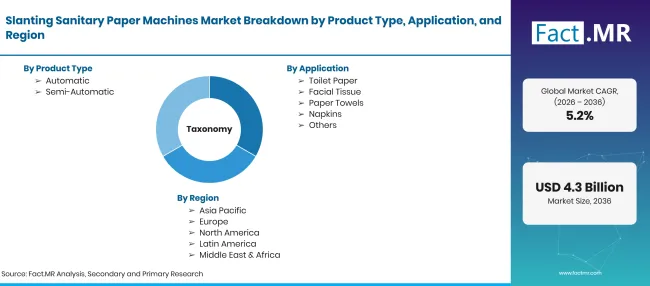
Slanting Sanitary Paper Machines Market Taxonomy | Source: Fact.MR
| Attribute | Details |
|---|---|
| Quantitative Units | USD billion |
| Market Definition | Machines that form, press, dry and reel base paper for sanitary tissue grades, including toilet paper, facial tissue, paper towels and napkins, in automatic and semi-automatic configurations. |
| Product Type | Automatic; Semi-Automatic |
| Application | Toilet Paper; Facial Tissue; Paper Towels; Napkins |
| Distribution Channel | Distributors; Direct Sales; Online Retail |
| Regions Covered | North America; Latin America; Western Europe; Eastern Europe; East Asia; South Asia & Pacific; Middle East & Africa |
| Countries Covered | Germany; Brazil; United States; United Kingdom; Japan |
| Companies Profiled | ANDRITZ AG; Valmet Oyj; Voith GmbH & Co. KGaA; Toscotec S.p.A.; Kawanoe Zoki Co., Ltd.; Hergen S.A. |
| Forecast Period | 2026 to 2036 |
| Approach | Hybrid top-down and bottom-up approach using tissue machine orders and start-ups by country; automatic and semi-automatic machine mix; tissue grade demand; distribution channel mix; and builder portfolio review. |
Source: Fact.MR analysis. Updated Oct 23, 2026
How is the market segmented?
-
By Product Type
- Automatic
- Semi-Automatic
-
By Application
- Toilet Paper
- Facial Tissue
- Paper Towels
- Napkins
-
By Distribution Channel
- Distributors
- Direct Sales
- Online Retail
-
By Region
- North America
- Latin America
- Western Europe
- Eastern Europe
- East Asia
- South Asia & Pacific
- Middle East & Africa
Frequently Asked Questions
How large is the slanting sanitary paper machines market in 2026?
What growth rate will the slanting sanitary paper machines market record from 2026 to 2036?
Which product type leads the slanting sanitary paper machines market?
Which application leads the slanting sanitary paper machines market?
Which distribution channel leads the slanting sanitary paper machines market?
Which country will grow the most in the slanting sanitary paper machines market?
Who are the main companies in the slanting sanitary paper machines market?
Who worked on this report


Preview the report firsthand - request a free sample
Free SampleGet the brochure for pricing and purchase details
Download PDF