- Base Value(2026): 0.80 Bn
- Forecast Value (2036): 1.48 Bn
- CAGR (2036): 6.3%
Endobronchial Ultrasound Biopsy Market Forecast and Outlook 2026 to 2036
In 2025, the endobronchial ultrasound biopsy market was valued at approximately USD 0.75 billion, modestly adjusted from baseline estimates. Based on Fact.MR analysis, demand for endobronchial ultrasound biopsy systems and consumables is estimated to reach around USD 0.80 billion in 2026 and expand to nearly USD 1.48 billion by 2036, reflecting a CAGR of 6.3% during the forecast period. Market progression reflects increased lung cancer screening programs and growing reliance on minimally invasive mediastinal staging. Commenting on imaging integration trends, Dave Rosa, CEO of Intuitive Surgical, stated,“By further integrating artificial intelligence with expanded advanced imaging capabilities, we're equipping physicians with smarter tools designed to support early diagnosis and improve access to advanced care for more patients.” [1]Fact.MR analysis interprets this as indicative of broader diagnostic platform convergence combining imaging, navigation, and AI-assisted visualization.
The market is projected to add roughly USD 0.73 billion in incremental value over the forecast window, reflecting steady procedural growth rather than episodic spikes. Early-period expansion is supported by increased CP-EBUS adoption in academic hospitals. Mid-period growth aligns with wider deployment in community hospitals and specialty pulmonary clinics. In later years, value realization is shaped by advanced imaging processors, disposable biopsy needle innovation, and integration with robotic bronchoscopy systems.
China leads growth at 8.5% CAGR, supported by expanding tertiary care infrastructure and oncology diagnostics. India follows at 7.9%, driven by rising lung cancer incidence and private hospital expansion. Germany records 7.2%, reflecting structured cancer screening programs. France grows at 6.6%, while the United Kingdom posts 6.0% linked to NHS diagnostic pathway optimization. The United States, at 5.4%, remains influenced by reimbursement structures and established procedural penetration, while Brazil at 4.7% reflects gradual adoption across urban healthcare centers.
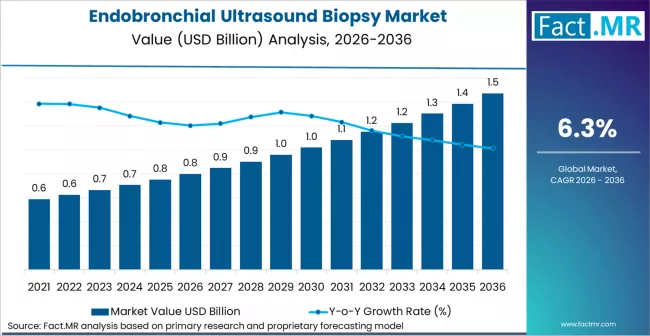
Endobronchial Ultrasound Biopsy Market Market Value Analysis | Source: Fact.MR
Endobronchial Ultrasound Biopsy MarketTop of Form
| Metric | Value |
|---|---|
| Market Value (2026) | USD 0.80 billion |
| Forecast Value (2036) | USD 1.48 billion |
| Forecast CAGR (2026-2036) | 6.3% |
Source: Fact.MR analysis. Updated Feb 28, 2026
Summary of Endobronchial Ultrasound Biopsy Market
- Market Definition
- The endobronchial ultrasound biopsy market comprises minimally invasive bronchoscopy-based ultrasound systems and biopsy consumables used for real-time guided sampling of mediastinal lymph nodes and pulmonary lesions for lung cancer diagnosis and staging.
- Demand Drivers
- Expansion of lung cancer screening programs is increasing procedural volumes for minimally invasive mediastinal staging.
- Clinical preference for image-guided, less invasive biopsy techniques is reducing reliance on surgical mediastinoscopy.
- Integration of advanced imaging processors and disposable EBUS-TBNA needles is improving diagnostic yield and workflow efficiency in tertiary hospitals.
- Key Segments Analyzed
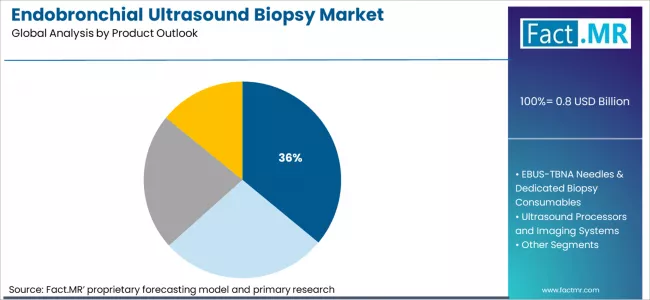
- Product outlook: EBUS scopes hold approximately 36% share, reflecting their role as core capital equipment integrating bronchoscopy and ultrasound imaging.
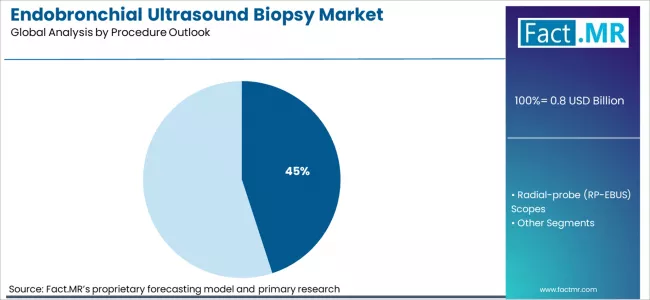
- Procedure outlook: Convex-probe linear EBUS systems account for nearly 45% share due to direct transbronchial needle aspiration capability.
- Geography: Asia Pacific is the fastest-growing region, led by China and India through oncology infrastructure expansion.
- Analyst Opinion at Fact.MR
- Shambhu Nath Jha, Principal Consultant at Fact.MR, opines, ‘CXOs will find this report useful for understanding how lung cancer staging protocols, reimbursement dynamics, and integration with advanced imaging platforms are shaping capital equipment and consumable demand in EBUS biopsy procedures.’
- Strategic Implications / Executive Takeaways
- Manufacturers should prioritize high-resolution imaging integration and needle accuracy improvements to enhance diagnostic yield.
- Expansion strategies should focus on tertiary care hospitals and academic centers adopting standardized lung cancer pathways.
- Partnerships aligned with robotic bronchoscopy and AI-assisted imaging platforms can strengthen long-term portfolio positioning.
- Methodology
- Market estimates are derived from lung cancer incidence data, biopsy procedure volumes, device utilization rates, and hospital replacement cycles.
- Regulatory and clinical validation references.
Endobronchial Ultrasound Biopsy Market Definition
The endobronchial ultrasound biopsy market covers minimally invasive diagnostic procedures and related medical devices used to obtain tissue samples from lymph nodes and lung structures through the airway. The technique combines bronchoscopy with ultrasound imaging to guide needle biopsy in real time. It is commonly used for lung cancer diagnosis, staging, and evaluation of mediastinal abnormalities. Device classification, safety standards, and clinical use are regulated under medical device frameworks administered by the US Food and Drug Administration and global health authorities. [2]
Endobronchial Ultrasound Biopsy Market Inclusions
The report provides global and regional market size estimates in volume and value with a forecast from 2026 to 2036. Segmentation includes device type such as ultrasound bronchoscopes and biopsy needles, application across lung cancer diagnosis and staging, and end use in hospitals and specialty diagnostic centers. Regional demand patterns, pricing trends, and procedural adoption rates are included.
Endobronchial Ultrasound Biopsy Market Exclusions
The scope excludes conventional bronchoscopy procedures without ultrasound guidance. CT guided needle biopsies, surgical lung biopsies, and imaging systems not integrated with bronchoscopy are not included. Cancer treatment modalities such as chemotherapy, radiotherapy, and surgical resection are excluded. Training services, laboratory research tools, prototype devices without regulatory clearance, and healthcare delivery services are also outside the scope.
Endobronchial Ultrasound Biopsy Market Research Methodology
- Primary Research: Interviews were conducted with pulmonologists, thoracic surgeons, hospital procurement teams, and device manufacturers.
- Desk Research: Desk research reviewed device approval databases, safety communications, and clinical guidance issued by the US Food and Drug Administration and public health information from the World Health Organization, along with hospital procedure statistics.
- Market Sizing and Forecasting: Estimates were developed using lung cancer incidence data, biopsy procedure volumes, device utilization rates, and replacement cycles.
- Data Validation and Update Cycle: Data was cross checked against regulatory approvals, hospital procurement records, trade statistics, and manufacturer disclosures before updates were finalized.
Segmental Analysis
Endobronchial Ultrasound Biopsy Market Analysis by Product Outlook
Endobronchial Ultrasound Biopsy Market Analysis By Product Outlook | Source: Fact.MR
Based on Fact.MR analysis, consumption of EBUS scopes is estimated to hold 36% share of the global endobronchial ultrasound biopsy market. Fact.MR analysts note EBUS scopes lead due to integration of real-time ultrasound imaging with bronchoscopy for guided tissue sampling. As per Fact.MR, this product outlook addresses pulmonologist requirements for precise lymph node visualization, minimally invasive access, and compatibility with dedicated biopsy needles, supporting accurate staging and diagnosis of thoracic malignancies across hospital and specialty respiratory centers worldwide today.
- Device oversight: Endobronchial ultrasound systems are regulated under national medical device approval frameworks.[3]
- Clinical adoption: Fact.MR analysts note scopes represent the core capital equipment in EBUS procedures.
- Imaging integration: Real-time ultrasound improves sampling precision.
Endobronchial Ultrasound Biopsy Market Analysis by Procedure Outlook
Endobronchial Ultrasound Biopsy Market Analysis By Procedure Outlook | Source: Fact.MR
Based on Fact.MR analysis, consumption of convex probe linear EBUS scopes is estimated to hold 45% share of the global market. Fact.MR analysts note convex probe systems lead due to ability to perform transbronchial needle aspiration under direct ultrasound guidance. As per Fact.MR, this procedure outlook addresses clinical requirements for mediastinal lymph node staging, reduced need for surgical biopsy, and improved diagnostic yield, supporting lung cancer management pathways across tertiary care hospitals worldwide today.
- Oncology framework: Lung cancer diagnostic pathways follow regulated clinical guidelines and screening programs.[4]
- Procedure frequency: Fact.MR analysts note CP-EBUS is commonly used for staging and diagnosis.
- Minimally invasive benefit: Linear scopes reduce reliance on open surgical sampling.
Endobronchial Ultrasound Biopsy Market Drivers, Restraints, And Opportunities
Fact.MR analysis indicates that the endobronchial ultrasound biopsy (EBUS biopsy) market exists as a specialised medical diagnostic and interventional segment focused on minimally invasive tissue sampling of mediastinal and pulmonary lesions. As per Fact.MR assessment, EBUS biopsy systems combine bronchoscope platforms with real-time ultrasound imaging and biopsy channel access, and their clinical use is shaped by medical device regulatory frameworks such as the U.S. Food and Drug Administration (FDA) medical device regulatory requirements, which define classification, performance evaluation, and post-market surveillance criteria for ultrasound-guided diagnostic tools and accessory biopsy instruments. Fact.MR analysts observe that the current market size is strongly influenced by rising incidence and early detection efforts in lung cancer, increasing clinical preference for minimally invasive diagnostics, and guideline recommendations that support EBUS biopsy as a standard staging and diagnostic modality in thoracic oncology.
Fact.MR is of the opinion that current market dynamics reflect a transition in clinical adoption toward integrated imaging, navigation, and sampling systems that improve diagnostic yield while reducing procedural invasiveness. Based on Fact.MR assessment, traditional bronchoscopy without ultrasound guidance remains in use for basic airway assessment due to cost and procedural familiarity, but demand for EBUS biopsy grows where higher diagnostic accuracy and real-time imaging are specified by pulmonary and oncology care pathways. Advanced EBUS biopsy solutions that offer enhanced image resolution, steerable biopsy instruments, and computer-assisted navigation generally carry higher per-unit pricing because of integrated technology and clinical validation requirements, meaning realised market value can grow even where procedural volume expansion is moderate. Fact.MR analysis suggests that this combination of evolving clinical expectations and premium system placement will shape near-term market progression.
- Regulatory medical device frameworks: Fact.MR analysts note that compliance with FDA medical device requirements influences design, testing, and market entry criteria for EBUS biopsy systems and related instruments intended for clinical diagnostic use.
- Shift to image-guided diagnostics: Based on Fact.MR assessment, increasing adoption of real-time ultrasound-guided sampling supports demand for EBUS biopsy technologies that improve lesion localisation, staging accuracy, and clinical decision support compared with conventional bronchoscopy.
- Asia Pacific clinical capacity growth: Fact.MR opines that expanding pulmonary care infrastructure, rising lung cancer incidence, and increased availability of advanced diagnostic services in China, India, and Southeast Asia support regional uptake of EBUS biopsy solutions across tertiary care facilities.
Regional Analysis
Based on regional assessment, the endobronchial ultrasound biopsy sector is analyzed across North America, Europe, East Asia, South Asia, and Latin America, spanning more than 40 countries. Regional performance varies according to lung cancer screening rates, availability of advanced diagnostic infrastructure, reimbursement coverage, and adoption of minimally invasive pulmonary diagnostic procedures.
Endobronchial Ultrasound Biopsy Market CAGR Analysis by Country (2026-2036)
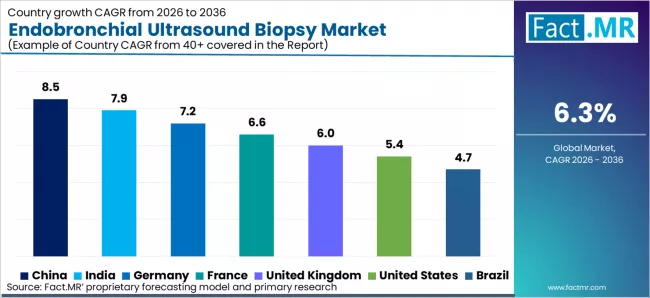
Endobronchial Ultrasound Biopsy Market Cagr Analysis By Country | Source: Fact.MR
| Country | CAGR |
|---|---|
| China | 8.5% |
| India | 7.9% |
| Germany | 7.2% |
| France | 6.6% |
| United Kingdom | 6.0% |
| United States | 5.4% |
| Brazil | 4.7% |
Source: Fact.MR analysis. Updated Feb 28, 2026
Source: Fact.MR analysis, based on proprietary forecasting models and primary research.
Outlook On Endobronchial Ultrasound Biopsy Demand In Asia Pacific
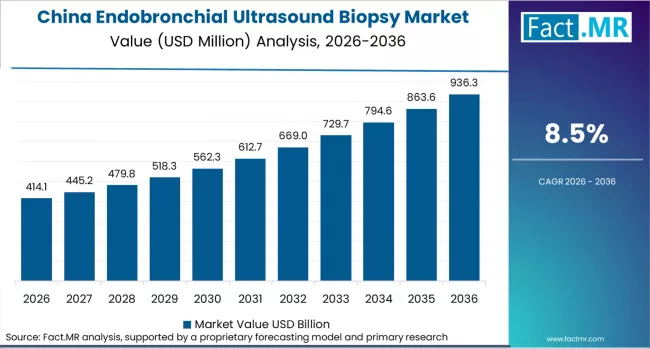
Endobronchial Ultrasound Biopsy Market Country Value Analysis | Source: Fact.MR
Asia Pacific reflects rising demand for endobronchial ultrasound biopsy procedures driven by increasing lung cancer incidence expanding tertiary care capacity and adoption of minimally invasive diagnostics. China and India anchor regional growth through large patient volumes and upgrades in pulmonology departments. Procurement emphasizes real time imaging precision and integration with oncology pathways. Market growth reflects hospital investments physician training programs and broader access to advanced bronchoscopic equipment across public and private healthcare systems regionwide.
- China: Demand for endobronchial ultrasound biopsy systems in China is projected to rise at 8.5% CAGR through 2036. Growth reflects expansion of oncology diagnostics and increased installation of advanced bronchoscopy equipment, as per Fact.MR.
- India: Demand for endobronchial ultrasound biopsy systems in India is projected to rise at 7.9% CAGR through 2036. Adoption reflects rising lung cancer screening and tertiary hospital capacity expansion, according to Fact.MR.
Fact.MR’s analysis of the Endobronchial Ultrasound Biopsy Market in Asia Pacific consists of country-wise assessment that includes China and India. Readers can find oncology diagnostics and hospital infrastructure insights.
Analysis On Endobronchial Ultrasound Biopsy Sales in Europe
Europe demonstrates structured demand for endobronchial ultrasound biopsy shaped by national cancer screening guidelines and public reimbursement frameworks. Germany France and the United Kingdom contribute through established pulmonology networks and tertiary referral centers. Procurement emphasizes CE compliant devices imaging clarity and integration with pathology workflows. Market growth reflects demographic aging lung cancer screening expansion and replacement of legacy bronchoscopic equipment across public health systems within Western European clinical environments.
- Germany: Demand for endobronchial ultrasound biopsy systems in Germany is projected to rise at 7.2% CAGR through 2036. Usage reflects standardized cancer diagnostic pathways and advanced pulmonology services, as per Fact.MR.
- France: Demand for endobronchial ultrasound biopsy systems in France is projected to rise at 6.6% CAGR through 2036. Adoption reflects hospital based lung cancer diagnostic programs, according to Fact.MR.
- United Kingdom: Demand for endobronchial ultrasound biopsy systems in the United Kingdom is projected to rise at 6.0% CAGR through 2036. Growth reflects structured cancer referral systems and equipment upgrades, as per Fact.MR.
Fact.MR’s analysis of the Endobronchial Ultrasound Biopsy Market in Europe consists of country-wise assessment that includes Germany, France, and the United Kingdom. Readers can find reimbursement and diagnostic protocol insights.
Demand for Endobronchial Ultrasound Biopsy in North America
North America shows steady demand for endobronchial ultrasound biopsy supported by advanced oncology diagnostics and strong hospital infrastructure. Sales are driven by early lung cancer detection minimally invasive sampling and integration with imaging systems. The United States anchors regional volume through tertiary hospitals and specialized cancer centers. Procurement emphasizes FDA cleared devices precision imaging and procedural efficiency. Market growth reflects stable screening uptake and continued investment in pulmonary diagnostic capabilities nationwide.
- United States: Demand for endobronchial ultrasound biopsy systems in the United States is projected to rise at 5.4% CAGR through 2036. Usage reflects adoption in tertiary oncology centers and minimally invasive lung diagnostics, as per Fact.MR.
Fact.MR’s analysis of the Endobronchial Ultrasound Biopsy Market in North America consists of country-wise assessment that includes the United States. Readers can find screening adoption and hospital procurement insights.
Outlook On Endobronchial Ultrasound Biopsy Demand in Latin America
Latin America reflects moderate growth in endobronchial ultrasound biopsy demand supported by gradual expansion of oncology services and hospital modernization. Brazil anchors regional adoption through tertiary care hospitals and private healthcare facilities. Procurement remains concentrated in urban centers with selective technology investments. Market growth reflects incremental expansion of pulmonary diagnostics and rising awareness of minimally invasive biopsy techniques across metropolitan healthcare systems regionwide.
- Brazil: Demand for endobronchial ultrasound biopsy systems in Brazil is projected to rise at 4.7% CAGR through 2036. Adoption reflects gradual expansion of oncology diagnostics in urban tertiary hospitals, according to Fact.MR.
Fact.MR’s analysis of the Endobronchial Ultrasound Biopsy Market in Latin America consists of country-wise assessment that includes Brazil. Readers can find hospital modernization and diagnostic capacity insights.
Competitive Landscape of Endobronchial Ultrasound Biopsy Market
As per Fact.MR analysis, the 2026 endobronchial ultrasound (EBUS) biopsy market is defined by validated imaging resolution, device reliability, and regulatory compliance, which determine competitive advantage. Olympus Corporation and GE HealthCare lead with high-precision EBUS systems and verified needle guidance performance, which strengthens adoption in pulmonary and thoracic oncology centers. Siemens Healthineers AG and Koninklijke Philips N.V. focus on integrated imaging platforms with validated real-time navigation and biopsy accuracy, which improves procedural outcomes and reduces complication rates. Boston Scientific Corporation and Cook Group provide validated endoscopic instruments with consistent performance and multi-region regulatory approvals, which supports hospital and clinic adoption. FUJIFILM Holdings Corporation and Medi-Globe Technologies GmbH emphasize high-resolution visualization and ergonomic device designs, which enhance clinician usability and procedural efficiency. ACE Medical Devices Pvt. Ltd. and Praxis Medical offer regionally compliant systems with documented reliability, which expands adoption in emerging markets. Across the market, validated imaging accuracy, procedural reliability, and regulatory adherence form enduring competitive moats, reducing reliance on pricing or isolated device claims.
Recent Industry Developments
- June 2024: American College of Chest Physicians (CHEST) announced a new guideline on collection, processing, and handling of EBUS-TBNA specimens, shaping clinical workflow expectations for biopsy programmes. [5]
- March 2024: NICE updated NG122 "Lung cancer: diagnosis and management", keeping UK staging and diagnostic pathway guidance current for service planning and procurement. [6]
Key Players in Endobronchial Ultrasound Biopsy Market
- Olympus Corporation
- GE HealthCare
- Siemens Healthineers AG
- Koninklijke Philips N.V.
- Boston Scientific Corporation
- Cook Group Incorporated
- FUJIFILM Holdings Corporation
- Medi-Globe Technologies GmbH
- ACE Medical Devices Pvt. Ltd.
- Praxis Medical
Bibliography
- [1] Intuitive Surgical, Inc. (2024). Corporate statement on imaging integration and artificial intelligence in minimally invasive diagnostics [Executive commentary].
- [2] U.S. Food and Drug Administration. (2024). Medical device regulatory framework and device classification guidance. U.S. Department of Health and Human Services.
World Health Organization. (2024). Cancer: Key facts and global health overview. World Health Organization. - [3] U.S. Food and Drug Administration. (2024). Overview of medical devices and regulatory requirements. U.S. Department of Health and Human Services.
- [4] Centers for Disease Control and Prevention. (2024). Lung cancer: Prevention, screening, and statistics. U.S. Department of Health and Human Services.
- [5] American College of Chest Physicians (CHEST). (2024). Guideline on collection, processing, and handling of EBUS-TBNA specimens [Clinical practice guideline].
- [6] National Institute for Health and Care Excellence (NICE). (2024). NG122: Lung cancer-Diagnosis and management [Clinical guideline update].
This Report Addresses
- Market intelligence to support capital equipment planning and consumables forecasting across lung cancer diagnostic pathways
- Global revenue sizing and 10-year forecasts (2026-2036), aligned with lung cancer incidence, screening uptake, and hospital replacement cycles
- Product-level opportunity mapping across EBUS scopes, EBUS-TBNA needles, ultrasound processors, and ancillary consumables with recurring revenue assessment
- Procedure outlook analysis comparing Convex-probe (CP-EBUS) and Radial-probe (RP-EBUS) adoption trends across staging and lesion localization workflows
- End-use demand modeling across academic hospitals, community hospitals, multispecialty networks, ASCs, and specialty pulmonary clinics
- Competitive benchmarking of imaging resolution, needle precision, workflow integration, regulatory clearance status, and platform convergence with robotic bronchoscopy
- Regulatory and clinical pathway assessment aligned with medical device frameworks and oncology diagnostic guidelines influencing procurement and reimbursement
- Strategic insights on AI-assisted imaging integration, disposable innovation, and platform convergence shaping long-term value realization beyond base procedural growth
Segmentation
Scope of the Report
| Metric | Value |
|---|---|
| Quantitative Units | USD 0.80 billion (2026) to USD 1.48 billion (2036), CAGR 6.3% |
| Market Definition | The endobronchial ultrasound (EBUS) biopsy market covers minimally invasive diagnostic systems and consumables for sampling mediastinal and pulmonary lymph nodes via the airway. Devices combine bronchoscopy with real-time ultrasound imaging to guide needle aspiration and tissue collection. Applications include lung cancer staging, diagnosis of mediastinal masses, and evaluation of pulmonary lesions. Regulatory oversight is provided by the US FDA and international health authorities, governing device safety, performance, and clinical use. |
| Product Outlook Segmentation | EBUS Scopes, EBUS-TBNA Needles & Dedicated Biopsy Consumables, Ultrasound Processors & Imaging Systems, Accessories & Ancillaries (sheaths, forceps, adapters, sterilization consumables) |
| Procedure Outlook Segmentation | Convex-probe Linear (CP-EBUS) Scopes, Radial-probe (RP-EBUS) Scopes |
| End-use Outlook Segmentation | Hospitals (Community, Academic/Teaching, Large Multispecialty Networks), Ambulatory Surgical Centers (Independent, Hospital-Affiliated), Specialty Clinics |
| Regions Covered | Asia Pacific, Europe, North America, Latin America, Middle East & Africa |
| Countries Covered | China, India, Japan, South Korea, Indonesia, Australia & New Zealand, Germany, Italy, France, United Kingdom, Spain, Benelux, Nordics, Central & Eastern Europe, United States, Canada, Mexico, Brazil, Argentina, Chile, Kingdom of Saudi Arabia, United Arab Emirates, South Africa, Turkey |
| Key Companies Profiled | Olympus Corporation, GE HealthCare, Siemens Healthineers AG, Koninklijke Philips N.V., Boston Scientific Corporation, Cook Group Incorporated, FUJIFILM Holdings Corporation, Medi-Globe Technologies GmbH, ACE Medical Devices Pvt. Ltd., Praxis Medical |
| Forecast Period | 2026 to 2036 |
| Approach | Market sizing and forecasting based on lung cancer incidence, EBUS procedural volumes, device utilization, replacement cycles, and hospital adoption. Data validated through interviews with pulmonologists, thoracic surgeons, hospital procurement teams, and device manufacturers, and cross-checked against regulatory approvals and hospital procedure statistics. |
Source: Fact.MR analysis. Updated Feb 28, 2026
Endobronchial Ultrasound Biopsy Market Analysis by Segments
-
By Product Outlook :
- EBUS Scopes
- EBUS-TBNA Needles & Dedicated Biopsy Consumables
- Ultrasound Processors and Imaging Systems
- Accessories & Ancillaries (sheaths, forceps, adapters, sterilization consumables)
-
By Procedure Outlook :
- Convex-probe (Linear / CP-EBUS) Scopes
- Radial-probe (RP-EBUS) Scopes
-
By End-Use Outlook :
- Hospitals
- Community Hospitals
- Academic/Teaching Hospitals
- Large Multispecialty Hospitals/Networks
- Ambulatory Surgical Centers (ASCs)
- Independent ASCs
- Hospital-Affiliated ASCs
- Specialty Clinics
- Hospitals
-
Region :
- Asia Pacific
- India
- China
- Japan
- South Korea
- Indonesia
- Australia & New Zealand
- ASEAN
- Rest of Asia Pacific
- Europe
- Germany
- Italy
- France
- United Kingdom
- Spain
- Benelux
- Nordics
- Central & Eastern Europe
- Rest of Europe
- North America
- United States
- Canada
- Mexico
- Latin America
- Brazil
- Argentina
- Chile
- Rest of Latin America
- Middle East & Africa
- Kingdom of Saudi Arabia
- United Arab Emirates
- South Africa
- Turkey
- Rest of Middle East & Africa
- Asia Pacific
Frequently Asked Questions
How large is the endobronchial ultrasound biopsy market in 2026?
What will the market size be by 2036?
What is the expected CAGR during 2026–2036?
How much incremental value will the market add between 2026 and 2036?
What was the market size in 2025?
Which product segment holds the leading share?
Why do EBUS scopes account for a significant share?
Which procedure segment is poised to lead?
Why are convex-probe linear systems widely adopted?
Which region is growing the fastest in the market?
What is the projected CAGR for China?
How fast is the market expected to grow in India?
What is the expected growth rate in Germany?
How is France expected to perform during the forecast period?
What is the growth outlook for the United Kingdom?
How is the United States market projected to expand?
What is the projected growth rate for Brazil?
What supports early-period growth in the market?
What drives mid-period growth during the forecast window?
What factors shape long-term value realization in this market?
Who worked on this report


Preview the report firsthand - request a free sample
Free SampleGet the brochure for pricing and purchase details
Download PDF