Environmental Allergy Monitoring Market (2026 - 2036)

Environmental Allergy Monitoring Market Size and Share Forecast Outlook 2026 to 2036

Core Findings

    Environmental Allergy Monitoring Market Forecast and Outlook 2026 to 2036

    The environmental allergy monitoring market is entering a phase of accelerated structural adoption, driven by the convergence of climate awareness, technological innovation, and precision health demands. Global demand is projected to rise sharply from USD 0.78 billion in 2026 to approximately USD 1.72 billion by 2036, advancing at a CAGR of 8.2%. This expansion is closely tied to the rising burden of allergic diseases, prolonged pollen seasons caused by climate change, and the normalization of predictive environmental surveillance as part of public health infrastructure. Digital monitoring platforms resolve a long-standing execution gap in allergy care by enabling real-time, data-driven allergen forecasting throughout the year, particularly in urban, climate-vulnerable, and healthcare settings.

    Key Takeaways from the Environmental Allergy Monitoring Market

    • Environmental Allergy Monitoring Market Value (2026): USD 0.78 billion
    • Environmental Allergy Monitoring Market Forecast Value (2036): USD 1.72 billion
    • Environmental Allergy Monitoring Market Forecast CAGR (2026-2036): 8.2%
    • Leading Offering Type: Digital monitoring platforms & analytics (24.5%)
    • Key Market Participants: Vaisala, IQAir, Thermo Fisher Scientific, Met One Instruments, Plair
    • Key Growth Regions: Asia Pacific, North America, Europe, Latin America, Middle East
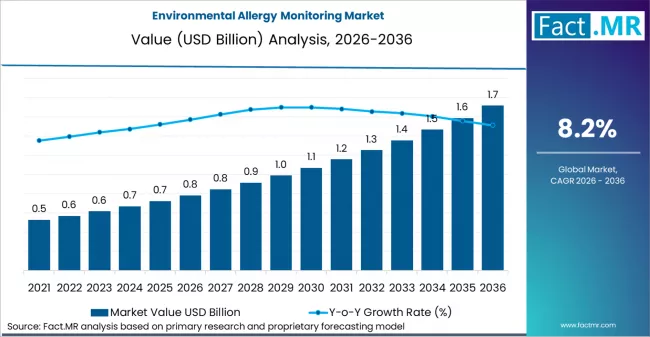
    Environmental Allergy Monitoring Market Market Value Analysis

    As environmental allergen monitoring has evolved from a seasonal convenience into a year-round public health essential because climate change has extended pollen seasons and intensified allergen exposure across all regions. By eliminating reliance on manual pollen counting, outdated forecasts, and reactive treatment approaches, automated monitoring systems align with the realities of data-driven prevention and personalized care. This shift is reinforced by strong momentum in AI-powered allergen detection, IoT sensor networks, and integration with digital health platforms, reflecting consumer and institutional demand for precision surveillance and environmental responsibility. Real-time allergen tracking for vulnerable populations, integration with weather forecasting, and cloud-based analytics further position environmental allergy monitoring as the most behaviorally aligned framework for sustained respiratory health protection.

    Environmental Allergy Monitoring Market

    Metric Value
    Estimated Value in (2026E) USD 0.78 billion
    Forecast Value in (2036F) USD 1.72 billion
    Forecast CAGR (2026 to 2036) 8.2 %

    Category 

    Category Segments
    Offering Type Pollen monitoring stations (hardware), Airborne allergen sampling consumables, Digital monitoring platforms & analytics, Indoor allergen sensors, Forecasting APIs / data subscriptions, Monitoring & maintenance services
    Use Case Public health surveillance, Clinical allergy management support, Workplace / environmental compliance, Smart home / consumer use, Research & academic monitoring
    End User Government agencies, Healthcare providers & payers, Employers / facility managers, Consumers / individuals, Universities & research institutes
    Region North America; Europe; Asia Pacific; Latin America; Middle East & Africa

    Segmental Analysis

    How are digital monitoring platforms and analytics positioning themselves as the leading format in the Environmental Allergy Monitoring Market?
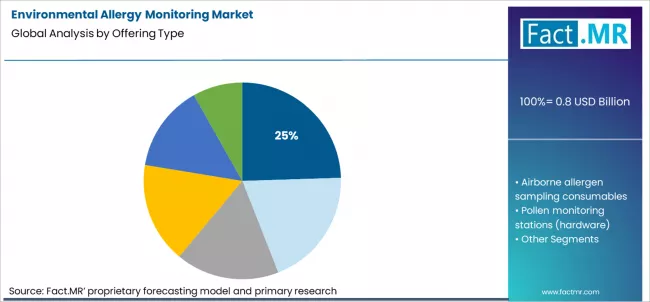
    Environmental Allergy Monitoring Market Analysis By Offering Type

    Digital monitoring platforms and analytics account for 24.5% of the Environmental Allergy Monitoring Market because they directly address the growing demand for real-time, predictive, and personalized allergy intelligence. Regulatory emphasis on environmental health tracking and heightened institutional concern around climate-driven allergen proliferation have shifted preference toward cloud-based, AI-powered monitoring ecosystems. Digital platforms enable precise, location-specific allergen forecasting integrated with weather models, reducing response lag and improving patient compliance. Their software-as-a-service structure also eliminates the need for expensive hardware deployments commonly associated with fragmented monitoring approaches, making digital analytics the default choice for public health agencies, research consortia, and commercial health applications.

    Why does public health surveillance dominate usage patterns in environmental allergy monitoring?
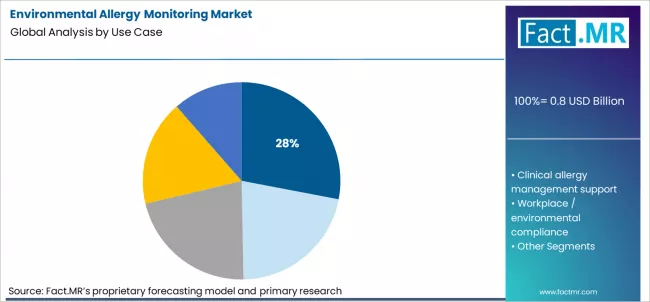
    Environmental Allergy Monitoring Market Analysis By Use Case

    Public health surveillance holds 28% share because epidemic preparedness and climate adaptation have become central to modern health policy frameworks. Governmental guidance increasingly emphasizes proactive environmental monitoring for respiratory sensitizations rather than episodic clinical interventions. Digital allergen tracking removes friction from surveillance by offering continuous, population-level data that can be integrated with disease registries and outbreak detection systems. Comprehensive coverage aligns with this behavior by providing longer actionable insights, especially for populations exposed to pollution, extreme weather events, and prolonged allergen seasons. The combination of accessibility, scalability, and health system integration has made public health surveillance the standard benchmark for environmental allergy monitoring.

    Market Dynamics

    • Drivers: A central driver shaping the environmental allergy monitoring market is the normalization of climate-health integration in public policy. Rising awareness of climate change impacts on pollen seasonality, allergen distribution, and respiratory disease incidence has shifted monitoring from optional research tools to essential public health infrastructure. Automated monitoring systems remove key friction points associated with manual pollen counting by enabling continuous, hyperlocal allergen detection across urban and rural environments. This improves population-level surveillance and frequency of data updates. In parallel, the broader shift toward precision health strengthens adoption, as data-driven allergen forecasts offer greater predictive accuracy, fewer reactive interventions, and superior integration with telehealth platforms for climate-vulnerable and allergy-sensitive populations.
    • Restraints: Market expansion is constrained by infrastructure and standardization challenges. Achieving consistent allergen identification accuracy across diverse pollen species requires advanced optical sensors and machine learning validation, particularly in regions where multiple allergenic taxa overlap. This elevates deployment costs and technical expertise requirements. In addition, some governmental health authorities continue to rely on legacy manual counting methods, creating a trust gap that technology providers must overcome through regulatory validation, clinical outcome studies, and interoperability with existing public health surveillance frameworks, especially in resource-limited and emerging markets.
    • Trend 1: Integration with Climate Forecasting and Early Warning Systems Environmental allergy monitoring platforms are increasingly integrated with national meteorological services and climate adaptation programs to provide real-time allergen alerts linked to weather patterns, air quality indices, and seasonal forecasts. This use-case expansion reframes monitoring from isolated pollen counts into comprehensive environmental health intelligence tools embedded in public safety infrastructure.
    • Trend 2: Consumer-Grade Indoor Allergen Sensors and Smart Home Integration Innovation is accelerating around consumer-accessible indoor allergen sensors optimized for home and workplace environments. Technology companies are prioritizing IoT connectivity, mobile app integration, and personalized allergen tracking to widen adoption among individuals managing chronic allergies, asthma, and respiratory sensitivities, particularly in smart home ecosystems focused on health optimization and environmental quality.

    Environmental Allergy Monitoring Market Analysis by Key Countries
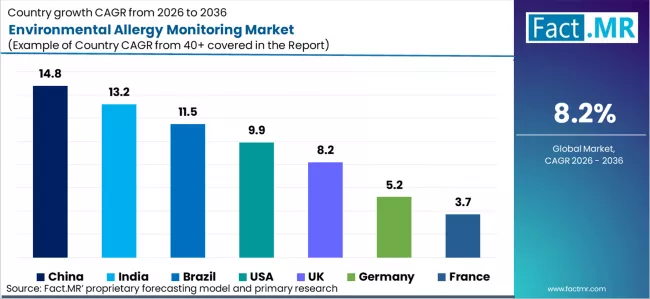
    Environmental Allergy Monitoring Market Cagr Analysis By Country

    Country CAGR (2026-2036)
    China 14.8%
    India 13.2%
    Brazil 11.5%
    USA 9.9%
    UK 8.2
    Germany 5.2%
    France 3.7%

    How is rapid urbanization and air quality regulation accelerating environmental allergy monitoring adoption in China?

    China leads the environmental allergy monitoring market with a CAGR of 14.8%, driven by worsening urban air pollution and strong government intervention. Expansion of national air quality surveillance programs and public health mandates has increased deployment of pollen, particulate, and allergen monitoring networks across major cities. Rising prevalence of allergic rhinitis and asthma, particularly among children and urban professionals, has pushed hospitals, municipalities, and digital health platforms to adopt real-time environmental allergy data. Integration of monitoring systems with mobile health apps is further expanding consumer access and awareness, reinforcing sustained market momentum.

    Why is India witnessing rapid growth in environmental allergy monitoring solutions?

    India is expanding at a CAGR of 13.2%, fueled by rising respiratory disease burden and increasing climate variability. High pollen loads, dust exposure, and seasonal crop burning have intensified allergy incidence in both urban and semi-urban regions. Growing awareness among clinicians and patients is driving adoption of localized allergy forecasting tools and monitoring stations. Additionally, smart city initiatives and digital health expansion are supporting integration of environmental data with preventive healthcare, positioning allergy monitoring as an essential public health and diagnostic support tool.

    How does Brazil’s climate diversity support strong growth in allergy monitoring demand?

    Brazil records a CAGR of 11.5%, supported by diverse climatic zones and high exposure to pollen, mold, and airborne allergens year-round. Rapid urban expansion and deforestation-related environmental changes are increasing allergy prevalence across regions. Healthcare providers are increasingly relying on environmental monitoring data to guide diagnosis and treatment planning for allergic conditions. Public health agencies and private laboratories are investing in regional allergen surveillance to support population health management, making Brazil a key growth market in Latin America.

    What factors are driving steady expansion of the environmental allergy monitoring market in the United States?

    The United States is growing at a CAGR of 9.9%, driven by advanced healthcare infrastructure and high allergy awareness. Climate change has extended pollen seasons and intensified allergen exposure, increasing demand for precise monitoring and forecasting solutions. Integration of allergy monitoring data into electronic health records and consumer wellness platforms has improved clinical decision making and patient self-management. Strong adoption among hospitals, research institutions, and digital health companies continues to support market expansion.

    Why is regulatory and public health focus shaping growth in the United Kingdom?

    The UK market advances at a CAGR of 8.2%, influenced by rising allergy prevalence and strong public health engagement. Government backed air quality initiatives and environmental health reporting are increasing demand for pollen and allergen monitoring systems. Healthcare providers are using monitoring data to support preventive care and patient education, particularly for asthma and hay fever management. Expansion of connected health platforms is further improving accessibility of localized allergy information.

    How does Germany’s evidence driven healthcare model influence market development?

    Germany grows at a CAGR of 5.2%, reflecting a cautious but structured adoption pattern. Strong emphasis on clinical validation and standardized data has positioned environmental allergy monitoring as a supportive diagnostic tool rather than a consumer driven product. Research institutions and public health agencies play a central role in deployment, focusing on accuracy and long-term epidemiological insights. While growth is moderate, the market benefits from high data reliability and institutional trust.

    What limits growth while sustaining innovation in the French environmental allergy monitoring market?

    France shows a conservative CAGR of 3.7%, shaped by a mature healthcare system and established allergy management practices. High baseline awareness and preventive care reduce rapid adoption of new monitoring solutions. However, research institutions and environmental agencies continue to invest in advanced monitoring technologies for epidemiological and climate impact studies. France primarily functions as an innovation and research hub, contributing expertise and technology that supports global market development despite slower domestic growth.

    Competitive Landscape in the Environmental Allergy Monitoring Market
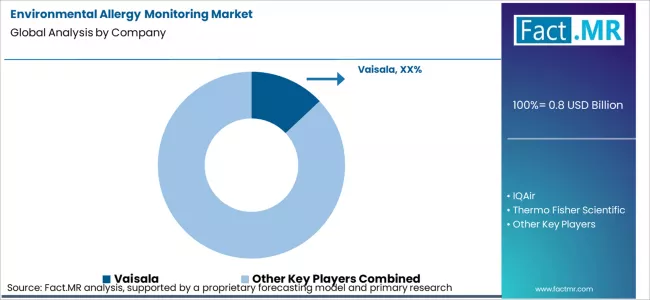
    Environmental Allergy Monitoring Market Analysis By Company

    Competition in the environmental allergy monitoring market has evolved from basic data provision toward integrated health intelligence ecosystems. In 2024, market participants primarily competed on sensor accuracy, geographic coverage, and historical pollen or air quality databases. Differentiation was largely technical, with emphasis on detection thresholds, monitoring frequency, and standalone reporting tools aimed at municipalities, research institutions, or weather services. Investment during this phase focused on hardware deployment and incremental sensor improvements rather than clinical integration or consumer engagement.

    The competitive landscape began to realign as allergy prevalence increased and healthcare systems sought actionable, patient relevant insights. Leading players started integrating environmental monitoring data with digital health platforms, mobile applications, and clinical decision support tools. Rather than offering raw data, companies began positioning themselves as partners in preventive care, enabling real-time allergy forecasting, symptom correlation, and personalized exposure alerts. This shift elevated the strategic value of analytics, interoperability, and data validation.

    Regulatory and public health pressures have further reshaped competition. Government led air quality initiatives, smart city programs, and climate health reporting requirements favor providers with scalable infrastructure, standardized data methodologies, and compliance capabilities. Healthcare adoption increasingly prioritizes monitoring platforms that meet clinical accuracy standards and integrate with electronic health systems.

    Recent Developments

    • In Japan, Mitsubishi Tanabe and Shiseido unveiled the PolRam platform in early 2026, which uses machine learning to predict cedar pollen spikes with 95% accuracy 48 hours in advance.
    • In 2026, Stallergenes Greer secures the only European source of certified Hymenoptera venom; critical for monitoring and treating insect-venom environmental allergies.

    Key Players in Environmental Allergy Monitoring Market

    • Vaisala
    • IQAir
    • Thermo Fisher Scientific
    • Met One Instruments
    • Plair

    Scope of Report

    Items Values
    Quantitative Units (2026) USD 0.78 Billion
    Offering Type Pollen monitoring stations (hardware), Airborne allergen sampling consumables, Digital monitoring platforms & analytics, Indoor allergen sensors, Forecasting APIs / data subscriptions, Monitoring & maintenance services
    Use Case Public health surveillance, Clinical allergy management support, Workplace / environmental compliance, Smart home / consumer use, Research & academic monitoring
    End User Government agencies, Healthcare providers & payers, Employers / facility managers, Consumers / individuals, Universities & research institutes
    Regions Covered North America, Europe, Asia Pacific, Latin America, Middle East & Africa
    Countries Covered U.S., Canada, Germany, Italy, UK, France, Japan, Australia, and other countries
    Key Companies Profiled Vaisala, IQAir, Thermo Fisher Scientific, Met One Instruments, Plair
    Additional Attributes Dollar revenue in the environmental allergy monitoring market is segmented by offering type (hardware, consumables, software, services), use case (public health, clinical, workplace, consumer, research), end user (government, healthcare, employers, consumers, academia), and region. Regional demand patterns are shaped by rising adoption of automated, real-time allergen detection systems.

    Environmental Allergy Monitoring Market by Segments

    • Offering Type :

      • Pollen monitoring stations (hardware)
      • Airborne allergen sampling consumables
      • Digital monitoring platforms & analytics
      • Indoor allergen sensors
      • Forecasting APIs / data subscriptions
      • Monitoring & maintenance services
    • Use Case :

      • Public health surveillance
      • Clinical allergy management support
      • Workplace / environmental compliance
      • Smart home / consumer use
      • Research & academic monitoring
    • End User :

      • Government agencies
      • Healthcare providers & payers
      • Employers / facility managers
      • Consumers / individuals
      • Universities & research institutes
    • Region :

      • Asia Pacific
        • China
        • India
        • Japan
        • Rest of Asia Pacific
      • North America
        • United States
        • Canada
        • Mexico
      • Europe
        • Germany
        • France
        • UK
        • Rest of Europe
      • Latin America
        • Brazil
        • Rest of Latin America

    Bibliography

    • World Health Organization. 2025. Climate change, air pollution, pollen and health: Science and policy snapshots on air quality, energy and health. Geneva: WHO Technical Document.
    • World Health Organization. 2025. Air Quality Standards Database: National air quality standards for criteria pollutants and airborne toxics. Geneva: WHO in collaboration with Swiss Tropical and Public Health Institute.
    • Asthma and Allergy Foundation of America. 2024. 2024 Allergy Capitals Report: Regional analysis of seasonal allergy prevalence and environmental triggers. Washington: AAFA.
    • European Academy of Allergy and Clinical Immunology. 2024. Allergic disease burden in Europe: Epidemiological estimates and healthcare system impact. Zurich: EAACI.
    • Sensors Journal. 2023. A laboratory evaluation of the new automated pollen sensor Beenose: Pollen discrimination using machine learning techniques. MDPI Sensors 23(6): 2964.
    • Science Direct. 2020. A new portable sampler to monitor pollen at street level in the environment of patients: Development and validation of the Pollensniffer device. Science of the Total Environment 741: 140339.

    Table of Content

    1. Executive Summary
      • Global Market Outlook
      • Demand to side Trends
      • Supply to side Trends
      • Technology Roadmap Analysis
      • Analysis and Recommendations
    2. Market Overview
      • Market Coverage / Taxonomy
      • Market Definition / Scope / Limitations
    3. Research Methodology
      • Chapter Orientation
      • Analytical Lens and Working Hypotheses
        • Market Structure, Signals, and Trend Drivers
        • Benchmarking and Cross-market Comparability
        • Market Sizing, Forecasting, and Opportunity Mapping
      • Research Design and Evidence Framework
        • Desk Research Programme (Secondary Evidence)
          • Company Annual and Sustainability Reports
          • Peer-reviewed Journals and Academic Literature
          • Corporate Websites, Product Literature, and Technical Notes
          • Earnings Decks and Investor Briefings
          • Statutory Filings and Regulatory Disclosures
          • Technical White Papers and Standards Notes
          • Trade Journals, Industry Magazines, and Analyst Briefs
          • Conference Proceedings, Webinars, and Seminar Materials
          • Government Statistics Portals and Public Data Releases
          • Press Releases and Reputable Media Coverage
          • Specialist Newsletters and Curated Briefings
          • Sector Databases and Reference Repositories
          • FMR Internal Proprietary Databases and Historical Market Datasets
          • Subscription Datasets and Paid Sources
          • Social Channels, Communities, and Digital Listening Inputs
          • Additional Desk Sources
        • Expert Input and Fieldwork (Primary Evidence)
          • Primary Modes
            • Qualitative Interviews and Expert Elicitation
            • Quantitative Surveys and Structured Data Capture
            • Blended Approach
          • Why Primary Evidence is Used
          • Field Techniques
            • Interviews
            • Surveys
            • Focus Groups
            • Observational and In-context Research
            • Social and Community Interactions
          • Stakeholder Universe Engaged
            • C-suite Leaders
            • Board Members
            • Presidents and Vice Presidents
            • R&D and Innovation Heads
            • Technical Specialists
            • Domain Subject-matter Experts
            • Scientists
            • Physicians and Other Healthcare Professionals
          • Governance, Ethics, and Data Stewardship
            • Research Ethics
            • Data Integrity and Handling
        • Tooling, Models, and Reference Databases
      • Data Engineering and Model Build
        • Data Acquisition and Ingestion
        • Cleaning, Normalisation, and Verification
        • Synthesis, Triangulation, and Analysis
      • Quality Assurance and Audit Trail
    4. Market Background
      • Market Dynamics
        • Drivers
        • Restraints
        • Opportunity
        • Trends
      • Scenario Forecast
        • Demand in Optimistic Scenario
        • Demand in Likely Scenario
        • Demand in Conservative Scenario
      • Opportunity Map Analysis
      • Product Life Cycle Analysis
      • Supply Chain Analysis
      • Investment Feasibility Matrix
      • Value Chain Analysis
      • PESTLE and Porter’s Analysis
      • Regulatory Landscape
      • Regional Parent Market Outlook
      • Production and Consumption Statistics
      • Import and Export Statistics
    5. Global Market Analysis 2021 to 2025 and Forecast, 2026 to 2036
      • Historical Market Size Value (USD Million) Analysis, 2021 to 2025
      • Current and Future Market Size Value (USD Million) Projections, 2026 to 2036
        • Y to o to Y Growth Trend Analysis
        • Absolute $ Opportunity Analysis
    6. Global Market Pricing Analysis 2021 to 2025 and Forecast 2026 to 2036
    7. Global Market Analysis 2021 to 2025 and Forecast 2026 to 2036, By Offering Type
      • Introduction / Key Findings
      • Historical Market Size Value (USD Million) Analysis By Offering Type, 2021 to 2025
      • Current and Future Market Size Value (USD Million) Analysis and Forecast By Offering Type, 2026 to 2036
        • Digital monitoring platforms & analytics
        • Airborne allergen sampling consumables
        • Pollen monitoring stations (hardware)
        • Indoor allergen sensors
        • Forecasting APIs / data subscriptions
        • Monitoring & maintenance services
      • Y to o to Y Growth Trend Analysis By Offering Type, 2021 to 2025
      • Absolute $ Opportunity Analysis By Offering Type, 2026 to 2036
    8. Global Market Analysis 2021 to 2025 and Forecast 2026 to 2036, By Use Case
      • Introduction / Key Findings
      • Historical Market Size Value (USD Million) Analysis By Use Case, 2021 to 2025
      • Current and Future Market Size Value (USD Million) Analysis and Forecast By Use Case, 2026 to 2036
        • Public health surveillance
        • Clinical allergy management support
        • Workplace / environmental compliance
        • Smart home / consumer use
        • Research & academic monitoring
      • Y to o to Y Growth Trend Analysis By Use Case, 2021 to 2025
      • Absolute $ Opportunity Analysis By Use Case, 2026 to 2036
    9. Global Market Analysis 2021 to 2025 and Forecast 2026 to 2036, By End User
      • Introduction / Key Findings
      • Historical Market Size Value (USD Million) Analysis By End User, 2021 to 2025
      • Current and Future Market Size Value (USD Million) Analysis and Forecast By End User, 2026 to 2036
        • Government agencies
        • Healthcare providers & payers
        • Employers / facility managers
        • Consumers / individuals
        • Universities & research institutes
      • Y to o to Y Growth Trend Analysis By End User, 2021 to 2025
      • Absolute $ Opportunity Analysis By End User, 2026 to 2036
    10. Global Market Analysis 2021 to 2025 and Forecast 2026 to 2036, By Region
      • Introduction
      • Historical Market Size Value (USD Million) Analysis By Region, 2021 to 2025
      • Current Market Size Value (USD Million) Analysis and Forecast By Region, 2026 to 2036
        • North America
        • Latin America
        • Western Europe
        • Eastern Europe
        • East Asia
        • South Asia and Pacific
        • Middle East & Africa
      • Market Attractiveness Analysis By Region
    11. North America Market Analysis 2021 to 2025 and Forecast 2026 to 2036, By Country
      • Historical Market Size Value (USD Million) Trend Analysis By Market Taxonomy, 2021 to 2025
      • Market Size Value (USD Million) Forecast By Market Taxonomy, 2026 to 2036
        • By Country
          • USA
          • Canada
          • Mexico
        • By Offering Type
        • By Use Case
        • By End User
      • Market Attractiveness Analysis
        • By Country
        • By Offering Type
        • By Use Case
        • By End User
      • Key Takeaways
    12. Latin America Market Analysis 2021 to 2025 and Forecast 2026 to 2036, By Country
      • Historical Market Size Value (USD Million) Trend Analysis By Market Taxonomy, 2021 to 2025
      • Market Size Value (USD Million) Forecast By Market Taxonomy, 2026 to 2036
        • By Country
          • Brazil
          • Chile
          • Rest of Latin America
        • By Offering Type
        • By Use Case
        • By End User
      • Market Attractiveness Analysis
        • By Country
        • By Offering Type
        • By Use Case
        • By End User
      • Key Takeaways
    13. Western Europe Market Analysis 2021 to 2025 and Forecast 2026 to 2036, By Country
      • Historical Market Size Value (USD Million) Trend Analysis By Market Taxonomy, 2021 to 2025
      • Market Size Value (USD Million) Forecast By Market Taxonomy, 2026 to 2036
        • By Country
          • Germany
          • UK
          • Italy
          • Spain
          • France
          • Nordic
          • BENELUX
          • Rest of Western Europe
        • By Offering Type
        • By Use Case
        • By End User
      • Market Attractiveness Analysis
        • By Country
        • By Offering Type
        • By Use Case
        • By End User
      • Key Takeaways
    14. Eastern Europe Market Analysis 2021 to 2025 and Forecast 2026 to 2036, By Country
      • Historical Market Size Value (USD Million) Trend Analysis By Market Taxonomy, 2021 to 2025
      • Market Size Value (USD Million) Forecast By Market Taxonomy, 2026 to 2036
        • By Country
          • Russia
          • Poland
          • Hungary
          • Balkan & Baltic
          • Rest of Eastern Europe
        • By Offering Type
        • By Use Case
        • By End User
      • Market Attractiveness Analysis
        • By Country
        • By Offering Type
        • By Use Case
        • By End User
      • Key Takeaways
    15. East Asia Market Analysis 2021 to 2025 and Forecast 2026 to 2036, By Country
      • Historical Market Size Value (USD Million) Trend Analysis By Market Taxonomy, 2021 to 2025
      • Market Size Value (USD Million) Forecast By Market Taxonomy, 2026 to 2036
        • By Country
          • China
          • Japan
          • South Korea
        • By Offering Type
        • By Use Case
        • By End User
      • Market Attractiveness Analysis
        • By Country
        • By Offering Type
        • By Use Case
        • By End User
      • Key Takeaways
    16. South Asia and Pacific Market Analysis 2021 to 2025 and Forecast 2026 to 2036, By Country
      • Historical Market Size Value (USD Million) Trend Analysis By Market Taxonomy, 2021 to 2025
      • Market Size Value (USD Million) Forecast By Market Taxonomy, 2026 to 2036
        • By Country
          • India
          • ASEAN
          • Australia & New Zealand
          • Rest of South Asia and Pacific
        • By Offering Type
        • By Use Case
        • By End User
      • Market Attractiveness Analysis
        • By Country
        • By Offering Type
        • By Use Case
        • By End User
      • Key Takeaways
    17. Middle East & Africa Market Analysis 2021 to 2025 and Forecast 2026 to 2036, By Country
      • Historical Market Size Value (USD Million) Trend Analysis By Market Taxonomy, 2021 to 2025
      • Market Size Value (USD Million) Forecast By Market Taxonomy, 2026 to 2036
        • By Country
          • Kingdom of Saudi Arabia
          • Other GCC Countries
          • Turkiye
          • South Africa
          • Other African Union
          • Rest of Middle East & Africa
        • By Offering Type
        • By Use Case
        • By End User
      • Market Attractiveness Analysis
        • By Country
        • By Offering Type
        • By Use Case
        • By End User
      • Key Takeaways
    18. Key Countries Market Analysis
      • USA
        • Pricing Analysis
        • Market Share Analysis, 2025
          • By Offering Type
          • By Use Case
          • By End User
      • Canada
        • Pricing Analysis
        • Market Share Analysis, 2025
          • By Offering Type
          • By Use Case
          • By End User
      • Mexico
        • Pricing Analysis
        • Market Share Analysis, 2025
          • By Offering Type
          • By Use Case
          • By End User
      • Brazil
        • Pricing Analysis
        • Market Share Analysis, 2025
          • By Offering Type
          • By Use Case
          • By End User
      • Chile
        • Pricing Analysis
        • Market Share Analysis, 2025
          • By Offering Type
          • By Use Case
          • By End User
      • Germany
        • Pricing Analysis
        • Market Share Analysis, 2025
          • By Offering Type
          • By Use Case
          • By End User
      • UK
        • Pricing Analysis
        • Market Share Analysis, 2025
          • By Offering Type
          • By Use Case
          • By End User
      • Italy
        • Pricing Analysis
        • Market Share Analysis, 2025
          • By Offering Type
          • By Use Case
          • By End User
      • Spain
        • Pricing Analysis
        • Market Share Analysis, 2025
          • By Offering Type
          • By Use Case
          • By End User
      • France
        • Pricing Analysis
        • Market Share Analysis, 2025
          • By Offering Type
          • By Use Case
          • By End User
      • India
        • Pricing Analysis
        • Market Share Analysis, 2025
          • By Offering Type
          • By Use Case
          • By End User
      • ASEAN
        • Pricing Analysis
        • Market Share Analysis, 2025
          • By Offering Type
          • By Use Case
          • By End User
      • Australia & New Zealand
        • Pricing Analysis
        • Market Share Analysis, 2025
          • By Offering Type
          • By Use Case
          • By End User
      • China
        • Pricing Analysis
        • Market Share Analysis, 2025
          • By Offering Type
          • By Use Case
          • By End User
      • Japan
        • Pricing Analysis
        • Market Share Analysis, 2025
          • By Offering Type
          • By Use Case
          • By End User
      • South Korea
        • Pricing Analysis
        • Market Share Analysis, 2025
          • By Offering Type
          • By Use Case
          • By End User
      • Russia
        • Pricing Analysis
        • Market Share Analysis, 2025
          • By Offering Type
          • By Use Case
          • By End User
      • Poland
        • Pricing Analysis
        • Market Share Analysis, 2025
          • By Offering Type
          • By Use Case
          • By End User
      • Hungary
        • Pricing Analysis
        • Market Share Analysis, 2025
          • By Offering Type
          • By Use Case
          • By End User
      • Kingdom of Saudi Arabia
        • Pricing Analysis
        • Market Share Analysis, 2025
          • By Offering Type
          • By Use Case
          • By End User
      • Turkiye
        • Pricing Analysis
        • Market Share Analysis, 2025
          • By Offering Type
          • By Use Case
          • By End User
      • South Africa
        • Pricing Analysis
        • Market Share Analysis, 2025
          • By Offering Type
          • By Use Case
          • By End User
    19. Market Structure Analysis
      • Competition Dashboard
      • Competition Benchmarking
      • Market Share Analysis of Top Players
        • By Regional
        • By Offering Type
        • By Use Case
        • By End User
    20. Competition Analysis
      • Competition Deep Dive
        • Vaisala
          • Overview
          • Product Portfolio
          • Profitability by Market Segments (Product/Age /Sales Channel/Region)
          • Sales Footprint
          • Strategy Overview
            • Marketing Strategy
            • Product Strategy
            • Channel Strategy
        • IQAir
        • Thermo Fisher Scientific
        • Met One Instruments
        • Plair
    21. Assumptions & Acronyms Used

    List Of Table

    • Table 1: Global Market Value (USD Million) Forecast by Region, 2021 to 2036
    • Table 2: Global Market Value (USD Million) Forecast by Offering Type, 2021 to 2036
    • Table 3: Global Market Value (USD Million) Forecast by Use Case, 2021 to 2036
    • Table 4: Global Market Value (USD Million) Forecast by End User, 2021 to 2036
    • Table 5: North America Market Value (USD Million) Forecast by Country, 2021 to 2036
    • Table 6: North America Market Value (USD Million) Forecast by Offering Type, 2021 to 2036
    • Table 7: North America Market Value (USD Million) Forecast by Use Case, 2021 to 2036
    • Table 8: North America Market Value (USD Million) Forecast by End User, 2021 to 2036
    • Table 9: Latin America Market Value (USD Million) Forecast by Country, 2021 to 2036
    • Table 10: Latin America Market Value (USD Million) Forecast by Offering Type, 2021 to 2036
    • Table 11: Latin America Market Value (USD Million) Forecast by Use Case, 2021 to 2036
    • Table 12: Latin America Market Value (USD Million) Forecast by End User, 2021 to 2036
    • Table 13: Western Europe Market Value (USD Million) Forecast by Country, 2021 to 2036
    • Table 14: Western Europe Market Value (USD Million) Forecast by Offering Type, 2021 to 2036
    • Table 15: Western Europe Market Value (USD Million) Forecast by Use Case, 2021 to 2036
    • Table 16: Western Europe Market Value (USD Million) Forecast by End User, 2021 to 2036
    • Table 17: Eastern Europe Market Value (USD Million) Forecast by Country, 2021 to 2036
    • Table 18: Eastern Europe Market Value (USD Million) Forecast by Offering Type, 2021 to 2036
    • Table 19: Eastern Europe Market Value (USD Million) Forecast by Use Case, 2021 to 2036
    • Table 20: Eastern Europe Market Value (USD Million) Forecast by End User, 2021 to 2036
    • Table 21: East Asia Market Value (USD Million) Forecast by Country, 2021 to 2036
    • Table 22: East Asia Market Value (USD Million) Forecast by Offering Type, 2021 to 2036
    • Table 23: East Asia Market Value (USD Million) Forecast by Use Case, 2021 to 2036
    • Table 24: East Asia Market Value (USD Million) Forecast by End User, 2021 to 2036
    • Table 25: South Asia and Pacific Market Value (USD Million) Forecast by Country, 2021 to 2036
    • Table 26: South Asia and Pacific Market Value (USD Million) Forecast by Offering Type, 2021 to 2036
    • Table 27: South Asia and Pacific Market Value (USD Million) Forecast by Use Case, 2021 to 2036
    • Table 28: South Asia and Pacific Market Value (USD Million) Forecast by End User, 2021 to 2036
    • Table 29: Middle East & Africa Market Value (USD Million) Forecast by Country, 2021 to 2036
    • Table 30: Middle East & Africa Market Value (USD Million) Forecast by Offering Type, 2021 to 2036
    • Table 31: Middle East & Africa Market Value (USD Million) Forecast by Use Case, 2021 to 2036
    • Table 32: Middle East & Africa Market Value (USD Million) Forecast by End User, 2021 to 2036

    List Of Figures

    • Figure 1: Global Market Pricing Analysis
    • Figure 2: Global Market Value (USD Million) Forecast 2021 to 2036
    • Figure 3: Global Market Value Share and BPS Analysis by Offering Type, 2026 and 2036
    • Figure 4: Global Market Y to o to Y Growth Comparison by Offering Type, 2026 to 2036
    • Figure 5: Global Market Attractiveness Analysis by Offering Type
    • Figure 6: Global Market Value Share and BPS Analysis by Use Case, 2026 and 2036
    • Figure 7: Global Market Y to o to Y Growth Comparison by Use Case, 2026 to 2036
    • Figure 8: Global Market Attractiveness Analysis by Use Case
    • Figure 9: Global Market Value Share and BPS Analysis by End User, 2026 and 2036
    • Figure 10: Global Market Y to o to Y Growth Comparison by End User, 2026 to 2036
    • Figure 11: Global Market Attractiveness Analysis by End User
    • Figure 12: Global Market Value (USD Million) Share and BPS Analysis by Region, 2026 and 2036
    • Figure 13: Global Market Y to o to Y Growth Comparison by Region, 2026 to 2036
    • Figure 14: Global Market Attractiveness Analysis by Region
    • Figure 15: North America Market Incremental Dollar Opportunity, 2026 to 2036
    • Figure 16: Latin America Market Incremental Dollar Opportunity, 2026 to 2036
    • Figure 17: Western Europe Market Incremental Dollar Opportunity, 2026 to 2036
    • Figure 18: Eastern Europe Market Incremental Dollar Opportunity, 2026 to 2036
    • Figure 19: East Asia Market Incremental Dollar Opportunity, 2026 to 2036
    • Figure 20: South Asia and Pacific Market Incremental Dollar Opportunity, 2026 to 2036
    • Figure 21: Middle East & Africa Market Incremental Dollar Opportunity, 2026 to 2036
    • Figure 22: North America Market Value Share and BPS Analysis by Country, 2026 and 2036
    • Figure 23: North America Market Value Share and BPS Analysis by Offering Type, 2026 and 2036
    • Figure 24: North America Market Y to o to Y Growth Comparison by Offering Type, 2026 to 2036
    • Figure 25: North America Market Attractiveness Analysis by Offering Type
    • Figure 26: North America Market Value Share and BPS Analysis by Use Case, 2026 and 2036
    • Figure 27: North America Market Y to o to Y Growth Comparison by Use Case, 2026 to 2036
    • Figure 28: North America Market Attractiveness Analysis by Use Case
    • Figure 29: North America Market Value Share and BPS Analysis by End User, 2026 and 2036
    • Figure 30: North America Market Y to o to Y Growth Comparison by End User, 2026 to 2036
    • Figure 31: North America Market Attractiveness Analysis by End User
    • Figure 32: Latin America Market Value Share and BPS Analysis by Country, 2026 and 2036
    • Figure 33: Latin America Market Value Share and BPS Analysis by Offering Type, 2026 and 2036
    • Figure 34: Latin America Market Y to o to Y Growth Comparison by Offering Type, 2026 to 2036
    • Figure 35: Latin America Market Attractiveness Analysis by Offering Type
    • Figure 36: Latin America Market Value Share and BPS Analysis by Use Case, 2026 and 2036
    • Figure 37: Latin America Market Y to o to Y Growth Comparison by Use Case, 2026 to 2036
    • Figure 38: Latin America Market Attractiveness Analysis by Use Case
    • Figure 39: Latin America Market Value Share and BPS Analysis by End User, 2026 and 2036
    • Figure 40: Latin America Market Y to o to Y Growth Comparison by End User, 2026 to 2036
    • Figure 41: Latin America Market Attractiveness Analysis by End User
    • Figure 42: Western Europe Market Value Share and BPS Analysis by Country, 2026 and 2036
    • Figure 43: Western Europe Market Value Share and BPS Analysis by Offering Type, 2026 and 2036
    • Figure 44: Western Europe Market Y to o to Y Growth Comparison by Offering Type, 2026 to 2036
    • Figure 45: Western Europe Market Attractiveness Analysis by Offering Type
    • Figure 46: Western Europe Market Value Share and BPS Analysis by Use Case, 2026 and 2036
    • Figure 47: Western Europe Market Y to o to Y Growth Comparison by Use Case, 2026 to 2036
    • Figure 48: Western Europe Market Attractiveness Analysis by Use Case
    • Figure 49: Western Europe Market Value Share and BPS Analysis by End User, 2026 and 2036
    • Figure 50: Western Europe Market Y to o to Y Growth Comparison by End User, 2026 to 2036
    • Figure 51: Western Europe Market Attractiveness Analysis by End User
    • Figure 52: Eastern Europe Market Value Share and BPS Analysis by Country, 2026 and 2036
    • Figure 53: Eastern Europe Market Value Share and BPS Analysis by Offering Type, 2026 and 2036
    • Figure 54: Eastern Europe Market Y to o to Y Growth Comparison by Offering Type, 2026 to 2036
    • Figure 55: Eastern Europe Market Attractiveness Analysis by Offering Type
    • Figure 56: Eastern Europe Market Value Share and BPS Analysis by Use Case, 2026 and 2036
    • Figure 57: Eastern Europe Market Y to o to Y Growth Comparison by Use Case, 2026 to 2036
    • Figure 58: Eastern Europe Market Attractiveness Analysis by Use Case
    • Figure 59: Eastern Europe Market Value Share and BPS Analysis by End User, 2026 and 2036
    • Figure 60: Eastern Europe Market Y to o to Y Growth Comparison by End User, 2026 to 2036
    • Figure 61: Eastern Europe Market Attractiveness Analysis by End User
    • Figure 62: East Asia Market Value Share and BPS Analysis by Country, 2026 and 2036
    • Figure 63: East Asia Market Value Share and BPS Analysis by Offering Type, 2026 and 2036
    • Figure 64: East Asia Market Y to o to Y Growth Comparison by Offering Type, 2026 to 2036
    • Figure 65: East Asia Market Attractiveness Analysis by Offering Type
    • Figure 66: East Asia Market Value Share and BPS Analysis by Use Case, 2026 and 2036
    • Figure 67: East Asia Market Y to o to Y Growth Comparison by Use Case, 2026 to 2036
    • Figure 68: East Asia Market Attractiveness Analysis by Use Case
    • Figure 69: East Asia Market Value Share and BPS Analysis by End User, 2026 and 2036
    • Figure 70: East Asia Market Y to o to Y Growth Comparison by End User, 2026 to 2036
    • Figure 71: East Asia Market Attractiveness Analysis by End User
    • Figure 72: South Asia and Pacific Market Value Share and BPS Analysis by Country, 2026 and 2036
    • Figure 73: South Asia and Pacific Market Value Share and BPS Analysis by Offering Type, 2026 and 2036
    • Figure 74: South Asia and Pacific Market Y to o to Y Growth Comparison by Offering Type, 2026 to 2036
    • Figure 75: South Asia and Pacific Market Attractiveness Analysis by Offering Type
    • Figure 76: South Asia and Pacific Market Value Share and BPS Analysis by Use Case, 2026 and 2036
    • Figure 77: South Asia and Pacific Market Y to o to Y Growth Comparison by Use Case, 2026 to 2036
    • Figure 78: South Asia and Pacific Market Attractiveness Analysis by Use Case
    • Figure 79: South Asia and Pacific Market Value Share and BPS Analysis by End User, 2026 and 2036
    • Figure 80: South Asia and Pacific Market Y to o to Y Growth Comparison by End User, 2026 to 2036
    • Figure 81: South Asia and Pacific Market Attractiveness Analysis by End User
    • Figure 82: Middle East & Africa Market Value Share and BPS Analysis by Country, 2026 and 2036
    • Figure 83: Middle East & Africa Market Value Share and BPS Analysis by Offering Type, 2026 and 2036
    • Figure 84: Middle East & Africa Market Y to o to Y Growth Comparison by Offering Type, 2026 to 2036
    • Figure 85: Middle East & Africa Market Attractiveness Analysis by Offering Type
    • Figure 86: Middle East & Africa Market Value Share and BPS Analysis by Use Case, 2026 and 2036
    • Figure 87: Middle East & Africa Market Y to o to Y Growth Comparison by Use Case, 2026 to 2036
    • Figure 88: Middle East & Africa Market Attractiveness Analysis by Use Case
    • Figure 89: Middle East & Africa Market Value Share and BPS Analysis by End User, 2026 and 2036
    • Figure 90: Middle East & Africa Market Y to o to Y Growth Comparison by End User, 2026 to 2036
    • Figure 91: Middle East & Africa Market Attractiveness Analysis by End User
    • Figure 92: Global Market - Tier Structure Analysis
    • Figure 93: Global Market - Company Share Analysis

    - FAQs -

    How big is the global environmental allergy monitoring market in 2026?

    The global environmental allergy monitoring market is valued at approximately USD 0.78 billion in 2026.

    What will be the size of the environmental allergy monitoring market in 2036?

    The market is projected to reach around USD 1.72 billion by 2036.

    How fast will the environmental allergy monitoring market grow between 2026 and 2036?

    The market is expected to expand at a CAGR of 8.2% during the forecast period.

    Which offering type dominates the environmental allergy monitoring market?

    Digital monitoring platforms and analytics dominate the market, accounting for approximately 24.5% of total demand in 2026.

    Which use case holds the largest share in environmental allergy monitoring?

    Public health surveillance represents the largest share, contributing about 28% of global revenue due to governmental climate adaptation mandates and population health monitoring requirements.

    Environmental Allergy Monitoring Market