- Base Value(2026): 532.00 Mn
- Estimated Value(2026): 532.0 Mn
- Forecast Value (2036): 989.3 Mn
- CAGR (2026 - 2036): 6.4%
Environmental Monitoring Reagents for On-Site Water Testing Market Forecast and Outlook 2026 to 2036
The global environmental monitoring reagents for on-site water testing market is projected to reach USD 989.30 million by 2036. The market is valued at USD 532.00 million in 2026 and is set to rise at a CAGR of 6.4% during the assessment period.
By product, pH & conductivity reagents hold a leading 20% share. Municipal drinking water testing (on-site) represents the dominant end-use at 24%, while Liquid reagents (bulk bottles, concentrates) is the primary format at 38.0%. Water utilities & direct procurement is the leading sales channel at 30.0%.
Key Takeaways from the Environmental Monitoring Reagents for On-Site Water Testing Market
- Market Value for 2026: USD 532.00 Million
- Market Value for 2036: USD 989.30 Million
- Forecast CAGR (2026-2036): 6.4%
- Leading Product Segment Share (2026): pH & conductivity reagents (20%)
- Leading End-Use Segment Share (2026): Municipal drinking water testing (on-site) (24%)
- Leading Format Segment Share (2026): Liquid reagents (bulk bottles, concentrates) (38.0%)
- Leading Sales Channel Share (2026): Water utilities & direct procurement (30.0%)
- Key Players in the Market: Hach (Danaher), Thermo Fisher Scientific, Merck Millipore, Palintest (HORIBA & Palintest brand), Metrohm, Chemetrics, Sigma Aldrich
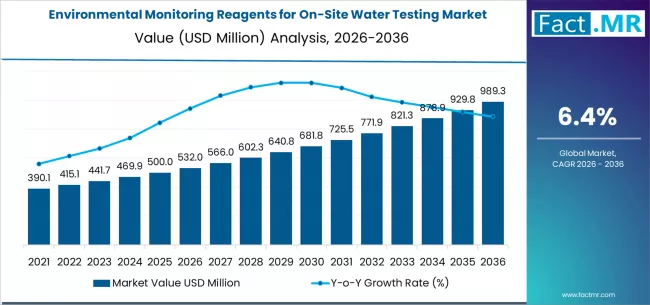
Environmental Monitoring Reagents For On Site Water Testing Market Market Value Analysis | Source: Fact.MR
Defining trends involve the development of integrated, low-interference reagent chemistries for multi-parameter field instruments. Innovation is focused on enhancing reagent stability, shelf-life, and accuracy under diverse field conditions. Integration of these reagents into smart, connected sensor systems with automated calibration and data logging is becoming a key competitive strategy.
Stringent global and regional water quality regulations and the increasing need for real-time compliance monitoring drive market growth. The expansion of water and wastewater treatment infrastructure, alongside growing industrial self-monitoring requirements, acts as a significant catalyst, creating sustained demand for reliable, accurate, and user-friendly on-site testing reagents.
Environmental Monitoring Reagents for On-Site Water Testing Market
| Metric | Value |
|---|---|
| Market Value (2026) | USD 532.00 Million |
| Market Forecast Value (2036) | USD 989.30 Million |
| Forecast CAGR (2026-2036) | 6.4% |
Source: Fact.MR analysis. Updated Dec 26, 2025
Category
| Category | Segments |
|---|---|
| Product | pH & conductivity reagents, Chlorine & disinfectant (free&total) reagents, Nutrients (nitrate, nitrite, phosphate, ammonia), Heavy metals (lead, mercury, cadmium, arsenic) reagents, Microbial & coliform & ATP reagents, Turbidity & suspended solids reagents, COD & BOD colorimetric reagents |
| End-Use | Municipal drinking water testing (on-site), Wastewater & sewage treatment monitoring, Industrial effluent monitoring (manufacturing, petrochem), Environmental field monitoring (rivers, lakes), Aquaculture & fisheries, Agriculture runoff & irrigation monitoring, Research, academic & QC labs (on-site rapid use) |
| Format | Liquid reagents (bulk bottles, concentrates), Test strips & dipsticks, Cartridge & dispenser reagent systems, Tablet & powder reagents, Ready-to-use colorimetric kits, Sensor consumables & enzymatic reagents |
| Sales Channel | Water utilities & direct procurement, Industrial distributors & chemical wholesalers, OEM consumables (analyzer manufacturers), Environmental service contractors & labs, Online & e-commerce (industrial platforms), Regional&local formulators & resellers |
| Region | North America, Latin America, Western Europe, Eastern Europe, East Asia, South Asia & Pacific, MEA |
Source: Fact.MR analysis. Updated Dec 26, 2025
Segmental Analysis
By Product, Which Parameter is the Universal Baseline for Water Quality Assessment?
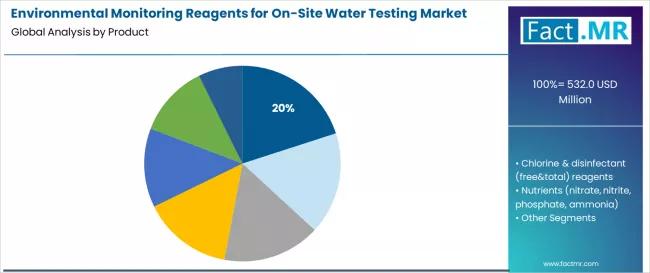
Environmental Monitoring Reagents For On Site Water Testing Market Analysis By Product | Source: Fact.MR
pH & conductivity reagents lead the segment with a 20% share. This dominance is due to their role as fundamental, first-line indicators of water quality in virtually every application, from drinking water to industrial effluent. Testing for these parameters is frequent, routine, and often mandated, driving high-volume, recurring demand for reliable and stable reagents that deliver consistent results in field conditions.
By End-Use, Which Sector is the Foundation of Regulatory Compliance and Public Health?
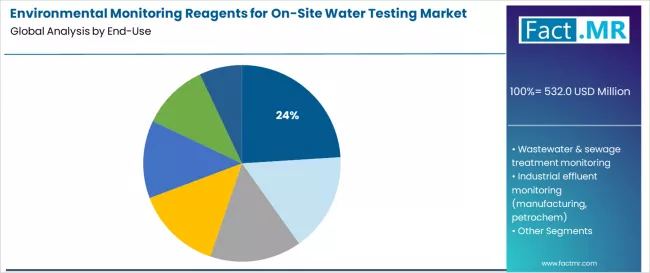
Environmental Monitoring Reagents For On Site Water Testing Market Analysis By End Use | Source: Fact.MR
Municipal drinking water testing (on-site) commands the largest end-use share at 24%. This sector is governed by the most stringent and non-negotiable public health regulations. The need for frequent testing at various points in the distribution network, from treatment plants to remote taps, creates consistent, high-volume demand for accurate, easy-to-use reagents to ensure regulatory compliance and consumer safety.
By Format, Which System Balances Cost-Effectiveness and Proven Reliability?
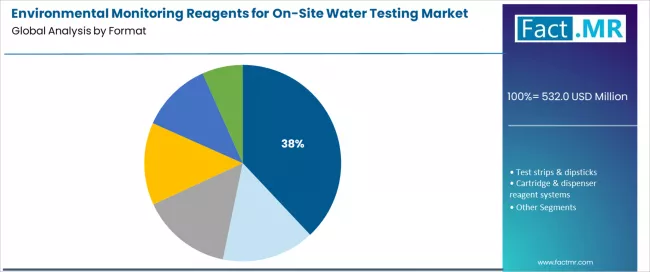
Environmental Monitoring Reagents For On Site Water Testing Market Analysis By Format | Source: Fact.MR
Liquid reagents (bulk bottles, concentrates) represent the leading format at 38.0%. This traditional format offers a favorable cost-per-test for high-volume users, proven analytical performance, and flexibility for use with various photometers and titrators. Its dominance is sustained in municipal and industrial labs and field stations where trained personnel prioritize established methods and cost efficiency.
By Sales Channel, Which Route Services the Core Institutional Customer Base?
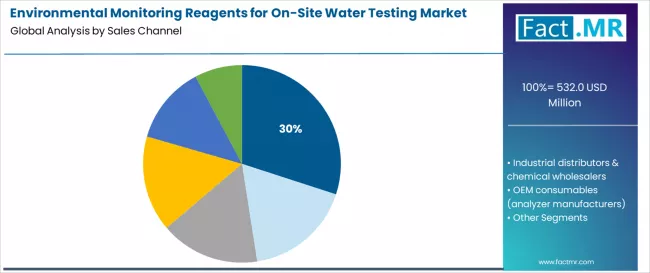
Environmental Monitoring Reagents For On Site Water Testing Market Analysis By Sales Channel | Source: Fact.MR
Water utilities & direct procurement is the leading sales channel at 30.0%. Large municipal water authorities and major industrial facilities with dedicated environmental departments often procure reagents directly from manufacturers or through framework contracts. This channel emphasizes technical specifications, regulatory compliance documentation, volume pricing, and integrated supply agreements for critical consumables.
What are the Drivers, Restraints, and Key Trends of the Environmental Monitoring Reagents for On-Site Water Testing Market?
Globally tightening water quality standards and discharge permit requirements drive market growth. The increasing decentralization of testing from central labs to field sites for faster decision-making propels demand. Growing public and regulatory focus on emerging contaminants like PFAS and specific heavy metals necessitates new reagent chemistries and test methods.
A significant restraint is the cost pressure from lower-priced generic or regional reagent alternatives, particularly in price-sensitive markets. The technical complexity of some tests requires trained operators, limiting broader adoption. Competition from advanced sensor technologies that require fewer or no wet chemistries poses a long-term challenge to certain reagent segments.
Key trends include the development of simplified, all-in-one reagent packets and cartridge systems to minimize user error and handling. There is a growing integration of reagents with smartphone-based photometry and data management apps. The market is also seeing increased demand for green chemistry reagents with lower toxicity and improved disposal profiles.
Analysis of the Environmental Monitoring Reagents for On-Site Water Testing Market by Key Countries
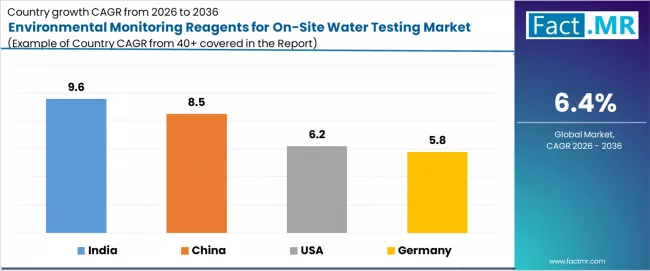
Environmental Monitoring Reagents For On Site Water Testing Market Cagr Analysis By Country | Source: Fact.MR
| Country | CAGR (2026-2036) |
|---|---|
| India | 9.60% |
| China | 8.50% |
| USA | 6.20% |
| Germany | 5.80% |
Source: Fact.MR analysis. Updated Dec 26, 2025
How does India's Water Infrastructure Push and Pollution Control Drive High Growth?
India leads with a 9.60% CAGR, driven by massive national missions to provide tap water to all households and to clean its rivers. The expansion of municipal water networks and stringent new regulations for industrial and sewage treatment plant effluent monitoring create enormous demand for affordable, robust on-site testing reagents to ensure compliance at thousands of new monitoring points.
Why is China's Water Quality Management and Industrial Monitoring a Key Driver?
The Water Ten Plan and other policies demanding comprehensive improvement of water quality in watersheds fuel China’s 8.50% growth. The scale of its industrial base under pressure to monitor discharge, coupled with the deployment of extensive surface water quality monitoring networks, generates significant volume demand for a wide range of testing reagents.
What Role does the USA's Mature Regulatory Framework and Decentralized Testing Play?
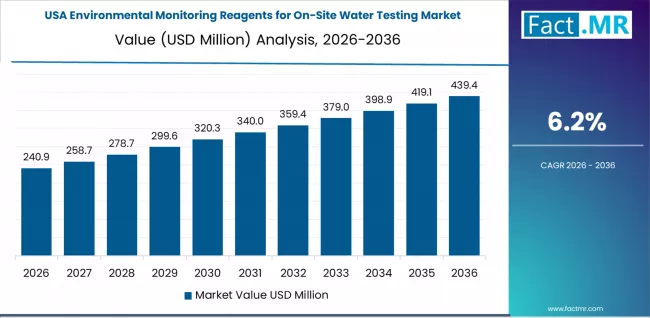
Environmental Monitoring Reagents For On Site Water Testing Market Country Value Analysis | Source: Fact.MR
The Safe Drinking Water Act, Clean Water Act, and state-level regulations underpin the USA’s 6.20% growth. Demand is driven by mandated testing in municipal systems, industrial NPDES permits, and the growing adoption of field-based testing by environmental consultants and water utilities seeking faster results than traditional lab turnarounds.
How does Germany's Strict EU Compliance and Advanced Engineering Influence the Market?
Germany’s 5.80% growth reflects its adherence to stringent EU Water Framework Directive standards and advanced engineering in monitoring technology. The market demands high-precision, reliable reagents for use in sophisticated portable analyzers deployed for monitoring surface water, groundwater, and the efficient operation of advanced wastewater treatment plants.
Competitive Landscape of the Environmental Monitoring Reagents for On-Site Water Testing Market
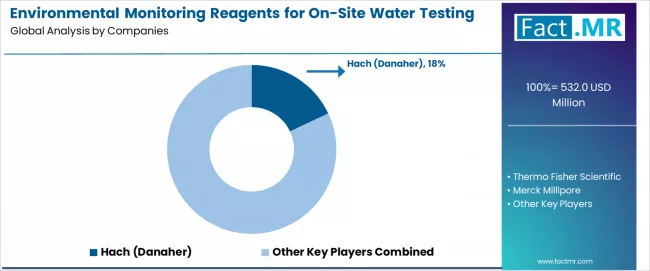
Environmental Monitoring Reagents For On Site Water Testing Market Analysis By Company | Source: Fact.MR
The competitive landscape is consolidated among global analytical instrument and life science giants with integrated reagent portfolios. Leaders like Hach (Danaher) and Thermo Fisher Scientific compete on the strength of their complete ecosystems, portable analyzers, matched reagents, and data software, creating strong customer lock-in for high-compliance applications.
Specialist water analysis companies like Palintest and Chemetrics compete through deep expertise in colorimetric and comparator methods, often offering simpler, cost-effective solutions. Broad-based chemical and reagent suppliers like Merck Millipore and Sigma-Aldrich leverage their vast distribution networks and brand reputation in research and industrial labs. Competition centers on reagent accuracy and stability data, compatibility with dominant field instrument platforms, and the completeness of regulatory support documentation.
Key Players in the Environmental Monitoring Reagents for On-Site Water Testing Market
- Hach (Danaher)
- Thermo Fisher Scientific
- Merck Millipore
- Palintest (HORIBA & Palintest brand)
- Metrohm
- Chemetrics
- Sigma Aldrich
Segmentation
Scope of Report
| Items | Values |
|---|---|
| Quantitative Units | USD Million |
| Product | pH & conductivity reagents, Chlorine & disinfectant (free&total) reagents, Nutrients (nitrate, nitrite, phosphate, ammonia), Heavy metals (lead, mercury, cadmium, arsenic) reagents, Microbial & coliform & ATP reagents, Turbidity & suspended solids reagents, COD & BOD colorimetric reagents |
| End-Use | Municipal drinking water testing (on-site), Wastewater & sewage treatment monitoring, Industrial effluent monitoring (manufacturing, petrochem), Environmental field monitoring (rivers, lakes), Aquaculture & fisheries, Agriculture runoff & irrigation monitoring, Research, academic & QC labs (on-site rapid use) |
| Format | Liquid reagents (bulk bottles, concentrates), Test strips & dipsticks, Cartridge & dispenser reagent systems, Tablet & powder reagents, Ready-to-use colorimetric kits, Sensor consumables & enzymatic reagents |
| Sales Channel | Water utilities & direct procurement, Industrial distributors & chemical wholesalers, OEM consumables (analyzer manufacturers), Environmental service contractors & labs, Online & e-commerce (industrial platforms), Regional&local formulators & resellers |
| Key Countries | India, China, USA, Germany |
| Key Companies | Hach (Danaher), Thermo Fisher Scientific, Merck Millipore, Palintest (HORIBA & Palintest brand), Metrohm, Chemetrics, Sigma Aldrich |
| Additional Analysis | Analysis of reagent shelf-life and stability under field conditions, comparative accuracy vs. laboratory reference methods, total cost-per-test models for different formats, competitive assessment against sensor-based continuous monitors, and impact of new contaminant regulations on reagent R&D. |
Source: Fact.MR analysis. Updated Dec 26, 2025
Environmental Monitoring Reagents for On-Site Water Testing Market by Segments
-
Product :
- pH & conductivity reagents
- Chlorine & disinfectant (free&total) reagents
- Nutrients (nitrate, nitrite, phosphate, ammonia)
- Heavy metals (lead, mercury, cadmium, arsenic) reagents
- Microbial & coliform & ATP reagents
- Turbidity & suspended solids reagents
- COD & BOD colorimetric reagents
-
End-Use :
- Municipal drinking water testing (on-site)
- Wastewater & sewage treatment monitoring
- Industrial effluent monitoring (manufacturing, petrochem)
- Environmental field monitoring (rivers, lakes)
- Aquaculture & fisheries
- Agriculture runoff & irrigation monitoring
- Research, academic & QC labs (on-site rapid use)
-
Format :
- Liquid reagents (bulk bottles, concentrates)
- Test strips & dipsticks
- Cartridge & dispenser reagent systems
- Tablet & powder reagents
- Ready-to-use colorimetric kits
- Sensor consumables & enzymatic reagents
-
Sales Channel :
- Water utilities & direct procurement
- Industrial distributors & chemical wholesalers
- OEM consumables (analyzer manufacturers)
- Environmental service contractors & labs
- Online & e-commerce (industrial platforms)
- Regional & local formulators & resellers
-
Region :
-
North America
- USA
- Canada
-
Latin America
- Brazil
- Mexico
- Argentina
- Rest of Latin America
-
Western Europe
- Germany
- UK
- France
- Spain
- Italy
- BENELUX
- Rest of Western Europe
-
Eastern Europe
- Russia
- Poland
- Czech Republic
- Rest of Eastern Europe
-
East Asia
- China
- Japan
- South Korea
- Rest of East Asia
-
South Asia & Pacific
- India
- ASEAN
- Australia
- Rest of South Asia & Pacific
-
MEA
- Saudi Arabia
- UAE
- Turkiye
- Rest of MEA
-
Frequently Asked Questions
How big is the environmental monitoring reagents for on-site water testing market in 2026?
What will be the size of environmental monitoring reagents for on-site water testing market in 2036?
How much will be the environmental monitoring reagents for on-site water testing market growth between 2026 and 2036?
What are the key product types in the environmental monitoring reagents for on-site water testing market?
Which end-use segment to contribute significant share in the environmental monitoring reagents for on-site water testing market in 2026?
Who worked on this report


Preview the report firsthand - request a free sample
Free SampleGet the brochure for pricing and purchase details
Download PDF