- Base Value(2025): 455 Mn
- Estimated Value(2026): 510 Mn
- Forecast Value (2036): 1273 Mn
- CAGR (2026 - 2036): 12.0%
EV Charging Cable Locks and Security Devices Market Forecast 2026 to 2036
In 2025, the EV charging cable locks and security devices market was valued at USD 455 million. Based on Fact MR’s analysis, demand for security solutions is estimated to grow to USD 510 million in 2026 and USD 1,273 million by 2036. FMI projects a CAGR of 12.0% during the forecast period. This represents an absolute dollar growth of USD 763 million, signaling a transformational shift as security evolves from a basic accessory to a mission-critical infrastructure component. While the global "copper theft" epidemic keeps demand steady for public curbside charging, growth is often limited by substitution pressure from OEMs who integrate internal locking solenoids directly into the charging hardware, alongside rising regulatory costs for safety certifications.
Industry leaders are increasingly prioritizing these defenses to maintain network reliability. As Rick Wilmer, CEO of ChargePoint, noted regarding the rising threat of infrastructure vandalism, "By increasing the time, effort, and resources required to steal them, these cables serve as a strong deterrent against theft." This executive focus highlights the move toward more robust, theft-resistant hardware across high-traffic charging corridors.
Regionally, growth is led by India (12.8%), driven by massive "PM E-Drive" infrastructure projects, followed by China (12.1%), USA (11.3%), and South Korea (10.2%), where rapid greenfield expansion necessitates localized security. Conversely, Germany (9.7%), the UK (9.3%), France (8.9%), and Japan (7.9%) represent mature markets that generate replacement demand rather than new growth. A primary structural constraint for this mature group is interoperability lag, as legacy charging stations often lack the physical architecture required to support modern, integrated electronic locking systems.
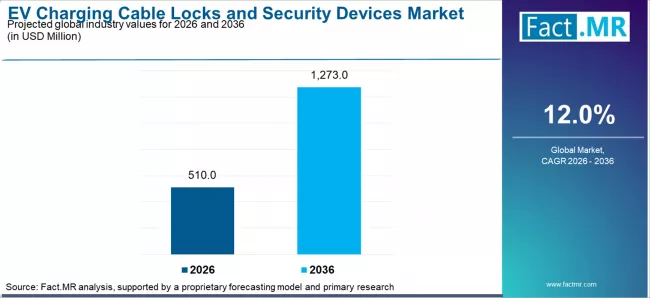
EV Charging Cable Locks And Security Devices Market Industry Value Analysis | Source: Fact.MR
EV Charging Cable Locks and Security Devices Market Definition
The EV charging cable locks and security devices market includes products designed to protect electric vehicle (EV) charging equipment from theft, vandalism, and unauthorized removal. This encompasses mechanical padlocks, steel dock-locks, and smart-locking systems with RFID or mobile app integration. These devices secure the connection between the vehicle and charging station, safeguarding valuable cables, and are used in both public and residential charging infrastructures.
EV Charging Cable Locks and Security Devices Market Inclusions
This report covers a detailed analysis of the market from 2026 to 2036, segmented by product type (mechanical, RFID/smart locks, and sensor alarms), sales channels (Direct-to-Consumer and OEM), and end-users (residential and commercial). It also includes regional pricing analysis and trade flow assessments, focusing on security components from Asia-Pacific, Europe, and North America.
EV Charging Cable Locks and Security Devices Market Exclusions
Exclusions include general charging station software, cybersecurity protocols, automotive components like vehicle charge-port flaps, universal EV chargers, and niche applications such as fleet cable management systems for electric buses.
EV Charging Cable Locks and Security Devices Market Research Methodology
- Primary Research: Interviews with product managers, security engineers, and public charging network operators to understand theft trends and system performance.
- Desk Research: Review of technical patents, municipal reports, and manufacturer financial statements, alongside EV adoption data.
- Market-Sizing and Forecasting: Hybrid modeling combining top-down global EV sales analysis with bottom-up security accessory attachment rates.
- Data Validation and Update Cycle: Estimates were cross-verified using logistics data and port import records. The database is updated semi-annually to reflect regulatory shifts and technological advancements.
Summary of EV Charging Cable Locks and Security Devices Market
EV Charging Cable Locks and Security Devices Market Definition:
The market includes products designed to secure EV charging cables and stations, preventing theft, vandalism, and unauthorized removal. Key products include mechanical padlocks, heavy-duty steel dock-locks, and smart-locking systems integrated with RFID or mobile apps.
Demand Drivers in the Market:
- Rising EV Adoption: Increased demand for secure charging solutions as electric vehicle adoption grows.
- Theft & Vandalism Risks: Rising cable theft and vandalism in public charging stations.
- Regulatory Push: Stricter regulations push for advanced security standards.
Key Segments Analyzed in the FMI Report:
- Product Type: Cable Lock Devices, Port Locking Caps, Anti-Theft Alarms/Tags, Other.
- Charging Setup: Home Charging, Public AC, Public DC Fast, Workplace/Depot.
- Security Method: Mechanical Locking, RFID/Smart Locking, Sensor Alarm-Based, Other.
Analyst Opinion at FMI:
According to Shambhu Nath Jha, Principal Consultant, FactMR, the market is transitioning from a niche accessory to critical infrastructure, driven by the need for robust security solutions to prevent theft and mitigate downtime.
Strategic Implications/Executive Takeaways:
- Focus on advanced, IoT-integrated security devices.
- Shift from basic security to mission-critical infrastructure.
- Prioritize regional market needs, especially in emerging markets.
Methodology:
Validated through first-hand data from interviews with product managers, engineers, and public charging network operators. Market forecasts combine top-down and bottom-up analyses, cross-verified with trade data.
Segmental Analysis
EV Charging Cable Locks and Security Devices Market Analysis by Security Method
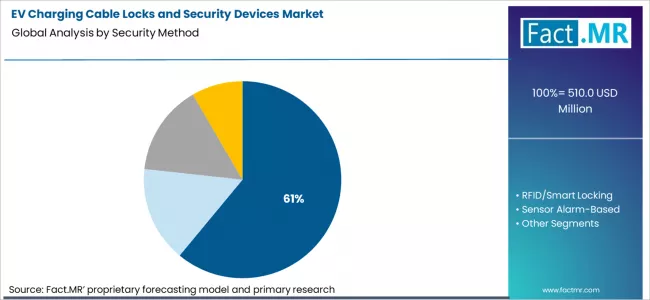
Ev Charging Cable Locks And Security Devices Market Analysis By Security Method | Source: Fact.MR
- Market Overview: Mechanical locking systems are expected to capture 61% of the EV charging cable locks market by 2026. These systems offer a straightforward, low-cost solution for protecting charging cables from theft and damage. Their use of padlocks and dock-locks is popular due to ease of installation and durability, making them suitable for both residential and public setups.
- Demand Drivers:
- Cost-Effectiveness: Mechanical locks are affordable and require little maintenance, appealing to homeowners and charging station operators alike.
- Market Penetration: With increasing EV adoption, demand for security solutions in both home and public charging grows, driving the use of mechanical locks.
- Emerging Alternatives: While RFID and smart locks are on the rise, mechanical locks remain a preferred choice for their simplicity and affordability.
EV Charging Cable Locks and Security Devices Market Analysis by Charging Setup
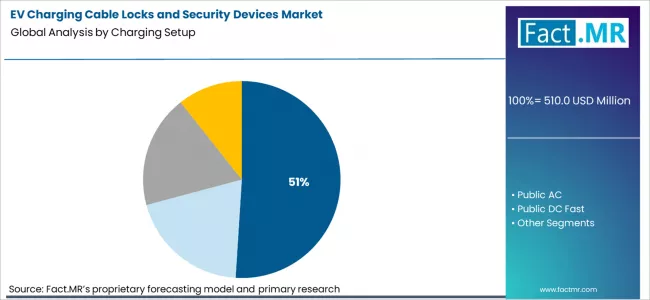
Ev Charging Cable Locks And Security Devices Market Analysis By Charging Setup | Source: Fact.MR
- Market Overview: Home charging is projected to account for 51% of the market share by 2026. This includes residential installations where EV owners charge overnight, alongside public AC and DC fast charging stations, crucial for urban and highway recharging.
- Demand Drivers:
- Home Charging Growth: With rising EV adoption, homeowners are increasingly adding locking devices to prevent theft and unauthorized use, especially in urban areas.
- Public Charging Infrastructure: Public stations are upgrading with advanced security features like RFID and alarms to protect cables in busy areas.
- Workplace and Depot Installations: The growing need for secure charging at workplaces and depots is driven by businesses and fleet operators integrating EVs into their operations.
EV Charging Cable Locks and Security Devices Market Drivers, Restraints, and Opportunities
FMR analysts observe that the EV charging cable locks and security devices market has evolved from a niche segment to a crucial part of EV infrastructure. As the adoption of electric vehicles has risen, so has the demand for secure charging stations due to increased risks of cable theft. The market's growth is largely driven by the expansion of public charging networks and regulatory pushes for higher security standards.
Demand for traditional mechanical locks is declining, while smarter, more advanced security devices are gaining ground. Although these smarter devices are more expensive, their higher per-unit cost is offset by the increasing need for secure, tamper-proof charging solutions. This shift reflects both technological advancements and the growing importance of security in the EV charging sector.
- Smart Device Adoption: As theft risks rise, mechanical locks are being replaced by advanced, app-controlled locks with higher per-unit costs.
- Regulatory Push: Regulations such as the EU’s charging station security standards are forcing manufacturers to adopt more sophisticated, tamper-resistant devices.
- Regional Dynamics: In markets like Europe and North America, demand for advanced security solutions is growing, while Asia-Pacific regions remain focused on more cost-effective options.
Regional Analysis
Based on the regional analysis, EV charging cable locks and security devices market is segmented into North America, Latin America, Europe, East Asia, South Asia, Oceania and Middle East & Africa across 40+ countries. The full report also offers market attractiveness analysis based on regional trends.
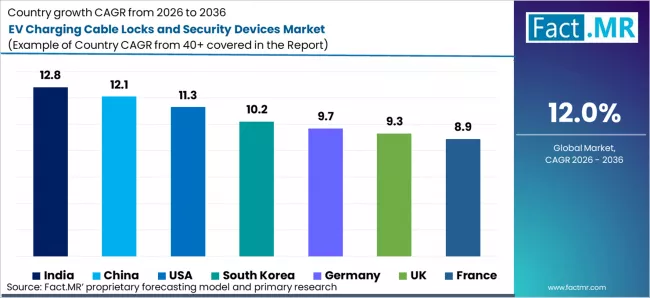
Ev Charging Cable Locks And Security Devices Market Cagr Analysis By Country | Source: Fact.MR
| Country | CAGR (%) |
|---|---|
| India | 12.8% |
| China | 12.1% |
| USA | 11.3% |
| Germany | 9.7% |
| UK | 9.3% |
| France | 8.9% |
| South Korea | 10.2% |
| Japan | 7.9% |
Source: Fact.MR analysis. Updated Feb 16, 2026
Source: Fact MR (FMR) analysis, based on proprietary forecasting model and primary research
North America EV Charging Cable Locks and Security Devices Market Analysis
North America is characterized by a "green recovery", with increasing investments in EV infrastructure and stringent environmental regulations. The rise in EV adoption and the growing need to secure public charging stations are driving the demand for EV charging cable locks and security devices. Key players such as Tesla, Inc. and ChargePoint are expanding their charging networks, increasing the need for enhanced security solutions.
- United States: Demand for EV charging cable locks and security devices in the United States is projected to rise at 11.3% CAGR through 2036. Growth is driven by the Biden administration’s infrastructure bill (2021), which allocates significant funding to expand public EV charging stations. Tesla, Inc. is also increasing its network of Supercharger stations, contributing to the rising demand for security devices to protect these valuable assets.
FMR’s report includes a detailed analysis of growth in the North American region, with a country-wise assessment that includes the U.S. and Canada. Readers can find regional trends, regulations, and market growth based on different segments in the North American market.
Asia Pacific EV Charging Cable Locks and Security Devices Market Analysis
Asia Pacific is the global production epicenter for EV infrastructure, driven by large-scale manufacturing and government support for EV adoption. The region leads in EV market growth, with countries like China and India rapidly expanding their charging networks, increasing the demand for security devices. Regional players like ARCL Organics Ltd and Kanoria Chemicals & Industries Ltd are responding to the demand for affordable and scalable security solutions.
- China: Demand for EV charging cable locks and security devices in China is projected to rise at 12.1% CAGR through 2036. China continues to dominate the global EV market, supported by the 13th Five-Year Plan for Electric Vehicle Development (2016-2020) and the expansion of public charging infrastructure by State Grid Corporation of China. This growth fuels the need for security solutions to protect the rapidly expanding network of charging stations.
- India: Demand for EV charging cable locks and security devices in India is projected to rise at 12.8% CAGR through 2036. The FAME II program (April 2019) and the Make in India initiative have driven the growth of electric vehicles and charging infrastructure. With companies like Tata Power expanding their EV networks, the need for secure charging solutions continues to rise.
- South Korea: Demand for EV charging cable locks and security devices in South Korea is projected to rise at 10.2% CAGR through 2036. The Green New Deal (2020) supports the expansion of EV charging infrastructure, and Hyundai Motor Group is also driving the development of public charging stations. This increase in charging points is driving the demand for security devices.
- Japan: Demand for EV charging cable locks and security devices in Japan is projected to rise at 7.9% CAGR through 2036. Japan’s Strategic Roadmap for EVs (2019) focuses on expanding charging infrastructure, with Toyota Motor Corporation investing in public and private networks. As charging stations increase, the need for security devices grows.
FMR’s analysis of the EV Charging Cable Locks and Security Devices market in Asia Pacific consists of country-wise assessments that include China, India, South Korea, and Japan. Readers can find detailed information about regional trends, government policies, infrastructure growth, and key investments that are driving the demand for EV charging security devices in these countries.
Europe EV Charging Cable Locks and Security Devices Market Analysis
Europe serves as the global regulatory laboratory, where strict environmental and regulatory standards drive market demand. The push for sustainable mobility and clean energy solutions has accelerated the deployment of EV charging networks across the region, which in turn drives the need for security solutions. Leading players like BASF SE and Kronospan are contributing to the demand for enhanced charging station protection.
- Germany: Demand for EV charging cable locks and security devices in Germany is projected to rise at 9.7% CAGR through 2036. The Federal Ministry for Economic Affairs and Energy (BMWi) program (2020) focuses on expanding public EV charging stations. With Volkswagen Group investing heavily in the expansion of charging infrastructure, the need for secure solutions to protect these installations continues to rise.
- United Kingdom: Demand for EV charging cable locks and security devices in the United Kingdom is projected to rise at 9.3% CAGR through 2036. The Road to Zero strategy (2018) and Clean Growth Strategy (2017) have driven significant investments in EV infrastructure. The increasing number of charging stations creates an ongoing demand for security solutions to protect these locations.
- France: Demand for EV charging cable locks and security devices in France is projected to rise at 8.9% CAGR through 2036. France’s Energy Transition for Green Growth Act (2015) mandates the expansion of public charging infrastructure. ENGIE is expanding its network of charging stations, driving the need for security solutions to safeguard these locations.
FMR’s analysis of the EV Charging Cable Locks and Security Devices market in Europe consists of country-wise assessments that include Germany, the United Kingdom, and France. Readers can find detailed insights into regional trends, government policies, infrastructure growth, and key investments that are driving the demand for EV charging security devices in these markets.
How Are Key Players Competing in the EV Charging Cable Locks and Security Devices Market?
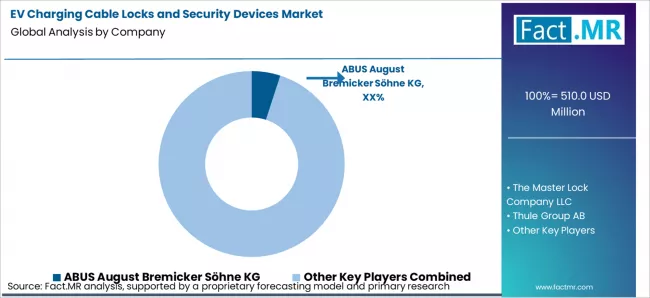
Ev Charging Cable Locks And Security Devices Market Analysis By Company | Source: Fact.MR
The EV charging cable locks and security devices market is becoming increasingly competitive with major players like ABUS August Bremicker Söhne KG and The Master Lock Company LLC, who offer specialized locking solutions to prevent theft and ensure the security of EV charging equipment. ChargePoint Holdings, Inc. and Wallbox N.V. are integrating security features within their charging systems, providing users with real-time monitoring and control. Industry leaders such as Schneider Electric SE, ABB Ltd., and Siemens AG focus on incorporating advanced technologies like IoT connectivity for remote locking and unlocking capabilities. Additionally, companies like EVBox B.V. and Delta Electronics, Inc. offer robust, secure charging stations with integrated anti-theft features, ensuring that both public and home charging points remain safe from unauthorized access. The market's growth is fueled by the expanding EV adoption and the increasing need for secure and reliable charging infrastructure.
Recent Industry Developments
- Site Agreement – BASF Ludwigshafen (Announced Dec 15, 2025): BASF announced a new site agreement for its Ludwigshafen site to address current chemical-industry challenges and strengthen the site’s competitiveness. [2]
- Technology Collaboration – Hexion × Bloom (Announced Jun 23, 2025): Hexion and Bloom Biorenewables announced an industry-first renewable adhesive technology collaboration to enable bio-based manufacturing transformation. [3]
Key Players in EV Charging Cable Locks and Security Devices Market
- ABUS August Bremicker Söhne KG
- The Master Lock Company LLC
- Thule Group AB
- ChargePoint Holdings, Inc.
- Wallbox N.V.
- Schneider Electric SE
- ABB Ltd.
- Siemens AG
- EVBox B.V.
- Delta Electronics, Inc.
Report Scope
| Metric | Value |
|---|---|
| Quantitative Units. | USD 510 million (2026) to USD 1,273 million (2036), at a CAGR of 12.0% |
| Market Definition | The EV charging cable locks and security devices market includes products designed to secure electric vehicle charging cables and stations, preventing theft, vandalism, and unauthorized removal. |
| Form Segmentation | Cable Lock Devices, Port Locking Caps, Anti-Theft Alarms/Tags, Other |
| End Use Segmentation | Home Charging, Public AC, Public DC Fast, Workplace/Depot |
| Application Coverage | Security Devices for EV Charging Cables, Locks, Alarms, Tags |
| Regions Covered | North America, Latin America, Europe, East Asia, South Asia, Oceania, Middle East and Africa |
| Countries Covered | United States, Canada, Mexico, Brazil, Argentina, Germany, France, United Kingdom, Italy, Spain, China, India, Japan, South Korea, Indonesia, Australia, and 40+ countries |
| Key Companies Profiled | ABUS August Bremicker Söhne KG, The Master Lock Company LLC, Thule Group AB, ChargePoint Holdings, Inc., Wallbox N.V., Schneider Electric SE, ABB Ltd., Siemens AG, EVBox B.V., Delta Electronics, Inc. |
| Forecast Period | 2026 to 2036 |
| Approach | Hybrid top-down and bottom-up market modeling validated through primary interviews with manufacturers and supported by trade data benchmarking and market research. |
Source: Fact.MR analysis. Updated Feb 16, 2026
Bibliography
- ChargePoint. (2025). ChargePoint leads fight against industry-wide EV charger cable theft with anti-vandalism solutions. ChargePoint. [1]
- BASF Ludwigshafen Site Agreement: BASF. (2025, December 15). Site agreement – BASF Ludwigshafen. BASF. [2]
- Hexion × Bloom Technology Collaboration: Hexion & Bloom Biorenewables. (2025, June 23). Technology collaboration – Hexion × Bloom. Hexion. [3]
Segmentation
EV Charging Cable Locks and Security Devices Market Key Segments
-
By Product Type :
- Cable Lock Devices
- Port Locking Caps
- Anti-Theft Alarms/Tags
- Other
-
By Charging Setup :
- Home Charging
- Public AC
- Public DC Fast
- Workplace/Depot
-
By Security Method :
- Mechanical Locking
- RFID/Smart Locking
- Sensor Alarm-Based
- Other
-
By Sales Channel :
- Online D2C
- Retail & Distributors
- Charger Brands Bundled
- Other
-
Region :
- North America
- USA
- Canada
- Mexico
- Europe
- Germany
- UK
- France
- Italy
- Spain
- Nordic Countries
- BENELUX
- Rest of Europe
- Asia Pacific
- China
- Japan
- South Korea
- India
- Australia
- Rest of Asia Pacific
- Latin America
- Brazil
- Argentina
- Rest of Latin America
- Middle East and Africa
- Kingdom of Saudi Arabia
- United Arab Emirates
- South Africa
- Rest of Middle East and Africa
- Other Regions
- Oceania
- Central Asia
- Other Markets
- North America
Frequently Asked Questions
How large is the demand for EV Charging Cable Locks and Security Devices in the global market in 2026?
What will be the market size of EV Charging Cable Locks and Security Devices in the global market by 2036?
What is the expected demand growth for EV Charging Cable Locks and Security Devices in the global market between 2026 and 2036?
Which region is expected to show the highest growth rate for EV Charging Cable Locks and Security Devices?
How significant is the growth outlook for China in this market?
What is the growth outlook for the United States in this report?
Which European markets are highlighted in this analysis?
What is the growth forecast for France in the EV Charging Cable Locks and Security Devices market?
How does South Korea perform in this market?
What is the expected growth rate for Japan in the forecast period?
Which company is identified as a leading player in the EV Charging Cable Locks and Security Devices market?
What are EV Charging Cable Locks and Security Devices mainly used for?
What does the EV Charging Cable Locks and Security Devices market include in this report?
How is the market forecast developed in this report?
What is meant by the EV Charging Cable Locks and Security Devices market in this report?
Who worked on this report


Preview the report firsthand - request a free sample
Free SampleGet the brochure for pricing and purchase details
Download PDF