- Estimated Value(2026): 3.4 Bn
- Forecast Value (2036): 25.2 Bn
- CAGR (2026 - 2036): 22.2%
EV Charging Cable Market Forecast and Outlook 2026 to 2036
In 2025, the EV charging cable market surpassed a valuation of USD 2.8 billion. Based on Fact.MR analysis, demand for EV charging cables is estimated to grow to USD 3.4 billion in 2026 and USD 25.2 billion by 2036. Fact.MR projects a CAGR of 22.2% during the forecast period.
Between 2026 and 2036, the EV charging cable market is projected to generate an absolute dollar opportunity of USD 21.8 billion, representing a near-eightfold expansion that reflects not steady incremental growth but a fundamental transformation of the global energy infrastructure. Growth is moderated by connector standard fragmentation, which creates supply chain complexity and inventory risk for distributors managing incompatible product families across NACS, CCS, CHAdeMO, and GB/T ecosystems, and by raw material cost volatility in copper and speciality polymer compounds that intermittently pressures cable converter margins.
Rick Wilmer, CEO of Charge Point, "We do not view ourselves as victims of vandalism, but rather responsible for solving it... our cut-resistant cables demonstrate our relentless dedication to offering a dependable charging network. We are sharing this technology to eliminate charger reliability as a hindrance to EV adoption."
Country growth varies by EV policy scale, connector standards, and charging investment. India leads at 38.4% CAGR under PM E-DRIVE funding 72,000 public chargers and targeting 30% EV penetration by 2030. Germany follows at 32.6% with AFIR-mandated CCS2 rollout. Japan grows at 30.2% on CHAdeMO upgrades. Australia posts 28.9% via national EV strategy funding. Canada records 27.6% under ZEV infrastructure expansion. The US reaches 25.5% driven by NACS retrofit cycles. China grows at 23.5%, focused on ultra-fast GB/T upgrades.
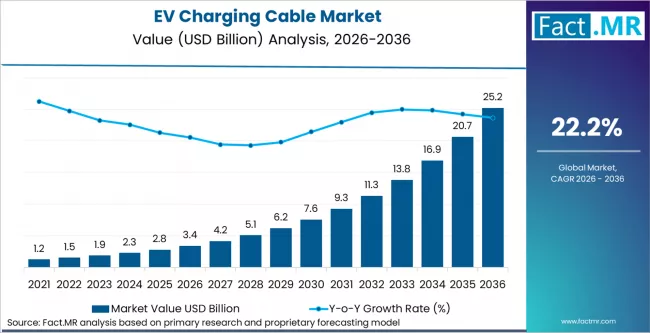
Ev Charging Cable Market Value Analysis | Source: Fact.MR
| Metric | Value |
|---|---|
| Estimated Value in 2026 | USD 3.4 billion |
| Forecast Value in 2036 | USD 25.2 billion |
| Forecast CAGR (2026 to 2036) | 22.2% |
Source: Fact.MR analysis. Updated Mar 2, 2026
Market Definition
The EV charging cable market covers electrical cable assemblies connecting EVs to home, workplace, and public chargers. It includes Mode 2 portable, Mode 3 AC (Type 1/Type 2), and Mode 4 DC (CCS, CHAdeMO, GB/T) cables, including liquid-cooled high-power formats for ultra-fast charging.
Market Inclusions
Global and regional forecasts (2026-2036) across AC/DC cables, connector types, charging modes, power levels, cable length, shape, and application. Country coverage includes India, Germany, Japan, Australia, Canada, the US, China, and others.
Market Exclusions
Excludes standalone EVSE hardware, power electronics, software, wireless charging, in-vehicle cables, and non-integrated station components.
Research Methodology
- Primary Research: Interviews with cable makers, OEMs, installers, network operators, and distributors across key regions.
- Desk Research: Sources included IEC 62196, SAE J1772, AFIR texts, IEA EV Outlook 2024, national EV data, and company filings.
- Market Sizing and Forecasting: Top-down EV fleet and charger targets combined with bottom-up ASPs, connector mix, and replacement cycles.
- Data Validation and Update Cycle: Validated against charging tenders, EV registrations, operator rollouts, and IEA data. Updated annually.
Summary
- Market Definition
- EV charging cables connect vehicles to AC and DC chargers across Type 1, Type 2, CCS, CHAdeMO, and GB/T standards for home and public use.
- Demand Drivers
- India’s PM E-DRIVE (INR 2,000 crore) funding 72,000 chargers drives large CCS2 cable procurement.
- EU AFIR mandates CCS2 and ISO 15118-20 from 2027, triggering Europe-wide upgrades.
- Phoenix Contact and Autel’s 1,000 kW liquid-cooled CCS2 launches shift value toward ultra-rapid DC cables.
- Key Segments Analyzed
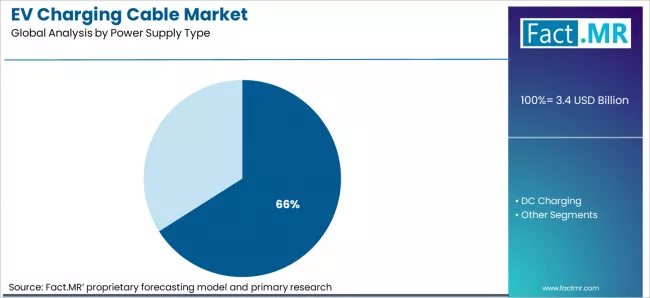
- By Power Supply: AC holds 66% share in 2026 due to home/workplace dominance.
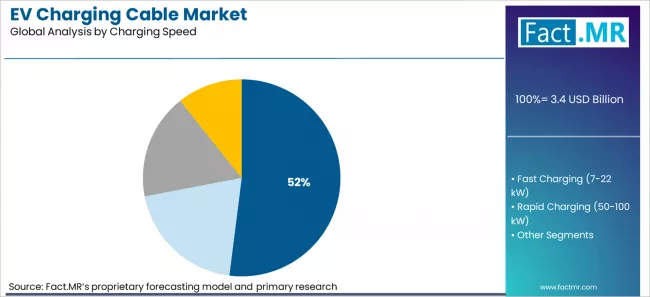
- By Charging Speed: 7-22 kW fast AC holds 52% volume share.
- By Geography: India leads growth (38.4% CAGR); China holds largest volume base.
- Analyst Opinion at FACT.MR
- Value growth shifts to liquid-cooled DC, NACS-CCS dual cables, and ISO 15118-compliant smart assemblies. Wrong connector bets risk premium loss.
- Strategic Implications
- Expand liquid-cooled 800-1,000 kW DC capacity for EU and North America corridors.
- Manage NACS-CCS1 dual inventory during US transition (2025-2028).
- Align India/Southeast Asia products with CCS2 and BEE-compliant specs.
- Methodology
- Based on IEA EV projections, charger targets, ASPs, and connector adoption timelines.
- Validated via IEC standards, AFIR mandates, OEM fitment, and national policies.
Segmental Analysis
EV Charging Cable Market Analysis by Power Supply Type
Ev Charging Cable Market Analysis By Power Supply Type | Source: Fact.MR
AC charging cables are estimated to hold 66% share in 2026. AC dominates as most charging occurs at home and workplaces, where Mode 3 Type 2 cables are standard. Mode 2 portable cables remain bundled with new EVs, sustaining OEM-driven volume. Type 2-to-Type 2 compatibility across European brands reinforces AC’s structural advantage.
- IEC 62196-2:2025 Update: The revised standard adds new latching and connector tests for Mode 1-3 AC charging, requiring recertification of Type 1 and Type 2 cables and driving a design upgrade cycle. [7]
- Leoni Smart Cable Expansion 2024: Leoni introduced AC cables with integrated communication chips supporting load balancing and ISO 15118-20 Plug & Charge, aligning with AFIR’s 2027 compliance rules.
- Residential Charging Growth: Home charging remains dominant globally. India’s PM E-DRIVE and state building codes mandating EV-ready infrastructure are driving sustained Mode 3 AC cable demand. [4][5]
EV Charging Cable Market Analysis by Charging Speed
Ev Charging Cable Market Analysis By Charging Speed | Source: Fact.MR
The 7-22 kW fast-charging segment holds 52% share in 2026. It balances charging speed and infrastructure cost, making Mode 3 Type 2 cables standard for home, workplace, and EU public AC installations.
- Phoenix Contact 1,000 kW CCS2 Launch: In May 2025, Phoenix Contact introduced a liquid-cooled CCS2 cable delivering 800 kW continuous and 1,000 kW boost power, targeting ultra-rapid corridors. [1]
- Autel DT1000 Integration: Autel integrated Phoenix Contact’s 1,000A liquid-cooled CCS2 cable into its MaxiCharger DT1000, supporting heavy-duty and highway ultra-fast charging. [6]
- US NACS Transition: The shift from CCS1 to NACS is triggering large-scale cable retrofits across US public networks through 2026-2028.
Drivers, Restraints, and Opportunities
The EV charging cable market is driven by rapid global EV adoption, government-backed charging infrastructure programmes, and regulatory mandates such as AFIR in Europe and PM E-DRIVE in India that require large-scale AC and DC cable deployment. Growth is further supported by the transition toward ultra-rapid DC charging, where liquid-cooled cables significantly increase average selling prices.
The market faces restraints from connector standard uncertainty (e.g., NACS vs CCS transitions), commodity price volatility in copper and insulation materials, and pricing pressure in low-cost AC cable segments from Asian manufacturers.
- AFIR and EU CCS2 Mandate as European Cable Upgrade Engine: AFIR (EU 2023/1804) mandates CCS2 at public DC stations. From Jan 2027, ISO 15118-20 smart charging is required, creating a long-term compliance-driven upgrade cycle. [2][3]
- India PM E-DRIVE as Emerging Market Volume Driver: PM E-DRIVE (INR 10,900 crore) funds 72,000 chargers; BEE names CCS2 as mandatory DC standard, aligning with IEC 62196 and driving bulk procurement. [4][5]
- Liquid-Cooled Cable Technology Redefining DC Cable Value: Phoenix Contact’s 800-1,000 kW CHARX CCS2 and Autel integration confirm shift to liquid-cooled cables above 350 kW, establishing a premium DC segment. [1][6]
Regional Analysis
The EV charging cable market is analysed across Asia Pacific, Europe, North America, Latin America, and Middle East and Africa, covering over 30 countries with individual regulatory, connector standard, and EV adoption profiles. The full report also offers market attractiveness analysis based on government programme procurement scale, connector standard compliance timelines, and ultra-rapid DC cable adoption rates by region.
| Country | CAGR 2026-2036 |
|---|---|
| India | 38.4% |
| Germany | 32.6% |
| Japan | 30.2% |
| United States | 25.5% |
| China | 23.5% |
Source: Fact.MR analysis. Updated Mar 2, 2026
Source: Fact.MR (FACT.MR) analysis, based on proprietary forecasting model and primary research
Asia Pacific EV Charging Cable Market Analysis
Asia Pacific is the largest and fastest-growing EV charging cable market, led by China’s scale and India’s policy-driven expansion. GB/T dominates China, while CCS2 and Type 2 gain share in India, Japan, South Korea, and Australia. Domestic suppliers compete with global premium cable manufacturers across segments.
- India: Demand is projected to rise at 38.4% CAGR through 2036. PM E-DRIVE (INR 10,900 crore) funds 72,000 public chargers, creating large structured cable procurement. BEE guidelines mandate CCS2 for new DC installations, replacing legacy Bharat DC-001 units. With EV penetration targeting 30% by 2030 from a low base, India offers multi-decade cable growth.
- China: Demand is projected to grow at 23.5% CAGR through 2036. China’s 8.4 million EV sales in 2024 and over 1 million public chargers sustain the world’s largest cable base. Growth now comes from upgrades to higher-power GB/T DC systems under the 14th Five-Year Plan. Domestic suppliers dominate under GB/T 20234 standards.
- Japan: Demand is projected to grow at 30.2% CAGR through 2036. EV expansion by Toyota, Honda, and Nissan drives charging growth. Upgrades from legacy CHAdeMO to higher-power CHAdeMO 2.0 and ChaoJi 3.0 require new high-current cables. Revised safety standards aligned with IEC 62196-3 reinforce compliance demand.
FACT.MR’s Asia Pacific coverage includes China, Japan, South Korea, India, Australia & New Zealand, ASEAN, and Rest of Asia Pacific. Readers can find connector standard adoption timelines, government programme procurement structures, GB/T versus CCS penetration trajectories, domestic manufacturer competitive positioning, and ultra-rapid DC cable upgrade cycle forecasts within Asia Pacific.
Europe EV Charging Cable Market Analysis
Europe is the regulatory benchmark market, driven by AFIR-mandated CCS2 and ISO 15118-20 compliance. Germany and the Netherlands lead DC upgrades, while Norway reflects a mature AC-to-DC shift.
- Germany: Demand is projected to rise at 32.6% CAGR through 2036. AFIR (EU 2023/1804) and Implementing Regulation EU 2025/655 mandate CCS2 and smart charging from 2027, creating non-discretionary upgrades. Autobahn fast-charging expansion supports high-value liquid-cooled DC cables. Phoenix Contact and Prysmian are key suppliers.
FACT.MR’s European coverage includes Germany, France, UK, Norway, Spain, Netherlands, Nordics, and Rest of Europe. Readers can find AFIR compliance deadline timelines, national charging programme procurement structures, CCS2 installation volume forecasts, ultra-rapid DC cable specification adoption rates, and manufacturer competitive positioning within Europe.
North America EV Charging Cable Market Analysis
North America is the most dynamic market due to the NACS transition and NEVI-funded infrastructure rollout. The shift from CCS1 to NACS is triggering the largest connector migration cycle globally.
- United States: Demand is projected to grow at 25.5% CAGR through 2036. SAE J3400 NACS adoption by major OEMs is driving cable retrofits and dual-standard installations. The USD 5 billion NEVI programme mandates nationwide DC deployment, while IRA tax credits support private charging investment. This creates sustained high-power cable demand through 2028 and beyond.
FACT.MR's North American analysis covers the United States, Canada, and Mexico. Readers can find NACS transition timelines, NEVI programme deployment schedules, federal tax credit impacts on charging investment, dual-standard cable management strategies, and ultra-rapid DC cable adoption forecasts within North America.
Competitive Aligners for Market Players
The EV charging cable market is competitive but clearly split into two tiers. Standard AC cables are fragmented and largely price-driven, with Asian manufacturers such as BESEN, DUOSIDA, EV Power, and Sinbon supplying high-volume, cost-sensitive markets. In contrast, the premium liquid-cooled DC segment is more concentrated, led by companies like Phoenix Contact E-Mobility, Leoni, Aptiv, TE Connectivity, and Prysmian. In AC cables, price and connector compatibility determine wins. In ultra-rapid DC, thermal performance, IEC certification depth, and charging-station integration capability are the real differentiators.
Long-term advantage belongs to manufacturers investing heavily in EV-focused R&D and multi-standard certification. Phoenix Contact’s leadership in liquid-cooled CCS2 cables, including its 1,000 kW system, gives it strong positioning in highway and fleet charging. Leoni and Aptiv benefit from close OEM relationships that influence bundled cable specifications. Meanwhile, Chinese producers leverage scale and lower manufacturing costs to dominate the standard segment.
Public charging operators typically dual-source cables and require strict compliance testing, creating multi-year demand visibility but raising entry barriers. For high-power DC systems, once a cable is integrated into a station platform, switching suppliers becomes technically complex, protecting established players.
Recent Developments
- In May 2025, Phoenix Contact E-Mobility launched the second generation of its CHARX connect professional liquid-cooled CCS2 charging cable at Power2Drive 2025 in Munich, achieving 800 kW continuous and 1,000 kW boost mode charging power through a newly developed direct-core water-glycol cooling concept, representing the highest-power CCS2 cable assembly available commercially.
- In September 2025, Autel Energy announced the integration of Phoenix Contact's new 1,000A liquid-cooled CCS2 cable and connector platform into its MaxiCharger DT1000 series, enabling sustained high-power output for commercial fleets, heavy-duty vehicles, and high-performance passenger cars at its highest-power DC charging station.
Key Players
- TE Connectivity
- Prysmian S.p.A.
- Tesla Inc.
- Phoenix Contact
- Leoni AG
- Aptiv PLC
- BESEN International Group
- Sinbon Electronics
- DUOSIDA
- EV Power
- Cables RCT
Bibliography
- [1] electrive.com. (2025, May 7). Phoenix Contact presents CCS connector for up to 1,000 kW. Electrive.
- [2] Official Journal of the European Union. (2023). Regulation (EU) 2023/1804 of the European Parliament and of the Council on the deployment of alternative fuels infrastructure.
- [3] Pionix GmbH. (2025). AFIR Update Spring 2025: Implementing Regulation EU 2025/655, ISO 15118-20 Smart Charging Mandate, and AFIR Compliance Deadlines.
- [4] International Council on Clean Transportation. (2025, January 15). India synchronizes EV sales and charging infrastructure growth in 2024.
- [5] Exicom. (2025, December 27). These Policies Scaled EV Charging in India 2025: PM E-DRIVE, FAME II, BEE Guidelines September 2024 Update.
- [6] Charged EVs. (2025, September 17). Autel Energy integrates Phoenix Contact's liquid-cooled cable and connector in new 1,000 A EV charging system.
- [7] International Electrotechnical Commission. (2025). IEC 62196-2:2025 (Fourth Edition): Plugs, socket-outlets, vehicle connectors and vehicle inlets for AC charging. IEC Standards. https://en.wikipedia.org/wiki/IEC_62196
- [8] ChargePoint / SAE International. (2023-2025). North American Charging Standard (NACS) SAE J3400: Transition from CCS1 and Adoption by Major Automakers for 2025 Model Year.
This Report Addresses
- Strategic intelligence on AFIR-driven CCS2 upgrades, India PM E-DRIVE procurement, US NACS transition, and liquid-cooled DC premiumisation.
- Market size: USD 3.4 bn (2026) to USD 25.2 bn (2036), 22.2% CAGR; segmented by power type, speed, mode, connector, application, and region.
- Growth mapping across India’s 72,000-station rollout, Germany’s AFIR pipeline, US NACS retrofit cycle, and >350 kW liquid-cooled DC cables.
- Country CAGR outlook: India (38.4%), Germany (32.6%), Japan (30.2%), Australia (28.9%), Canada (27.6%), US (25.5%), China (23.5%).
- Competitive analysis of Phoenix Contact, Leoni, TE Connectivity, Aptiv, Prysmian, BESEN, DUOSIDA on DC capability, certification, and OEM positioning.
- Technology tracking: 1,000 kW CCS2 cables, ISO 15118-20 smart integration, NACS (SAE J3400), CHAdeMO 2.0/ChaoJi 3.0 upgrades, coiled formats.
- Regulatory coverage: AFIR EU 2023/1804, EU 2025/655, IEC 62196 updates, India BEE 2024 revision, SAE J3400, China GB/T 20234.
- Delivery formats: PDF report, Excel datasets, PowerPoint summary, and interactive dashboard with verified sources.
Segmentation
Scope of Report
| Items | Values |
|---|---|
| Quantitative Units | USD 3.4 billion (2026) to USD 25.2 billion (2036), at a CAGR of 22.2% |
| Market Definition | EV charging cables include all cable assemblies that connect electric vehicles to home, workplace, and public chargers. This covers Mode 1 domestic cables, Mode 2 portable cables with in-cable control boxes, Mode 3 AC cables (Type 1/Type 2), Mode 4 DC fast-charging cables (CCS, CHAdeMO, GB/T), and liquid-cooled high-power DC cables for ultra-rapid charging. |
| Power Supply Type Segmentation | AC Charging (66%), DC Charging |
| Charging Speed Segmentation | Slow Charging (<3 kW), Fast Charging (7-22 kW) (52%), Rapid Charging (50-100 kW), Ultra-Rapid Charging (>100 kW) |
| Mode Type Segmentation | Mode 1, Mode 2, Mode 3, Mode 4 |
| Connector Type Segmentation | Type 1 (SAE J1772), Type 2 (Mennekes), CCS (Combined Charging System), CHAdeMO, GB/T |
| Application Segmentation | Private Charging (Residential, Workplace), Public Charging (Destination, Highway) |
| Cable Length Segmentation | 2-5 meters, 6-10 meters, 10 meters |
| Cable Shape Segmentation | Straight, Coiled |
| Application Coverage | Home residential EV charging, workplace fleet and employee charging, urban destination public charging, highway ultra-rapid DC fast charging, commercial fleet depot charging, OEM EV delivery cable bundling, charging station OEM integration supply, government public infrastructure programme procurement |
| Regions Covered | Asia Pacific, Europe, North America, Latin America, Middle East and Africa |
| Countries Covered | China, Japan, South Korea, India, Australia and New Zealand, ASEAN, Rest of Asia Pacific, Germany, United Kingdom, France, Norway, Spain, Netherlands, Nordics, Rest of Europe, United States, Canada, Mexico, Brazil, Chile, Ecuador, Rest of Latin America, Kingdom of Saudi Arabia, United Arab Emirates, South Africa, Turkey, Rest of Middle East and Africa |
| Key Companies Profiled | TE Connectivity, Prysmian S.p.A., Tesla Inc., Phoenix Contact, Leoni AG, Aptiv PLC, BESEN International Group, Sinbon Electronics, DUOSIDA, EV Power, Cables RCT |
| Forecast Period | 2026 to 2036 |
| Approach | A hybrid top-down and bottom-up model was used. Top-down inputs included IEA EV fleet forecasts, national charging deployment targets, and connector penetration by market. Bottom-up inputs incorporated cable ASPs, units per station, OEM bundling rates, connector transition timelines, and liquid-cooled cable adoption based on installer and manufacturer interviews. |
Source: Fact.MR analysis. Updated Mar 2, 2026
EV Charging Cable Market by Segment
-
By Power Supply Type
- AC Charging
- DC Charging
-
By Charging Speed
- Slow Charging (<3 kW)
- Fast Charging (7-22 kW)
- Rapid Charging (50-100 kW)
- Ultra-Rapid Charging (>100 kW)
-
By Mode Type
- Mode 1
- Mode 2
- Mode 3
- Mode 4
-
By Connector Type
- Type 1 (SAE J1772)
- Type 2 (Mennekes)
- CCS (Combined Charging System)
- CHAdeMO
- GB/T
-
By Application
- Private Charging (Residential, Workplace)
- Public Charging (Destination, Highway)
-
By Cable Length
- 2-5 meters
- 6-10 meters
- 10 meters
-
By Cable Shape
- Straight
- Coiled
-
By Region
- North America
- United States
- Canada
- Mexico
- Europe
- Germany
- United Kingdom
- France
- Norway
- Spain
- Netherlands
- Nordics
- Rest of Europe
- Asia Pacific
- China
- Japan
- South Korea
- India
- Australia and New Zealand
- ASEAN
- Rest of Asia Pacific
- Latin America
- Brazil
- Chile
- Ecuador
- Rest of Latin America
- Middle East and Africa
- Kingdom of Saudi Arabia
- United Arab Emirates
- South Africa
- Turkey
- Rest of Middle East and Africa
- North America
Frequently Asked Questions
How large is the EV charging cable market in 2025?
What will the market size be in 2026?
What is the projected market size by 2036?
What is the expected CAGR for the forecast period 2026 to 2036?
Which power supply type segment holds the leading share?
Which charging speed segment commands the largest share?
Which country is projected to grow the fastest?
What is the expected growth rate for Germany?
What is the forecast CAGR for the United States EV charging cable market?
How is China's EV charging cable market expected to grow?
Who worked on this report


Preview the report firsthand - request a free sample
Free SampleGet the brochure for pricing and purchase details
Download PDF