- Base Value(2025): 1.1 Bn
- Estimated Value(2026): 1.1 Bn
- Forecast Value (2036): 1.5 Bn
- CAGR (2026 - 2036): 3.1%
Extension Ladder Market Analysis and Forecast by Fact.MR
- The global extension ladder market covers extendable access equipment used for construction, maintenance, electrical work, warehousing, and residential applications.
- The category includes telescopic extension ladders, sliding extension ladders, multi-purpose extension ladders, and rope-operated extension ladders.
- These products use structural extension, material engineering, safety mechanism, and load-bearing technologies to deliver portable, height-adjustable access solutions.
- Demand is shaped by construction activity, building maintenance requirements, electrical and utility infrastructure work, warehouse operations, and residential home improvement activity.
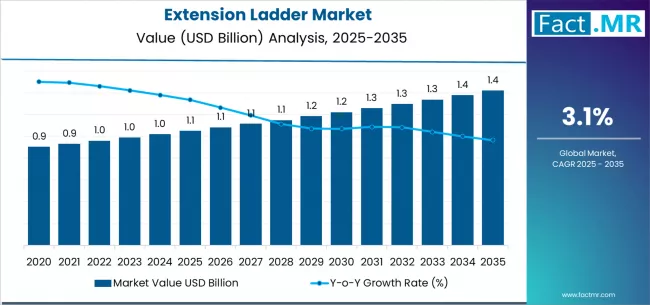
Extension Ladder Market Market Value Analysis | Source: Fact.MR
Summary of Extension Ladder Market
- Market Snapshot
- In 2025, the global Extension Ladder Market was valued at approximately USD 1.05 billion.
- The market is estimated to reach USD 1.08 billion in 2026 and is projected to attain USD 1.47 billion by 2036.
- The extension ladder market is likely to expand at a CAGR of 3.1% during the forecast period.
- The market is anticipated to create an absolute dollar opportunity of USD 0.39 billion between 2026 and 2036.
- Telescopic Extension Ladders accounts for 46% of product share in 2026.
- India (4.6%) and China (3.8%) are the key growth markets during the forecast period.
- Demand and Growth Drivers
- The largest procurement volume of extension ladders for use in framing, roofing, exterior finishing and facade work is accounted for by construction activity on commercial, residential and infrastructure projects.
- Building maintenance and repair operations such as painting, gutter cleaning, window washing and exterior inspection help to provide a steady stream of replacement and new purchase demand.
- Extension ladders used in electrical and utility infrastructure work must be rated for protection against electrical hazards and designed for overhead line access and pole maintenance.
- Extension ladders are used in warehousing and logistics operations for racking access, inventory management and facility maintenance in distribution and storage environments.
- Sales of consumer-grade extension ladders via retail and e-commerce are driven by residential home improvement activity and the DIY culture.
- Product and Segment View
- Telescopic Extension Ladders to account for 46% of the product segment in 2026, supported by wide applicability and established installed base across core end-use verticals
- The application segment is led by Construction Activities with 55% in 2026. Demand is driven by institutional procurement, regulatory requirements, and growing professional adoption.
- Structural Extension Technology occupies a 64% share of the technology section, indicating its well-established position as the standard operational approach.
- Key segmentation includes:
- Product: Telescopic Extension Ladders, Sliding Extension Ladders, Multi Purpose Extension Ladders, Rope Operated Extension Ladders
- Application: Construction Activities, Maintenance and Repair, Electrical and Utility Works, Warehousing and Logistics, Residential Use
- Distribution Channel: Direct Sales, Distributors, E Commerce, Aftermarket Services
- These systems enable:
- Measurement, monitoring, or control functions across distributed operational environments.
- Remote management and data integration through connected platforms.
- Performance optimization in applications where precision and reliability are primary procurement criteria.
- Geography and Competitive Outlook
- North America shows stable demand supported by established end-use verticals, replacement cycles, and technology upgrade activity.
- Europe is experiencing steady growth from regulatory compliance, process modernization, and expanding professional adoption.
- Asia Pacific is the fastest-growing region, with India (4.6%) and China (3.8%) leading demand expansion.
- Key companies include Werner Co., Little Giant Ladder Systems, Inc., Louisville Ladder, Inc., Youngman Group Ltd., Hailo-Werk Rudolf Loh GmbH & Co. KG, and Zarges GmbH, Gorilla Ladders, Hymer-Leichtmetallbau GmbH.
- Analyst Opinion
- Shambhu Nath Jha, Principal Consultant at Fact.MR, says 'The extension ladder market is shaped by construction cycles, building maintenance demand, and safety regulation. Telescopic extension ladders lead because they offer the best combination of compact storage, ease of transport, and quick deployment compared to traditional sliding models. Construction activities account for the largest application share because building sites consume the highest volume and variety of access equipment. India and China are growing fastest because construction activity, utility infrastructure expansion, and building maintenance demand are increasing ladder procurement at rates exceeding mature markets. The competitive differentiation is shifting toward lightweight materials, safety features, and multi-position versatility, with aluminum and fiberglass designs replacing heavier traditional models.'
Key Growth Drivers, Constraints, and Opportunities
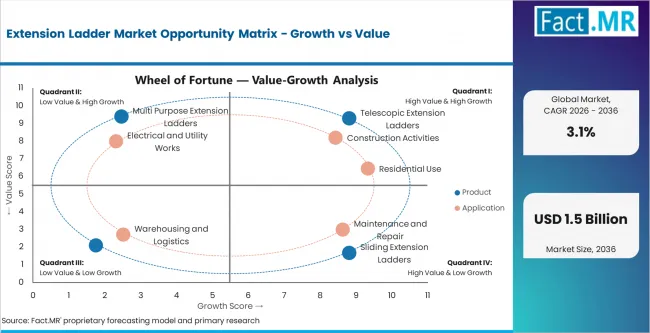
Extension Ladder Market Opportunity Matrix Growth Vs Value | Source: Fact.MR
Key Factors Driving Growth
- Extension ladders are most widely procured for use in construction activity, including framing, roofing, exterior finishing and general site access.
- Steady demand for replacement ladders and purchases of new ones is sustained by professional service providers that perform building maintenance and repair.
- Electrical and utility infrastructure work leads to the specification of fiberglass and nonconductive extension ladders with electrical hazard ratings.
Key Market Constraints
- The use of extension ladders for commercial construction is limited by competition from powered access equipment including scissor lifts and boom lifts where working-at-height regulation favors platform solutions.
- They’re more durable, and aluminum and fiberglass ladders have a lifespan of 10 to 15 years in a commercial environment, if properly maintained.
- Cheap imported ladders are squeezing margins for established brands, especially in the consumer and light-commercial sectors.
Key Opportunity Areas
- The telescopic and compact storage designs are increasing the addressable market by attracting users with limited vehicle and storage space.
- Multi-purpose extension ladders convertible between extension, A-frame and scaffold configurations are commanding price premiums through versatility.
- The e-commerce distribution of professional-grade ladders is increasing consumer access to these products, broadening the market beyond the traditional hardware and industrial supply channels.
Segment-wise Analysis of the Extension Ladder Market
- Telescopic Extension Ladders will account for 46% of the product segment in 2026, driven by their wide applicability, lower complexity, and continued application in the largest end-use verticals.
- In 2026, Construction Activities accounts for 55% of the application segment. The main demand contributors of Construction Activities are institutional demand, regulatory mandates and professional adoption.
- Technology is 64% of Structural Extension Technology, because of its established role in operation and wide installed base.
The extension ladder market is segmented based on product, application, end use, technology, formulation, distribution channel, and region. The market is segmented by product as follows: Telescopic Extension Ladders, Sliding Extension Ladders, Multi Purpose Extension Ladders, Rope Operated Extension Ladders. Application Coverage Construction Activities Maintenance and Repair Electrical and Utility Works Warehousing and Logistics Residential Use In the near term, Telescopic Extension Ladders drove value, given their installed base and broad use, while emerging segments are projected to be the growth drivers in the next phase, as needs evolve.
Which Product Segment Dominates the Extension Ladder Market?
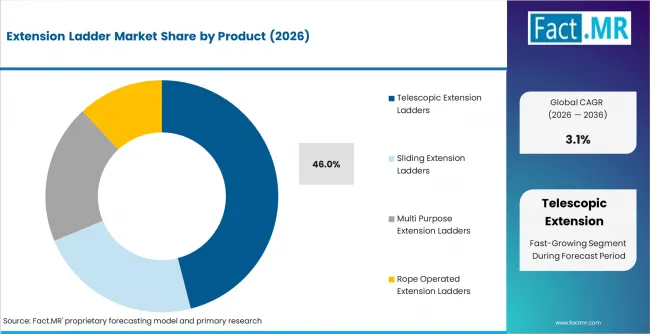
Extension Ladder Market Analysis By Product | Source: Fact.MR
The product type segment is expected to have the largest share of 46.0% in 2026 in the telescopic extension ladders segment. Their leadership is an example of a growing trend to compact, portable ladders that can extend to full working height and fold down to a fraction of their extended length for transportation and storage. In the professional and consumer segments, telescoping models are gaining market share.Sliding extension ladders represent the second largest portion of the market, with demand supported by the installed base of traditional two-section ladders used in construction, utility work and professional maintenance applications requiring the maximum duty rating and extended reach.
Which Application Segment Dominates the Extension Ladder Market?
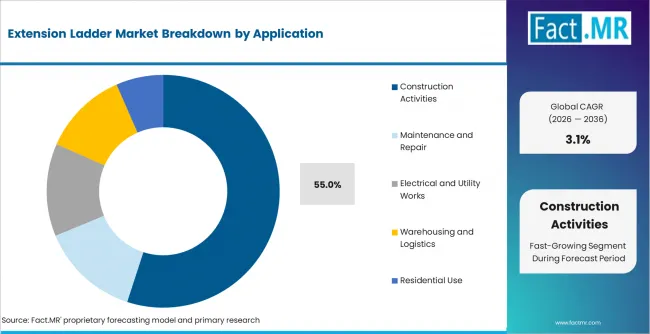
Extension Ladder Market Analysis By Application | Source: Fact.MR
The application segment is expected to contribute 55.0% in 2026. This preponderance illustrates the commonality of ladder use within building sites. Extension ladders are the primary access equipment for framing, roofing, exterior finishing and general movement at heights beyond the reach of step ladders.The second biggest application is maintenance and repair. The demand for maintenance and repair is driven by the professional painting, building exterior, facility maintenance and property management activities that require frequent access to heights.
Which Product Trend is Shaping the Next Phase of Growth in the Extension Ladder Market?
Multi-purpose extension ladders that can be used in extension, A-frame, scaffold and stairwell configurations are still not the biggest product category, but it is the fastest growing. As professional users and consumers demand a single ladder to replace multiple access products, their share is anticipated to grow.The trend towards multi-purpose design is indicative of a shift in purchasing behaviour, where the user is looking for versatility and value. Contractors and homeowners are increasingly turning to a single ladder that can handle extension reach, standing platform work and uneven surface access rather than storing and transporting multiple single-purpose products. Manufacturers are gaining an increasing share of the professional and high-end consumer market with articulating, multi-position designs with high-duty ratings and compact folding.
Regional Outlook Across Key Markets
.webp "Top Country Growth Comparison Extension Ladder Market Cagr (2026 2036)")
Top Country Growth Comparison Extension Ladder Market Cagr (2026 2036) | Source: Fact.MR
- India’s growth is at 4.6% with support from rising domestic demand, infrastructure investment and policy-led adoption.
- North America is split, with the U.S. at 2.6%, indicative of a mature market with established replacement cycles and technology upgrade activity.
- European demand is stable, Germany 2.7% supported by regulatory compliance, process modernization and quality driven procurement.
CAGR Table
| Country | CAGR (%) |
|---|---|
| India | 4.6% |
| China | 3.8% |
| Mexico | 2.9% |
| Germany | 2.7% |
| USA | 2.6% |
| South Korea | 2.5% |
| Japan | 2.3% |
Source: Fact.MR analysis. Updated May 21, 2026
Source: Fact MR (FMR) analysis, based on proprietary forecasting model and primary research.
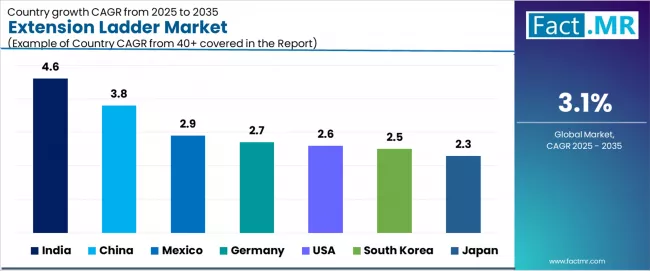
Extension Ladder Market Cagr Analysis By Country | Source: Fact.MR
Market Outlook for Extension Ladders in India
The India extension ladder market is projected to grow at a CAGR of 4.6% through 2036. Demand is shaped by construction activity, building maintenance requirements, utility infrastructure work, and growing organized retail distribution.
- Construction activity drives the largest ladder procurement volume.
- Building maintenance requirements sustain professional demand.
- Utility infrastructure work supports fiberglass ladder specification.
China Extension Ladder Demand Trends
The China extension ladder market is projected to grow at a CAGR of 3.8% through 2036. Demand is supported by construction, manufacturing facility maintenance, and strong domestic ladder manufacturing capability.
- Construction generates core extension ladder demand.
- Manufacturing facility maintenance sustains professional procurement.
- Domestic manufacturing supports competitive pricing and export.
Mexico Extension Ladder Growth Assessment
The Mexico extension ladder market is projected to grow at a CAGR of 2.9% through 2036. Demand is supported by construction growth, building maintenance, and expanding distribution channels.
- Construction growth drives new ladder procurement.
- Building maintenance sustains replacement demand.
- Distribution expansion improves market access.
Germany Extension Ladder Market Demand Analysis
The Germany extension ladder market is projected to grow at a CAGR of 2.7% through 2036. Demand is supported by building maintenance standards, safety regulation compliance, and professional trade procurement.
- Building maintenance standards drive professional ladder specification.
- Safety regulation compliance sustains certified product demand.
- Professional trade procurement supports premium brand positioning.
United States Extension Ladder Market Outlook
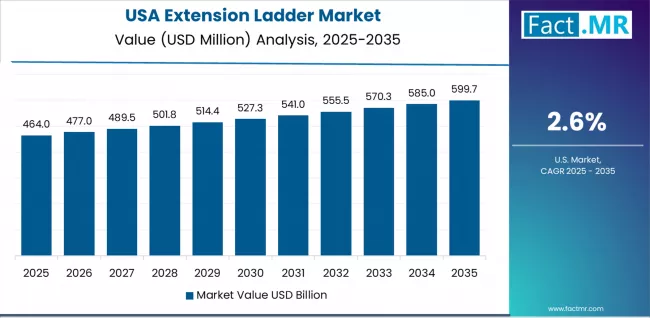
Extension Ladder Market Country Value Analysis | Source: Fact.MR
The U.S. extension ladder market is projected to grow at a CAGR of 2.6% through 2036. Demand is supported by construction activity, residential home improvement, and professional maintenance services.
- Construction activity generates professional-grade procurement.
- Residential home improvement drives consumer segment sales.
- Maintenance services sustain replacement and upgrade demand.
Japan Extension Ladder Growth Outlook
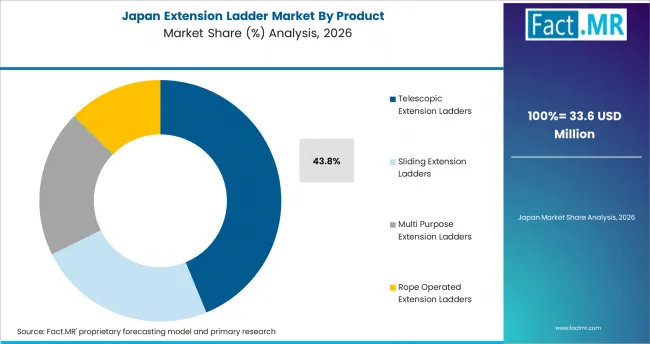
Extension Ladder Market Japan Market Share Analysis By Product | Source: Fact.MR
The Japan extension ladder market is projected to grow at a CAGR of 2.3% through 2036. Demand is shaped by building maintenance, safety standards, and replacement cycles in the professional segment.
- Building maintenance drives steady professional procurement.
- Safety standards support certified equipment specification.
- Replacement cycles sustain regular purchasing activity.
Competitive Benchmarking and Company Positioning
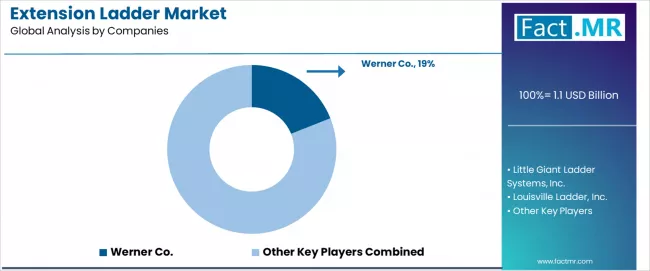
Extension Ladder Market Analysis By Company | Source: Fact.MR
Extension Ladder Market Analysis By Company
- Werner, Little Giant Ladder Systems, Louisville Ladder and Youngman have a strong presence in the global extension ladder market, backed by broad product portfolios, strong retail distribution and well-recognized brands across the professional and consumer segments.
- Competitors (Hailo, Zarges, Gorilla Ladders, and Hymer) compete in specific product categories, price segments and geographic markets. Positioning is based on quality of materials, safety features and design innovation.
- With competition increasingly driven by telescopic design capability, multi-purpose versatility and e-commerce distribution, manufacturers offering compact, convertible ladder systems are gaining share in both professional and consumer channels.
The competitive landscape is moderately fragmented with global ladder manufacturers and regional producers competing across professional and consumer segments. Werner and Little Giant Ladder Systems compete on broad portfolios, strong retail presence and brand recognition in North America.
Specific product focus, regional distribution strength and professional specification relationships allow Louisville Ladder, Youngman, Hailo, Zarges and Gorilla Ladders to maintain their positions.
Competition is increased in telescopic designs, safety rated products and regional market specialization. Hymer Telesteps Krause Lyte Alve ABRU Baileys Gunzburger
Strategic priorities include expanding telescopic and multi-purpose product lines, developing lightweight materials, expanding e-commerce distribution and expanding professional specification coverage in high-growth construction markets.
Key Companies in the Extension Ladder Market
- Werner Co., Little Giant Ladder Systems, Inc., Louisville Ladder, Inc., Youngman Group Ltd. are among the leading players in the extension ladder market globally, supported by strong brand visibility, broad product portfolios, and established positions across core end-use segments.
- Hailo-Werk Rudolf Loh GmbH & Co. KG, Zarges GmbH, Gorilla Ladders, Hymer-Leichtmetallbau GmbH hold established positions across specific application verticals, geographic markets, and technology tiers, supported by product quality, distribution penetration, and category experience.
- Telesteps AB, Krause GmbH, Lyte Ladders, Alve S.r.l., ABRU GmbH, Baileys Industrial & Domestic Ladders, Günzburger Steigtechnik GmbH continue to compete through focused product offerings, price-point coverage, and niche strength in specific applications or regional markets.
Recent Industry Developments
- Werner Co. – Product Launch / Compact Telescopic Extension Ladder (2025)
- Werner introduced the TS1000 Series compact telescopic extension ladder with one-touch retraction, speed-controlled soft-close lowering, enhanced locking mechanisms, and ANSI Type IA (300 lb) rating for professional construction and maintenance applications.
- Little Giant Ladder Systems, Inc. – Product Highlight / Multi-Position Extension Ladders (Ongoing / 2025)
- Little Giant continued to promote and expand visibility of its versatile multi-position ladder lineup, featuring extension-capable articulated systems designed for uneven surface access, multiple configurations including scaffold-mode work in professional settings.
- Zarges GmbH – Ongoing Product Line / Lightweight Aluminum Extension Ladders (2025-2026)
- Zarges offers a range of lightweight aluminum extension ladders with improved rung designs, ergonomic features, and enhanced stability tailored for European professional trade applications. No specific new launch was announced in January 2026.
Leading Companies Shaping the Extension Ladder Market
- Werner Co.
- Little Giant Ladder Systems, Inc.
- Louisville Ladder, Inc.
- Youngman Group Ltd.
- Hailo-Werk Rudolf Loh GmbH & Co. KG
- Zarges GmbH
- Gorilla Ladders
- Hymer-Leichtmetallbau GmbH
- Telesteps AB
- Krause GmbH
- Lyte Ladders
- Alve S.r.l.
- ABRU GmbH
- Baileys Industrial & Domestic Ladders
- Günzburger Steigtechnik GmbH
Sources and Research References
- Werner Co. Compact telescopic extension ladder and professional access product updates.
- Little Giant Ladder Systems, Inc. Multi-position extension system and product expansion.
- Zarges GmbH. Lightweight aluminum extension ladder and professional trade product updates.
- Construction industry statistics, building maintenance data, workplace safety regulation publications, and access equipment market reports.
- Primary interviews with ladder manufacturers, distributors, construction contractors, maintenance service providers, and retail buyers.
This bibliography is provided for reader reference and is not exhaustive. The full report contains the complete reference list and detailed citations.
Key Questions This Report Addresses
- What is the current and future size of the Extension Ladder Market?
- How fast is the market expected to grow between 2026 and 2036?
- Which product type is likely to lead the market by 2026?
- Which application segment accounts for the highest demand by 2026?
- What factors are driving demand for extension ladders globally?
- How is the shift toward telescopic designs influencing the market?
- Why are India and China the fastest-growing markets?
- How are safety regulations shaping product specification?
- Which countries are projected to show the fastest growth through 2036?
- Who are the key companies active in the Extension Ladder Market?
- How does Fact.MR estimate and validate the market forecast?
Extension Ladder Market Definition
The extension ladder market covers extendable access equipment for construction, maintenance, electrical work, warehousing, and residential applications across telescopic, sliding, multi-purpose, and rope-operated configurations.
Extension Ladder Market Inclusions
- The scope covers global and regional market size and forecasts for 2026 to 2036 across product type, application, end use, technology, formulation, and distribution channel.
- It includes regional demand analysis based on construction activity, building maintenance requirements, utility infrastructure work, and residential improvement spending.
- The report covers technology trends, market drivers and constraints, and the competitive landscape, including product portfolios, distribution networks, and safety certification coverage.
- It includes pricing and cost analysis across consumer, professional, and industrial-grade extension ladder categories.
Extension Ladder Market Exclusions
- The scope excludes step ladders, platform ladders, and fixed access systems not classified as extension ladders.
- It excludes powered access equipment including scissor lifts, boom lifts, and aerial work platforms.
- The report excludes scaffolding systems, suspended access platforms, and permanent fixed ladders installed as building infrastructure.
- It also excludes ladder accessories, stabilizers, and safety harnesses sold independently from extension ladders.
Extension Ladder Market Research Methodology
- The methodology combines secondary research, primary interviews, and forecast modelling.
- It draws on 100+ secondary sources and benchmarks 50+ company product portfolios.
- Market sizing covers 30+ countries through a demand-side model, supported by top-down validation.
- Key inputs include application demand trends, regulatory activity, end-use adoption rates, pricing analysis, and distribution penetration.
- The model cross-checks demand with shipments, pricing trends, channel mix, and product launches.
- Primary validation includes 25+ interviews across manufacturers, distributors, end users, and industry participants.
- Final estimates go through trade-flow checks, sales-pattern review, and sensitivity testing.
Segmentation
Scope of Analysis
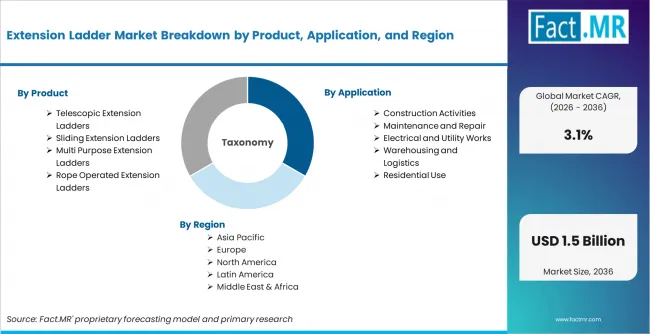
Extension Ladder Market Breakdown By Product, Application, And Region | Source: Fact.MR
| Parameter | Details |
|---|---|
| Quantitative Units | USD 1.08 billion to USD 1.47 billion, at a CAGR of 3.1% |
| Market Definition | The extension ladder market covers extendable access equipment for construction, maintenance, electrical work, warehousing, and residential applications across telescopic, sliding, multi-purpose, and rope-operated configurations. |
| Regions Covered | North America, Latin America, Europe, East Asia, South Asia and Pacific, Middle East and Africa |
| Countries Covered | India, China, Mexico, Germany, USA, South Korea, Japan, 30 plus countries |
| Key Companies | Werner Co., Little Giant Ladder Systems, Inc., Louisville Ladder, Inc., Youngman Group Ltd., Hailo-Werk Rudolf Loh GmbH & Co. KG, Zarges GmbH, Gorilla Ladders, Hymer-Leichtmetallbau GmbH, Telesteps AB, Krause GmbH, Lyte Ladders, Alve S.r.l., ABRU GmbH, Baileys Industrial & Domestic Ladders, Günzburger Steigtechnik GmbH |
| Forecast Period | 2026 to 2036 |
| Approach | Hybrid demand-side and top-down methodology built on country-level application demand, product benchmarking, pricing analysis, shipment validation, and primary interviews across manufacturers, distributors, and end users |
Source: Fact.MR analysis. Updated May 21, 2026
Extension Ladder Market Segmentation
-
Extension Ladder Market Segmented by Product:
- Telescopic Extension Ladders
- Aluminum Telescopic Ladders
- Light Duty Extension Ladders
- Heavy Duty Telescopic Ladders
- Fiberglass Telescopic Ladders
- Electrical Safety Ladders
- Industrial Grade Fiberglass Ladders
- Aluminum Telescopic Ladders
- Sliding Extension Ladders
- Two Section Sliding Ladders
- Standard Extension Sliding Ladders
- Professional Grade Sliding Ladders
- Three Section Sliding Ladders
- High Reach Industrial Ladders
- Construction Site Sliding Ladders
- Two Section Sliding Ladders
- Multi Purpose Extension Ladders
- Convertible Ladders
- Step to Extension Conversion Ladders
- Scaffold Compatible Ladders
- Articulated Extension Ladders
- Multi Position Ladders
- Hinged Joint Ladders
- Convertible Ladders
- Rope Operated Extension Ladders
- Pulley Extension Ladders
- Heavy Height Access Ladders
- Industrial Rope Controlled Ladders
- Counterweight Ladders
- Precision Extension Systems
- Safety Locked Extension Ladders
- Pulley Extension Ladders
- Telescopic Extension Ladders
-
Extension Ladder Market Segmented by Application:
- Construction Activities
- Building Construction
- Residential Construction Works
- Commercial Construction Projects
- Infrastructure Development
- Bridge Construction Works
- Roadside Installation Works
- Building Construction
- Maintenance and Repair
- Industrial Maintenance
- Factory Equipment Maintenance
- Plant Structural Repair Works
- Building Maintenance
- High Rise Maintenance Works
- Facade Cleaning Operations
- Industrial Maintenance
- Electrical and Utility Works
- Power Line Maintenance
- Overhead Cable Installation
- Transformer Maintenance Works
- Telecommunication Maintenance
- Tower Installation Works
- Signal System Maintenance
- Power Line Maintenance
- Warehousing and Logistics
- Storage Facility Operations
- Rack Access Operations
- High Shelf Storage Access
- Distribution Centers
- Inventory Management Access
- Loading Dock Operations
- Storage Facility Operations
- Residential Use
- Home Improvement Activities
- Roof Repair Works
- Painting and Cleaning Tasks
- DIY Household Applications
- Gardening and Outdoor Tasks
- Minor Repair Works
- Home Improvement Activities
- Construction Activities
-
Extension Ladder Market Segmented by End Use:
- Construction Companies
- Residential Builders
- Housing Contractors
- Apartment Developers
- Commercial Builders
- Office Construction Firms
- Retail Infrastructure Builders
- Residential Builders
- Industrial Facilities
- Manufacturing Plants
- Heavy Engineering Units
- Assembly Line Facilities
- Maintenance Contractors
- Facility Management Firms
- Industrial Service Providers
- Manufacturing Plants
- Utility Service Providers
- Power Utilities
- Electrical Distribution Companies
- Grid Maintenance Authorities
- Telecom Operators
- Network Infrastructure Firms
- Tower Maintenance Providers
- Power Utilities
- Government Bodies
- Public Works Departments
- Infrastructure Maintenance Agencies
- Municipal Corporations
- Public Works Departments
- Residential Users
- Homeowners
- Individual Households
- Property Maintenance Users
- Small Contractors
- Local Service Providers
- Freelance Maintenance Workers
- Homeowners
- Construction Companies
-
Extension Ladder Market Segmented by Technology:
- Structural Extension Technology
- Telescopic Mechanism
- Sliding Lock Systems
- Incremental Extension Systems
- Segmented Extension Systems
- Multi Section Locking Ladders
- Modular Extension Frames
- Telescopic Mechanism
- Material Technology
- Aluminum Alloy Technology
- Lightweight Structural Aluminum
- Corrosion Resistant Aluminum Frames
- Fiberglass Reinforced Polymer
- Electrical Insulation Ladders
- High Strength Composite Ladders
- Aluminum Alloy Technology
- Safety Technology
- Anti Slip Systems
- Rubber Footing Systems
- Grip Surface Rungs
- Locking Mechanisms
- Auto Locking Joints
- Safety Pin Systems
- Anti Slip Systems
- Load Bearing Technology
- High Load Distribution
- Reinforced Side Rails
- Weight Balance Systems
- Industrial Strength Design
- Heavy Duty Load Frames
- Shock Resistant Structures
- High Load Distribution
- Structural Extension Technology
-
Extension Ladder Market Segmented by Formulation:
- Ladder Systems
- Extension Ladder Structures
- Sliding Ladder Systems
- Telescopic Ladder Units
- Multi Purpose Ladder Systems
- Convertible Ladder Systems
- Articulated Ladder Units
- Extension Ladder Structures
- Material Systems
- Metal Based Systems
- Aluminum Ladder Frames
- Steel Reinforced Ladders
- Composite Systems
- Fiberglass Ladder Structures
- Hybrid Material Ladders
- Metal Based Systems
- Safety Systems
- Locking Systems
- Mechanical Locking Devices
- Auto Safety Lock Systems
- Grip Systems
- Anti Slip Rung Systems
- Rubber Foot Safety Systems
- Locking Systems
- Service Systems
- Maintenance Services
- Ladder Repair Services
- Inspection Services
- Upgrade Services
- Safety Upgrade Kits
- Extension Enhancement Kits
- Maintenance Services
- Ladder Systems
-
Extension Ladder Market Segmented by Distribution Channel:
- Direct Sales
- Manufacturer Sales
- Industrial Equipment Manufacturers
- Construction Equipment OEMs
- Project Based Sales
- Construction Project Procurement
- Government Infrastructure Projects
- Manufacturer Sales
- Distributors
- Industrial Distributors
- Hardware Equipment Suppliers
- Construction Material Dealers
- Retail Dealers
- Hardware Stores
- Local Tool Shops
- Industrial Distributors
- E Commerce
- Online Marketplaces
- Industrial Equipment Platforms
- Retail Hardware Platforms
- Online Marketplaces
- Aftermarket Services
- Maintenance Services
- Repair Service Providers
- Inspection Agencies
- Spare Parts Supply
- Replacement Parts Suppliers
- Accessory Dealers
- Maintenance Services
- Direct Sales
-
Extension Ladder Market by Region:
- North America
- USA
- Canada
- Mexico
- Latin America
- Brazil
- Chile
- Rest of Latin America
- Western Europe
- Germany
- UK
- Italy
- Spain
- France
- Nordic
- BENELUX
- Rest of Western Europe
- Eastern Europe
- Russia
- Poland
- Hungary
- Balkan & Baltic
- Rest of Eastern Europe
- East Asia
- China
- Japan
- South Korea
- South Asia and Pacific
- India
- ASEAN
- Australia & New Zealand
- Rest of South Asia and Pacific
- Middle East & Africa
- Kingdom of Saudi Arabia
- Other GCC Countries
- Turkiye
- South Africa
- Other African Union
- Rest of Middle East & Africa
- North America
Frequently Asked Questions
How big is the Extension Ladder Market in 2025?
What will be the size of the Extension Ladder Market in 2036?
How much will the Extension Ladder Market grow between 2026 and 2036?
What are the key product types in the Extension Ladder Market?
Which application segment will contribute significant share in the Extension Ladder Market in 2026?
Who worked on this report


Preview the report firsthand - request a free sample
Free SampleGet the brochure for pricing and purchase details
Download PDF