- Base Value(2025): 749 Mn
- Forecast Value (2035): 4715 Mn
- CAGR (2035): 33.5%
Farm-Scale Protein Bioreactors Market Outlook 2025 to 2035
The global farm-scale protein bioreactors market is expected to reach USD 4,715 Million by 2035, up from USD 749 Million in 2025. During the forecast period (2025 - 2035), the industry is projected to expand at a CAGR of 20.2%.
The market is supported by the increasing demand in sustainable and locally-produced alternative proteins, the development of precision fermentation and cellular agriculture, and the decentralized bio-manufacturing systems of basic products of this nature. Market expansion is picking up with rising investments in modular and cost-effective bioreactor designs and utilization in food, feed, and nutraceutical markets. Besides, the technological advancement of single-use systems and bioprocess automation can improve the ability to scale and efficiency of production.
Quick Stats for Farm-Scale Protein Bioreactors Market
- Industry Value (2025): USD 749 Million
- Projected Value (2035): USD 4,715 Million
- Forecast CAGR (2025 to 2035): 20.2%
- Leading Segment (2025): Stirred-Tank Bioreactors (35.5% Market Share)
- Fastest Growing Country (2025-2035): China (21.7% CAGR)
- Top Key Players: Sartorius AG, Thermo Fisher Scientific, Alfa Laval, Perfect Day, Inc., The EVERY Company, and Calysta
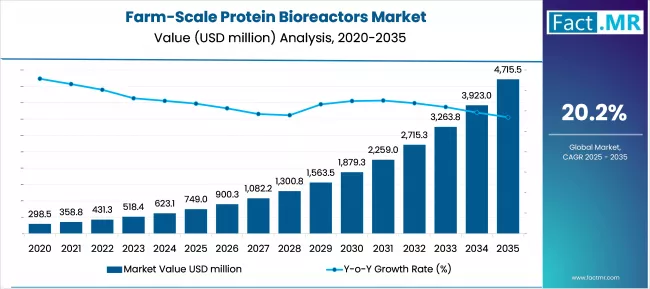
Farm Scale Protein Bioreactors Market Market Value Analysis | Source: Fact.MR
What are the drivers of the Farm-Scale Protein Bioreactors Market?
The market of the farm-scale protein bioreactors is growing at a high rate, with the world becoming interested in sustainable and ethical production of proteins, as well as the technological advancement of precision fermentation and cellular agriculture. Localized and cost-effective biomanufacturing using small and automated bioreactor systems will be made possible by the integration of modular, scalable and automated bioreactor systems.
Modifications in single-use systems, microbial and plant-cell fermentation and optimization of bioprocesses boost yield and efficiency. The rising consumer demand in alternative proteins in food, feed and nutraceuticals as well as conducive government policies in stimulating sustainable food technologies are increasing the pace of adoption. The cooperation between biotech companies, food manufacturers and equipments manufacturers contributes to constant product innovation and scalability.
What are the regional trends of the Farm-Scale Protein Bioreactors Market?
The Farm-Scale Protein Bioreactors Market has unique regional patterns that are based on technological potential, investment opportunities, and the utilization of sustainable food production systems. North America is the market leader and is fuelled by high levels of investment in R&D, high levels of venture capital, and early adoption of precision fermentation. Europe comes next with the focus on regulated-based innovation, food safety, and sustainability programs. East Asia, such as China, Japan and South Korea are becoming the center of manufacturing and technology of modules of bioprocess systems. South Asia & Pacific develop at a high pace because of the fast-growing agritech sectors and the protein innovation initiatives supported by governments. The adoption of localized biomanufacturing is also slowly picking up in Latin America and MEA, as a measure of promoting food security and decreasing imports.
What are the challenges and restraining factors of the Farm-Scale Protein Bioreactors Market?
Farm-Scale Protein Bioreactors Market has various challenges that restrict its use in large scale. Scalability and commercialization are hindered by high capital requirements, complicated bioprocess integration and poor standardization across modular systems. Precision fermentation, food-grade biomanufacturing is characterized by regulatory uncertainty that slows down approval worldwide. Technical barriers like contamination control, optimization of the processes and uniformity of the yields are major challenges.
Moreover, there is a lack of technical knowledge on decentralized facilities and supply chain limitations of the bioprocess media and equipment which can influence efficiency. The absence of harmonized sustainability requirements, lack of ethical considerations about genetically modified microorganisms, and imbalanced government support across regions further limit the ability to penetrate into the market and commercialize in the long term.
Country-Wise Insights
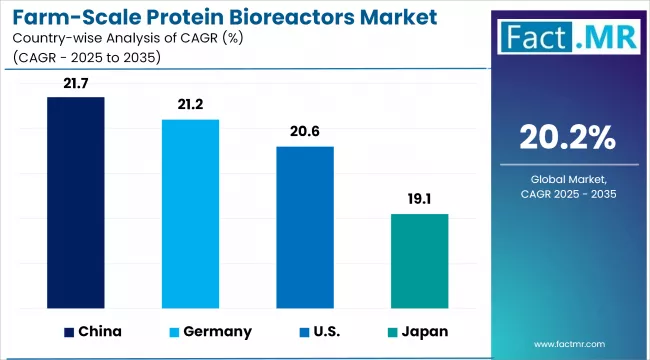
Farm Scale Protein Bioreactors Market Cagr Analysis By Country | Source: Fact.MR
The U.S. leads global innovation in scalable protein bioreactors
The Farm-Scale Protein Bioreactors Market is dominated by the United States, which is supported by a well-developed biotechnology ecosystem, well-developed research facilities and the substantial investment in alternative protein manufacture. Scalable precision fermentation and modular bioreactor platforms are being developed by such companies to produce sustainable foods and feed. Bio-manufacturing and sustainability have supportive government programs which enhance commercialization.
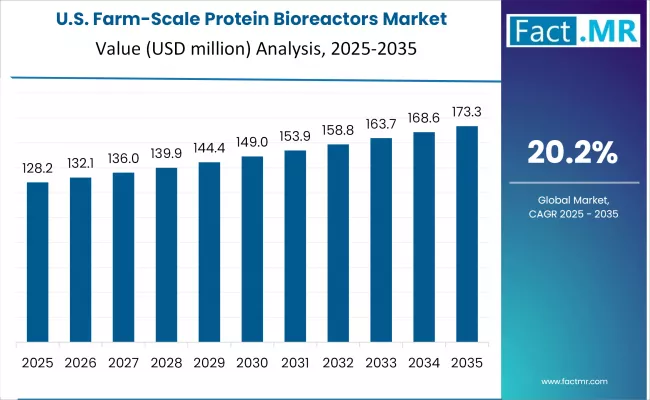
Farm Scale Protein Bioreactors Market Country Value Analysis | Source: Fact.MR
The demand of animal-free protein is high, and the cooperation between startups and agri-tech companies improves the innovation. Moreover, the trends of automation, optimization of bioprocesses through data and the development of the single-use bioreactor technology fixate the U.S. as the leader in the global farm-scale protein bioreactor markets.
China rapidly expands bioreactor production through biotech-driven agriculture
China is now becoming a fast expanding center in the Farm-Scale Protein Bioreactors Market driven by the solid government backing to biotechnology, local production incentives, and food security ambitions. Synthetic biology and fermentation infrastructure are being massively invested in the country to decrease reliance on foreign sources of protein.
Academic institutions and domestic players are working together to develop cost effective and modular bioreactor systems that can be used in farms and cooperatives in rural areas. There is a sharp increase in the demand to have sustainable animal feeds, plant-based protein feeds, and microbial fermentation solutions. Also, China has a capacity to growth massively and has specialized in automation and low-cost bio-manufacturing, thus making it a worldwide growth powerhouse.
Germany pioneers sustainable, precision-engineered farm-scale protein bioreactor systems
Germany is the most developed market in Europe regarding farm-scale protein bioreactors that have access to the traditional engineering culture, developed bioprocessing firms like Sartorius AG and GEA Group, and sustainability-focused food policies. The nation focuses on accuracy in control, automation, and energy saving in small-scale to medium-scale fermentation systems applied in protein production. Commercialization is facilitated by the government programs on bioeconomy and circular agriculture.
Cooperative work of universities and biotech companies leads to constant innovation in reactor design, downstream processing and use of renewable resources. Germany is a major supplier and exporter of high-purity sustainable protein products in food and feed, which makes it a leader in innovation in the new global market.
Category-Wise Analysis
Stirred-tank bioreactors ensure efficient, scalable, and controlled protein production
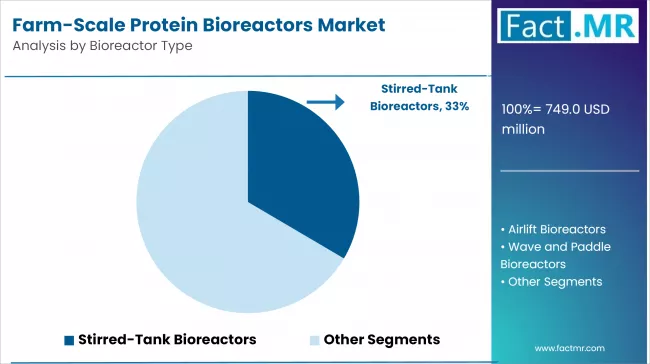
Farm Scale Protein Bioreactors Market Analysis By Bioreactor Type | Source: Fact.MR
Stirred-tank bioreactors are the main type of bioreactors that are chosen for farm-scale protein production due to the fact that they possess the features that have been referred to i.e. they are versatile, scalable, and allow for precise control of the process. They are sources of uniform mixing, high oxygen transfer, and very stable culture conditions for microbial and cell-based protein production.
Their flexibility to different feedstocks and compatibility with both batch and continuous processes make them the best choice for precision fermentation. The effect of impurity, digital monitors, and automated nutrient control to productivity and the risk of contamination have been greatly improved due to technological advancements in these areas.
These devices are becoming more prevalent in food-tech startups and pilot-scale production units that desire to commercialize sustainable protein alternatives efficiently and with reproducible yields.
Microbial-based proteins drive sustainable, high-yield alternative protein production
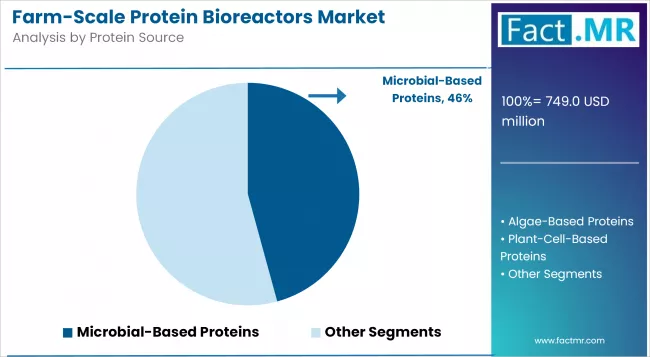
Farm Scale Protein Bioreactors Market Analysis By Protein Source | Source: Fact.MR
Microbial-based proteins account for the largest share of the source segment in the farm-scale protein bioreactor market, which is largely influenced by their fast growth rates, low resource requirements, and scalability. Bacteria, fungi, and yeast are used to produce high-quality, nutrient-rich proteins for alternative meat, dairy, and feed applications. This segment has a lower impact on the environment due to less reliance on agricultural land and water while at the same time it supports the circular bioeconomy goals.
The output is continuously being made more efficient and economical through strain engineering, precision fermentation, and downstream processing. Consequently, startups as well as big food-tech companies are putting more and more money into microbial systems to offer sustainable, protein-rich food solutions that are compatible with climate and nutrition global goals.
Medium-scale bioreactors enable flexible, localized, and cost-effective protein manufacturing
Bioreactors of a medium scale from 500 to 5,000 liters are the core of farm-scale production systems that maintain a balance between efficiency, flexibility, and affordability. These systems are sufficiently large for commercial protein production while still keeping experimental agility for process optimization. Medium-scale units are most commonly used by startups, research farms, and decentralized food biomanufacturers for the pilot-to-production transition.
Their coupling with automated control systems, single-use components, and modular designs elevates operational safety and productivity. This size of the scale is instrumental in supporting local production models that call for less logistics costs and carbon footprint, thus, it is a main driver of community-based, environmentally friendly protein manufacturing and the spread of bioprocess innovation at the farm level all over the globe.
Competitive Analysis
Key players in the farm-scale protein bioreactors market include Sartorius AG, Thermo Fisher Scientific, Alfa Laval, Perfect Day, Inc., The EVERY Company, Calysta
The competition for the largest share of the farm-scale protein bioreactors market is becoming the most intense is the core of the fight among producers of the foremost technological changes in the field of the Sartorius AG, Thermo Fisher Scientific, GEA Group, Solaris Biotech, and Applikon Biotechnology being the major contenders. The development by these companies of modular, scalable, and single-use bioreactor systems capable of supporting precision fermentation as well as the production of alternative proteins is their commitment. The collaboration between bioreactor manufacturers, cellular agriculture startups, and food-tech companies is the main reason for the rapid progress of the design and bioprocess automation. Continuous R&D endeavors are essentially geared to better scalability, higher process efficiency, and lower costs. The competition is also fueled by the demand for decentralized, eco-friendly protein production systems that enable local biomanufacturing and have a lesser environmental impact.
Recent Development
- In July 2025, GEA Group inaugurated New Food Application & Technology Center in Janesville, Wisconsin which is a USD 20 million facility with pilot-scale bioreactors to ferment and cultivate with precision, alternative proteins in the scale of farms and regional production.
- In May 2025, Millow AB established a full-scale production facility in Gothenburg, Sweden (2,500 m 2 ) of mycelium-based protein through a near-dry (also known as dry-state) fermentation process, a new category of fermentation-/bioreactor-based protein production.
Fact.MR has provided detailed information about the price points of key manufacturers of Farm-Scale Protein Bioreactors Market positioned across regions, sales growth, production capacity, and speculative technological expansion, in the recently published report.
Methodology and Industry Tracking Approach
The market for protein bioreactors on farm-scale was a focus of a 2025 Fact.MR study. To compile the data, the study had a survey open to bioprocess engineers, producers of alternative proteins, manufacturers of bioreactors, and investors in agri-tech. Nearly 65% of the people surveyed were users from the food and biomanufacturing sectors, while the remaining 35% were equipment suppliers, researchers, and policymakers. The study concentrated on primary interviews and also collected secondary data from scientific journals, patent filings, industry white papers, and company reports from October 2024 to September 2025. To measure the innovation potential, scalability, and market dynamics across system type and application segments, the researchers used sophisticated modeling, technology mapping, and regional trend analysis.
With Fact.MR monitoring consumer behavior, product efficacy, industry trends, and market opportunities since 2018, this report is becoming an authoritative source of information that stakeholders can rely on.
Segmentation
Segmentation of Farm-Scale Protein Bioreactors Market
-
By Bioreactor Type :
- Stirred-Tank Bioreactors
- Airlift Bioreactors
- Wave and Paddle Bioreactors
- Single-Use Bioreactors (SUBs)
- Photobioreactors
-
By Protein Source :
- Microbial-Based Proteins
- Algae-Based Proteins
- Plant-Cell-Based Proteins
- Animal-Cell-Based Proteins
-
By Capacity Scale :
- Small Farm Units (≤500 L)
- Medium Scale (500-5,000 L)
- Large Farm-Integrated Units (>5,000 L)
-
By End Product Form :
- Protein Concentrates and Isolates
- Functional Ingredients and Powders
- Ready-to-Use Protein Solutions
- Fermented Food & Beverage Bases
-
By Region :
- North America
- Latin America
- Western Europe
- Eastern Europe
- East Asia
- South Asia & Pacific
- Middle East & Africa
Frequently Asked Questions
What was the global Farm-Scale Protein Bioreactors Market size reported by Fact.MR for 2025?
Who are the major players operating in the Farm-Scale Protein Bioreactors Market?
What is the estimated valuation of the Farm-Scale Protein Bioreactors Market in 2035?
What Value CAGR did the Farm-Scale Protein Bioreactors Market exhibit over the last five years?
Who worked on this report


Preview the report firsthand - request a free sample
Free SampleGet the brochure for pricing and purchase details
Download PDF