- Market Value (2025): USD 417.8 Bn
- Estimated Value (2026): USD 445.0 Bn
- Forecast Value (2036): USD 1,150 Bn
- CAGR (2026-2036): 10.0%
What is the Fat-Mimicking Protein Systems Market forecast to be worth by 2036?
USD 1.9 billion in 2026 to USD 5.0 billion by 2036 at a 9.9% CAGR.
- The Fat-Mimicking Protein Systems Market reached USD 1.8 billion in 2025.
- Demand is projected to increase from USD 1.9 billion in 2026 to USD 5.0 billion by 2036.
- The market is forecast to record a 9.9% CAGR from 2026 to 2036. Dairy and nutrition brands use protein systems to keep texture while cutting fat or raising protein.
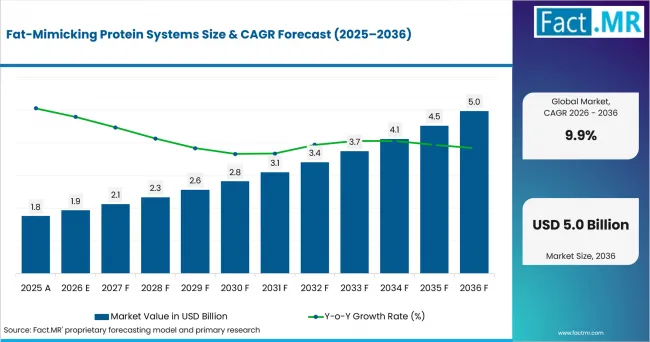
Fat Mimicking Protein Systems Value Analysis | Source: Fact.MR
What are the defining numbers behind Fat-Mimicking Protein Systems Market growth?
USD 3.0400 billion absolute opportunity by 2036, led by whey proteins, dairy / alternatives and lubrication / creaminess.
- Demand Drivers in the Market
- Dairy brands need a smooth feel after fat is cut. In March 2025, China’s Ministry of Agriculture and Rural Affairs, National Health Commission, and Ministry of Industry and Information Technology published a guideline targeting annual per-capita dairy consumption of at least 47 kg by 2030.
- Beverage teams need proteins that add body without too much thickness. Hydrolyzed forms can help keep drinks easy to pour. Clean dispersion is vital during mixing and storage.
- Sauce and dressing makers need emulsion support when fat is cut. The mix must stay smooth during pumping and filling. It also needs to hold during chilled storage. Protein systems can help bind water and oil while keeping the sauce easy to spread or pour.
- Nutrition-food brands need dense protein with a familiar mouthfeel. Bars can turn hard as protein rises. Drinks can feel chalky or thick. Spoonable foods can lose creaminess when fat is cut. Protein systems are expected to help brands balance these limits in one recipe.
- Key Segments Analyzed
- By Protein Platform: Whey proteins are expected to hold 34.0% share in 2026. Fine whey particles can support creaminess after fat is reduced.
- By Functional Role: Lubrication / creaminess is projected to account for 31.0% share in 2026. Food makers use it to keep smoothness and oral coating.
- By Application: Dairy / alternatives are anticipated to capture 36.0% share in 2026. Whey, milk and plant proteins fit both spoonable foods and drinks.
- By Format: Powder concentrate is estimated to represent 29.0% share in 2026. It is easy to store, ship and dose in food plants.
- Analyst Opinion at Fact.MR
- Shambhu Nath Jha, Principal Consultant at Fact.MR states, “Texture is the market test. Growth is expected to favor protein systems that add smooth feel at practical use levels. Suppliers need sound taste tests and clear process guidance.”
- Strategic Implications
- Dairy ingredient firms should test particle size and heat effects on creaminess. In March 2025, Arla Foods Ingredients signed a contract manufacturing agreement with Valley Queen for Nutrilac ProteinBoost.
- Food makers should test protein systems in the finished product. Shear, pH and total solids can change the smooth feel. A bench test may behave differently on a plant line. Pilot work should therefore use the real heat and mixing steps planned for sale.
- Application labs should compare fat reduction with texture retention and calorie goals. Added protein should remain part of the same recipe test. Teams can then see whether a small dose gives enough body. This approach can keep cost and sensory checks in the same trial.
China is projected to record 11.2% CAGR through 2036 as dairy and protein-rich foods expand. Japan is anticipated to reach 10.1% as dairy and drink makers focus on smooth texture. The USA is estimated at 9.7% as whey supply supports recipe work. France is forecast at 9.7% on dairy output. Germany is expected at 9.5% as food plants seek steady texture.
How does the Fat-Mimicking Protein Systems Market break down by segment?
Dairy / alternatives lead at 36.0%; whey proteins lead at 34.0%.
Which Protein Platform leads?
Whey proteins are expected to hold 34.0% share in 2026.
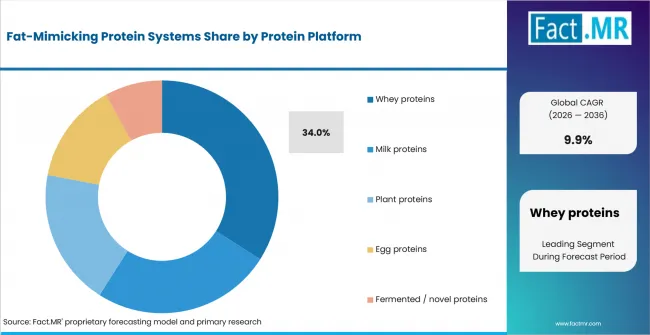
Fat Mimicking Protein Systems Analysis By Protein Platform | Source: Fact.MR
Whey proteins are expected to lead because fine whey particles can add a smooth feel. Milk proteins suit foods that need dairy taste and heat fit. Plant proteins serve dairy substitutes and hybrid foods. Egg and novel proteins cover narrower uses. Fine-particle whey can work well in yogurt and dessert bases. It can also help high-protein foods feel less dry. In April 2026, USDA NASS reported 501.792 million pounds of U.S. whey protein concentrate output in 2025. Output was 2.1% above 2024.
What leads the Functional Role segment?
Lubrication / creaminess is projected to account for 31.0% share in 2026.
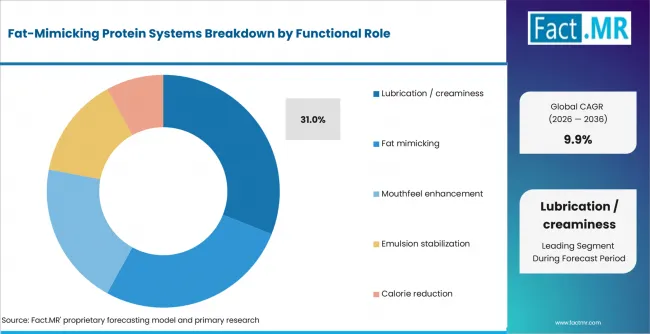
Fat Mimicking Protein Systems Analysis By Functional Role | Source: Fact.MR
Lubrication / creaminess is projected to lead because fat loss changes how food feels in the mouth. Fat mimicking can restore body. Mouthfeel systems help high-protein foods feel less dry. Emulsion support helps sauces and drinks. Calorie reduction can follow from the same recipe work. The best fit depends on the food base and the amount of fat removed. A smooth result can reduce the need for extra texture aids.
How does Application shape demand?
Dairy / alternatives are anticipated to capture 36.0% share in 2026.
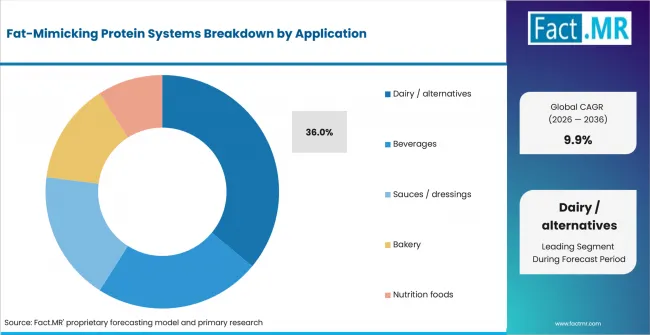
Fat Mimicking Protein Systems Analysis By Application | Source: Fact.MR
Dairy / alternatives are anticipated to lead because yogurt and dairy-style foods rely on creaminess. Drinks need good flow and clean dispersion. Sauces need stable emulsions under shear. Bakery foods use proteins for moisture and bite. Nutrition foods need high protein with a smooth feel. Dairy bases give whey and milk proteins a natural fit. Plant bases create more room for pea and other novel proteins.
What leads the Format segment?
Powder concentrate is estimated to represent 29.0% share in 2026.
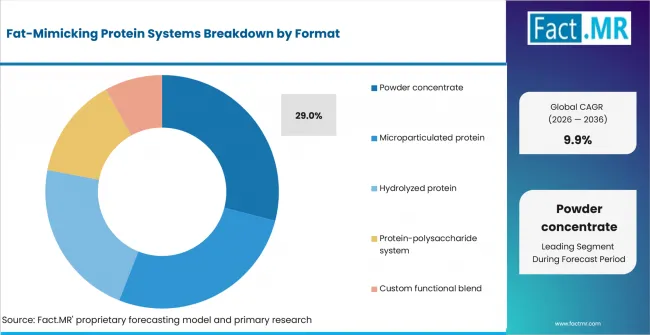
Fat Mimicking Protein Systems Analysis By Format | Source: Fact.MR
Powder concentrate is expected to lead because it is easy to ship, store and dose. Microparticulated protein can add creamy texture. Hydrolyzed protein helps when lower thickness is needed. Protein-polysaccharide systems help manage water and body. Custom blends let food makers tune texture. Powder formats also fit dry blending and batch production.
What is accelerating Fat-Mimicking Protein Systems Market adoption, and what is holding it back?
Texture-led fat reduction drives adoption; sensory and recipe complexity restrain it.
Drivers Impact Analysis
| DRIVER | (~) % IMPACT ON CAGR | GEOGRAPHIC RELEVANCE | IMPACT TIMELINE |
|---|---|---|---|
| Fat-reduction reformulation | +1.8% | Global | Short term (<= 2 years) |
| High-protein texture management | +1.5% | North America, Europe, East Asia | Short term (<= 2 years) |
| Dairy-alternative creaminess | +1.2% | Global | Medium term (2-4 years) |
| Functional whey supply | +0.8% | North America, Europe | Medium term (2-4 years) |
Opportunity Impact Analysis
| OPPORTUNITY | (~) % IMPACT ON CAGR | GEOGRAPHIC RELEVANCE | IMPACT TIMELINE |
|---|---|---|---|
| Microparticulated dairy systems | +1.0% | North America, Europe | Medium term (2-4 years) |
| Protein-polysaccharide blends | +0.7% | Global | Medium term (2-4 years) |
| Nutrition beverage systems | +0.6% | North America, East Asia | Long term (>= 4 years) |
Restraints Impact Analysis
| RESTRAINT | (~) % IMPACT ON CAGR | GEOGRAPHIC RELEVANCE | IMPACT TIMELINE |
|---|---|---|---|
| Graininess and off-notes | -0.6% | Global | Short term (<= 2 years) |
| Protein input cost variability | -0.5% | Global | Medium term (2-4 years) |
| Application-specific process sensitivity | -0.4% | Global | Medium term (2-4 years) |
Which countries are scaling Fat-Mimicking Protein Systems Market through 2036?
- China remains 1.1 percentage points above Japan as dairy processing and protein-rich food development expand recipe activity.
- Japan remains 0.4 percentage point above the USA as beverage and dairy teams place a high value on controlled thickness and smooth texture.
- The USA and France each record 9.7% CAGR, though the USA is shaped by whey supply while France draws on an established dairy-processing base.
- France remains 0.2 percentage point above Germany as dairy and plant-protein recipe activity supports broader texture-system use.
- Germany closes the displayed range at 9.5% as processors balance creaminess targets with steady handling in dairy and prepared-food uses.
Similar CAGRs can still lead to different sales paths. Each country has its own dairy base and food mix. The report links each rate to local food output and product use. Coverage spans the listed global regions.
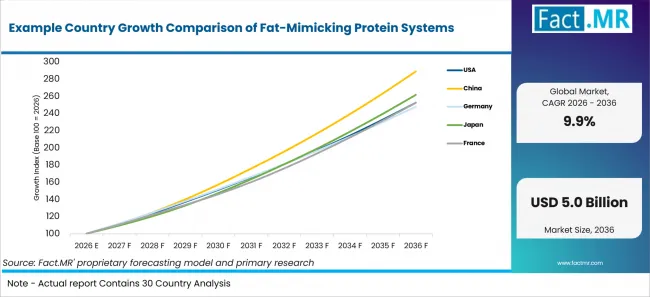
Example Country Growth Comparison Of Fat Mimicking Protein Systems | Source: Fact.MR
| Country | CAGR (2026-2036) |
|---|---|
| China | 11.2% |
| Japan | 10.1% |
| USA | 9.7% |
| France | 9.7% |
| Germany | 9.5% |
What supports China demand?
11.2% CAGR through 2036, supported by dairy output and protein-rich food development.
China has a large dairy and food base for whey, milk and plant proteins. In February 2026, the National Bureau of Statistics reported 40.91 million tonnes of milk output in 2025. The scale supports local protein supply. Brands are expected to favor systems that give smooth texture in drinks and spoonable foods. Local teams can pair milk proteins with plant sources when price or taste needs change. Powder formats also suit large food plants that run many recipes.
How is Japan scaling demand?
10.1% CAGR through 2036, shaped by dairy processing and controlled texture requirements.
Japan has many dairy and drink formats that need a clean mouthfeel. In November 2025, Japan’s MAFF reported 604,114 tonnes of raw milk output for October 2025. The milk base supports whey and milk protein use. Powder and hydrolyzed proteins fit products that need smooth flow. Small pack sizes can make texture faults easy to notice. Food makers therefore need close control of graininess and drink thickness.
What supports the USA outlook?
9.7% CAGR through 2036, supported by broad food spending and whey-centered recipe activity.
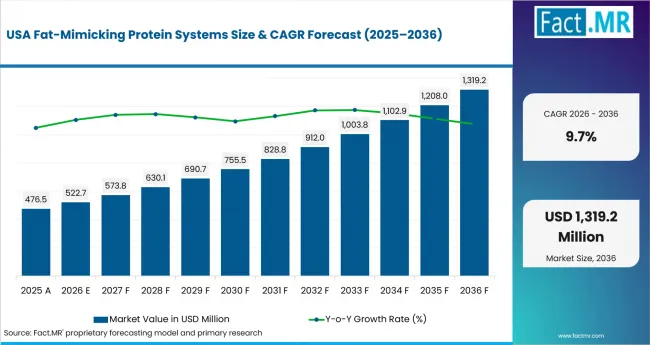
Fat Mimicking Protein Systems Country Value Analysis | Source: Fact.MR
The USA has a large food base and strong whey supply. In June 2026, USDA Economic Research Service reported USD 2.51 trillion in total food spending for 2025. The scale gives protein systems many uses in dairy and drinks. Sauces and nutrition foods add more uses. Large brands are expected to favor steady texture across long production runs. Whey and milk proteins can serve both fat reduction and protein claims. Plant proteins add options for dairy-free lines.
How is France developing demand?
9.7% CAGR through 2036, reinforced by dairy collection and plant-protein recipe expertise.
France has a broad dairy base and active plant protein work. In June 2026, Agreste reported that April 2026 cow-milk collection was 1.2% above a year earlier. The dairy stream supports work in yogurt and cream-style foods. Plant proteins add another route for dairy-style and hybrid products. French food makers can use both dairy and plant sources to tune body. Taste and smoothness remain central in cultured and dessert formats.
What underpins Germany growth?
9.5% CAGR through 2036, supported by dairy scale and prepared-food processing.
Germany has large dairy plants and a deep prepared-food base. In January 2026, Destatis reported 1.7 million tonnes of ready meals were made in 2024. The food output widens the use of texture systems. Milk and whey proteins fit dairy and sauces. Protein-polysaccharide systems can serve prepared foods. Plant-scale use favors powders that are easy to meter. Stable texture after heat is also important in chilled and ready-to-eat foods.
Who leads the Fat-Mimicking Protein Systems Market?
Tate & Lyle / SIMPLESSE and Leprino Nutrition are part of the profiled supplier group serving protein-based texture and mouthfeel applications. Their relevance sits within a market where food makers use protein systems to recreate creaminess, body and fat-like sensory performance in dairy, beverages and other formulated foods.
Arla Foods Ingredients participates through functional dairy proteins and related texture solutions. Its Nutrilac ProteinBoost activity illustrates the use of dairy-protein systems in applications where smooth texture and higher protein content need to work together. Heat response, particle size and final mouthfeel remain important formulation considerations.
FrieslandCampina Ingredients and Fonterra / NZMP broaden the competitive field through dairy-protein capabilities, while IFF is also profiled across protein and texture applications. Together, these suppliers address formulations spanning whey, milk and other protein platforms used for creaminess, mouthfeel improvement and emulsion support.
Competition therefore depends on how well a protein system manages smoothness, graininess, thickness, taste and processing stability in the finished recipe. Suppliers also need to support performance under heat, shear and changing solids levels, because texture results can shift significantly between laboratory trials and plant-scale production.
Which companies are the key providers?
Tate & Lyle / SIMPLESSE; Leprino Nutrition; Arla Foods Ingredients; FrieslandCampina Ingredients; Fonterra / NZMP; and IFF are profiled.
- Tate & Lyle / SIMPLESSE
- Leprino Nutrition
- Arla Foods Ingredients
- FrieslandCampina Ingredients
- Fonterra / NZMP
- IFF
Bibliography
- Touati-Houari, N. (2026, June 12). Lait. Avril 2026 : la collecte de lait toujours en hausse sur un an [Milk: April 2026—Milk collection remains above the previous year]. Agreste.
- Arla Foods Ingredients. (2025, March 3). Arla Foods Ingredients strengthens US foothold with Valley Queen agreement.
- Statistisches Bundesamt (Destatis). (2026, January 14). Produktion von Fertiggerichten binnen fünf Jahren mengenmäßig um 25,6 % gestiegen [Production of ready meals increased by 25.6% in volume within five years].
- National Bureau of Statistics of China. (2026, February 28). Statistical communiqué of the People’s Republic of China on the 2025 national economic and social development.
- IFF. (2025, April 2). Cracking the code on high-protein dairy.
- Zeballos, E., & Sinclair, W. (2026, June 11). Total U.S. food spending reached $2.51 trillion in 2025. U.S. Department of Agriculture, Economic Research Service.
- U.S. Department of Agriculture, National Agricultural Statistics Service. (2026, April 24). Dairy products 2025 summary.
This Report Answers
- The report explains where fat-mimicking protein systems are used by protein platform and functional role. It also covers application and format choices.
- Segment analysis identifies the share leaders and explains why food makers select them for texture and smooth feel.
- Country analysis covers the USA and China. It also covers Germany, Japan and France. Each country block uses one official evidence point.
- Competitive analysis reviews Tate & Lyle / SIMPLESSE and Leprino Nutrition. It also covers Arla Foods Ingredients, FrieslandCampina Ingredients, Fonterra / NZMP and IFF across protein and texture capabilities.
What does the Fat-Mimicking Protein Systems Market cover?
Whey, milk, plant, egg and fermented protein systems used to reproduce fat-like texture or smooth feel in foods and beverages.
The market covers protein systems that add creaminess and smooth feel. Body and emulsion support are included. It includes whey and milk proteins. Plant, egg and novel proteins are also covered. Fine-particle and hydrolyzed forms are included when they help copy the feel of fat. The focus is the role of protein in texture. Nutrition alone is outside the core test.
The scope is narrower than the full texturant field. Starch, gums and fibers enter only when they are part of a protein-polysaccharide system built for fat mimicry or mouthfeel. The protein must have a clear texture role in the finished food. Simple thickening on its own falls outside the core market.
What is included in the scope?
Protein systems used in dairy / alternatives, beverages, sauces / dressings, bakery and nutrition foods.
Coverage includes whey and milk proteins used for body and creaminess in reduced-fat foods. Adjacent supply analysis includes whey protein concentrate and milk protein concentrate categories.
Plant-based systems are included when protein contributes directly to creaminess or body. Relevant adjacent categories include plant protein ingredients and acid-stable pea protein beverages.
Dairy-alternative recipe is covered where proteins replace or complement milk structures. Related context includes precision fermentation dairy alternatives and cow-free dairy.
What is excluded from the scope?
General texturizers and nutrition proteins without a defined fat-mimicking or mouthfeel function are excluded.
Pure hydrocolloid systems remain outside the core scope when protein is absent from the texture mechanism. Adjacent comparisons include fiber-integrated fat mimetics and food emulsifiers.
General protein ingredients used only for nutrition are outside the core boundary. Broader context is available in protein ingredients and functional foods.
How Was the Analysis Built?
The analysis draws on 120+ sources, 35+ company portfolios, 25+ countries, and more than 20 industry interviews.
- Primary Research: Primary research includes discussions with manufacturers, service providers, technology developers, distributors, end users, and subject-matter experts. These conversations examine purchasing priorities, product adoption, operational challenges, approval requirements, competitive positioning, and the factors that influence wider market acceptance.
- Desk Research: Desk research covers government statistics, regulatory publications, company filings, trade data, technical studies, industry associations, standards, public policy, and other authoritative sources. Every source used in the analysis is documented in the bibliography.
- Market Sizing and Forecasting: Market estimates combine historical performance, demand indicators, pricing and volume trends, segment shares, company participation, country-level growth, adoption patterns, investment activity, and barriers to market expansion.
- Data Validation and Update Cycle: Findings are validated by comparing primary interviews with public data, company activity, regulatory changes, trade patterns, and industry developments. Regular updates review new product launches, capacity changes, partnerships, approvals, and shifts in commercial adoption.
What is the report’s scope and coverage?
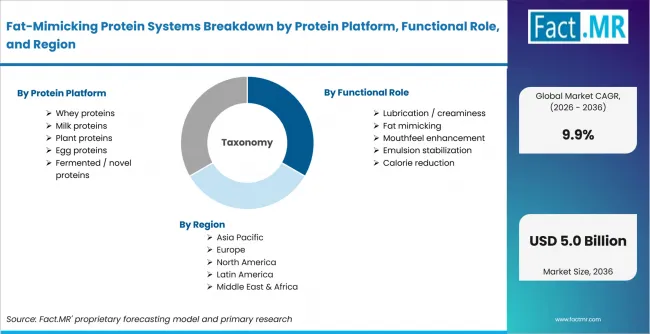
Fat Mimicking Protein Systems Breakdown By Protein Platform, Functional Role, And Region | Source: Fact.MR
| Attribute | Details |
|---|---|
| Quantitative Units | USD billion |
| Market Definition | Protein-based ingredient systems formulated to reproduce fat-like smooth feel, creaminess, body or emulsion support in food and beverage products. |
| Protein Platform | Whey proteins; Milk proteins; Plant proteins; Egg proteins; Fermented / novel proteins |
| Functional Role | Lubrication / creaminess; Fat mimicking; Mouthfeel enhancement; Emulsion stabilization; Calorie reduction |
| Application | Dairy / alternatives; Beverages; Sauces / dressings; Bakery; Nutrition foods |
| Format | Powder concentrate; Microparticulated protein; Hydrolyzed protein; Protein-polysaccharide system; Custom functional blend |
| Regions Covered | North America; Latin America; Western Europe; Eastern Europe; East Asia; South Asia & Pacific; Middle East & Africa |
| Countries Covered | USA; China; Germany; Japan; France |
| Key Companies Profiled | Tate & Lyle / SIMPLESSE; Leprino Nutrition; Arla Foods Ingredients; FrieslandCampina Ingredients; Fonterra / NZMP; IFF |
| Forecast Period | 2026 to 2036 |
| Approach | Hybrid top-down and bottom-up review using protein ingredient supply, use demand, functional roles, country indicators and provider portfolios. |
How is the market segmented?
-
By Protein Platform:
- Whey proteins
- Milk proteins
- Plant proteins
- Egg proteins
- Fermented / novel proteins
-
By Functional Role:
- Lubrication / creaminess
- Fat mimicking
- Mouthfeel enhancement
- Emulsion stabilization
- Calorie reduction
-
By Application:
- Dairy / alternatives
- Beverages
- Sauces / dressings
- Bakery
- Nutrition foods
-
By Format:
- Powder concentrate
- Microparticulated protein
- Hydrolyzed protein
- Protein-polysaccharide system
- Custom functional blend
-
By Region:
- North America
- Latin America
- Western Europe
- Eastern Europe
- East Asia
- South Asia & Pacific
- Middle East & Africa