- Base Value(2026): 13724.0 Mn
- Forecast Value (2036): 33090.8 Mn
- CAGR (2036): 9.2%
Cow - Free Dairy Market Forecast 2026 to 2036
In 2025, the cow-free dairy market was valued at USD 12,653.5 Mn. Based on Fact.MR's analysis, demand for cow-free dairy products is estimated to grow to USD 13,724.0 Mn in 2026 and USD 33,090.8 Mn by 2036. Fact.MR projects a CAGR of 9.2% during the forecast period.
The market is set to expand by an absolute dollar opportunity of approximately USD 19,366.8 Mn between 2026 and 2036. This reflects strong structural expansion rather than incremental growth, driven by scaling precision fermentation capacity and increasing retail penetration. However, capital-intensive biomanufacturing infrastructure, feedstock cost volatility, and regulatory approval timelines continue to moderate the pace of adoption in price-sensitive markets.
Industry disclosures consistently emphasize the importance of cost parity and production scale. Leading fermentation companies highlight strain optimization and downstream processing efficiency as key levers to reduce per-unit costs and secure long-term B2B supply agreements, reinforcing disciplined and phased capacity expansion strategies.
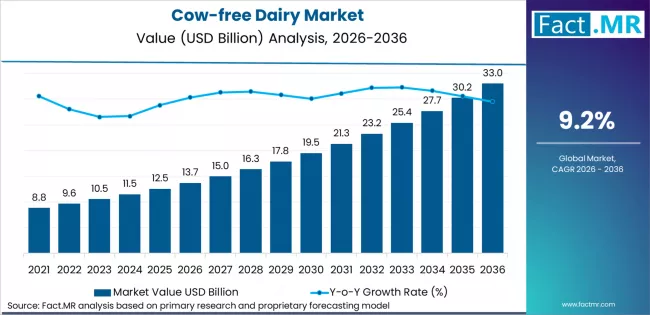
Cow Free Dairy Market Market Value Analysis | Source: Fact.MR
Country-level growth remains differentiated. India (11.8% CAGR) and China (11.2% CAGR) lead due to rising protein consumption and food security initiatives. The United States (9.8% CAGR) follows, supported by established commercialization infrastructure. Germany (9.1%) and the United Kingdom (8.9%) benefit from regulatory clarity and sustainability mandates. Japan (8.4%) and Canada (8.1%) reflect steady adoption, while mature Western European markets generate more replacement-driven demand, constrained by strict novel food approval processes and price sensitivity.
Cow- Free Dairy Market Definition
The cow-free dairy market refers to dairy-identical proteins and related products produced without using cows, typically through precision fermentation or synthetic biology. In this process, microorganisms such as yeast are engineered to produce milk proteins like whey and casein. These proteins are then used to make milk, cheese, yogurt, ice cream, and other dairy products that closely match conventional dairy in taste, texture, and nutrition. The primary industrial function of cow-free dairy proteins is to replicate the functional properties of traditional dairy such as melting, foaming, and emulsifying while reducing reliance on animal agriculture. Key end-uses include retail consumer products, foodservice, nutritional supplements, and infant nutrition formulations.
Market Inclusions
This report covers global and regional market size estimates and forecasts for the cow-free dairy market over the defined forecast period. It provides segment-level analysis by product type, technology platform, ingredient type, form, application, and distribution channel. The study includes pricing trends, investment analysis, regulatory developments, and capacity expansion tracking. Regional breakdowns include North America, Europe, Asia Pacific, Latin America, and Middle East & Africa, along with country-level insights for key markets.
Market Exclusions
The scope excludes plant-based dairy alternatives made solely from soy, almond, oat, or other crops unless blended with fermentation-derived dairy proteins. It also omits conventional animal-derived dairy products and cell-cultured dairy grown directly from animal cells. Downstream finished foods not containing cow-free dairy ingredients are excluded. The report focuses strictly on precision-fermented dairy proteins and their immediate applications in dairy-equivalent products and ingredient supply chains.
Research Methodology
Primary Research
Interviews were conducted with fermentation technology providers, dairy ingredient manufacturers, food and beverage companies, distributors, and industry experts.
Desk Research
Public sources such as company annual reports, investor presentations, regulatory filings, government policy documents, and trade databases were analyzed.
Market‑Sizing and Forecasting
A hybrid model combining bottom-up company revenue analysis and top-down industry benchmarking was used to estimate current size and forecast growth.
Data Validation and Update Cycle
Findings were triangulated across supply-side and demand-side inputs, with periodic updates aligned to major regulatory approvals, funding announcements, and capacity expansions.
Cow- Free Dairy Market Summary
Market Definition
The cow-free dairy market comprises dairy-identical proteins and finished products produced using precision fermentation or synthetic biology without the use of animal agriculture.
Demand Drivers
- Food and beverage manufacturers are adopting fermentation-derived whey and casein to replicate meltability and emulsification properties that plant-based proteins cannot deliver.
- Retail consumers with lactose intolerance are shifting toward animal-free dairy products that provide conventional taste and nutritional equivalence.
- Multinational food companies are integrating low-emission dairy alternatives into portfolios to meet ESG targets and Scope 3 carbon reduction commitments.
Key Segments Analyzed
- By Product Type, Whey & Casein Proteins lead with an estimated ~24% share due to strong B2B ingredient demand.
- By Application, Retail Consumer Products account for roughly ~31% share, driven by premium positioning and brand visibility.
- By Geography, North America remains the leading regional market, supported by early regulatory clarity and fermentation infrastructure.
Analyst Opinion at FACT.MR
A senior analyst at Fact.MR opines, ‘CXOs will gain actionable insights on cost-parity milestones, regulatory turning points, and competitive strategy development shaping the future trajectory of the cow-free dairy market.’
Strategic Implications / Executive Takeaways
- Prioritize investment in fermentation capacity and strain optimization to accelerate cost reduction.
- Secure long-term B2B supply agreements with multinational food processors to stabilize revenue streams.
- Develop hybrid product strategies combining fermentation-derived proteins with plant-based bases to enhance price competitiveness.
Methodology
- Market sizing validated through triangulation of company disclosures, investor presentations, and regulatory filings.
- Demand estimates cross-verified with primary interviews across ingredient suppliers and food manufacturers.
- Regional projections modeled using production capacity announcements and policy-driven investment trends.
Segmental Analysis
Cow- Free Dairy Market Analysis by Product Type
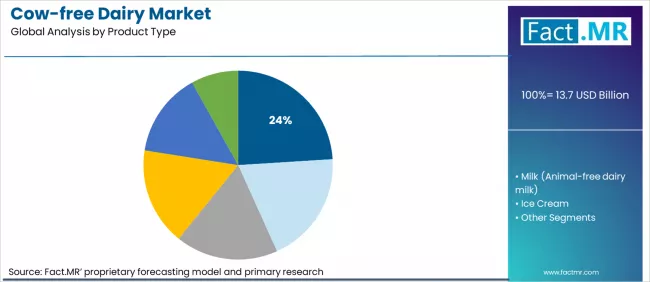
Cow Free Dairy Market Analysis By Product Type | Source: Fact.MR
Based on Fact.MR's cow- free dairy market report, consumption of Whey & Casein Proteins is estimated to hold 24% share in 2025. This sub-segment dominates because it functions as the core enabling ingredient for multiple downstream applications, including milk, cheese, and high-protein formulations. Fermentation-derived whey and casein provide identical functional properties-such as emulsification, foaming, and meltability-solving performance limitations faced by plant-based substitutes and enabling B2B scalability.
- Capacity Expansion Investment: Perfect Day announced expansion of its precision fermentation production through partnerships with established manufacturers in March 2023, strengthening commercial whey protein output capacity and reinforcing ingredient-level dominance [1].
- Casein Innovation Launch: Formo secured funding in July 2022 to scale animal-free casein production for cheese applications, supporting functional protein commercialization across European markets [2].
- B2B Supply Agreements: Remilk entered a commercial partnership with major dairy producer Gad Dairies in November 2023 to supply precision-fermented whey protein for retail milk products, reflecting ingredient-level integration into traditional dairy supply chains [3].
Cow- Free Dairy Market Analysis by Application
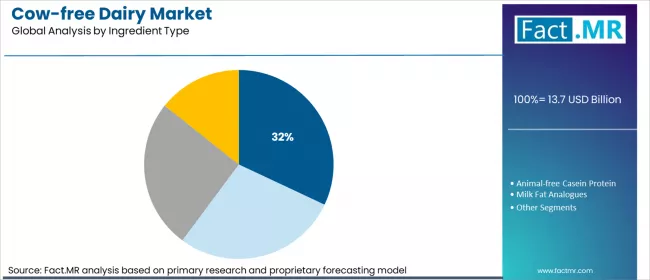
Cow Free Dairy Market Analysis By Ingredient Type | Source: Fact.MR
Based on Fact.MR's cow- free dairy market report, consumption in Retail Consumer Products is estimated to hold 31% share in 2025. This segment leads due to increasing consumer demand for sustainable, lactose-free, and animal-free alternatives that closely replicate conventional dairy taste and texture. Retail channels provide brand visibility and pricing flexibility, enabling premium positioning during early commercialization stages.
- Retail Product Launch: Remilk’s partnership with Gad Dairies in November 2023 introduced “The New Milk” into Israeli retail channels, signaling commercial retail rollout of cow-free dairy beverages [4].
- Foodservice Commercialization: New Culture announced plans in September 2023 to launch animal-free mozzarella in U.S. foodservice outlets, validating restaurant channel demand for functional dairy proteins [5].
- Nutritional Application Expansion: TurtleTree expanded commercialization of fermentation-derived lactoferrin for nutrition markets in 2023, targeting high-value supplement and infant nutrition applications [6].
Key Dynamics
Cow- Free Dairy Market Drivers, Restraints, and Opportunities
Fact.MR analysis indicates that the cow-free dairy market is in a high-growth transition phase, evolving from pilot-scale biotechnology innovation to early-stage commercialization. The market exists at its current size primarily due to advances in precision fermentation and regulatory pathways that allow animal-free proteins to enter the food supply. A defining structural force has been regulatory validation, particularly novel food and safety review frameworks that legitimize fermentation-derived dairy proteins. Capital-intensive infrastructure requirements and strain engineering complexity have kept supply constrained, limiting volume expansion despite strong investor interest and sustainability-driven demand.
The core tension in the market lies between technological promise and cost competitiveness. Conventional dairy remains price-efficient due to established supply chains and subsidies in several regions, while cow-free dairy proteins are still scaling toward price parity. Demand for traditional dairy is stable in mass markets but facing long-term sustainability scrutiny, especially in climate-sensitive economies. Meanwhile, demand for high-performance, animal-free proteins is growing in premium retail and B2B ingredient channels. Although fermentation-derived proteins carry higher per-unit production costs, their superior functionality and ESG positioning support premium pricing. As production volumes increase and fermentation efficiency improves, cost curves are expected to narrow, strengthening mainstream adoption.
- Regulatory Validation Momentum: Regulatory frameworks such as the U.S. FDA’s “Generally Recognized as Safe” (GRAS) review process have created commercialization pathways for precision-fermented proteins. Clear safety evaluations reduce investor risk and accelerate product launches, directly influencing market confidence and capacity expansion.
- Sustainability Mandates: Corporate climate commitments and ESG disclosure pressures are pushing multinational food companies to diversify protein sourcing. Regions such as the European Union, with its Farm to Fork Strategy, are indirectly stimulating demand for low-emission dairy alternatives.
- Geographic Investment Clusters: North America and Israel have emerged as fermentation investment hubs due to strong venture ecosystems and biotech infrastructure. Concentrated capital deployment in these regions accelerates innovation cycles and gives early movers structural scaling advantages.
Regional Analysis
The market analysis covers key global regions, including South Asia and Pacific, Middle East & Africa, North America, Latin America, Western Europe, and Eastern Europe. It is segmented geographically, with specific market dynamics for each region. The full report provides a detailed market attractiveness analysis.
Cow- Free Dairy Market CAGR Table
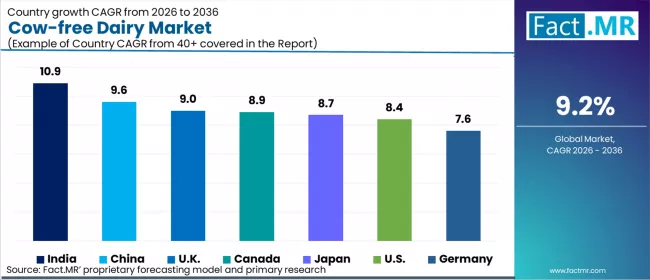
Cow Free Dairy Market Cagr Analysis By Country | Source: Fact.MR
| Country | CAGR (%) |
|---|---|
| U.S. | 8.4% |
| Germany | 7.6% |
| U.K. | 9.0% |
| Canada | 8.9% |
| China | 9.6% |
| India | 10.9% |
| Japan | 8.7% |
Source: Fact.MR analysis. Updated Feb 19, 2026
Source: Fact MR (FMR) analysis, based on proprietary forecasting model and primary research.
North America
The Commercialization Powerhouse
North America functions as the commercialization powerhouse of the Cow-Free Dairy Market, supported by advanced biomanufacturing infrastructure and early regulatory clarity. The U.S.-based Perfect Day leads in precision-fermented whey scale-up, while Motif FoodWorks strengthens B2B ingredient capabilities. Canada-backed innovation clusters, supported by Protein Industries Canada, reinforce regional fermentation R&D and downstream commercialization competitiveness.
- United States
Demand for cow-free dairy products in the United States is projected to rise at 28% CAGR through 2032. Growth is supported by regulatory clarity and industrial investment momentum. In March 2023, Perfect Day announced expansion of commercial production capacity through strategic manufacturing partnerships to scale whey protein output. Rising sustainability-driven consumption and strong foodservice trials further reinforce domestic demand.
- Canada
Demand for cow-free dairy products in Canada is projected to rise at 24% CAGR through 2032. Market expansion is supported by structured alternative protein investment programs. In 2023, the Government of Canada announced additional funding under the Strategic Innovation Fund to support food-biotech scale-up projects. These initiatives strengthen local fermentation infrastructure and supply chain resilience. While commercial production remains smaller than in the U.S., supportive public funding and export-oriented protein strategies are improving long-term market prospects.
Western Europe
The Regulatory Innovation Hub
Western Europe acts as the regulatory innovation hub for cow-free dairy, supported by stringent food safety frameworks and strong biotech ecosystems. Germany’s Formo and France-based Standing Ovation are advancing precision-fermented casein development, while the Netherlands provides fermentation infrastructure and pilot-scale support, positioning the region as a structured commercialization zone.
- Germany
Demand for cow-free dairy products in Germany is projected to rise at 26% CAGR through 2032. Growth is influenced by EU novel food regulations and sustainability mandates. The European Commission’s Novel Food Regulation framework continues to define commercialization timelines, shaping product launches across Germany. Additionally, Germany’s Federal Ministry of Food and Agriculture expanded alternative protein research funding in 2023 to encourage sustainable protein innovation. These measures enhance R&D strength but regulatory approval timelines may moderate short-term market expansion.
- France
Demand for cow-free dairy products in France is projected to rise at 23% CAGR through 2032. Strong consumer sustainability awareness and EU-aligned food safety standards support adoption, though labeling debates and dairy sector sensitivity may influence pace of mainstream penetration.
East Asia
The Emerging Scale Market
East Asia represents the emerging scale market for cow-free dairy, driven by food security priorities and advanced fermentation ecosystems. Japan’s food-tech R&D ecosystem and South Korea’s biotech expansion policies are strengthening the region’s production capabilities and commercialization pathways
- Japan
Demand for cow-free dairy products in Japan is projected to rise at 22% CAGR through 2032. In June 2023, the Japanese government expanded its Bioeconomy Strategy to promote biomanufacturing and fermentation-based innovation. Additionally, Japan’s Consumer Affairs Agency continues to regulate labeling under the Food Labeling Act, providing structured commercialization pathways. Rising lactose intolerance prevalence and strong plant-based adoption trends are encouraging interest in precision-fermented dairy proteins, though conservative consumer acceptance patterns may temper rapid scaling.
South Asia & Pacific
The Innovation-Led Growth Frontier
South Asia & Pacific serves as an innovation-led growth frontier, supported by startup activity and export-oriented protein strategies. India is emerging as a fermentation innovation hub, while ANZ countries emphasize sustainable food production and agri-biotech modernization.
- India
Demand for cow-free dairy products in India is projected to rise at 30% CAGR through 2032. In 2023, India’s Department of Biotechnology expanded funding under its BioE3 policy to support bio-manufacturing innovation. Growing lactose intolerance prevalence and sustainability awareness among urban consumers are key growth drivers, although regulatory clarity for novel foods remains evolving.
Fact.MR's analysis of the cow-free dairy market across North America, Western Europe, East Asia, South Asia & Pacific, and Middle East & Africa consists of country-wise assessment that includes the U.S., Canada, Germany, France, Japan, India, and Saudi Arabia. Readers can find insights on regulatory developments, investment activity, production scale-up trends, and demand outlook shaping regional growth trajectories.
Competitive Landscape
What Is the Competitive Structure and Buyer Dynamics of the Cow-Free Dairy Market?
The Cow-Free Dairy Market remains moderately fragmented but is gradually consolidating as a handful of precision fermentation pioneers scale production and secure strategic partnerships. While numerous startups operate in niche protein development, the top five players account for a significant share of commercialized fermentation-derived dairy proteins, particularly whey and casein. Competitive intensity is driven less by branding and more by technological capability. The primary competitive variable is cost-efficient fermentation at scale, including yield optimization, downstream processing efficiency, and regulatory approvals. Intellectual property portfolios and strain engineering capabilities also serve as key differentiators in maintaining competitive positioning.
Companies with structural advantages are those that combine proprietary microbial strains with secured fermentation capacity and strong downstream partnerships. Firms that have invested in dedicated large-scale fermentation facilities or formed joint ventures with established dairy processors benefit from reduced production risk and improved cost control.
Strategic alliances with contract manufacturers, long-term supply agreements, and access to established distribution networks further strengthen their market position. Vertical integration across strain development, protein purification, and ingredient formulation enhances margin capture and accelerates commercialization timelines.
Buyer behavior is increasingly strategic and risk-conscious. Large food and beverage manufacturers avoid overdependence on a single fermentation supplier by engaging multiple partners or signing phased supply agreements. Some buyers pursue co-development models to secure customized protein functionality. This multi-sourcing approach moderates supplier pricing power in the short term. However, as production scales and regulatory barriers limit new entrants, suppliers with proven capacity and performance reliability may gain stronger long-term pricing leverage.
Recent Industry Developments
- Perfect Day and Zydus Lifesciences form 50:50 joint venture – August 2024: Perfect Day entered a strategic 50:50 joint venture with Zydus Lifesciences to advance precision-fermented animal-free protein manufacturing in India and strengthen local production capabilities. (New Tech Foods) [7]
???? https://www.newtechfoods.com/news/pharmaceutical-firm-zydus-boosts-india-s-alt-protein-sector-with-perfect-day-jv? - Perfect Day announces new Gujarat production facility – December 2025: Perfect Day confirmed construction of a large-scale precision fermentation facility in Gujarat, India, with operations expected to begin in late 2026, significantly expanding global manufacturing capacity. (AgFunderNews) [8]
???? https://agfundernews.com/perfect-day-says-gujarat-facility-on-track-for-2026-start-2027-ramp-up-for-recombinant-whey-protein? - Superlatus acquires The Urgent Company brands – August 2023: Superlatus acquired the consumer brand portfolio - including Brave Robot, Coolhaus, and Modern Kitchen - broadening distribution and market reach of cow-free dairy products. (Vegconomist) [9]
???? https://vegconomist.com/organisations-and-brands/perfect-day/
Key Players of the Cow- Free Dairy Market
- Perfect Day
- Remilk
- Imagindairy
- New Culture
- Formo
- Change Foods
- Motif FoodWorks
- TurtleTree
- The EVERY Company
- Geltor
- Eden Brew
- Vivici
Report Scope
| Metric | Value |
|---|---|
| Quantitative Units | USD 13,724 million (2026) to USD 33,090.8 million (2036), at a CAGR of 9.2% |
| Market Definition | The Cow-Free Dairy Market comprises dairy proteins and products produced without cows using precision fermentation and biotechnology, including whey and casein, for use in milk, cheese, yogurt, and related food applications. |
| By Product Type | Milk (Animal-free dairy milk), Ice Cream, Cheese, Yogurt, Butter & Cream, Whey & Casein Proteins |
| By Technology Platform | Precision Fermentation, Synthetic Biology / Recombinant DNA, Microbial Fermentation Platforms |
| By Ingredient Type | Animal-free Whey Protein, Animal-free Casein Protein, Milk Fat Analogues, Functional Dairy Enzymes |
| By Form | Liquid, Powder |
| By Application | Retail Consumer Products, Foodservice, Bakery & Confectionery, Nutraceuticals & Protein Supplements, Infant Nutrition |
| By Distribution Channel | Supermarkets/Hypermarkets, Specialty Stores, Online Retail, Foodservice Channels, B2B Ingredient Supply |
| Regions Covered | North America, Latin America, Europe, East Asia, South Asia, Oceania, Middle East and Africa |
| Countries Covered | United States, Canada, Mexico, Brazil, Argentina, Germany, France, United Kingdom, Italy, Spain, China, India, Japan, South Korea, Indonesia, Australia, and 40+ countries |
| Key Companies Profiled | Perfect Day, Remilk, Imagindairy, New Culture, Formo, Change Foods, Motif FoodWorks, TurtleTree, The EVERY Company |
| Forecast Period | 2026 to 2036 |
| Approach | Hybrid top-down and bottom-up market modeling validated through primary interviews with manufacturers and supported by trade data benchmarking and market research. |
Source: Fact.MR analysis. Updated Feb 19, 2026
Bibliographies
[1] Perfect Day Inc., Perfect Day Expands Production Through Strategic Manufacturing Partnerships, March 2023.
URL: https://www.perfectday.com/blog/perfect-day-expands-production-partnerships
[2] Formo Bio GmbH, Formo Raises €42 Million Series A to Scale Animal-Free Cheese Production, July 2022.
URL: https://www.formo.bio/press/formo-raises-series-a
[3] Green Queen Media, Remilk & Gad Dairies Launch Precision-Fermented “The New Milk” in Israel, November 2023.
[4] Green Queen Media, Remilk & Gad Dairies Launch Precision-Fermented “The New Milk” in Israel, November 2023.
[5] New Culture, New Culture to Launch Animal-Free Mozzarella in U.S. Foodservice, September 2023.
URL: https://www.newculturefood.com/press
[6] TurtleTree Labs, TurtleTree Expands Precision-Fermented Lactoferrin Commercialization, 2023.
URL: https://www.turtletree.com/news
[7] New Tech Foods, Pharmaceutical Firm Zydus Boosts India’s Alt-Protein Sector with Perfect Day JV, August 2024.
[8] AgFunderNews, Perfect Day Says Gujarat Facility on Track for 2026 Start, 2027 Ramp-Up for Recombinant Whey Protein, December 2025.
[9] Vegconomist, Superlatus Acquires The Urgent Company Brands Including Brave Robot and Coolhaus, August 2023.
URL: https://vegconomist.com/organisations-and-brands/perfect-day/
Segmentation
Cow- Free Dairy Market Key Segments
-
By Product Type :
- Milk (Animal-free dairy milk)
- Ice Cream
- Cheese
- Yogurt
- Butter & Cream
- Whey & Casein Proteins
-
By Technology Platform :
- Precision Fermentation
- Synthetic Biology / Recombinant DNA
- Microbial Fermentation Platforms
-
By Ingredient Type :
- Animal-free Whey Protein
- Animal-free Casein Protein
- Milk Fat Analogues
- Functional Dairy Enzymes
-
By Form :
- Liquid
- Powder
-
By Application :
- Retail Consumer Products
- Foodservice
- Bakery & Confectionery
- Nutraceuticals & Protein Supplements
- Infant Nutrition
-
By Distribution Channel :
- Supermarkets/Hypermarkets
- Specialty Stores
- Online Retail
- Foodservice Channels
- B2B Ingredient Supply
-
Region :
- North America
- USA
- Canada
- Mexico
- Europe
- Germany
- UK
- France
- Italy
- Spain
- Nordic Countries
- BENELUX
- Rest of Europe
- Asia Pacific
- China
- Japan
- South Korea
- India
- Australia
- Rest of Asia Pacific
- Latin America
- Brazil
- Argentina
- Rest of Latin America
- Middle East and Africa
- Kingdom of Saudi Arabia
- United Arab Emirates
- South Africa
- Rest of Middle East and Africa
- Other Regions
- Oceania
- Central Asia
- Other Markets
- North America
Frequently Asked Questions
How large is the demand for Cow-Free Dairy in the global market in 2026?
What will be the market size of Cow-Free Dairy in the global market by 2036?
What is the expected demand growth for Cow-Free Dairy in the global market between 2026 and 2036?
Which product type is expected to dominate the market?
Which region is expected to show the highest growth rate for Cow-Free Dairy?
How significant is the growth outlook for the United Kingdom in this market?
What is the growth outlook for Canada in this report?
What is the growth forecast for the United States in the Cow-Free Dairy market?
Which European market is highlighted in this analysis?
Which company is identified as a leading player in the Cow-Free Dairy market?
What are Cow-Free Dairy products used for?
What does the Cow-Free Dairy market include in this report?
How is the market forecast developed in this report?
What is meant by the Cow-Free Dairy market in this report?
Who worked on this report


Preview the report firsthand - request a free sample
Free SampleGet the brochure for pricing and purchase details
Download PDF