- Market Value (2025): USD 1.2 Bn
- Estimated Value (2026): USD 1.3 Bn
- Forecast Value (2036): USD 2.6 Bn
- CAGR (2026-2036): 7.4%
What is the Fermented Savory Flavor Concentrates Market forecast to be worth by 2036?
USD 1.3 billion in 2026 to USD 2.6 billion by 2036 at 7.4% CAGR.
- The fermented savory flavor concentrates market reached USD 1.2 billion in 2025 as brands widened reformulation work around sodium, savory depth, and clean-label seasoning systems.
- Demand is projected to increase from USD 1.3 billion in 2026 to USD 2.6 billion by 2036.
- The market is forecast to record 7.4% CAGR from 2026 to 2036 owing to snack manufacturers, soup makers, and ready-to-eat soup developers needing compact fermented bases.
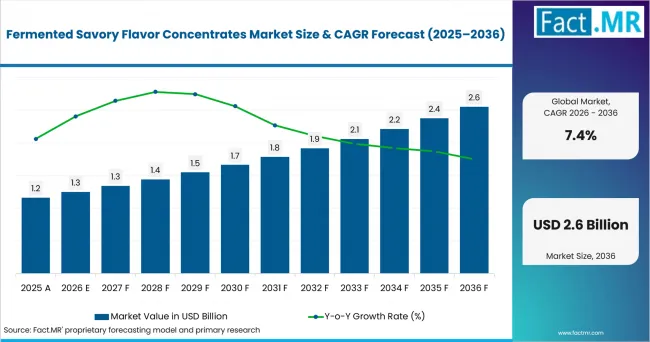
Fermented Savory Flavor Concentrates Market Value Analysis | Source: Fact.MR
What are the defining numbers behind Fermented Savory Flavor Concentrates Market growth?
USD 1.30 billion absolute opportunity by 2036, led by yeast extracts, paste formats and umami enhancement.
- Demand Drivers in the Market
- Snack brands need compact flavor enhancers that keep umami impact when salt levels are reduced.
- Soup and sauce formulators need paste concentrates because wet bases carry broth depth better than dry spice blends.
- Meat-alternative developers use fermented concentrates to soften beany notes and add cooked savory depth in protein matrices.
- Foodservice and retail manufacturers track sodium pressure closely. The World Health Organization reported in May 2026 that adult mean sodium intake was 4,278 mg/day in 2021, more than twice its recommended level.
- Key Segments Analyzed
- By Source: Yeast extracts are expected to hold 34.0% share in 2026 because they deliver familiar umami notes and fit broth, snack, and seasoning bases.
- By Form: Paste is projected to account for 41.0% share in 2026 due to its fit in sauces, soup bases, and seasoning slurries.
- By Application: Savoury snacks are anticipated to capture 28.0% share in 2026 owing to high seasoning intensity and frequent recipe renovation.
- By Function: Umami enhancement is estimated to represent 44.0% share in 2026 since it anchors the core buying reason for fermented concentrates.
- Analyst Opinion at Fact.MR
- Shambhu Nath Jha, Principal Consultant at Fact.MR, states, "Fermented savory concentrates are being bought for recipe control rather than flavor novelty alone. Procurement teams are expected to ask for salt-reduction proof, allergen clarity, and batch consistency before wider approval. Suppliers that combine fermentation know-how with application testing are positioned to win repeat briefs from snacks, sauces, and prepared meals."
- Strategic Implications
- Formulators should test dosage curves against salt perception enhancing flavor modulators before moving a concentrate into full recipe approval.
- Ingredient suppliers should build evidence around real applications. Eurostat reported in July 2025 that EU food, beverage and tobacco sold production rose 1.8% to EUR 1,081 billion in 2024.
- Investors should separate fermented savory systems from broad food additives because margins depend on source control and sensory proof.
South Korea is projected to record 9.8% CAGR through 2036 as ambient ready meals and fermented condiment familiarity support concentrate use. The United Kingdom is expected to post 8.1% CAGR through salt-aware eating and chilled convenience foods. The United States is forecast to advance at 7.9% CAGR owing to foodservice scale and snack renovation. France is anticipated to reach 7.4% CAGR through culinary bases and prepared sauces. Japan is estimated to register 7.2% CAGR with umami familiarity and disciplined seasoning use. Germany is estimated to record 6.9% CAGR as meat-alternative reformulation remains selective.
How does the Fermented Savory Flavor Concentrates Market break down by segment?
Yeast extracts lead Source at 34.0%; Paste leads Form at 41.0%.
Which source dominates?
Yeast extracts are projected to account for 34.0% share in 2026.
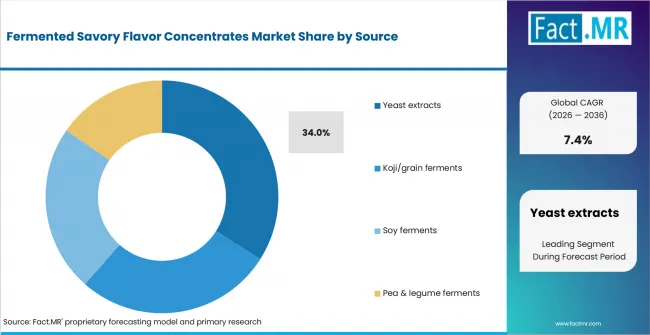
Fermented Savory Flavor Concentrates Market Analysis By Source | Source: Fact.MR
Yeast extracts are expected to lead Source because they provide familiar umami, nucleotides, and savory depth without changing the recipe identity. Koji and grain ferments remain useful where brands want a rounder cereal note. Soy ferments serve Asian sauces and marinades. Pea and legume ferments are used where plant-protein masking is part of the brief. Angel Yeast said in September 2025 that its Fi India 2025 showcase included a peptide-based umami enhancer designed to deliver instant umami flavor from the first bite.
What leads the Form segment?
Paste is expected to hold 41.0% share in 2026.
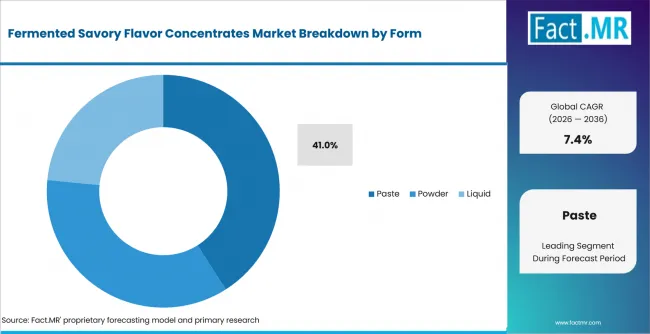
Fermented Savory Flavor Concentrates Market Analysis By Form | Source: Fact.MR
Paste formats are projected to lead Form because they disperse well in sauces, wet seasoning bases, and soup concentrates. Powder keeps a strong position in snacks and dry mixes where storage and dosing are easier. Liquid systems remain relevant for industrial sauces and foodservice bases that require direct blending.
How does Application shape demand?
Savoury snacks are anticipated to lead with 28.0% share in 2026.
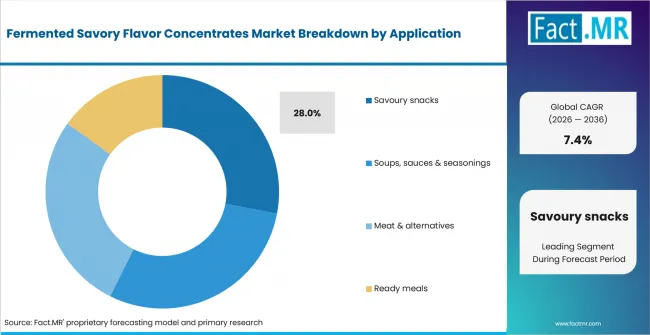
Fermented Savory Flavor Concentrates Market Analysis By Application | Source: Fact.MR
Savoury snacks are anticipated to lead Application because seasoning coverage and repeat launches reward compact umami systems. Soups, sauces, and seasonings follow closely since broth notes often define consumer acceptance. Meat and alternatives use masking and rounding systems when protein bases add bitterness. Ready meals create a broad base for paste and powder formats. Statistics Korea reported in January 2025 that rice use in other prepared meals and dishes reached 162,697 tons in 2024, up 25.0% from 2023.
What supports Umami enhancement within Function?
Umami enhancement is estimated to represent 44.0% share in 2026.
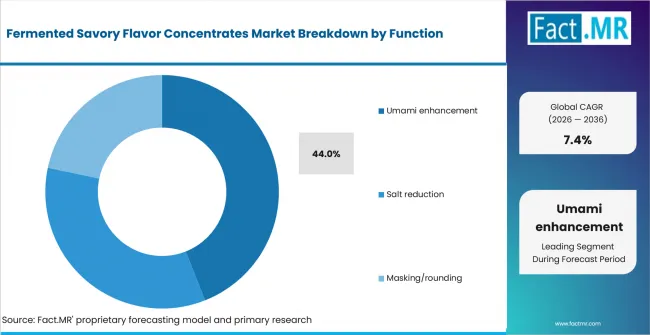
Fermented Savory Flavor Concentrates Market Analysis By Function | Source: Fact.MR
Umami enhancement is estimated to lead Function because it is the clearest commercial reason for fermented savory concentrates. Salt reduction follows as brands work to keep perceived intensity when sodium drops. Masking and rounding are useful in plant-based foods and protein-rich meals where base ingredients carry off-notes.
What is accelerating Fermented Savory Flavor Concentrates Market adoption, and what is holding it back?
Salt-reduction reformulation drives it; allergen and taste-match risk restrain it.
Drivers Impact Analysis
| Driver | (~) % Impact on CAGR | Geographic Relevance | Impact Timeline |
|---|---|---|---|
| Salt-reduction reformulation | +2.0% | United States, United Kingdom, Japan | Short term (<= 2 years) |
| Snack seasoning renovation | +1.7% | United States, Germany, South Korea | Short term (<= 2 years) |
| Ready-meal and soup bases | +1.4% | South Korea, Japan, France | Medium term (2-4 years) |
| Plant-protein masking | +1.2% | Germany, United Kingdom, United States | Medium term (2-4 years) |
| Clean-label taste systems | +0.9% | Europe and East Asia | Long term (>= 4 years) |
- Salt-reduction reformulation: Fermented concentrates are expected to help formulators protect savory intensity while lowering direct salt loading. WHO noted in May 2026 that sodium is often found in high amounts in processed foods such as snack foods, as well as in condiments.
- Snack seasoning renovation: Snack brands are projected to use yeast and grain ferments when cheese, roast, and broth profiles need stronger upfront impact.
- Ready-meal and soup bases: Paste and liquid concentrates are anticipated to fit centralized sauce bases where heating, storage, and reheating affect taste.
- Plant-protein masking: Pea, soy, and legume proteins are estimated to keep masking demand visible because bitter notes reduce repeat purchase.
- Clean-label taste systems: Fermentation-derived labels are expected to appeal where brands want depth without relying only on artificial flavor descriptions.
Opportunity Impact Analysis
| Opportunity | (~) % Impact on CAGR | Geographic Relevance | Impact Timeline |
|---|---|---|---|
| Peptide-rich umami systems | +1.1% | East Asia and North America | Medium term (2-4 years) |
| Paste bases for ready meals | +0.9% | South Korea, Japan, United Kingdom | Medium term (2-4 years) |
| Dry blends for snacks | +0.8% | United States and Germany | Short term (<= 2 years) |
| Localized fermented notes | +0.6% | Japan, France, South Korea | Long term (>= 4 years) |
- Peptide-rich umami systems: Suppliers are expected to use controlled fermentation to create rounded savory notes with lower dosage levels.
- Paste bases for ready meals: Prepared-food developers are anticipated to prefer paste formats when wet sauces need repeatable roast or broth character.
- Dry blends for snacks: Powder formats are projected to gain briefs where snack plants need dosing accuracy and shelf stability.
- Localized fermented notes: Country-specific profiles are expected to create opportunities for koji, soy, and legume ferments tailored to local taste memory.
Restraints Impact Analysis
| Restraint | (~) % Impact on CAGR | Geographic Relevance | Impact Timeline |
|---|---|---|---|
| Allergen and label review | -1.0% | Europe, Japan, United States | Short term (<= 2 years) |
| Taste-match risk | -0.8% | Japan, France, South Korea | Short term (<= 2 years) |
| Input and fermentation cost | -0.7% | Global | Medium term (2-4 years) |
| Thermal stability proof | -0.5% | Ready-meal and soup plants | Medium term (2-4 years) |
- Allergen and label review: Soy and yeast-derived systems are expected to face additional checks when clean-label claims or vegan claims are used.
- Taste-match risk: Fermented notes can become too dark, bitter, or broth-heavy when a product has a familiar local profile.
- Input and fermentation cost: Controlled fermentation is projected to carry a higher proof burden than commodity seasonings when brands cannot show dosage savings.
- Thermal stability proof: Ready meals and soups require evidence that savory notes survive retort, UHT, or reheating without developing harsh aftertaste.
Which countries are scaling Fermented Savory Flavor Concentrates Market fastest?
- The country comparison spans 2.90 percentage points and forms three practical growth bands across the forecast period.
- South Korea remains 1.77 percentage points above the United Kingdom as prepared meals and fermented condiment familiarity support concentrate testing.
- The United Kingdom remains 0.16 percentage point above the United States because salt-aware eating and chilled convenience foods support reformulation briefs.
- The United States remains 0.52 percentage point above France owing to foodservice scale and snack seasoning renovation.
- France remains 0.20 percentage point above Japan through culinary bases and prepared sauce applications.
- Japan remains 0.25 percentage point above Germany because umami familiarity shortens product education.
- Germany closes the displayed range as meat-alternative and processed-food reformulation remains selective.
Comparable CAGRs create different entry conditions across application depth and local formulation habits. Full report coverage includes North America, Europe, East Asia, South Asia and Pacific, and Oceania.
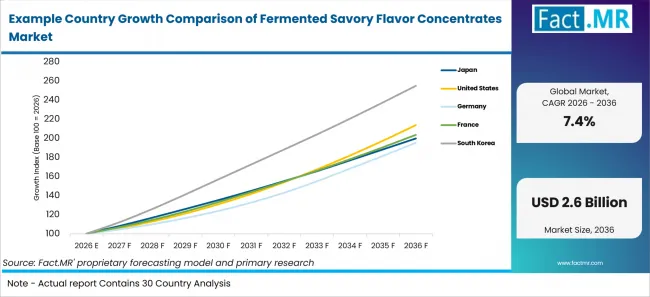
Example Country Growth Comparison Of Fermented Savory Flavor Concentrates Market | Source: Fact.MR
| Country | CAGR (2026-2036) |
|---|---|
| South Korea | 9.8% |
| United Kingdom | 8.1% |
| United States | 7.9% |
| France | 7.4% |
| Japan | 7.2% |
| Germany | 6.9% |
What supports South Korea adoption?
9.8% CAGR, supported by prepared meals and fermented condiment use.
South Korea’s growth reflects a food system where rice-based prepared meals, soups, and fermented condiments create direct applications for paste and powder concentrates. Local formulators are expected to use fermented savory notes when convenience meals need deeper broth character without heavy sauce loading.
How is the United Kingdom scaling demand?
8.1% CAGR, shaped by salt-aware eating and chilled convenience foods.
The United Kingdom is expected to scale through retail meals, snacks, and sauces that need stronger flavor after sodium or ingredient changes. The Office for National Statistics reported in June 2026 that UK spending on food and non-alcoholic drinks rose by GBP 3.20 per week in FYE 2025, a 5.0% nominal increase.
What is driving United States growth from 2026 to 2036?
7.9% CAGR, backed by foodservice scale and snack flavor renovation.
The United States has a large prepared-food and foodservice base that supports repeat testing of concentrated savory systems. USDA Economic Research Service reported in June 2026 that food-away-from-home spending reached USD 1.41 trillion in 2025 and accounted for 56.3% of total food expenditures.
How does France perform?
7.4% CAGR, led by culinary bases and prepared-food flavor depth.
France is anticipated to grow through sauces, ready meals, and culinary bases where fermented notes must support flavor depth without making recipes taste industrial. Prepared-food brands are expected to use yeast and legume ferments cautiously because French consumers often judge broth, roast, and cheese notes by authenticity. Paste formats are forecast to gain use where sauce bases need a round finish and stable mouthfeel.
What supports Japan adoption?
7.2% CAGR, reinforced by umami familiarity and seasoning discipline.
Japan’s market benefits from long familiarity with dashi, miso, soy sauce, and umami seasoning. The Statistics Bureau of Japan reported in February 2026 that average monthly consumption expenditure for two-or-more-person households reached 314,001 yen in 2025, up 4.6% nominally.
How is Germany developing demand?
6.9% CAGR, supported by processed-food scale and selective plant-protein reformulation.
Germany is expected to develop through meat alternatives, snacks, and dry mixes where off-note masking and savory lift are defined recipe needs. Federal Statistical Office reported in May 2026 that Germany produced 124,900 tons of meat substitute products in 2025, down 1.2% from 2024.
Who leads the Fermented Savory Flavor Concentrates Market?
Ajinomoto and Angel Yeast show the clearest fermented umami exposure, while Kerry Group, Givaudan broaden application reach.
Ajinomoto has direct relevance through umami seasonings and fermentation-based flavor knowledge. Angel Yeast brings yeast extract capability across food applications. Kerry Group supports sodium-reduction and savory formulation work. Givaudan opened a CHF 50 million production facility in July 2026 to produce savoury and snack flavor powders. Sensient Technologies completes the provider set through flavors and extracts used across food formulation, including adjacent meat flavors.
Which companies are the key providers?
Key companies include Ajinomoto, Angel Yeast, Kerry Group, Givaudan, and Sensient Technologies.
- Ajinomoto
- Angel Yeast
- Kerry Group
- Givaudan
- Sensient Technologies
What is the report’s scope and coverage?
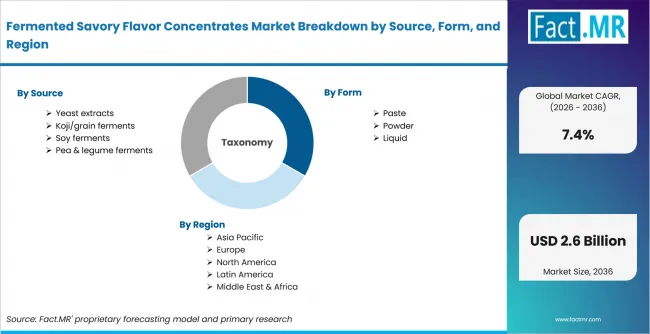
Fermented Savory Flavor Concentrates Market Breakdown By Source, Form, And Region | Source: Fact.MR
| Attribute | Details |
|---|---|
| Quantitative Units | USD billion |
| Market Definition | Concentrated savory flavor systems produced through fermentation where umami, broth depth, salt reduction support, masking, and rounding determine use in food formulation |
| Source | Yeast extracts; Koji/grain ferments; Soy ferments; Pea and legume ferments |
| Form | Paste; Powder; Liquid |
| Application | Savoury snacks; Soups, sauces and seasonings; Meat and alternatives; Ready meals |
| Function | Umami enhancement; Salt reduction; Masking/rounding |
| Regions Covered | North America; Europe; East Asia; South Asia and Pacific; Oceania |
| Countries Covered | Japan; United States; Germany; France; South Korea; United Kingdom |
| Key Companies Profiled | Ajinomoto; Angel Yeast; Kerry Group; Givaudan; Sensient Technologies |
| Forecast Period | 2026 to 2036 |
| Approach | Hybrid top-down and bottom-up approach using food manufacturing demand; savory snack renovation; ready-meal and soup applications; sodium-reduction pressure; fermentation source review; form selection; country adoption patterns and company portfolio review |
Bibliography
- Angel Yeast Co., Ltd. (2025, September 3). Angel Yeast unveils groundbreaking innovations at Fi India 2025.
- Statistisches Bundesamt (Destatis). (2026, May 18). Nach jahrelangem Anstieg: Fleischersatz-Produktion sinkt 2025 um 1,2 % gegenüber dem Vorjahr [After years of growth: Production of meat substitutes falls by 1.2% in 2025 compared with the previous year].
- Eurostat. (2025, July 24). Decrease in industrial production in 2024.
- Givaudan. (2026, July 3). Givaudan inaugurates new production facility in Indonesia.
- Kerry. (2025, September 30). Kerry launches Smart Taste™ to help customers navigate market complexities without compromising on taste.
- Office for National Statistics. (2026, June 11). Family spending in the UK: April 2024 to March 2025.
- Statistics Bureau of Japan. (2026, February 6). 2025 yearly average. Family Income and Expenditure Survey.
- Statistics Korea. (2025, January 23). Food Grain Consumption Survey in 2024.
- World Health Organization. (2026, May 11). Sodium reduction.
This Report Answers
- The report provides strategic intelligence on the Fermented Savory Flavor Concentrates Market across Source and Form choices that shape recipe approval.
- Segment analysis covers yeast extracts and paste formats as the share leaders within the 2026 market.
- Application assessment connects savoury snacks with ambient ready meals and ready-to-eat soup applications that need stable savory notes.
- Country outlook evaluates South Korea and the United Kingdom alongside the United States, France, Japan, and Germany.
- Competitive analysis reviews Ajinomoto and Angel Yeast alongside Kerry Group, Givaudan, and Sensient Technologies.
- Adjacent coverage includes broader flavors and food additives where those categories overlap with savory formulation.
What does the Fermented Savory Flavor Concentrates Market cover?
Fermented savory flavor concentrates are used to add umami, roasted, broth, and rounded savory notes to foods where direct seasoning is not enough.
The Fermented Savory Flavor Concentrates Market covers yeast extracts, koji and grain ferments, soy ferments, and pea or legume ferments. Coverage extends to paste, powder, and liquid forms used in snacks, soups, sauces, seasonings, meat alternatives, and ready meals. It includes products used for umami enhancement, salt reduction, and masking or rounding when the savory function comes from fermentation.
What is included in the scope?
The scope includes fermented savory systems sold as concentrates to food brands, co-packers, seasoning houses, and foodservice formulation teams.
It includes source selection and format selection where fermentation delivers the main savory function. The scope also includes high nucleotide yeast extract when it is used in finished savory concentrates. Coverage includes concentrates used in plant-based meat, meat substitutes, and meat flavors when the product is bought for fermented savory depth or masking support.
What is excluded from the scope?
General flavor blends and commodity seasonings remain outside the scope when fermentation is not the defining source or function.
The scope excludes whole fermented foods sold directly to consumers. It also excludes ordinary spice blends, artificial savory flavors, and single salts where no fermented concentrate is sold. Broader yeast, amino acid, or flavoring ingredient revenue is excluded unless the product is sold as a savory concentrate for food manufacturing.
How Was the Analysis Built?
The analysis draws on 120+ sources, 35+ company portfolios, 25+ countries, and more than 20 industry interviews.
- Primary Research: Primary research includes discussions with manufacturers, service providers, technology developers, distributors, end users, procurement teams, and subject-matter experts. These conversations examine purchasing priorities, product adoption, operational challenges, approval requirements, competitive positioning, and the factors that influence wider market acceptance.
- Desk Research: Desk research covers government statistics, regulatory publications, company filings, trade data, technical studies, industry associations, standards, public policy, and other authoritative sources. Every source used in the analysis is documented in the bibliography.
- Market Sizing and Forecasting: Market estimates combine historical performance, demand indicators, pricing and volume trends, segment shares, company participation, country-level growth, adoption patterns, investment activity, and barriers to market expansion.
- Data Validation and Update Cycle: Findings are validated by comparing primary interviews with public data, company activity, regulatory changes, trade patterns, and industry developments. Regular updates review new product launches, capacity changes, partnerships, approvals, procurement trends, and shifts in commercial adoption.
How is the market segmented?
-
By Source
- Yeast extracts
- Koji/grain ferments
- Soy ferments
- Pea and legume ferments
-
By Form
- Paste
- Powder
- Liquid
-
By Application
- Savoury snacks
- Soups, sauces and seasonings
- Meat and alternatives
- Ready meals
-
By Function
- Umami enhancement
- Salt reduction
- Masking/rounding
-
By Region
- North America
- Latin America
- Europe
- East Asia
- South Asia and Oceania
- Middle East and Africa