- Market Value (2025): USD 8.8 Bn
- Estimated Value (2026): USD 9.7 Bn
- Forecast Value (2036): USD 24.0 Bn
- CAGR (2026-2036): 9.5%
What is the Fiber-Based Hot Food Trays Market forecast to be worth by 2036?
USD 9.7 billion in 2026 to USD 24.0 billion by 2036 at a 9.5% CAGR.
- The Fiber-Based Hot Food Trays Market crossed a valuation of USD 8.8 billion in 2025.
- Demand is projected to increase from USD 9.7 billion in 2026 to USD 24.0 billion by 2036.
- The market is forecast to record a 9.5% CAGR from 2026 to 2036 while foodservice operators replace foam trays in hot meal service.
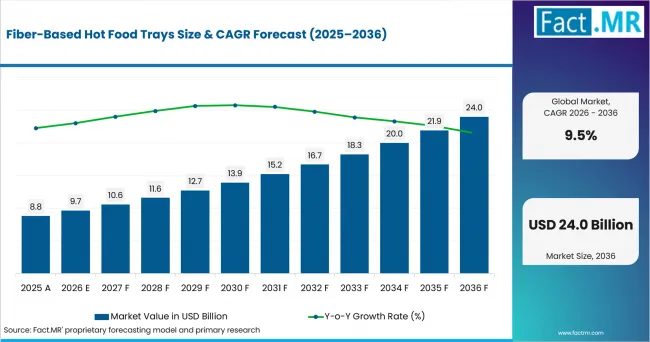
Fiber Based Hot Food Trays Value Analysis | Source: Fact.MR
What are the defining numbers behind Fiber-Based Hot Food Trays Market growth?
USD 14.3 billion absolute opportunity by 2036, led by molded fiber trays, PFAS-free aqueous barriers and compartment formats.
- Demand Drivers in the Market
- Quick-service chains need heat-stable trays for fried foods and sauced meals. USDA ERS reported U.S. food-away-from-home spending of USD 1.41 trillion in 2025.
- School and workplace caterers need PFAS-free tray options. In January 2025, FDA determined that 35 food contact notifications related to PFAS-containing grease-proofers for paper and paperboard food packaging were no longer effective.
- Prepared-meal brands need heatable fiber trays as chilled meals move into microwave and oven-ready packs.
- Converters track paper packaging materials when tray recovery claims depend on fiber sorting and mill acceptance.
- Foodservice teams compare hot trays with nearby foodservice packaging choices when menu format and serving speed guide pack approval.
- Key Segments Analyzed
- By Material Platform: Molded fiber trays are expected to hold 37.0% share in 2026 driven by rigid pulp structures for hot foods.
- By Barrier Technology: PFAS-free aqueous barriers are projected to account for 33.0% share in 2026 as grease control becomes part of approval.
- By Tray Format: Compartment trays are anticipated to capture 34.0% share in 2026 owing to meals that combine mains and sides.
- By End-use: Quick-service restaurants are estimated to represent 31.0% share in 2026 supported by takeaway and counter-service tray use.
- Analyst Opinion at Fact.MR
- Shambhu Nath Jha, Principal Consultant at Fact.MR, states, "Fiber-based hot food trays are winning attention when they perform under real menu conditions. Operators are expected to approve trays that combine heat resistance, oil holdout and clear recovery claims. Suppliers need coating proof, tray geometry and filling-line fit in the same sales file."
- Strategic Implications
- Converters should document heat limits, oil holdout and lid compatibility for each tray family before chain approval.
- Foodservice operators should test trays with curries, fried foods and sauced meals before regional rollout.
- Barrier suppliers should align coatings with food-contact rules and local recovery acceptance.
- Retail meal teams should match tray depth with microwave and oven instructions.
- Packaging planners should connect tray choices with wider next-gen paper-based and fiber-based packaging transitions across prepared food programs.
China is projected to record 10.5% CAGR through 2036 supported by catering scale and online food sales. The USA and Japan are forecast to advance at 10.0% as foodservice and convenience retail require reliable hot-meal trays. Germany is expected to post 9.8% owing to European packaging rules and board-conversion capacity. France is anticipated to record 9.3% as quick-service operators prepare for professional packaging responsibility rules.
How does the Fiber-Based Hot Food Trays Market break down by segment?
Molded fiber trays lead at 37.0%; compartment trays lead tray format at 34.0%.
Which Material Platform dominates?
Molded fiber trays hold 37.0% share in 2026.
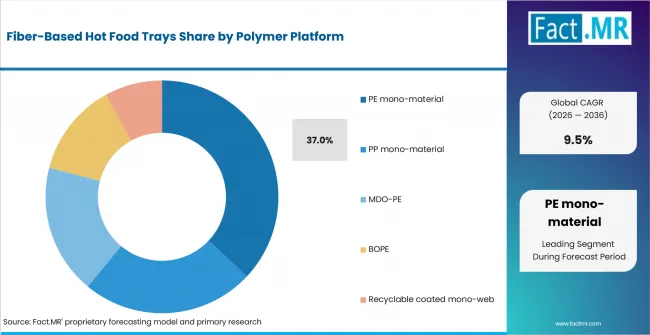
Fiber Based Hot Food Trays Analysis By Polymer Platform | Source: Fact.MR
Molded fiber trays lead because pressed pulp gives operators a rigid base for hot portions. Sidewall design and molded cavities help trays survive stacking during service. Waste fiber trays coverage links recovered-fiber tray production with foodservice and ready-meal containment.
What leads the Barrier Technology segment?
PFAS-free aqueous barriers account for 33.0% share in 2026.
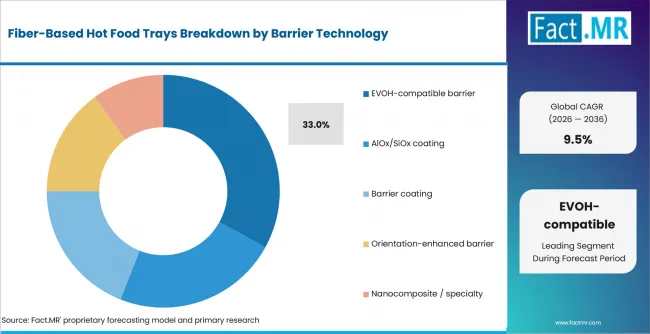
Fiber Based Hot Food Trays Analysis By Barrier Technology | Source: Fact.MR
PFAS-free aqueous barriers lead because hot meals expose trays to oil and steam together. In January 2025, FDA determined that 35 food contact notifications for PFAS-containing grease-proofers used on paper and paperboard food packaging were no longer effective. Coating selection is expected to depend on performance proof and food-contact records.
How does Tray Format shape demand?
Compartment trays capture 34.0% share in 2026.
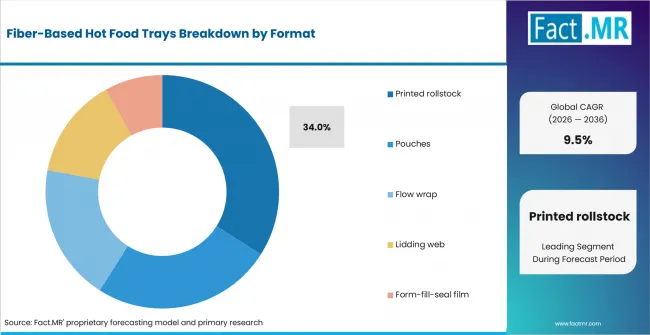
Fiber Based Hot Food Trays Analysis By Format | Source: Fact.MR
Compartment trays lead tray format because operators serve complete meals in one pack. Schools and catering kitchens use separated cavities to control portions and sauces. Ready meal trays coverage reinforces portioned-tray use in convenience and prepared-meal packaging.
What supports quick-service restaurants within End-use?
Quick-service restaurants represent 31.0% share in 2026.
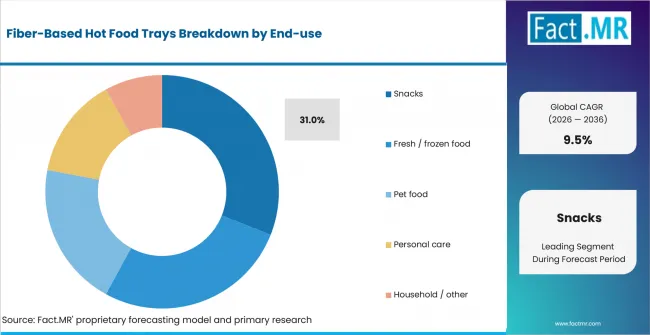
Fiber Based Hot Food Trays Analysis By End Use | Source: Fact.MR
Quick-service restaurants lead end-use because a hot tray is handled several times before the meal is eaten. Stiffness and grease control affect complaints during takeaway and delivery. Paper trays coverage also reflects the role of molded pulp in food and beverage applications.
What is accelerating Fiber-Based Hot Food Trays Market adoption, and what is holding it back?
Foodservice substitution drives it; barrier qualification restrains it.
| DRIVER | (~) % IMPACT ON CAGR | GEOGRAPHIC RELEVANCE | IMPACT TIMELINE |
|---|---|---|---|
| Foam and plastic replacement in hot meals | +1.8% | North America, Europe, East Asia | Short term (<= 2 years) |
| PFAS restrictions in food-contact packaging | +1.3% | USA, Europe | Medium term (2-4 years) |
| Foodservice meal demand | +1.2% | USA, China, France | Short term (<= 2 years) |
| Retail ready-meal conversion to heatable trays | +0.9% | Europe, Japan | Medium term (2-4 years) |
| Printed tray and menu differentiation | +0.6% | Global | Long term (>= 4 years) |
Opportunity Impact Analysis
| OPPORTUNITY | (~) % IMPACT ON CAGR | GEOGRAPHIC RELEVANCE | IMPACT TIMELINE |
|---|---|---|---|
| Ovenable fiber trays for chilled meals | +1.1% | USA, Japan, Western Europe | Medium term (2-4 years) |
| Home-compostable serviceware alignment | +0.8% | Europe, North America | Long term (>= 4 years) |
| Paper liner and barrier pairing | +0.7% | Global | Medium term (2-4 years) |
| Foodservice chain menu trials | +0.5% | USA, China, France | Short term (<= 2 years) |
Restraints Impact Analysis
| RESTRAINT | (~) % IMPACT ON CAGR | GEOGRAPHIC RELEVANCE | IMPACT TIMELINE |
|---|---|---|---|
| Barrier approval cost and trial time | -0.8% | Global | Short term (<= 2 years) |
| Variation in recovery acceptance | -0.6% | Europe, North America | Medium term (2-4 years) |
| Price sensitivity in foodservice channels | -0.5% | USA, China, Japan | Short term (<= 2 years) |
| Filling-line and lid-fit constraints | -0.4% | Global | Long term (>= 4 years) |
Which countries are scaling the Fiber-Based Hot Food Trays Market fastest?
- The country comparison spans 1.2 percentage points and forms two practical growth bands across the forecast period.
- China remains 0.5 percentage point above the USA through catering scale and online food consumption.
- The USA matches Japan at 10.0% as food-away-from-home spending and PFAS-free conversion influence tray selection.
- Japan remains 0.2 percentage point above Germany through convenience meals and heat-and-eat formats.
- Germany remains 0.5 percentage point above France through European packaging rules and board-conversion capacity.
- France closes the displayed range as quick-service operators align with professional packaging responsibility rules.
Comparable CAGRs create different entry conditions because catering scale, food-contact approval, recovery rules and prepared-meal formats vary by country. Full report coverage includes North America, Latin America, Western Europe, Eastern Europe, East Asia, South Asia and Pacific, and Middle East and Africa.
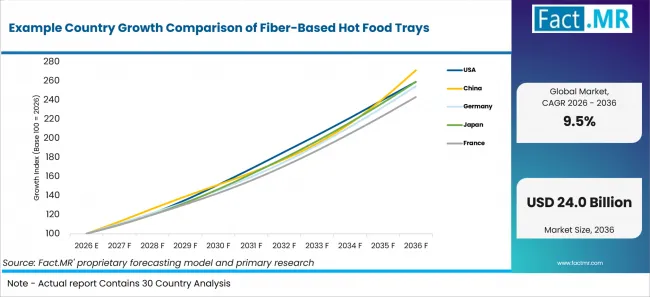
Example Country Growth Comparison Of Fiber Based Hot Food Trays | Source: Fact.MR
| Country | CAGR |
|---|---|
| China | 10.5% |
| United States | 10.0% |
| Japan | 10.0% |
| Germany | 9.8% |
| France | 9.3% |
What supports China adoption?
10.5% CAGR through 2036, driven by catering scale and online food sales.
China foodservice operators evaluate tray stiffness and grease holdout before shifting hot meals into fiber formats. The National Bureau of Statistics reported China catering income of 5,798.2 billion yuan in 2025. The market is projected to record 10.5% CAGR through 2036 as delivery and counter-service meals require stable trays.
What supports USA adoption?
10.0% CAGR through 2036, supported by food-away-from-home spending and PFAS-free conversion.
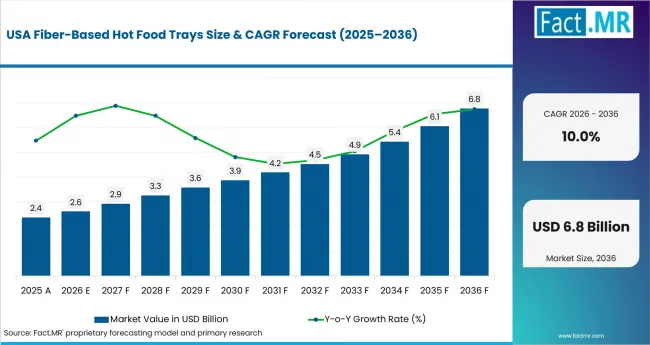
Fiber Based Hot Food Trays Country Value Analysis | Source: Fact.MR
U.S. restaurants need hot-food trays that handle fried foods, sauces and delivery handoffs. BLS reported average U.S. food-away-from-home spending of USD 3,945 per consumer unit in 2024. The market is expected to advance at 10.0% CAGR through 2036 as operators move toward fiber trays with documented barriers.
How does Japan perform?
10.0% CAGR through 2036, led by convenience retail meals and heat-and-eat formats.
Japan convenience retailers rely on trays that move from chilled shelf to microwave service. METI reported that convenience-store sales increased 3.4% year on year in 2025, with processed foods and fast food/daily foods among the categories that increased. The market is forecast to record 10.0% CAGR through 2036 as prepared meals require heatable formats.
What underpins Germany growth?
9.8% CAGR through 2036, reinforced by EU packaging rules and foodservice conversion.
German foodservice buyers pair tray decisions with EU packaging compliance and local sorting practice. Destatis reported that nominal turnover in Germany’s gastronomy sector increased 1.8% in 2025. The market is anticipated to post 9.8% CAGR through 2036 as board-based service packs gain approval routes.
What supports France outlook?
9.3% CAGR through 2036, shaped by professional packaging responsibility and quick-service shifts.
French quick-service operators review service packaging through producer responsibility planning and menu-specific pack trials. ADEME states that three eco-organisations were accredited on 5 June 2026 for the broader professional-packaging EPR scheme that expands to all professional packaging from 1 January 2027. The market is estimated to record 9.3% CAGR through 2036 as operators align takeaway packs with compliance planning.
Who leads the Fiber-Based Hot Food Trays Market?
ProAmpac offers dual ovenable RAPTrays for hot or cold meals, while Coveris offers fibre-composite dual-ovenable HEAT packs for hot-to-go foods. Amcor has fiber-based ready-meal tray development, while Mondi supplies adjacent fiber-based food tray formats.
ProAmpac supports hot-meal and food-to-go applications through RAPTray™ and related ovenable formats. Its portfolio includes hot-hold, microwaveable and oven-safe RAPTray options as well as HotRap™ solutions for heated food-to-go applications.
Amcor incorporates the former Berry Global business following completion of their combination on April 30, 2025. Amcor has also expanded its fiber-based food-packaging activity through collaboration with Metsä Group on molded-fiber trays combined with barrier liners and lidding films for food applications.
Coveris supports direct hot-food use through recyclable HEAT packs, a fibre-composite, dual-ovenable board solution designed for food-to-go products that can be cooked, merchandised and consumed from the same pack.
Competitive differentiation across these packaging formats includes structural performance, barrier and coating functionality, sealing compatibility, suitability for heating applications and documented recyclability or material-reduction performance.
Which companies are the key providers?
Companies profiled include ProAmpac, Coveris, Amcor plc and Huhtamaki.
- ProAmpac
- Coveris
- Amcor plc, including Berry Global
- Huhtamaki
Bibliography
- Zeballos, E., & Sinclair, W. (2026, June 11). Total U.S. food spending reached $2.51 trillion in 2025. U.S. Department of Agriculture, Economic Research Service.
- U.S. Bureau of Labor Statistics. (2025, December 19). Consumer expenditures—2024 [News release].
- U.S. Food and Drug Administration. (2025, January 3). FDA determines authorization for 35 food contact notifications related to PFAS are no longer effective.
- National Bureau of Statistics of China. (2026a, February 28). Statistical communiqué of the People’s Republic of China on the 2025 national economic and social development.
- National Bureau of Statistics of China. (2026b, July 16). Total retail sales of consumer goods in the first half of 2026.
- Statistisches Bundesamt. (2026, February 19). Gastgewerbeumsatz 2025 real 2,1 % niedriger als im Vorjahr.
- European Parliament, & Council of the European Union. (2025, January 22). Regulation (EU) 2025/40 of the European Parliament and of the Council of 19 December 2024 on packaging and packaging waste, amending Regulation (EU) 2019/1020 and Directive (EU) 2019/904, and repealing Directive 94/62/EC. Official Journal of the European Union.
- ProAmpac. (2025, October 14). From counter to curbside: ProAmpac’s food-to-go innovations take center stage at NACS 2025.
- Amcor. (2026, April 21). Amcor accelerates all-in-one fiber packaging innovation through strategic collaboration with Metsä Group and G. Mondini.
- Amcor. (2025, April 30). Amcor completes combination with Berry Global; positioned to significantly enhance value for customers and shareholders.
- Mondi. (2025, November 18). Mondi launches extended corrugated and solid board portfolio for the food packaging industry.
- Coveris. (2026, January 13). Driving a No Waste future: Coveris unveils new packaging solutions for bakery and confectionery at ExpoSweet 2026.
- Constantia Flexibles. (2025, August 12). FACHPACK 2025: Constantia Flexibles invests over €100 million and expands product portfolio.
This Report Answers
- The report explains how fiber-based hot food trays are used across material platform and barrier technology while sustainable food packaging coverage frames substitution pressure.
- Segment analysis identifies molded fiber trays, PFAS-free aqueous barriers and compartment trays for hot meal applications.
- Country analysis covers China, the USA, Japan, Germany and France using official foodservice and packaging indicators.
- Competitive analysis reviews ProAmpac, Coveris, Amcor plc and Huhtamaki across tray-related and adjacent capabilities.
- Technology assessment covers barrier coating choices and related recyclable food liners where hot meals require grease control.
What does the Fiber-Based Hot Food Trays Market cover?
The market covers finished trays made primarily from fiber materials and designed for hot food contact. Covered products include compartment trays, clamshell tray bases, ovenable trays and carry-out trays used by restaurants, caterers and prepared-meal brands.
The scope differs from broader foodservice packaging by focusing on tray formats that carry hot meals. It differs from general paper trays by requiring heat tolerance, grease resistance and meal-service fit.
What is included in the scope?
The scope includes molded fiber trays, solid board trays, bagasse pulp trays and recycled paper-fiber trays with coated or uncoated surfaces. It covers compartment trays, clamshell tray bases and heatable ready-meal formats. Related ready meal trays coverage places heatable packs beside convenience food packaging. Adjacent home-compostable food serviceware helps frame compostability choices in service environments.
What is excluded from the scope?
The scope excludes plastic-only trays, aluminum trays, foam trays, pouches, rollstock, lidding film and mono-material flexible packaging. Flexible films are covered only when supplied within a hot-tray pack set. Adjacent microwave packaging coverage is used for heat-ready context, while this scope remains focused on fiber tray bodies.
How Was the Analysis Built?
The analysis draws on 120+ sources, 35+ company portfolios, 25+ countries, and more than 20 industry interviews.
- Primary Research: Primary research includes discussions with foodservice operators, converters, catering buyers, prepared-meal suppliers and distributors. These conversations examine tray approval, menu testing, heat performance and recovery claims.
- Desk Research: Desk research covers government statistics, food-contact rules, packaging waste data, official classifications and company developments. The review also covers product pages, company announcements and standards material.
- Market Sizing and Forecasting: Market estimates combine foodservice spending, takeaway exposure, tray replacement patterns, barrier adoption, country growth rates and provider participation. Segment shares are assessed by material platform, barrier technology, tray format and end-use.
- Data Validation and Update Cycle: Findings are checked against official dates, government statistics, company portfolios and packaging developments. Updates review food-contact rules, tray launches, barrier claims and country-level foodservice indicators.
What is the report’s scope and coverage?
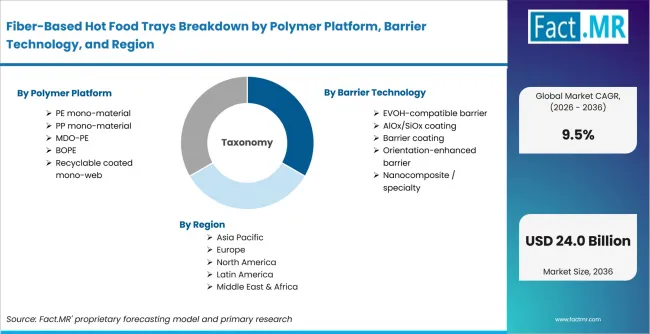
Fiber Based Hot Food Trays Breakdown By Polymer Platform, Barrier Technology, And Region | Source: Fact.MR
| Attribute | Details |
|---|---|
| Quantitative Units | USD billion |
| Market Definition | Fiber-based trays designed for hot food service, including molded fiber, solid board, bagasse pulp and recycled paper-fiber tray formats. |
| Material Platform | Molded fiber; solid board; bagasse pulp; recycled paper fiber |
| Barrier Technology | PFAS-free aqueous barrier; dispersion coating; bio-based liner; uncoated absorbent surface |
| Tray Format | Compartment trays; clamshell trays; ovenable ready-meal trays; carry-out trays |
| End-use | Quick-service restaurants; institutional catering; convenience retail; prepared meals |
| Regions Covered | North America; Latin America; Western Europe; Eastern Europe; East Asia; South Asia and Pacific; Middle East and Africa |
| Countries Covered | United States; China; Germany; Japan; France |
| Companies Profiled | ProAmpac; Coveris; Amcor plc; Huhtamaki |
| Forecast Period | 2026 to 2036 |
| Approach | Hybrid top-down and bottom-up approach using foodservice demand, tray formats, barrier qualification, country adoption and provider portfolio review. |
How is the market segmented?
-
By Material Platform
- Molded fiber
- Solid board
- Bagasse pulp
- Recycled paper fiber
-
By Barrier Technology
- PFAS-free aqueous barrier
- Dispersion coating
- Bio-based liner
- Uncoated absorbent surface
-
By Tray Format
- Compartment trays
- Clamshell trays
- Ovenable ready-meal trays
- Carry-out trays
-
By End-use
- Quick-service restaurants
- Institutional catering
- Convenience retail
- Prepared meals
-
By Region
- North America
- Latin America
- Western Europe
- Eastern Europe
- East Asia
- South Asia and Pacific
- Middle East and Africa