- Market Value (2025): USD 1.2 Bn
- Estimated Value (2026): USD 1.3 Bn
- Forecast Value (2036): USD 2.4 Bn
- CAGR (2026-2036): 6.1%
What is the Fiber-Based Wraparound Packaging Market forecast to be worth by 2036?
USD 1.3 billion in 2026 to USD 2.4 billion by 2036, recording 6.1% CAGR.
- The fiber-based wraparound packaging market reached USD 1.2 billion in 2025 as beverage and packaged-food programs expanded paperboard grouping formats.
- Fiber-based wraparound packaging industry is forecast to climb from USD 1.3 billion in 2026 to USD 2.4 billion by 2036.
- The market is forecast to record a 6.1% CAGR from 2026 to 2036 as packaging teams qualify fiber formats on existing production lines.
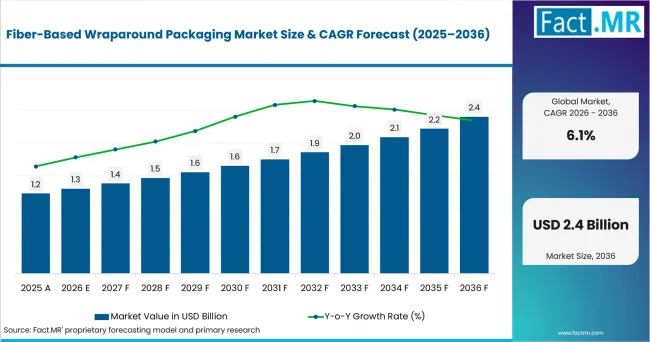
Fiber Based Wraparound Packaging Market Value Analysis | Source: Fact.MR
What are the defining numbers behind Fiber-Based Wraparound Packaging Market growth?
USD 1.1 billion absolute opportunity by 2036, led by Wraparound Cases and Recycled Paperboard alongside Preprinted formats.
- Demand Drivers in the Market
- Beverage producers need wraps that secure container arrays while replacing shrink film without reducing rated line output.
- Food manufacturers need fiber wraps that preserve compression strength across chilled storage and dense pallet movement.
- Brand owners need printable wraps that combine transit protection with shelf communication across recurring multipack programs.
- Packaging engineers need local trials because caliper and moisture changes often alter feeder or glue performance.
- Key Segments Analyzed
- By product type: Wraparound cases are expected to hold 42% share in 2026 supported by automated containment.
- By material: Recycled paperboard is projected to account for 44% share in 2026 owing to familiar converting routes.
- By print - finish: Preprinted formats are anticipated to capture 44% share in 2026 due to repeat graphics.
- By application: Beverages are estimated to represent 34% share in 2026 attributable to uniform container arrays.
- By end use: Food and beverage is forecast to account for 62% share in 2026 driven by recurring production.
- By sales channel: Direct - brand OEM is expected to capture 52% share in 2026 supported by joint qualification.
- Analyst Opinion at Fact.MR
- Fact.MR Principal Consultant Shambhu Nath Jha states that successful conversion aligns structural design with machinery settings and loaded-pack performance. Providers are expected to gain repeat orders by protecting line speed during commercial production cycles.
- Strategic Implications
- Converters should document board tolerances and adhesive settings before proposing plastic replacement on high-speed production lines.
- Brand teams should compare packed-unit cost and transit damage exposure during approval across several factories.
- Machinery specialists should define retrofit limits because feeder geometry and compression timing determine installed-line compatibility.
- Paperboard producers should coordinate caliper consistency and regional availability with converters serving recurring multipack programs.
Recycled-content targets are increasing scrutiny of material performance across wraparound packaging applications. Converters assess caliper consistency and supply reliability before approving boards for commercial use. Stable performance during cutting and gluing remains essential for maintaining line efficiency and reducing disruptions across recurring packaging programs.
India is projected to lead growth with an 8.5% CAGR through 2036, while China is expected to expand at 7.7% CAGR. The United Kingdom is forecast to advance at 6.6% CAGR, followed by Brazil at estimated 6.4% CAGR. Germany is anticipated to register 5.7% CAGR during the assessment period.
How does the Fiber-Based Wraparound Packaging Market break down by segment?
Wraparound Cases account for 42%, Recycled Paperboard accounts for 44%.
Which Product Type dominates?
Wraparound Cases hold 42% share in 2026.
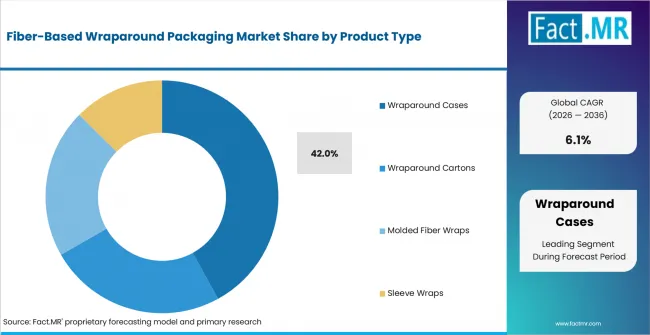
Fiber Based Wraparound Packaging Market Analysis By Product Type | Source: Fact.MR
Based on product type, wraparound cases are projected to account for 42% in 2026 due to secure automated containment. Their panels control fixed arrays across corrugated packaging programs while protecting line speed and distribution stability.
Why does Recycled Paperboard lead the Material segment?
Recycled Paperboard accounts for 44% share in 2026.
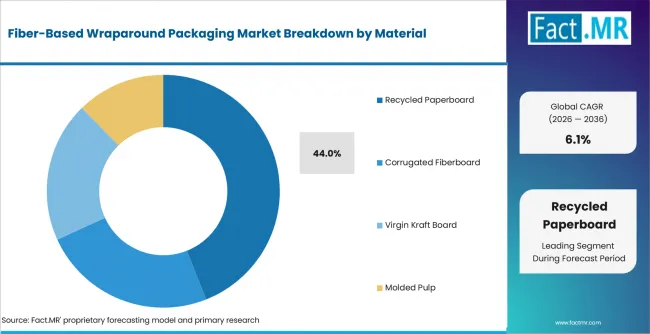
Fiber Based Wraparound Packaging Market Analysis By Material | Source: Fact.MR
By material, recycled paperboard is estimated to hold 44% in 2026 owing to familiar converting routes. Documented fiber content supports folding carton packaging programs while established commercial equipment limits qualification changes.
How does Preprinted hold the Print - Finish position?
Preprinted formats capture 44% share in 2026.
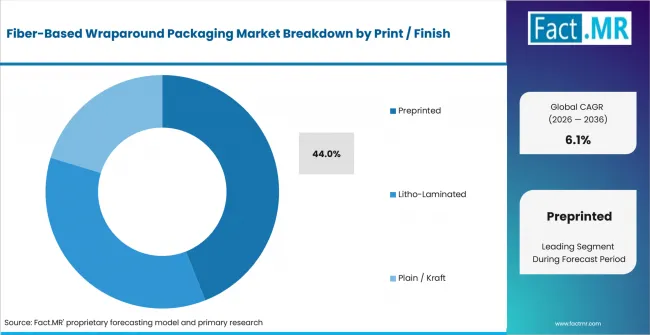
Fiber Based Wraparound Packaging Market Analysis By Print Finish | Source: Fact.MR
In 2026, preprinted formats are expected to lead print and finish with 44% share due to repeat graphics. Early decoration supports custom packaging programs without adding a separate printing stage during case forming.
What supports Beverages within Application?
Beverages represent 34% share in 2026.
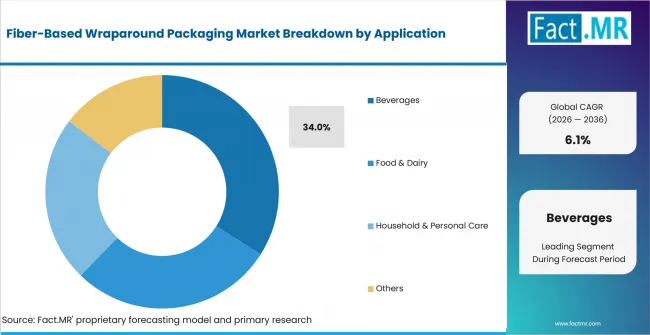
Fiber Based Wraparound Packaging Market Analysis By Application | Source: Fact.MR
By application, beverages are forecast to represent 34% in 2026 driven by uniform container geometry. Secondary wraps protect ready-to-drink packaging during pallet movement and shelf replenishment without disrupting line speed.
Why does Food & Beverage lead the End Use segment?
Food & Beverage holds 62% share in 2026.
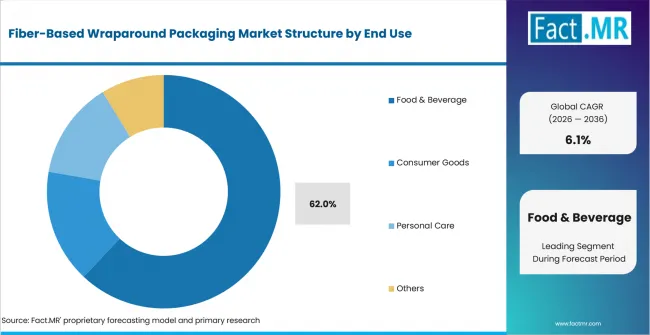
Fiber Based Wraparound Packaging Market Analysis By End Use | Source: Fact.MR
The food and beverage end use is anticipated to capture 62% share in 2026 attributable to recurring production. Plants qualify fresh food packaging across chilled and ambient routes with different moisture and compression conditions.
What drives Direct - Brand OEM leadership in Sales Channel?
Direct - Brand OEM accounts for 52% share in 2026.
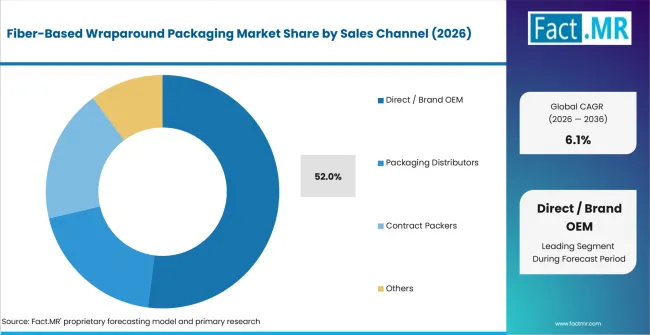
Fiber Based Wraparound Packaging Market Analysis By Sales Channel | Source: Fact.MR
The sales channel category is forecast to be led by direct - brand OEM at 52% share in 2026. Brand teams and plant engineers jointly control retail-ready packaging artwork and machine settings during qualification
What is accelerating Fiber-Based Wraparound Packaging Market adoption, and what is holding it back?
Plastic-reduction rules are anticipated to support demand, line-qualification risk restrains it.
Drivers Impact Analysis
| DRIVER | (~) % IMPACT ON CAGR | GEOGRAPHIC RELEVANCE | IMPACT TIMELINE |
|---|---|---|---|
| Producer-responsibility requirements | +0.7% | Europe, North America | Medium term (2-4 years) |
| Multipack conversion | +0.6% | Global, Europe focus | Medium term (2-4 years) |
| Retail-ready presentation | +0.5% | North America, Europe | Short term (<= 2 years) |
| Recycled-paperboard capacity | +0.4% | North America, Europe | Medium term (2-4 years) |
| Local validation services | +0.3% | India, China, Brazil | Long term (>= 4 years) |
Source: Fact.MR analysis. Updated Aug 1, 2026
- Producer-responsibility rules: Regulation 2025-40 places reporting and recoverability inside European packaging reviews, increasing scrutiny of material choices.
- Beverage and food multipacks: High-volume plants favor fiber formats that preserve container orientation and line speed across qualified product arrays.
- Retail-ready presentation: Supermarkets require printed wraps that protect goods while maintaining tear features and graphic alignment during replenishment.
- Paperboard capacity: Regional consumer-board supply shortens qualification time while stable caliper and moisture control protect line performance.
- Local validation support: Plant engineers favor providers whose technicians adjust installed equipment and reproduce loaded-pack conditions during trials.
Opportunity Impact Analysis
| OPPORTUNITY | (~) % IMPACT ON CAGR | GEOGRAPHIC RELEVANCE | IMPACT TIMELINE |
|---|---|---|---|
| Installed-line conversions | +0.5% | North America, Europe | Short term (<= 2 years) |
| Recycled-board qualification | +0.4% | Europe, North America | Medium term (2-4 years) |
| Localized multipack programs | +0.4% | India, China | Medium term (2-4 years) |
| Integrated service contracts | +0.3% | Global plants | Long term (>= 4 years) |
Source: Fact.MR analysis. Updated Aug 1, 2026
- Existing-line conversions: Brand owners seek wraparound formats that preserve feeder timing and compression settings on installed equipment.
- Recycled-content qualification: Documented fiber content supports material goals if sheet consistency protects compression strength and line speed.
- Localized beverage programs: Regional teams adapt pack counts and artwork while maintaining controlled board specifications across approved plants.
- Integrated service contracts: Larger brand owners reduce handoffs by combining structural design with tooling support and loaded-pallet validation.
Restraints Impact Analysis
| RESTRAINT | (~) % IMPACT ON CAGR | GEOGRAPHIC RELEVANCE | IMPACT TIMELINE |
|---|---|---|---|
| Line qualification risk | -0.6% | Global plants | Short term (<= 2 years) |
| Material variability | -0.4% | Food and beverage | Medium term (2-4 years) |
| Tooling and artwork costs | -0.3% | Global brands | Medium term (2-4 years) |
| Recovery classification differences | -0.2% | Emerging markets | Long term (>= 4 years) |
Source: Fact.MR analysis. Updated Aug 1, 2026
- Line qualification risk: New blanks often alter feeding and glue compression, causing downtime or tooling costs on high-output lines.
- Material variability: Changes in humidity and caliper require repeated feeder or glue adjustments across commercial production plants.
- Change costs: Dedicated tools and controlled artwork raise qualification expense across branded programs with frequent pack variants.
- Recovery differences: Uneven material classification slows adoption because fiber composites create unclear disposal instructions across local systems.
Which countries are scaling Fiber-Based Wraparound Packaging Market fastest?
Brazil 6.4%, United Kingdom 5.8%, United States 5.6%.
Regional analysis covers North America, Latin America, Western Europe, Eastern Europe, East Asia, South Asia and Pacific, and the Middle East and Africa.
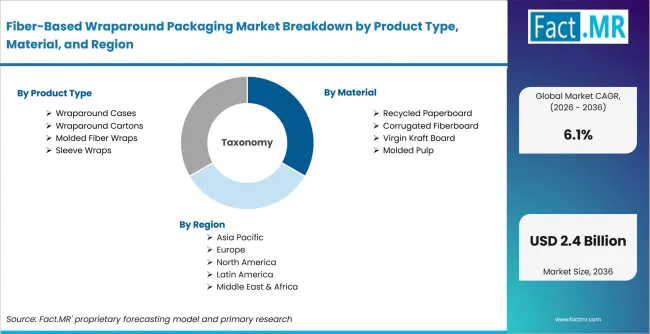
Fiber Based Wraparound Packaging Market Breakdown By Product Type, Material, And Region | Source: Fact.MR
| COUNTRY | CAGR |
|---|---|
| Brazil | 6.4% |
| United Kingdom | 5.8% |
| United States | 5.6% |
Source: Fact.MR analysis. Updated Aug 1, 2026
What supports the Brazil outlook?
6.4% CAGR, owing to beverage production and broad food distribution requirements.
Brazil is anticipated to grow at 6.4% CAGR as regional pack adaptation challenges pallet stability.
How is the United Kingdom developing Fiber-Based Wraparound Packaging demand?
5.8% CAGR, supported by EPR reporting and retailer specification control.
United Kingdom brand owners carefully review recyclability evidence and packaging data during each material change. Sales are estimated to record a 5.8% CAGR as retailer specifications formalize design approval. Updated EPR guidance strengthens reporting, while compliance costs restrict smaller converters and short production runs.
What underpins United States growth?
5.6% CAGR, driven by state regulation and high-speed installed packaging lines.
United States beverage and food plants rely on high-speed lines whose retrofit compatibility determines approval. Demand is forecast to post a 5.6% CAGR as state rules change packaging reviews. California requires plastic reduction and recyclable packaging by 2032, while fragmented rules and trials restrict rollout.
Who leads the Fiber-Based Wraparound Packaging Market?
Integrated paperboard groups and regional converters compete through local design expertise and responsive service capacity. Entry remains possible for businesses with testing equipment and direct access to customer production lines.
Graphic Packaging International combines integrated board with proprietary multipack designs and machinery expertise across beverage applications. Smurfit Westrock and Mondi Group provide converting scale, while International Paper contributes DS Smith wraparound capability.
MM Group supplies cartonboard multipacks while Atlantic Packaging develops commercial carriers that replace plastic rings. Across the protective packaging market, commercial advantage depends on proven throughput and local technical support.
Which companies are the key providers?
Graphic Packaging International, Smurfit Westrock, Mondi Group, International Paper, MM Group, and Atlantic Packaging are key providers.
- Graphic Packaging International
- Smurfit Westrock
- Mondi Group
- International Paper
- MM Group
- Atlantic Packaging
Bibliography
- California Department of Resources Recycling and Recovery. (2026, May 1). California approves new plastic and packaging rules that put consumers first. CalRecycle.
- Department for Environment, Food & Rural Affairs, & PackUK. (2025, July 11). Extended producer responsibility for packaging. GOV.UK.
- European Parliament & Council of the European Union. (2025, January 22). Regulation (EU) 2025-40 of the European Parliament and of the Council of 19 December 2024 on packaging and packaging waste, amending Regulation (EU) 2019-1020 and Directive (EU) 2019-904, and repealing Directive 94-62-EC (Text with EEA relevance). EUR-Lex.
- Graphic Packaging Holding Company. (2026, March 2). 10-K: Annual report [Section 13 and 15(d), not S-K Item 405]. Graphic Packaging Holding Company.
- Mayr-Melnhof Karton AG. (2025, September 10). MM Packaging’s multi-pack cartonboard solution protects Kingsland Drinks’ range of canned beverages. MM Group.
- Mondi Group. (2025, November 18). Mondi launches extended corrugated and solid board portfolio for the food packaging industry. Mondi Group.
- Smurfit Westrock plc. (2026, February 27). Form 10-K. Smurfit Westrock.
- State Administration for Market Regulation & Standardization Administration of China. (2024, April 25). GB-T 31268-2024: Restricting excessive packaging for commodity—General rule. National Public Service Platform for Standards Information.
- Presidency of the Republic of Brazil. (2025, October 21). Decreto Nº 12.688, de 21 de outubro de 2025. Planalto.
- International Paper. (2025, January 31). About the IP + DS Smith combination. International Paper.
- Atlantic Packaging. (2025, December 31). Atlantic 2025 Year in Review. Atlantic Packaging.
- Press Information Bureau. (2025, September 5). Simplified GST for Growth of Indian Commerce and Trade. Government of India.
This Report Addresses
- The report provides strategic intelligence across product type and material choices shaping commercial wraparound conversions.
- Segment analysis covers wraparound cases and recycled paperboard alongside four additional purchasing dimensions within the taxonomy.
- Regional outlook evaluates India and China alongside Brazil, while the United Kingdom and United States complete comparison.
- Competitive analysis profiles six verified providers across integrated and regional fiber multipack capabilities and service networks.
- Product assessment covers cases and cartons alongside molded fiber and sleeve wraps across grouped applications.
- Use-case assessment covers beverages and food or dairy alongside household and personal-care programs across grouped products.
- The forecast combines official policy evidence and company developments with provider checks and commercial modelling.
What does the Fiber-Based Wraparound Packaging Market cover?
Wraparound Cases, Wraparound Cartons, Molded Fiber Wraps, and Sleeve Wraps used for grouped-product protection and display.
The market covers converted fiber structures that wrap grouped products for containment and shelf presentation.
Revenue excludes conventional shipping cases and primary containers alongside commercial machinery sold outside converted-pack programs.
What is included in the scope?
Fiber-based wraparound formats used across beverage, food, consumer-goods, and personal-care production lines.
Coverage spans four product types and materials across three print routes for beverage and consumer-goods applications. End users include food manufacturers and personal-care companies through direct brand programs or contract packing routes.
What is excluded from the scope?
Standalone machinery, primary containers, plastic shrink formats, and conventional shipping cases are outside the scope.
Packaged contents and primary containers remain excluded alongside regular slotted cases and plastic shrink formats. Separate printing services and standalone machinery enter the scope only within a qualifying converted-pack transaction.
How Was the Analysis Built?
The analysis draws on 120+ sources, 35+ company portfolios, 25+ countries, and more than 20 industry interviews.
- Primary Research: Primary research includes discussions with manufacturers, service providers, technology developers, distributors, end users, procurement teams, and subject-matter experts. These conversations examine purchasing priorities, product adoption, operational challenges, approval requirements, competitive positioning, and the factors that influence wider market acceptance.
- Desk Research: Desk research covers government statistics, regulatory publications, company filings, trade data, technical studies, industry associations, standards, public policy, and other authoritative sources. Every source used in the analysis is documented in the bibliography.
- Market Sizing and Forecasting: Market estimates combine historical performance, demand indicators, pricing and volume trends, segment shares, company participation, country-level growth, adoption patterns, investment activity, and barriers to market expansion.
- Data Validation and Update Cycle: Findings are validated by comparing primary interviews with public data, company activity, regulatory changes, trade patterns, and industry developments. Regular updates review new product launches, capacity changes, partnerships, approvals, procurement trends, and shifts in commercial adoption.
Segmentation
What is the report’s scope and coverage?
Fiber Based Wraparound Packaging Market Breakdown By Product Type, Material, And Region | Source: Fact.MR
| Coverage field | Report scope |
|---|---|
| Quantitative Units | USD Billion |
| Market Definition | Converted fiber wraparound formats sold for grouped-product protection and retail presentation |
| Product Type | Wraparound Cases, Wraparound Cartons, Molded Fiber Wraps, Sleeve Wraps |
| Material | Recycled Paperboard, Corrugated Fiberboard, Virgin Kraft Board, Molded Pulp |
| Print - Finish | Preprinted, Litho-Laminated, Plain - Kraft |
| Application | Beverages, Food & Dairy, Household & Personal Care, Others |
| End Use | Food & Beverage, Consumer Goods, Personal Care, Others |
| Sales Channel | Direct - Brand OEM, Packaging Distributors, Contract Packers, Others |
| Regions Covered | North America, Latin America, Western Europe, Eastern Europe, East Asia, South Asia and Pacific, Middle East and Africa |
| Countries Covered | Brazil, United Kingdom, United States, Germany, Japan, and others |
| Key Companies Profiled | Graphic Packaging International, Smurfit Westrock, Mondi Group, International Paper, MM Group, Atlantic Packaging |
| Forecast Period | 2026 to 2036 |
| Approach | Hybrid sizing using converted-pack revenue, product mix, applications, channels, company activity |
Source: Fact.MR analysis. Updated Aug 1, 2026
How is the market segmented?
-
By Product Type:
- Wraparound Cases
- Wraparound Cartons
- Molded Fiber Wraps
- Sleeve Wraps
-
By Material:
- Recycled Paperboard
- Corrugated Fiberboard
- Virgin Kraft Board
- Molded Pulp
-
By Print - Finish:
- Preprinted
- Litho-Laminated
- Plain - Kraft
-
By Application:
- Beverages
- Food & Dairy
- Household & Personal Care
- Others
-
By End Use:
- Food & Beverage
- Consumer Goods
- Personal Care
- Others
-
By Sales Channel:
- Direct - Brand OEM
- Packaging Distributors
- Contract Packers
- Others
-
By Region:
- North America
- United States
- Canada
- Latin America
- Brazil
- Mexico
- Argentina
- Chile
- Western Europe
- Germany
- France
- United Kingdom
- Italy
- Spain
- Benelux
- Nordics
- Eastern Europe
- Poland
- Czech Republic
- Romania
- Hungary
- East Asia
- Japan
- South Korea
- South Asia and Pacific
- ASEAN
- Australia and New Zealand
- Middle East and Africa
- GCC Countries
- South Africa
- Türkiye
- Israel
- North America
Frequently Asked Questions
Which product type holds the primary share?
How is recycled paperboard positioned by material?
What supports preprinted formats within print and finish?
Why do beverages carry the primary application share?
What supports India’s projected expansion?
How is China’s outlook shaped?
Which operating factor drives conversion?
What restraint limits wider adoption?
Who worked on this report


Preview the report firsthand - request a free sample
Free SampleGet the brochure for pricing and purchase details
Download PDF