- Market Value (2025): USD 1178.4 Mn
- Estimated Value (2026): USD 1291.5 Mn
- Forecast Value (2036): USD 3230.0 Mn
- CAGR (2026-2036): 9.6%
What is the Fixed Commercial Gas Detection Market forecast to be worth by 2036?
USD 1,291.5 million in 2026 to USD 3,230.0 million by 2036, at 9.6% CAGR.
- The fixed commercial gas detection market value stood at USD 1,178.4 million in 2025, led by commercial gas safety systems across fuel rooms and fixed alarm networks.
- Demand is projected to increase from USD 1,291.5 million in 2026 to USD 3,230.0 million by 2036.
- The sector is forecast to record a 9.6% CAGR from 2026 to 2036, due to facility managers and safety teams planning around leak detection and service documentation.
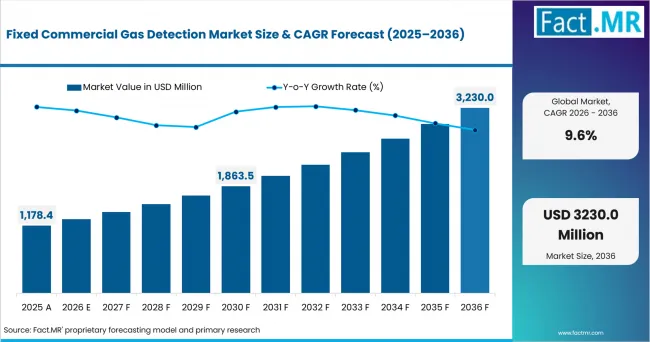
Fixed Commercial Gas Detection Market Market Value Analysis | Source: Fact.MR
What are the defining numbers behind Fixed Commercial Gas Detection Market growth?
USD 1,938.5 million absolute opportunity by 2036, led by SME facilities and cloud deployment alongside BFSI sites.
- Demand Drivers in the Market
- Facility operators depend on fixed alarms supported by leak response routines across kitchens and mechanical rooms.
- Safety teams require maintenance evidence driven by inspection routines and alarm investigation logs.
- Multi-site owners seek connected dashboards shaped by remote alarm review and device-health monitoring.
- Building integrators need detector links reinforced by ventilation controls and shutdown relays.
- Key Segments Analyzed
- By Gas type: Combustible gases are projected to hold 38% share in 2026, reflected by commercial fuel rooms and fixed alarm networks.
- By Technology: Electrochemical is expected to account for 31% share in 2026, guided by toxic gas and oxygen monitoring needs.
- By Application: Leak detection is estimated to capture 42% share in 2026, influenced by fuel safety and refrigerant monitoring.
- By End use: Oil & gas is anticipated to represent 29% share in 2026, owing to gas infrastructure and utility-linked monitoring needs.
- Analyst Opinion at Fact.MR
- Shambhu Nath Jha, Senior Analyst at Fact.MR, states, “Fixed commercial gas detection has become a facility-control and documentation challenge. Demand is expected to favor providers proving cleaner service records and alarm data usable by safety managers. Suppliers are expected to combine fixed detector accuracy and connected service support.”
- Strategic Implications
- Facility operators are expected to prioritize refrigeration rooms, commercial kitchens and backup power areas before wider building rollouts.
- System integrators are likely to connect fixed sensors with ventilation panels and building management systems.
- Detector vendors are anticipated to align service contracts with calibration routines and alarm recordkeeping.
- Software providers are projected to build cloud dashboards suited to SMEs and multi-site commercial estates.
Emerson announced the Rosemount 625IR fixed gas detector in March 2025, describing factory calibration for life and fast hydrocarbon gas detection. Development activity reflects supplier focus on reducing false alarms, service visits, and detector uncertainty across fixed safety installations.
India is projected to post 11.4% CAGR through 2036, reflected by commercial LPG allocation and kitchen fuel safety needs. China is expected to record 10.7% CAGR by 2036, influenced by natural gas production scale and commercial facility coverage. Australia is anticipated to grow at 9.4% CAGR from 2026 to 2036, supported by workplace safety enforcement and high-risk commercial sites. United Kingdom is estimated to hold 9.1% CAGR during the study period, shaped by work-related fatality reporting and hospitality facility controls. U.S. is forecast to record 8.9% CAGR between 2026 and 2036, reinforced by nonresidential fire exposure and building safety reviews. Germany is likely to post 8.6% CAGR to 2036 backed by gas-using commercial and industrial buildings. Japan is expected to expand at 8.3% CAGR to 2036, led by utility gas safety culture and industrial production systems.
How does the Fixed Commercial Gas Detection Market break down by segment?
Leak detection is expected to garner 42% share in 2026, and Combustible gases are anticipated to represent 38% share in 2026.
What gas type is likely to lead the market?
Combustible gases are set to represent 38% share in 2026.
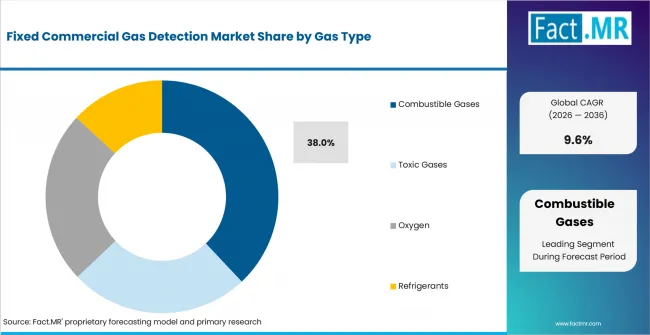
Fixed Commercial Gas Detection Market Analysis By Gas Type | Source: Fact.MR
Combustible gases are projected to hold 38% share in 2026, influenced by natural gas and fuel-room monitoring needs. Toxic gases follow through enclosed utility rooms and process-linked commercial spaces. Oxygen and refrigerants retain adoption across mechanical rooms and refrigeration areas. Press Information Bureau reported in April 2026 stating more than 90,000 5 Kg FTL cylinders were sold in a single day under India’s commercial LPG program, reflecting fixed detector demand across kitchens and service sites.
What is projected to lead the technology segment?
Electrochemical is predicted to garner 31% share in 2026.
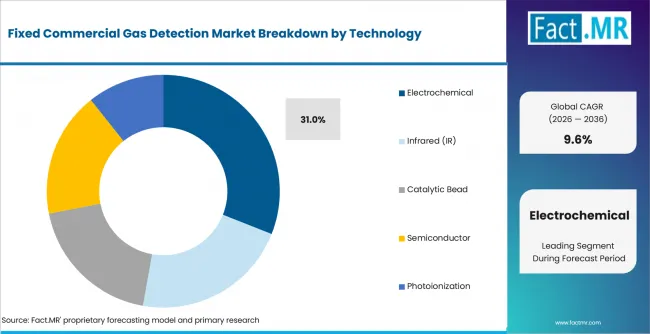
Fixed Commercial Gas Detection Market Analysis By Technology | Source: Fact.MR
Electrochemical is expected to account for 31% share in 2026, led by toxic gas and oxygen detection across commercial safety systems. Infrared (IR) follows through combustible gas and hydrocarbon monitoring. Catalytic bead and photoionization technologies support applications needing gas-specific detection and response. Bureau of Labor Statistics reported in March 2026 noting private industry employers to have recorded 2.5 million workplace injuries and illnesses in 2024, highlighting preventive monitoring needs across fixed safety installations.
How is application anticipated to shape demand?
Leak Detection is expected to secure 42% share in 2026.
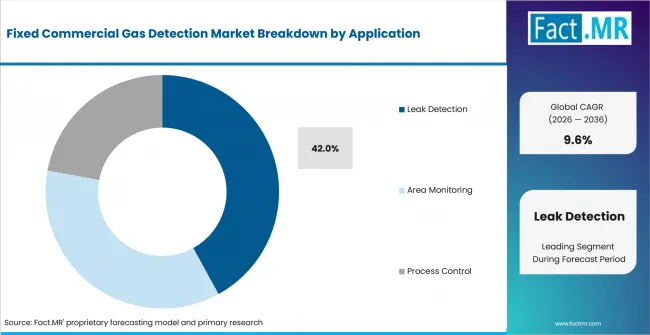
Fixed Commercial Gas Detection Market Analysis By Application | Source: Fact.MR
Leak detection is estimated to capture 42% share in 2026, shaped by refrigerant control and alarm-response needs. Area monitoring follows through wider facility coverage across mechanical rooms and public-access spaces. Process control supports controlled environments where gas conditions affect operations and safety. Federal Register published EPA’s HFC management rule in October 2024 stating leak repair coverage applies to refrigerants with global warming potential greater than 53, reflecting fixed leak detection recordkeeping needs.
What is likely to lead the end use segment?
Oil & Gas is estimated to hold 29% share in 2026.
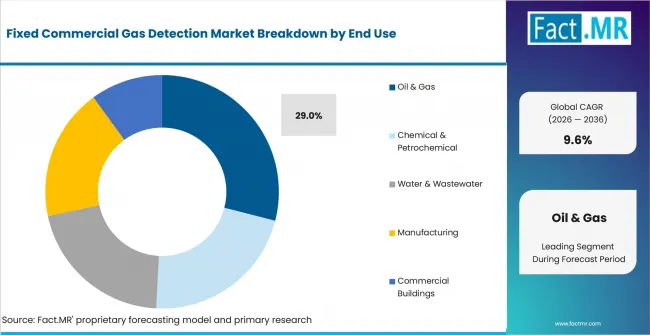
Fixed Commercial Gas Detection Market Analysis By End Use | Source: Fact.MR
Oil & gas is anticipated to represent 29% share in 2026, owing to gas infrastructure and utility-linked monitoring needs. Chemical & petrochemical follows through toxic and combustible gas exposure across commercial-industrial sites. Water & wastewater and commercial buildings retain adoption through enclosed process and facility safety requirements. Bundesnetzagentur reported in January 2026 stating Germany consumed 864 TWh of gas in 2025, showcasing facility monitoring needs across gas-intensive building operations.
What is accelerating Fixed Commercial Gas Detection Market adoption, and what is holding it back?
Facility safety compliance supports it; retrofit complexity and service burden restrain it.
Drivers Impact Analysis
| Driver | (~) % Impact on CAGR | Geographic Coverage | Impact Timeline |
|---|---|---|---|
| Refrigeration machinery-room detection rules | +1.8% | North America, Europe, Japan | Short term (<= 2 years) |
| Commercial kitchen and fuel-room safety | +1.6% | India, U.S., United Kingdom | Medium term (2-4 years) |
| Workplace incident documentation needs | +1.4% | U.S., Australia, Europe | Short term (<= 2 years) |
| Gas-intensive commercial operations | +1.2% | India, China, Germany | Medium term (2-4 years) |
| Sensor diagnostics and false-alarm reduction | +0.9% | Global multi-site buyers | Long term (>= 4 years) |
Source: Fact.MR analysis. Updated Jul 13, 2026
- Refrigeration machinery-room detection rules: Refrigeration rooms need fixed detectors connected to alarms and ventilation response. ASHRAE stated in September 2024 each machinery room needs a detector at a setpoint no greater than the occupational exposure limit, making detection part of mechanical-room safety design. Adoption is expected to expand as refrigerant rules make alarm proof and response design easier to audit.
- Commercial kitchen and fuel-room safety: Commercial kitchens and fuel rooms need fixed alarms as cooking and heating create nonresidential fire exposure. National Fire Protection Association reported in October 2025 119,500 non-residential structure fires during 2024 caused 170 civilian deaths and 1,020 injuries, supporting detector adoption in restaurants and institutional kitchens. Suppliers are projected to pair fuel leak detection with routine inspection records.
- Workplace incident documentation needs: Facility safety programs need records proving alarm response and hazard correction. U.S. Bureau of Labor Statistics reported in February 2026 5,070 fatal work injuries were recorded in 2024 at a rate of 3.3 per 100,000 full-time workers, reinforcing preventive monitoring. Fixed detection is anticipated to gain priority in sites needing stronger safety evidence.
- Gas-intensive commercial operations: Commercial gas use requires tighter monitoring in metering rooms and along fuel lines. Press Information Bureau reported in April 2026 more than 90,000 5 Kg FTL cylinders were sold in a single day under India’s commercial LPG program, supporting fixed detector demand across kitchens and service sites. Detector providers are expected to target fuel transition points and high-use kitchens.
- Sensor diagnostics and false-alarm reduction: Fixed detector buyers need dependable sensing without avoidable shutdowns. Emerson’s March 2025 operation manual for Rosemount 625IR stated a function check passes after a response above 20% FS, giving maintenance teams a measurable service threshold. Demand is forecast to shift toward detectors with clear test routines and health diagnostics.
Opportunity Impact Analysis
| Opportunity | (~) % Impact on CAGR | Geographic Coverage | Impact Timeline |
|---|---|---|---|
| Cloud-connected detector fleets | +1.5% | U.S., Europe, Australia | Short term (<= 2 years) |
| Refrigerant leak management | +1.3% | North America, Europe, Japan | Medium term (2-4 years) |
| Connected service and calibration programs | +1.1% | Global multi-site buyers | Medium term (2-4 years) |
| Building system integration | +0.8% | Commercial buildings worldwide | Long term (>= 4 years) |
Source: Fact.MR analysis. Updated Jul 13, 2026
- Cloud-connected detector fleets: Multi-site owners need one view of service status and detector fleet condition. Industrial Scientific reported in July 2025 its connected safety program with Gerdau improved alarm traceability and reduced maintenance downtime by 98%, proving connected monitoring value. Platform demand is expected to rise among facility teams managing scattered sites.
- Refrigerant leak management: Refrigeration and HVAC assets create detector opportunities in laboratories and cold rooms. Federal Register published EPA’s HFC management rule in October 2024 requiring leak repair coverage for refrigerants with global warming potential greater than 53, supporting fixed leak detection records. Demand is projected to rise around refrigerant rooms needing faster service response.
- Connected service and calibration programs: Calibration workloads create recurring service opportunities after detector installation. Dräger stated in 2025 product material REGARD 3000 combines 3 module types across relay and gateway functions, supporting compact fixed systems suited to later service expansion. Service providers are anticipated to package detector checks with repair and recordkeeping.
- Building system integration: Fixed detectors gain value based on links with ventilation and shutdown controls. Riken Keiki stated in April 2026 the FPM-80A multi-point toxic gas detection system monitors up to 80 points and provides a 180-day tape life, supporting centralized monitoring in gas-intensive buildings. Integration demand is estimated to favor systems reducing scattered device checks.
Restraints Impact Analysis
| Restraint | (~) % Impact on CAGR | Geographic Coverage | Impact Timeline |
|---|---|---|---|
| Retrofit wiring and panel compatibility | -1.4% | Older commercial buildings | Medium term (2-4 years) |
| Calibration and service workload | -1.2% | Global installed base | Short term (<= 2 years) |
| False alarms and alarm fatigue | -0.9% | High-traffic facilities | Medium term (2-4 years) |
| Budget cycles in smaller facilities | -0.7% | SME-heavy markets | Long term (>= 4 years) |
Source: Fact.MR analysis. Updated Jul 13, 2026
- Retrofit wiring and panel compatibility: Older buildings need wiring paths and relay setup before detectors connect to ventilation systems. Dräger stated in 2025 product material REGARD 1000 supports up to 4 transmitters and 3 freely configurable alarm relays, reflecting how even compact upgrades require panel planning. Adoption is expected to slow in buildings with limited control-room space.
- Calibration and service workload: Fixed detectors need service discipline after installation. Emerson’s March 2025 manual recommended test gas at 50% ±10% FS with a minimum flow rate of 2 liters/minute for function checks, showing how service work adds recurring tasks. Facility teams are projected to prefer contracts bundling testing and repair records.
- False alarms and alarm fatigue: High-traffic kitchens, garages, laboratories, and loading areas need dependable alarm thresholds. Emerson stated in March 2025 Rosemount 625IR uses dual IR sources and dual IR receivers for continual cross checks, supporting a lower false-alarm burden. Buyers are anticipated to compare nuisance-alarm evidence before approving large rollouts.
- Budget cycles in smaller facilities: SMEs often approve detector upgrades during renovation, insurance review, or equipment replacement. National Safety Council stated in 2025 33,000,000 workdays were lost in 2024 due to permanently disabling injuries from prior years, giving safety teams a cost-avoidance argument. Adoption is forecast to remain phased across cash-constrained properties.
How are country markets expected to scale Fixed Commercial Gas Detection Market demand?
India 11.4%; China 10.7%; Australia 9.4%; United Kingdom 9.1%; U.S. 8.9%.
Regional analysis covers North America, Latin America, Europe, East Asia, South Asia and Pacific, and Middle East and Africa.
.webp "Top Country Growth Comparison Fixed Commercial Gas Detection Market Cagr (2026 2036)")
Top Country Growth Comparison Fixed Commercial Gas Detection Market Cagr (2026 2036) | Source: Fact.MR
| Country | CAGR |
|---|---|
| India | 11.4% |
| China | 10.7% |
| Australia | 9.4% |
| United Kingdom | 9.1% |
| U.S. | 8.9% |
Source: Fact.MR analysis. Updated Jul 13, 2026
What is driving India’s growth to 2036?
11.4% CAGR by 2036, driven by commercial LPG and urban fuel safety needs.
India’s commercial kitchens and fuel distribution points create dense detector demand. Press Information Bureau reported in April 2026 78,833 MT of commercial LPG had been sold since 14 March 2026, supporting leak detection needs across commercial fuel users. Market in India is projected to record 11.4% CAGR through 2036, led by fixed alarms near LPG and PNG-connected premises.
How is China scaling fixed commercial gas detection demand?
10.7% CAGR from 2026 to 2036, supported by gas production scale and industrial building coverage.
China’s industrial and commercial facilities need fixed monitoring around gas storage and utility rooms. National Energy Administration reported in January 2025 natural gas production reached 246.4 billion cubic meters in 2024, supporting monitoring around wider gas infrastructure. Demand in China is expected to record 10.7% CAGR during the study period, driven by wider gas use and building safety modernization.
What supports the Australia outlook?
9.4% CAGR between 2026 and 2036, owing to workplace safety enforcement and dispersed commercial assets.
Australia’s commercial sites, warehouses, food service areas, and light-industrial buildings need dependable alarm systems across dispersed property networks. Safe Work Australia reported in October 2025 146,700 serious workers compensation claims involved at least one week of lost time in 2023-24, supporting preventive safety equipment. Industry in Australia is anticipated to post 9.4% CAGR during the forecast period, due to owners tightening detector records across facility networks.
What underpins United Kingdom demand?
9.1% CAGR between 2026 and 2036, shaped by work-safety reporting and hospitality facility controls.
United Kingdom demand reflects care facilities and commercial heating rooms. Health and Safety Executive reported in July 2026 126 workers were killed in work-related incidents during 2025/26, reinforcing preventive safety investment. Sector in the United Kingdom is estimated to advance at 9.1% CAGR from 2026 and 2036 since operators prioritize gas hazard controls.
How does the U.S. market perform?
8.9% CAGR through 2036, reinforced by nonresidential fire exposure and building safety reviews.
United States buyers use fixed detection across mechanical rooms and mixed-use facilities. U.S. Fire Administration reported in 2026 a 2024 estimate of 111,900 nonresidential building fires, supporting detector upgrades in public-access and service buildings. Market in the United States is forecast to record 8.9% CAGR by 2036, led by fire risk and gas-related building reviews influencing safety spending.
What shapes Germany’s outlook?
8.6% CAGR to 2036, influenced by gas-using commercial and industrial buildings.
Germany’s fixed detector demand reflects industrial customers, commercial buildings, heating systems, and process rooms using gas infrastructure. Bundesnetzagentur reported in January 2026 Germany consumed 864 TWh of gas in 2025, supporting facility monitoring needs across gas-intensive building operations. Demand is likely to post 8.6% CAGR through 2036, driven by service-led detector upgrades in commercial and industrial sites.
How is Japan positioned in fixed commercial gas detection?
8.3% CAGR during the forecast period, supported by utility gas safety and factory monitoring.
Japan relies on utility gas safety practices and manufacturing-site controls. METI reported in June 2026 the seasonally adjusted industrial production index reached 103.0 in May 2026, sustaining fixed monitoring across factories and commercial infrastructure. Sales in Japan are expected to advance at 8.3% CAGR during the study period, supported by gas safety routines and production-site control needs.
Who leads the Fixed Commercial Gas Detection Market?
Honeywell and MSA Safety lead fixed detector coverage alongside Dräger and Teledyne Gas and Flame Detection across control systems and gas safety portfolios.
Honeywell brings fixed gas and flame detection products used across industrial and commercial environments. MSA Safety stated in May 2026 its Detection unit includes fixed gas and flame detection and portable gas detection, confirming live portfolio activity. Dräger adds REGARD control systems suited to compact and expandable fixed monitoring installations.
Teledyne Gas and Flame Detection supports fixed and portable detection portfolios across industrial gas safety applications. Emerson adds Rosemount fixed-point detection products suited to hydrocarbon gas monitoring. Industrial Scientific strengthens service-backed monitoring through connected safety platforms. Riken Keiki stated in 2026 FPM-80A detects toxic gases up to 80 points in one unit, confirming active fixed detector coverage.
Which companies are the key providers?
Honeywell and MSA Safety are key providers. Dräger and Teledyne Gas and Flame Detection are also profiled. Emerson, Industrial Scientific, and Riken Keiki complete the company set.
- Honeywell International Inc.
- MSA Safety Incorporated
- Drägerwerk AG & Co. KGaA
- Teledyne Gas and Flame Detection
- Emerson Electric Co.
- Industrial Scientific Corporation
- Riken Keiki Co., Ltd.
Bibliography
- American Society of Heating, Refrigerating and Air-Conditioning Engineers. (2024, September 30). ANSI/ASHRAE addendum q to ANSI/ASHRAE Standard 15-2022. ASHRAE.
- Bureau of Labor Statistics. (2026, February 19). National census of fatal occupational injuries in 2024. U.S. Bureau of Labor Statistics.
- Bureau of Labor Statistics. (2026, March 23). 2.5 million workplace injuries and illnesses in private industry in 2024, down 3.1 percent from 2023. U.S. Bureau of Labor Statistics.
- Bundesnetzagentur. (2026, January 7). The gas market in 2025. SMARD.
- Dräger. (2025). Product catalog 2025: Fixed gas detection. Dräger.
- Emerson Electric Co. (2025, March 5). Emerson’s new fixed point gas detector provides fast and reliable detection without false alarms. Emerson.
- Emerson Electric Co. (2025, March). Rosemount 625IR fixed gas detector operation manual. Emerson.
- Federal Register. (2024, October 11). Phasedown of hydrofluorocarbons: Management of certain hydrofluorocarbons and substitutes under the AIM Act. Federal Register.
- Health and Safety Executive. (2026, July 1). Latest annual work-related fatalities published. Health and Safety Executive.
- Honeywell. (2026, April 12). Debunking common misconceptions about toxic gas detection in semiconductor facilities. Honeywell.
- Industrial Scientific Corporation. (2025, July 28). Industrial Scientific and Gerdau forge safety-focused partnership with connected gas monitoring solutions. Industrial Scientific.
- Ministry of Economy, Trade and Industry. (2026, June 30). Preliminary report for May 2026: Indices of industrial production. METI.
- Ministry of Petroleum and Natural Gas. (2026, April). Updates on key sectors in view of developments in West Asia. Press Information Bureau, Government of India.
- MSA Safety Incorporated. (2026, May 4). MSA Safety announces first quarter 2026 results. MSA Safety Incorporated.
- National Energy Administration. (2025, January 28). China’s oil, gas output exceeds 400 million tonnes for first time. State Council of the People’s Republic of China.
- National Fire Protection Association. (2025, October 31). Fire loss in the United States during 2024. NFPA Research.
- National Safety Council. (2025). Work injury costs. National Safety Council.
- Riken Keiki Co., Ltd. (2026, April 6). The evolution of gas detection tape: 180 days of maintenance-free operation. Riken Keiki Co., Ltd.
- Riken Keiki Co., Ltd. (2026). FPM-80A multi-point toxic gas detection system. Riken Keiki Co., Ltd.
- Safe Work Australia. (2025, October 16). Key work health and safety statistics Australia 2025. Safe Work Australia.
- Teledyne Gas and Flame Detection. (2025). Teledyne GFD to unveil next-gen gas detector and show how to transform field data into actionable business data. Teledyne Gas and Flame Detection.
- U.S. Fire Administration. (2026). Nonresidential building fire causes: 2024 estimate. U.S. Fire Administration.
This Report Addresses
- Report provides strategic intelligence on fixed commercial gas detection across gas type and technology choices shaping commercial safety programs.
- Segment analysis covers leak detection and combustible gases as share leaders within the 2026 market structure.
- Regional outlook evaluates India and China alongside Australia, the United Kingdom, the U.S., Germany, and Japan.
- Competitive analysis profiles Honeywell and MSA Safety alongside Dräger and Teledyne Gas and Flame Detection, followed by three additional active fixed gas detection providers.
- Gas type assessment covers combustible gases and toxic gases across commercial fuel and safety applications.
- Technology assessment covers Electrochemical and Infrared (IR) detection alongside catalytic bead, semiconductor and photoionization systems.
- Primary interviews and official source reviews support final validation of segment shares and company inclusion.
Segmentation
What is the report’s scope and coverage?
| Attribute | Details |
|---|---|
| Quantitative Units | USD million in 2026 to USD million by 2036 at CAGR |
| Market Definition | Fixed commercial gas detection systems installed across commercial and light-industrial facilities to monitor hazardous gases, refrigerants, oxygen deficiency, and combustible gas leaks |
| Gas Type | Combustible Gases; Toxic Gases; Oxygen; Refrigerants |
| Technology | Electrochemical; Infrared (IR); Catalytic Bead; Semiconductor; Photoionization |
| Application | Leak Detection; Area Monitoring; Process Control |
| End Use | Oil & Gas; Chemical & Petrochemical; Water & Wastewater; Manufacturing; Commercial Buildings |
| Regions Covered | North America; Latin America; Europe; East Asia; South Asia and Pacific; Middle East and Africa |
| Countries Covered | India; China; Australia; United Kingdom; U.S.; Germany; Japan |
| Key Companies Profiled | Honeywell International Inc.; MSA Safety Incorporated; Drägerwerk AG & Co. KGaA; Teledyne Gas and Flame Detection; Emerson Electric Co.; Industrial Scientific Corporation; Riken Keiki Co., Ltd. |
| Forecast Period | 2026 to 2036 |
| Approach | Hybrid top-down and bottom-up approach using official safety statistics; building safety standards; detector product portfolios; commercial facility use cases; country CAGRs; |
Source: Fact.MR analysis. Updated Jul 13, 2026
How is the market segmented?
-
By Gas Type
- Combustible Gases
- Toxic Gases
- Oxygen
- Refrigerants
-
By Technology
- Electrochemical
- Infrared (IR)
- Catalytic Bead
- Semiconductor
- Photoionization
-
By Application
- Leak Detection
- Area Monitoring
- Process Control
-
By End Use
- Oil & Gas
- Chemical & Petrochemical
- Water & Wastewater
- Manufacturing
- Commercial Buildings
-
By Region
- North America
- United States
- Canada
- Latin America
- Brazil
- Mexico
- Chile
- Peru
- Europe
- Germany
- United Kingdom
- France
- Italy
- Spain
- East Asia
- China
- Japan
- South Korea
- South Asia and Pacific
- India
- Australia
- Indonesia
- Middle East and Africa
- UAE
- Saudi Arabia
- South Africa
- North America
Frequently Asked Questions
What gas type is expected to lead the fixed commercial gas detection market?
What technology is anticipated to dominate the fixed commercial gas detection market?
What application is projected to garner the top share in the fixed commercial gas detection market?
What end use is predicted to secure the major share in the fixed commercial gas detection market?
Why are combustible gases important in fixed commercial gas detection demand?
Why is leak detection expected to lead application demand?
Who worked on this report


Preview the report firsthand - request a free sample
Free SampleGet the brochure for pricing and purchase details
Download PDF