Flexible Glass for Flexible Electronics Market (2026 - 2036)

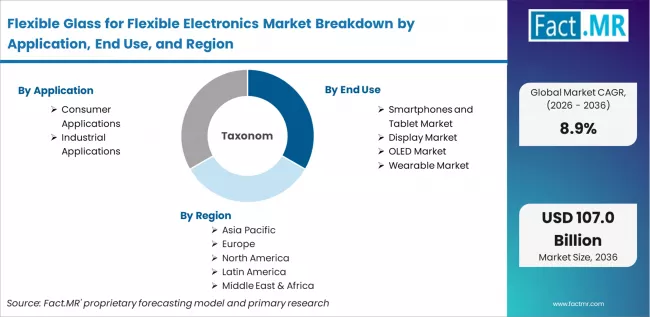
Flexible Glass for Flexible Electronics Market is segmented by Application (Consumer Applications and Industrial Applications), End User (Display Market, OLED Market, Smartphones and Tablet Market, and Wearable Market), and Region. Forecast for 2026 to 2036.

Core Findings

    Flexible Glass for Flexible Electronics Market Forecast and Outlook By Fact.MR

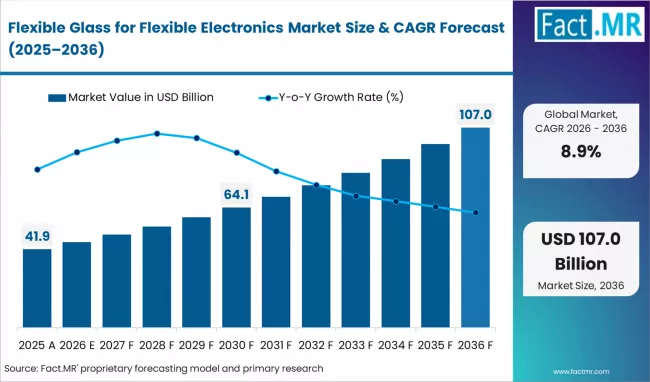
    In 2025, the flexible glass for flexible electronics market was valued at USD 41.9 billion. Based on Fact.MR analysis, demand for flexible glass is estimated to grow to USD 45.6 billion in 2026 and USD 107.0 billion by 2036. FACT.MR projects a CAGR of 8.9% during the forecast period.

    The market is expected to generate USD 61.4 billion in incremental revenue. This reflects transformational growth rather than incremental expansion. Growth is driven by foldable smartphone proliferation and OLED display panel expansion. Flexible glass offers superior scratch resistance and optical clarity over polymer alternatives, supporting premium OEM adoption. However, high fabrication costs at sub-100-micron thickness limit faster mass-market penetration. Polymer film substrates remain competitive in cost-sensitive wearable segments.
    Flexible Glass For Flexible Electronics Market Market Value Analysis

    Metric Value
    Estimated Value in 2026 USD 45.6 billion
    Forecast Value in 2036 USD 107.0 billion
    Forecast CAGR (2026 to 2036) 8.9%

    South Korea leads country-level growth at 11.5% CAGR, supported by Samsung and LG OLED foldable device production concentration and advanced glass processing ecosystems. The USA at 11.6% reflects the highest country-level CAGR driven by Corning's Gorilla Glass Victus flex programme investment and strong foldable device and AR wearable demand from Apple and Google OEM platforms. Japan at 11.3% benefits from Nippon Electric Glass and AGC ultra-thin glass substrate leadership and precision electronics manufacturing. The European Union at 11.0% is driven by Schott AG flexible glass capacity expansion and industrial electronics adoption in automotive display and medical device applications. The UK at 10.8% records steady growth from enterprise wearable and flexible display programme deployment. Structural constraints across all markets include the capital intensity of ultra-thin glass drawing processes and limited qualified fabrication capacity outside East Asia.

    Summary of Flexible Glass for Flexible Electronics Market

    • Market Definition
      • The market covers ultra-thin glass substrates engineered below 0.1 mm thickness for foldable and flexible consumer electronics, OLED display panels, smartphones, tablets, and wearable devices operating across consumer and industrial application categories.
    • Demand Drivers
      • Foldable smartphone OEMs like Samsung and Apple are increasing flexible glass usage as both cover glass and display substrate to improve durability and fold resistance in premium devices.
      • OLED panel manufacturers are gradually replacing polymer PI films with glass substrates to achieve better optical clarity, higher brightness, and improved moisture barrier performance.
      • Corning’s Victus flex programme highlights rising demand for ultra-thin, scratch-resistant glass solutions in wearables and AR devices where polymer films fall short.
    • Key Segments Analyzed
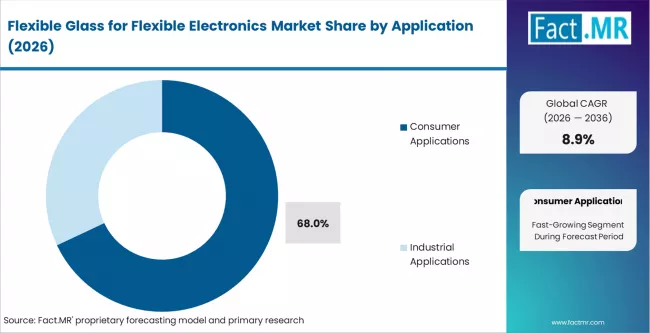
      • By Application: Consumer applications hold 68% share in 2026, driven by large-scale production of foldable smartphones, OLED display panels, and premium wearable devices requiring high-performance substrates.
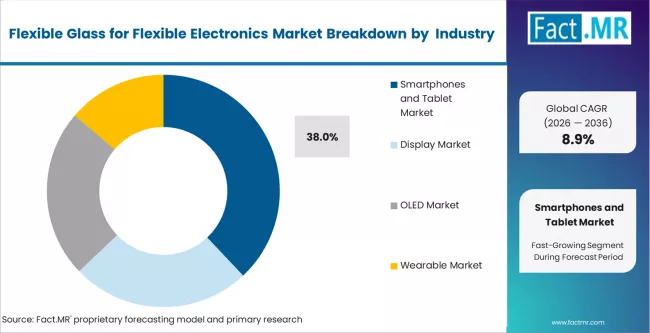
      • By End User: Smartphones and tablets hold 38% share in 2026, supported by increasing foldable device launches and higher flexible glass content per device.
      • By Geography: USA leads growth at 11.6% CAGR, supported by strong OEM ecosystem, Corning’s innovation pipeline.
    • Analyst Opinion at FACT.MR
      • Shambhu Nath Jha notes that foldable devices and OLED transitions are accelerating the shift toward flexible glass as polymer alternatives fail to meet durability and performance needs.
    • Strategic Implications
      • OEMs should adopt dual sourcing from Corning, AGC, or NEG to reduce supply risk as foldable device volumes scale.
      • Producers should target automotive display certification to capture emerging demand from OLED dashboards and infotainment systems.
      • Companies should focus on ultra-thin glass (<50 microns) with strengthened surfaces to compete in wearables and AR applications.
    • Methodology
      • Market sizing is based on foldable device shipments, OLED panel capacity, and pricing benchmarks by substrate type.
      • Technology inputs include product data from Corning, AGC, NEG, and Schott along with teardown analysis.
      • Forecasts include foldable adoption trends, OLED expansion, wearable growth, and expert insights.

    Segmental Analysis

    Flexible Glass for Flexible Electronics Market Analysis by Application
    Flexible Glass For Flexible Electronics Market Analysis By Application

    Consumer applications are expected to hold 68% share in 2026. This is supported by strong demand from foldable smartphones, OLED panels, and wearable devices requiring durable and high-clarity substrates.

    • Samsung Foldable Glass Investment: Samsung expanded flexible glass integration across Galaxy Z Fold and Flip production lines, increasing glass content per device. [4]
    • Corning Gorilla Glass Victus Flex Launch: Corning launched advanced flexible glass capable of tight bending radius with high scratch resistance for consumer devices. [1]
    • Industrial Application Expansion Trend: Flexible glass adoption is rising in automotive, medical, and industrial applications beyond consumer electronics. [3]

    Flexible Glass for Flexible Electronics Market Analysis by End User
    Flexible Glass For Flexible Electronics Market Analysis By End Use

    Smartphones and tablets are expected to hold 38% share in 2026. Growth is driven by foldable device adoption and increasing use of flexible glass in display stacks.

    • Google Pixel Fold Glass: Google expanded flexible glass usage in its foldable smartphone, reflecting broader OEM adoption trends. [5]
    • NEG Ultra-Thin Glass Development: NEG introduced ultra-thin glass (~30 microns) for advanced flexible displays and lightweight devices. [6]
    • OLED Wearable Display Trend: Growth in wearable OLED panels is driving higher adoption of flexible glass in premium smartwatches and devices. [7]

    Drivers, Restraints, and Opportunities
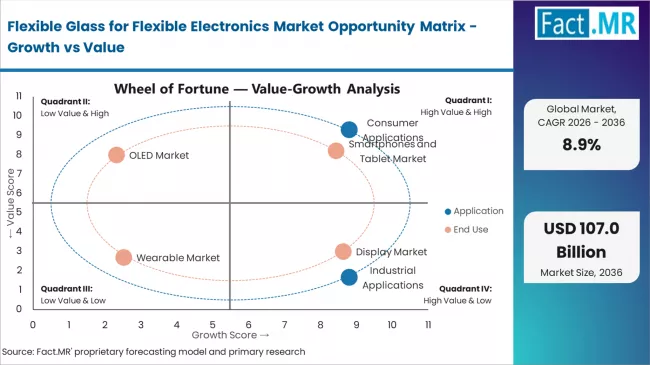
    Flexible Glass For Flexible Electronics Market Opportunity Matrix Growth Vs Value

    FACT.MR notes that flexible glass has evolved into a commercially viable material for foldable electronics. It addresses key limitations of polymer films, especially in durability and optical clarity. Demand for polymer films is declining in premium segments as flexible glass offers significantly higher scratch resistance and longer lifespan. It enhances user experience in foldable smartphones and wearables. This enables 30-50% price premiums in flagship devices.

    • South Korea OLED Scale-Up: Samsung and LG invested over KRW 10 trillion in OLED capacity expansion, directly increasing procurement of flexible glass substrates. [2]
    • Corning Gorilla Glass Victus Programme: Corning reported strong revenue growth driven by ultra-thin flexible glass adoption in foldable device platforms. [1]
    • EU Automotive Display Adoption: Flexible OLED displays in vehicles are expanding, increasing demand for automotive-grade flexible glass substrates. [3]

    Regional Analysis

    The flexible glass for flexible electronics market is analysed across North America, Europe, Asia Pacific, Latin America, and Middle East and Africa, covering 40+ country-level demand profiles shaped by foldable device OEM concentration, OLED panel manufacturing capacity, ultra-thin glass producer ecosystems, and industrial flexible display adoption in automotive and medical verticals. The full report offers market attractiveness analysis based on OEM design win benchmarks, glass substrate thickness specifications, and regional policy support for advanced display manufacturing.

    Top Country Growth Comparison Flexible Glass For Flexible Electronics Market Cagr (2026 2036)

    Country CAGR (2026 to 2036)
    United States 11.6%
    South Korea 11.5%
    Japan 11.3%
    European Union 11.0%
    United Kingdom 10.8%

    Source: Fact.MR (FACT.MR) analysis, based on proprietary forecasting model and primary research
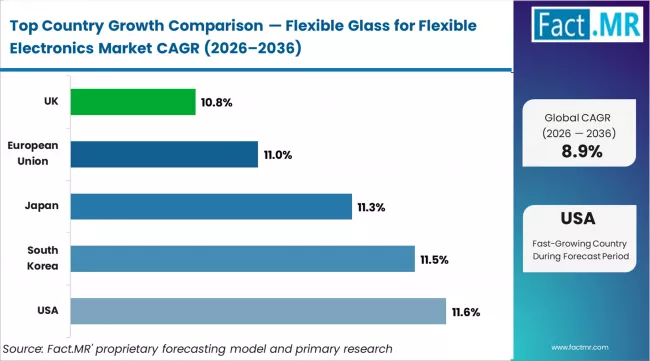
    Flexible Glass For Flexible Electronics Market Cagr Analysis By Country

    Asia Pacific Flexible Glass for Flexible Electronics Market Analysis
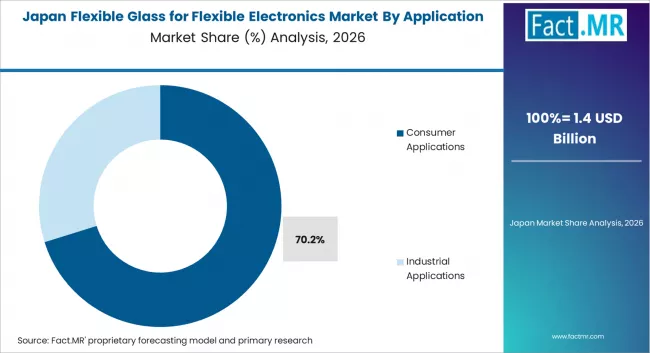
    Flexible Glass For Flexible Electronics Market Japan Market Share Analysis By Application

    Asia Pacific is the production hub of the flexible glass market, led by South Korea’s OLED manufacturing, Japan’s ultra-thin glass leadership, and China’s expanding display capacity. Corning, NEG, and AGC supply most globally qualified flexible glass substrates.

    • South Korea: South Korea led by display manufacturing scale: Flexible glass demand in South Korea is projected to grow at an 11.5% CAGR through 2036. Samsung Display invested KRW 6.2 trillion in 2024 to expand OLED capacity at Asan, increasing flexible glass usage in foldable devices. LG Display also expanded its Paju facility for automotive OLED panels. Demand spans both consumer electronics and automotive applications.
    • Japan: Japan driven by material innovation leadership: Flexible glass demand in Japan is projected to grow at an 11.3% CAGR through 2036. NEG launched ultra-thin 30-micron glass in 2024 for OLED and wearable devices. AGC continued investment in flexible glass production at its Chiba facility. Japan’s market is led by glass producers supplying global OEMs.

    FACT.MR's analysis of Asia Pacific includes South Korea, Japan, China, India, ASEAN, and Australia and New Zealand. It covers OEM trends, capacity expansion, and forecasts.

    North America Flexible Glass for Flexible Electronics Market Analysis
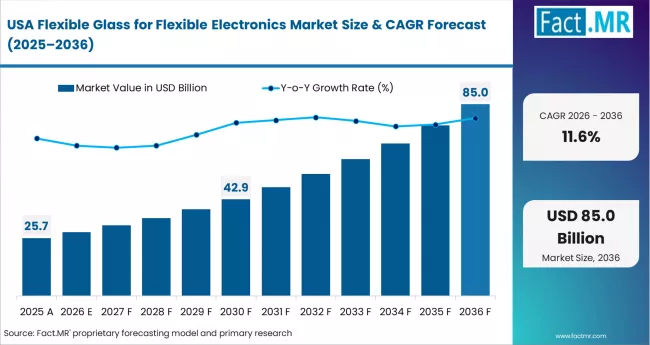
    Flexible Glass For Flexible Electronics Market Country Value Analysis

    North America is an innovation hub, driven by Corning’s technology leadership and strong OEM design activity. The region focuses on premium applications and advanced glass development.

    • United States: United States supported by OEM and technology leadership: Flexible glass demand in the United States is projected to grow at an 11.6% CAGR through 2036. Corning’s Victus flex programme is gaining OEM traction. Apple, Google, and Motorola are expanding foldable device development. CHIPS Act incentives also support advanced material investment.

    FACT.MR's analysis of North America includes the United States, Canada, and Mexico. It highlights OEM activity, innovation trends, and forecasts.

    Europe Flexible Glass for Flexible Electronics Market Analysis
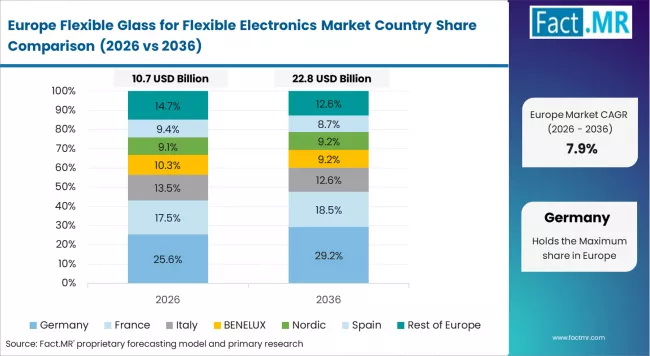
    Flexible Glass For Flexible Electronics Market Europe Country Market Share Analysis, 2026 & 2036

    Europe focuses on industrial and automotive applications, supported by strong research funding and material innovation. Schott AG leads automotive-grade flexible glass development.

    • European Union: European Union driven by automotive and research investment: Flexible glass demand in the EU is projected to grow at an 11.0% CAGR through 2036. Schott achieved automotive OLED qualification with major OEMs in 2024. Horizon Europe allocated EUR 45 million for flexible materials research. This supports industrial and medical applications.
    • United Kingdom: United Kingdom supported by research-led innovation: Flexible glass demand in the UK is projected to grow at a 10.8% CAGR through 2036. Government programmes funded flexible electronics R&D in 2024. FlexEnable expanded flexible display development using glass substrates. The market is driven by research and niche applications.

    FACT.MR's analysis of Europe includes Germany, France, the UK, Italy, Spain, and Western Europe. It covers automotive trends, research funding, and forecasts.

    Key Players of Flexible Glass for Flexible Electronics Market

    • Corning Incorporated
    • AGC Inc.
    • Nippon Electric Glass
    • Schott AG
    • Saint-Gobain
    • Asahi Glass Co.
    • BOE Technology Group
    • Samsung Corning Precision Materials
    • NEG (Nippon Electric Glass)
    • Apple Inc. (Patent Developments)

    Scope of Report

    Flexible Glass For Flexible Electronics Market Breakdown By Application, End Use, And Region

    Attribute Details
    Quantitative Units USD 45.6 billion (2026) to USD 107.0 billion (2036), at a CAGR of 8.9%
    Market Definition Ultra-thin glass substrates engineered below 0.1 mm thickness for foldable and flexible consumer electronics, OLED display panels, foldable smartphones, tablets, and wearable devices, delivering superior optical clarity, scratch resistance, and moisture barrier performance over polymer film alternatives.
    Application Segmentation Consumer Applications, Industrial Applications
    End User Segmentation Display Market, OLED Market, Smartphones and Tablet Market, Wearable Market
    Application Coverage Foldable smartphone cover glass, OLED display panel substrates, smartwatch and AR wearable display glass, automotive interior flexible display substrates, medical wearable device display panels, and building-integrated photovoltaic flexible glass substrates.
    Regions Covered North America, Europe, Asia Pacific, Latin America, Middle East and Africa
    Countries Covered USA, Canada, Mexico, UK, Germany, France, Italy, Spain, Nordic, BENELUX, Eastern Europe, Japan, South Korea, China, India, ASEAN, Australia and New Zealand, Brazil, Argentina, Chile, KSA, GCC, Turkey, South Africa, Rest of MEA
    Key Companies Profiled Corning Incorporated, AGC Inc., Nippon Electric Glass, Schott AG, Saint-Gobain, Asahi Glass Co., BOE Technology Group, Samsung Corning Precision Materials, NEG (Nippon Electric Glass), Apple Inc. (Patent Developments)
    Forecast Period 2026 to 2036
    Approach Hybrid top-down and bottom-up model using global foldable device and OLED panel shipment volumes, flexible glass attach rates by end-user category, substrate pricing benchmarks by thickness tier, and primary interviews with display panel engineers, OEM materials procurement managers, and flexible glass substrate specialists.

    Flexible Glass for Flexible Electronics Market by Segments

    • By Application :

      • Consumer Applications
      • Industrial Applications
    • By End User :

      • Display Market
      • OLED Market
      • Smartphones and Tablet Market
      • Wearable Market
    • By Region :

      • North America
        • United States
        • Canada
        • Mexico
      • Latin America
        • Brazil
        • Mexico
        • Argentina
        • Chile
        • Rest of Latin America
      • Western Europe
        • Germany
        • United Kingdom
        • France
        • Italy
        • Spain
        • Nordic Countries
        • BENELUX
        • Rest of Western Europe
      • Eastern Europe
        • Russia
        • Poland
        • Hungary
        • Balkan and Baltic
        • Rest of Eastern Europe
      • East Asia
        • China
        • Japan
        • South Korea
      • South Asia and Pacific
        • India
        • ASEAN
        • Australia and New Zealand
        • Rest of South Asia and Pacific
      • Middle East and Africa
        • Kingdom of Saudi Arabia
        • Other GCC Countries
        • Turkey
        • South Africa
        • Rest of Middle East and Africa

    Bibliography

    • [1] Corning Incorporated. 2024. Q3 2024 Earnings Call Transcript and Specialty Glass Segment Revenue Update: Gorilla Glass Victus Flex Programme OEM Qualification Activity and Revenue Growth. October 2024.
    • [2] Samsung Display Corporation. 2024. Capital Expenditure Disclosure: Flexible OLED Production Line Expansion and Flexible Glass Substrate Integration. 2024.
    • [3] Schott AG. 2024. Annual Results 2024: FLEXINITY Ultra-Thin Flexible Glass Automotive Display Qualification and Industrial Growth. 2024.
    • [4] Samsung Electronics. 2024. Galaxy Z Fold 6 and Z Flip 6 Launch Materials: Flexible Glass Integration in Display Stack. July 2024.
    • [5] Google LLC. 2024. Pixel 9 Pro Fold Launch and Teardown Analysis: Ultra-Thin Glass Display Integration. June 2024.
    • [6] Nippon Electric Glass Co., Ltd. 2024. D263 Ultra-Thin Glass Product Announcement for Flexible OLED Applications. October 2024.
    • [7] OLED Association. 2024. Annual Display Market Review 2024: Wearable OLED Growth and Flexible Glass Adoption. December 2024.
    • [8] LG Display Co., Ltd. 2024. P10 Paju OLED Facility Ramp Disclosure: Automotive Flexible Display Integration. November 2024.

    This Report Addresses

    • Strategic insights on Corning, Samsung, LG, and Schott initiatives shaping flexible glass demand through 2036.
    • Market forecast from USD 45.6 billion (2026) to USD 107.0 billion by 2036 at 8.9% CAGR.
    • Growth opportunities across US OEMs, South Korea OLED expansion, Japan tech advances, and EU automotive displays.
    • Country outlook led by US, South Korea, Japan, EU, and UK with strong double-digit growth.
    • Competitive analysis covering Corning, AGC, NEG, Schott, and key players with focus on technology and OEM strategies.
    • Technology tracking on ultra-thin glass, fold performance, strengthening, and OLED integration.
    • Regulatory coverage including EU Horizon Europe, US CHIPS Act, and global display programmes.
    • Deliverables include PDF report, Excel data, PowerPoint summary, and dashboards.

    Flexible Glass for Flexible Electronics Market Definition

    The flexible glass market includes ultra-thin glass substrates below 0.1 mm thickness engineered for foldable and flexible electronics, enabling bendable OLED displays, foldable smartphone covers, and wearable device panels.

    Flexible Glass for Flexible Electronics Market Inclusions

    Covers global forecasts (2026 to 2036) by application and end user across major consumer and industrial flexible electronics categories and device platforms.

    Flexible Glass for Flexible Electronics Market Exclusions

    Excludes standard rigid glass substrates, polymer PET and PI films, flexible printed circuit boards, and finished foldable device assemblies not supplied as bare glass substrate.

    Flexible Glass for Flexible Electronics Market Research Methodology

    • Primary Research: Interviews with display panel engineers, OEM materials procurement managers, flexible glass substrate specialists, and wearable device designers.
    • Desk Research: Includes Corning, AGC, NEG, and Schott AG filings, SEMI standards data, and foldable device market shipment reports from 2024 to 2025.
    • Market Sizing and Forecasting: Based on foldable device shipment volumes, ultra-thin glass attach rates, substrate pricing benchmarks, and OLED panel production data.
    • Data Validation and Update Cycle: Validated using glass producer revenues, foldable device shipment data, display industry association statistics, and expert interviews.

    Table of Content

    1. Executive Summary
      • Global Market Outlook
      • Demand to side Trends
      • Supply to side Trends
      • Technology Roadmap Analysis
      • Analysis and Recommendations
    2. Market Overview
      • Market Coverage / Taxonomy
      • Market Definition / Scope / Limitations
    3. Research Methodology
      • Chapter Orientation
      • Analytical Lens and Working Hypotheses
        • Market Structure, Signals, and Trend Drivers
        • Benchmarking and Cross-market Comparability
        • Market Sizing, Forecasting, and Opportunity Mapping
      • Research Design and Evidence Framework
        • Desk Research Programme (Secondary Evidence)
          • Company Annual and Sustainability Reports
          • Peer-reviewed Journals and Academic Literature
          • Corporate Websites, Product Literature, and Technical Notes
          • Earnings Decks and Investor Briefings
          • Statutory Filings and Regulatory Disclosures
          • Technical White Papers and Standards Notes
          • Trade Journals, Industry Magazines, and Analyst Briefs
          • Conference Proceedings, Webinars, and Seminar Materials
          • Government Statistics Portals and Public Data Releases
          • Press Releases and Reputable Media Coverage
          • Specialist Newsletters and Curated Briefings
          • Sector Databases and Reference Repositories
          • Fact.MR Internal Proprietary Databases and Historical Market Datasets
          • Subscription Datasets and Paid Sources
          • Social Channels, Communities, and Digital Listening Inputs
          • Additional Desk Sources
        • Expert Input and Fieldwork (Primary Evidence)
          • Primary Modes
            • Qualitative Interviews and Expert Elicitation
            • Quantitative Surveys and Structured Data Capture
            • Blended Approach
          • Why Primary Evidence is Used
          • Field Techniques
            • Interviews
            • Surveys
            • Focus Groups
            • Observational and In-context Research
            • Social and Community Interactions
          • Stakeholder Universe Engaged
            • C-suite Leaders
            • Board Members
            • Presidents and Vice Presidents
            • R&D and Innovation Heads
            • Technical Specialists
            • Domain Subject-matter Experts
            • Scientists
            • Physicians and Other Healthcare Professionals
          • Governance, Ethics, and Data Stewardship
            • Research Ethics
            • Data Integrity and Handling
        • Tooling, Models, and Reference Databases
      • Data Engineering and Model Build
        • Data Acquisition and Ingestion
        • Cleaning, Normalisation, and Verification
        • Synthesis, Triangulation, and Analysis
      • Quality Assurance and Audit Trail
    4. Market Background
      • Market Dynamics
        • Drivers
        • Restraints
        • Opportunity
        • Trends
      • Scenario Forecast
        • Demand in Optimistic Scenario
        • Demand in Likely Scenario
        • Demand in Conservative Scenario
      • Opportunity Map Analysis
      • Product Life Cycle Analysis
      • Supply Chain Analysis
      • Investment Feasibility Matrix
      • Value Chain Analysis
      • PESTLE and Porter’s Analysis
      • Regulatory Landscape
      • Regional Parent Market Outlook
      • Production and Consumption Statistics
      • Import and Export Statistics
    5. Global Market Analysis 2021 to 2025 and Forecast, 2026 to 2036
      • Historical Market Size Value (USD Million) Analysis, 2021 to 2025
      • Current and Future Market Size Value (USD Million) Projections, 2026 to 2036
        • Y to o to Y Growth Trend Analysis
        • Absolute $ Opportunity Analysis
    6. Global Market Pricing Analysis 2021 to 2025 and Forecast 2026 to 2036
    7. Global Market Analysis 2021 to 2025 and Forecast 2026 to 2036, By Application
      • Introduction / Key Findings
      • Historical Market Size Value (USD Million) Analysis By Application, 2021 to 2025
      • Current and Future Market Size Value (USD Million) Analysis and Forecast By Application, 2026 to 2036
        • Consumer Applications
        • Industrial Applications
      • Y to o to Y Growth Trend Analysis By Application, 2021 to 2025
      • Absolute $ Opportunity Analysis By Application, 2026 to 2036
    8. Global Market Analysis 2021 to 2025 and Forecast 2026 to 2036, By End Use
      • Introduction / Key Findings
      • Historical Market Size Value (USD Million) Analysis By End Use, 2021 to 2025
      • Current and Future Market Size Value (USD Million) Analysis and Forecast By End Use, 2026 to 2036
        • Smartphones and Tablet Market
        • Display Market
        • OLED Market
        • Wearable Market
      • Y to o to Y Growth Trend Analysis By End Use, 2021 to 2025
      • Absolute $ Opportunity Analysis By End Use, 2026 to 2036
    9. Global Market Analysis 2021 to 2025 and Forecast 2026 to 2036, By Region
      • Introduction
      • Historical Market Size Value (USD Million) Analysis By Region, 2021 to 2025
      • Current Market Size Value (USD Million) Analysis and Forecast By Region, 2026 to 2036
        • North America
        • Latin America
        • Western Europe
        • Eastern Europe
        • East Asia
        • South Asia and Pacific
        • Middle East & Africa
      • Market Attractiveness Analysis By Region
    10. North America Market Analysis 2021 to 2025 and Forecast 2026 to 2036, By Country
      • Historical Market Size Value (USD Million) Trend Analysis By Market Taxonomy, 2021 to 2025
      • Market Size Value (USD Million) Forecast By Market Taxonomy, 2026 to 2036
        • By Country
          • USA
          • Canada
          • Mexico
        • By Application
        • By End Use
      • Market Attractiveness Analysis
        • By Country
        • By Application
        • By End Use
      • Key Takeaways
    11. Latin America Market Analysis 2021 to 2025 and Forecast 2026 to 2036, By Country
      • Historical Market Size Value (USD Million) Trend Analysis By Market Taxonomy, 2021 to 2025
      • Market Size Value (USD Million) Forecast By Market Taxonomy, 2026 to 2036
        • By Country
          • Brazil
          • Chile
          • Rest of Latin America
        • By Application
        • By End Use
      • Market Attractiveness Analysis
        • By Country
        • By Application
        • By End Use
      • Key Takeaways
    12. Western Europe Market Analysis 2021 to 2025 and Forecast 2026 to 2036, By Country
      • Historical Market Size Value (USD Million) Trend Analysis By Market Taxonomy, 2021 to 2025
      • Market Size Value (USD Million) Forecast By Market Taxonomy, 2026 to 2036
        • By Country
          • Germany
          • UK
          • Italy
          • Spain
          • France
          • Nordic
          • BENELUX
          • Rest of Western Europe
        • By Application
        • By End Use
      • Market Attractiveness Analysis
        • By Country
        • By Application
        • By End Use
      • Key Takeaways
    13. Eastern Europe Market Analysis 2021 to 2025 and Forecast 2026 to 2036, By Country
      • Historical Market Size Value (USD Million) Trend Analysis By Market Taxonomy, 2021 to 2025
      • Market Size Value (USD Million) Forecast By Market Taxonomy, 2026 to 2036
        • By Country
          • Russia
          • Poland
          • Hungary
          • Balkan & Baltic
          • Rest of Eastern Europe
        • By Application
        • By End Use
      • Market Attractiveness Analysis
        • By Country
        • By Application
        • By End Use
      • Key Takeaways
    14. East Asia Market Analysis 2021 to 2025 and Forecast 2026 to 2036, By Country
      • Historical Market Size Value (USD Million) Trend Analysis By Market Taxonomy, 2021 to 2025
      • Market Size Value (USD Million) Forecast By Market Taxonomy, 2026 to 2036
        • By Country
          • China
          • Japan
          • South Korea
        • By Application
        • By End Use
      • Market Attractiveness Analysis
        • By Country
        • By Application
        • By End Use
      • Key Takeaways
    15. South Asia and Pacific Market Analysis 2021 to 2025 and Forecast 2026 to 2036, By Country
      • Historical Market Size Value (USD Million) Trend Analysis By Market Taxonomy, 2021 to 2025
      • Market Size Value (USD Million) Forecast By Market Taxonomy, 2026 to 2036
        • By Country
          • India
          • ASEAN
          • Australia & New Zealand
          • Rest of South Asia and Pacific
        • By Application
        • By End Use
      • Market Attractiveness Analysis
        • By Country
        • By Application
        • By End Use
      • Key Takeaways
    16. Middle East & Africa Market Analysis 2021 to 2025 and Forecast 2026 to 2036, By Country
      • Historical Market Size Value (USD Million) Trend Analysis By Market Taxonomy, 2021 to 2025
      • Market Size Value (USD Million) Forecast By Market Taxonomy, 2026 to 2036
        • By Country
          • Kingdom of Saudi Arabia
          • Other GCC Countries
          • Turkiye
          • South Africa
          • Other African Union
          • Rest of Middle East & Africa
        • By Application
        • By End Use
      • Market Attractiveness Analysis
        • By Country
        • By Application
        • By End Use
      • Key Takeaways
    17. Key Countries Market Analysis
      • USA
        • Pricing Analysis
        • Market Share Analysis, 2025
          • By Application
          • By End Use
      • Canada
        • Pricing Analysis
        • Market Share Analysis, 2025
          • By Application
          • By End Use
      • Mexico
        • Pricing Analysis
        • Market Share Analysis, 2025
          • By Application
          • By End Use
      • Brazil
        • Pricing Analysis
        • Market Share Analysis, 2025
          • By Application
          • By End Use
      • Chile
        • Pricing Analysis
        • Market Share Analysis, 2025
          • By Application
          • By End Use
      • Germany
        • Pricing Analysis
        • Market Share Analysis, 2025
          • By Application
          • By End Use
      • UK
        • Pricing Analysis
        • Market Share Analysis, 2025
          • By Application
          • By End Use
      • Italy
        • Pricing Analysis
        • Market Share Analysis, 2025
          • By Application
          • By End Use
      • Spain
        • Pricing Analysis
        • Market Share Analysis, 2025
          • By Application
          • By End Use
      • France
        • Pricing Analysis
        • Market Share Analysis, 2025
          • By Application
          • By End Use
      • India
        • Pricing Analysis
        • Market Share Analysis, 2025
          • By Application
          • By End Use
      • ASEAN
        • Pricing Analysis
        • Market Share Analysis, 2025
          • By Application
          • By End Use
      • Australia & New Zealand
        • Pricing Analysis
        • Market Share Analysis, 2025
          • By Application
          • By End Use
      • China
        • Pricing Analysis
        • Market Share Analysis, 2025
          • By Application
          • By End Use
      • Japan
        • Pricing Analysis
        • Market Share Analysis, 2025
          • By Application
          • By End Use
      • South Korea
        • Pricing Analysis
        • Market Share Analysis, 2025
          • By Application
          • By End Use
      • Russia
        • Pricing Analysis
        • Market Share Analysis, 2025
          • By Application
          • By End Use
      • Poland
        • Pricing Analysis
        • Market Share Analysis, 2025
          • By Application
          • By End Use
      • Hungary
        • Pricing Analysis
        • Market Share Analysis, 2025
          • By Application
          • By End Use
      • Kingdom of Saudi Arabia
        • Pricing Analysis
        • Market Share Analysis, 2025
          • By Application
          • By End Use
      • Turkiye
        • Pricing Analysis
        • Market Share Analysis, 2025
          • By Application
          • By End Use
      • South Africa
        • Pricing Analysis
        • Market Share Analysis, 2025
          • By Application
          • By End Use
    18. Market Structure Analysis
      • Competition Dashboard
      • Competition Benchmarking
      • Market Share Analysis of Top Players
        • By Regional
        • By Application
        • By End Use
    19. Competition Analysis
      • Competition Deep Dive
        • Corning Incorporated
          • Overview
          • Product Portfolio
          • Profitability by Market Segments (Product/Age /Sales Channel/Region)
          • Sales Footprint
          • Strategy Overview
            • Marketing Strategy
            • Product Strategy
            • Channel Strategy
        • AGC Inc.
        • Nippon Electric Glass
        • Schott AG
        • Saint-Gobain
        • Asahi Glass Co.
        • BOE Technology Group
        • Samsung Corning Precision Materials
        • NEG (Nippon Electric Glass)
        • Apple Inc. (Patent Developments)
    20. Assumptions & Acronyms Used

    List Of Table

    • Table 1: Global Market Value (USD Million) Forecast by Region, 2021 to 2036
    • Table 2: Global Market Value (USD Million) Forecast by Application, 2021 to 2036
    • Table 3: Global Market Value (USD Million) Forecast by End Use, 2021 to 2036
    • Table 4: North America Market Value (USD Million) Forecast by Country, 2021 to 2036
    • Table 5: North America Market Value (USD Million) Forecast by Application, 2021 to 2036
    • Table 6: North America Market Value (USD Million) Forecast by End Use, 2021 to 2036
    • Table 7: Latin America Market Value (USD Million) Forecast by Country, 2021 to 2036
    • Table 8: Latin America Market Value (USD Million) Forecast by Application, 2021 to 2036
    • Table 9: Latin America Market Value (USD Million) Forecast by End Use, 2021 to 2036
    • Table 10: Western Europe Market Value (USD Million) Forecast by Country, 2021 to 2036
    • Table 11: Western Europe Market Value (USD Million) Forecast by Application, 2021 to 2036
    • Table 12: Western Europe Market Value (USD Million) Forecast by End Use, 2021 to 2036
    • Table 13: Eastern Europe Market Value (USD Million) Forecast by Country, 2021 to 2036
    • Table 14: Eastern Europe Market Value (USD Million) Forecast by Application, 2021 to 2036
    • Table 15: Eastern Europe Market Value (USD Million) Forecast by End Use, 2021 to 2036
    • Table 16: East Asia Market Value (USD Million) Forecast by Country, 2021 to 2036
    • Table 17: East Asia Market Value (USD Million) Forecast by Application, 2021 to 2036
    • Table 18: East Asia Market Value (USD Million) Forecast by End Use, 2021 to 2036
    • Table 19: South Asia and Pacific Market Value (USD Million) Forecast by Country, 2021 to 2036
    • Table 20: South Asia and Pacific Market Value (USD Million) Forecast by Application, 2021 to 2036
    • Table 21: South Asia and Pacific Market Value (USD Million) Forecast by End Use, 2021 to 2036
    • Table 22: Middle East & Africa Market Value (USD Million) Forecast by Country, 2021 to 2036
    • Table 23: Middle East & Africa Market Value (USD Million) Forecast by Application, 2021 to 2036
    • Table 24: Middle East & Africa Market Value (USD Million) Forecast by End Use, 2021 to 2036

    List Of Figures

    • Figure 1: Global Market Pricing Analysis
    • Figure 2: Global Market Value (USD Million) Forecast 2021 to 2036
    • Figure 3: Global Market Value Share and BPS Analysis by Application, 2026 and 2036
    • Figure 4: Global Market Y-o-Y Growth Comparison by Application, 2026 to 2036
    • Figure 5: Global Market Attractiveness Analysis by Application
    • Figure 6: Global Market Value Share and BPS Analysis by End Use, 2026 and 2036
    • Figure 7: Global Market Y-o-Y Growth Comparison by End Use, 2026 to 2036
    • Figure 8: Global Market Attractiveness Analysis by End Use
    • Figure 9: Global Market Value (USD Million) Share and BPS Analysis by Region, 2026 and 2036
    • Figure 10: Global Market Y-o-Y Growth Comparison by Region, 2026 to 2036
    • Figure 11: Global Market Attractiveness Analysis by Region
    • Figure 12: North America Market Incremental Dollar Opportunity, 2026 to 2036
    • Figure 13: Latin America Market Incremental Dollar Opportunity, 2026 to 2036
    • Figure 14: Western Europe Market Incremental Dollar Opportunity, 2026 to 2036
    • Figure 15: Eastern Europe Market Incremental Dollar Opportunity, 2026 to 2036
    • Figure 16: East Asia Market Incremental Dollar Opportunity, 2026 to 2036
    • Figure 17: South Asia and Pacific Market Incremental Dollar Opportunity, 2026 to 2036
    • Figure 18: Middle East & Africa Market Incremental Dollar Opportunity, 2026 to 2036
    • Figure 19: North America Market Value Share and BPS Analysis by Country, 2026 and 2036
    • Figure 20: North America Market Value Share and BPS Analysis by Application, 2026 and 2036
    • Figure 21: North America Market Y-o-Y Growth Comparison by Application, 2026 to 2036
    • Figure 22: North America Market Attractiveness Analysis by Application
    • Figure 23: North America Market Value Share and BPS Analysis by End Use, 2026 and 2036
    • Figure 24: North America Market Y-o-Y Growth Comparison by End Use, 2026 to 2036
    • Figure 25: North America Market Attractiveness Analysis by End Use
    • Figure 26: Latin America Market Value Share and BPS Analysis by Country, 2026 and 2036
    • Figure 27: Latin America Market Value Share and BPS Analysis by Application, 2026 and 2036
    • Figure 28: Latin America Market Y-o-Y Growth Comparison by Application, 2026 to 2036
    • Figure 29: Latin America Market Attractiveness Analysis by Application
    • Figure 30: Latin America Market Value Share and BPS Analysis by End Use, 2026 and 2036
    • Figure 31: Latin America Market Y-o-Y Growth Comparison by End Use, 2026 to 2036
    • Figure 32: Latin America Market Attractiveness Analysis by End Use
    • Figure 33: Western Europe Market Value Share and BPS Analysis by Country, 2026 and 2036
    • Figure 34: Western Europe Market Value Share and BPS Analysis by Application, 2026 and 2036
    • Figure 35: Western Europe Market Y-o-Y Growth Comparison by Application, 2026 to 2036
    • Figure 36: Western Europe Market Attractiveness Analysis by Application
    • Figure 37: Western Europe Market Value Share and BPS Analysis by End Use, 2026 and 2036
    • Figure 38: Western Europe Market Y-o-Y Growth Comparison by End Use, 2026 to 2036
    • Figure 39: Western Europe Market Attractiveness Analysis by End Use
    • Figure 40: Eastern Europe Market Value Share and BPS Analysis by Country, 2026 and 2036
    • Figure 41: Eastern Europe Market Value Share and BPS Analysis by Application, 2026 and 2036
    • Figure 42: Eastern Europe Market Y-o-Y Growth Comparison by Application, 2026 to 2036
    • Figure 43: Eastern Europe Market Attractiveness Analysis by Application
    • Figure 44: Eastern Europe Market Value Share and BPS Analysis by End Use, 2026 and 2036
    • Figure 45: Eastern Europe Market Y-o-Y Growth Comparison by End Use, 2026 to 2036
    • Figure 46: Eastern Europe Market Attractiveness Analysis by End Use
    • Figure 47: East Asia Market Value Share and BPS Analysis by Country, 2026 and 2036
    • Figure 48: East Asia Market Value Share and BPS Analysis by Application, 2026 and 2036
    • Figure 49: East Asia Market Y-o-Y Growth Comparison by Application, 2026 to 2036
    • Figure 50: East Asia Market Attractiveness Analysis by Application
    • Figure 51: East Asia Market Value Share and BPS Analysis by End Use, 2026 and 2036
    • Figure 52: East Asia Market Y-o-Y Growth Comparison by End Use, 2026 to 2036
    • Figure 53: East Asia Market Attractiveness Analysis by End Use
    • Figure 54: South Asia and Pacific Market Value Share and BPS Analysis by Country, 2026 and 2036
    • Figure 55: South Asia and Pacific Market Value Share and BPS Analysis by Application, 2026 and 2036
    • Figure 56: South Asia and Pacific Market Y-o-Y Growth Comparison by Application, 2026 to 2036
    • Figure 57: South Asia and Pacific Market Attractiveness Analysis by Application
    • Figure 58: South Asia and Pacific Market Value Share and BPS Analysis by End Use, 2026 and 2036
    • Figure 59: South Asia and Pacific Market Y-o-Y Growth Comparison by End Use, 2026 to 2036
    • Figure 60: South Asia and Pacific Market Attractiveness Analysis by End Use
    • Figure 61: Middle East & Africa Market Value Share and BPS Analysis by Country, 2026 and 2036
    • Figure 62: Middle East & Africa Market Value Share and BPS Analysis by Application, 2026 and 2036
    • Figure 63: Middle East & Africa Market Y-o-Y Growth Comparison by Application, 2026 to 2036
    • Figure 64: Middle East & Africa Market Attractiveness Analysis by Application
    • Figure 65: Middle East & Africa Market Value Share and BPS Analysis by End Use, 2026 and 2036
    • Figure 66: Middle East & Africa Market Y-o-Y Growth Comparison by End Use, 2026 to 2036
    • Figure 67: Middle East & Africa Market Attractiveness Analysis by End Use
    • Figure 68: Global Market - Tier Structure Analysis
    • Figure 69: Global Market - Company Share Analysis

    - Frequently Asked Questions -

    How large is the flexible glass for flexible electronics market in 2025?

    The global flexible glass for flexible electronics market was valued at USD 41.9 billion in 2025.

    What will the market size be in 2026?

    Based on Fact.MR analysis, the flexible glass market is estimated to grow to USD 45.6 billion in 2026.

    What is the projected market size by 2036?

    The market is projected to reach USD 107.0 billion by 2036, generating USD 61.4 billion in absolute revenue opportunity over the forecast period from 2026 to 2036.

    What is the expected CAGR?

    The forecast CAGR from 2026 to 2036 is 8.9%.

    Which application segment leads the flexible glass market?

    Consumer Applications hold approximately 68% share in 2026.

    Which end-user segment dominates flexible glass demand?

    Smartphones and Tablet Market hold approximately 38% share in 2026.

    Which country shows the fastest growth?

    The United States leads at 11.6% CAGR through 2036.

    Why is flexible glass preferred over polymer films in foldable devices?

    Because it offers better scratch resistance, durability, and optical clarity.

    What drives demand for flexible glass in smartphones?

    The growth of foldable smartphones increases the need for ultra-thin, durable display materials.

    How do OEM partnerships impact flexible glass suppliers?

    Early design wins secure long-term supply contracts and reduce replacement risk.

    Why is ultra-thin glass important in flexible electronics?

    It enables bending without breaking while maintaining strength and performance.

    Which companies dominate the flexible glass market?

    Corning, AGC, Nippon Electric Glass, and Schott AG lead due to advanced technology capabilities.

    How does OLED expansion influence flexible glass demand?

    Flexible OLED panels require high-quality glass substrates, increasing material demand.

    Flexible Glass for Flexible Electronics Market