- Market Value (2025): USD 2.3 Bn
- Estimated Value (2026): USD 2.4 Bn
- Forecast Value (2036): USD 5.1 Bn
- CAGR (2026-2036): 7.7%
What is the Flexible Packaging Soft-Touch Finishes Market forecast to be worth by 2036?
USD 2.4 billion in 2026 to USD 5.1 billion by 2036 at a 7.7% CAGR.
- As per Fact.MR analysis, the flexible packaging soft-touch finishes market reached USD 2.3 billion in 2025.
- Demand is projected to increase from USD 2.4 billion in 2026 to USD 5.1 billion by 2036.
- The market is forecast to record 7.7% CAGR from 2026 to 2036 as converters use tactile finishes on premium paperboard and flexible packs.
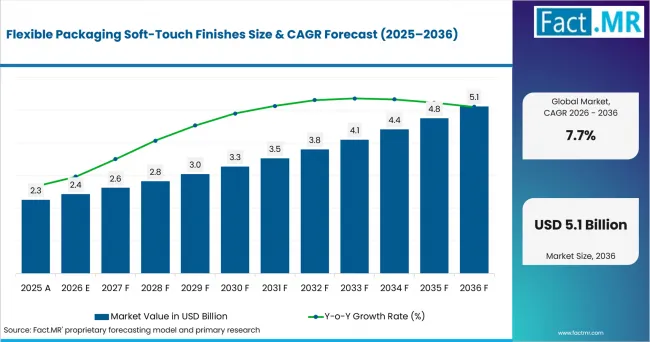
Flexible Packaging Soft Touch Finishes Value Analysis | Source: Fact.MR
What are the defining numbers behind Flexible Packaging Soft-Touch Finishes Market growth?
An absolute opportunity of USD 2.7 billion is anticipated between 2026 and 2036.
- Demand Drivers in the Market
- Online sellers use packaging that stays clean after repeated handling. On March 10, 2026, the U.S. Census Bureau reported that retail e-commerce sales reached USD 316.1 billion in Q4 2025 [1].
- Flexible packaging companies use soft-touch coatings on regular printing lines. For some products, adding the coating directly also removes the need for a separate soft-touch film.
- Paperboard packaging uses matte coatings that keep printed designs clear. Folding cartons also provide a large surface for velvet or suede-like finishes.
- Beauty and premium food packaging requires a soft surface that stays strong during filling, stacking, and transport without sticking to other packs.
- Key Segments Analyzed
- By Coating Chemistry: Water-based polyurethane is expected to hold 34.0% share in 2026 because it gives packaging a soft feel and stays flexible after drying.
- By Substrate: Paperboard is projected to account for 31.0% share in 2026 because folding cartons provide a large printed surface for soft-touch coatings.
- By End-use: Luxury packaging is estimated to capture 36.0% share in 2026 because a soft feel and matte look help premium packs stand out.
- By Finish: Velvet / suede is forecast to represent 29.0% share in 2026 because it gives packaging a clear soft feel without changing the pack design.
- Analyst Opinion at Fact.MR
- Shambhu Nath Jha of Fact.MR states, “Soft-touch finishes are becoming more common in premium packaging. Packaging companies prefer coatings that give a soft feel and protect the surface from rub marks. Clear details on coating thickness and drying also help keep the finish even during production.”
- Strategic Implications
- Coating makers offer water-based coatings for paperboard and selected flexible films.
- Testing coating thickness and drying before full production helps packaging companies avoid problems during larger runs. On February 11, 2025, the European Commission stated that Regulation (EU) 2025/40 on packaging and packaging waste had entered into force [2].
- Luxury and cosmetics brands compare the soft feel they want with the recycling method used for the package before choosing a finish.
- Printing teams choose the required feel before selecting a coating. A clear choice between velvet and silky finishes helps reduce extra printing tests.
China is forecast at 8.7% CAGR through 2036 because cosmetics and parcel activity support branded packaging, while Japan follows at 7.6% as premium presentation stays important. The USA and France are projected at 7.2% and Germany is forecast at 7.0%.
How does the Flexible Packaging Soft-Touch Finishes Market break down by segment?
Water-based polyurethane leads Coating Chemistry at 34.0%; Paperboard leads Substrate at 31.0%; Luxury packaging leads End-use at 36.0%; Velvet / suede leads Finish at 29.0%.
Which Coating Chemistry dominates?
Water-based polyurethane is expected to hold 34.0% share in 2026.
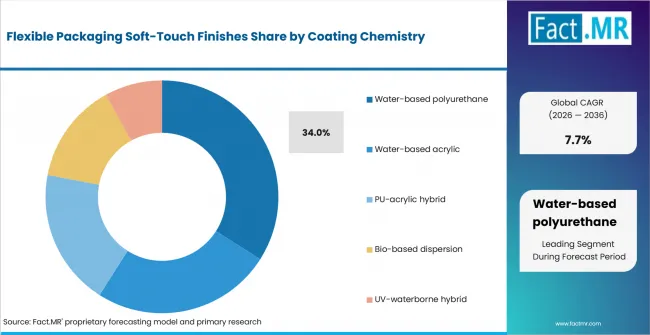
Flexible Packaging Soft Touch Finishes Analysis By Coating Chemistry | Source: Fact.MR
Water-based polyurethane is expected to lead because it gives packaging a soft feel and stays flexible after drying. Water-based acrylic works well on cartons and labels. PU-acrylic blends, bio-based coatings, and UV-water-based coatings are used when packaging requires more surface protection or different production methods.
What leads the Substrate segment?
Paperboard is projected to account for 31.0% share in 2026.
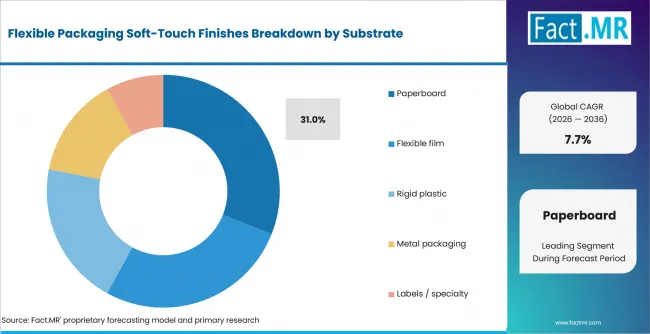
Flexible Packaging Soft Touch Finishes Analysis By Substrate | Source: Fact.MR
As per Fact.MR analysis, paperboard is projected to lead because cartons provide a large surface for soft-touch coatings. Flexible film requires a coating that stays flexible during production. On September 23, 2026, the UK Department for Environment, Food & Rural Affairs reported that provisional figures showed 80.3% of paper and cardboard packaging waste was recycled in 2025 [3].
How does End-use shape demand?
Luxury packaging is anticipated to capture 36.0% share in 2026.
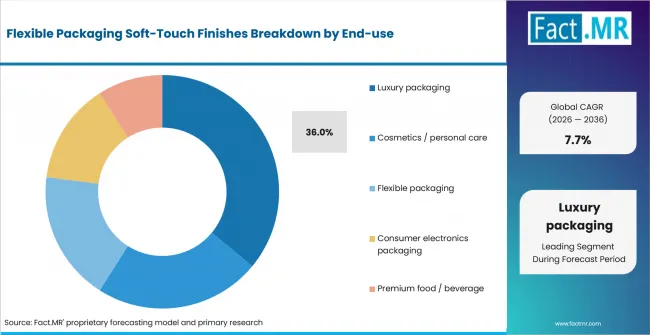
Flexible Packaging Soft Touch Finishes Analysis By End Use | Source: Fact.MR
Luxury packaging is anticipated to lead because a soft surface gives the pack a premium feel before it is opened. Cosmetics and personal care brands use matte and velvet finishes on premium cartons. Some flexible and electronics packaging also uses soft-touch finishes to improve the feel and protect the surface from rub marks.
What supports the Finish segment?
Velvet / suede is estimated to represent 29.0% share in 2026.
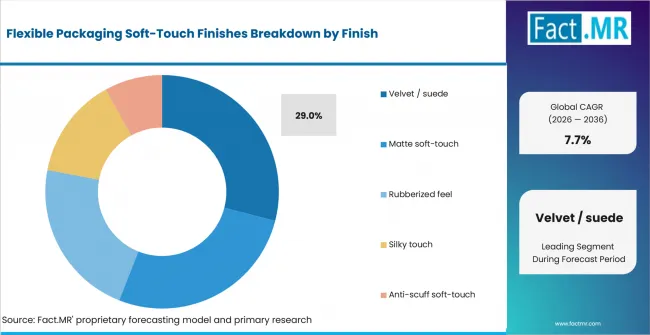
Flexible Packaging Soft Touch Finishes Analysis By Finish | Source: Fact.MR
Velvet and suede finishes are estimated to lead because they give packaging a clear soft feel with low shine. Matte soft-touch finishes are widely used on cartons, while rubberized and silky finishes give different levels of grip and smoothness. Scratch-resistant finishes add extra surface protection.
What is accelerating Flexible Packaging Soft-Touch Finishes Market adoption, and what is holding it back?
Demand for premium soft-touch packaging supports growth, while recycling needs and production limits can slow wider use.
Drivers Impact Analysis
| DRIVER | (~) % IMPACT ON CAGR | GEOGRAPHIC RELEVANCE | IMPACT TIMELINE |
|---|---|---|---|
| Premium tactile differentiation in consumer packs | +1.5% | Global | Short term (<= 2 years) |
| Water-based coating conversion | +1.2% | North America, Europe, East Asia | Medium term (2-4 years) |
| Growth of cosmetics and luxury packaging | +1.0% | North America, East Asia, Western Europe | Medium term (2-4 years) |
| E-commerce presentation and unboxing needs | +0.8% | North America, East Asia | Short term (<= 2 years) |
| Scuff protection combined with tactile feel | +0.6% | Global | Long term (>= 4 years) |
Source: Fact.MR analysis. Updated Oct 7, 2026
Opportunity Impact Analysis
| OPPORTUNITY | (~) % IMPACT ON CAGR | GEOGRAPHIC RELEVANCE | IMPACT TIMELINE |
|---|---|---|---|
| Soft-touch coatings for recyclable paper structures | +1.0% | Western Europe, North America | Medium term (2-4 years) |
| Tactile coatings for mono-material films | +0.8% | Global | Long term (>= 4 years) |
| Premium cosmetics and personal-care packs | +0.7% | East Asia, North America, Western Europe | Short term (<= 2 years) |
| High-speed gravure and flexo coating systems | +0.5% | Global | Medium term (2-4 years) |
Source: Fact.MR analysis. Updated Oct 7, 2026
Restraints Impact Analysis
| RESTRAINT | (~) % IMPACT ON CAGR | GEOGRAPHIC RELEVANCE | IMPACT TIMELINE |
|---|---|---|---|
| Recyclability concerns from added coating layers | -0.9% | Europe, North America | Long term (>= 4 years) |
| Blocking and rub-performance trade-offs | -0.7% | Global | Short term (<= 2 years) |
| Higher finishing cost on value packaging | -0.5% | Global | Medium term (2-4 years) |
| Substrate-specific qualification requirements | -0.4% | Global | Medium term (2-4 years) |
Source: Fact.MR analysis. Updated Oct 7, 2026
Which countries are scaling the Flexible Packaging Soft-Touch Finishes Market through 2036?
- China is forecast to keep a 1.1-point lead over Japan as cosmetics and parcel activity support branded packaging.
- Japan is anticipated to stay 0.4 points ahead of the USA because premium presentation remains important for beauty and gift packs.
- The USA and France are projected to share a 7.2% CAGR as e-commerce and premium retail keep tactile packaging in use.
- France is projected to stay 0.2 points ahead of Germany as premium retail and shipped consumer goods support tactile packs.
- Germany closes the range at 7.0% as converters balance tactile feel with recycling rules.
Comparable CAGRs create different entry conditions because retail mix and recycling rules vary by country. Full coverage includes North America, Latin America, Western Europe, Eastern Europe, East Asia, South Asia & Pacific, and Middle East & Africa.
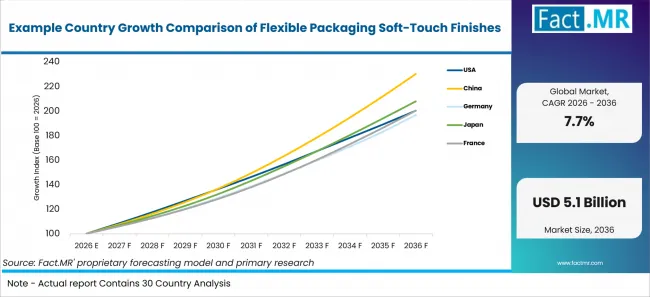
Example Country Growth Comparison Of Flexible Packaging Soft Touch Finishes | Source: Fact.MR
| Country | CAGR (2026-2036) |
|---|---|
| China | 8.7% |
| Japan | 7.6% |
| USA | 7.2% |
| France | 7.2% |
| Germany | 7.0% |
Source: Fact.MR analysis. Updated Oct 7, 2026
What supports adoption in China?
8.7% CAGR, supported by cosmetics sales and parcel activity.
China has a large consumer goods market that supports demand for soft-touch packaging. On January 20, 2026, the National Bureau of Statistics reported that cosmetics retail sales by enterprises above designated size reached 465.3 billion yuan in 2025 [4]. Matte and suede-like finishes are used on flexible film and paperboard, mainly for premium packaging where brands can manage the extra cost.
How is Japan scaling demand?
7.6% CAGR, shaped by premium retail presentation.
Japan has a large retail market for beauty and gift packaging. On April 14, 2026, METI reported that retail sales reached 157.508 trillion yen in 2025 [5]. Paperboard cartons work well with smooth matte finishes, while flexible films require closer control to prevent slipping or sticking during packing.
What supports U.S. adoption?
7.2% CAGR, supported by cosmetics and direct-to-consumer packaging.
The U.S. beauty market supports demand for a wide range of consumer packaging. On September 9, 2026, the FDA reported 1,298,361 unique active cosmetic products as of June 30, 2026 [6]. Soft-touch finishes are mainly used on premium cartons and selected pouches when the coating works with the planned recycling method.
How does France perform?
7.2% CAGR, supported by retail and shipped consumer goods.
France has a large market for premium retail and consumer packaging. On June 18, 2026, Insee reported that retail and craft trade sales increased 2.3% in volume in 2025 [7]. Soft-touch coatings are used on cartons and sleeves to give packaging a premium feel while keeping material use under control.
What underpins Germany's growth?
7.0% CAGR, supported by retail activity and recycling rules.
Germany has steady retail demand and a strong focus on packaging recycling. On January 7, 2026, Destatis estimated that retail sales increased 2.4% in real terms in 2025 compared with 2024 [8]. Paperboard remains useful for soft-touch coatings when the finish gives a soft feel and meets recycling and food packaging requirements.
Who leads the Flexible Packaging Soft-Touch Finishes Market?
ACTEGA and Siegwerk offer soft-touch finishes for printed packaging. Sun Chemical and Flint Group supply inks and coatings for flexible packaging, while Michelman provides water-based coatings for paper and film packaging.
Henkel offers coatings and adhesives for packaging. These companies compete on soft feel, surface protection, production performance, and use with recyclable packaging.
On September 16, 2025, ACTEGA updated the product details for STARKOTE® AQ-5011. It is a water-based matte soft-touch coating for coated board and paper used in decorative packaging. Fact.MR finds that this product fits the growing use of water-based soft-touch finishes in premium paperboard packaging.
Which companies are the key providers?
The profiled companies are ACTEGA; Hubergroup; Sun Chemical; INX International; Henkel.
- ACTEGA
- Hubergroup
- Sun Chemical
- INX International
- Henkel
Bibliography
- [1] U.S. Census Bureau. (2026, March 10). Quarterly Retail E-Commerce Sales: 4th Quarter 2025.
- [2] European Commission, Directorate-General for Environment. (2025, February 11). New rules enter into force for a more sustainable and competitive packaging economy.
- [3] Department for Environment, Food & Rural Affairs. (2026, September 23). UK statistics on waste.
- [4] National Bureau of Statistics of China. (2026, January 20). Total Retail Sales of Consumer Goods in December 2025.
- [5] Ministry of Economy, Trade and Industry. (2026, April 14). 2025[Reviewing retail sales in 2025].
- [6] U.S. Food and Drug Administration. (2026, September 9). FDA Clarifies It Does Not Provide Certificates or Other Documents to Verify Compliance for Cosmetic Product Facility Registration.
- [7] Bonfils, J., Ceci-Renaud, N., Finot, J., Gallot, P., Gamrasni, A., & Lépine, N. (2026, June 18). Le compte du commerce en 2025 : L’activité accélère dans le commerce de détail et se contracte de nouveau dans le commerce de gros et dans le commerce et la réparation d’automobiles. Insee.
- [8] Statistisches Bundesamt (Destatis). (2026, January 7). Einzelhandelsumsatz im Jahr 2025 real voraussichtlich um 2,4 % höher als im Vorjahr [Retail sales in 2025 expected to be 2.4% higher in real terms than the previous year].
- [9] ACTEGA. (2025, September 16). STARKOTE® AQ-5011: Aqueous soft touch coating [Technical data sheet].
This Report Answers
- The report explains how coating chemistry and substrate shape the market, and it also covers end-use and finish type across each region. The focus stays on pack surfaces where tactile feel forms part of the final commercial finish.
- Country analysis compares China and Japan with the USA while France and Germany are covered in the same framework. The comparison uses retail demand and packaging mix together with local recycling rules, and each country block uses one official statistic to support the local point.
- Competitive analysis reviews active coating and packaging-ink suppliers and connects current product direction with converter needs, focusing on companies already active in packaging surface chemistry or flexible-packaging print systems.
- Technology analysis covers chemistry and drying needs together with adhesion and rub resistance, while blocking control and recycling fit are assessed before a finish is treated as suitable for repeat production.
What does the Flexible Packaging Soft-Touch Finishes Market cover?
The market covers coatings and overprint finishes that give consumer packaging a soft tactile surface, including velvet and suede effects as well as matte or silky touch. Rubberized and anti-scuff finishes are included when the finish forms part of the printed pack and keeps the basic package format unchanged.
The assessment covers paperboard and flexible film, while rigid plastic and metal packaging are included where a soft-touch layer forms part of the finished pack. Specialty labels are covered under the same rule, and the review follows premium secondary packs and selected primary flexible formats.
What is included in the scope?
The scope includes water-based polyurethane and water-based acrylic systems, together with PU-acrylic hybrids and bio-based dispersions that create a defined tactile effect. UV-waterborne hybrids fall within the same boundary and the review covers drying and coat weight together with surface resistance across the print run.
The scope also tracks tactile finishing where it meets flexible film printing and mono-material pack design. Related formats include high-recycling flexible packs and printed labels. These areas help explain why converters compare feel with adhesion. They also review winding behavior and sealing steps before a finish reaches production.
What is excluded from the scope?
Laminating adhesives and ordinary barrier coatings fall outside the scope unless they create a defined soft-touch effect, while standard primers and plain varnishes are excluded for the same reason. Decorative films are covered only when the market value comes from the tactile coating layer instead of the base film itself.
Packaging substrates and color-only printing inks fall outside finish revenue, while adjacent categories such as sustainable packaging and luxury paperboard packaging are used only for context. The revenue boundary therefore stays focused on coatings and finishes sold for a soft tactile result on consumer-facing packaging.
How Was the Analysis Built?
The analysis draws on 120+ sources, 35+ company portfolios, 25+ countries, and more than 20 industry interviews.
- Primary Research: Primary research includes discussions with manufacturers, service providers, technology developers, distributors, end users, and subject-matter experts. These conversations examine purchasing priorities, product adoption, operational challenges, approval requirements, competitive positioning, and the factors that influence wider market acceptance.
- Desk Research: Desk research covers government statistics, regulatory publications, company filings, trade data, technical studies, industry associations, standards, public policy, and other authoritative sources. Every source used in the analysis is documented in the bibliography.
- Market Sizing and Forecasting: Market estimates combine historical performance, demand indicators, pricing and volume trends, segment shares, company participation, country-level growth, adoption patterns, investment activity, and barriers to market expansion.
- Data Validation and Update Cycle: Findings are validated by comparing primary interviews with public data, company activity, regulatory changes, trade patterns, and industry developments. Regular updates review new product launches, capacity changes, partnerships, approvals, and shifts in commercial adoption.
Segmentation
What is the report’s scope and coverage?
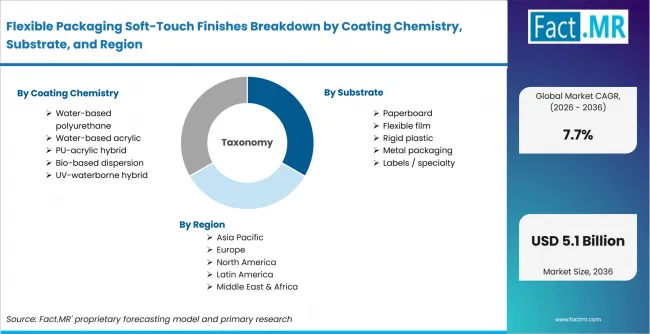
Flexible Packaging Soft Touch Finishes Breakdown By Coating Chemistry, Substrate, And Region | Source: Fact.MR
| Attribute | Details |
|---|---|
| Quantitative Units | USD billion |
| Market Definition | Soft-touch coatings and overprint finishes applied to flexible packaging, paperboard, labels, rigid plastic, or metal packaging to create a tactile matte, velvet, suede, silky, rubberized, or anti-scuff surface. |
| Coating Chemistry | Water-based polyurethane; Water-based acrylic; PU-acrylic hybrid; Bio-based dispersion; UV-waterborne hybrid |
| Substrate | Paperboard; Flexible film; Rigid plastic; Metal packaging; Labels / specialty |
| End-use | Luxury packaging; Cosmetics / personal care; Flexible packaging; Consumer electronics packaging; Premium food / beverage |
| Finish | Velvet / suede; Matte soft-touch; Rubberized feel; Silky touch; Anti-scuff soft-touch |
| Regions Covered | North America; Latin America; Western Europe; Eastern Europe; East Asia; South Asia & Pacific; Middle East & Africa |
| Countries Covered | China; Japan; USA; France; Germany |
| Key Companies Profiled | ACTEGA; Hubergroup; Sun Chemical; INX International; Henkel |
| Forecast Period | 2026 to 2036 |
| Approach | Hybrid top-down and bottom-up approach using coating chemistry mix; substrate use; end-use demand; finish type; country growth; and manufacturer portfolio review. |
Source: Fact.MR analysis. Updated Oct 7, 2026
How is the market segmented?
-
By Coating Chemistry:
- Water-based polyurethane
- Water-based acrylic
- PU-acrylic hybrid
- Bio-based dispersion
- UV-waterborne hybrid
-
By Substrate:
- Paperboard
- Flexible film
- Rigid plastic
- Metal packaging
- Labels / specialty
-
By End-use:
- Luxury packaging
- Cosmetics / personal care
- Flexible packaging
- Consumer electronics packaging
- Premium food / beverage
-
By Finish:
- Velvet / suede
- Matte soft-touch
- Rubberized feel
- Silky touch
- Anti-scuff soft-touch
-
By Region:
- North America
- Latin America
- Western Europe
- Eastern Europe
- East Asia
- South Asia & Pacific
- Middle East & Africa
Frequently Asked Questions
How big is the flexible packaging soft-touch finishes market in 2026?
What is the CAGR of the flexible packaging soft-touch finishes market from 2026 to 2036?
Which coating chemistry leads the flexible packaging soft-touch finishes market?
Which end-use leads the flexible packaging soft-touch finishes market?
Who are the main companies in the flexible packaging soft-touch finishes market?
Who worked on this report


Preview the report firsthand - request a free sample
Free SampleGet the brochure for pricing and purchase details
Download PDF