- Base Value(2025): 1.7 Bn
- Forecast Value (2036): 4.0 Bn
- CAGR (2036): 8.2%
Food And Beverage Air Filtration Market Forecast
The food and beverage air filtration market reached USD 1.7 billion in 2025. Fact MR estimates the market will expand to USD 1.8 billion in 2026 and attain USD 4.0 billion by 2036. The market is forecast to register a CAGR of 8.2% across the assessment period.
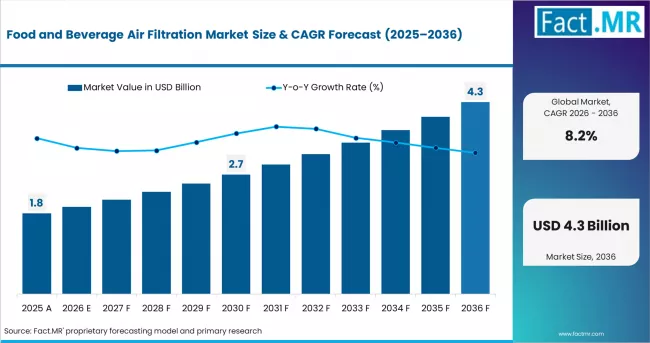
Food And Beverage Air Filtration Market Market Value Analysis | Source: Fact.MR
Summary of Food and Beverage Air Filtration Market
- Market Definition
- The market includes air filtration systems designed to maintain controlled air quality in food and beverage processing environments. These systems remove airborne particles, microorganisms, and contaminants that may affect product safety, shelf life, and compliance with hygiene regulations. Filtration technologies include HEPA, ULPA, activated carbon, and mechanical filtration systems installed across production, packaging, and storage facilities.
- Demand Drivers
- Increasing regulatory focus on contamination control in food processing environments
- Rising installation of high efficiency filtration systems in dairy, beverage, and packaged food production facilities
- Expansion of hygienic HVAC systems supporting controlled airflow and particulate removal
- Growth in replacement demand due to periodic filter change cycles required for compliance
- Key Segments Analyzed
- Filter Type: HEPA and ULPA filters lead with around 28% share in 2026 supported by high particulate removal efficiency
- End Use: Dairy processing accounts for approximately 14% share driven by strict microbial control requirements
- Application Scope: Beverage, bakery, and ready to eat food processing facilities represent steady demand
- Geography: Asia Pacific shows relatively higher growth supported by expansion of food processing infrastructure
- Analyst Opinion at Fact MR
- Shambhu Nath Jha, Principal Consultant, Fact MR, opines, "In this updated edition of the Food and Beverage Air Filtration Market report, industry participants will observe sustained demand for contamination control systems aligned with hygiene compliance frameworks. High efficiency filtration technologies remain critical for maintaining controlled production environments across dairy, beverage, and packaged food manufacturing facilities. Companies that strengthen filtration efficiency, system durability, and energy performance optimization are expected to maintain competitive positioning through 2036.
- Strategic Implications/Executive Takeaways
- Invest in high efficiency filtration media supporting compliance with food safety standards
- Strengthen system integration capabilities across HVAC and clean air processing environments
- Expand replacement and maintenance service offerings aligned with recurring filter change cycles
- Focus on energy efficient filtration technologies to manage operational cost pressures
- Methodology
- Primary interviews conducted with filtration equipment manufacturers, food processors, and facility management specialists
- Desk research based on industrial filtration publications, regulatory guidelines, company reports, and trade statistics
- Market sizing derived using a hybrid approach combining bottom up equipment sales analysis with top down demand assessment
- Data validation performed through cross verification with industry datasets and internal peer review aligned with Fact MR standards
Food and Beverage Air Filtration Market
| Metric | Details |
|---|---|
| Industry Size (2026E) | USD 1.8 billion |
| Industry Value (2036F) | USD 4 billion |
| CAGR (2026 to 2036) | 8.2% |
Source: Fact.MR analysis. Updated Apr 15, 2026
A CAGR of 8.2% indicates moderate to transformational expansion, with demand resilience supported by regulatory compliance requirements for hygiene-controlled production environments and contamination risk management. Growth remains steady due to recurring replacement cycles and stricter air quality standards, while variability may arise from capital expenditure sensitivity among small processors and cost pressure linked to high-efficiency filtration media and energy consumption.
India leads with a projected CAGR of 10.7%, supported by expansion of food processing infrastructure and increasing installation of contamination control systems. The United States follows with a CAGR of 8.0%, driven by continuous upgrades of HVAC filtration systems across packaged food manufacturing facilities. Germany records a CAGR of 5.5%, reflecting steady replacement of high efficiency particulate air filters in regulated production environments. The United Kingdom shows a CAGR of 4.8%, supported by consistent adoption of controlled air systems in beverage and dairy processing units. China records the slowest growth at 4.0%, reflecting a mature industrial filtration base with demand largely tied to replacement cycles. Mature markets generate a significant share of replacement demand as regulatory compliance standards require periodic filter change and system retrofitting across food safety controlled environments.
Segmental Analysis
Food and Beverage Air Filtration Market Analysis by Filter Type

Food And Beverage Air Filtration Market Analysis By Filter Type | Source: Fact.MR
- Market Overview: Based on Fact MR assessment, HEPA and ULPA filters are projected to account for 28% share of the food and beverage air filtration market in 2026. High-efficiency particulate air filtration systems are specified across controlled processing environments requiring removal of airborne particulates, microbial contaminants, and fine aerosols. HEPA and ULPA media are incorporated into HVAC units, laminar airflow cabinets, and cleanroom systems supporting contamination control protocols in food manufacturing facilities. Filtration efficiency requirements are defined by particle retention thresholds aligned with hygiene compliance frameworks applied in packaged food and beverage production lines.
- Demand Drivers:
- Contamination Control Requirements: Food processors deploy high-efficiency air filtration media to reduce airborne microbial load affecting product stability and shelf life performance.
- Compliance Alignment: Filtration systems are integrated to meet hygiene specifications defined within hazard analysis and critical control point protocols across regulated processing environments.
- Process Air Quality Stability: Controlled airflow management supports prevention of particulate migration across production zones handling sensitive food ingredients and liquid processing stages.
Food and Beverage Air Filtration Market Analysis by End Use
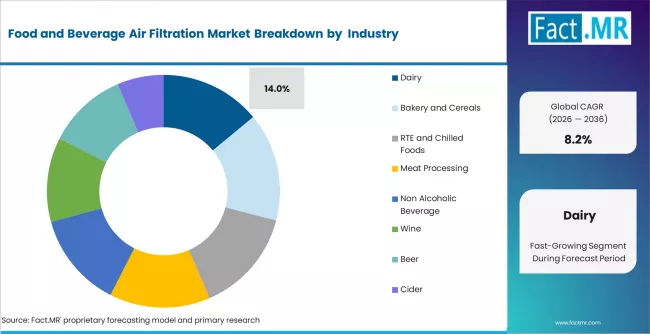
Food And Beverage Air Filtration Market Analysis By End Use | Source: Fact.MR
- Market Overview: Dairy processing applications are estimated to hold 14% share of the food and beverage air filtration market in 2026, supported by strict air hygiene requirements across milk handling, fermentation, drying, and packaging operations. Air filtration systems are deployed to maintain controlled microbial exposure levels across cheese maturation chambers, milk powder drying towers, and yogurt fermentation facilities. Filtration performance consistency is required to maintain product quality parameters sensitive to airborne contamination risks present during open processing stages.
- Demand Drivers:
- Microbial Exposure Control: Dairy processing environments utilize high-efficiency filtration to limit airborne contamination affecting bacterial culture performance during fermentation cycles.
- Powder Handling Requirements: Milk powder and whey protein drying operations require particulate control systems designed to prevent cross contamination and maintain product purity standards.
- Packaging Environment Protection: Air filtration systems are installed within aseptic filling and packaging zones to reduce exposure to airborne particles during final product sealing processes.
Key Dynamics
Food and Beverage Air Filtration Market Drivers, Restraints, and Opportunities
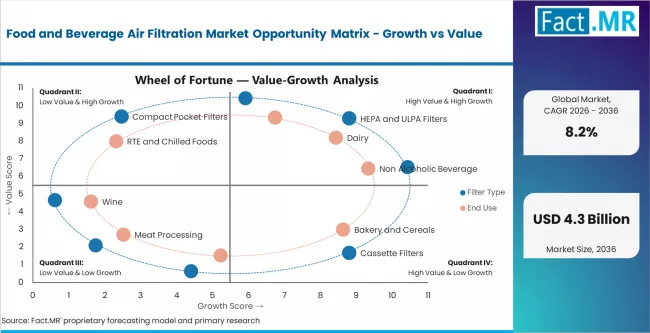
Food And Beverage Air Filtration Market Opportunity Matrix Growth Vs Value | Source: Fact.MR
Fact MR analysis indicates that the food and beverage air filtration market developed from hygiene control systems used in food processing environments where airborne contaminants affect product quality and safety. Early filtration solutions focused on basic particulate removal systems installed in processing plants to reduce dust and microbial contamination. The current market valuation reflects widespread use of high-efficiency filtration systems that maintain controlled air quality across food manufacturing, beverage bottling, and packaging facilities. Demand persists because controlled air environments reduce contamination risk and support compliance with food safety requirements.
A structural shift is occurring as conventional basic air filtration systems transition toward high-efficiency particulate air filtration and controlled environment systems integrated with modern processing infrastructure. Standard filtration units remain widely used in facilities where basic air quality control remains sufficient for production requirements. Advanced filtration systems incorporate HEPA filters, activated carbon filtration, and controlled airflow technologies designed to maintain sterile or low-contaminant production environments. These systems require higher installation and maintenance costs due to specialized filter materials and monitoring equipment. Even with moderate facility expansion, higher system pricing supports steady market value growth.
- Contamination Control Systems: Food processors deploy high-efficiency air filtration systems to reduce airborne particles, microorganisms, and contaminants in production environments.
- Food Safety Regulation: Standards such as Hazard Analysis and Critical Control Points (HACCP) and ISO 22000 food safety management systems influence air filtration requirements in processing facilities.
- North America Processing Facilities: The United States maintains large food and beverage manufacturing infrastructure that utilizes advanced air filtration technologies to maintain regulatory compliance.
Regional Analysis
The Food and Beverage Air Filtration Market is assessed across North America, Europe, Asia Pacific, Latin America, and Middle East & Africa, segmented by country-level processing facility standards, air quality compliance requirements, and industrial filtration adoption. Regional demand reflects food safety regulations, contamination control systems, and hygienic processing environments. The full report offers market attractiveness analysis.
.webp "Top Country Growth Comparison Food And Beverage Air Filtration Market Cagr (2026 2036)")
Top Country Growth Comparison Food And Beverage Air Filtration Market Cagr (2026 2036) | Source: Fact.MR
CAGR Table of Food and Beverage Air Filtration Market
| Country | CAGR (2026–2036) |
|---|---|
| USA | 8.0% |
| China | 4.0% |
| India | 10.7% |
| UK | 4.8% |
| Germany | 5.5% |
Source: Fact.MR analysis. Updated Apr 15, 2026
Source: Fact MR analysis, based on proprietary forecasting model and primary research
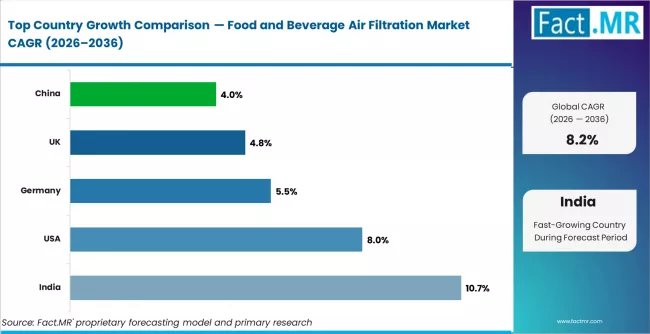
Food And Beverage Air Filtration Market Cagr Analysis By Country | Source: Fact.MR
North America
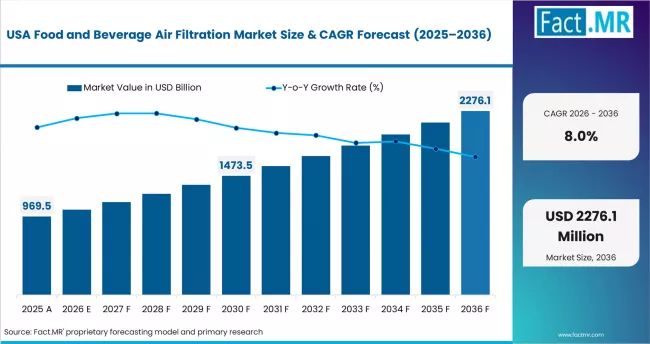
Food And Beverage Air Filtration Market Country Value Analysis | Source: Fact.MR
North America functions as the regulated hygienic processing and contamination control hub, supported by strict food safety standards and advanced filtration technologies. Parker Hannifin Corporation maintains leadership in industrial filtration systems. Donaldson Company, Inc. expands air filtration solutions for food processing. 3M Company supports filtration material innovation.
- USA: Demand for food and beverage air filtration in USA is projected to rise at 8.0% CAGR through 2036. Growth is supported by Food Safety Modernization Act requirements (U.S. FDA, ongoing), governing hygienic processing environments. Parker Hannifin Corporation expanded food-grade air filtration systems (March 2023), supporting industry demand.
Europe
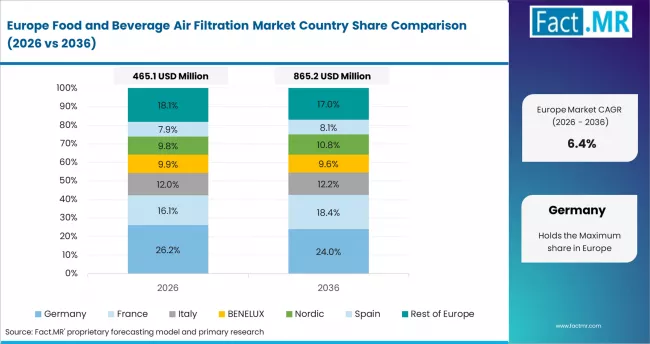
Food And Beverage Air Filtration Market Europe Country Market Share Analysis, 2026 & 2036 | Source: Fact.MR
Europe operates as the regulatory and quality assurance processing base, shaped by strict hygiene directives and contamination control standards. Camfil AB leads in clean air solutions. Freudenberg Filtration Technologies GmbH & Co. KG supports industrial air filtration products. Mann+Hummel Group expands filtration system solutions.
- UK: Demand for food and beverage air filtration in UK is projected to rise at 4.8% CAGR through 2036. The UK Food Hygiene Regulations (Food Standards Agency, updated 2021) support contamination control requirements. Camfil AB expanded filtration solutions for food processing environments (February 2023), supporting adoption.
- Germany: Demand for food and beverage air filtration in Germany is projected to rise at 5.5% CAGR through 2036. EU hygiene regulations (European Commission, updated 2022) govern air quality standards in processing facilities. Freudenberg Filtration Technologies GmbH & Co. KG expanded industrial filtration product lines (January 2023), supporting market growth.
Asia Pacific
Asia Pacific serves as the high-growth food processing infrastructure and hygiene compliance market, supported by expanding packaged food production and regulatory modernization. AAF International strengthens industrial filtration solutions. Daikin Industries, Ltd. expands air filtration technologies. Nippon Muki Co., Ltd. supports clean air systems.
- China: Demand for food and beverage air filtration in China is projected to rise at 4.0% CAGR through 2036. The Food Safety Law updates (SAMR, revised 2021) support hygienic processing environments. AAF International expanded air filtration solutions in food processing facilities (April 2023), supporting adoption.
- India: Demand for food and beverage air filtration in India is projected to rise at 10.7% CAGR through 2036. The Food Safety and Standards Authority of India hygiene regulations (updated 2022) support clean processing environments. Daikin Industries, Ltd. expanded filtration technologies for food manufacturing (May 2023), supporting market growth.
Fact MR's analysis of food and beverage air filtration market in global regions consists of country-wise assessment that includes USA, China, India, UK, and Germany. Readers can find hygiene compliance trends, filtration technology adoption patterns, regulatory developments, and competitive positioning across key markets.
Competitive Landscape
Competitive Structure and Buyer Dynamics in the Food and Beverage Air Filtration Market
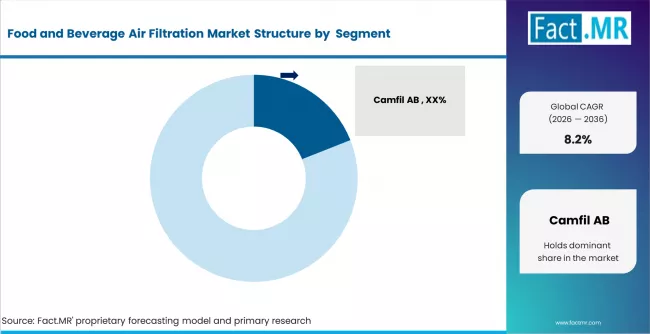
Food And Beverage Air Filtration Market Analysis By Company | Source: Fact.MR
The competitive structure of the Food and Beverage Air Filtration Market is moderately concentrated, with global filtration technology companies controlling a significant share of industrial air purification solutions. Companies such as Camfil AB, Donaldson Company, Inc., Freudenberg Filtration Technologies SE & Co. KG, Parker-Hannifin Corporation, Pall Corporation, and American Air Filter Company, Inc. maintain strong positions through advanced filtration technologies and established relationships with food processing facilities. These firms supply high efficiency air filters, particulate filtration systems, and contamination control solutions used in food manufacturing environments. Additional participants including Porvair plc contribute through specialized filtration materials and industrial air purification components. Competition is primarily influenced by filtration efficiency, compliance with food safety standards, operational durability, and integration with processing facility infrastructure.
Several companies maintain structural advantages through proprietary filtration media technologies and strong industrial distribution networks. Firms such as Camfil AB and Freudenberg Filtration Technologies SE & Co. KG benefit from extensive research capabilities in filtration materials and air purification engineering. Parker-Hannifin Corporation and Pall Corporation maintain advantages through broad industrial filtration portfolios and long standing relationships with manufacturing companies. Food and beverage producers often adopt multi supplier procurement strategies to reduce dependence on a single filtration provider and ensure operational continuity. Procurement decisions evaluate suppliers based on filtration performance, regulatory compliance, and long term maintenance requirements. This purchasing behavior moderates supplier pricing leverage across the market, while companies with advanced filtration technologies and established industrial service networks retain stronger negotiating influence.
Key Players of the Food and Beverage Air Filtration Market
- Camfil AB
- Donaldson Company, Inc.
- Freudenberg Filtration Technologies SE & Co. KG
- Pall Corporation
- Parker-Hannifin Corporation
- Porvair plc
- American Air Filter Company, Inc.
- Parker-Hannifin Corporation
Food and Beverage Air Filtration Market Key Segments
-
Filter Type:
- HEPA and ULPA Filters
- Cassette Filters
- Compact Pocket Filters
- Dust Removal Filters
- Honeycomb (HM) Module
- Pleated Filters
- Moisture Separators
- Activated Carbon Filters
-
End Use:
- Dairy
- Bakery and Cereals
- RTE and Chilled Foods
- Meat Processing
- Non Alcoholic Beverage
- Wine
- Beer
- Cider
- Distilled Spirits
- Confectionery
- Cannabis
- Food Ingredients
-
Region:
- North America
- USA
- Canada
- Mexico
- Europe
- Germany
- UK
- France
- Italy
- Spain
- Nordic Countries
- BENELUX
- Rest of Europe
- Asia Pacific
- China
- Japan
- South Korea
- India
- Australia
- Rest of Asia Pacific
- Latin America
- Brazil
- Argentina
- Rest of Latin America
- Middle East and Africa
- Kingdom of Saudi Arabia
- United Arab Emirates
- South Africa
- Rest of Middle East and Africa
- Other Regions
- Oceania
- Central Asia
- Other Markets
- North America
Bibliographies
- [1] Institute of Food Science and Technology (IFST). (2023). Hygienic air quality for the food industry: Guidance on ventilation and filtration. IFST. Retrieved March 23, 2026.
- [2] BRCGS. (2023). Air quality in food manufacturing: Guidance on filtration and environmental controls (BRCGS food safety documents). BRCGS. Retrieved March 23, 2026.
- [3] International Food Hygiene Hub (Clean Link). (2025, April 21). Air filtration in food processing: Compliance, contaminants, and consumer safety. Clean Link. Retrieved March 23, 2026.
- [4] Camfil. (2023, August 22). Food and beverage air filtration: Purity and safety. Camfil USA. Retrieved March 23, 2026.
- [5] International Food Hygiene Hub (Clean Link). (2025, August 31). Air filtration solutions for the food and beverage industry. Clean Link. Retrieved March 23, 2026.
This Report Addresses
- Market size estimation and revenue forecasts for the Food and Beverage Air Filtration Market from 2026 to 2036, supported by industrial filtration demand trends and hygiene compliance benchmarks in processing environments.
- Growth opportunity mapping across HEPA and ULPA filters, pleated filters, activated carbon filters, and moisture separation technologies, reflecting demand for contamination control systems in regulated production facilities.
- Segment and regional revenue forecasts covering filter types, end use industries, and key markets including India, United States, Germany, United Kingdom, and China.
- Competition strategy assessment of leading companies such as Camfil AB, Parker-Hannifin Corporation, Donaldson Company, Inc., Freudenberg Filtration Technologies SE & Co. KG, and Pall Corporation, including filtration efficiency benchmarking and industrial integration capability analysis.
- Regulatory impact analysis covering HACCP protocols, ISO 22000 food safety standards, and FDA Food Safety Modernization Act requirements influencing installation and replacement cycles of air filtration systems.
- Market report delivery in PDF, Excel, PPT, and interactive dashboard formats designed for facility planning, compliance assessment, and capital expenditure evaluation.
- Supply chain vulnerability assessments examining high efficiency filtration media availability, energy consumption requirements, and replacement cycle dependency impacting long term operational cost structures.
Food and Beverage Air Filtration Market Definition
The Food and Beverage Air Filtration Market includes air filtration systems designed to maintain clean and controlled air conditions in food and beverage processing environments. These systems remove airborne particles such as dust, microorganisms, and contaminants that may affect product safety and quality. Air filtration equipment is used in production facilities, packaging areas, and storage environments to maintain hygiene standards and regulatory compliance. Common filtration technologies include high efficiency particulate air filters, activated carbon filters, and mechanical filtration systems. The primary function of air filtration systems in this market is to support contamination control and maintain clean air conditions during food and beverage processing.
Food and Beverage Air Filtration Market Inclusions
This report covers global and regional market sizes for air filtration systems used in food and beverage processing with forecast analysis for the study period. The market is segmented by filter type including high efficiency particulate air filters, activated carbon filters, and cartridge filters. Application segments include food processing plants, beverage production facilities, packaging environments, and cold storage operations. End users include food manufacturers, beverage producers, and processing facility operators. The report also evaluates pricing trends, installation patterns, and selected trade flow analysis across major industrial filtration markets.
Food and Beverage Air Filtration MarketExclusions
The report excludes air filtration systems used in residential or general commercial buildings that are not designed for food processing environments. Industrial filtration systems applied in chemical manufacturing, automotive production, or power generation are not included. The scope also excludes water filtration equipment used in beverage processing. Standalone ventilation equipment that does not perform filtration functions is outside the defined market scope, as the analysis focuses strictly on air filtration systems used in food and beverage production facilities.
Food and Beverage Air Filtration Market Research Methodology
- Primary Research
- Interviews were conducted with filtration equipment manufacturers, food processing companies, facility managers, and system integrators.
- Desk Research
- Public information was collected from industrial filtration publications, company reports, regulatory guidelines, and trade statistics.
- Market-Sizing and Forecasting
- A hybrid model combining bottom up equipment sales analysis with top down demand assessment across food and beverage processing sectors was applied.
- Data Validation and Update Cycle
- Findings were cross verified using multiple industry data sources and expert inputs, with periodic updates conducted as new market information becomes available.
Segmentation
Report Scope

Food And Beverage Air Filtration Market Breakdown By Filter Type, End Use, And Region | Source: Fact.MR
| Metric | Value |
|---|---|
| Quantitative Units | USD 1.8 billion (2026) to USD 4 billion (2036), at a CAGR of 8.2% |
| Market Definition | The food and beverage air filtration market includes filtration systems designed to control airborne contaminants, microorganisms, and particulates in food processing and beverage production environments, ensuring product safety, hygiene compliance, and controlled air quality across manufacturing facilities. |
| Filter Type Segmentation | HEPA and ULPA Filters, Cassette Filters, Compact Pocket Filters, Dust Removal Filters, Honeycomb (HM) Module, Pleated Filter, Moisture Separators, Activated Carbon Filters |
| End Use Segmentation | Dairy, Bakery or Cereals, RTE or Chilled Foods, Meat Processing, Non-Alcoholic Beverage, Wine, Beer, Cider, Distilled Spirits, Confectionery, Cannabis, Food Ingredients |
| Regions Covered | North America, Latin America, Europe, East Asia, South Asia, Oceania, Middle East and Africa |
| Countries Covered | United States, Canada, Mexico, Brazil, Germany, United Kingdom, France, Italy, Spain, China, India, Japan, South Korea, Australia, and 40+ countries |
| Key Companies Profiled | Camfil AB, Donaldson Company, Inc., Freudenberg Filtration Technologies SE and Co. KG, Pall Corporation, Parker-Hannifin Corporation, Porvair plc, American Air Filter Company, Inc. |
| Forecast Period | 2026 to 2036 |
| Approach | Hybrid top-down and bottom-up market modeling supported by industrial air quality standards assessment, food processing facility expansion analysis, filtration equipment demand trends, and validation through interviews with filtration manufacturers, food processors, and regulatory compliance specialists. |
Source: Fact.MR analysis. Updated Apr 15, 2026
Frequently Asked Questions
How large is the demand for Food and Beverage Air Filtration in the global market in 2026?
What will be the market size of Food and Beverage Air Filtration in the global market by 2036?
What is the expected demand growth for Food and Beverage Air Filtration in the global market between 2026 and 2036?
Which Filter Type Segment is poised to lead global demand by 2026?
Which Company is Identified as a Leading Participant in the Food and Beverage Air Filtration Market?
What is Driving Food and Beverage Air Filtration Demand in the United States?
What is the United States Growth Outlook in this Report?
Why is China an Important Market for Food and Beverage Air Filtration?
What is the China Growth Outlook in this Report?
What Factors Support Food and Beverage Air Filtration Demand in India?
What is the India Growth Outlook in this Report?
What Factors Support Food and Beverage Air Filtration Adoption in the United Kingdom?
What is the United Kingdom Growth Outlook in this Report?
Why is Germany Considered an Important Market for Food and Beverage Air Filtration in Europe?
What is the Germany Growth Outlook in this Report?
What is Food and Beverage Air Filtration and What is It Mainly Used For?
What does Food and Beverage Air Filtration Market Mean in this Report?
What is Included in the Scope of this Food and Beverage Air Filtration Market Report?
What is Excluded from the Scope of this Report?
What does Market Forecast Mean on this Page?
How is the Food and Beverage Air Filtration Market Forecast Developed in this Report?
Who worked on this report


Preview the report firsthand - request a free sample
Free SampleGet the brochure for pricing and purchase details
Download PDF