- Base Value(2025): 187.0 Mn
- Estimated Value(2026): 197.1 Mn
- Forecast Value (2036): 333.5 Mn
- CAGR (2026 - 2036): 5.4%
Fruit Preservation Sprays Market Overview, Growth Outlook, and Forecast by Fact.MR
- In 2025, the fruit preservation sprays market was valued at USD 187.0 million.
- Based on market analysis, demand for fruit preservation sprays is estimated to grow to USD 197.1 million in 2026 and USD 333.5 million by 2036.
- The market is projected to expand at a CAGR of 5.4% during the forecast period.
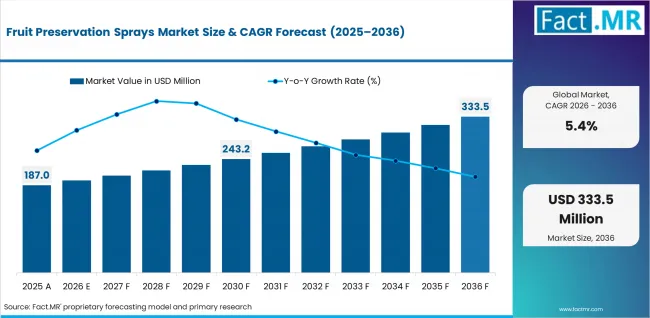
Fruit Preservation Sprays Market Value Analysis | Source: Fact.MR
Summary of the Fruit Preservation Sprays Market
- Market Snapshot
- Global fruit preservation sprays market revenue stood at USD 197.1 million in 2026 and is forecast to reach USD 333.5 million by 2036.
- At a 5.4% CAGR from 2026 to 2036, the market is expected to expand ~1.7x in value, creating an absolute dollar opportunity of USD 135.9 million.
- Market growth is attributable to the growing demand for shelf-life extension technology, increasing global exports of fresh fruits, and expanding popularity of edible coatings and antimicrobial preservation products.
- Growing preference for clean-label and bio-based preservation solutions are increasing demand across both mature and emerging agricultural regions.
- The development of cold-chain infrastructure, the increasing initiatives to reduce food wastage, and the escalating investment in post-harvest treatment technology are also driving the world market growth.
- Demand and Growth Drivers
- Post-harvest fruit losses are on the rise in the global supply chains
- Growing consumer interest in fresh, good quality fruits with a longer shelf life
- Increase in the usage of edible coatings, antimicrobial sprays, and bio-based preservation solutions
- The dynamic development of fruit export activities worldwide and international trading in fresh
- Increasing investments in cold storage and refrigerated logistic facilities
- Enhanced concern towards minimizing food wastage and sustainable preservation methods.
- Need for solutions providing:
- Shelf-life extension for fresh fruits
- Microbial and fungal spoilage prevention
- Moisture retention and freshness maintenance
- Improved fruit texture and visual appearance
- Clean-label and bio-based preservation technologies
- Enhanced export durability and transportation stability
- Sustainable post-harvest treatment alternatives
- Product and Segment View
- Edible coating sprays account for 33.8% of product type share in 2026, emerging as the leading segment due to increasing adoption of bio-based shelf-life extension technologies.
- Polysaccharide-based formulations hold 35.6% of ingredient type share in 2026, supported by strong commercial adoption in edible coating applications.
- Citrus fruits represent 27.6% of fruit type share in 2026, driven by high global citrus production and export-oriented preservation requirements.
- Geography and Competitive Outlook
- Increasing fruit export activities, growing usage of post-harvest preservation technologies, and cold-chain infrastructure development are the key factors that fuel robust market growth in East Asia, South Asia & Pacific, and Latin America.
- Major growth markets in the Fruit Preservation Sprays Market include Mexico (8.1%), India (7.7% CAGR), Italy (7.1% CAGR), China (6.8% CAGR), Brazil (6.7% CAGR), Spain (6.6% CAGR), and the United States (4.7% CAGR) during the forecast period.
- The development of the market can be attributed by:
- Increasing need for solutions for shelf-life extension
- Growing penetration of edible coatings and antimicrobial sprays
- Increasing attention towards food waste reduction
- Increasing global fresh fruit trade and exports
- Growing investments in cold-chain and storage facilities
- AgroFresh, Apeel Sciences, JBT Corporation, UPL Ltd, Mantrose-Haeuser, Liquidseal Holding BV., Citrosol, Fomesa Fruitech, Sufresca, and Mori Inc. are the key players in the market.
- Analyst Opinion
- Shambhu Nath Jha, Principal Consultant at Fact.MR, opines, “The leaders of CXO should realize that competitiveness in the fruit preservation sprays industry is likely to rely more on the development of sophisticated edible coatings, growth of bio-based and antimicrobial solutions, utilization of trends such as clean label and sustainability in post-harvest management, and improvement in cold chain and export-related fruit preservation in response to growing global demand for increased shelf life, reduced food waste, and superior preservation of fresh fruits.
Fruit Preservation Sprays Market — At a Glance
| Attribute | Details |
|---|---|
| Market Value 2025 | USD 187.0 Million |
| Market Value 2026 | USD 197.1 Million |
| Market Value 2036 | USD 333.5 Million |
| Absolute Dollar Opportunity | USD 135.9 Million |
| Total Growth | 68.95% |
| CAGR | 5.40% |
| Growth Multiple | 1.7x |
| Key Demand Theme | Rising demand for shelf-life extension technologies, increasing focus on post-harvest loss reduction, growing adoption of edible coatings and antimicrobial preservation solutions, expansion of cold-chain infrastructure, and increasing preference for clean-label and sustainable fruit preservation technologies |
| Leading Product Type | Edible Coating Sprays |
| Product Type Share | 33.8% |
| Leading Ingredient Type | Polysaccharide-Based |
| Ingredient Type Share | 35.6% |
| Leading Fruit Type | Citrus Fruits |
| Fruit Type Share | 27.6% |
| Leading Nature Segment | Conventional/Synthetic |
| Nature Segment Share | 61.4% |
| Leading End User | Fruit Exporters |
| End User Share | 32.6% |
| Key Growth Regions | East Asia, South Asia & Pacific, Latin America |
| Key Companies | AgroFresh, Apeel Sciences, JBT Corporation, UPL Ltd, Mantrose-Haeuser, Liquidseal Holding BV, Citrosol, Fomesa Fruitech, Sufresca, Mori Inc. |
| Segmentation by Product Type | Edible Coating Sprays, Wax Sprays, Antimicrobial Sprays, Organic/Natural Sprays, Nano-Coating Sprays |
| Segmentation by Ingredient Type | Polysaccharide-Based, Lipid-Based, Protein-Based, Essential Oil-Based, Chemical Preservative-Based |
| Segmentation by Fruit Type | Citrus Fruits, Tropical Fruits, Berries, Pome Fruits, Grapes, Avocados |
| Segmentation by Nature | Organic/Natural, Conventional/Synthetic |
| Segmentation by End User | Fruit Exporters, Packing Houses, Food Processors, Retail Chains, Cold Storage Operators |
| Segmentation by Region | North America, Latin America, East Asia, South Asia & Pacific, Western Europe, Eastern Europe, Middle East & Africa |
Source: Fact.MR analysis. Updated May 25, 2026
The fruit preservation sprays market is projected to create an absolute dollar opportunity of USD 135.9 million between 2026 and 2036. Market growth is driven by increasing demand for shelf-life extension technologies, rising global fresh fruit exports, and growing adoption of edible coatings and antimicrobial preservation solutions. Expanding cold-chain infrastructure, increasing focus on reducing post-harvest losses, and rising preference for clean-label and bio-based preservation technologies are further supporting market expansion. In addition, growing retailer demand for improved fruit quality and food waste reduction initiatives continue to accelerate market demand globally.
Key Growth Drivers, Constraints, and Opportunities
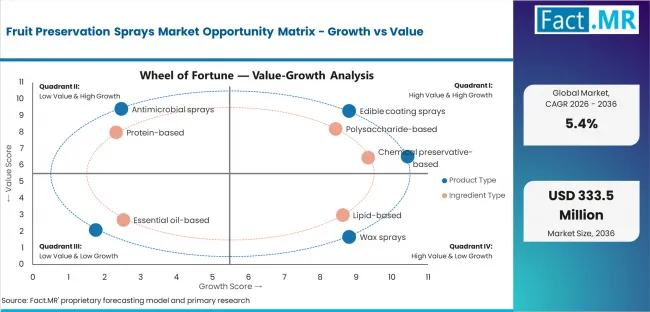
Fruit Preservation Sprays Market Opportunity Matrix Growth Vs Value | Source: Fact.MR
Key Factors Driving Growth
- Global fresh fruit exports are on the rise and the need for fruits with longer shelf life is increasing, which are the major factors pushing the demand for fruit preservation sprays in fruit export-oriented supply chains.
- Increasing emphasis on minimizing post-harvest fruit losses particularly in the developing countries is driving the focus on edible coatings, antimicrobial sprays and post-harvest treatments.
- A trend toward increased retailer appetite for premium, visually engaging and longer-lasting fresh produce is also contributing to commercial uptake for the more advanced fruit preservation solutions.
| Growth Driver | Demand Impact | Time Horizon | Key Impact Area | Fact.MR Insight |
|---|---|---|---|---|
| Rising global demand for shelf-life extension technologies | High | Short–Mid Term | Post-harvest preservation demand | Increasing international fruit trade and retailer demand for longer-lasting fresh produce are significantly driving adoption of fruit preservation sprays globally. |
| Growing focus on reducing post-harvest fruit losses | High | Short–Mid Term | Food waste reduction & export efficiency | High spoilage rates across fruit supply chains, especially in emerging economies, are accelerating investment in edible coatings and antimicrobial preservation technologies. |
| Expanding adoption of edible coatings and bio-based preservation sprays | Medium-High | Mid–Long Term | Clean-label preservation & product innovation | Increasing preference for residue-controlled and bio-based preservation systems is supporting commercialization of polysaccharide-based and natural antimicrobial coating technologies. |
| Increasing investments in cold-chain infrastructure and fruit export logistics | Medium-High | Mid–Long Term | Export-quality fruit preservation & supply-chain stability | Expansion of refrigerated transportation, cold storage facilities, and export-oriented agricultural infrastructure is improving commercial demand for advanced preservation sprays. |
Source: Fact.MR analysis. Updated May 25, 2026
Key Market Constraints
- The commercialization might be limited in some export markets by the complex regulations concerning food-contact materials, approvals of edible coatings and standards of residue compliance.
- The higher costs of formulation and production for bio-based and nano-coating preservation technologies may make these solutions less attractive to cost-conscious producers and exporters of fruit.
- Differences in raw material quality, coating stability and antimicrobial efficacy can lead to problems with formulation consistency for producers.
Key Opportunity Areas
- Growth in premium fruit exports is anticipated to be driven by increasing usage of natural antimicrobial preservation systems and edible coatings.
- The commercialization of polysaccharide-based, chitosan-based and essential oil-based preservation sprays formulations is leading new opportunities in the clean-label and organic fruit preservation markets.
- The boom in international trade for fruits that perish easily, such as berries, avocados, grapes, and tropical fruits, is also driving demand for superior shelf-life extension solutions.
Segment-wise Analysis of the Fruit Preservation Sprays Market
- Edible coating sprays account for 33.8% share of the product type segment in 2026, driven by increasing demand for shelf-life extension technologies, rising adoption of bio-based preservation systems, and growing preference for clean-label post-harvest treatment solutions across global fruit export supply chains.
- Polysaccharide-based formulations represent 35.6% share of the ingredient type segment in 2026, supported by strong commercial adoption of chitosan, starch, and pectin-based edible coatings offering effective moisture retention, microbial protection, and fruit quality preservation.
- Citrus fruits hold 27.6% share of the fruit type segment in 2026, owing to high global citrus production volumes, extensive export activities, and widespread utilization of preservation sprays to maintain freshness and reduce spoilage during long-distance transportation.
The fruit preservation sprays market is segmented by product type, ingredient type, fruit type, nature, end user, and region.
Which Product Type Segment Topped the Fruit Preservation Sprays Market?
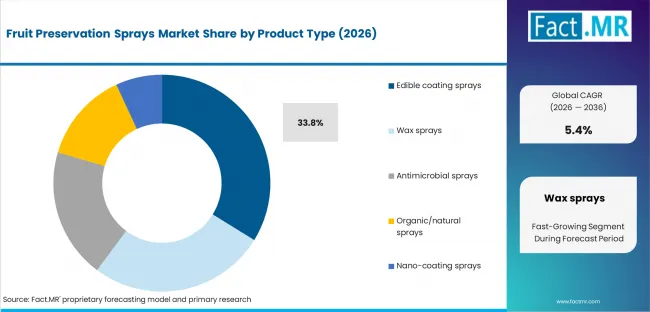
Fruit Preservation Sprays Market Analysis By Product Type | Source: Fact.MR
The largest share of the fruit preservation sprays market is expected to be held by the Edible Coating Sprays segment with a share of 33.8% by 2026. This dominance attributed to the rising demand for shelf-life extension technologies, increasing adoption of clean-label preservation systems and increasing use of bio-based edible coatings in fruit export and retail supply chain. Growing emphasis on minimizing post-harvest losses and preserving the freshness of fruits are driving the pace of adoption for the spray technology of edible coating globally.
Which Fruit Type Segment Leads the Market?
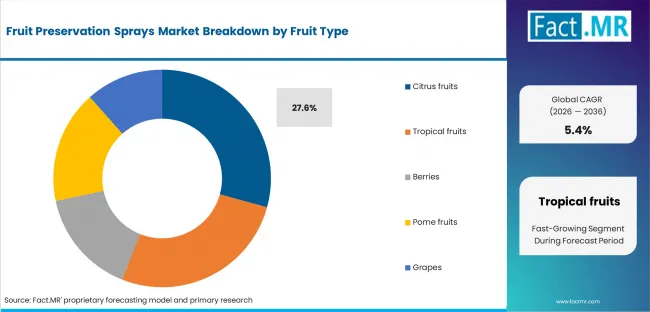
Fruit Preservation Sprays Market Analysis By Fruit Type | Source: Fact.MR
The market share of Citrus Fruits is expected to be the highest at 27.6% by 2026, due to large citrus production across the globe, growing export activities and increasing use of preservation sprays to retain freshness, appearance, and stability of shelf-life during transportation for long distance and storage operation.
Which Nature Segment Holds the Largest Share in the Market?
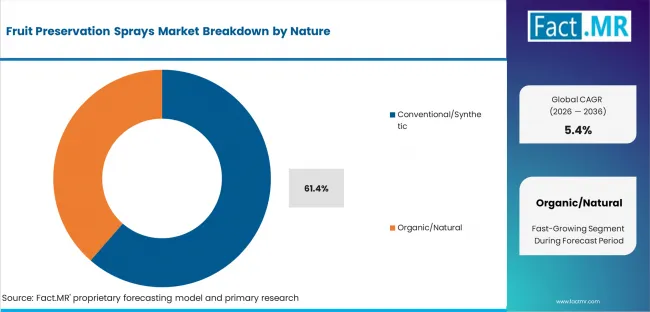
Fruit Preservation Sprays Market Analysis By Nature | Source: Fact.MR
Conventional/Synthetic formulations are projected to dominate the nature segment, capturing 61.4% share in 2026. This leadership is driven by lower formulation costs, established commercial infrastructure, consistent preservation performance, and broad adoption across large-scale fruit export, packing house, and post-harvest treatment operations.
Which End User Segment Holds the Largest Share in the Market?
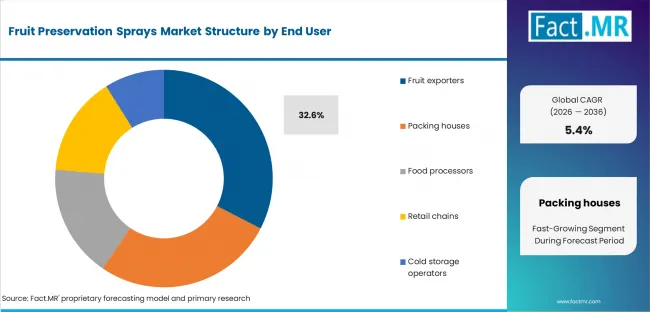
Fruit Preservation Sprays Market Analysis By End User | Source: Fact.MR
The Fruit Exporters are predicted to hold the largest share of 32.6% by 2026. This can be attributed to the growth in international trade in fresh fruit, increase in the demand for fruit quality suitable for export, growing necessity of shelf-life extension for long distance transportation and application of advanced post-harvest preservation techniques all over the global fruit export supply chains.
Regional Outlook Across Key Markets
North America, Latin America, Western Europe, Eastern Europe, East Asia, South Asia & Pacific, and Middle East & Africa are the key geographies covered in this report. It includes detailed analysis of fruit production and export trends, adoption of post-harvest preservation technologies, expansion of cold-chain infrastructure, demand for shelf-life extension solutions, utilization of edible coatings and antimicrobial sprays, regulatory developments related to food-contact preservation formulations, increasing preference for clean-label and bio-based preservation technologies, and rising investments in export-quality fresh produce handling across global fruit supply chains and post-harvest treatment industries.
.webp "Top Country Growth Comparison Fruit Preservation Sprays Market Cagr (2026 2036)")
Top Country Growth Comparison Fruit Preservation Sprays Market Cagr (2026 2036) | Source: Fact.MR
CAGR Table
| Country | CAGR (%) |
|---|---|
| United States | 4.7% |
| China | 6.8% |
| India | 7.7% |
| Brazil | 6.7% |
| Spain | 6.6% |
| Mexico | 8.1% |
| Italy | 7.1% |
Source: Fact.MR analysis. Updated May 25, 2026
Source: Fact.MR (FMR) analysis, based on proprietary forecasting model and primary research.
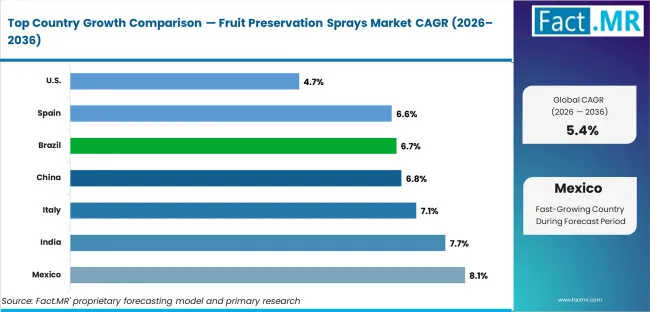
Fruit Preservation Sprays Market Cagr Analysis By Country | Source: Fact.MR
North America Fruit Preservation Sprays Market
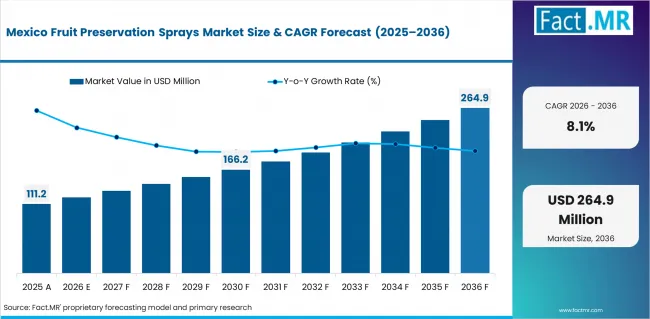
Fruit Preservation Sprays Market Country Value Analysis | Source: Fact.MR
North America is believed to hold the largest share in the fruit preservation sprays market and is said to be one of the most technologically advanced regions because of the increasing application of the post-harvest treatment technology, high fresh produce retail standards, growing cold-chain facilities, and increasing demand for shelf-life extension. Increasing preference for clean-label preservation techniques, edible coatings, and antimicrobial sprays is further boosting growth of market in the region. Leading companies including AgroFresh, Apeel Sciences, JBT Corporation, Mantrose-Haeuser are enhancing their leading position through innovative edible coating technologies, specialized export-oriented preservation systems and post-harvest innovation programs.
- United States: Demand for fruit preservation sprays in the United States is projected to rise at 4.7% CAGR through 2036. Growth is driven by increasing demand for export-quality fresh produce, rising adoption of edible coating technologies, expansion of retail cold-chain infrastructure, and growing focus on reducing food waste across fruit supply chains.
- Canada: Demand for fruit preservation sprays in Canada is projected to grow steadily through 2036, supported by increasing adoption of sustainable post-harvest preservation technologies, growing fresh produce imports, and rising demand for clean-label fruit preservation solutions.
Europe Fruit Preservation Sprays Market
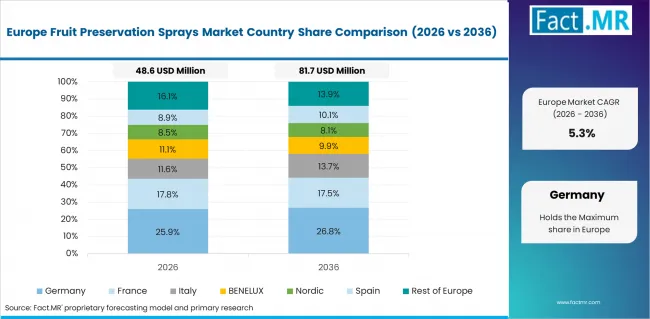
Fruit Preservation Sprays Market Europe Country Market Share Analysis, 2026 & 2036 | Source: Fact.MR
A strong fruit export scenario in the region, growing demand for sustainable post-harvest care solutions, and evolving regulations directing the use of residue-controlled preservation technologies are fuelling the market growth in Europe. The increasing penetration of edible coatings, natural antimicrobial sprays and bio-based preservation systems in the region is driving the market growth. Market players such as Citrosol, Fomesa Fruitech, and local providers of post-harvest technology such as the one based in Africa, are extending their commercial reach via cutting-edge fruit coating systems and solutions for preserving as the export.
- Germany: Demand for fruit preservation sprays in Germany is projected to rise steadily through 2036, supported by increasing demand for high-quality imported fruits, expansion of sustainable food preservation technologies, and growing retailer preference for clean-label preservation systems.
- France: Demand for fruit preservation sprays in France is supported by increasing utilization of edible coatings, rising focus on food waste reduction, and expansion of premium fresh produce distribution networks.
East Asia Fruit Preservation Sprays Market
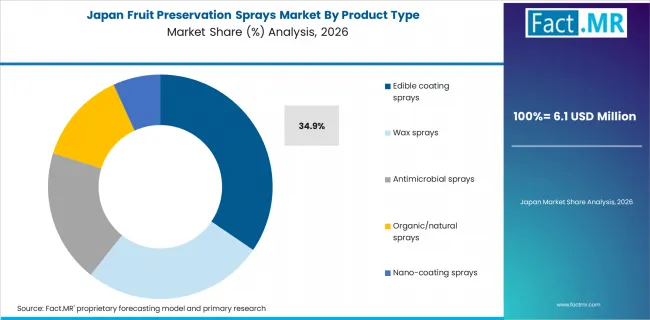
Fruit Preservation Sprays Market Japan Market Share Analysis By Product Type | Source: Fact.MR
East Asia is anticipated to become one of the growth centers in the fruit preservation sprays market on account of the growth in fresh fruit exports, modernization of agriculture supply chain, and higher penetration of advanced post-harvest preservation technologies. Regional producers are also increasingly concentrating on antimicrobial coatings, bio-based preservation systems and export grade fruit handling.
- China: Demand for fruit preservation sprays in China is projected to rise at 6.8% CAGR through 2036, driven by increasing fruit production volumes, growing cold-chain investments, expansion of fresh produce exports, and rising adoption of post-harvest preservation technologies.
- Japan: Demand for fruit preservation sprays in Japan is expected to grow steadily through 2036 due to increasing demand for premium-quality fruits, rising food waste reduction initiatives, and growing utilization of advanced edible coating technologies.
- South Korea: Demand for fruit preservation sprays in South Korea is projected to rise steadily through 2036, supported by expansion of cold-chain logistics, increasing fresh produce imports, and growing adoption of sustainable fruit preservation technologies.
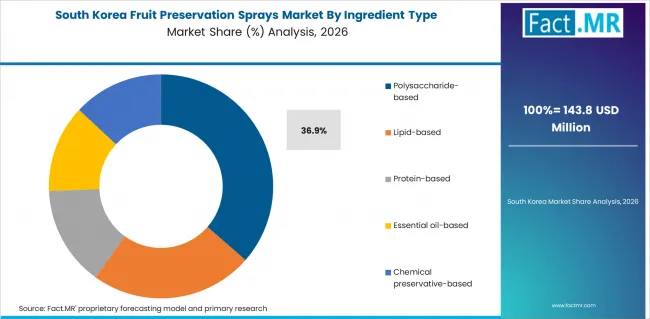
Fruit Preservation Sprays Market South Korea Market Share Analysis By Ingredient Type | Source: Fact.MR
South Asia & Pacific Fruit Preservation Sprays Market
South Asia & Pacific is anticipated to be one of the fastest-growing regions in the fruit preservation sprays market owing to increasing fruit production, expanding export-oriented agriculture, rapid cold-chain infrastructure development, and growing awareness regarding post-harvest loss reduction technologies. Regional companies are increasingly investing in edible coating technologies and antimicrobial preservation solutions.
- India: Demand for fruit preservation sprays in India is projected to rise at 7.7% CAGR through 2036, driven by high post-harvest loss reduction requirements, expanding fruit export activities, increasing cold storage infrastructure, and rising adoption of post-harvest preservation technologies.
The Fact.MR report analyzes market trends, post-harvest treatment technologies, competitive benchmarking, preservation technology adoption patterns, edible coating innovations, export-oriented fruit handling practices, and long-term growth opportunities across individual countries in North America, Latin America, Europe, East Asia, South Asia & Pacific, and Middle East & Africa. Readers gain detailed insights into fruit export expansion, clean-label preservation adoption, cold-chain infrastructure growth, antimicrobial coating commercialization, and future opportunities across global fruit preservation supply chains.
Competitive Benchmarking and Company Positioning
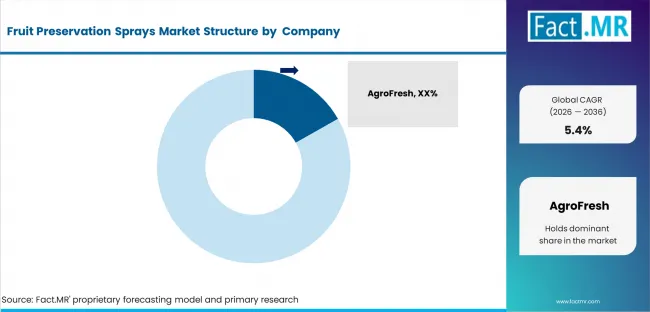
Fruit Preservation Sprays Market Analysis By Company | Source: Fact.MR
Leading Companies Shaping the Fruit Preservation Sprays Market
The fruit preservation sprays industry is fairly consolidated and consists of AgroFresh, Apeel Sciences, JBT Corporation, UPL Ltd, Mantrose-Haeuser, Liquidseal Holding BV, Citrosol, Fomesa Fruitech, Sufresca, and Mori Inc. Competitiveness is also predicted to be high as a result of incentives related to performance in extending shelf life, antimicrobial effectiveness, innovation in edible coatings, friendly clean-label characteristics, and capacity to preserve for exporting and scalability along fruit supply chains worldwide.
The leading players are expanding their market holdings through introduction of novel bio-based edible coatings solutions, antimicrobial spray solutions and advanced post-harvest preservation solutions to prevent spoilage and retain fruit quality during transportation and storage. New players are challenging the market with natural preservation formulations and sustainable coating technologies, solutions for the organic sector, and premium protection systems dedicated to the preservation of high-value fruit exports and modern retail supply chains around the world.
Recent Industry Developments
- AgroFresh – Distribution Agreement for NatuWrap Fruit Protection Technology (June 2025)
- AgroFresh entered an exclusive distribution agreement for NatuWrap, a natural fruit protection and freshness preservation technology designed to improve shelf life, reduce spoilage, and enhance post-harvest fruit quality during storage and transportation. The agreement strengthens AgroFresh’s bio-based preservation portfolio and supports expanding adoption of clean-label post-harvest treatment solutions across global fresh produce supply chains.
- Apeel Sciences – Recognition as a 2025 Game Changer for Food Innovation (June 2025)
- Apeel Sciences was recognized by Food & Wine as a 2025 “Game Changer for Food Innovation” for its plant-based edible coating technology designed to extend fruit and vegetable shelf life by reducing moisture loss and oxidation. The recognition strengthens Apeel’s position in advanced edible coating technologies and supports increasing commercial adoption of bio-based fruit preservation solutions across retail and export supply chains.
- AgroFresh – Launch of Digital Post-Harvest Monitoring Technology at Fruit Attraction 2025 (March 2025)
- AgroFresh introduced a new digital post-harvest technology platform during Fruit Attraction 2025 in São Paulo designed to improve fruit quality monitoring, harvest timing analysis, and preservation management across fresh produce supply chains. The technology strengthens AgroFresh’s digital post-harvest portfolio and supports increasing demand for precision preservation systems and export-quality fruit handling solutions globally.
- DECCO – Expansion of Global Manufacturing Footprint with New Valencia Plant (September 2025)
- DECCO expanded its global post-harvest preservation operations through a new production facility in Valencia, Spain focused on strengthening manufacturing capacity for fruit coating technologies, preservation formulations, and post-harvest treatment solutions. The expansion supports increasing commercial demand for shelf-life extension technologies and reinforces DECCO’s position in export-oriented fruit preservation infrastructure.
- MIT – Development of Silk-Based Produce Preservation Technology (May 2025)
- Researchers at Massachusetts Institute of Technology developed a silk fibroin-based coating technology designed to extend the shelf life of fresh fruits and vegetables by reducing moisture loss and slowing spoilage. The innovation highlights growing R&D activity in bio-based edible coatings and next-generation post-harvest preservation technologies with potential future commercialization across global fresh produce markets.
Leading Companies Shaping the Fruit Preservation Sprays Market
- AgroFresh
- Sufresca
- JBT Corporation
- UPL Ltd
- Liquidseal Holding BV
- Mantrose-Haeuser
- Mori Inc.
- Fomesa Fruitech
- Citrosol
- Apeel Sciences
Sources and Research References
- [1] AgroFresh, “AgroFresh to Distribute New Fruit Protection Technology”, June 2025
- [2] Apeel Sciences, “Apeel Sciences Recognized by Food & Wine as a 2025 Game Changer for Food Innovation”, June 2025
- [3] AgroFresh, “AgroFresh Presents New Digital Post-Harvest Technology at Fruit Attraction 2025 in São Paulo”, March 2025
- [4] DECCO Postharvest, “DECCO Expands Global Footprint with New Plant in Valencia, Spain”, September 2025
- [5] Massachusetts Institute of Technology (MIT News), “A New Technology for Extending the Shelf Life of Produce”, May 2025
Fruit Preservation Sprays Market Definition
The fruit preservation sprays market is a segment of the post-harvest preservation solutions market and it constitutes the spray delivery technology for the purpose of shelf-life extension, spoilage reduction, freshness maintenance and quality retention of fruits during storage and transportation. These are edible coating sprays, wax sprays, antimicrobial sprays, organic/natural sprays and nano-coating formulations based on polysaccharides, lipids, proteins, essential oils and/or chemical preservatives. Fruit preservation sprays are also utilized to retain moisture, to control microbes, to prevent oxidation and to maintain fruit quality for export over fruit export, food processing, retail, cold-chain and post-harvest treatment in different size markets worldwide.
Fruit Preservation Sprays Market Inclusions
The fruit preservation sprays market report offers an exhaustive analysis of the worldwide as well as regional market for the period 2026–2036. It provides detailed information on various segments (by product type, ingredient type, fruit type, nature, end user, and region) and also analyses trends in post-harvest preservation, competitive landscape, technological advancements, and adoption patterns across the fresh produce supply chains. The report also mentions some of the new trends in the industry namely, edible coatings, bio-based preservation solutions, antimicrobial sprays, nano-coating technologies, clean-label formulations, cold-chain expansion and food waste reduction initiatives.
Fruit Preservation Sprays Market Exclusions
This review focuses on spray-based post-harvest treatments, Coatings emulsions and suspensions that have been proposed or used for extending the shelf life of fruit, reducing spoilage, controlling microbial contamination, and preserving freshness during storage and shipping. Refrigerated storages devices, controlled atmosphere (CA) systems, fruit packaging materials, single-use fungicides not part of a formulation as a preservation spray and general agrochemicals for field treatment of crops that have no application in maintaining post-harvest fruit quality are not considered in this review. It does not cover preservation methods for vegetables, processed goods, meat, dairy products or drinks, except as spray-based preservative solutions for the protection of fresh fruit.
Fruit Preservation Sprays Market Research Methodology
- Primary Research
- Fact.MR has considered the fruit preservation sprays market from a global as well as region based perspective by predicting revenue and analyzing the trends in each of the segments. Primary research was conducted with key post-harvest value chain participants such as producers of edible coatings and preservation sprays, fruit exporters, cold-chain providers, food processors, distributors, farm tech providers, and industry consultants. These discussions were instrumental in confirming the trends seen in adoption, pricing, innovation, shelf-life extension need, post-harvest loss reduction projects, and future opportunities in the major fruit producers and exporters nations.
- Desk Research
- This report contains a view of intelligence that includes company annual reports, investor presentations, publications of the postharvest treatment industry, research papers on edible coatings, trade journals in agriculture, statistics on exporting fresh produce, studies on food preservation, databases in agriculture at the government level, journals on regulation, and reports on the infrastructure of the cold-chain. Other references are studies on antimicrobial coatings, bio-based preservation technologies, fruit export patterns, food waste reduction programs, and solutions of sustainable post-harvest treatments that have an impact on the world demand for fruit preservation spray.
- Market-Sizing and Forecasting
- Fact.MR’s market assessment methodology is a combination of both bottom-up and top-down approaches to get viewpoint of the vendors, players, experts and suppliers is considered to analyze market application/end user potential and pie size in the country-wise region and then further to the global perspective. To understand the market size, recent trends, and growth prospects, forecasting models took into account fruit production volumes, export demand, use of shelf-life extension technology, expansion of cold chain, clean-label preservation trends, price analysis, and growth of regional post-harvest infrastructure over the 2026–2036 period.
- Data Validation and Update Cycle
- The market estimates were validated by various primary interviews and analyzing company financials, evaluating the demand of products, analyzing trends of regional fruits exports, analyzing investment patterns in cold-chain, analyzing up-take rates for post-harvest treatments and by reviewing historical market performance. To keep current, forecasts are periodically revised to include changes in regulatory requirements, improvements in technologies of edible coatings and antimicrobial sprays, changing quality requirements of retailers, sustainability initiatives, clean label preservation approaches, and global activities in food waste reduction and fresh produce supply chains.
Segmentation
Scope of Analysis
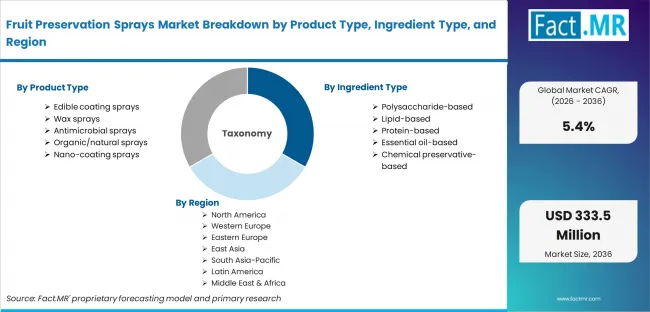
Fruit Preservation Sprays Market Breakdown By Product Type, Ingredient Type, And Region | Source: Fact.MR
Parameter |
Details |
|---|---|
| Quantitative Units | USD 187.0 million (2025) to USD 333.5 million (2036), at a CAGR of 5.4% |
| Market Definition | The fruit preservation sprays market comprises spray-based post-harvest preservation solutions designed to extend shelf life, reduce spoilage, maintain freshness, control microbial contamination, minimize moisture loss, and preserve the texture and appearance of fresh fruits during storage and transportation. These products include edible coating sprays, wax sprays, antimicrobial sprays, organic/natural preservation sprays, and nano-coating sprays formulated using polysaccharides, lipids, proteins, essential oils, and chemical preservative-based ingredients used across fruit export, post-harvest treatment, food processing, retail, and cold-chain industries. |
| Regions Covered | North America, Eastern Europe, Western Europe, East Asia, South Asia & Pacific, Latin America, Middle East & Africa |
| Countries Covered | USA, Canada, Mexico, Brazil, Germany, France, Italy, Spain, U.K., China, Japan, South Korea, India, Thailand, Vietnam, Australia, UAE, South Africa, and 20+ countries |
| Key Companies | AgroFresh, Apeel Sciences, JBT Corporation, UPL Ltd, Mantrose-Haeuser, Liquidseal Holding BV, Citrosol, Fomesa Fruitech, Sufresca, Mori Inc. |
| Forecast Period | 2026 to 2036 |
| Approach | Hybrid demand-side and top-down methodology based on fruit production volumes, fresh produce export trends, post-harvest loss reduction initiatives, edible coating adoption rates, shelf-life extension demand, cold-chain infrastructure expansion, clean-label preservation trends, food waste reduction initiatives, and increasing adoption of bio-based post-harvest technologies, validated through primary interviews with post-harvest treatment manufacturers, fruit exporters, coating solution providers, distributors, food processors, retail supply-chain participants, and industry experts across major global regions. |
Source: Fact.MR analysis. Updated May 25, 2026
Analysis by Product Type, Ingredient Type, Fruit Type, Nature, End User, and Region
-
Fruit Preservation Sprays Market by Product Type:
- Edible Coating Sprays
- Wax Sprays
- Antimicrobial Sprays
- Organic/Natural Sprays
- Nano-Coating Sprays
-
Fruit Preservation Sprays Market by Ingredient Type:
- Polysaccharide-Based
- Lipid-Based
- Protein-Based
- Essential Oil-Based
- Chemical Preservative-Based
-
Fruit Preservation Sprays Market by Fruit Type:
- Citrus Fruits
- Tropical Fruits
- Berries
- Pome Fruits
- Grapes
- Avocados
-
Fruit Preservation Sprays Market by Nature:
- Organic/Natural
- Conventional/Synthetic
-
Fruit Preservation Sprays Market by End User:
- Fruit Exporters
- Packing Houses
- Food Processors
- Retail Chains
- Cold Storage Operators
-
Fruit Preservation Sprays Market by Region:
- North America
- USA
- Canada
- Mexico
- Latin America
- Brazil
- Chile
- Rest of LATAM
- East Asia
- China
- Japan
- South Korea
- Taiwan
- South Asia & Pacific
- India
- Singapore
- Australia
- ASEAN
- Western Europe
- Germany
- France
- U.K.
- Italy
- Spain
- BENELUX
- Nordic
- Rest of Western Europe
- Eastern Europe
- Poland
- Hungary
- Czech Republic
- Balkan & Baltics
- Rest of Eastern Europe
- Middle East and Africa
- Kingdom of Saudi Arabia
- United Arab Emirates
- South Africa
- Rest of Middle East and Africa
- North America
Frequently Asked Questions
How large is the demand for Fruit Preservation Sprays in the global market in 2025?
What will be the market size of the Fruit Preservation Sprays Market by 2036?
What is the expected demand growth for the Fruit Preservation Sprays Market between 2026 and 2036?
How significant is the growth outlook for India in this market?
Which company is identified as a leading player in the Fruit Preservation Sprays Market?
Who worked on this report


Preview the report firsthand - request a free sample
Free SampleGet the brochure for pricing and purchase details
Download PDF